1
Hydrothermal Liquefaction as a Tool to Enable
Plastic Circularity
29 March 2023
Erica S. Howard (Battelle Memorial Institute, Columbus, Ohio, USA)
Plastic circularity is necessary to stop plastic
pollution
2
Global plastic consumption,
production, and waste
generation has more than
doubled since 2000
70% of plastic waste is
disposed of by traditional
methods
15% of plastic waste is
collected for recycling, while
9% of plastic is recycled
successfully
Remaining plastic eludes waste management and ends up incinerated or dumped into
the ecosystem
Innovative feedstocks improve sustainable industry
3
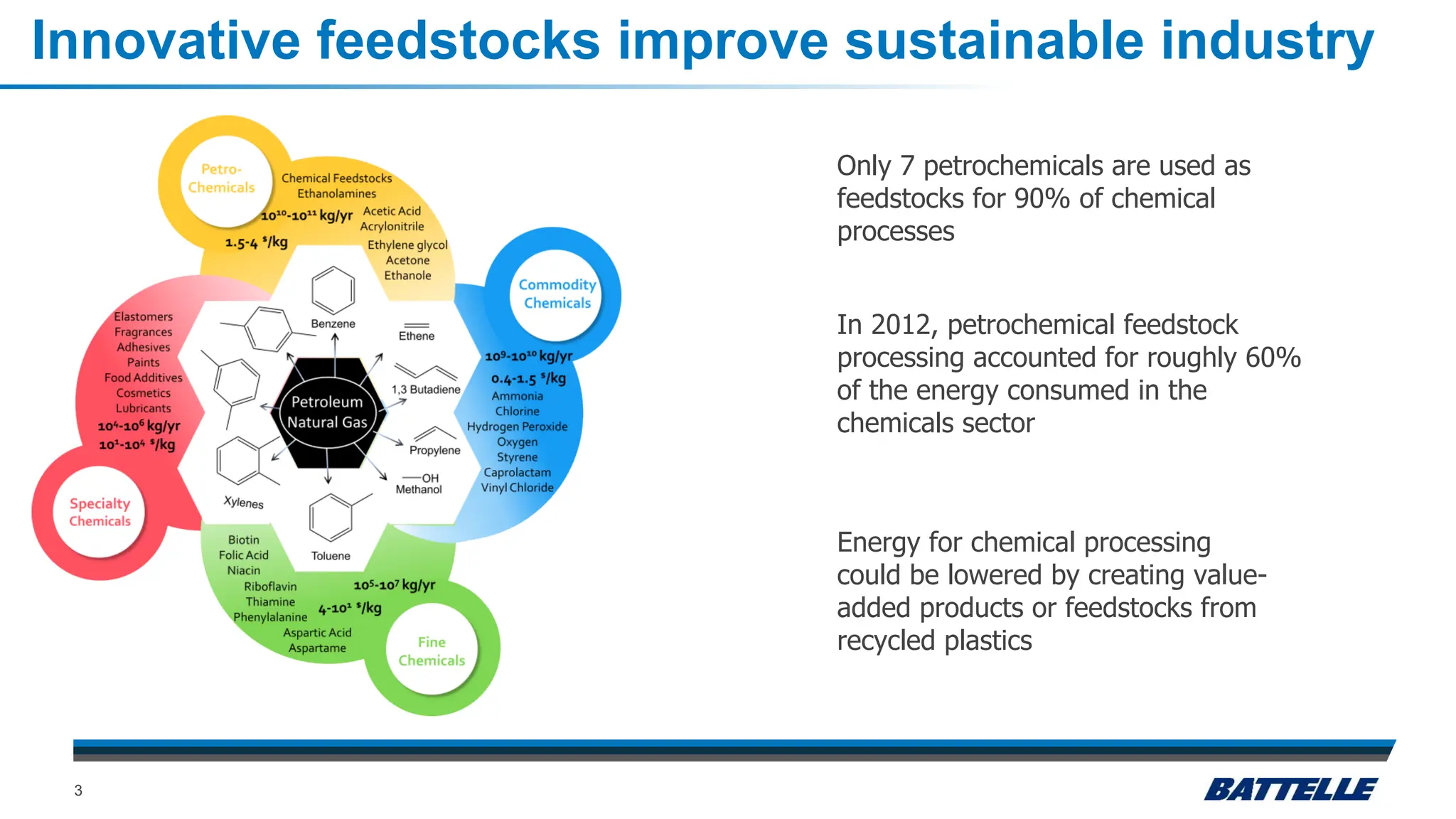
Energy for chemical processing
could be lowered by creating value-
added products or feedstocks from
recycled plastics
Only 7 petrochemicals are used as
feedstocks for 90% of chemical
processes
In 2012, petrochemical feedstock
processing accounted for roughly 60%
of the energy consumed in the
chemicals sector
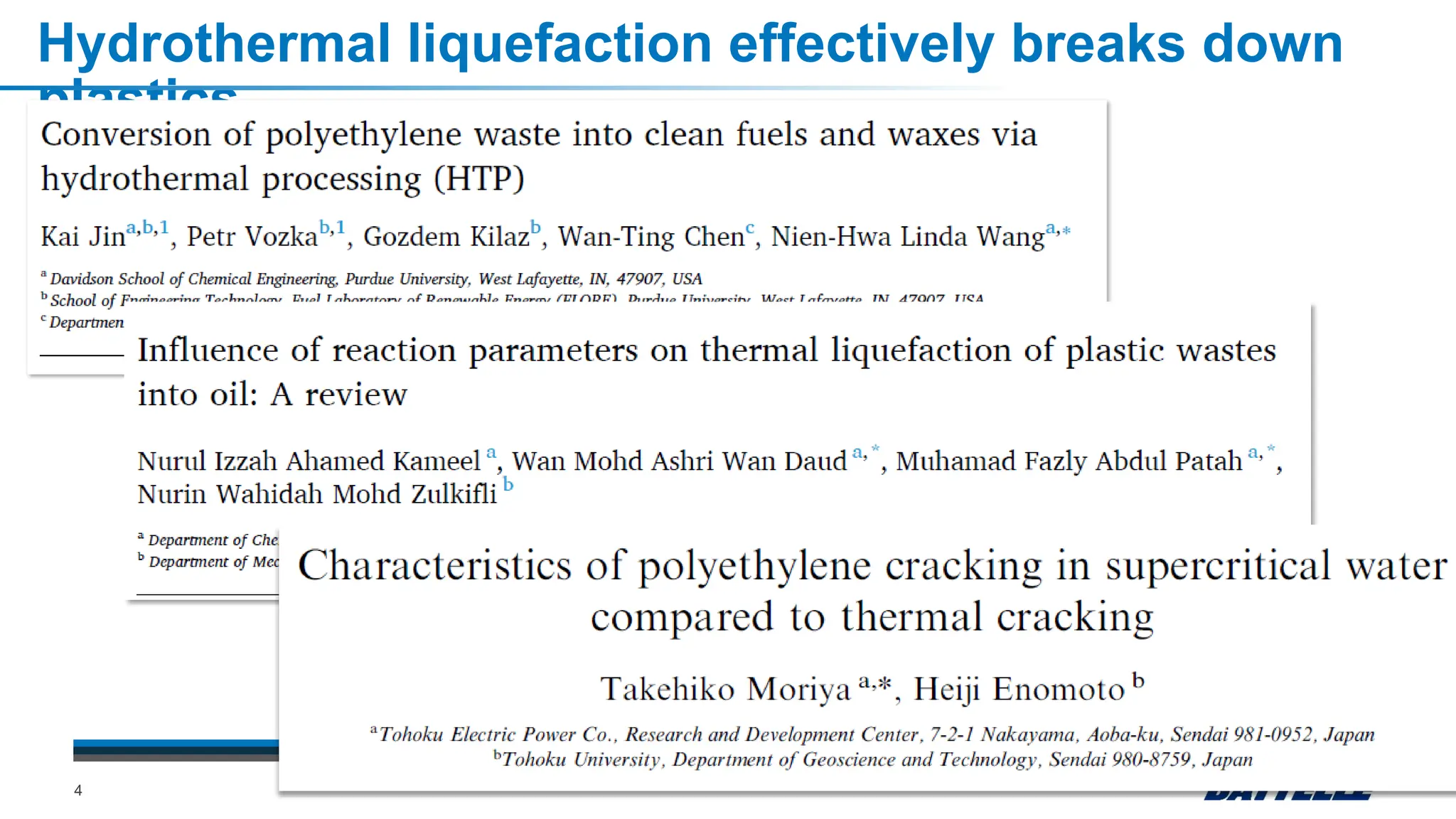
Hydrothermal liquefaction effectively breaks down
plastics
4
Hydrothermal liquefaction uses water to degrade
plastic
5
Hydrothermal liquefaction uses subcritical and supercritical water as a universal reaction media
Hydrothermal liquefaction is a thermal depolymerization process that converts organic waste,
biomass, and other macromolecules, into value added products under moderate-extreme
temperature and high pressure
• Low dielectric constant
• Low viscosity
• High diffusivity
• Very low ionic product
• Acts as both solvent
and catalyst
• Suitable for free radical
reaction
Normal
Water
Sub-
critical water
Super-
critical water
Temperature (°C) 25 250 400 400
Pressure (MPa) 0.1 5 25 50
Relative static dielectric
constant (ε)
0.997 0.8 0.17 0.58
pKW 78.50 27.10 5.90 10.50
Thermal Conducitivty
(mW/mK)
0.89 0.11 0.03 0.07
Dynamic viscosity (mPAs) 608 620 160 438
Features of supercritical water:
Tunable parameters offer a high level of reaction
design
6
Catalysts
Process
Environment
Products
Reactants
• Stability
• Phase Behavior
• Longevity
• Sintering
• Supercritical water
• Acid-base behavior
• Reactor Design
• Operating Mode
• Condition
• Type
• Preparation
• Characterization
• Compounds
• Oxidants
• Behavior
• Reaction Mechanism
• Reaction Kinetics
• Kinetic Models
• Catalytic Effect
• Product Distribution
• Selectivity
• Yield
• Heat Dissipation
• Mass transfer
• Separation potential
• Others
• Surface Phenomena
• Molecular Geometry
• Adsorption
• Coking
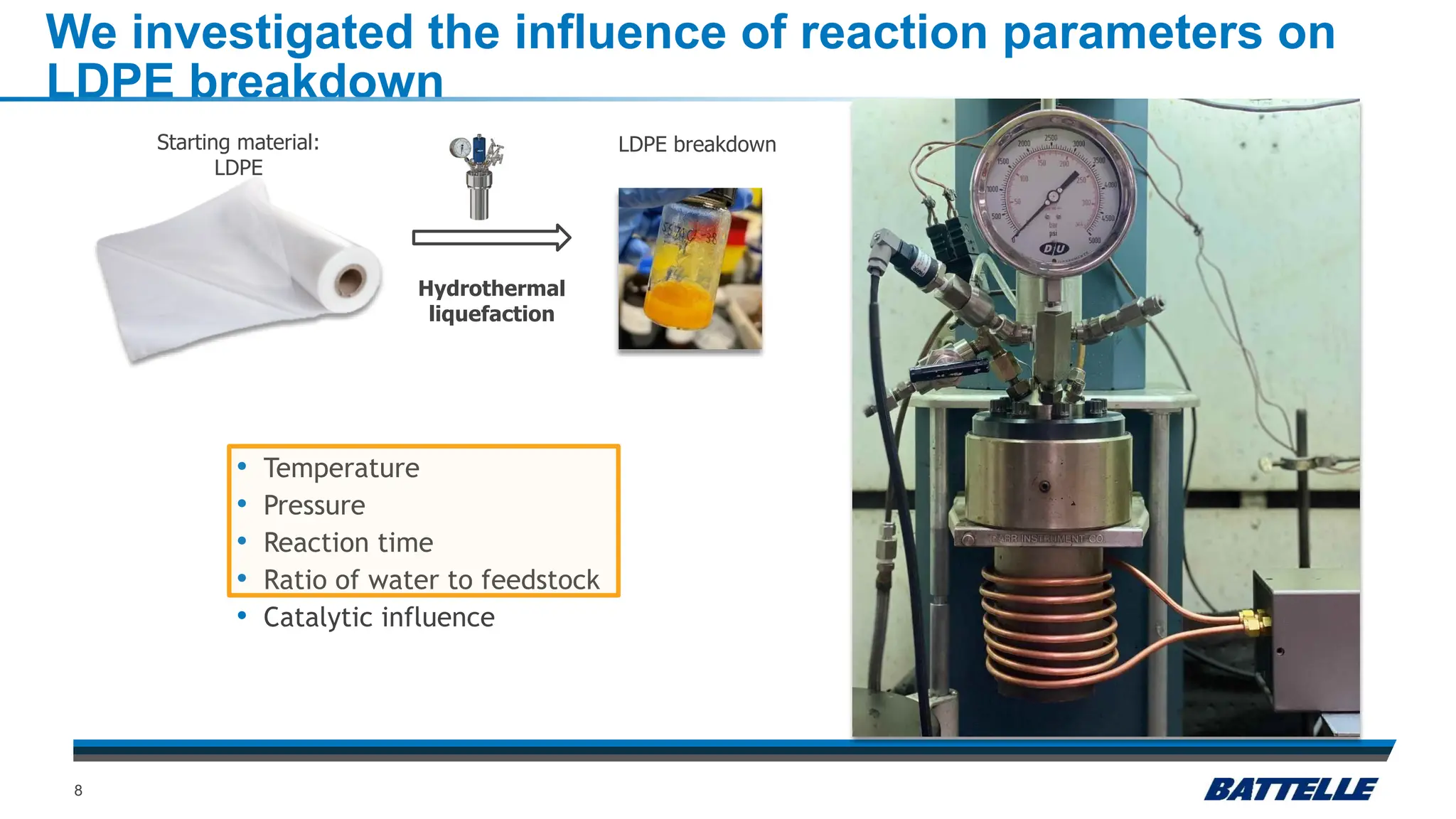
We investigated the influence of reaction parameters on
LDPE breakdown
7
• Temperature
• Pressure
• Reaction time
• Ratio of water to feedstock
• Catalytic influence
LDPE breakdown
Hydrothermal
liquefaction
Starting material:
LDPE
We investigated the influence of reaction parameters on
LDPE breakdown
8
• Temperature
• Pressure
• Reaction time
• Ratio of water to feedstock
• Catalytic influence
LDPE breakdown
Hydrothermal
liquefaction
Starting material:
LDPE
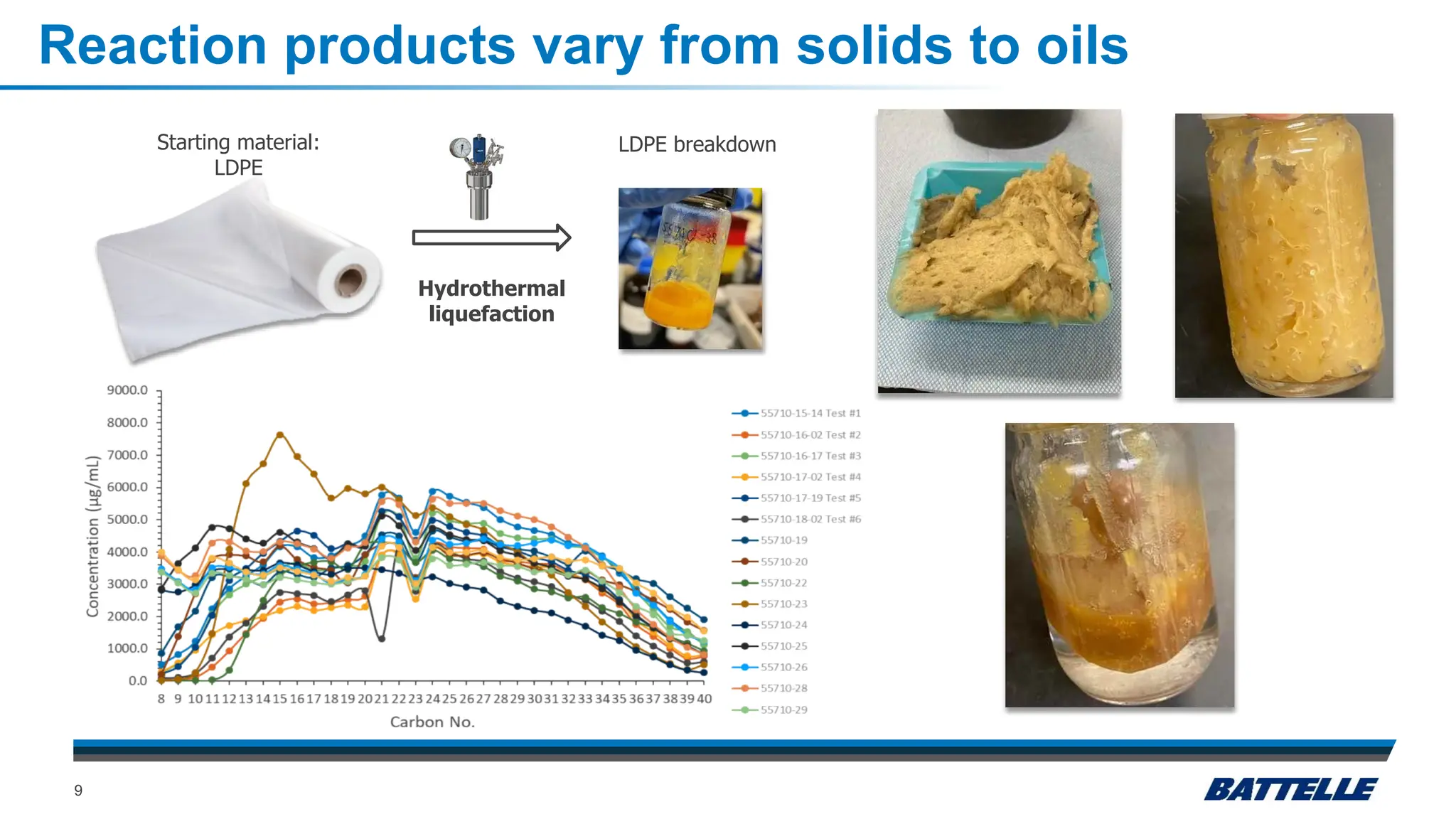
Reaction products vary from solids to oils
9
LDPE breakdown
Hydrothermal
liquefaction
Starting material:
LDPE
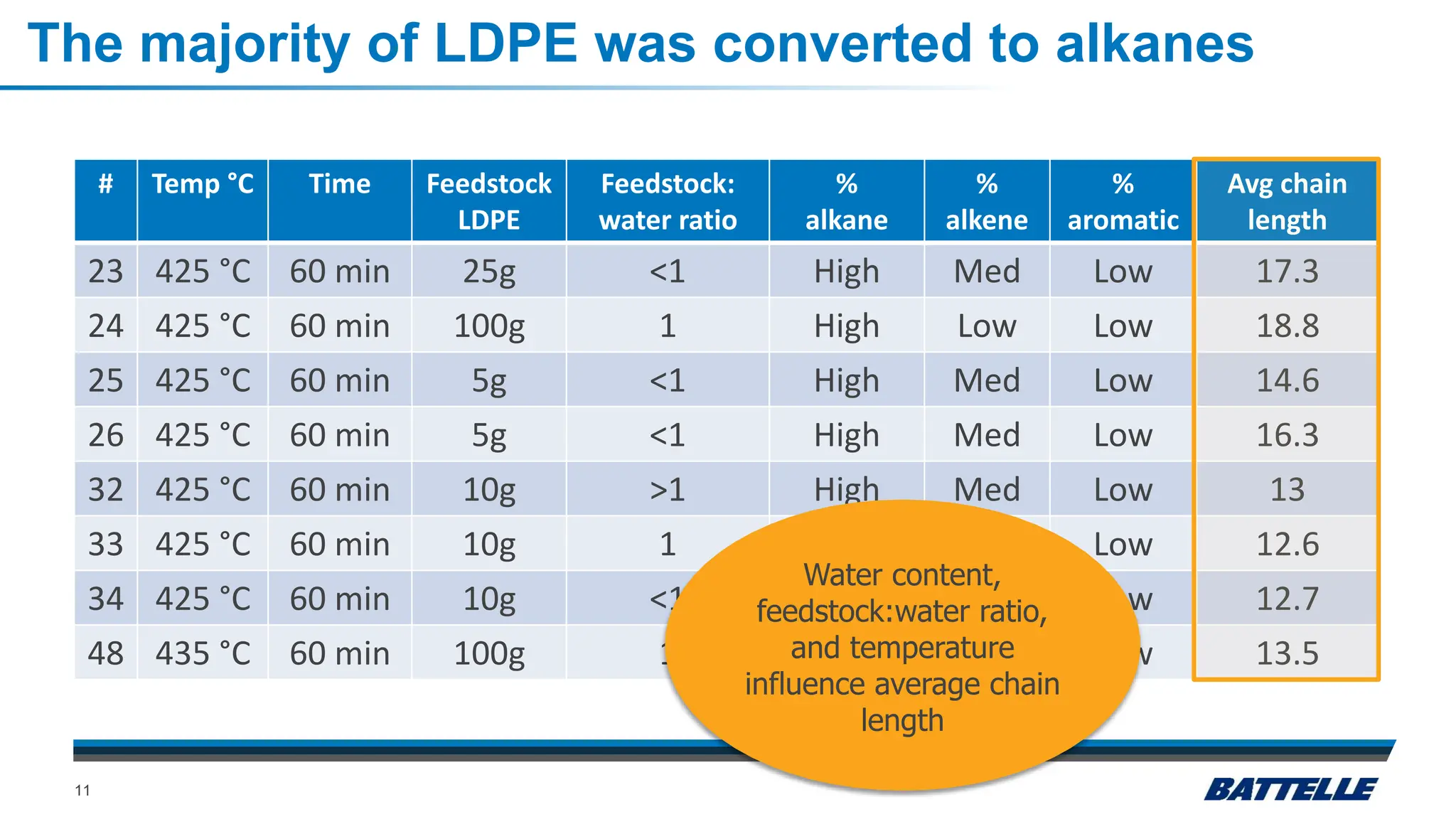
The majority of LDPE was converted to alkanes
10
# Temp °C Time Feedstock
LDPE
Feedstock:
water ratio
%
alkane
%
alkene
%
aromatic
Avg chain
length
23 425 °C 60 min 25g <1 High Med Low 17.3
24 425 °C 60 min 100g 1 High Low Low 18.8
25 425 °C 60 min 5g <1 High Med Low 14.6
26 425 °C 60 min 5g <1 High Med Low 16.3
32 425 °C 60 min 10g >1 High Med Low 13
33 425 °C 60 min 10g 1 High Med Low 12.6
34 425 °C 60 min 10g <1 High Med Low 12.7
48 435 °C 60 min 100g 1 High Low Low 13.5
The majority of LDPE was converted to alkanes
11
# Temp °C Time Feedstock
LDPE
Feedstock:
water ratio
%
alkane
%
alkene
%
aromatic
Avg chain
length
23 425 °C 60 min 25g <1 High Med Low 17.3
24 425 °C 60 min 100g 1 High Low Low 18.8
25 425 °C 60 min 5g <1 High Med Low 14.6
26 425 °C 60 min 5g <1 High Med Low 16.3
32 425 °C 60 min 10g >1 High Med Low 13
33 425 °C 60 min 10g 1 High Med Low 12.6
34 425 °C 60 min 10g <1 High Med Low 12.7
48 435 °C 60 min 100g 1 High Low Low 13.5
Water content,
feedstock:water ratio,
and temperature
influence average chain
length
We investigated the influence of catalysts on LDPE
breakdown
12
• Temperature
• Pressure
• Reaction time
• Ratio of water to feedstock
• Catalytic influence
LDPE breakdown
Hydrothermal
liquefaction
Starting material:
LDPE
13
# Temp
°C
Time Feedstock
LDPE
Solid
Catalyst
Feedstock:
water ratio
%
alkane
%
alkene
%
aromatic
Avg chain length
32 425 °C 60
min
10g >1 High Med Low 13
33 425 °C 60
min
10g 1 High Med Low 12.6
34 425 °C 60
min
10g <1 High Med Low 12.7
35 425 °C 60
min
10g 0.5g >1 High Low Med 9.3
36 425 °C 60
min
10g 0.5g 1 High Low Med 9.0
37 425 °C 60
min
10g 0.5g <1 High Low Med 9.5
Catalyst promotes aromatic production under supercritical
conditions
14
# Temp
°C
Time Feedstock
LDPE
Solid
Catalyst
Feedstock:
water ratio
%
alkane
%
alkene
%
aromatic
Avg chain length
32 425 °C 60
min
10g >1 High Med Low 13
33 425 °C 60
min
10g 1 High Med Low 12.6
34 425 °C 60
min
10g <1 High Med Low 12.7
35 425 °C 60
min
10g 0.5g >1 High Low Med 9.3
36 425 °C 60
min
10g 0.5g 1 High Low Med 9.0
37 425 °C 60
min
10g 0.5g <1 High Low Med 9.5
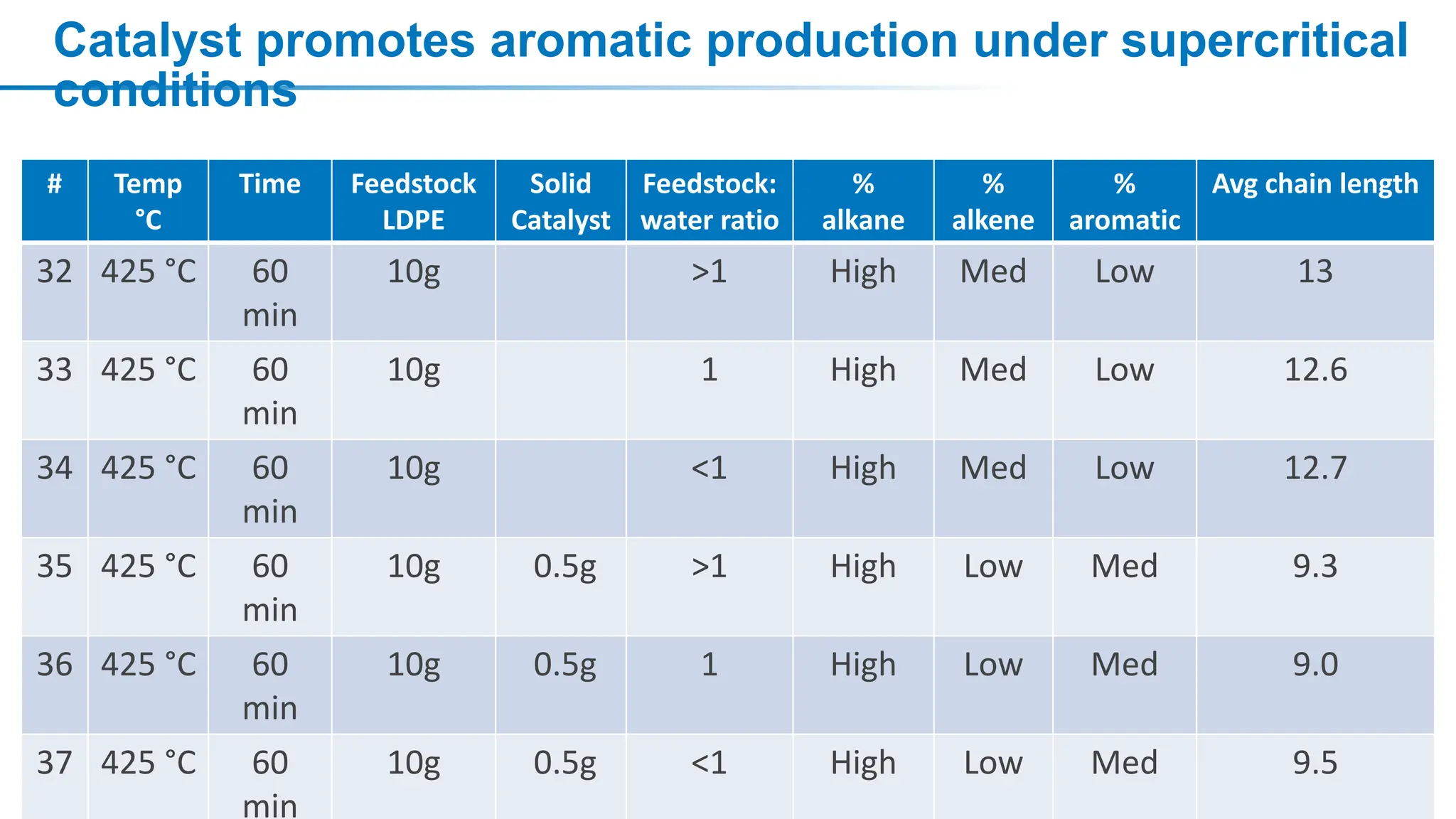
Catalyst promotes aromatic production under supercritical
conditions
Catalyst promotes
aromatic products and
reduces average chain
length
Conclusions
15
Degrading chemically resistant plastics can be challenging.
Hydrothermal liquefaction is a promising technology for
degrading and re-functionalizing plastic waste.
The reaction parameters for hydrothermal liquefaction
can be tuned to change products and physical properties.
Use of catalysts increases the variety of products
available using hydrothermal liquefaction.
Currently, the influence of reaction parameters,
catalysts, and solvent selection is being used to
investigate hydrothermal liquefaction of different
plastics and mixed waste.
16
Thank you for your time!
17
Extra slides
PE degradation mechanism & insight
18
• Bockhorn et al suggest mechanism for PE decomposition is radical chain mechanism
• Initial polymer chain random cracking will form alkenes by b-scission and hydrogen
abstraction
• The alkene/alkane ratio is determined by the contribution of b-scission and
intermolecular hydrogen reaction
• Alkene/alkane ratio and
selectivity of alkadienes
increase with increasing b-
scission
• The product distribution
helps narrow down which
pathway our reaction is
taking
• Zhang suggests in flow
reactor primary radicals
surrounded by flowing SCW
reduces hydrogen
abstraction and enhances
unimolecular b-scission
19
Type of plastic
Ratio of plastic
to solvent
Solvent
selection
Temperature
Pressure
Reaction time
Type of reactor
Gas product
Liquid Product
Solid Product

Hydrothermal liquefaction literature.pdf

  • 1.
    1 Hydrothermal Liquefaction asa Tool to Enable Plastic Circularity 29 March 2023 Erica S. Howard (Battelle Memorial Institute, Columbus, Ohio, USA)
  • 2.
    Plastic circularity isnecessary to stop plastic pollution 2 Global plastic consumption, production, and waste generation has more than doubled since 2000 70% of plastic waste is disposed of by traditional methods 15% of plastic waste is collected for recycling, while 9% of plastic is recycled successfully Remaining plastic eludes waste management and ends up incinerated or dumped into the ecosystem
  • 3.
    Innovative feedstocks improvesustainable industry 3 Energy for chemical processing could be lowered by creating value- added products or feedstocks from recycled plastics Only 7 petrochemicals are used as feedstocks for 90% of chemical processes In 2012, petrochemical feedstock processing accounted for roughly 60% of the energy consumed in the chemicals sector
  • 4.
  • 5.
    Hydrothermal liquefaction useswater to degrade plastic 5 Hydrothermal liquefaction uses subcritical and supercritical water as a universal reaction media Hydrothermal liquefaction is a thermal depolymerization process that converts organic waste, biomass, and other macromolecules, into value added products under moderate-extreme temperature and high pressure • Low dielectric constant • Low viscosity • High diffusivity • Very low ionic product • Acts as both solvent and catalyst • Suitable for free radical reaction Normal Water Sub- critical water Super- critical water Temperature (°C) 25 250 400 400 Pressure (MPa) 0.1 5 25 50 Relative static dielectric constant (ε) 0.997 0.8 0.17 0.58 pKW 78.50 27.10 5.90 10.50 Thermal Conducitivty (mW/mK) 0.89 0.11 0.03 0.07 Dynamic viscosity (mPAs) 608 620 160 438 Features of supercritical water:
  • 6.
    Tunable parameters offera high level of reaction design 6 Catalysts Process Environment Products Reactants • Stability • Phase Behavior • Longevity • Sintering • Supercritical water • Acid-base behavior • Reactor Design • Operating Mode • Condition • Type • Preparation • Characterization • Compounds • Oxidants • Behavior • Reaction Mechanism • Reaction Kinetics • Kinetic Models • Catalytic Effect • Product Distribution • Selectivity • Yield • Heat Dissipation • Mass transfer • Separation potential • Others • Surface Phenomena • Molecular Geometry • Adsorption • Coking
  • 7.
    We investigated theinfluence of reaction parameters on LDPE breakdown 7 • Temperature • Pressure • Reaction time • Ratio of water to feedstock • Catalytic influence LDPE breakdown Hydrothermal liquefaction Starting material: LDPE
  • 8.
    We investigated theinfluence of reaction parameters on LDPE breakdown 8 • Temperature • Pressure • Reaction time • Ratio of water to feedstock • Catalytic influence LDPE breakdown Hydrothermal liquefaction Starting material: LDPE
  • 9.
    Reaction products varyfrom solids to oils 9 LDPE breakdown Hydrothermal liquefaction Starting material: LDPE
  • 10.
    The majority ofLDPE was converted to alkanes 10 # Temp °C Time Feedstock LDPE Feedstock: water ratio % alkane % alkene % aromatic Avg chain length 23 425 °C 60 min 25g <1 High Med Low 17.3 24 425 °C 60 min 100g 1 High Low Low 18.8 25 425 °C 60 min 5g <1 High Med Low 14.6 26 425 °C 60 min 5g <1 High Med Low 16.3 32 425 °C 60 min 10g >1 High Med Low 13 33 425 °C 60 min 10g 1 High Med Low 12.6 34 425 °C 60 min 10g <1 High Med Low 12.7 48 435 °C 60 min 100g 1 High Low Low 13.5
  • 11.
    The majority ofLDPE was converted to alkanes 11 # Temp °C Time Feedstock LDPE Feedstock: water ratio % alkane % alkene % aromatic Avg chain length 23 425 °C 60 min 25g <1 High Med Low 17.3 24 425 °C 60 min 100g 1 High Low Low 18.8 25 425 °C 60 min 5g <1 High Med Low 14.6 26 425 °C 60 min 5g <1 High Med Low 16.3 32 425 °C 60 min 10g >1 High Med Low 13 33 425 °C 60 min 10g 1 High Med Low 12.6 34 425 °C 60 min 10g <1 High Med Low 12.7 48 435 °C 60 min 100g 1 High Low Low 13.5 Water content, feedstock:water ratio, and temperature influence average chain length
  • 12.
    We investigated theinfluence of catalysts on LDPE breakdown 12 • Temperature • Pressure • Reaction time • Ratio of water to feedstock • Catalytic influence LDPE breakdown Hydrothermal liquefaction Starting material: LDPE
  • 13.
    13 # Temp °C Time Feedstock LDPE Solid Catalyst Feedstock: waterratio % alkane % alkene % aromatic Avg chain length 32 425 °C 60 min 10g >1 High Med Low 13 33 425 °C 60 min 10g 1 High Med Low 12.6 34 425 °C 60 min 10g <1 High Med Low 12.7 35 425 °C 60 min 10g 0.5g >1 High Low Med 9.3 36 425 °C 60 min 10g 0.5g 1 High Low Med 9.0 37 425 °C 60 min 10g 0.5g <1 High Low Med 9.5 Catalyst promotes aromatic production under supercritical conditions
  • 14.
    14 # Temp °C Time Feedstock LDPE Solid Catalyst Feedstock: waterratio % alkane % alkene % aromatic Avg chain length 32 425 °C 60 min 10g >1 High Med Low 13 33 425 °C 60 min 10g 1 High Med Low 12.6 34 425 °C 60 min 10g <1 High Med Low 12.7 35 425 °C 60 min 10g 0.5g >1 High Low Med 9.3 36 425 °C 60 min 10g 0.5g 1 High Low Med 9.0 37 425 °C 60 min 10g 0.5g <1 High Low Med 9.5 Catalyst promotes aromatic production under supercritical conditions Catalyst promotes aromatic products and reduces average chain length
  • 15.
    Conclusions 15 Degrading chemically resistantplastics can be challenging. Hydrothermal liquefaction is a promising technology for degrading and re-functionalizing plastic waste. The reaction parameters for hydrothermal liquefaction can be tuned to change products and physical properties. Use of catalysts increases the variety of products available using hydrothermal liquefaction. Currently, the influence of reaction parameters, catalysts, and solvent selection is being used to investigate hydrothermal liquefaction of different plastics and mixed waste.
  • 16.
    16 Thank you foryour time!
  • 17.
  • 18.
    PE degradation mechanism& insight 18 • Bockhorn et al suggest mechanism for PE decomposition is radical chain mechanism • Initial polymer chain random cracking will form alkenes by b-scission and hydrogen abstraction • The alkene/alkane ratio is determined by the contribution of b-scission and intermolecular hydrogen reaction • Alkene/alkane ratio and selectivity of alkadienes increase with increasing b- scission • The product distribution helps narrow down which pathway our reaction is taking • Zhang suggests in flow reactor primary radicals surrounded by flowing SCW reduces hydrogen abstraction and enhances unimolecular b-scission
  • 19.
    19 Type of plastic Ratioof plastic to solvent Solvent selection Temperature Pressure Reaction time Type of reactor Gas product Liquid Product Solid Product