HYDROCEPHALUS
PRESENTED BY….
MS. ANEETA SHARMA
NURSING LECTURER (CHILD HEALTH
INTRODUCTION
•Hydrocephalus refers to a condition where there is an
abnormal accumulation of cerebrospinal fluid (CSF) within the
ventricles (fluid-filled spaces) of the brain.
•This buildup can lead to increased pressure inside the skull,
potentially causing brain damage and developmental delays..
MS. ANEETA SHARMA
NURSING LECTURER (CHILD HEALTH
NURSING
DEFINITION
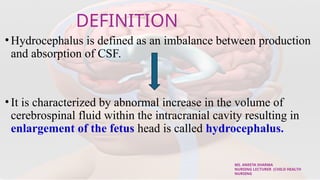
•Hydrocephalus is defined as an imbalance between production
and absorption of CSF.
•It is characterized by abnormal increase in the volume of
cerebrospinal fluid within the intracranial cavity resulting in
enlargement of the fetus head is called hydrocephalus.
MS. ANEETA SHARMA
NURSING LECTURER (CHILD HEALTH
NURSING
NORMAL PATHOLOGY OF CSF
CSF produced by choroid plexus
Lateral ventricles of the brain
3rd
ventricles of the brain
aqueduct of Sylvius
4th
ventricles of the brain
MS. ANEETA SHARMA
NURSING LECTURER (CHILD HEALTH
NURSING
foramen Magendie foramen Luschka
( medium aperture) ( Lateral aperture)
Cisterna magna
Subarachnoid space
Arachnoid villi
CSF is finally reabsorbed in to venous sinus
(superior sagittal suture)
MS. ANEETA SHARMA
NURSING LECTURER (CHILD HEALTH
NURSING
MS. ANEETA SHARMA
NURSING LECTURER (CHILD HEALTH
NURSING
INCIDENCE
•It occurs in approx. 3-4 per 1000 live birth.
MS. ANEETA SHARMA
NURSING LECTURER (CHILD HEALTH
NURSING
ETIOLOGY
(a) Congenital -
•Maternal infection (TORCH)
•Congenital brain defect
•Dandy-Walker syndrome
•Arnold Chiari malformation
•congenital brain tumor (CBT)
MS. ANEETA SHARMA
NURSING LECTURER (CHILD HEALTH
NURSING
(b) Acquired-
•Meningitis
•Encephalitis
•Brain tumor (medulloblastoma)
•Birth injuries MS. ANEETA SHARMA
NURSING LECTURER (CHILD HEALTH
NURSING
TYPES OF HYDROCEPHALUS
Communicating Non- Communicating
Hydrocephalus Hydrocephalus
MS. ANEETA SHARMA
NURSING LECTURER (CHILD HEALTH
NURSING
1-Communicating hydrocephalus-
Imbalance between production and absorption of CSF
No blockage in CSF flow
Communicating hydrocephalus
MS. ANEETA SHARMA
NURSING LECTURER (CHILD HEALTH
NURSING
2-Non-Communicating hydrocephalus-
Blockage in CSF fluid flow
Blockage occurs in cerebral aqueduct /aqueduct of Sylvius
Non-Communicating hydrocephalus-
MS. ANEETA SHARMA
NURSING LECTURER (CHILD HEALTH
NURSING
CLINICAL FEATURES -
INFANT-
•Head enlarge
•Suture become
widely separated
MS. ANEETA SHARMA
NURSING LECTURER (CHILD HEALTH
NURSING
•Delayed Clouser of
anterior fontanelle
•Tense bulging
fontanelle
MS. ANEETA SHARMA
NURSING LECTURER (CHILD HEALTH
NURSING
•Scalp veins are prominent, and scalp appear shiny
•Cracked pot sign is heard on percussion of skull is called
(Macewen's sign)
•Poor feeding
MS. ANEETA SHARMA
NURSING LECTURER (CHILD HEALTH
NURSING
•Sun setting sign
•High pitch cry
•Infant may have physical and mental retardation
MS. ANEETA SHARMA
NURSING LECTURER (CHILD HEALTH
NURSING
CHILDREN
•No enlargement of head but increased ICP
•Headache on awaking in the morning
•Nausea vomiting
•Irritability and high shrill cry
•Lethargy
•Confusion
•Impaired judgment and reasoning
•Affected motor activity ataxia
MS. ANEETA SHARMA
NURSING LECTURER (CHILD HEALTH
NURSING
DIAGNOSTIC EVALUATION-
•Physical assessment
•Head circumferences > 35cm
•Enlarging head
•Bulging fontanelle
•Enlarged scalp veins
•High Pich cry
MS. ANEETA SHARMA
NURSING LECTURER (CHILD HEALTH
NURSING
•Intracranial pressure monitoring-Intracranial pressure (ICP)
monitoring is a diagnostic test that measures the pressure inside the brain and
surrounding tissues. The test is used to treat a variety of neurological conditions,
including severe traumatic brain injury, stroke, brain bleeds, hydrocephalus, and
brain tumors
MS. ANEETA SHARMA
NURSING LECTURER (CHILD HEALTH
NURSING
•Ultrasonography
•CT Scan $ MRI (types of hydrocephalus)
•Amniocentesis-amniocentesis can be used to detect
hydrocephalus, a condition where cerebrospinal fluid (CSF)
builds up in the brain's ventricles.
MS. ANEETA SHARMA
NURSING LECTURER (CHILD HEALTH
NURSING
MANAGEMENT
1-Medical management-
•Medical management is only possible for communicating
hydrocephalus.
•Acetazolamide
•Glycerol
•Mannitol
MS. ANEETA SHARMA
NURSING LECTURER (CHILD HEALTH
NURSING
2-Surgical management-
V.A. Shunt (Ventriculoarterial shunt)-
• Shunt in between lateral ventricles and right atrium.
• ventriculoarterial (VA) shunt is a procedure that drains
cerebrospinal fluid (CSF) from the brain's cerebral ventricles
into the heart's right atrium.
MS. ANEETA SHARMA
NURSING LECTURER (CHILD HEALTH
NURSING
•V.P. Shunt (Ventricular peritoneal)-
•Shunt in between lateral ventricles and peritoneum.
•A ventriculoperitoneal (VP) shunt is a thin plastic tube that
drains excess cerebrospinal fluid (CSF) from the brain to
stomach to treat hydrocephalus
MS. ANEETA SHARMA
NURSING LECTURER (CHILD HEALTH
NURSING
3- Nursing management-
PRE-OPERATIVE CARE-
•Measures the head circumferences of the child daily.
•Palpate the fontanelles for evidence of increase ICP.
•Assess the level of consciousness.
•Monitor vital sign regularly .
•Use barrier nursing while providing care.
•A water pillow or lamb wool may be used to keep head over it.
•The infant is prone to vomit ,so provide small frequents feeding
with intermittent burping.
MS. ANEETA SHARMA
NURSING LECTURER (CHILD HEALTH
NURSING
POST-OPERATIVE NURSING CARE-
•Monitor vital sign frequently after surgery.
•Assess the neurological status and level of
consciousness.
•Maintain intake and output chart.
•Observe for any drainage from operated site.
•Prophylactic antibiotic must administer to infant.
•Teach parents about care of the child at home.
MS. ANEETA SHARMA
NURSING LECTURER (CHILD HEALTH
NURSING
MS. ANEETA SHARMA
NURSING LECTURER (CHILD HEALTH
NURSING

Hydrocephalus pptx

  • 1.
    HYDROCEPHALUS PRESENTED BY…. MS. ANEETASHARMA NURSING LECTURER (CHILD HEALTH
  • 2.
    INTRODUCTION •Hydrocephalus refers toa condition where there is an abnormal accumulation of cerebrospinal fluid (CSF) within the ventricles (fluid-filled spaces) of the brain. •This buildup can lead to increased pressure inside the skull, potentially causing brain damage and developmental delays.. MS. ANEETA SHARMA NURSING LECTURER (CHILD HEALTH NURSING
  • 3.
    DEFINITION •Hydrocephalus is definedas an imbalance between production and absorption of CSF. •It is characterized by abnormal increase in the volume of cerebrospinal fluid within the intracranial cavity resulting in enlargement of the fetus head is called hydrocephalus. MS. ANEETA SHARMA NURSING LECTURER (CHILD HEALTH NURSING
  • 4.
    NORMAL PATHOLOGY OFCSF CSF produced by choroid plexus Lateral ventricles of the brain 3rd ventricles of the brain aqueduct of Sylvius 4th ventricles of the brain MS. ANEETA SHARMA NURSING LECTURER (CHILD HEALTH NURSING
  • 5.
    foramen Magendie foramenLuschka ( medium aperture) ( Lateral aperture) Cisterna magna Subarachnoid space Arachnoid villi CSF is finally reabsorbed in to venous sinus (superior sagittal suture) MS. ANEETA SHARMA NURSING LECTURER (CHILD HEALTH NURSING
  • 6.
    MS. ANEETA SHARMA NURSINGLECTURER (CHILD HEALTH NURSING
  • 7.
    INCIDENCE •It occurs inapprox. 3-4 per 1000 live birth. MS. ANEETA SHARMA NURSING LECTURER (CHILD HEALTH NURSING
  • 8.
    ETIOLOGY (a) Congenital - •Maternalinfection (TORCH) •Congenital brain defect •Dandy-Walker syndrome •Arnold Chiari malformation •congenital brain tumor (CBT) MS. ANEETA SHARMA NURSING LECTURER (CHILD HEALTH NURSING
  • 9.
    (b) Acquired- •Meningitis •Encephalitis •Brain tumor(medulloblastoma) •Birth injuries MS. ANEETA SHARMA NURSING LECTURER (CHILD HEALTH NURSING
  • 10.
    TYPES OF HYDROCEPHALUS CommunicatingNon- Communicating Hydrocephalus Hydrocephalus MS. ANEETA SHARMA NURSING LECTURER (CHILD HEALTH NURSING
  • 11.
    1-Communicating hydrocephalus- Imbalance betweenproduction and absorption of CSF No blockage in CSF flow Communicating hydrocephalus MS. ANEETA SHARMA NURSING LECTURER (CHILD HEALTH NURSING
  • 12.
    2-Non-Communicating hydrocephalus- Blockage inCSF fluid flow Blockage occurs in cerebral aqueduct /aqueduct of Sylvius Non-Communicating hydrocephalus- MS. ANEETA SHARMA NURSING LECTURER (CHILD HEALTH NURSING
  • 13.
    CLINICAL FEATURES - INFANT- •Headenlarge •Suture become widely separated MS. ANEETA SHARMA NURSING LECTURER (CHILD HEALTH NURSING
  • 14.
    •Delayed Clouser of anteriorfontanelle •Tense bulging fontanelle MS. ANEETA SHARMA NURSING LECTURER (CHILD HEALTH NURSING
  • 15.
    •Scalp veins areprominent, and scalp appear shiny •Cracked pot sign is heard on percussion of skull is called (Macewen's sign) •Poor feeding MS. ANEETA SHARMA NURSING LECTURER (CHILD HEALTH NURSING
  • 16.
    •Sun setting sign •Highpitch cry •Infant may have physical and mental retardation MS. ANEETA SHARMA NURSING LECTURER (CHILD HEALTH NURSING
  • 17.
    CHILDREN •No enlargement ofhead but increased ICP •Headache on awaking in the morning •Nausea vomiting •Irritability and high shrill cry •Lethargy •Confusion •Impaired judgment and reasoning •Affected motor activity ataxia MS. ANEETA SHARMA NURSING LECTURER (CHILD HEALTH NURSING
  • 18.
    DIAGNOSTIC EVALUATION- •Physical assessment •Headcircumferences > 35cm •Enlarging head •Bulging fontanelle •Enlarged scalp veins •High Pich cry MS. ANEETA SHARMA NURSING LECTURER (CHILD HEALTH NURSING
  • 19.
    •Intracranial pressure monitoring-Intracranialpressure (ICP) monitoring is a diagnostic test that measures the pressure inside the brain and surrounding tissues. The test is used to treat a variety of neurological conditions, including severe traumatic brain injury, stroke, brain bleeds, hydrocephalus, and brain tumors MS. ANEETA SHARMA NURSING LECTURER (CHILD HEALTH NURSING
  • 20.
    •Ultrasonography •CT Scan $MRI (types of hydrocephalus) •Amniocentesis-amniocentesis can be used to detect hydrocephalus, a condition where cerebrospinal fluid (CSF) builds up in the brain's ventricles. MS. ANEETA SHARMA NURSING LECTURER (CHILD HEALTH NURSING
  • 21.
    MANAGEMENT 1-Medical management- •Medical managementis only possible for communicating hydrocephalus. •Acetazolamide •Glycerol •Mannitol MS. ANEETA SHARMA NURSING LECTURER (CHILD HEALTH NURSING
  • 22.
    2-Surgical management- V.A. Shunt(Ventriculoarterial shunt)- • Shunt in between lateral ventricles and right atrium. • ventriculoarterial (VA) shunt is a procedure that drains cerebrospinal fluid (CSF) from the brain's cerebral ventricles into the heart's right atrium. MS. ANEETA SHARMA NURSING LECTURER (CHILD HEALTH NURSING
  • 23.
    •V.P. Shunt (Ventricularperitoneal)- •Shunt in between lateral ventricles and peritoneum. •A ventriculoperitoneal (VP) shunt is a thin plastic tube that drains excess cerebrospinal fluid (CSF) from the brain to stomach to treat hydrocephalus MS. ANEETA SHARMA NURSING LECTURER (CHILD HEALTH NURSING
  • 24.
    3- Nursing management- PRE-OPERATIVECARE- •Measures the head circumferences of the child daily. •Palpate the fontanelles for evidence of increase ICP. •Assess the level of consciousness. •Monitor vital sign regularly . •Use barrier nursing while providing care. •A water pillow or lamb wool may be used to keep head over it. •The infant is prone to vomit ,so provide small frequents feeding with intermittent burping. MS. ANEETA SHARMA NURSING LECTURER (CHILD HEALTH NURSING
  • 25.
    POST-OPERATIVE NURSING CARE- •Monitorvital sign frequently after surgery. •Assess the neurological status and level of consciousness. •Maintain intake and output chart. •Observe for any drainage from operated site. •Prophylactic antibiotic must administer to infant. •Teach parents about care of the child at home. MS. ANEETA SHARMA NURSING LECTURER (CHILD HEALTH NURSING
  • 26.
    MS. ANEETA SHARMA NURSINGLECTURER (CHILD HEALTH NURSING