More Related Content

PPTX
Hydrocarbons_10th_Class_111Version2.pptx 
PDF
Hydrocarbons Alkane, Alkene and Alkyne.pdf 
PPT

PPTX
CHAPTER 2 INTRODUCTION TO CARBON COMPOUND ![Carbon and Its compounds. [ Class- X ]](https://cdn.slidesharecdn.com/ss_thumbnails/scienceproject-160112145158-thumbnail.jpg?width=640&height=640&fit=bounds)
PPTX
Carbon and Its compounds. [ Class- X ] 
PPTX
hydrocarbon class 11 ppt.pptx 
PPTX
Types_of_Hydrocarbons_and_Nomenclature_Class_11.pptx 
PPTX
Hydrocarbons_Presentation.pptx IN DETAILED BY ME Similar to Hydrocarbons_10th_Class_ewwwVersion3.pptx

PPTX
hydrocarbons-introduction,alkanes and alkenes.pptx 
PPTX
Introduction to Organic Chemistry.pptx 
PPTX
Chapter 20.3 : Saturated and Unsaturated Hydrocarbons 
PPTX
Notes- Organic day 2.pptx 
PDF

DOC
Innovative teaching manual 
PPT
307-Alkanes.ppt-Pharmaceutical Organic Chemistry 
PPTX
HYDROCARBONS AND FUNCTIONAL GROUPS.pptx gr 
PPTX
lecture-3 updated all about hydrocarbons.pptx 
PPTX

PPTX
Alkynes and hydrogenation of alkynes 
PDF
ALKENES and it Functional Groups Compund 
PPTX
Hydrocarbons_Lecture_Ms_Sameera_Sajjad.pptx 
PPT
Hydrocarbons_Lecture_Ms_Sameera_Sajjad.ppt 
PPTX

PPTX
Alkane alkene and alkynes ![Chemistry ail shashank [hydrocarbons]](https://cdn.slidesharecdn.com/ss_thumbnails/chemistryailshashankhydrocarbons-210105031943-thumbnail.jpg?width=640&height=640&fit=bounds)
PDF
Chemistry ail shashank [hydrocarbons] 
PPT
P O S T L A B Biochem D L S L 
PPTX

PPTX
Recently uploaded

PPTX
English 8 Q3 Wk6.pptx prewriting opinion editorial article 
PPTX
PixelX : Think Design Experience powerpoint presentation 
PDF
Enhancing Accessibility and Inclusivity: The TU Dublin Leaving Certificate St... 
PDF
Homebound (2025): A Critical Analysis of Social Realism, Systemic Apathy, and... 
PPTX
From AI curious to AI conversant – a year of experimentation at TCD Library. ... 
PPTX
GRADE-1-Q3-MATH-WEEK-6.pptx_202633333333 
PPTX
Chapter No. 5 Anti- Hypertensive Pharmacognosy-2.pptx 
PPTX
LEARNING PART 1. SHILPA HOTAKAR PSYCHOLOGY NOTES pptx 
PPTX
Inter School Quiz Competition Final.pptx 
PPTX
Conduction System of the Heart, The Cardiac Cycle, The Cardiac Output, ECG.pptx 
PDF
Visualising Library Insights: Power BI Dashboard for Data-Driven Decision Mak... 
PPTX
LEARNING PART 2.SHILPA HOTAKAR PSYCHOLOGY NOTES pptx 
PDF
Fever & Fragment Uncovering the Plague in The Waste Land 
PPTX
Bookish Bats: a unique sustainable delivery service in the Russell Library. A... 
PDF
Old Historicism vs New Historicism Slides 
PDF
Pharmaceutical Biotechnology unitI Notes 
PDF
‘You can do anything, but not everything’: Using UCC’s Service Principles to ... 
PDF
A predictive coding framework for rapid neural dynamics during sentence-level... 
PPTX
AI Literacy at UCD Library. Dr Marta Bustillo & Sandra Dunkin, University Col... 
PPTX
Cardiovascular System or The Details of Heart.pptx Hydrocarbons_10th_Class_ewwwVersion3.pptx
- 1.
- 2.
Introduction
• Hydrocarbons: compoundsmade up of Carbon (C) and Hydrogen (H).
• Main categories:
• • Alkanes → Saturated (single bonds).
• • Alkenes → Unsaturated (double bond).
• • Alkynes → Unsaturated (triple bond).
- 3.
Alkanes (CnH2n+2)
• GeneralFormula: CnH2n+2
• Tetrahedral geometry around carbon atoms.
• Examples: CH4 (Methane), C2H6 (Ethane), C3H8 (Propane).
• Nomenclature: root name + 'ane'.
• Reactions:
• • Complete combustion: CH4 + 2O2 → CO2 + 2H2O
• • Substitution: CH4 + Cl2 → CH3Cl + HCl (UV light)
- 4.
Alkenes (CnH2n)
• GeneralFormula: CnH2n
• Planar structure around double bond carbon atoms.
• Examples: C2H4 (Ethene), C3H6 (Propene).
• Nomenclature: root name + 'ene'.
• Reactions:
• • Combustion: C2H4 + 3O2 → 2CO2 + 2H2O
• • Addition: C2H4 + Br2 → C2H4Br2 (Bromination).
• • Polymerization: n(C2H4) → (C2H4)n (Polyethene).
- 5.
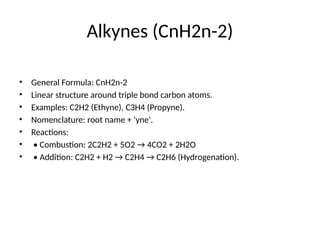
Alkynes (CnH2n-2)
• GeneralFormula: CnH2n-2
• Linear structure around triple bond carbon atoms.
• Examples: C2H2 (Ethyne), C3H4 (Propyne).
• Nomenclature: root name + 'yne'.
• Reactions:
• • Combustion: 2C2H2 + 5O2 → 4CO2 + 2H2O
• • Addition: C2H2 + H2 → C2H4 → C2H6 (Hydrogenation).
- 6.
Formation of Hydrocarbons
•Alkanes: Hydrogenation of alkenes/alkynes.
• Alkenes: Dehydration of alcohols, cracking of alkanes.
• Alkynes: Dehydrohalogenation of dihalides.
• Natural sources: Petroleum, Natural Gas, Coal.
- 7.
Comparison of Hydrocarbons
•Alkanes → Single bond, least reactive, undergo substitution.
• Alkenes → Double bond, reactive, undergo addition reactions.
• Alkynes → Triple bond, highly reactive, undergo addition reactions.
- 8.
Applications
• Alkanes: Fuels(methane, propane, butane).
• Alkenes: Plastics (polyethene, PVC), solvents, alcohol synthesis.
• Alkynes: Welding (oxy-acetylene torch), organic synthesis.
- 9.
Summary
• Hydrocarbons areessential organic compounds.
• Different types depend on C–C bond (single, double, triple).
• Alkanes (CnH2n+2) → Saturated hydrocarbons.
• Alkenes (CnH2n) → Unsaturated, double bond.
• Alkynes (CnH2n-2) → Unsaturated, triple bond.