Encapsulation of Cells in Hyaluronic Acid as a Means of Cell Delivery Daniel Wilson, 11/15/2006
What is a cell delivery system? A cell delivery system is a vector by which cells can be implanted into the body. The delivery system should support (limited) cell proliferation, maturation, and function. Many different variations including ceramic and polymer scaffolds as well as injectable hydrogels. Polyester scaffold http://www.cbmm.lodz.pl/res/sppb_big2.jpg
Why Use Injectable Hydrogels as a Delivery Mechanism? Minimally invasive procedure Shape-forming Conducive to cell support – highly permeable to oxygen and nutrients. Biodegradibility Easy incorporation of therapeutics such as growth factors http://www.wwu.edu/depts/healthyliving/PE511info/arthritis/oatreatment.htm
Pure HA? Pure HA has met significant success as a dermal implant for cosmetics and hormone release 1 . “ Hyaluronan hydrogels resist attachment and spreading of fibroblasts” 2 .  Hydrophilic and poly-anionic surfaces restrict attachment. Decreased viscocity with increased temperature leads to difficulty in controlling placement as well as stasis of implant. 1 Anna Gutowska, Gyeongmoon Jeong, Marek Jasionowski. “Injectable Gels for Tissue Engineering.”  The Anatomical Record  263 (2001):342–349 2 Xiao Zheng Shu, Kaustabh Ghosh, Yanchun Liu, Fabio S. Palumbo3 Yi Luo, Richard A. Clark, Glenn D. Prestwich. “Attachment and spreading of fibroblasts on an RGD peptide–modified injectable hyaluronan hydrogel.”  Journal of Biomedical Materials Research. Part A.  63(2) (2004): 365-75.
Alternative HA-derived Cell Delivery Systems Hydrogel beads. Conventional or electrospun HA scaffolds. “ RGD” peptide-modified injectable HA hydrogels. “ Fabrication of Hyaluronic Acid Hydrogel Beads for Cell Encapsulation.” Biotechnol. Prog. 2006, 22, 297-302 “ Electrospun three-dimensional hyaluronic acid nanofibrous scaffolds.” Biomaterials 27 (2006): 3782–3792
RGD peptide-modified injectable HA hydrogels Arg-Gly-Asp (RGD) promotes cellular attachment and proliferation by binding through integrin receptors. RGD can be added to polyethylene glycol diacrylate (PEGDA) via a conjugate addition reaction. The RGD/PEGDA complex can then be added to thiol-modified HA (HA-DTPH) to form a cytocompatible hydrogel. “ Attachment and spreading of fibroblasts on an RGD peptide–modified injectable hyaluronan hydrogel.”  Journal of Biomedical Materials Research. Part A.  63(2) (2004): 365-75.
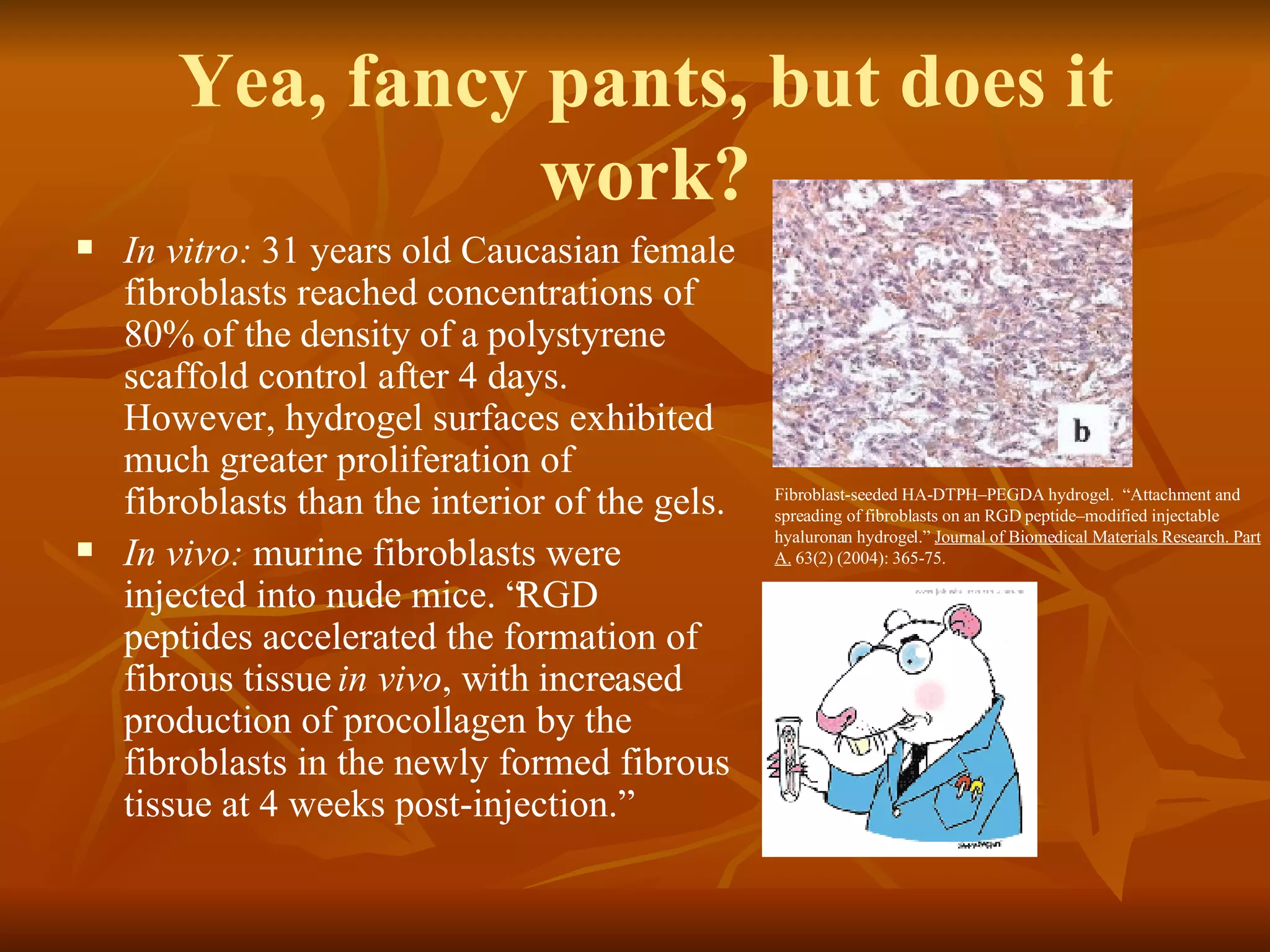
Yea, fancy pants, but does it work? In vitro:  31 years old Caucasian female fibroblasts reached concentrations of 80% of the density of a polystyrene scaffold control after 4 days.  However, hydrogel surfaces exhibited much greater proliferation of fibroblasts than the interior of the gels. In vivo:  murine fibroblasts were  injected into nude mice. “RGD peptides accelerated the formation of fibrous tissue  in vivo , with increased production of procollagen by the fibroblasts in the newly formed fibrous tissue at 4 weeks post-injection.” Fibroblast-seeded HA-DTPH–PEGDA hydrogel.  “Attachment and spreading of fibroblasts on an RGD peptide–modified injectable hyaluronan hydrogel.”  Journal of Biomedical Materials Research. Part A.  63(2) (2004): 365-75.
The Wrap Use of pure HA as a cell delivery system, especially for fibroblasts, is non-condusive to cell proliferation. In order to encourage proliferation of fibroblasts in HA, some form of cell-anchoring must be used.
Watch Out For: Glenn D. Prestwich from the University of Utah.  It seems that if it has to do with HA, he has done it. http://www.pharmacy.utah.edu/medchem/prestwich/aboutus.html

Hyaluronic Acid Presentation

  • 1.
    Encapsulation of Cellsin Hyaluronic Acid as a Means of Cell Delivery Daniel Wilson, 11/15/2006
  • 2.
    What is acell delivery system? A cell delivery system is a vector by which cells can be implanted into the body. The delivery system should support (limited) cell proliferation, maturation, and function. Many different variations including ceramic and polymer scaffolds as well as injectable hydrogels. Polyester scaffold http://www.cbmm.lodz.pl/res/sppb_big2.jpg
  • 3.
    Why Use InjectableHydrogels as a Delivery Mechanism? Minimally invasive procedure Shape-forming Conducive to cell support – highly permeable to oxygen and nutrients. Biodegradibility Easy incorporation of therapeutics such as growth factors http://www.wwu.edu/depts/healthyliving/PE511info/arthritis/oatreatment.htm
  • 4.
    Pure HA? PureHA has met significant success as a dermal implant for cosmetics and hormone release 1 . “ Hyaluronan hydrogels resist attachment and spreading of fibroblasts” 2 . Hydrophilic and poly-anionic surfaces restrict attachment. Decreased viscocity with increased temperature leads to difficulty in controlling placement as well as stasis of implant. 1 Anna Gutowska, Gyeongmoon Jeong, Marek Jasionowski. “Injectable Gels for Tissue Engineering.” The Anatomical Record 263 (2001):342–349 2 Xiao Zheng Shu, Kaustabh Ghosh, Yanchun Liu, Fabio S. Palumbo3 Yi Luo, Richard A. Clark, Glenn D. Prestwich. “Attachment and spreading of fibroblasts on an RGD peptide–modified injectable hyaluronan hydrogel.” Journal of Biomedical Materials Research. Part A. 63(2) (2004): 365-75.
  • 5.
    Alternative HA-derived CellDelivery Systems Hydrogel beads. Conventional or electrospun HA scaffolds. “ RGD” peptide-modified injectable HA hydrogels. “ Fabrication of Hyaluronic Acid Hydrogel Beads for Cell Encapsulation.” Biotechnol. Prog. 2006, 22, 297-302 “ Electrospun three-dimensional hyaluronic acid nanofibrous scaffolds.” Biomaterials 27 (2006): 3782–3792
  • 6.
    RGD peptide-modified injectableHA hydrogels Arg-Gly-Asp (RGD) promotes cellular attachment and proliferation by binding through integrin receptors. RGD can be added to polyethylene glycol diacrylate (PEGDA) via a conjugate addition reaction. The RGD/PEGDA complex can then be added to thiol-modified HA (HA-DTPH) to form a cytocompatible hydrogel. “ Attachment and spreading of fibroblasts on an RGD peptide–modified injectable hyaluronan hydrogel.” Journal of Biomedical Materials Research. Part A. 63(2) (2004): 365-75.
  • 7.
    Yea, fancy pants,but does it work? In vitro: 31 years old Caucasian female fibroblasts reached concentrations of 80% of the density of a polystyrene scaffold control after 4 days. However, hydrogel surfaces exhibited much greater proliferation of fibroblasts than the interior of the gels. In vivo: murine fibroblasts were injected into nude mice. “RGD peptides accelerated the formation of fibrous tissue in vivo , with increased production of procollagen by the fibroblasts in the newly formed fibrous tissue at 4 weeks post-injection.” Fibroblast-seeded HA-DTPH–PEGDA hydrogel. “Attachment and spreading of fibroblasts on an RGD peptide–modified injectable hyaluronan hydrogel.” Journal of Biomedical Materials Research. Part A. 63(2) (2004): 365-75.
  • 8.
    The Wrap Useof pure HA as a cell delivery system, especially for fibroblasts, is non-condusive to cell proliferation. In order to encourage proliferation of fibroblasts in HA, some form of cell-anchoring must be used.
  • 9.
    Watch Out For:Glenn D. Prestwich from the University of Utah. It seems that if it has to do with HA, he has done it. http://www.pharmacy.utah.edu/medchem/prestwich/aboutus.html