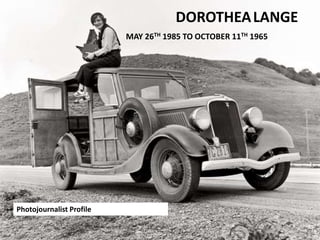
DOROTHEALANGE
MAY 26TH 1985 TO OCTOBER 11TH 1965
Photojournalist Profile
Launch of her Career as a
Photographer
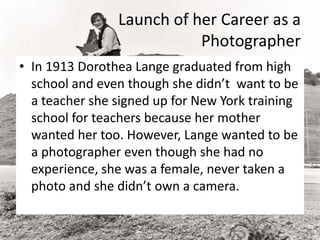
• In 1913 Dorothea Lange graduated from high
school and even though she didn’t want to be
a teacher she signed up for New York training
school for teachers because her mother
wanted her too. However, Lange wanted to be
a photographer even though she had no
experience, she was a female, never taken a
photo and she didn’t own a camera.
Launch of her Career as a
Photographer Cont’d
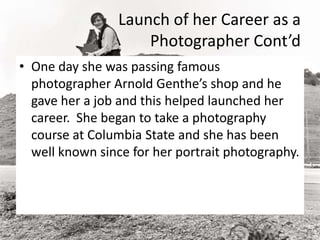
• One day she was passing famous
photographer Arnold Genthe’s shop and he
gave her a job and this helped launched her
career. She began to take a photography
course at Columbia State and she has been
well known since for her portrait photography.
THE GREAT DEPRESSION
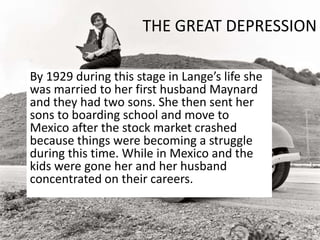
By 1929 during this stage in Lange’s life she
was married to her first husband Maynard
and they had two sons. She then sent her
sons to boarding school and move to
Mexico after the stock market crashed
because things were becoming a struggle
during this time. While in Mexico and the
kids were gone her and her husband
concentrated on their careers.
Great Depression to
World War II
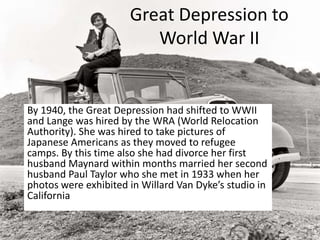
By 1940, the Great Depression had shifted to WWII
and Lange was hired by the WRA (World Relocation
Authority). She was hired to take pictures of
Japanese Americans as they moved to refugee
camps. By this time also she had divorce her first
husband Maynard within months married her second
husband Paul Taylor who she met in 1933 when her
photos were exhibited in Willard Van Dyke’s studio in
California
Motivation
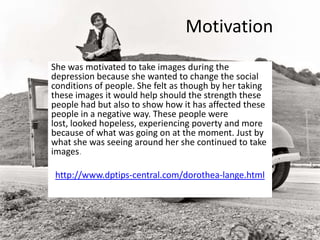
She was motivated to take images during the
depression because she wanted to change the social
conditions of people. She felt as though by her taking
these images it would help should the strength these
people had but also to show how it has affected these
people in a negative way. These people were
lost, looked hopeless, experiencing poverty and more
because of what was going on at the moment. Just by
what she was seeing around her she continued to take
images.
http://www.dptips-central.com/dorothea-lange.html
Ethics
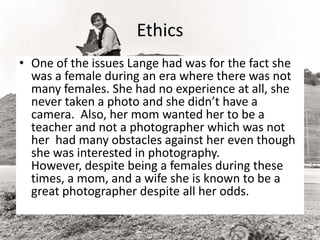
• One of the issues Lange had was for the fact she
was a female during an era where there was not
many females. She had no experience at all, she
never taken a photo and she didn’t have a
camera. Also, her mom wanted her to be a
teacher and not a photographer which was not
her had many obstacles against her even though
she was interested in photography.
However, despite being a females during these
times, a mom, and a wife she is known to be a
great photographer despite all her odds.
BIAS
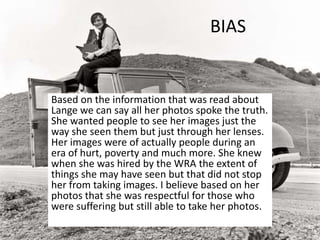
Based on the information that was read about
Lange we can say all her photos spoke the truth.
She wanted people to see her images just the
way she seen them but just through her lenses.
Her images were of actually people during an
era of hurt, poverty and much more. She knew
when she was hired by the WRA the extent of
things she may have seen but that did not stop
her from taking images. I believe based on her
photos that she was respectful for those who
were suffering but still able to take her photos.
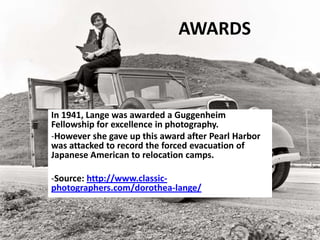
AWARDS
In 1941, Lange was awarded a Guggenheim
Fellowship for excellence in photography.
-However she gave up this award after Pearl Harbor
was attacked to record the forced evacuation of
Japanese American to relocation camps.
-Source: http://www.classic-
photographers.com/dorothea-lange/
Images by Dorothea Lange
Image Source
:http://www.bbc.co.uk/photography/genius/gallery/lange.shtml
Images cont’d
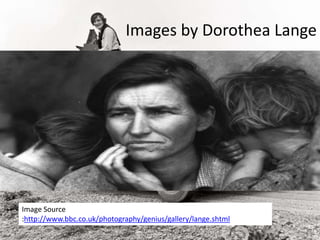
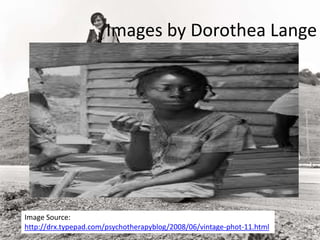
• The image is black and white due to the era in
which she took images. Black and white
photos were very popular during this era.
• The images captures my attention because by
the look of the mother’s face you can tell that
something is wrong. She looks as if she is
hopeless and then you can see two kids
resting on her
Images by Dorothea Lange
Image Source: http://www.ibiblio.org/channel/lange.html
Images Cont’d
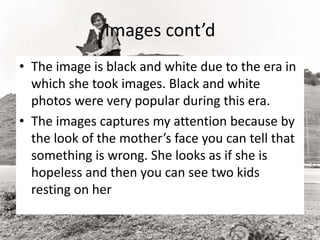
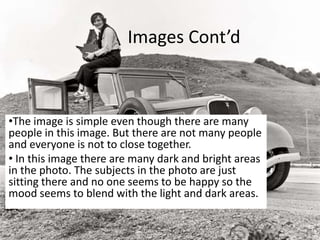
•The image is simple even though there are many
people in this image. But there are not many people
and everyone is not to close together.
• In this image there are many dark and bright areas
in the photo. The subjects in the photo are just
sitting there and no one seems to be happy so the
mood seems to blend with the light and dark areas.
Images by Dorothea Lange
Image Source:
http://drx.typepad.com/psychotherapyblog/2008/06/vintage-phot-11.html
Images Cont’d
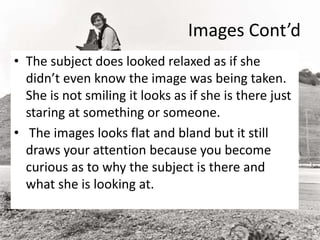
• The subject does looked relaxed as if she
didn’t even know the image was being taken.
She is not smiling it looks as if she is there just
staring at something or someone.
• The images looks flat and bland but it still
draws your attention because you become
curious as to why the subject is there and
what she is looking at.
Images by Dorothea Lange
Image Source
:http://www.npr.org/templates/story/story.php?storyId=126289455
Images Cont’d
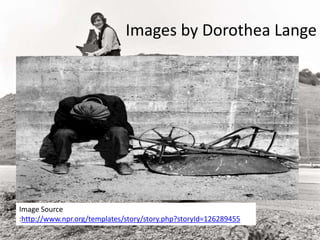
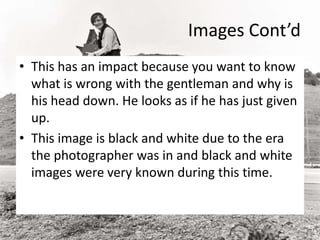
• This has an impact because you want to know
what is wrong with the gentleman and why is
his head down. He looks as if he has just given
up.
• This image is black and white due to the era
the photographer was in and black and white
images were very known during this time.
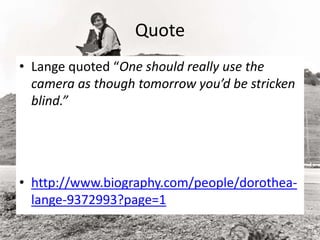
Quote
• Lange quoted “One should really use the
camera as though tomorrow you’d be stricken
blind.”
• http://www.biography.com/people/dorothea-
lange-9372993?page=1
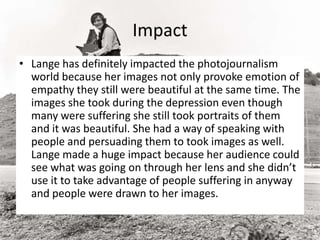
Impact
• Lange has definitely impacted the photojournalism
world because her images not only provoke emotion of
empathy they still were beautiful at the same time. The
images she took during the depression even though
many were suffering she still took portraits of them
and it was beautiful. She had a way of speaking with
people and persuading them to took images as well.
Lange made a huge impact because her audience could
see what was going on through her lens and she didn’t
use it to take advantage of people suffering in anyway
and people were drawn to her images.
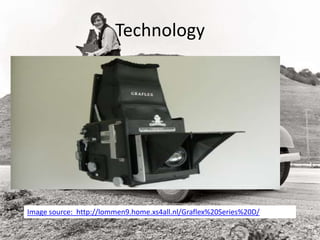
Technology
Image source: http://lommen9.home.xs4all.nl/Graflex%20Series%20D/
Technology Cont’d
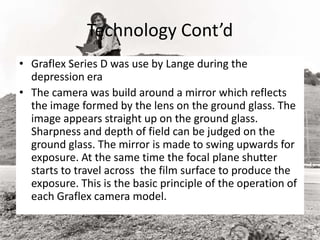
• Graflex Series D was use by Lange during the
depression era
• The camera was build around a mirror which reflects
the image formed by the lens on the ground glass. The
image appears straight up on the ground glass.
Sharpness and depth of field can be judged on the
ground glass. The mirror is made to swing upwards for
exposure. At the same time the focal plane shutter
starts to travel across the film surface to produce the
exposure. This is the basic principle of the operation of
each Graflex camera model.
Major At AIC is Liberal
Arts &Pre-Education
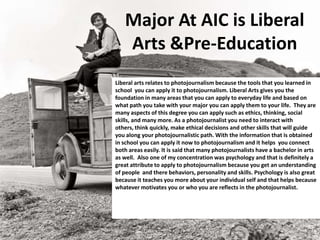
Liberal arts relates to photojournalism because the tools that you learned in
school you can apply it to photojournalism. Liberal Arts gives you the
foundation in many areas that you can apply to everyday life and based on
what path you take with your major you can apply them to your life. They are
many aspects of this degree you can apply such as ethics, thinking, social
skills, and many more. As a photojournalist you need to interact with
others, think quickly, make ethical decisions and other skills that will guide
you along your photojournalistic path. With the information that is obtained
in school you can apply it now to photojournalism and it helps you connect
both areas easily. It is said that many photojournalists have a bachelor in arts
as well. Also one of my concentration was psychology and that is definitely a
great attribute to apply to photojournalism because you get an understanding
of people and there behaviors, personality and skills. Psychology is also great
because it teaches you more about your individual self and that helps because
whatever motivates you or who you are reflects in the photojournalist.

Husbands dorothea lange

  • 1.
    DOROTHEALANGE MAY 26TH 1985TO OCTOBER 11TH 1965 Photojournalist Profile
  • 2.
    Launch of herCareer as a Photographer • In 1913 Dorothea Lange graduated from high school and even though she didn’t want to be a teacher she signed up for New York training school for teachers because her mother wanted her too. However, Lange wanted to be a photographer even though she had no experience, she was a female, never taken a photo and she didn’t own a camera.
  • 3.
    Launch of herCareer as a Photographer Cont’d • One day she was passing famous photographer Arnold Genthe’s shop and he gave her a job and this helped launched her career. She began to take a photography course at Columbia State and she has been well known since for her portrait photography.
  • 4.
    THE GREAT DEPRESSION By1929 during this stage in Lange’s life she was married to her first husband Maynard and they had two sons. She then sent her sons to boarding school and move to Mexico after the stock market crashed because things were becoming a struggle during this time. While in Mexico and the kids were gone her and her husband concentrated on their careers.
  • 5.
    Great Depression to WorldWar II By 1940, the Great Depression had shifted to WWII and Lange was hired by the WRA (World Relocation Authority). She was hired to take pictures of Japanese Americans as they moved to refugee camps. By this time also she had divorce her first husband Maynard within months married her second husband Paul Taylor who she met in 1933 when her photos were exhibited in Willard Van Dyke’s studio in California
  • 6.
    Motivation She was motivatedto take images during the depression because she wanted to change the social conditions of people. She felt as though by her taking these images it would help should the strength these people had but also to show how it has affected these people in a negative way. These people were lost, looked hopeless, experiencing poverty and more because of what was going on at the moment. Just by what she was seeing around her she continued to take images. http://www.dptips-central.com/dorothea-lange.html
  • 7.
    Ethics • One ofthe issues Lange had was for the fact she was a female during an era where there was not many females. She had no experience at all, she never taken a photo and she didn’t have a camera. Also, her mom wanted her to be a teacher and not a photographer which was not her had many obstacles against her even though she was interested in photography. However, despite being a females during these times, a mom, and a wife she is known to be a great photographer despite all her odds.
  • 8.
    BIAS Based on theinformation that was read about Lange we can say all her photos spoke the truth. She wanted people to see her images just the way she seen them but just through her lenses. Her images were of actually people during an era of hurt, poverty and much more. She knew when she was hired by the WRA the extent of things she may have seen but that did not stop her from taking images. I believe based on her photos that she was respectful for those who were suffering but still able to take her photos.
  • 9.
    AWARDS In 1941, Langewas awarded a Guggenheim Fellowship for excellence in photography. -However she gave up this award after Pearl Harbor was attacked to record the forced evacuation of Japanese American to relocation camps. -Source: http://www.classic- photographers.com/dorothea-lange/
  • 10.
    Images by DorotheaLange Image Source :http://www.bbc.co.uk/photography/genius/gallery/lange.shtml
  • 11.
    Images cont’d • Theimage is black and white due to the era in which she took images. Black and white photos were very popular during this era. • The images captures my attention because by the look of the mother’s face you can tell that something is wrong. She looks as if she is hopeless and then you can see two kids resting on her
  • 12.
    Images by DorotheaLange Image Source: http://www.ibiblio.org/channel/lange.html
  • 13.
    Images Cont’d •The imageis simple even though there are many people in this image. But there are not many people and everyone is not to close together. • In this image there are many dark and bright areas in the photo. The subjects in the photo are just sitting there and no one seems to be happy so the mood seems to blend with the light and dark areas.
  • 14.
    Images by DorotheaLange Image Source: http://drx.typepad.com/psychotherapyblog/2008/06/vintage-phot-11.html
  • 15.
    Images Cont’d • Thesubject does looked relaxed as if she didn’t even know the image was being taken. She is not smiling it looks as if she is there just staring at something or someone. • The images looks flat and bland but it still draws your attention because you become curious as to why the subject is there and what she is looking at.
  • 16.
    Images by DorotheaLange Image Source :http://www.npr.org/templates/story/story.php?storyId=126289455
  • 17.
    Images Cont’d • Thishas an impact because you want to know what is wrong with the gentleman and why is his head down. He looks as if he has just given up. • This image is black and white due to the era the photographer was in and black and white images were very known during this time.
  • 18.
    Quote • Lange quoted“One should really use the camera as though tomorrow you’d be stricken blind.” • http://www.biography.com/people/dorothea- lange-9372993?page=1
  • 19.
    Impact • Lange hasdefinitely impacted the photojournalism world because her images not only provoke emotion of empathy they still were beautiful at the same time. The images she took during the depression even though many were suffering she still took portraits of them and it was beautiful. She had a way of speaking with people and persuading them to took images as well. Lange made a huge impact because her audience could see what was going on through her lens and she didn’t use it to take advantage of people suffering in anyway and people were drawn to her images.
  • 20.
  • 21.
    Technology Cont’d • GraflexSeries D was use by Lange during the depression era • The camera was build around a mirror which reflects the image formed by the lens on the ground glass. The image appears straight up on the ground glass. Sharpness and depth of field can be judged on the ground glass. The mirror is made to swing upwards for exposure. At the same time the focal plane shutter starts to travel across the film surface to produce the exposure. This is the basic principle of the operation of each Graflex camera model.
  • 22.
    Major At AICis Liberal Arts &Pre-Education Liberal arts relates to photojournalism because the tools that you learned in school you can apply it to photojournalism. Liberal Arts gives you the foundation in many areas that you can apply to everyday life and based on what path you take with your major you can apply them to your life. They are many aspects of this degree you can apply such as ethics, thinking, social skills, and many more. As a photojournalist you need to interact with others, think quickly, make ethical decisions and other skills that will guide you along your photojournalistic path. With the information that is obtained in school you can apply it now to photojournalism and it helps you connect both areas easily. It is said that many photojournalists have a bachelor in arts as well. Also one of my concentration was psychology and that is definitely a great attribute to apply to photojournalism because you get an understanding of people and there behaviors, personality and skills. Psychology is also great because it teaches you more about your individual self and that helps because whatever motivates you or who you are reflects in the photojournalist.