YEAR 3, ISSUE 1              MARCH 2010

               THE PREPAREDNESS
                         POST
UTAH DEPARTMENT OF HEALTH
YEAR 3, ISSUE 1


  Reorganization for Better Service by Dean Penovich
The Utah Department of Health’s    Emergency Medical Services for
Bureau of Emergency Medical        Children (EMSC) and has taken on
Services (EMS) and Prepared-       the assignment of healthcare
ness reorganized in January 2010   preparedness program manager.
as a result of personnel changes   Dennis Bang manages the profes-
and in an effort to economize      sional development program and
due to funding issues. Leslie      Scott Munson has taken on the
Johnson and Sharon Ormond          assignment of managing systems
retired after many years of        and support.
employment with the Bureau.
Mindy Johnson married and
moved out of state, and Sharon Other staff changes include
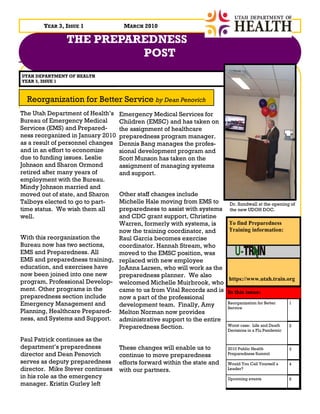
Talboys elected to go to part- Michelle Hale moving from EMS to            Dr. Sundwall at the opening of
time status. We wish them all  preparedness to assist with systems         the new UDOH DOC.
well.                          and CDC grant support, Christine
                               Warren, formerly with systems, is          To find Preparedness
                               now the training coordinator, and          Training information:
With this reorganization the   Raul Garcia becomes exercise
Bureau now has two sections,   coordinator. Hannah Stream, who
EMS and Preparedness. All      moved to the EMSC position, was
EMS and preparedness training, replaced with new employee
education, and exercises have  JoAnna Larsen, who will work as the
now been joined into one new   preparedness planner. We also
                                                                          https://www.utah.train.org
program, Professional Develop- welcomed Michelle Muirbrook, who
ment. Other programs in the    came to us from Vital Records and is       In this issue:
preparedness section include   now a part of the professional
Emergency Management and       development team. Finally, Amy             Reorganization for Better     1
                                                                          Service
Planning, Healthcare Prepared- Melton Norman now provides
ness, and Systems and Support. administrative support to the entire
                               Preparedness Section.                      Worst case: Life and Death
                                                                          Decisions in a Flu Pandemic
                                                                                                        2


Paul Patrick continues as the
department’s preparedness          These changes will enable us to        2010 Public Health            3
director and Dean Penovich         continue to move preparedness          Preparedness Summit

serves as deputy preparedness      efforts forward within the state and   Would You Call Yourself a     4
director. Mike Stever continues    with our partners.                     Leader?
in his role as the emergency                                              Upcoming events               5
manager. Kristin Gurley left
Page 2                                                                             YEAR 3, ISSUE 1

     Worst Case: Life and Death Decisions in a Flu Pandemic
                                           by Charla Haley

 The 2009 H1N1 influenza outbreak forced              certain patients from life support regardless of
 health officials to seriously consider what          family permission. Rear Admiral Ann Knebel
 might happen when demand on hospitals                of the U.S. Department of Health and Human
 during a worst-case public health emergency          Services is quoted in a New York Times article
 exceeds capacity. What if things get so              asserting that it’s better to provide for the best
 overcrowded, doctors and hospitals are forced        outcome for the public at large. “You change
 to decide which patients will be given access        your perspective from thinking about the
 to lifesaving treatments? In the event of a          individual patient to thinking about the
 major outbreak, how would hospitals handle           community of patients,” says Knebel.
 the overflow?
                                                  UDOH Executive Director, Dr. David Sundwall
 Planning for this type of situation grew, in part,
                                                  admits the guidelines will be a bitter pill for
 from the confusion that occurred in New          some to swallow. He says, “In any kind of
 Orleans hospitals following Hurricane Katrina    triage situation, there won’t be adequate
 in 2005. Doctors struggled with how to           resources to go around. The medical commu-
 prioritize patients for treatment. While many    nity will be forced to make difficult decisions
 patients lived, some died. Lawsuits followed,    and I sincerely hope we never have to face
 and laws were changed to protect health          allocating potentially life-saving services
 workers from prosecution for their actions “in   based on who is most likely to survive and
 accordance with disaster medicine protocol.”     improve.” Officials reiterate that these
                                                  guidelines would only be activated in the
 In Utah, health officials recognized that making
                                                  event of pandemic influenza or other public
 life and death decisions during a public health
                                                  health emergency declared by the Utah
 emergency would put an additional burden on
                                                  Governor’s office.
 the system, unless some kind of planning was
 done beforehand. The state triage guidelines
 were developed by the UDOH with input from
 local health departments and a workgroup
 comprised of representatives from Intermoun-
 tain Healthcare, MountainStar Healthcare,
 University of Utah Health Care and the Utah
 Hospitals and Health Systems Association
 (UHA). (See the documents at www.uha-
 utah.org.) Noting that application of the
 guidelines will require physician judgment at
 the point of patient care, the idea behind the
 proposals is to give priority to those patients
 for whom treatment would most likely be
 lifesaving. In other words, patients whose
 outcome would most likely improve with
 treatment would be given priority over those
 who would likely die even with treatment.
 Utah’s pandemic triage guidelines outline
 categories of patients, such as the elderly,
 those with end stage heart failure and incur-
 able cancer, who might be denied hospital
 care during a severe pandemic. In some
 cases, there is also the possibility of removing
YEAR 3, ISSUE 1
                                                                                  Page 3


2010 Public Health Preparedness Summit by Dean Penovich
Engaging a Community for a Successful Public Health Response
               Every year, public health professionals and other partners at the federal, state and local
               levels gather to share ideas and best practices for planning for disasters and other public
               health emergencies. Last month, Utah Department of Health employees and representa-
               tives from Utah’s local health departments attended the 2010 Public Health Preparedness
               Summit in Atlanta, Georgia. In addition to public health professionals, conference atten-
               dees included tribal, territorial and international representatives. Many of the sessions
               focused on lessons learned as a result of the H1N1 pandemic.
              The summit provided an opportunity to discuss key issues, including the National Health
              Security Strategy (NHSS) and how its implementation will affect future ASPR and CDC
cooperative agreements. Participants also discussed and evaluated the H1N1 response and shared ideas
that might improve the public health response to future pandemics.
Attendees were treated to speeches from the nation’s leading public health officials. Kathleen Sebelius,
Secretary of the U.S. Department of Health and Human Services (DHSS), and Dr. Nicole Lurie, DHSS
Assistant Secretary for Preparedness and Response (ASPR), participated in the opening session, focusing
on the response to the H1N1 outbreak. Dr. Thomas Frieden, Director of the Centers for Disease Control
and Prevention (CDC), delivered closing remarks and discussed ways to move public health forward by
assessing progress, gaps and future strategies. Audience members heard firsthand the vision for
strengthening the public health preparedness enterprise at the local, state and national levels.
Presentations from many of the sessions can be found at http://www.phprep.org/2010/Agenda/
Schedule.cfm. Utah presentations included those by Mike Stever, UDOH Emergency Manager and a joint
presentation by Kevin McCulley, Association for Utah Community Health, and Linda Stearns, Oquirrh
View Community Health Center.


                                                                UDOH Web sites:
            Utah Department of Health
         Public Health and Preparedness                         health.utah.gov (main)
      3760 S. Highland Drive SLC.UT 84106
                                                                health.utah.gov/preparedness
             MAILING ADDRESS:
               P.O. Box 142006
             SLC, Utah 84114-2006
                                                                health.utah.gov/ems


               Promote business, community and workplace preparedness:
                               www.BeReadyUtah.com
YEAR 3, ISSUE 1
                                                                                   YEAR 3, ISSUE 1
                                                                                   Page 4
 Professional Development Zone
                     Would You Call Yourself a Leader?
                                           By Christine Warren
Leadership isn’t about position or title, power or authority, celebrity or wealth, family or genetics. It’s
also not something best left for a chosen few. Leadership is everyone’s business! Leadership is about
relationships, personal credibility and what you do in your role as a leader. It’s about an observable
set of skills and abilities that are useful regardless of the situation. And as a skill, with the right
motivation, desire, practice, feedback, role models and coaching, leadership can be strengthened,
honed, and enhanced.
If you find yourself in a challenging situation that requires setting a good example for others, looking
ahead to the future, taking initiative to change the status quo, building teamwork and trust, and
encouraging others to succeed - then you are in a situation that requires leadership. You are a
leader.
The first place to look for leadership is within yourself. Be reflective. Consider what others see in you
that would make you a good leader. You might want to focus on the qualities you lack to make you
a good leader. Honestly measure and assess your current leadership strengths and weaknesses. As
you stay determined to overcome your leadership obstacles and enhance your leadership qualities,
you will make a difference within your personal and working environment, and within the community
you serve.
Take the challenge and liberate the leader within yourself. Make a plan for improvement and commit
to learn, stretch, and develop as a leader. Through your leadership journey, you will feel more
empowered and capable to accept the challenges of leadership.
                                         Adapted from an article by Barry Posner, The Leadership Challenge


                          Upcoming events—March—July 2010

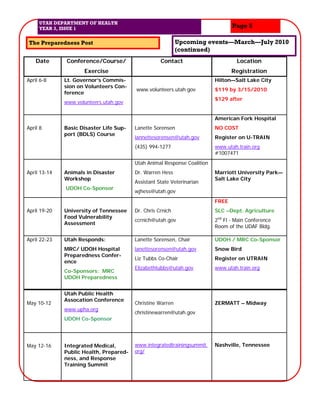
    Date        Conference/Course/                            Contact                   Location
                        Exercise                                                     Registration

                                                                              Jordan Valley Medical
                                                                              Center
March 25       Basic Disaster Life Sup-         Lanette Sorensen
               port (BDLS) Course                                             NO COST
                                                lannettesorensen@utah.gov
                                                                              Register on U-TRAIN
                                                (435) 994-1277
                                                                              www.utah.train.org #1007471

               2010 EMS Conference:
April 2        Sponsored by Utah Valley         (801) 357-2135                PROVO
               Regional Medical Center
                                                                              $50 per person for Friday


               Refugee Conference
April 5        Healing Trauma Today             Rich Foster                   Horizonte Center
               Preparing for Disasters          Rfoster@utah.gov              Salt Lake City
UTAH DEPARTMENT OF HEALTH
     YEAR 3, ISSUE 1                                                             Page 5

The Preparedness Post                                       Upcoming events—March—July 2010
                                                            (continued)
    Date      Conference/Course/                    Contact                        Location
                     Exercise                                                    Registration
April 6-8     Lt. Governor’s Commis-                                      Hilton—Salt Lake City
              sion on Volunteers Con-
                                         www.volunteers.utah.gov          $119 by 3/15/2010
              ference
                                                                          $129 after
              www.volunteers.utah.gov


                                                                          American Fork Hospital
April 8       Basic Disaster Life Sup-   Lanette Sorensen                 NO COST
              port (BDLS) Course
                                         lannettesorensen@utah.gov        Register on U-TRAIN
                                         (435) 994-1277                   www.utah.train.org
                                                                          #1007471
                                         Utah Animal Response Coalition
April 13-14   Animals in Disaster        Dr. Warren Hess                  Marriott University Park—
              Workshop                                                    Salt Lake City
                                         Assistant State Veterinarian
              UDOH Co-Sponsor
                                         wjhess@utah.gov
                                                                          FREE
April 19-20   University of Tennessee    Dr. Chris Crnich                 SLC –Dept. Agriculture
              Food Vulnerability
                                         ccrnich@utah.gov                 2nd Fl - Main Conference
              Assessment
                                                                          Room of the UDAF Bldg.

April 22-23   Utah Responds:             Lanette Sorensen, Chair          UDOH / MRC Co-Sponsor
              MRC/ UDOH Hospital         lanettesorensen@utah.gov         Snow Bird
              Preparedness Confer-
                                         Liz Tubbs Co-Chair               Register on UTRAIN
              ence
                                         Elizabethtubbs@utah.gov          www.utah.train.org
              Co-Sponsors: MRC
              UDOH Preparedness


              Utah Public Health
              Assocation Conference
May 10-12                                Christine Warren                 ZERMATT – Midway
              www.upha.org
                                         christinewarren@utah.gov
              UDOH Co-Sponsor


May 12-16     Integrated Medical,        www.integratedtrainingsummit.    Nashville, Tennessee
              Public Health, Prepared-   org/
              ness, and Response
              Training Summit
UTAH DEPARTMENT OF HEALTH
     YEAR 3, ISSUE 1                                                         Page 6

The Preparedness Post                                       Upcoming events—March—July 2010

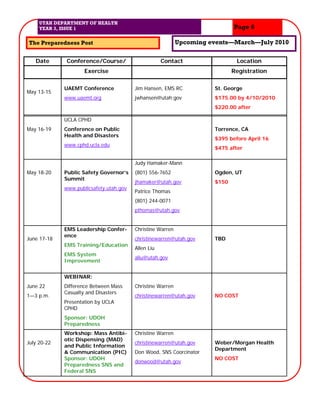
   Date       Conference/Course/                     Contact                  Location
                     Exercise                                                Registration

             UAEMT Conference            Jim Hansen, EMS RC           St. George
May 13-15
             www.uaemt.org               jwhansen@utah.gov            $175.00 by 4/10/2010
                                                                      $220.00 after

             UCLA CPHD
May 16-19    Conference on Public                                     Torrence, CA
             Health and Disasters
                                                                      $395 before April 16
             www.cphd.ucla.edu
                                                                      $475 after

                                         Judy Hamaker-Mann
May 18-20    Public Safety Governor’s    (801) 556-7652               Ogden, UT
             Summit
                                         jhamaker@utah.gov            $150
             www.publicsafety.utah.gov
                                         Patrice Thomas
                                         (801) 244-0071
                                         pthomas@utah.gov


             EMS Leadership Confer-      Christine Warren
             ence
June 17-18                               christinewarren@utah.gov     TBD
             EMS Training/Education
                                         Allen Liu
             EMS System
                                         aliu@utah.gov
             Improvement


             WEBINAR:
June 22      Difference Between Mass     Christine Warren
             Casualty and Disasters
1—3 p.m.                                 christinewarren@utah.gov     NO COST
             Presentation by UCLA
             CPHD
             Sponsor: UDOH
             Preparedness
             Workshop: Mass Antibi-      Christine Warren
             otic Dispensing (MAD)
July 20-22                               christinewarren@utah.gov     Weber/Morgan Health
             and Public Information
                                                                      Department
             & Communication (PIC)       Don Wood, SNS Coorcinator
             Sponsor: UDOH                                            NO COST
                                         donwood@utah.gov
             Preparedness SNS and
             Federal SNS
UTAH DEPARTMENT OF HEALTH
     YEAR 3, ISSUE 1                                                                Page 7

 The Preparedness Post

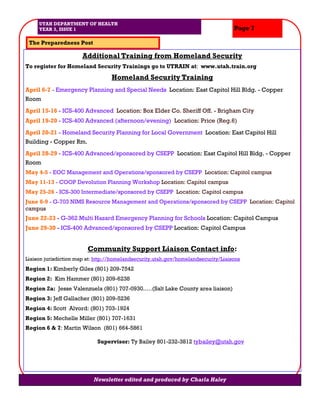
                       Additional Training from Homeland Security
To register for Homeland Security Trainings go to UTRAIN at: www.utah.train.org

                                  Homeland Security Training
April 6-7 - Emergency Planning and Special Needs Location: East Capitol Hill Bldg. - Copper
Room
April 15-16 - ICS-400 Advanced Location: Box Elder Co. Sheriff Off. - Brigham City
April 19-20 - ICS-400 Advanced (afternoon/evening) Location: Price (Reg.6)
April 20-21 - Homeland Security Planning for Local Government Location: East Capitol Hill
Building - Copper Rm.
April 28-29 - ICS-400 Advanced/sponsored by CSEPP Location: East Capitol Hill Bldg. - Copper
Room
May 4-5 - EOC Management and Operations/sponsored by CSEPP Location: Capitol campus
May 11-13 - COOP Devolution Planning Workshop Location: Capitol campus
May 25-26 - ICS-300 Intermediate/sponsored by CSEPP Location: Capitol campus
June 8-9 - G-703 NIMS Resource Management and Operations/sponsored by CSEPP Location: Capitol
campus
June 22-23 - G-362 Multi Hazard Emergency Planning for Schools Location: Capitol Campus
June 29-30 - ICS-400 Advanced/sponsored by CSEPP Location: Capitol Campus


                         Community Support Liaison Contact info:
Liaison jurisdiction map at: http://homelandsecurity.utah.gov/homelandsecurity/Liaisons
Region 1: Kimberly Giles (801) 209-7542
Region 2: Kim Hammer (801) 209-6238
Region 2a: Jesse Valenzuela (801) 707-0930..…(Salt Lake County area liaison)
Region 3: Jeff Gallacher (801) 209-5236
Region 4: Scott Alvord: (801) 703-1924
Region 5: Mechelle Miller (801) 707-1631
Region 6 & 7: Martin Wilson (801) 664-5861

                             Supervisor: Ty Bailey 801-232-3812 tybailey@utah.gov


                           Newsletter edited and produced by Charla Haley

Preparedness Post March 2010

  • 1.
    YEAR 3, ISSUE1 MARCH 2010 THE PREPAREDNESS POST UTAH DEPARTMENT OF HEALTH YEAR 3, ISSUE 1 Reorganization for Better Service by Dean Penovich The Utah Department of Health’s Emergency Medical Services for Bureau of Emergency Medical Children (EMSC) and has taken on Services (EMS) and Prepared- the assignment of healthcare ness reorganized in January 2010 preparedness program manager. as a result of personnel changes Dennis Bang manages the profes- and in an effort to economize sional development program and due to funding issues. Leslie Scott Munson has taken on the Johnson and Sharon Ormond assignment of managing systems retired after many years of and support. employment with the Bureau. Mindy Johnson married and moved out of state, and Sharon Other staff changes include Talboys elected to go to part- Michelle Hale moving from EMS to Dr. Sundwall at the opening of time status. We wish them all preparedness to assist with systems the new UDOH DOC. well. and CDC grant support, Christine Warren, formerly with systems, is To find Preparedness now the training coordinator, and Training information: With this reorganization the Raul Garcia becomes exercise Bureau now has two sections, coordinator. Hannah Stream, who EMS and Preparedness. All moved to the EMSC position, was EMS and preparedness training, replaced with new employee education, and exercises have JoAnna Larsen, who will work as the now been joined into one new preparedness planner. We also https://www.utah.train.org program, Professional Develop- welcomed Michelle Muirbrook, who ment. Other programs in the came to us from Vital Records and is In this issue: preparedness section include now a part of the professional Emergency Management and development team. Finally, Amy Reorganization for Better 1 Service Planning, Healthcare Prepared- Melton Norman now provides ness, and Systems and Support. administrative support to the entire Preparedness Section. Worst case: Life and Death Decisions in a Flu Pandemic 2 Paul Patrick continues as the department’s preparedness These changes will enable us to 2010 Public Health 3 director and Dean Penovich continue to move preparedness Preparedness Summit serves as deputy preparedness efforts forward within the state and Would You Call Yourself a 4 director. Mike Stever continues with our partners. Leader? in his role as the emergency Upcoming events 5 manager. Kristin Gurley left
  • 2.
    Page 2 YEAR 3, ISSUE 1 Worst Case: Life and Death Decisions in a Flu Pandemic by Charla Haley The 2009 H1N1 influenza outbreak forced certain patients from life support regardless of health officials to seriously consider what family permission. Rear Admiral Ann Knebel might happen when demand on hospitals of the U.S. Department of Health and Human during a worst-case public health emergency Services is quoted in a New York Times article exceeds capacity. What if things get so asserting that it’s better to provide for the best overcrowded, doctors and hospitals are forced outcome for the public at large. “You change to decide which patients will be given access your perspective from thinking about the to lifesaving treatments? In the event of a individual patient to thinking about the major outbreak, how would hospitals handle community of patients,” says Knebel. the overflow? UDOH Executive Director, Dr. David Sundwall Planning for this type of situation grew, in part, admits the guidelines will be a bitter pill for from the confusion that occurred in New some to swallow. He says, “In any kind of Orleans hospitals following Hurricane Katrina triage situation, there won’t be adequate in 2005. Doctors struggled with how to resources to go around. The medical commu- prioritize patients for treatment. While many nity will be forced to make difficult decisions patients lived, some died. Lawsuits followed, and I sincerely hope we never have to face and laws were changed to protect health allocating potentially life-saving services workers from prosecution for their actions “in based on who is most likely to survive and accordance with disaster medicine protocol.” improve.” Officials reiterate that these guidelines would only be activated in the In Utah, health officials recognized that making event of pandemic influenza or other public life and death decisions during a public health health emergency declared by the Utah emergency would put an additional burden on Governor’s office. the system, unless some kind of planning was done beforehand. The state triage guidelines were developed by the UDOH with input from local health departments and a workgroup comprised of representatives from Intermoun- tain Healthcare, MountainStar Healthcare, University of Utah Health Care and the Utah Hospitals and Health Systems Association (UHA). (See the documents at www.uha- utah.org.) Noting that application of the guidelines will require physician judgment at the point of patient care, the idea behind the proposals is to give priority to those patients for whom treatment would most likely be lifesaving. In other words, patients whose outcome would most likely improve with treatment would be given priority over those who would likely die even with treatment. Utah’s pandemic triage guidelines outline categories of patients, such as the elderly, those with end stage heart failure and incur- able cancer, who might be denied hospital care during a severe pandemic. In some cases, there is also the possibility of removing
  • 3.
    YEAR 3, ISSUE1 Page 3 2010 Public Health Preparedness Summit by Dean Penovich Engaging a Community for a Successful Public Health Response Every year, public health professionals and other partners at the federal, state and local levels gather to share ideas and best practices for planning for disasters and other public health emergencies. Last month, Utah Department of Health employees and representa- tives from Utah’s local health departments attended the 2010 Public Health Preparedness Summit in Atlanta, Georgia. In addition to public health professionals, conference atten- dees included tribal, territorial and international representatives. Many of the sessions focused on lessons learned as a result of the H1N1 pandemic. The summit provided an opportunity to discuss key issues, including the National Health Security Strategy (NHSS) and how its implementation will affect future ASPR and CDC cooperative agreements. Participants also discussed and evaluated the H1N1 response and shared ideas that might improve the public health response to future pandemics. Attendees were treated to speeches from the nation’s leading public health officials. Kathleen Sebelius, Secretary of the U.S. Department of Health and Human Services (DHSS), and Dr. Nicole Lurie, DHSS Assistant Secretary for Preparedness and Response (ASPR), participated in the opening session, focusing on the response to the H1N1 outbreak. Dr. Thomas Frieden, Director of the Centers for Disease Control and Prevention (CDC), delivered closing remarks and discussed ways to move public health forward by assessing progress, gaps and future strategies. Audience members heard firsthand the vision for strengthening the public health preparedness enterprise at the local, state and national levels. Presentations from many of the sessions can be found at http://www.phprep.org/2010/Agenda/ Schedule.cfm. Utah presentations included those by Mike Stever, UDOH Emergency Manager and a joint presentation by Kevin McCulley, Association for Utah Community Health, and Linda Stearns, Oquirrh View Community Health Center. UDOH Web sites: Utah Department of Health Public Health and Preparedness health.utah.gov (main) 3760 S. Highland Drive SLC.UT 84106 health.utah.gov/preparedness MAILING ADDRESS: P.O. Box 142006 SLC, Utah 84114-2006 health.utah.gov/ems Promote business, community and workplace preparedness: www.BeReadyUtah.com
  • 4.
    YEAR 3, ISSUE1 YEAR 3, ISSUE 1 Page 4 Professional Development Zone Would You Call Yourself a Leader? By Christine Warren Leadership isn’t about position or title, power or authority, celebrity or wealth, family or genetics. It’s also not something best left for a chosen few. Leadership is everyone’s business! Leadership is about relationships, personal credibility and what you do in your role as a leader. It’s about an observable set of skills and abilities that are useful regardless of the situation. And as a skill, with the right motivation, desire, practice, feedback, role models and coaching, leadership can be strengthened, honed, and enhanced. If you find yourself in a challenging situation that requires setting a good example for others, looking ahead to the future, taking initiative to change the status quo, building teamwork and trust, and encouraging others to succeed - then you are in a situation that requires leadership. You are a leader. The first place to look for leadership is within yourself. Be reflective. Consider what others see in you that would make you a good leader. You might want to focus on the qualities you lack to make you a good leader. Honestly measure and assess your current leadership strengths and weaknesses. As you stay determined to overcome your leadership obstacles and enhance your leadership qualities, you will make a difference within your personal and working environment, and within the community you serve. Take the challenge and liberate the leader within yourself. Make a plan for improvement and commit to learn, stretch, and develop as a leader. Through your leadership journey, you will feel more empowered and capable to accept the challenges of leadership. Adapted from an article by Barry Posner, The Leadership Challenge Upcoming events—March—July 2010 Date Conference/Course/ Contact Location Exercise Registration Jordan Valley Medical Center March 25 Basic Disaster Life Sup- Lanette Sorensen port (BDLS) Course NO COST lannettesorensen@utah.gov Register on U-TRAIN (435) 994-1277 www.utah.train.org #1007471 2010 EMS Conference: April 2 Sponsored by Utah Valley (801) 357-2135 PROVO Regional Medical Center $50 per person for Friday Refugee Conference April 5 Healing Trauma Today Rich Foster Horizonte Center Preparing for Disasters Rfoster@utah.gov Salt Lake City
  • 5.
    UTAH DEPARTMENT OFHEALTH YEAR 3, ISSUE 1 Page 5 The Preparedness Post Upcoming events—March—July 2010 (continued) Date Conference/Course/ Contact Location Exercise Registration April 6-8 Lt. Governor’s Commis- Hilton—Salt Lake City sion on Volunteers Con- www.volunteers.utah.gov $119 by 3/15/2010 ference $129 after www.volunteers.utah.gov American Fork Hospital April 8 Basic Disaster Life Sup- Lanette Sorensen NO COST port (BDLS) Course lannettesorensen@utah.gov Register on U-TRAIN (435) 994-1277 www.utah.train.org #1007471 Utah Animal Response Coalition April 13-14 Animals in Disaster Dr. Warren Hess Marriott University Park— Workshop Salt Lake City Assistant State Veterinarian UDOH Co-Sponsor wjhess@utah.gov FREE April 19-20 University of Tennessee Dr. Chris Crnich SLC –Dept. Agriculture Food Vulnerability ccrnich@utah.gov 2nd Fl - Main Conference Assessment Room of the UDAF Bldg. April 22-23 Utah Responds: Lanette Sorensen, Chair UDOH / MRC Co-Sponsor MRC/ UDOH Hospital lanettesorensen@utah.gov Snow Bird Preparedness Confer- Liz Tubbs Co-Chair Register on UTRAIN ence Elizabethtubbs@utah.gov www.utah.train.org Co-Sponsors: MRC UDOH Preparedness Utah Public Health Assocation Conference May 10-12 Christine Warren ZERMATT – Midway www.upha.org christinewarren@utah.gov UDOH Co-Sponsor May 12-16 Integrated Medical, www.integratedtrainingsummit. Nashville, Tennessee Public Health, Prepared- org/ ness, and Response Training Summit
  • 6.
    UTAH DEPARTMENT OFHEALTH YEAR 3, ISSUE 1 Page 6 The Preparedness Post Upcoming events—March—July 2010 Date Conference/Course/ Contact Location Exercise Registration UAEMT Conference Jim Hansen, EMS RC St. George May 13-15 www.uaemt.org jwhansen@utah.gov $175.00 by 4/10/2010 $220.00 after UCLA CPHD May 16-19 Conference on Public Torrence, CA Health and Disasters $395 before April 16 www.cphd.ucla.edu $475 after Judy Hamaker-Mann May 18-20 Public Safety Governor’s (801) 556-7652 Ogden, UT Summit jhamaker@utah.gov $150 www.publicsafety.utah.gov Patrice Thomas (801) 244-0071 pthomas@utah.gov EMS Leadership Confer- Christine Warren ence June 17-18 christinewarren@utah.gov TBD EMS Training/Education Allen Liu EMS System aliu@utah.gov Improvement WEBINAR: June 22 Difference Between Mass Christine Warren Casualty and Disasters 1—3 p.m. christinewarren@utah.gov NO COST Presentation by UCLA CPHD Sponsor: UDOH Preparedness Workshop: Mass Antibi- Christine Warren otic Dispensing (MAD) July 20-22 christinewarren@utah.gov Weber/Morgan Health and Public Information Department & Communication (PIC) Don Wood, SNS Coorcinator Sponsor: UDOH NO COST donwood@utah.gov Preparedness SNS and Federal SNS
  • 7.
    UTAH DEPARTMENT OFHEALTH YEAR 3, ISSUE 1 Page 7 The Preparedness Post Additional Training from Homeland Security To register for Homeland Security Trainings go to UTRAIN at: www.utah.train.org Homeland Security Training April 6-7 - Emergency Planning and Special Needs Location: East Capitol Hill Bldg. - Copper Room April 15-16 - ICS-400 Advanced Location: Box Elder Co. Sheriff Off. - Brigham City April 19-20 - ICS-400 Advanced (afternoon/evening) Location: Price (Reg.6) April 20-21 - Homeland Security Planning for Local Government Location: East Capitol Hill Building - Copper Rm. April 28-29 - ICS-400 Advanced/sponsored by CSEPP Location: East Capitol Hill Bldg. - Copper Room May 4-5 - EOC Management and Operations/sponsored by CSEPP Location: Capitol campus May 11-13 - COOP Devolution Planning Workshop Location: Capitol campus May 25-26 - ICS-300 Intermediate/sponsored by CSEPP Location: Capitol campus June 8-9 - G-703 NIMS Resource Management and Operations/sponsored by CSEPP Location: Capitol campus June 22-23 - G-362 Multi Hazard Emergency Planning for Schools Location: Capitol Campus June 29-30 - ICS-400 Advanced/sponsored by CSEPP Location: Capitol Campus Community Support Liaison Contact info: Liaison jurisdiction map at: http://homelandsecurity.utah.gov/homelandsecurity/Liaisons Region 1: Kimberly Giles (801) 209-7542 Region 2: Kim Hammer (801) 209-6238 Region 2a: Jesse Valenzuela (801) 707-0930..…(Salt Lake County area liaison) Region 3: Jeff Gallacher (801) 209-5236 Region 4: Scott Alvord: (801) 703-1924 Region 5: Mechelle Miller (801) 707-1631 Region 6 & 7: Martin Wilson (801) 664-5861 Supervisor: Ty Bailey 801-232-3812 tybailey@utah.gov Newsletter edited and produced by Charla Haley