Girma Shumi, Jannik Schultner, Ine Dorresteijn, Patricia Rodrigues, Jan Hanspach, Kristoffer Hylander, Feyera Senbeta and Joern Fischer
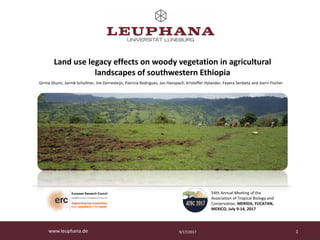
Land use legacy effects on woody vegetation in agricultural
landscapes of southwestern Ethiopia
www.leuphana.de 19/17/2017
54th Annual Meeting of the
Association of Tropical Biology and
Conservation, MERIDA, YUCATAN,
MEXICO, July 9-14, 2017
9/17/2017WWW.LEUPHANA.DE 2
Introduction
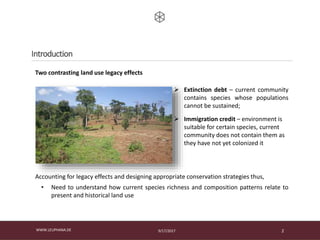
 Extinction debt – current community
contains species whose populations
cannot be sustained;
 Immigration credit – environment is
suitable for certain species, current
community does not contain them as
they have not yet colonized it
Two contrasting land use legacy effects
Accounting for legacy effects and designing appropriate conservation strategies thus,
• Need to understand how current species richness and composition patterns relate to
present and historical land use
9/17/2017WWW.LEUPHANA.DE 3
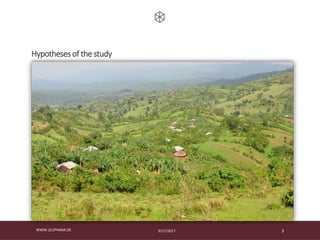
Hypotheses of the study
9/17/2017WWW.LEUPHANA.DE 4
1. Present-day land use variables influence woody plant species composition,
distribution and richness
2. Legacy effects of historical land use influence species composition, distribution and
richness, particularly forest specialists surviving as relicts in farmland
3. Legacy effects could be detectable from population structure – large diameter trees
might disappear in old farmland but persist in converted farmland
Hypotheses of the study
9/17/2017WWW.LEUPHANA.DE 5
Studyareaand methods
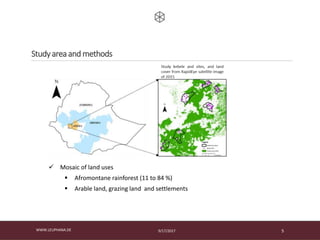
 Mosaic of land uses
 Afromontane rainforest (11 to 84 %)
 Arable land, grazing land and settlements
9/17/2017WWW.LEUPHANA.DE 6
Studyareaand methods
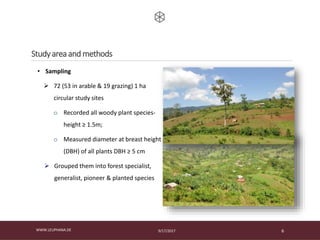
• Sampling
 72 (53 in arable & 19 grazing) 1 ha
circular study sites
o Recorded all woody plant species-
height ≥ 1.5m;
o Measured diameter at breast height
(DBH) of all plants DBH ≥ 5 cm
 Grouped them into forest specialist,
generalist, pioneer & planted species
9/17/2017WWW.LEUPHANA.DE 7
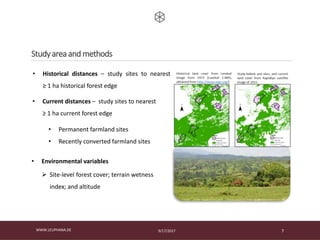
• Historical distances – study sites to nearest
≥ 1 ha historical forest edge
• Current distances – study sites to nearest
≥ 1 ha current forest edge
• Environmental variables
 Site-level forest cover; terrain wetness
index; and altitude
Studyareaand methods
• Permanent farmland sites
• Recently converted farmland sites
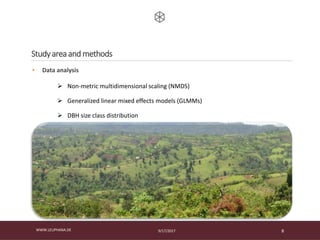
• Data analysis
9/17/2017WWW.LEUPHANA.DE 8
Studyareaand methods
 Non-metric multidimensional scaling (NMDS)
 Generalized linear mixed effects models (GLMMs)
 DBH size class distribution
9/17/2017WWW.LEUPHANA.DE 9
Results and discussion
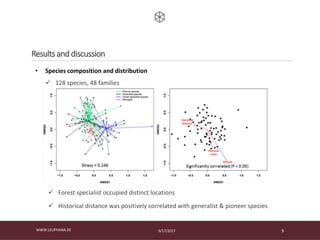
• Species composition and distribution
 128 species, 48 families
 Forest specialist occupied distinct locations
 Historical distance was positively correlated with generalist & pioneer species
9/17/2017WWW.LEUPHANA.DE 10
Results and discussion
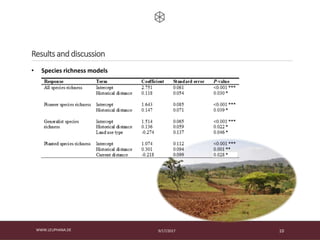
• Species richness models
9/17/2017WWW.LEUPHANA.DE 11
Results and discussion
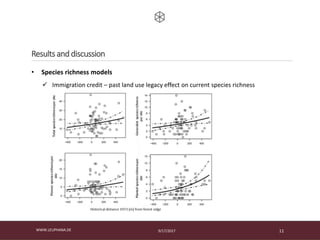
• Species richness models
 Immigration credit – past land use legacy effect on current species richness
9/17/2017WWW.LEUPHANA.DE 11
Results and discussion
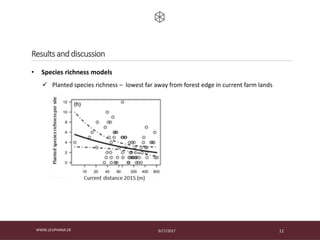
• Species richness models
 Planted species richness – lowest far away from forest edge in current farm lands
9/17/2017WWW.LEUPHANA.DE 13
Results and discussion
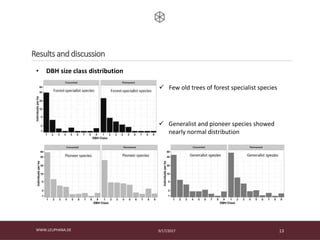
• DBH size class distribution
 Few old trees of forest specialist species
 Generalist and pioneer species showed
nearly normal distribution
9/17/2017WWW.LEUPHANA.DE 14
Results and discussion
 Overall
• Hypothesis 1
• Only planted species richness negatively related with current distance; and
generalist species richness was affected by farmland type
 Fewer relationship between current land use and current species richness
• Hypothesis 2
• Significant relationships between historical distance and total species, generalist,
pioneer, and planted species richness but not forest specialist species richness
 The dominant legacy effect identified was immigration credit, rather than
extinction debt
• Hypothesis 3
• Only recently converted farmland showed limited evidence of large relict of
forest trees, while trees of other groups was close to natural populations in both
converted and permanent farmland sites
9/17/2017WWW.LEUPHANA.DE 15
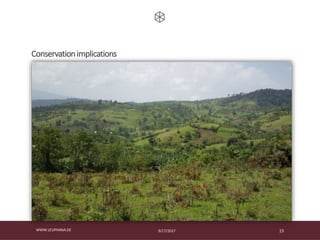
Conservationimplications
9/17/2017WWW.LEUPHANA.DE 16
Conservationimplications
 Possible extinction debt for forest specialist species in farmland was rapidly paid off -
farmers cleared remnant trees
 Evidence of immigration credit in farmland for total, generalist, pioneer and planted
species richness and composition
o Nurse tree effects in increasingly old farmland  development of novel ecosystems
and sustainable cultural landscapes
o Long-established farmland unrecognised conservation value
o Forest conservation should remain the highest priority
 Biodiversity conservation policies should also recognize the agricultural mosaic
 A future priority could also be to reintroduce forest specialists into the farmland mosaic
9/17/2017WWW.LEUPHANA.DE 17
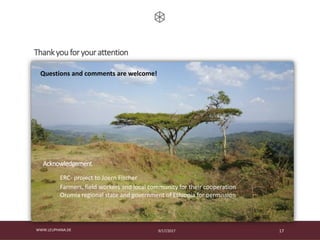
Thankyou for your attention
ERC- project to Joern Fischer
Farmers, field workers and local community for their cooperation
Oromia regional state and government of Ethiopia for permission
Acknowledgement
Questions and comments are welcome!

Atbc2017 mexico pp

  • 1.
    Girma Shumi, JannikSchultner, Ine Dorresteijn, Patricia Rodrigues, Jan Hanspach, Kristoffer Hylander, Feyera Senbeta and Joern Fischer Land use legacy effects on woody vegetation in agricultural landscapes of southwestern Ethiopia www.leuphana.de 19/17/2017 54th Annual Meeting of the Association of Tropical Biology and Conservation, MERIDA, YUCATAN, MEXICO, July 9-14, 2017
  • 2.
    9/17/2017WWW.LEUPHANA.DE 2 Introduction  Extinctiondebt – current community contains species whose populations cannot be sustained;  Immigration credit – environment is suitable for certain species, current community does not contain them as they have not yet colonized it Two contrasting land use legacy effects Accounting for legacy effects and designing appropriate conservation strategies thus, • Need to understand how current species richness and composition patterns relate to present and historical land use
  • 3.
  • 4.
    9/17/2017WWW.LEUPHANA.DE 4 1. Present-dayland use variables influence woody plant species composition, distribution and richness 2. Legacy effects of historical land use influence species composition, distribution and richness, particularly forest specialists surviving as relicts in farmland 3. Legacy effects could be detectable from population structure – large diameter trees might disappear in old farmland but persist in converted farmland Hypotheses of the study
  • 5.
    9/17/2017WWW.LEUPHANA.DE 5 Studyareaand methods Mosaic of land uses  Afromontane rainforest (11 to 84 %)  Arable land, grazing land and settlements
  • 6.
    9/17/2017WWW.LEUPHANA.DE 6 Studyareaand methods •Sampling  72 (53 in arable & 19 grazing) 1 ha circular study sites o Recorded all woody plant species- height ≥ 1.5m; o Measured diameter at breast height (DBH) of all plants DBH ≥ 5 cm  Grouped them into forest specialist, generalist, pioneer & planted species
  • 7.
    9/17/2017WWW.LEUPHANA.DE 7 • Historicaldistances – study sites to nearest ≥ 1 ha historical forest edge • Current distances – study sites to nearest ≥ 1 ha current forest edge • Environmental variables  Site-level forest cover; terrain wetness index; and altitude Studyareaand methods • Permanent farmland sites • Recently converted farmland sites
  • 8.
    • Data analysis 9/17/2017WWW.LEUPHANA.DE8 Studyareaand methods  Non-metric multidimensional scaling (NMDS)  Generalized linear mixed effects models (GLMMs)  DBH size class distribution
  • 9.
    9/17/2017WWW.LEUPHANA.DE 9 Results anddiscussion • Species composition and distribution  128 species, 48 families  Forest specialist occupied distinct locations  Historical distance was positively correlated with generalist & pioneer species
  • 10.
    9/17/2017WWW.LEUPHANA.DE 10 Results anddiscussion • Species richness models
  • 11.
    9/17/2017WWW.LEUPHANA.DE 11 Results anddiscussion • Species richness models  Immigration credit – past land use legacy effect on current species richness
  • 12.
    9/17/2017WWW.LEUPHANA.DE 11 Results anddiscussion • Species richness models  Planted species richness – lowest far away from forest edge in current farm lands
  • 13.
    9/17/2017WWW.LEUPHANA.DE 13 Results anddiscussion • DBH size class distribution  Few old trees of forest specialist species  Generalist and pioneer species showed nearly normal distribution
  • 14.
    9/17/2017WWW.LEUPHANA.DE 14 Results anddiscussion  Overall • Hypothesis 1 • Only planted species richness negatively related with current distance; and generalist species richness was affected by farmland type  Fewer relationship between current land use and current species richness • Hypothesis 2 • Significant relationships between historical distance and total species, generalist, pioneer, and planted species richness but not forest specialist species richness  The dominant legacy effect identified was immigration credit, rather than extinction debt • Hypothesis 3 • Only recently converted farmland showed limited evidence of large relict of forest trees, while trees of other groups was close to natural populations in both converted and permanent farmland sites
  • 15.
  • 16.
    9/17/2017WWW.LEUPHANA.DE 16 Conservationimplications  Possibleextinction debt for forest specialist species in farmland was rapidly paid off - farmers cleared remnant trees  Evidence of immigration credit in farmland for total, generalist, pioneer and planted species richness and composition o Nurse tree effects in increasingly old farmland  development of novel ecosystems and sustainable cultural landscapes o Long-established farmland unrecognised conservation value o Forest conservation should remain the highest priority  Biodiversity conservation policies should also recognize the agricultural mosaic  A future priority could also be to reintroduce forest specialists into the farmland mosaic
  • 17.
    9/17/2017WWW.LEUPHANA.DE 17 Thankyou foryour attention ERC- project to Joern Fischer Farmers, field workers and local community for their cooperation Oromia regional state and government of Ethiopia for permission Acknowledgement Questions and comments are welcome!