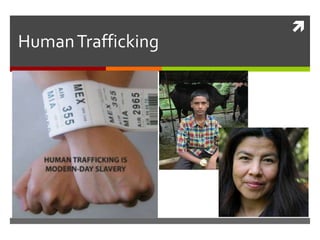
Human Trafficking
The Facts in Numbers27 million modern-day slaves across the world.800,000 trafficked across international borders.80% of victims are women and children.32 billion yearly profits generated by the human trafficking industry.There are 161 countries affected by trafficking that are classified as the following 127 countries of origin; 98 transit countries; 137 destination countries
The Human Trafficking Chain	Recruitment	This is the stage where the trafficking victims are believed to be at the most vulnerable state and therefore more susceptible to false promises.  At this point recruiters might even receive money from the victims with the promise of work abroad.
The Human Trafficking Chain 	Transportation	In order to maintain their vulnerable status, victims are typically transported to a foreign country accompanied by the initial recruiter and therefore establishing a sense of trust between the victims and the recruiter.
The Human Trafficking ChainArrivalThe recruiter now passes on his victims to the next member of the chain. “The middle man” who receives the victims and then takes them to where they are “wanted”. At this point, the passports are moved from the recruiter to the “middleman” to ensure continued control and elimination of the possibility of escape.
The Human Trafficking ChainFinal Destination	The “middleman” now sells the victims. This will end up being where the victims will reside. Here they will suffer from the worst forms of abuse and their most fundamental rights violated.
Countries of Origin
Countries of Transit
Countries of Destination
Human Trafficking and the Root CausesPovertyDiscriminationSocial Exclusion
Human Trafficking vs Forced LaborThe act of trafficking in itself has proven to be a violation of human rightsThe three factors (force, fraud and coercion) are present in both. They are the core of modern day slaveryHuman Trafficking is the modern day slave trade. It requires transport from one place to another – even though it might occur internally within one country- but transport has to occurAfter being trafficked an individual might end up as a forced laborer however that is sometimes not the case. The act of trafficking in itself has proven to be a violation of human rights.
The United NationsUN.GIFTThe United Nations Global Initiative to Fight Human Trafficking (UN.GIFT) was conceived to promote the global fight on human trafficking, on the basis of international agreements reached at the UNThe Global Report on Trafficking in Persons – prepared by the United Nations office of Drugs and Crime (UNODC)
The United NationsProtocol to Prevent, Suppress and Punish Trafficking in Persons especially Women and ChildrenArticle 2The purposes of this Protocol are:To prevent and combat trafficking in persons, paying particular attention to women and children;To protect and assist the victims of such trafficking, with full respect for their human rights; andTo promote cooperation among States Parties in order to meet those objectives.
Human Trafficking
Human Trafficking
Human Trafficking
Human Trafficking

Human Trafficking

  • 1.
  • 2.
    The Facts inNumbers27 million modern-day slaves across the world.800,000 trafficked across international borders.80% of victims are women and children.32 billion yearly profits generated by the human trafficking industry.There are 161 countries affected by trafficking that are classified as the following 127 countries of origin; 98 transit countries; 137 destination countries
  • 3.
    The Human TraffickingChain Recruitment This is the stage where the trafficking victims are believed to be at the most vulnerable state and therefore more susceptible to false promises. At this point recruiters might even receive money from the victims with the promise of work abroad.
  • 4.
    The Human TraffickingChain Transportation In order to maintain their vulnerable status, victims are typically transported to a foreign country accompanied by the initial recruiter and therefore establishing a sense of trust between the victims and the recruiter.
  • 5.
    The Human TraffickingChainArrivalThe recruiter now passes on his victims to the next member of the chain. “The middle man” who receives the victims and then takes them to where they are “wanted”. At this point, the passports are moved from the recruiter to the “middleman” to ensure continued control and elimination of the possibility of escape.
  • 6.
    The Human TraffickingChainFinal Destination The “middleman” now sells the victims. This will end up being where the victims will reside. Here they will suffer from the worst forms of abuse and their most fundamental rights violated.
  • 7.
  • 8.
  • 9.
  • 10.
    Human Trafficking andthe Root CausesPovertyDiscriminationSocial Exclusion
  • 11.
    Human Trafficking vsForced LaborThe act of trafficking in itself has proven to be a violation of human rightsThe three factors (force, fraud and coercion) are present in both. They are the core of modern day slaveryHuman Trafficking is the modern day slave trade. It requires transport from one place to another – even though it might occur internally within one country- but transport has to occurAfter being trafficked an individual might end up as a forced laborer however that is sometimes not the case. The act of trafficking in itself has proven to be a violation of human rights.
  • 12.
    The United NationsUN.GIFTTheUnited Nations Global Initiative to Fight Human Trafficking (UN.GIFT) was conceived to promote the global fight on human trafficking, on the basis of international agreements reached at the UNThe Global Report on Trafficking in Persons – prepared by the United Nations office of Drugs and Crime (UNODC)
  • 13.
    The United NationsProtocolto Prevent, Suppress and Punish Trafficking in Persons especially Women and ChildrenArticle 2The purposes of this Protocol are:To prevent and combat trafficking in persons, paying particular attention to women and children;To protect and assist the victims of such trafficking, with full respect for their human rights; andTo promote cooperation among States Parties in order to meet those objectives.

Editor's Notes