CHAPTER 4:
TRAINING
AND
INDUCTION
TRAINING
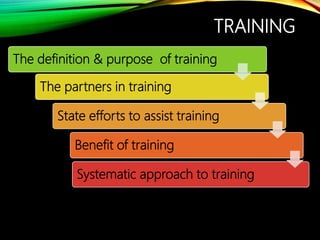
The definition & purpose of training
The partners in training
State efforts to assist training
Benefit of training
Systematic approach to training
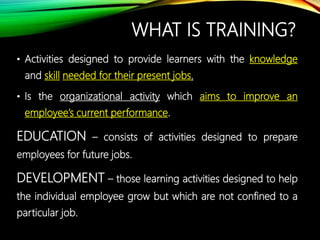
WHAT IS TRAINING?
• Activities designed to provide learners with the knowledge
and skill needed for their present jobs.
• Is the organizational activity which aims to improve an
employee’s current performance.
EDUCATION – consists of activities designed to prepare
employees for future jobs.
DEVELOPMENT – those learning activities designed to help
the individual employee grow but which are not confined to a
particular job.
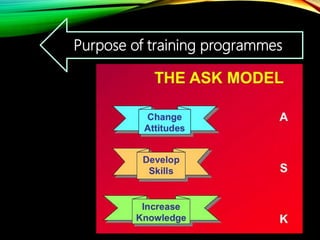
Purpose of training programmes
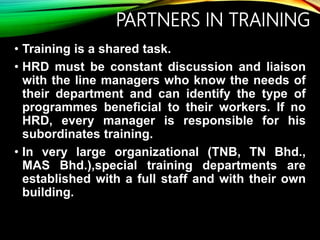
PARTNERS IN TRAINING
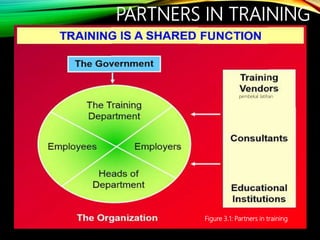
• Training is a shared task.
• HRD must be constant discussion and liaison
with the line managers who know the needs of
their department and can identify the type of
programmes beneficial to their workers. If no
HRD, every manager is responsible for his
subordinates training.
• In very large organizational (TNB, TN Bhd.,
MAS Bhd.),special training departments are
established with a full staff and with their own
building.
PARTNERS IN TRAINING
Figure 3.1: Partners in training
pembekal latihan
PARTNERS IN TRAINING
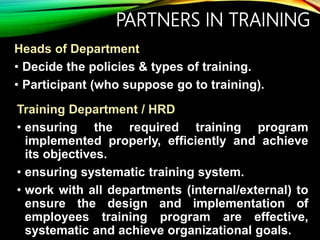
Heads of Department
• Decide the policies & types of training.
• Participant (who suppose go to training).
Training Department / HRD
• ensuring the required training program
implemented properly, efficiently and achieve
its objectives.
• ensuring systematic training system.
• work with all departments (internal/external) to
ensure the design and implementation of
employees training program are effective,
systematic and achieve organizational goals.
PARTNERS IN TRAINING
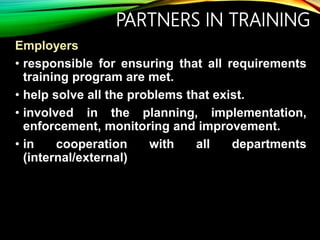
Employers
• responsible for ensuring that all requirements
training program are met.
• help solve all the problems that exist.
• involved in the planning, implementation,
enforcement, monitoring and improvement.
• in cooperation with all departments
(internal/external)
PARTNERS IN TRAINING
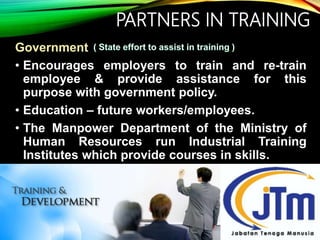
Government
• Encourages employers to train and re-train
employee & provide assistance for this
purpose with government policy.
• Education – future workers/employees.
• The Manpower Department of the Ministry of
Human Resources run Industrial Training
Institutes which provide courses in skills.
PARTNERS IN TRAINING
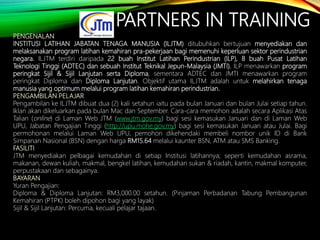
PENGENALAN
INSTITUSI LATIHAN JABATAN TENAGA MANUSIA (ILJTM) ditubuhkan bertujuan menyediakan dan
melaksanakan program latihan kemahiran pra-pekerjaan bagi memenuhi keperluan sektor perindustrian
negara. ILJTM terdiri daripada 22 buah Institut Latihan Perindustrian (ILP), 8 buah Pusat Latihan
Teknologi Tinggi (ADTEC) dan sebuah Institut Teknikal Jepun-Malaysia (JMTI). ILP menawarkan program
peringkat Sijil & Sijil Lanjutan serta Diploma, sementara ADTEC dan JMTI menawarkan program
peringkat Diploma dan Diploma Lanjutan. Objektif utama ILJTM adalah untuk melahirkan tenaga
manusia yang optimum melalui program latihan kemahiran perindustrian.
PENGAMBILAN PELAJAR
Pengambilan ke ILJTM dibuat dua (2) kali setahun iaitu pada bulan Januari dan bulan Julai setiap tahun.
Iklan akan dikeluarkan pada bulan Mac dan September. Cara-cara memohon adalah secara Aplikasi Atas
Talian (online) di Laman Web JTM (www.jtm.gov.my) bagi sesi kemasukan Januari dan di Laman Web
UPU, Jabatan Pengajian Tinggi (http://upu.mohe.gov.my) bagi sesi kemasukan Januari atau Julai. Bagi
permohonan melalui Laman Web UPU, pemohon dikehendaki membeli nombor unik ID di Bank
Simpanan Nasional (BSN) dengan harga RM15.64 melalui kaunter BSN, ATM atau SMS Banking.
FASILITI
JTM menyediakan pelbagai kemudahan di setiap Institusi latihannya; seperti kemudahan asrama,
makanan, dewan kuliah, makmal, bengkel latihan, kemudahan sukan & riadah, kantin, makmal komputer,
perpustakaan dan sebagainya.
BAYARAN
Yuran Pengajian:
Diploma & Diploma Lanjutan: RM3,000.00 setahun. (Pinjaman Perbadanan Tabung Pembangunan
Kemahiran (PTPK) boleh dipohon bagi yang layak)
Sijil & Sijil Lanjutan: Percuma, kecuali pelajar tajaan.
PARTNERS IN TRAINING
Government
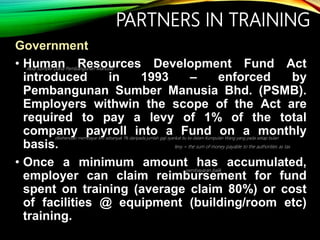
• Human Resources Development Fund Act
introduced in 1993 – enforced by
Pembangunan Sumber Manusia Bhd. (PSMB).
Employers withwin the scope of the Act are
required to pay a levy of 1% of the total
company payroll into a Fund on a monthly
basis.
• Once a minimum amount has accumulated,
employer can claim reimbursement for fund
spent on training (average claim 80%) or cost
of facilities @ equipment (building/room etc)
training.
Akta Sumber Dana Pembangunan Manusia
dikehendaki membayar levi sebanyak 1% daripada jumlah gaji syarikat itu ke dalam Kumpulan Wang yang pada setiap bulan
levy = the sum of money payable to the authorities as tax
pembayaran balik
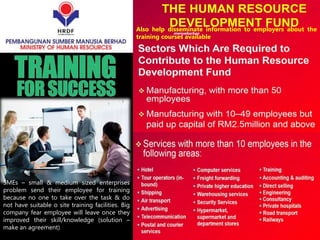
SMEs – small & medium sized enterprises
problem send their employee for training
because no one to take over the task & do
not have suitable o site training facilities. Big
company fear employee will leave once they
improved their skill/knowledge (solution –
make an agreement)
Also help disseminate information to employers about the
training courses available
menyebarkan
THE BENEFITS OF TRAINING
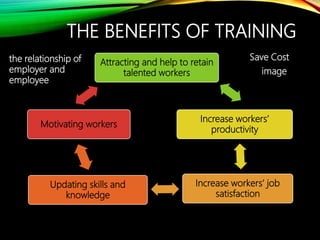
Attracting and help to retain
talented workers
Increase workers’
productivity
Increase workers’ job
satisfaction
Updating skills and
knowledge
Motivating workers
image
Save Costthe relationship of
employer and
employee
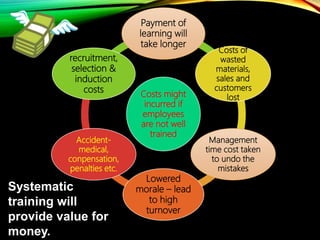
Costs might
incurred if
employees
are not well
trained
Payment of
learning will
take longer
Costs of
wasted
materials,
sales and
customers
lost
Management
time cost taken
to undo the
mistakes
Lowered
morale – lead
to high
turnover
Accident-
medical,
conpensation,
penalties etc.
recruitment,
selection &
induction
costs
Systematic
training will
provide value for
money.
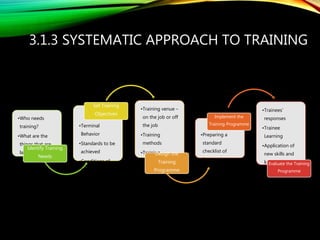
3.1.3 SYSTEMATIC APPROACH TO TRAINING
•Who needs
training?
•What are the
things that are
lack?
Identify Training
Needs
•Terminal
Behavior
•Standards to be
achieved
•Conditions of
performance
Set Training
Objectives
•Training venue –
on the job or off
the job
•Training
methods
•Training
facilitator
Design the
Training
Programme
•Preparing a
standard
checklist of
items
Implement the
Training Programme
•Trainees’
responses
•Trainee
Learning
•Application of
new skills and
knowledge
•Assessing the
results
Evaluate the Training
Programme
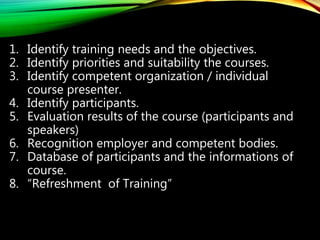
1. Identify training needs and the objectives.
2. Identify priorities and suitability the courses.
3. Identify competent organization / individual
course presenter.
4. Identify participants.
5. Evaluation results of the course (participants and
speakers)
6. Recognition employer and competent bodies.
7. Database of participants and the informations of
course.
8. “Refreshment of Training”
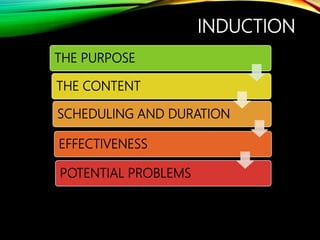
INDUCTION
THE PURPOSE
THE CONTENT
SCHEDULING AND DURATION
EFFECTIVENESS
POTENTIAL PROBLEMS
THE PURPOSE of INDUCTION
• It’s the process by which the new recruit is
familiarized with the working environment.
• The purpose of induction to make sure
new employee can adopted the
environment and reduce their anxious ,
fear, worries, nervous or unexpected
situation and other negatives
feeling/emotion. On the same time to
build up the positives emotion, thinking &
attitute.
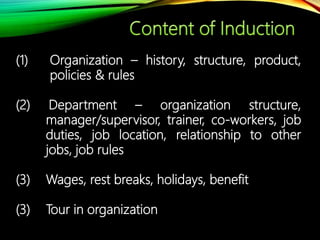
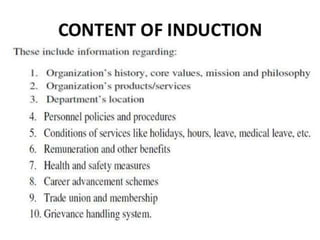
(1) Organization – history, structure, product,
policies & rules
(2) Department – organization structure,
manager/supervisor, trainer, co-workers, job
duties, job location, relationship to other
jobs, job rules
(3) Wages, rest breaks, holidays, benefit
(3) Tour in organization
ketidakpuasan hati
• Duration : not too long with related
information. Concentration in receive
information, affectively 1-1½ hours, so the
programme can split into certains
modules and offered / spread by session,
example : over two week period. Example
: HSBC provides a 30 month training
programme for management trainees.
1) overload / unrelated information
2) pack schedule
3) unattractive
4) unrelated group of employee
5) the programme not give a real
situation and scope of duties
(unexpection)
1) Maklumat yang berkaitan, tepat, jelas dan
sesuai (tak pack)
2) Tempoh masa yang sesuai
3) Pelbagai aktiviti
4) Dalam kumpulan yang sama
5) Pendedahan persekitaran yang positif
6) Memberi gambaran sebenar organisasi dari
aspek peraturan, proses kerja dan sebagainya.
7) Program yang dapat meningkatkan keyakinan
diri pekerja baru
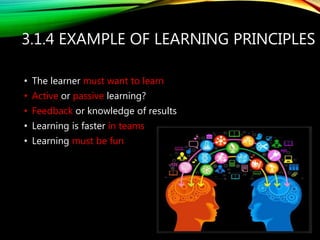
3.1.4 EXAMPLE OF LEARNING PRINCIPLES
• The learner must want to learn
• Active or passive learning?
• Feedback or knowledge of results
• Learning is faster in teams
• Learning must be fun
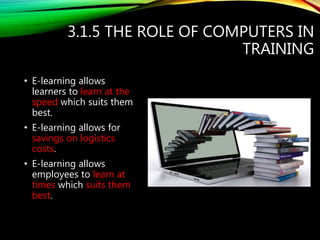
3.1.5 THE ROLE OF COMPUTERS IN
TRAINING
• E-learning allows
learners to learn at the
speed which suits them
best.
• E-learning allows for
savings on logistics
costs.
• E-learning allows
employees to learn at
times which suits them
best.
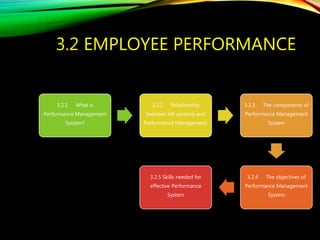
3.2 EMPLOYEE PERFORMANCE
3.2.1 What is
Performance Management
System?
3.2.2 Relationship
between HR systems and
Performance Management.
3.2.3 The components of
Performance Management
System
3.2.4 The objectives of
Performance Management
System
3.2.5 Skills needed for
effective Performance
System
3.2.1 WHAT IS PERFORMANCE
MANAGEMENT SYSTEM?
An employee performance
management system consisting of
all organizational processes that
determine how well employees,
teams, and ultimately, the
organization perform.
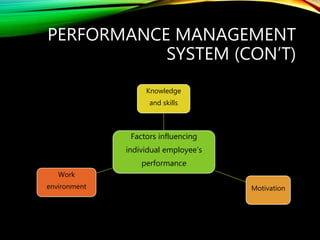
PERFORMANCE MANAGEMENT
SYSTEM (CON’T)
Factors influencing
individual employee’s
performance
Knowledge
and skills
Motivation
Work
environment
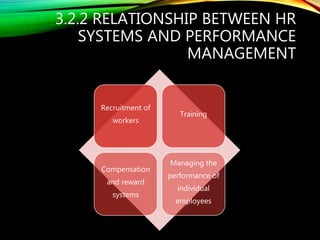
3.2.2 RELATIONSHIP BETWEEN HR
SYSTEMS AND PERFORMANCE
MANAGEMENT
Recruitment of
workers
Training
Compensation
and reward
systems
Managing the
performance of
individual
employees
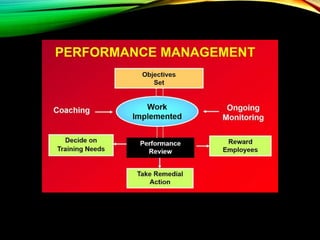
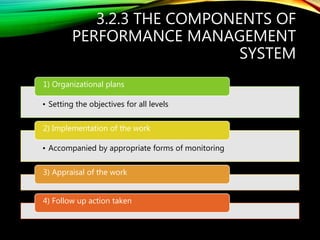
3.2.3 THE COMPONENTS OF
PERFORMANCE MANAGEMENT
SYSTEM
• Setting the objectives for all levels
1) Organizational plans
• Accompanied by appropriate forms of monitoring
2) Implementation of the work
3) Appraisal of the work
4) Follow up action taken
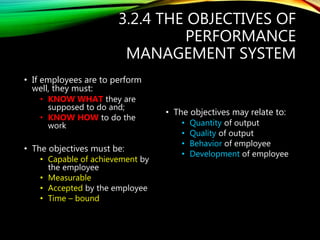
3.2.4 THE OBJECTIVES OF
PERFORMANCE
MANAGEMENT SYSTEM
• If employees are to perform
well, they must:
• KNOW WHAT they are
supposed to do and;
• KNOW HOW to do the
work
• The objectives must be:
• Capable of achievement by
the employee
• Measurable
• Accepted by the employee
• Time – bound
• The objectives may relate to:
• Quantity of output
• Quality of output
• Behavior of employee
• Development of employee
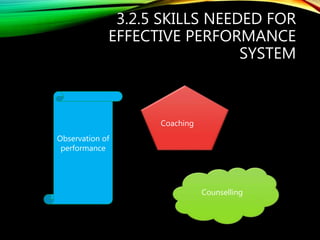
3.2.5 SKILLS NEEDED FOR
EFFECTIVE PERFORMANCE
SYSTEM
Coaching
Observation of
performance
Counselling
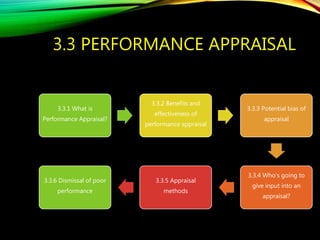
3.3 PERFORMANCE APPRAISAL
3.3.1 What is
Performance Appraisal?
3.3.2 Benefits and
effectiveness of
performance appraisal
3.3.3 Potential bias of
appraisal
3.3.4 Who’s going to
give input into an
appraisal?
3.3.5 Appraisal
methods
3.3.6 Dismissal of poor
performance
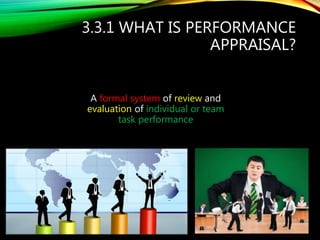
3.3.1 WHAT IS PERFORMANCE
APPRAISAL?
A formal system of review and
evaluation of individual or team
task performance
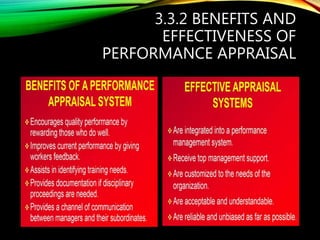
3.3.2 BENEFITS AND
EFFECTIVENESS OF
PERFORMANCE APPRAISAL
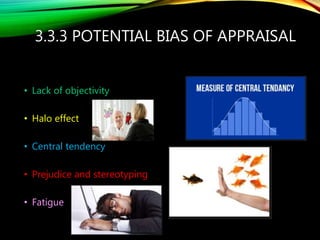
3.3.3 POTENTIAL BIAS OF APPRAISAL
• Lack of objectivity
• Halo effect
• Central tendency
• Prejudice and stereotyping
• Fatigue
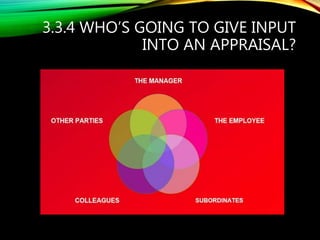
3.3.4 WHO’S GOING TO GIVE INPUT
INTO AN APPRAISAL?
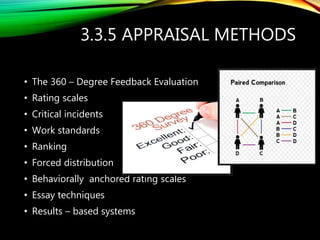
3.3.5 APPRAISAL METHODS
• The 360 – Degree Feedback Evaluation
• Rating scales
• Critical incidents
• Work standards
• Ranking
• Forced distribution
• Behaviorally anchored rating scales
• Essay techniques
• Results – based systems
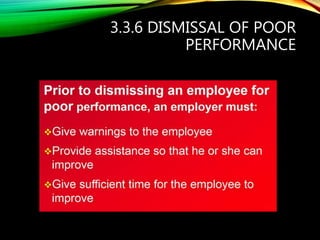
3.3.6 DISMISSAL OF POOR
PERFORMANCE
THE END
Q & A SESSION
RECAPITULATE
1. What is training?
2. Define ASK Model.
3. What are the benefits of training?
4. What are the steps that exist in training process?
5. Define performance appraisal and identify the uses of
performance appraisal.
6. Identify the various performance appraisal methods used.
7. What are the various problems associated with
performance appraisal?
8. What are the characteristics of an effective appraisal
system?

Human Resources Management

  • 1.
  • 2.
    TRAINING The definition &purpose of training The partners in training State efforts to assist training Benefit of training Systematic approach to training
  • 3.
    WHAT IS TRAINING? •Activities designed to provide learners with the knowledge and skill needed for their present jobs. • Is the organizational activity which aims to improve an employee’s current performance. EDUCATION – consists of activities designed to prepare employees for future jobs. DEVELOPMENT – those learning activities designed to help the individual employee grow but which are not confined to a particular job.
  • 4.
  • 5.
    PARTNERS IN TRAINING •Training is a shared task. • HRD must be constant discussion and liaison with the line managers who know the needs of their department and can identify the type of programmes beneficial to their workers. If no HRD, every manager is responsible for his subordinates training. • In very large organizational (TNB, TN Bhd., MAS Bhd.),special training departments are established with a full staff and with their own building.
  • 6.
    PARTNERS IN TRAINING Figure3.1: Partners in training pembekal latihan
  • 7.
    PARTNERS IN TRAINING Headsof Department • Decide the policies & types of training. • Participant (who suppose go to training). Training Department / HRD • ensuring the required training program implemented properly, efficiently and achieve its objectives. • ensuring systematic training system. • work with all departments (internal/external) to ensure the design and implementation of employees training program are effective, systematic and achieve organizational goals.
  • 8.
    PARTNERS IN TRAINING Employers •responsible for ensuring that all requirements training program are met. • help solve all the problems that exist. • involved in the planning, implementation, enforcement, monitoring and improvement. • in cooperation with all departments (internal/external)
  • 9.
    PARTNERS IN TRAINING Government •Encourages employers to train and re-train employee & provide assistance for this purpose with government policy. • Education – future workers/employees. • The Manpower Department of the Ministry of Human Resources run Industrial Training Institutes which provide courses in skills.
  • 10.
    PARTNERS IN TRAINING PENGENALAN INSTITUSILATIHAN JABATAN TENAGA MANUSIA (ILJTM) ditubuhkan bertujuan menyediakan dan melaksanakan program latihan kemahiran pra-pekerjaan bagi memenuhi keperluan sektor perindustrian negara. ILJTM terdiri daripada 22 buah Institut Latihan Perindustrian (ILP), 8 buah Pusat Latihan Teknologi Tinggi (ADTEC) dan sebuah Institut Teknikal Jepun-Malaysia (JMTI). ILP menawarkan program peringkat Sijil & Sijil Lanjutan serta Diploma, sementara ADTEC dan JMTI menawarkan program peringkat Diploma dan Diploma Lanjutan. Objektif utama ILJTM adalah untuk melahirkan tenaga manusia yang optimum melalui program latihan kemahiran perindustrian. PENGAMBILAN PELAJAR Pengambilan ke ILJTM dibuat dua (2) kali setahun iaitu pada bulan Januari dan bulan Julai setiap tahun. Iklan akan dikeluarkan pada bulan Mac dan September. Cara-cara memohon adalah secara Aplikasi Atas Talian (online) di Laman Web JTM (www.jtm.gov.my) bagi sesi kemasukan Januari dan di Laman Web UPU, Jabatan Pengajian Tinggi (http://upu.mohe.gov.my) bagi sesi kemasukan Januari atau Julai. Bagi permohonan melalui Laman Web UPU, pemohon dikehendaki membeli nombor unik ID di Bank Simpanan Nasional (BSN) dengan harga RM15.64 melalui kaunter BSN, ATM atau SMS Banking. FASILITI JTM menyediakan pelbagai kemudahan di setiap Institusi latihannya; seperti kemudahan asrama, makanan, dewan kuliah, makmal, bengkel latihan, kemudahan sukan & riadah, kantin, makmal komputer, perpustakaan dan sebagainya. BAYARAN Yuran Pengajian: Diploma & Diploma Lanjutan: RM3,000.00 setahun. (Pinjaman Perbadanan Tabung Pembangunan Kemahiran (PTPK) boleh dipohon bagi yang layak) Sijil & Sijil Lanjutan: Percuma, kecuali pelajar tajaan.
  • 11.
    PARTNERS IN TRAINING Government •Human Resources Development Fund Act introduced in 1993 – enforced by Pembangunan Sumber Manusia Bhd. (PSMB). Employers withwin the scope of the Act are required to pay a levy of 1% of the total company payroll into a Fund on a monthly basis. • Once a minimum amount has accumulated, employer can claim reimbursement for fund spent on training (average claim 80%) or cost of facilities @ equipment (building/room etc) training. Akta Sumber Dana Pembangunan Manusia dikehendaki membayar levi sebanyak 1% daripada jumlah gaji syarikat itu ke dalam Kumpulan Wang yang pada setiap bulan levy = the sum of money payable to the authorities as tax pembayaran balik
  • 12.
    SMEs – small& medium sized enterprises problem send their employee for training because no one to take over the task & do not have suitable o site training facilities. Big company fear employee will leave once they improved their skill/knowledge (solution – make an agreement) Also help disseminate information to employers about the training courses available menyebarkan
  • 13.
    THE BENEFITS OFTRAINING Attracting and help to retain talented workers Increase workers’ productivity Increase workers’ job satisfaction Updating skills and knowledge Motivating workers image Save Costthe relationship of employer and employee
  • 14.
    Costs might incurred if employees arenot well trained Payment of learning will take longer Costs of wasted materials, sales and customers lost Management time cost taken to undo the mistakes Lowered morale – lead to high turnover Accident- medical, conpensation, penalties etc. recruitment, selection & induction costs Systematic training will provide value for money.
  • 15.
    3.1.3 SYSTEMATIC APPROACHTO TRAINING •Who needs training? •What are the things that are lack? Identify Training Needs •Terminal Behavior •Standards to be achieved •Conditions of performance Set Training Objectives •Training venue – on the job or off the job •Training methods •Training facilitator Design the Training Programme •Preparing a standard checklist of items Implement the Training Programme •Trainees’ responses •Trainee Learning •Application of new skills and knowledge •Assessing the results Evaluate the Training Programme
  • 16.
    1. Identify trainingneeds and the objectives. 2. Identify priorities and suitability the courses. 3. Identify competent organization / individual course presenter. 4. Identify participants. 5. Evaluation results of the course (participants and speakers) 6. Recognition employer and competent bodies. 7. Database of participants and the informations of course. 8. “Refreshment of Training”
  • 17.
    INDUCTION THE PURPOSE THE CONTENT SCHEDULINGAND DURATION EFFECTIVENESS POTENTIAL PROBLEMS
  • 19.
    THE PURPOSE ofINDUCTION
  • 20.
    • It’s theprocess by which the new recruit is familiarized with the working environment. • The purpose of induction to make sure new employee can adopted the environment and reduce their anxious , fear, worries, nervous or unexpected situation and other negatives feeling/emotion. On the same time to build up the positives emotion, thinking & attitute.
  • 21.
    (1) Organization –history, structure, product, policies & rules (2) Department – organization structure, manager/supervisor, trainer, co-workers, job duties, job location, relationship to other jobs, job rules (3) Wages, rest breaks, holidays, benefit (3) Tour in organization
  • 22.
  • 23.
    • Duration :not too long with related information. Concentration in receive information, affectively 1-1½ hours, so the programme can split into certains modules and offered / spread by session, example : over two week period. Example : HSBC provides a 30 month training programme for management trainees.
  • 24.
    1) overload /unrelated information 2) pack schedule 3) unattractive 4) unrelated group of employee 5) the programme not give a real situation and scope of duties (unexpection)
  • 25.
    1) Maklumat yangberkaitan, tepat, jelas dan sesuai (tak pack) 2) Tempoh masa yang sesuai 3) Pelbagai aktiviti 4) Dalam kumpulan yang sama 5) Pendedahan persekitaran yang positif 6) Memberi gambaran sebenar organisasi dari aspek peraturan, proses kerja dan sebagainya. 7) Program yang dapat meningkatkan keyakinan diri pekerja baru
  • 29.
    3.1.4 EXAMPLE OFLEARNING PRINCIPLES • The learner must want to learn • Active or passive learning? • Feedback or knowledge of results • Learning is faster in teams • Learning must be fun
  • 30.
    3.1.5 THE ROLEOF COMPUTERS IN TRAINING • E-learning allows learners to learn at the speed which suits them best. • E-learning allows for savings on logistics costs. • E-learning allows employees to learn at times which suits them best.
  • 31.
    3.2 EMPLOYEE PERFORMANCE 3.2.1What is Performance Management System? 3.2.2 Relationship between HR systems and Performance Management. 3.2.3 The components of Performance Management System 3.2.4 The objectives of Performance Management System 3.2.5 Skills needed for effective Performance System
  • 32.
    3.2.1 WHAT ISPERFORMANCE MANAGEMENT SYSTEM? An employee performance management system consisting of all organizational processes that determine how well employees, teams, and ultimately, the organization perform.
  • 34.
    PERFORMANCE MANAGEMENT SYSTEM (CON’T) Factorsinfluencing individual employee’s performance Knowledge and skills Motivation Work environment
  • 35.
    3.2.2 RELATIONSHIP BETWEENHR SYSTEMS AND PERFORMANCE MANAGEMENT Recruitment of workers Training Compensation and reward systems Managing the performance of individual employees
  • 36.
    3.2.3 THE COMPONENTSOF PERFORMANCE MANAGEMENT SYSTEM • Setting the objectives for all levels 1) Organizational plans • Accompanied by appropriate forms of monitoring 2) Implementation of the work 3) Appraisal of the work 4) Follow up action taken
  • 37.
    3.2.4 THE OBJECTIVESOF PERFORMANCE MANAGEMENT SYSTEM • If employees are to perform well, they must: • KNOW WHAT they are supposed to do and; • KNOW HOW to do the work • The objectives must be: • Capable of achievement by the employee • Measurable • Accepted by the employee • Time – bound • The objectives may relate to: • Quantity of output • Quality of output • Behavior of employee • Development of employee
  • 38.
    3.2.5 SKILLS NEEDEDFOR EFFECTIVE PERFORMANCE SYSTEM Coaching Observation of performance Counselling
  • 39.
    3.3 PERFORMANCE APPRAISAL 3.3.1What is Performance Appraisal? 3.3.2 Benefits and effectiveness of performance appraisal 3.3.3 Potential bias of appraisal 3.3.4 Who’s going to give input into an appraisal? 3.3.5 Appraisal methods 3.3.6 Dismissal of poor performance
  • 40.
    3.3.1 WHAT ISPERFORMANCE APPRAISAL? A formal system of review and evaluation of individual or team task performance
  • 41.
    3.3.2 BENEFITS AND EFFECTIVENESSOF PERFORMANCE APPRAISAL
  • 42.
    3.3.3 POTENTIAL BIASOF APPRAISAL • Lack of objectivity • Halo effect • Central tendency • Prejudice and stereotyping • Fatigue
  • 43.
    3.3.4 WHO’S GOINGTO GIVE INPUT INTO AN APPRAISAL?
  • 44.
    3.3.5 APPRAISAL METHODS •The 360 – Degree Feedback Evaluation • Rating scales • Critical incidents • Work standards • Ranking • Forced distribution • Behaviorally anchored rating scales • Essay techniques • Results – based systems
  • 46.
    3.3.6 DISMISSAL OFPOOR PERFORMANCE
  • 47.
    THE END Q &A SESSION
  • 48.
    RECAPITULATE 1. What istraining? 2. Define ASK Model. 3. What are the benefits of training? 4. What are the steps that exist in training process? 5. Define performance appraisal and identify the uses of performance appraisal. 6. Identify the various performance appraisal methods used. 7. What are the various problems associated with performance appraisal? 8. What are the characteristics of an effective appraisal system?