HUMAN CAPITAL
FORMATION
 How people become resource
 Role of human capital in economic development
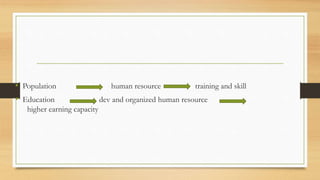
• Population human resource training and skill
• Education dev and organized human resource
higher earning capacity
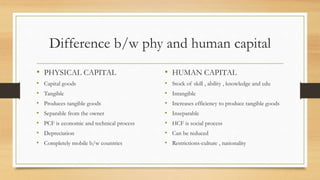
Difference b/w phy and human capital
• PHYSICAL CAPITAL
• Capital goods
• Tangible
• Produces tangible goods
• Separable from the owner
• PCF is economic and technical process
• Depreciation
• Completely mobile b/w countries
• HUMAN CAPITAL
• Stock of skill , ability , knowledge and edu
• Intangible
• Increases efficiency to produce tangible goods
• Inseparable
• HCF is social process
• Can be reduced
• Restrictions-culture , nationality
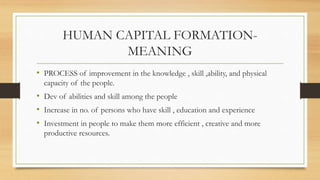
HUMAN CAPITAL FORMATION-
MEANING
• PROCESS of improvement in the knowledge , skill ,ability, and physical
capacity of the people.
• Dev of abilities and skill among the people
• Increase in no. of persons who have skill , education and experience
• Investment in people to make them more efficient , creative and more
productive resources.
SOURCES OF HCF
Expenditure on education
Expenditure on health
On – the- job training
Expenditure on migration
Expenditure on acquiring information
EXP ON EDUCATION
o Process of teaching ,training ,learning,in schools,colleges, to improve the knowledge and develop
skills.
o Imp source because----
 Generates tech skills, create manpower which improve labour productivity,result in eco dev
 Decline pop growth rate
 More resources available per person
 Social benefit
• Investment in education increase future income and improve living standard.
ROLE OF EDUCATION
o Improve learning capacity and ability to understand
o Analyse changes taking place in socio-economic environment
o Encourages research and innovations
o Modern outlook and rational behavior
o Enables one to make right choices in various aspects of life
EXPENDITURE ON HEALTH
o Sick labour abstain from work low productivity
o Health exp supply of healthy labour force high productivity
o TYPES: 1. preventive medicine: vaccination
2. curative medicine : medical interventions during illness
3. social medicine : spread of health literacy
4. provision of clean drinking water
5. good sanitation facilities
EXP ON ON –THE –JOB TRAINING
Learning while doing the work knowledge of actual work process
Becomes expert in the work greater efficiency and higher productivt
 need –new technologies
Advantage : fast , less costly , increase productivity
Firm do exp
Return of such exp in the form of enhanced labour productivity is more
than the cost of it.
EXPENDITURE ON MIGRATION
• Better earning opportunities
• Enables to make better use of skill, kn , expertise
• Improves productivity and efficiency
• Larger output and income
EXPENDITURE ON MIGRATION
• People migrate in search of jobs
• Rural –urban migration due to unemployment
• Migration to other countries
• Migration involves cost of transport,living cost , psychic cost of living in a
strange socio- cultural set-up.
• Enhanced earnings in the new place outweigh the costs of migration.
EXP ON ACQUIRING INFORMATION
People spend to acquire information relating to the labour mkt
People seek info regarding salaries and other facilities available in diff labour
mkts.
Also wants to know edu institutions , health
ASSESSMENT
• Determine whether the capital listed is an example of PHYSICAL CAPITAL (P) or HUMAN CAPITAL
(H)?
1. Doctor
2. Bus
3. Factory
4. Teacher
5. Driver
6. School building
7. Manager
8. Train
ASSESSMENT
• FILL-IN
…………….capital benefits not only the owner but also the society in general.
• TRUE/ FALSE
Human capital is perfectly mobile between countries.
• MCQ
We need investment in human capital to produce :
a) More physical capital out of human resource
b) More human capital out of physical resources
c) More human capital out of physical capital
d) More human capital out of human resources.

HCF.pptx

  • 1.
    HUMAN CAPITAL FORMATION  Howpeople become resource  Role of human capital in economic development
  • 2.
    • Population humanresource training and skill • Education dev and organized human resource higher earning capacity
  • 3.
    Difference b/w phyand human capital • PHYSICAL CAPITAL • Capital goods • Tangible • Produces tangible goods • Separable from the owner • PCF is economic and technical process • Depreciation • Completely mobile b/w countries • HUMAN CAPITAL • Stock of skill , ability , knowledge and edu • Intangible • Increases efficiency to produce tangible goods • Inseparable • HCF is social process • Can be reduced • Restrictions-culture , nationality
  • 4.
    HUMAN CAPITAL FORMATION- MEANING •PROCESS of improvement in the knowledge , skill ,ability, and physical capacity of the people. • Dev of abilities and skill among the people • Increase in no. of persons who have skill , education and experience • Investment in people to make them more efficient , creative and more productive resources.
  • 5.
    SOURCES OF HCF Expenditureon education Expenditure on health On – the- job training Expenditure on migration Expenditure on acquiring information
  • 6.
    EXP ON EDUCATION oProcess of teaching ,training ,learning,in schools,colleges, to improve the knowledge and develop skills. o Imp source because----  Generates tech skills, create manpower which improve labour productivity,result in eco dev  Decline pop growth rate  More resources available per person  Social benefit • Investment in education increase future income and improve living standard.
  • 7.
    ROLE OF EDUCATION oImprove learning capacity and ability to understand o Analyse changes taking place in socio-economic environment o Encourages research and innovations o Modern outlook and rational behavior o Enables one to make right choices in various aspects of life
  • 8.
    EXPENDITURE ON HEALTH oSick labour abstain from work low productivity o Health exp supply of healthy labour force high productivity o TYPES: 1. preventive medicine: vaccination 2. curative medicine : medical interventions during illness 3. social medicine : spread of health literacy 4. provision of clean drinking water 5. good sanitation facilities
  • 9.
    EXP ON ON–THE –JOB TRAINING Learning while doing the work knowledge of actual work process Becomes expert in the work greater efficiency and higher productivt  need –new technologies Advantage : fast , less costly , increase productivity Firm do exp Return of such exp in the form of enhanced labour productivity is more than the cost of it.
  • 10.
    EXPENDITURE ON MIGRATION •Better earning opportunities • Enables to make better use of skill, kn , expertise • Improves productivity and efficiency • Larger output and income
  • 11.
    EXPENDITURE ON MIGRATION •People migrate in search of jobs • Rural –urban migration due to unemployment • Migration to other countries • Migration involves cost of transport,living cost , psychic cost of living in a strange socio- cultural set-up. • Enhanced earnings in the new place outweigh the costs of migration.
  • 12.
    EXP ON ACQUIRINGINFORMATION People spend to acquire information relating to the labour mkt People seek info regarding salaries and other facilities available in diff labour mkts. Also wants to know edu institutions , health
  • 13.
    ASSESSMENT • Determine whetherthe capital listed is an example of PHYSICAL CAPITAL (P) or HUMAN CAPITAL (H)? 1. Doctor 2. Bus 3. Factory 4. Teacher 5. Driver 6. School building 7. Manager 8. Train
  • 14.
    ASSESSMENT • FILL-IN …………….capital benefitsnot only the owner but also the society in general. • TRUE/ FALSE Human capital is perfectly mobile between countries. • MCQ We need investment in human capital to produce : a) More physical capital out of human resource b) More human capital out of physical resources c) More human capital out of physical capital d) More human capital out of human resources.