DESIGNING	MECHATRONIC	SYSTEMS	FOR	REHABILITATION		
FINAL	PROJECT	
PARIS,	FRANCE,	JANUARY	11TH,	2018	
Human Balance
LUÍS RITA
3702256, luis.domingues_rita@etu.upmc.fr
H
U
M
A
N
O
I
D
R
O
B
O
T
S
A
G
E
I
N
G
B
A
L
A
N
C
E
B
I
P
E
D
R
O
B
O
T
S
D
E
A
T
H
F
A
L
L
S
V
I
S
I
O
N
V
E
S
T
I
B
U
L
A
R
S
Y
S
T
E
M
S
O
M
A
T
O
S
E
N
S
O
R
Y
S
Y
S
T
E
M
Z
E
R
O
M
O
M
E
N
T
P
O
I
N
T
C
E
N
T
E
R
O
F
P
R
E
S
S
U
R
E
F
I
C
T
I
O
U
S
Z
M
P
DESIGNING	MECHATRONIC	SYSTEMS	FOR	REHABILITATION	
	 2	
Introduction
With the progressively ageing of the population, the proportion of elders is
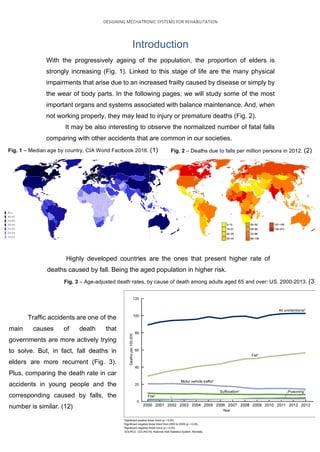
strongly increasing (Fig. 1). Linked to this stage of life are the many physical
impairments that arise due to an increased frailty caused by disease or simply by
the wear of body parts. In the following pages, we will study some of the most
important organs and systems associated with balance maintenance. And, when
not working properly, they may lead to injury or premature deaths (Fig. 2).
It may be also interesting to observe the normalized number of fatal falls
comparing with other accidents that are common in our societies.
Highly developed countries are the ones that present higher rate of
deaths caused by fall. Being the aged population in higher risk.
Fig. 3 – Age-adjusted death rates, by cause of death among adults aged 65 and over: US, 2000-2013. (3)
Fig. 1 – Median age by country, CIA World Factbook 2016. (1)
Traffic accidents are one of the
main causes of death that
governments are more actively trying
to solve. But, in fact, fall deaths in
elders are more recurrent (Fig. 3).
Plus, comparing the death rate in car
accidents in young people and the
corresponding caused by falls, the
number is similar. (12)
Fig. 2 – Deaths due to falls per million persons in 2012. (2)
DESIGNING	MECHATRONIC	SYSTEMS	FOR	REHABILITATION	
	 3	
Anatomy
In the human body, the main responsible for balance control are: vision,
vestibular system and somatosensory system. (4)
Vision (5)
In the most posterior part of the eye, there is
a structure called retina, which contains rods
and cones responsible for converting
luminous signals into electric impulses, later
transmitted through the optic nerve to the
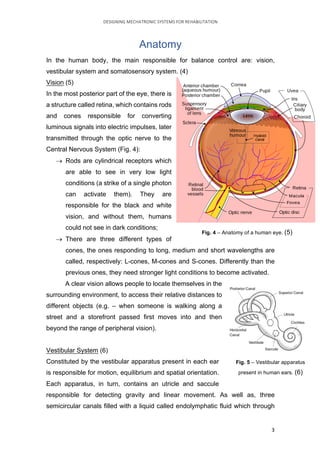
Central Nervous System (Fig. 4):
® Rods are cylindrical receptors which
are able to see in very low light
conditions (a strike of a single photon
can activate them). They are
responsible for the black and white
vision, and without them, humans
could not see in dark conditions;
® There are three different types of
cones, the ones responding to long, medium and short wavelengths are
called, respectively: L-cones, M-cones and S-cones. Differently than the
previous ones, they need stronger light conditions to become activated.
A clear vision allows people to locate themselves in the
surrounding environment, to access their relative distances to
different objects (e.g. – when someone is walking along a
street and a storefront passed first moves into and then
beyond the range of peripheral vision).
Vestibular System (6)
Constituted by the vestibular apparatus present in each ear
is responsible for motion, equilibrium and spatial orientation.
Each apparatus, in turn, contains an utricle and saccule
responsible for detecting gravity and linear movement. As well as, three
semicircular canals filled with a liquid called endolymphatic fluid which through
Fig. 4 – Anatomy of a human eye. (5)
Fig. 5 – Vestibular apparatus
present in human ears. (6)
DESIGNING	MECHATRONIC	SYSTEMS	FOR	REHABILITATION	
	 4	
lagging mechanism caused by inertia, (induced by the rotational movements)
exerts a pressure on the sensors present in the canal, leading to a sequence of
impulses sent to the brain. Depending on the source of these electrical signals, it
will capture the type of movement in their genesis. A scheme of these structure
is depicted in Fig. 5.
Unbalanced situations arise when contradictory information is sent by
different vestibular apparatus present in each ear.
Somatosensory System (7)
Proprioceptive and exteroceptive information from skin, muscles and joints
involves the detection of stretch or pressure signals through sensory receptors
present in these locations.
An intuitive example is during tiptoeing gate, when the body is able to feel
the increased pressure on the fingers comparing to the plantar surface, and
realize its position regardless of using its visual capabilities. Or during a walk in
a stable/unstable surface, the gate is well adapted by the brain to the referred
situation.
DESIGNING	MECHATRONIC	SYSTEMS	FOR	REHABILITATION	
	 5	
Zero Moment Point
Zero Moment Point or ZMP is a concept that was introduced for the 1st
time in
January 1968 by Miomir Vukobratović at The Third All-Union Congress of
Theoretical and Applied Mechanics in Moscow. Although, it was only properly
named in the papers that arose between the years of 1970 and 1972. Becoming
a worldwide phenomenon by that time. (8)
Since many decades ago, humanoid (biped) robots are part of a field that
many interest has been causing among the scientific community. Issues related
to gait planning and control have contributed to an increased attention of ZMP.
The importance of this concept is that it allows researchers to objectively say in
which circumstances the robot will be find in a state of dynamic equilibrium or not.
(9)
Human gait is a complex process. Although, it is not the point here to
thoroughly characterize it, it is well worth it to remember that 2 distinct phases
are present: stance and swing. Due to this fact, it would be very complicated to
replicate every detail. Thus, researchers have been focusing in several points:
(9)
® Possibility of rotation of the body (caused by strong disturbances) around
the edges of one foot;
® Gait repeatability which is inseparable of a normal gait feature;
® Interchangeability between 1-foot/2-feet support.
Although, before explaining the concepts linked to this recent approach of
biped robot movement, it is essential to understand the limitations and methods
used in the past. After, other than specifically characterize what is the ZMP, it will
be clarified how to locate it. An extension of the last concept will be derived -
FZMP. A clear distinction between CoP (Centre of Pressure) and ZMP will be
also provided. All of this, focusing in a walking gate where forces are being
applied in the foot which completely rests in the floor.
Static Stability: Centre of Gravity (CoG) (10)
The gate of the 1st
biped robots was based exclusively in the concept of
CoG. Thus, the goal was to assure that the projection of this point in the ground
DESIGNING	MECHATRONIC	SYSTEMS	FOR	REHABILITATION	
	 6	
was always inside the support polygon. This immediately neglects a human-like
gate and the dynamics of the body. Meaning that when the previous criteria is not
satisfied, the robot will inevitably fall. Another consequence of this approach is
the impossibility of fast movements.
Dynamic Stability: ZMP Notion (9)
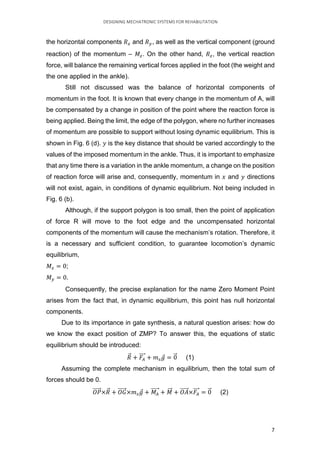
Starting by identifying all the forces being applied in the foot
(considering a single-support phase and, remember, the
whole foot in contact with the ground): the weight of the foot
(𝑚" 𝑔); force applied by the upper part of the body in the
ankle/point A (𝐹%) and the reaction force of the ground (𝑅 →
(𝑅), 𝑅+, 𝑅,)). Plus, the momentum in the joint A (𝑀%) and the one produced by the
ground (𝑀 → (𝑀), 𝑀+, 𝑀,)) are also present.
Keeping in mind the foot is at rest in the floor and that the friction force acts
at the point of contact between
the horizontal plane and the
foot, the horizontal
components of 𝑅 and 𝑀 acting
on the horizontal plane are
balanced by friction.
In the case of horizontal
forces 𝑅) and 𝑅+, generated
by friction, they will cancel the
respective components of 𝐹%.
The corresponding vertical
momentum (𝑀,) generated by
the 2 ground reaction
components will cancel out the
vertical 𝑀% and the one
induced by 𝐹%. Finally, if we
consider a non-sliding
environment, the static
friction will compensate for
ZMP Definition
Point that results from the
intersection of an axis of constant
vertical momentum with the
plane of the support polygon.
Fig. 6 – Humanoid (biped) robot with the representation of forces and
momenta being applied on it. (8)
DESIGNING	MECHATRONIC	SYSTEMS	FOR	REHABILITATION	
	 7	
the horizontal components 𝑅) and 𝑅+, as well as the vertical component (ground
reaction) of the momentum – 𝑀,. On the other hand, 𝑅,, the vertical reaction
force, will balance the remaining vertical forces applied in the foot (the weight and
the one applied in the ankle).
Still not discussed was the balance of horizontal components of
momentum in the foot. It is known that every change in the momentum of A, will
be compensated by a change in position of the point where the reaction force is
being applied. Being the limit, the edge of the polygon, where no further increases
of momentum are possible to support without losing dynamic equilibrium. This is
shown in Fig. 6 (d). 𝑦 is the key distance that should be varied accordingly to the
values of the imposed momentum in the ankle. Thus, it is important to emphasize
that any time there is a variation in the ankle momentum, a change on the position
of reaction force will arise and, consequently, momentum in 𝑥 and 𝑦 directions
will not exist, again, in conditions of dynamic equilibrium. Not being included in
Fig. 6 (b).
Although, if the support polygon is too small, then the point of application
of force R will move to the foot edge and the uncompensated horizontal
components of the momentum will cause the mechanism’s rotation. Therefore, it
is a necessary and sufficient condition, to guarantee locomotion’s dynamic
equilibrium,
𝑀) = 0;
𝑀+ = 0.
Consequently, the precise explanation for the name Zero Moment Point
arises from the fact that, in dynamic equilibrium, this point has null horizontal
components.
Due to its importance in gate synthesis, a natural question arises: how do
we know the exact position of ZMP? To answer this, the equations of static
equilibrium should be introduced:
𝑅 + 𝐹% + 𝑚" 𝑔 = 0 (1)
Assuming the complete mechanism in equilibrium, then the total sum of
forces should be 0.
𝑂𝑃×𝑅 + 𝑂𝐺×𝑚" 𝑔 + 𝑀% + 𝑀 + 𝑂𝐴×𝐹% = 0 (2)
DESIGNING	MECHATRONIC	SYSTEMS	FOR	REHABILITATION	
	 8	
Where 𝑂𝑃, 𝑂𝐺 and 𝑂𝐴 are the vectors from the origin of the referential O to
the ground reaction force point (P), center of gravity (G) or ankle joint (A),
respectively.
Highlighting the fact that the definition of ZMP does not suppose that
total moment in point P to be 0. In fact, by projecting equation (2) in z-plane, 𝑀,
is given by:
𝑀, = 𝑀9: = −(𝑀%
,
+ (𝑂𝐴×𝐹%),
)
And by projecting equation (2) in the horizontal plane, the location of ZMP
is found using the following relation:
(𝑂𝑃×𝑅)<
+ 𝑂𝐺×𝑚" 𝑔 + 𝑀%
<
+ (𝑂𝐴×𝐹%)<
= 0
All the previous analysis was done supposing a single support situation, but
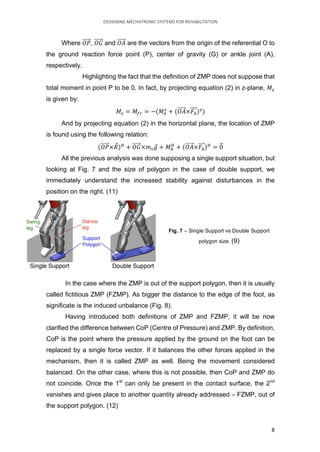
looking at Fig. 7 and the size of polygon in the case of double support, we
immediately understand the increased stability against disturbances in the
position on the right. (11)
In the case where the ZMP is out of the support polygon, then it is usually
called fictitious ZMP (FZMP). As bigger the distance to the edge of the foot, as
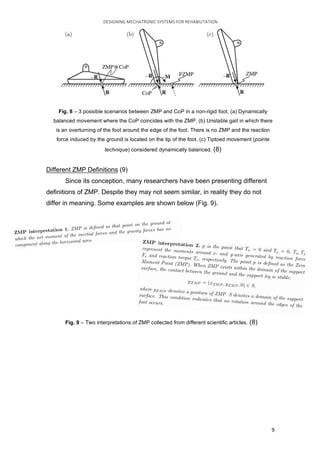
significate is the induced unbalance (Fig. 8).
Having introduced both definitions of ZMP and FZMP, it will be now
clarified the difference between CoP (Centre of Pressure) and ZMP. By definition,
CoP is the point where the pressure applied by the ground on the foot can be
replaced by a single force vector. If it balances the other forces applied in the
mechanism, then it is called ZMP as well. Being the movement considered
balanced. On the other case, where this is not possible, then CoP and ZMP do
not coincide. Once the 1st
can only be present in the contact surface, the 2nd
vanishes and gives place to another quantity already addressed – FZMP, out of
the support polygon. (12)
Fig. 7 – Single Support vs Double Support
polygon size. (9)
DESIGNING	MECHATRONIC	SYSTEMS	FOR	REHABILITATION	
	 9	
Different ZMP Definitions (9)
Since its conception, many researchers have been presenting different
definitions of ZMP. Despite they may not seem similar, in reality they do not
differ in meaning. Some examples are shown below (Fig. 9).
Fig. 9 – Two interpretations of ZMP collected from different scientific articles. (8)
Fig. 8 – 3 possible scenarios between ZMP and CoP in a non-rigid foot. (a) Dynamically
balanced movement where the CoP coincides with the ZMP. (b) Unstable gait in which there
is an overturning of the foot around the edge of the foot. There is no ZMP and the reaction
force induced by the ground is located on the tip of the foot. (c) Tiptoed movement (pointe
technique) considered dynamically balanced. (8)
DESIGNING	MECHATRONIC	SYSTEMS	FOR	REHABILITATION	
	 10	
References
Websites
1. List of countries by median age. In: Wikipedia [Internet]. 2017 [cited 2018 Jan
11]. Available from:
https://en.wikipedia.org/w/index.php?title=List_of_countries_by_median_age
&oldid=813536623
2. Falling (accident). In: Wikipedia [Internet]. 2018 [cited 2018 Jan 11]. Available
from:
https://en.wikipedia.org/w/index.php?title=Falling_(accident)&oldid=8189990
43
3. Products - Data Briefs - Number 199 - May 2015 [Internet]. [cited 2018 Jan
11]. Available from: https://www.cdc.gov/nchs/products/databriefs/db199.htm
4. The Human Balance System | Vestibular Disorders Association [Internet].
[cited 2018 Jan 9]. Available from: http://vestibular.org/understanding-
vestibular-disorder/human-balance-system
5. Human eye. In: Wikipedia [Internet]. 2018 [cited 2018 Jan 11]. Available from:
https://en.wikipedia.org/w/index.php?title=Human_eye&oldid=818786738
6. Vestibular system. In: Wikipedia [Internet]. 2017 [cited 2018 Jan 11]. Available
from:
https://en.wikipedia.org/w/index.php?title=Vestibular_system&oldid=812197
324
7. Somatosensory system. In: Wikipedia [Internet]. 2017 [cited 2018 Jan 11].
Available from:
https://en.wikipedia.org/w/index.php?title=Somatosensory_system&oldid=81
7766033
8. Zero moment point. In: Wikipedia [Internet]. 2016 [cited 2018 Jan 10].
Available from:
https://en.wikipedia.org/w/index.php?title=Zero_moment_point&oldid=73811
0493
9. Vukobratović M, Borovac B. Zero-moment point — thirty five years of its life.
Int J Humanoid Robot. 2004 Mar 1;01(01):157–73.
10. Goswami A. FRI point: A new gate planning tool to evaluate postural stability
of biped robots [Internet]. [cited 2018 Jan 10]. Available from:
https://www.cc.gatech.edu/fac/Chris.Atkeson/legs/kuff1c.pdf
11. Robot's Walking - Chapter 5 [Internet]. [cited 2018 Jan 11]. Available from:
http://www.diss.fu-
berlin.de/diss/servlets/MCRFileNodeServlet/FUDISS_derivate_0000000025
DESIGNING	MECHATRONIC	SYSTEMS	FOR	REHABILITATION	
	 11	
04/05_Kapitel5.pdf;jsessionid=BB71E0C0242031B3A6B5F4E873C63233?h
osts=
12. D A Winter. Human balance and posture control during standing and walking
[Internet]. [cited 2018 Jan 10]. Available from:
https://www.cc.gatech.edu/fac/Chris.Atkeson/legs/kuff1c.pdf

Human Balance - Anatomy & ZMP

  • 1.
    DESIGNING MECHATRONIC SYSTEMS FOR REHABILITATION FINAL PROJECT PARIS, FRANCE, JANUARY 11TH, 2018 Human Balance LUÍS RITA 3702256,luis.domingues_rita@etu.upmc.fr H U M A N O I D R O B O T S A G E I N G B A L A N C E B I P E D R O B O T S D E A T H F A L L S V I S I O N V E S T I B U L A R S Y S T E M S O M A T O S E N S O R Y S Y S T E M Z E R O M O M E N T P O I N T C E N T E R O F P R E S S U R E F I C T I O U S Z M P
  • 2.
    DESIGNING MECHATRONIC SYSTEMS FOR REHABILITATION 2 Introduction With theprogressively ageing of the population, the proportion of elders is strongly increasing (Fig. 1). Linked to this stage of life are the many physical impairments that arise due to an increased frailty caused by disease or simply by the wear of body parts. In the following pages, we will study some of the most important organs and systems associated with balance maintenance. And, when not working properly, they may lead to injury or premature deaths (Fig. 2). It may be also interesting to observe the normalized number of fatal falls comparing with other accidents that are common in our societies. Highly developed countries are the ones that present higher rate of deaths caused by fall. Being the aged population in higher risk. Fig. 3 – Age-adjusted death rates, by cause of death among adults aged 65 and over: US, 2000-2013. (3) Fig. 1 – Median age by country, CIA World Factbook 2016. (1) Traffic accidents are one of the main causes of death that governments are more actively trying to solve. But, in fact, fall deaths in elders are more recurrent (Fig. 3). Plus, comparing the death rate in car accidents in young people and the corresponding caused by falls, the number is similar. (12) Fig. 2 – Deaths due to falls per million persons in 2012. (2)
  • 3.
    DESIGNING MECHATRONIC SYSTEMS FOR REHABILITATION 3 Anatomy In thehuman body, the main responsible for balance control are: vision, vestibular system and somatosensory system. (4) Vision (5) In the most posterior part of the eye, there is a structure called retina, which contains rods and cones responsible for converting luminous signals into electric impulses, later transmitted through the optic nerve to the Central Nervous System (Fig. 4): ® Rods are cylindrical receptors which are able to see in very low light conditions (a strike of a single photon can activate them). They are responsible for the black and white vision, and without them, humans could not see in dark conditions; ® There are three different types of cones, the ones responding to long, medium and short wavelengths are called, respectively: L-cones, M-cones and S-cones. Differently than the previous ones, they need stronger light conditions to become activated. A clear vision allows people to locate themselves in the surrounding environment, to access their relative distances to different objects (e.g. – when someone is walking along a street and a storefront passed first moves into and then beyond the range of peripheral vision). Vestibular System (6) Constituted by the vestibular apparatus present in each ear is responsible for motion, equilibrium and spatial orientation. Each apparatus, in turn, contains an utricle and saccule responsible for detecting gravity and linear movement. As well as, three semicircular canals filled with a liquid called endolymphatic fluid which through Fig. 4 – Anatomy of a human eye. (5) Fig. 5 – Vestibular apparatus present in human ears. (6)
  • 4.
    DESIGNING MECHATRONIC SYSTEMS FOR REHABILITATION 4 lagging mechanismcaused by inertia, (induced by the rotational movements) exerts a pressure on the sensors present in the canal, leading to a sequence of impulses sent to the brain. Depending on the source of these electrical signals, it will capture the type of movement in their genesis. A scheme of these structure is depicted in Fig. 5. Unbalanced situations arise when contradictory information is sent by different vestibular apparatus present in each ear. Somatosensory System (7) Proprioceptive and exteroceptive information from skin, muscles and joints involves the detection of stretch or pressure signals through sensory receptors present in these locations. An intuitive example is during tiptoeing gate, when the body is able to feel the increased pressure on the fingers comparing to the plantar surface, and realize its position regardless of using its visual capabilities. Or during a walk in a stable/unstable surface, the gate is well adapted by the brain to the referred situation.
  • 5.
    DESIGNING MECHATRONIC SYSTEMS FOR REHABILITATION 5 Zero MomentPoint Zero Moment Point or ZMP is a concept that was introduced for the 1st time in January 1968 by Miomir Vukobratović at The Third All-Union Congress of Theoretical and Applied Mechanics in Moscow. Although, it was only properly named in the papers that arose between the years of 1970 and 1972. Becoming a worldwide phenomenon by that time. (8) Since many decades ago, humanoid (biped) robots are part of a field that many interest has been causing among the scientific community. Issues related to gait planning and control have contributed to an increased attention of ZMP. The importance of this concept is that it allows researchers to objectively say in which circumstances the robot will be find in a state of dynamic equilibrium or not. (9) Human gait is a complex process. Although, it is not the point here to thoroughly characterize it, it is well worth it to remember that 2 distinct phases are present: stance and swing. Due to this fact, it would be very complicated to replicate every detail. Thus, researchers have been focusing in several points: (9) ® Possibility of rotation of the body (caused by strong disturbances) around the edges of one foot; ® Gait repeatability which is inseparable of a normal gait feature; ® Interchangeability between 1-foot/2-feet support. Although, before explaining the concepts linked to this recent approach of biped robot movement, it is essential to understand the limitations and methods used in the past. After, other than specifically characterize what is the ZMP, it will be clarified how to locate it. An extension of the last concept will be derived - FZMP. A clear distinction between CoP (Centre of Pressure) and ZMP will be also provided. All of this, focusing in a walking gate where forces are being applied in the foot which completely rests in the floor. Static Stability: Centre of Gravity (CoG) (10) The gate of the 1st biped robots was based exclusively in the concept of CoG. Thus, the goal was to assure that the projection of this point in the ground
  • 6.
    DESIGNING MECHATRONIC SYSTEMS FOR REHABILITATION 6 was alwaysinside the support polygon. This immediately neglects a human-like gate and the dynamics of the body. Meaning that when the previous criteria is not satisfied, the robot will inevitably fall. Another consequence of this approach is the impossibility of fast movements. Dynamic Stability: ZMP Notion (9) Starting by identifying all the forces being applied in the foot (considering a single-support phase and, remember, the whole foot in contact with the ground): the weight of the foot (𝑚" 𝑔); force applied by the upper part of the body in the ankle/point A (𝐹%) and the reaction force of the ground (𝑅 → (𝑅), 𝑅+, 𝑅,)). Plus, the momentum in the joint A (𝑀%) and the one produced by the ground (𝑀 → (𝑀), 𝑀+, 𝑀,)) are also present. Keeping in mind the foot is at rest in the floor and that the friction force acts at the point of contact between the horizontal plane and the foot, the horizontal components of 𝑅 and 𝑀 acting on the horizontal plane are balanced by friction. In the case of horizontal forces 𝑅) and 𝑅+, generated by friction, they will cancel the respective components of 𝐹%. The corresponding vertical momentum (𝑀,) generated by the 2 ground reaction components will cancel out the vertical 𝑀% and the one induced by 𝐹%. Finally, if we consider a non-sliding environment, the static friction will compensate for ZMP Definition Point that results from the intersection of an axis of constant vertical momentum with the plane of the support polygon. Fig. 6 – Humanoid (biped) robot with the representation of forces and momenta being applied on it. (8)
  • 7.
    DESIGNING MECHATRONIC SYSTEMS FOR REHABILITATION 7 the horizontalcomponents 𝑅) and 𝑅+, as well as the vertical component (ground reaction) of the momentum – 𝑀,. On the other hand, 𝑅,, the vertical reaction force, will balance the remaining vertical forces applied in the foot (the weight and the one applied in the ankle). Still not discussed was the balance of horizontal components of momentum in the foot. It is known that every change in the momentum of A, will be compensated by a change in position of the point where the reaction force is being applied. Being the limit, the edge of the polygon, where no further increases of momentum are possible to support without losing dynamic equilibrium. This is shown in Fig. 6 (d). 𝑦 is the key distance that should be varied accordingly to the values of the imposed momentum in the ankle. Thus, it is important to emphasize that any time there is a variation in the ankle momentum, a change on the position of reaction force will arise and, consequently, momentum in 𝑥 and 𝑦 directions will not exist, again, in conditions of dynamic equilibrium. Not being included in Fig. 6 (b). Although, if the support polygon is too small, then the point of application of force R will move to the foot edge and the uncompensated horizontal components of the momentum will cause the mechanism’s rotation. Therefore, it is a necessary and sufficient condition, to guarantee locomotion’s dynamic equilibrium, 𝑀) = 0; 𝑀+ = 0. Consequently, the precise explanation for the name Zero Moment Point arises from the fact that, in dynamic equilibrium, this point has null horizontal components. Due to its importance in gate synthesis, a natural question arises: how do we know the exact position of ZMP? To answer this, the equations of static equilibrium should be introduced: 𝑅 + 𝐹% + 𝑚" 𝑔 = 0 (1) Assuming the complete mechanism in equilibrium, then the total sum of forces should be 0. 𝑂𝑃×𝑅 + 𝑂𝐺×𝑚" 𝑔 + 𝑀% + 𝑀 + 𝑂𝐴×𝐹% = 0 (2)
  • 8.
    DESIGNING MECHATRONIC SYSTEMS FOR REHABILITATION 8 Where 𝑂𝑃,𝑂𝐺 and 𝑂𝐴 are the vectors from the origin of the referential O to the ground reaction force point (P), center of gravity (G) or ankle joint (A), respectively. Highlighting the fact that the definition of ZMP does not suppose that total moment in point P to be 0. In fact, by projecting equation (2) in z-plane, 𝑀, is given by: 𝑀, = 𝑀9: = −(𝑀% , + (𝑂𝐴×𝐹%), ) And by projecting equation (2) in the horizontal plane, the location of ZMP is found using the following relation: (𝑂𝑃×𝑅)< + 𝑂𝐺×𝑚" 𝑔 + 𝑀% < + (𝑂𝐴×𝐹%)< = 0 All the previous analysis was done supposing a single support situation, but looking at Fig. 7 and the size of polygon in the case of double support, we immediately understand the increased stability against disturbances in the position on the right. (11) In the case where the ZMP is out of the support polygon, then it is usually called fictitious ZMP (FZMP). As bigger the distance to the edge of the foot, as significate is the induced unbalance (Fig. 8). Having introduced both definitions of ZMP and FZMP, it will be now clarified the difference between CoP (Centre of Pressure) and ZMP. By definition, CoP is the point where the pressure applied by the ground on the foot can be replaced by a single force vector. If it balances the other forces applied in the mechanism, then it is called ZMP as well. Being the movement considered balanced. On the other case, where this is not possible, then CoP and ZMP do not coincide. Once the 1st can only be present in the contact surface, the 2nd vanishes and gives place to another quantity already addressed – FZMP, out of the support polygon. (12) Fig. 7 – Single Support vs Double Support polygon size. (9)
  • 9.
    DESIGNING MECHATRONIC SYSTEMS FOR REHABILITATION 9 Different ZMPDefinitions (9) Since its conception, many researchers have been presenting different definitions of ZMP. Despite they may not seem similar, in reality they do not differ in meaning. Some examples are shown below (Fig. 9). Fig. 9 – Two interpretations of ZMP collected from different scientific articles. (8) Fig. 8 – 3 possible scenarios between ZMP and CoP in a non-rigid foot. (a) Dynamically balanced movement where the CoP coincides with the ZMP. (b) Unstable gait in which there is an overturning of the foot around the edge of the foot. There is no ZMP and the reaction force induced by the ground is located on the tip of the foot. (c) Tiptoed movement (pointe technique) considered dynamically balanced. (8)
  • 10.
    DESIGNING MECHATRONIC SYSTEMS FOR REHABILITATION 10 References Websites 1. Listof countries by median age. In: Wikipedia [Internet]. 2017 [cited 2018 Jan 11]. Available from: https://en.wikipedia.org/w/index.php?title=List_of_countries_by_median_age &oldid=813536623 2. Falling (accident). In: Wikipedia [Internet]. 2018 [cited 2018 Jan 11]. Available from: https://en.wikipedia.org/w/index.php?title=Falling_(accident)&oldid=8189990 43 3. Products - Data Briefs - Number 199 - May 2015 [Internet]. [cited 2018 Jan 11]. Available from: https://www.cdc.gov/nchs/products/databriefs/db199.htm 4. The Human Balance System | Vestibular Disorders Association [Internet]. [cited 2018 Jan 9]. Available from: http://vestibular.org/understanding- vestibular-disorder/human-balance-system 5. Human eye. In: Wikipedia [Internet]. 2018 [cited 2018 Jan 11]. Available from: https://en.wikipedia.org/w/index.php?title=Human_eye&oldid=818786738 6. Vestibular system. In: Wikipedia [Internet]. 2017 [cited 2018 Jan 11]. Available from: https://en.wikipedia.org/w/index.php?title=Vestibular_system&oldid=812197 324 7. Somatosensory system. In: Wikipedia [Internet]. 2017 [cited 2018 Jan 11]. Available from: https://en.wikipedia.org/w/index.php?title=Somatosensory_system&oldid=81 7766033 8. Zero moment point. In: Wikipedia [Internet]. 2016 [cited 2018 Jan 10]. Available from: https://en.wikipedia.org/w/index.php?title=Zero_moment_point&oldid=73811 0493 9. Vukobratović M, Borovac B. Zero-moment point — thirty five years of its life. Int J Humanoid Robot. 2004 Mar 1;01(01):157–73. 10. Goswami A. FRI point: A new gate planning tool to evaluate postural stability of biped robots [Internet]. [cited 2018 Jan 10]. Available from: https://www.cc.gatech.edu/fac/Chris.Atkeson/legs/kuff1c.pdf 11. Robot's Walking - Chapter 5 [Internet]. [cited 2018 Jan 11]. Available from: http://www.diss.fu- berlin.de/diss/servlets/MCRFileNodeServlet/FUDISS_derivate_0000000025
  • 11.
    DESIGNING MECHATRONIC SYSTEMS FOR REHABILITATION 11 04/05_Kapitel5.pdf;jsessionid=BB71E0C0242031B3A6B5F4E873C63233?h osts= 12. DA Winter. Human balance and posture control during standing and walking [Internet]. [cited 2018 Jan 10]. Available from: https://www.cc.gatech.edu/fac/Chris.Atkeson/legs/kuff1c.pdf