The “crazy” world of
              HTML5
                            Chris Mills, Opera Software


Monday, 19 September 2011
Who am I?
     ‣ Opera open standards evangelist and tech writer
     ‣ Telling the world about open standards & Opera
     ‣ Improving web education
     ‣ Drumming in a heavy metal band


Monday, 19 September 2011
What is HTML5?
     A new HTML spec that defines:
     ‣ New semantic elements
     ‣ New features such as native video, more
       powerful forms, web sockets
     ‣ New APIs for controlling such features
     ‣ Error handling, and other such useful things


Monday, 19 September 2011
Or according to some...
     ‣ HTML5
     ‣ CSS3, WOFF
     ‣ SVG, SMIL, WebGL
     ‣ Geolocation, WAC
     ‣ Indexed DB, File API
     ‣ Server-sent events
     ‣ Web workers, XHR2
     ‣ & every other open standard under the sun!
Monday, 19 September 2011
A brief history of HTML
     ‣ HTML first proposed 1989-1991
     ‣ HTML3 first standardised in 1995
     ‣ HTML 4.01 standardised in 1999
     ‣ Corrections submitted in 2001


Monday, 19 September 2011
HTML5 history + politics
     ‣ W3C decided the future was XHTML
     ‣ This didn’t go down well, and no-one cared
          about XHTML2


Monday, 19 September 2011
Why did XHTML fail?
     ‣ XHTML2 features aren’t backwards compatible
       with “the Web so far”
     ‣ XHTML1 didn’t work properly anyway
     ‣ XML in general doesn’t suit the Web


Monday, 19 September 2011
HTML5 history + politics
     ‣ HTML5 (was web applications 1.0) started by
       WHATWG in 2004ish
     ‣ Adopted by W3C 2008
     ‣ WHATWG version became version-less in 2011


Monday, 19 September 2011
HTML is the new HTML5?
     In January 2011, Ian Hickson announced that the
     WHATWG HTML5 spec was dropping its version
     number, and becoming a living spec that could
     keep being added to, as more features came to
     fruition. The W3C version is keeping its version
     number, and acting as a snapshot.


Monday, 19 September 2011
Why can HTML5 succeed?
     ‣ It is backwards compatible with HTML4
     ‣ It is written to be competitive with other
       technologies, eg Flash, Silverlight
     ‣ It fills up holes and adds features: it doesn’t
       replace HTML4.x


Monday, 19 September 2011
HTML5 features


                              http://www.flickr.com/photos/cybertoad/247896160/
Monday, 19 September 2011
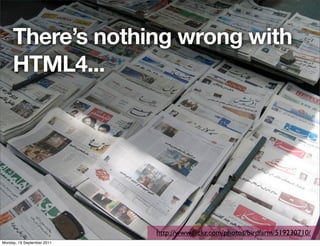
There’s nothing wrong with
     HTML4...


                            http://www.flickr.com/photos/birdfarm/519230710/
Monday, 19 September 2011
But HTML5 has more bling
                            As if! Not publishing this one...
Monday, 19 September 2011
HTML5 features
     ‣ More accurate semantics (eg <header>,
       <footer>)
     ‣ Better forms
     ‣ <video>, <audio>
     ‣ <canvas>
     ‣ Offline apps
     ‣ Web Sockets*, Geolocation*
     ‣ Microdata, Web Workers, History API, etc.
Monday, 19 September 2011
New semantics


                                  http://www.flickr.com/photos/zscheyge/49012397/
Monday, 19 September 2011
HTML5 doctype
     <!DOCTYPE html>


Monday, 19 September 2011
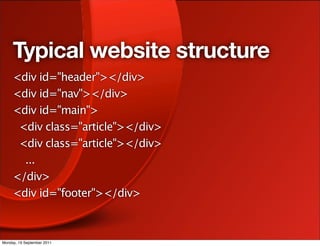
Typical website structure
     <div id="header"></div>
     <div id="nav"></div>
     <div id="main">
      <div class="article"></div>
      <div class="article"></div>
       ...
     </div>
     <div id="footer"></div>


Monday, 19 September 2011
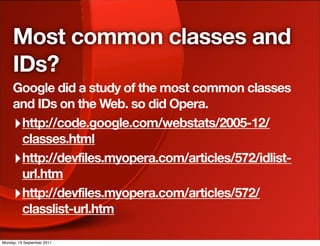
Most common classes and
     IDs?
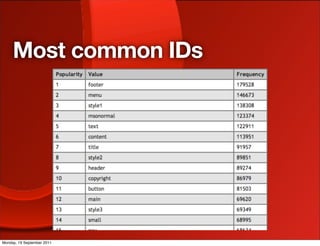
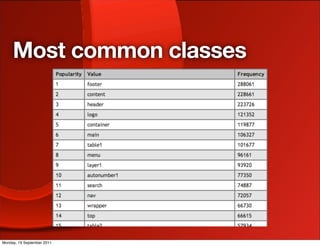
     Google did a study of the most common classes
     and IDs on the Web. so did Opera.
     ‣ http://code.google.com/webstats/2005-12/
       classes.html
     ‣ http://devfiles.myopera.com/articles/572/idlist-
       url.htm
     ‣ http://devfiles.myopera.com/articles/572/
       classlist-url.htm

Monday, 19 September 2011
Most common IDs


Monday, 19 September 2011
Most common classes


Monday, 19 September 2011
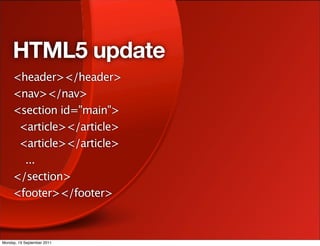
HTML5 update
     <header></header>
     <nav></nav>
     <section id="main">
      <article></article>
      <article></article>
       ...
     </section>
     <footer></footer>


Monday, 19 September 2011
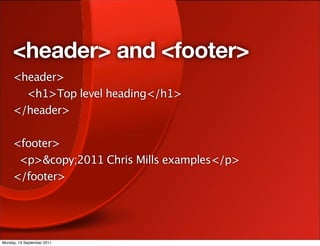
<header> and <footer>
     <header>
     
 <h1>Top level heading</h1>
     </header>
     
     <footer>
       <p>&copy;2011 Chris Mills examples</p>
     </footer>


Monday, 19 September 2011
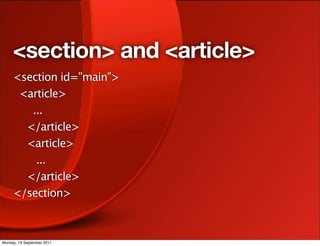
<section> and <article>
     <section id="main">
       <article>
     
 ...
     
 </article>
     
 <article>
     
    ...
     
 </article>
     </section>


Monday, 19 September 2011
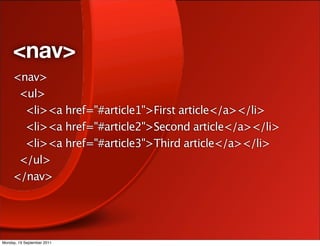
<nav>
     <nav>
      <ul>
       <li><a href="#article1">First article</a></li>
       <li><a href="#article2">Second article</a></li>
       <li><a href="#article3">Third article</a></li>
      </ul>
     </nav>


Monday, 19 September 2011
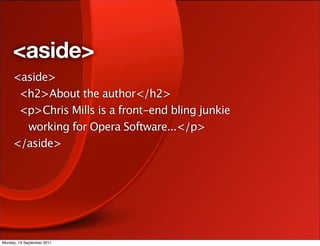
<aside>
     <aside>
      <h2>About the author</h2>
      <p>Chris Mills is a front-end bling junkie
       working for Opera Software...</p>
     </aside>


Monday, 19 September 2011
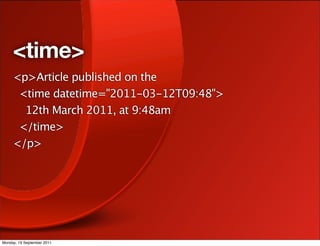
<time>
     <p>Article published on the
      <time datetime="2011-03-12T09:48">
       12th March 2011, at 9:48am
      </time>
     </p>


Monday, 19 September 2011
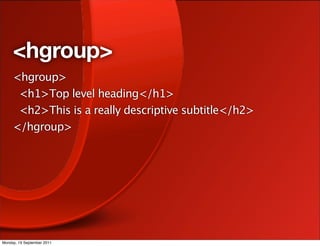
<hgroup>
     <hgroup>
      <h1>Top level heading</h1>
      <h2>This is a really descriptive subtitle</h2>
     </hgroup>


Monday, 19 September 2011
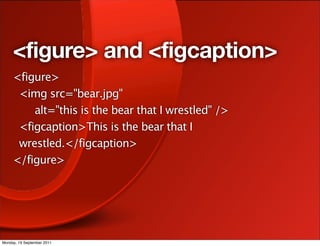
<figure> and <figcaption>
     <figure>
      <img src="bear.jpg"
         alt="this is the bear that I wrestled" />
      <figcaption>This is the bear that I
      wrestled.</figcaption>
     </figure>


Monday, 19 September 2011
Where does this leave the
     humble <div>?
     Use it for anything that isn’t covered by other new
     elements, and is just a general grouping, e.g. for
     styling purposes, for which you don’t want to
     create a new section. An intro <div>, perhaps?


Monday, 19 September 2011
The HTML5 outlining
     algorithm
     Heading/section hierarchy based on sectioning
     element hierarchy, not <hx> elements used
     ‣ No longer limited to six heading levels
     ‣ Hierarchy stays correct when syndicated
     ‣ You can retain HTML4 heading levels for
       backwards compatibility


Monday, 19 September 2011
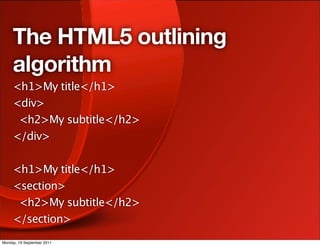
The HTML5 outlining
     algorithm
     <h1>My title</h1>
     <div>
      <h2>My subtitle</h2>
     </div>

     <h1>My title</h1>
     <section>
      <h2>My subtitle</h2>
     </section>
Monday, 19 September 2011
New semantics rock!
     ‣ Better machine readability
     ‣ Better interoperability
     ‣ More consistency of code
     ‣ Better accessibility (once screen readers catch
       up)
     ‣ Leaner markup that is easier to style
     ‣ More in keeping with what real webdevs do

Monday, 19 September 2011
Lax syntax?
     Some say that HTML5 syntax is really lax — you:
     ‣ don’t need to quote attributes
     ‣ can minimise attributes
     ‣ don’t need to self close
     ‣ can mix upper and lower case
     ‣ You don’t even need to include <html>, <head>
       and <body>!


Monday, 19 September 2011
Lax syntax?
     But this more accurately reflects what real
     developers do, rather than what the XHTML spec
     THINKS they should
     ‣ You can use the style you want (although you
       should stick to some best practices)
     ‣ The browser fills in a lot of this stuff
     ‣ The HTML5 spec defines how errors should be
       handled


Monday, 19 September 2011
Example
     http://people.opera.com/cmills/workshop/
     http://devfiles.myopera.com/articles/4612/
     pwei_sample_html5.html


Monday, 19 September 2011
Browsers don’t ACTUALLY
     support these ... yet
     But we can get them displaying fine
     ‣ You can style any element with CSS, even if the
       browser doesn’t recognise it
     ‣ Give all the structural elements display: block;
     ‣ IE also needs createElement('article');


Monday, 19 September 2011
Styling with CSS


                             http://www.flickr.com/photos/nickwebb/3016498475/
Monday, 19 September 2011
Styling with CSS
     ‣ Not much different to what we already do
     ‣ Needs a bit of extra help to style HTML5
       semantic elements
     ‣ CSS3 brings some useful tricks
     ‣ Fallbacks need some careful thought


Monday, 19 September 2011
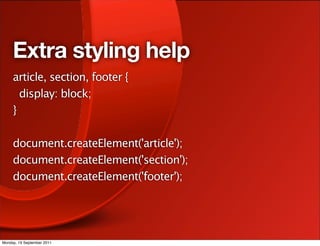
Extra styling help
     article, section, footer {
       display: block;
     }

     document.createElement('article');
     document.createElement('section');
     document.createElement('footer');


Monday, 19 September 2011
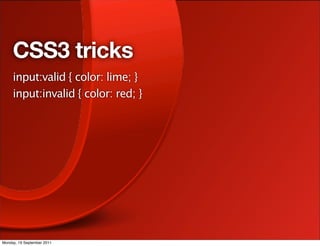
CSS3 tricks
     input:valid { color: lime; }
     input:invalid { color: red; }


Monday, 19 September 2011
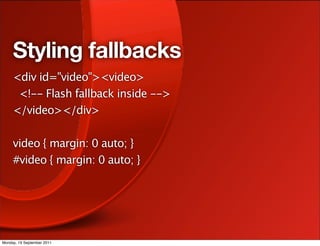
Styling fallbacks
     <div id="video"><video>
      <!-- Flash fallback inside -->
     </video></div>

     video { margin: 0 auto; }
     #video { margin: 0 auto; }


Monday, 19 September 2011
Error handling


                                  http://www.flickr.com/photos/nickwebb/3016498475/
Monday, 19 September 2011
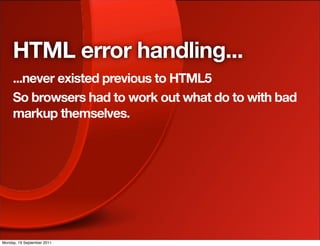
HTML error handling...
     ...never existed previous to HTML5
     So browsers had to work out what do to with bad
     markup themselves.


Monday, 19 September 2011
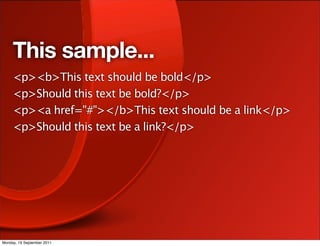
This sample...
     <p><b>This text should be bold</p>
     <p>Should this text be bold?</p>
     <p><a href="#"></b>This text should be a link</p>
     <p>Should this text be a link?</p>


Monday, 19 September 2011
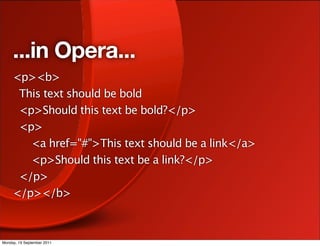
...in Opera...
     <p><b>
      This text should be bold
      <p>Should this text be bold?</p>
      <p>
        <a href="#">This text should be a link</a>
        <p>Should this text be a link?</p>
      </p>
     </p></b>


Monday, 19 September 2011
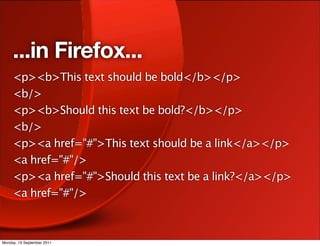
...in Firefox...
     <p><b>This text should be bold</b></p>
     <b/>
     <p><b>Should this text be bold?</b></p>
     <b/>
     <p><a href="#">This text should be a link</a></p>
     <a href="#"/>
     <p><a href="#">Should this text be a link?</a></p>
     <a href="#"/>


Monday, 19 September 2011
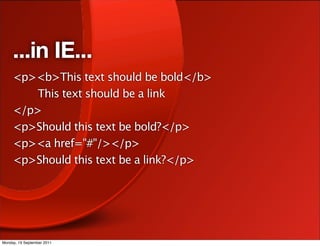
...in IE...
     <p><b>This text should be bold</b>
        This text should be a link
     </p>
     <p>Should this text be bold?</p>
     <p><a href="#"/></p>
     <p>Should this text be a link?</p>


Monday, 19 September 2011
HTML5 states exactly what
     to do
     This will cut down on a lot of cross site problems
     For more, see “100% Ragnarök’n’roll” at
     http://labs.opera.com/news/2011/07/21/


Monday, 19 September 2011
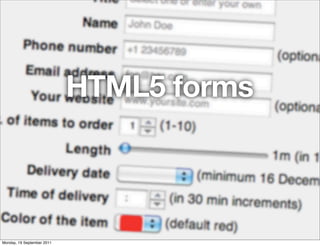
HTML5 forms


Monday, 19 September 2011
HTML5 forms
     Previously called Web Forms 2.0
     ‣ More powerful form controls
     ‣ Built-in validation


Monday, 19 September 2011
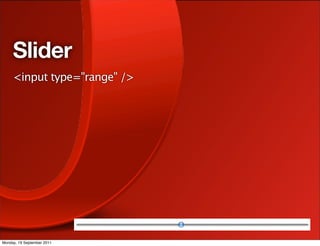
Slider
     <input type="range" />


Monday, 19 September 2011
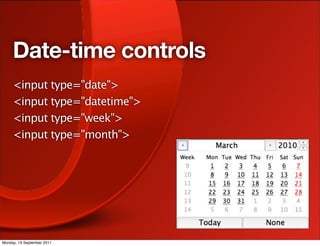
Date-time controls
     <input type="date">
     <input type="datetime">
     <input type="week">
     <input type="month">


Monday, 19 September 2011
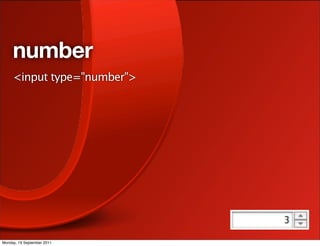
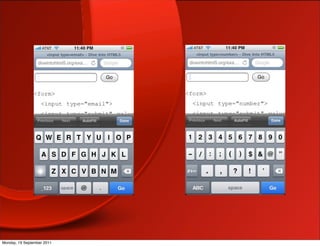
number
     <input type="number">


Monday, 19 September 2011
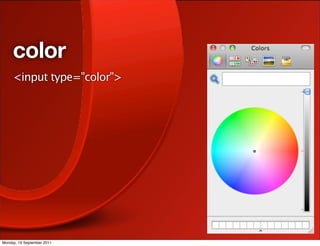
color
     <input type="color">


Monday, 19 September 2011
Search boxes
     <input type="search">


Monday, 19 September 2011
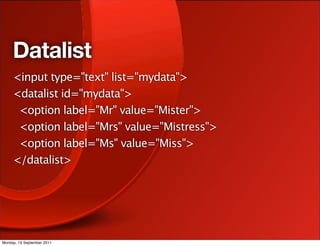
Datalist
     <input type="text" list="mydata">
     <datalist id="mydata">
      <option label="Mr" value="Mister">
      <option label="Mrs" value="Mistress">
      <option label="Ms" value="Miss">
     </datalist>


Monday, 19 September 2011
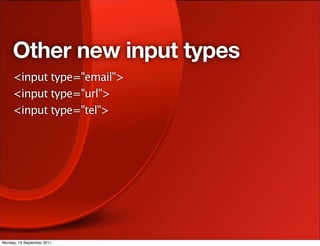
Other new input types
     <input type="email">
     <input type="url">
     <input type="tel">


Monday, 19 September 2011
Validation
     Form validation used to be horrendous


Monday, 19 September 2011
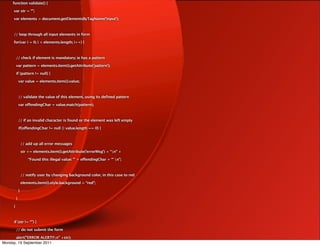
function validate() {

      var str = “”;

      var elements = document.getElementsByTagName('input');


      // loop through all input elements in form

      for(var i = 0; i < elements.length; i++) {


          // check if element is mandatory; ie has a pattern

          var pattern = elements.item(i).getAttribute('pattern');

          if (pattern != null) {

              var value = elements.item(i).value;


              // validate the value of this element, using its defined pattern

              var offendingChar = value.match(pattern);


              // if an invalid character is found or the element was left empty

              if(offendingChar != null || value.length == 0) {


                  // add up all error messages

                  str += elements.item(i).getAttribute('errorMsg') + “n” +

                      “Found this illegal value: '” + offendingChar + “' n”;


                  // notify user by changing background color, in this case to red

                  elements.item(i).style.background = “red”;

              }

          }

      }


      if (str != “”) {

          // do not submit the form

      alert(”ERROR ALERT!!n” +str);
Monday, 19 September 2011
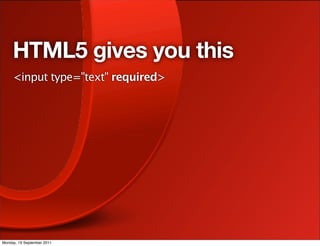
HTML5 gives you this
     <input type="text" required>


Monday, 19 September 2011
And this
     <input type="text" required
         pattern="[A-z]{1,20} [A-z]{1,20}">


Monday, 19 September 2011
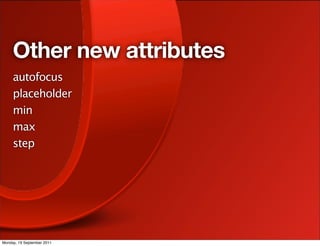
Other new attributes
     autofocus
     placeholder
     min
     max
     step


Monday, 19 September 2011
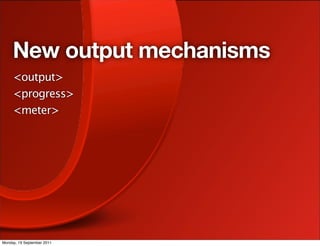
New output mechanisms
     <output>
     <progress>
     <meter>


Monday, 19 September 2011
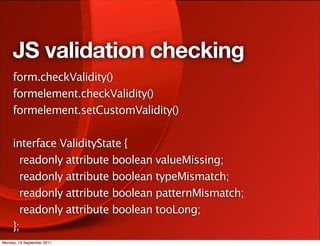
JS validation checking
     form.checkValidity()
     formelement.checkValidity()
     formelement.setCustomValidity()

     interface ValidityState {
       readonly attribute boolean valueMissing;
       readonly attribute boolean typeMismatch;
       readonly attribute boolean patternMismatch;
       readonly attribute boolean tooLong;
     };
Monday, 19 September 2011
JS custom error message
     input.setCustomValidity('That is not the correct answer!');


Monday, 19 September 2011
Form awesomeness
     ‣ Much easier validation
     ‣ Easier to implement complicated controls, with
       better semantics
     ‣ They degrade to basic text inputs
     ‣ Hinting at better UX


Monday, 19 September 2011
Form detractors
     ‣ Support not completely there yet
     ‣ Not easy to customise text of error messages
     ‣ Impossible to customise styling of error
          messages


Monday, 19 September 2011
Examples
     http://people.opera.com/cmills/workshop/
     html5_forms.html

     http://devfiles.myopera.com/articles/4582/html5-
     forms-example.html


Monday, 19 September 2011
<video> and <audio>


                            http://www.flickr.com/photos/stonebird/28894187/
Monday, 19 September 2011
<video> and <audio>
     New elements, plus new API for controlling audio
     and video


Monday, 19 September 2011
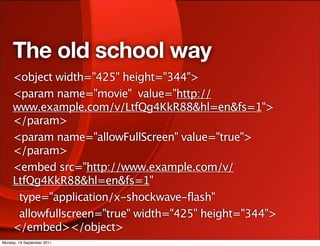
The old school way
     <object width="425" height="344">
     <param name="movie" value="http://
     www.example.com/v/LtfQg4KkR88&hl=en&fs=1">
     </param>
     <param name="allowFullScreen" value="true">
     </param>
     <embed src="http://www.example.com/v/
     LtfQg4KkR88&hl=en&fs=1"
      type="application/x-shockwave-flash"
      allowfullscreen="true" width="425" height="344">
     </embed></object>
Monday, 19 September 2011
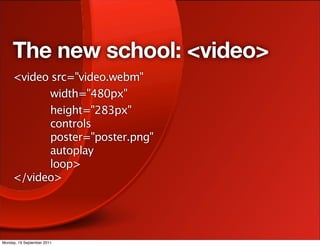
The new school: <video>
     <video src="video.webm"
           width="480px"
           height="283px"
           controls
           poster="poster.png"
           autoplay
           loop>
     </video>


Monday, 19 September 2011
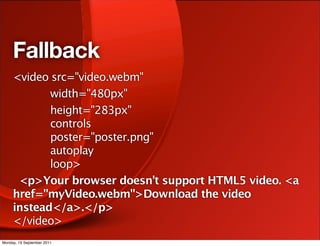
Fallback
     <video src="video.webm"
            width="480px"
            height="283px"
            controls
            poster="poster.png"
            autoplay
            loop>
      <p>Your browser doesn’t support HTML5 video. <a
     href="myVideo.webm">Download the video
     instead</a>.</p>
     </video>
Monday, 19 September 2011
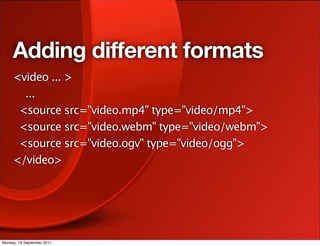
Adding different formats
     <video ... >
       ...
      <source src="video.mp4" type="video/mp4">
      <source src="video.webm" type="video/webm">
      <source src="video.ogv" type="video/ogg">
     </video>


Monday, 19 September 2011
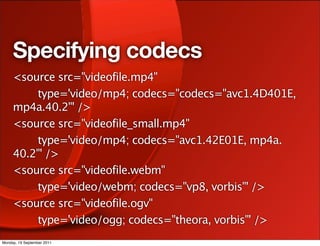
Specifying codecs
     <source src="videofile.mp4"
         type='video/mp4; codecs="codecs="avc1.4D401E,
     mp4a.40.2"' />
     <source src="videofile_small.mp4"
         type='video/mp4; codecs="avc1.42E01E, mp4a.
     40.2"' />
     <source src="videofile.webm"
         type='video/webm; codecs="vp8, vorbis"' />
     <source src="videofile.ogv"
         type='video/ogg; codecs="theora, vorbis"' />
Monday, 19 September 2011
Simple API
     var v = document.getElementById('player');

     v.play();
     v.pause();
     v.volume = … ;
     v.currentTime = … ;


Monday, 19 September 2011
Events
     v.addEventListener('loadeddata', function() { … }, true)
     v.addEventListener('play', function() { … }, true)
     v.addEventListener('pause', function() { … }, true)
     v.addEventListener('timeupdate', function() { … }, true)
     v.addEventListener('ended', function() { … }, true)


Monday, 19 September 2011
Examples
     http://people.opera.com/patrickl/experiments/webm/
     fancy-swap/

     http://people.opera.com/cmills/mediaquery/

     http://dev.opera.com/articles/view/html5-audio-radio-
     player/

     http://dev.opera.com/articles/tags/video/


Monday, 19 September 2011
Native <video> is awesome!
     ‣ Works well with other open standards
     ‣ Built-in keyboard accessibility
     ‣ API for customizing controls, etc.
     ‣ Doesn’t require plugins!
     ‣ Good cross browser support
     ‣ Can provide fallbacks for older browsers
     ‣ Many ready rolled players exist - jPlayer, Sublime
          video

Monday, 19 September 2011
What’s bad about <video>?
     ‣ People can download <video> easily
     ‣ Captioning and suchlike is at an early stage
     ‣ Format wars...


Monday, 19 September 2011
WebVTT (née WebSRT)
     ‣ Add text tracks onto a video
     ‣ for things such as subtitles and captions
     ‣ .vtt files contain timestamp ranges with text
       tracks, and limited styling info
     ‣ <track> element associates these with video


Monday, 19 September 2011
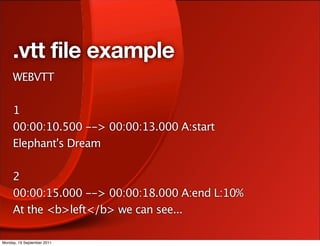
.vtt file example
     WEBVTT

     1
     00:00:10.500 --> 00:00:13.000 A:start
     Elephant's Dream

     2
     00:00:15.000 --> 00:00:18.000 A:end L:10%
     At the <b>left</b> we can see...

Monday, 19 September 2011
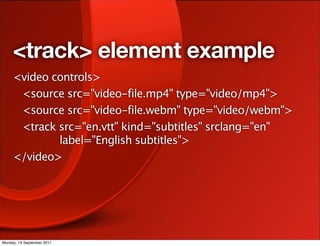
<track> element example
     <video controls>
      <source src="video-file.mp4" type="video/mp4">
      <source src="video-file.webm" type="video/webm">
      <track src="en.vtt" kind="subtitles" srclang="en"
             label="English subtitles">
     </video>


Monday, 19 September 2011
Currently supported
     nowhere
     ‣ But you can add support in using JS libraries
      ‣ Playr
      ‣ Leanback Player
      ‣ Captionator


Monday, 19 September 2011
Future Audio APIs
     ‣ Web Audio API (and Moz’s Audio Data API)
     ‣ Supported in Chrome and FF, respectively
     ‣ Access sample rates, frame buffer length, etc.
     ‣ Create audio visualisations
     ‣ Write your own audio data programatically
     ‣ Audio stream synthesis and processing
     ‣ Spacialised audio for 3D games

Monday, 19 September 2011
APIs for streaming media
     ‣ getUserMedia — get a media source (eg a
       microphone or a web cam)
     ‣ PeerConnection API — make a connection (web
       socket or XHR) between peers through which to
       send media
     ‣ Stream API — stream a media source
     ‣ WebRTC (http://www.webrtc.org/) is the umbrella
       term for all this stuff
     ‣ Opera has experimental support
Monday, 19 September 2011
Adaptive streaming
     ‣ Each stream stored in multiple quality levels
     ‣ As bandwidth changes, the supporting device
       can grab video chunks from the different quality
       levels
     ‣ an XML manifest file stores the data that relates
       to the different quality levels
     ‣ MPEG’s DASH is a first attempt, but not great


Monday, 19 September 2011
<canvas>


                               http://www.flickr.com/photos/pixeljuice23/3121241987/
Monday, 19 September 2011
<canvas>
     ‣ Standard API for drawing
     ‣ Scriptable graphics


Monday, 19 September 2011
The basics
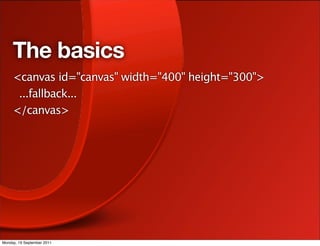
     <canvas id="canvas" width="400" height="300">
      ...fallback...
     </canvas>


Monday, 19 September 2011
The basics
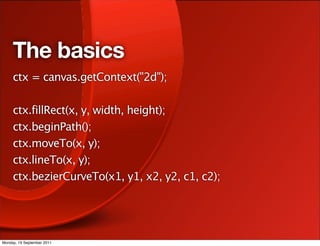
     ctx = canvas.getContext("2d");

     ctx.fillRect(x, y, width, height);
     ctx.beginPath();
     ctx.moveTo(x, y);
     ctx.lineTo(x, y);
     ctx.bezierCurveTo(x1, y1, x2, y2, c1, c2);


Monday, 19 September 2011
Drawing an image onto a
     canvas
     ctx = canvas.getContext("2d");

     var logo = new Image();
     logo.src = 'logo.png';

     ctx.drawImage(logo,x1,y1,w1,h1,x2,y2,w2,h2);


Monday, 19 September 2011
Accessing an image data
     array
     ctx = canvas.getContext("2d");

     canvasData = ctx.getImageData(x,y,w,h);
     [R,G,B,A,R,G,B,A,R,G,B,A,R,G,B,A, … ]


Monday, 19 September 2011
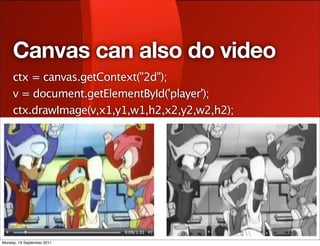
Canvas can also do video
     ctx = canvas.getContext("2d");
     v = document.getElementById('player');
     ctx.drawImage(v,x1,y1,w1,h2,x2,y2,w2,h2);


Monday, 19 September 2011
<canvas> pros
     ‣ Great for games and image/video manipulation
       (now JS processors have caught up)
     ‣ Much faster than markup-based animation (eg
       SVG, SMIL)
     ‣ Runs on iDevices, unlike Flash
     ‣ Support across all modern browsers
     ‣ Add support for older browsers using Polyfills,
       like Excanvas

Monday, 19 September 2011
<canvas> cons
     ‣ Content is inaccessible
     ‣ No animation API built in
     ‣ Can be really slow for large dynamic areas, like
          UIs


Monday, 19 September 2011
Examples
     ‣ http://dev.opera.com/articles/view/html-5-
       canvas-the-basics/
     ‣ http://html5doctor.com/video-canvas-magic/
     ‣ http://www.hakim.se/experiments/
     ‣ http://www.canvasdemos.com/
     ‣ http://people.opera.com/patrickl/experiments/
       canvas/particle/3/
     ‣ https://github.com/mezzoblue/PaintbrushJS

Monday, 19 September 2011
Offline apps


                                 http://www.flickr.com/photos/bzedan/2441516764/
Monday, 19 September 2011
The web is pretty crap
     offline
     ‣ So how do we address this?
     ‣ HTML5 saves the day (again)
      ‣ Application Cache (AppCache) for assets
      ‣ Web storage for simple data
      ‣ WebSQL/IndexedDB for complex data


Monday, 19 September 2011
AppCache Manifest
     reference
     <html manifest="blah.manifest">


Monday, 19 September 2011
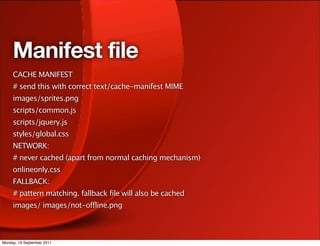
Manifest file
     CACHE MANIFEST
     # send this with correct text/cache-manifest MIME
     images/sprites.png
     scripts/common.js
     scripts/jquery.js
     styles/global.css
     NETWORK:
     # never cached (apart from normal caching mechanism)
     onlineonly.css
     FALLBACK:
     # pattern matching. fallback file will also be cached
     images/ images/not-offline.png


Monday, 19 September 2011
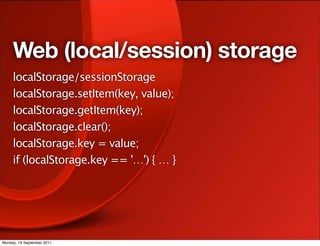
Web (local/session) storage
     localStorage/sessionStorage
     localStorage.setItem(key, value);
     localStorage.getItem(key);
     localStorage.clear();
     localStorage.key = value;
     if (localStorage.key == '…') { … }


Monday, 19 September 2011
WebSQL
     var db =
     openDatabase(dbName, version, displayName,
     expectedSize);
     db.transaction(function(tx) {
       tx.executeSql(sqlStatement, [], function (tx, result) {
         /* do something with the results */
       });
     });


Monday, 19 September 2011
Web databases: future
     ‣ WebSQL supported in Opera/Webkit
     ‣ But being discontinued
     ‣ Moz/IE prefer IndexedDB
     ‣ All will eventually go this way
     ‣ WebSQL may well remain good option for mobile


Monday, 19 September 2011
Caching issues?


Monday, 19 September 2011
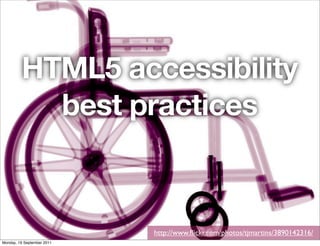
HTML5 accessibility
           best practices


                            http://www.flickr.com/photos/tjmartins/3890142316/
Monday, 19 September 2011
HTML5 accessibility?
     ‣ Still no magic bullet
     ‣ Some a11y boons
     ‣ And some new (old?) problems
     ‣ html5accessibility.com is very useful


Monday, 19 September 2011
The good things
     ‣ A lot of elements have keyboard accessibility
       built in
     ‣ New semantics mean lot of advantages (eg no
       more skip links?)
     ‣ Video captioning is coming
     ‣ WAI ARIA can still be used to supplement where
       needed
     ‣ Some browsers have started exposing element
       semantics to AT
Monday, 19 September 2011
The bad things
     ‣ Canvas!
     ‣ Video a11y (coming soon)


Monday, 19 September 2011
Should we use
                             HTML5 now?


Monday, 19 September 2011
When should I use it?
     Now!
     ‣ Most modern browsers support most of this stuff
       now
     ‣ Workarounds are perfectly possible
     ‣ You are already using HTML5 by using HTML4.x
     ‣ Don’t wait till it’s completely finished


Monday, 19 September 2011
The UK road system is
     never finished...


                            http://www.flickr.com/photos/50014762@N03/4632637811/
Monday, 19 September 2011
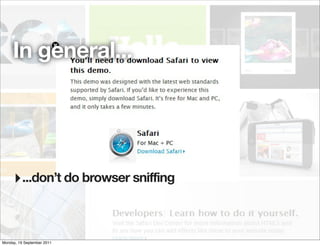
In general...


     ‣ ...don’t do browser sniffing


Monday, 19 September 2011
Do feature detection/
     graceful degradation
     ‣ http://diveintohtml5.org/everything.html
     ‣ http://www.modernizr.com/
     ‣ http://yepnopejs.com/


Monday, 19 September 2011
And patch older browsers
     as needed
     ‣ https://github.com/Modernizr/Modernizr/wiki/
          HTML5-Cross-Browser-Polyfills


Monday, 19 September 2011
HTML5 security?


                            http://www.flickr.com/photos/freefoto/5692512457/
Monday, 19 September 2011
HTML5 security?
     ‣ Very similar to HTML4
     ‣ Not much can be done to protect source
     ‣ Need to be careful about cross domain resource
       sharing and messaging
     ‣ Other questions?


Monday, 19 September 2011
Device APIs


                                 http://www.flickr.com/photos/freefoto/5692512457/
Monday, 19 September 2011
Device APIs
     ‣ http://www.w3.org/2009/dap/
     ‣ Far from being supported
     ‣ And there are still competing proposals, like WAC
     ‣ Shame, as this is one killer feature area for web
          apps


Monday, 19 September 2011
Questions?

   What would we like to
     see in the spec?
                                http://www.flickr.com/photos/mikecogh/1812288874/
Monday, 19 September 2011
Thanks for listening!
     ‣ cmills@opera.com
     ‣ @chrisdavidmills
     ‣ http://dev.opera.com/articles/tags/html5/
     ‣ http://html5doctor.com


Monday, 19 September 2011

HTML5 Pearson preso

  • 1.
    The “crazy” worldof HTML5 Chris Mills, Opera Software Monday, 19 September 2011
  • 2.
    Who am I? ‣ Opera open standards evangelist and tech writer ‣ Telling the world about open standards & Opera ‣ Improving web education ‣ Drumming in a heavy metal band Monday, 19 September 2011
  • 3.
  • 4.
    What is HTML5? A new HTML spec that defines: ‣ New semantic elements ‣ New features such as native video, more powerful forms, web sockets ‣ New APIs for controlling such features ‣ Error handling, and other such useful things Monday, 19 September 2011
  • 5.
    Or according tosome... ‣ HTML5 ‣ CSS3, WOFF ‣ SVG, SMIL, WebGL ‣ Geolocation, WAC ‣ Indexed DB, File API ‣ Server-sent events ‣ Web workers, XHR2 ‣ & every other open standard under the sun! Monday, 19 September 2011
  • 6.
    A brief historyof HTML ‣ HTML first proposed 1989-1991 ‣ HTML3 first standardised in 1995 ‣ HTML 4.01 standardised in 1999 ‣ Corrections submitted in 2001 Monday, 19 September 2011
  • 7.
    HTML5 history +politics ‣ W3C decided the future was XHTML ‣ This didn’t go down well, and no-one cared about XHTML2 Monday, 19 September 2011
  • 8.
    Why did XHTMLfail? ‣ XHTML2 features aren’t backwards compatible with “the Web so far” ‣ XHTML1 didn’t work properly anyway ‣ XML in general doesn’t suit the Web Monday, 19 September 2011
  • 9.
    HTML5 history +politics ‣ HTML5 (was web applications 1.0) started by WHATWG in 2004ish ‣ Adopted by W3C 2008 ‣ WHATWG version became version-less in 2011 Monday, 19 September 2011
  • 10.
    HTML is thenew HTML5? In January 2011, Ian Hickson announced that the WHATWG HTML5 spec was dropping its version number, and becoming a living spec that could keep being added to, as more features came to fruition. The W3C version is keeping its version number, and acting as a snapshot. Monday, 19 September 2011
  • 11.
    Why can HTML5succeed? ‣ It is backwards compatible with HTML4 ‣ It is written to be competitive with other technologies, eg Flash, Silverlight ‣ It fills up holes and adds features: it doesn’t replace HTML4.x Monday, 19 September 2011
  • 12.
    HTML5 features http://www.flickr.com/photos/cybertoad/247896160/ Monday, 19 September 2011
  • 13.
    There’s nothing wrongwith HTML4... http://www.flickr.com/photos/birdfarm/519230710/ Monday, 19 September 2011
  • 14.
    But HTML5 hasmore bling As if! Not publishing this one... Monday, 19 September 2011
  • 15.
    HTML5 features ‣ More accurate semantics (eg <header>, <footer>) ‣ Better forms ‣ <video>, <audio> ‣ <canvas> ‣ Offline apps ‣ Web Sockets*, Geolocation* ‣ Microdata, Web Workers, History API, etc. Monday, 19 September 2011
  • 16.
    New semantics http://www.flickr.com/photos/zscheyge/49012397/ Monday, 19 September 2011
  • 17.
    HTML5 doctype <!DOCTYPE html> Monday, 19 September 2011
  • 18.
    Typical website structure <div id="header"></div> <div id="nav"></div> <div id="main"> <div class="article"></div> <div class="article"></div> ... </div> <div id="footer"></div> Monday, 19 September 2011
  • 19.
    Most common classesand IDs? Google did a study of the most common classes and IDs on the Web. so did Opera. ‣ http://code.google.com/webstats/2005-12/ classes.html ‣ http://devfiles.myopera.com/articles/572/idlist- url.htm ‣ http://devfiles.myopera.com/articles/572/ classlist-url.htm Monday, 19 September 2011
  • 20.
    Most common IDs Monday,19 September 2011
  • 21.
    Most common classes Monday,19 September 2011
  • 22.
    HTML5 update <header></header> <nav></nav> <section id="main"> <article></article> <article></article> ... </section> <footer></footer> Monday, 19 September 2011
  • 23.
    <header> and <footer> <header> <h1>Top level heading</h1> </header> <footer> <p>&copy;2011 Chris Mills examples</p> </footer> Monday, 19 September 2011
  • 24.
    <section> and <article> <section id="main"> <article> ... </article> <article> ... </article> </section> Monday, 19 September 2011
  • 25.
    <nav> <nav> <ul> <li><a href="#article1">First article</a></li> <li><a href="#article2">Second article</a></li> <li><a href="#article3">Third article</a></li> </ul> </nav> Monday, 19 September 2011
  • 26.
    <aside> <aside> <h2>About the author</h2> <p>Chris Mills is a front-end bling junkie working for Opera Software...</p> </aside> Monday, 19 September 2011
  • 27.
    <time> <p>Article published on the <time datetime="2011-03-12T09:48"> 12th March 2011, at 9:48am </time> </p> Monday, 19 September 2011
  • 28.
    <hgroup> <hgroup> <h1>Top level heading</h1> <h2>This is a really descriptive subtitle</h2> </hgroup> Monday, 19 September 2011
  • 29.
    <figure> and <figcaption> <figure> <img src="bear.jpg" alt="this is the bear that I wrestled" /> <figcaption>This is the bear that I wrestled.</figcaption> </figure> Monday, 19 September 2011
  • 30.
    Where does thisleave the humble <div>? Use it for anything that isn’t covered by other new elements, and is just a general grouping, e.g. for styling purposes, for which you don’t want to create a new section. An intro <div>, perhaps? Monday, 19 September 2011
  • 31.
    The HTML5 outlining algorithm Heading/section hierarchy based on sectioning element hierarchy, not <hx> elements used ‣ No longer limited to six heading levels ‣ Hierarchy stays correct when syndicated ‣ You can retain HTML4 heading levels for backwards compatibility Monday, 19 September 2011
  • 32.
    The HTML5 outlining algorithm <h1>My title</h1> <div> <h2>My subtitle</h2> </div> <h1>My title</h1> <section> <h2>My subtitle</h2> </section> Monday, 19 September 2011
  • 33.
    New semantics rock! ‣ Better machine readability ‣ Better interoperability ‣ More consistency of code ‣ Better accessibility (once screen readers catch up) ‣ Leaner markup that is easier to style ‣ More in keeping with what real webdevs do Monday, 19 September 2011
  • 34.
    Lax syntax? Some say that HTML5 syntax is really lax — you: ‣ don’t need to quote attributes ‣ can minimise attributes ‣ don’t need to self close ‣ can mix upper and lower case ‣ You don’t even need to include <html>, <head> and <body>! Monday, 19 September 2011
  • 35.
    Lax syntax? But this more accurately reflects what real developers do, rather than what the XHTML spec THINKS they should ‣ You can use the style you want (although you should stick to some best practices) ‣ The browser fills in a lot of this stuff ‣ The HTML5 spec defines how errors should be handled Monday, 19 September 2011
  • 36.
    Example http://people.opera.com/cmills/workshop/ http://devfiles.myopera.com/articles/4612/ pwei_sample_html5.html Monday, 19 September 2011
  • 37.
    Browsers don’t ACTUALLY support these ... yet But we can get them displaying fine ‣ You can style any element with CSS, even if the browser doesn’t recognise it ‣ Give all the structural elements display: block; ‣ IE also needs createElement('article'); Monday, 19 September 2011
  • 38.
    Styling with CSS http://www.flickr.com/photos/nickwebb/3016498475/ Monday, 19 September 2011
  • 39.
    Styling with CSS ‣ Not much different to what we already do ‣ Needs a bit of extra help to style HTML5 semantic elements ‣ CSS3 brings some useful tricks ‣ Fallbacks need some careful thought Monday, 19 September 2011
  • 40.
    Extra styling help article, section, footer { display: block; } document.createElement('article'); document.createElement('section'); document.createElement('footer'); Monday, 19 September 2011
  • 41.
    CSS3 tricks input:valid { color: lime; } input:invalid { color: red; } Monday, 19 September 2011
  • 42.
    Styling fallbacks <div id="video"><video> <!-- Flash fallback inside --> </video></div> video { margin: 0 auto; } #video { margin: 0 auto; } Monday, 19 September 2011
  • 43.
    Error handling http://www.flickr.com/photos/nickwebb/3016498475/ Monday, 19 September 2011
  • 44.
    HTML error handling... ...never existed previous to HTML5 So browsers had to work out what do to with bad markup themselves. Monday, 19 September 2011
  • 45.
    This sample... <p><b>This text should be bold</p> <p>Should this text be bold?</p> <p><a href="#"></b>This text should be a link</p> <p>Should this text be a link?</p> Monday, 19 September 2011
  • 46.
    ...in Opera... <p><b> This text should be bold <p>Should this text be bold?</p> <p> <a href="#">This text should be a link</a> <p>Should this text be a link?</p> </p> </p></b> Monday, 19 September 2011
  • 47.
    ...in Firefox... <p><b>This text should be bold</b></p> <b/> <p><b>Should this text be bold?</b></p> <b/> <p><a href="#">This text should be a link</a></p> <a href="#"/> <p><a href="#">Should this text be a link?</a></p> <a href="#"/> Monday, 19 September 2011
  • 48.
    ...in IE... <p><b>This text should be bold</b> This text should be a link </p> <p>Should this text be bold?</p> <p><a href="#"/></p> <p>Should this text be a link?</p> Monday, 19 September 2011
  • 49.
    HTML5 states exactlywhat to do This will cut down on a lot of cross site problems For more, see “100% Ragnarök’n’roll” at http://labs.opera.com/news/2011/07/21/ Monday, 19 September 2011
  • 50.
    HTML5 forms Monday, 19September 2011
  • 51.
    HTML5 forms Previously called Web Forms 2.0 ‣ More powerful form controls ‣ Built-in validation Monday, 19 September 2011
  • 52.
    Slider <input type="range" /> Monday, 19 September 2011
  • 53.
    Date-time controls <input type="date"> <input type="datetime"> <input type="week"> <input type="month"> Monday, 19 September 2011
  • 54.
    number <input type="number"> Monday, 19 September 2011
  • 55.
    color <input type="color"> Monday, 19 September 2011
  • 56.
    Search boxes <input type="search"> Monday, 19 September 2011
  • 57.
    Datalist <input type="text" list="mydata"> <datalist id="mydata"> <option label="Mr" value="Mister"> <option label="Mrs" value="Mistress"> <option label="Ms" value="Miss"> </datalist> Monday, 19 September 2011
  • 58.
    Other new inputtypes <input type="email"> <input type="url"> <input type="tel"> Monday, 19 September 2011
  • 59.
    Validation Form validation used to be horrendous Monday, 19 September 2011
  • 60.
    function validate() { var str = “”; var elements = document.getElementsByTagName('input'); // loop through all input elements in form for(var i = 0; i < elements.length; i++) { // check if element is mandatory; ie has a pattern var pattern = elements.item(i).getAttribute('pattern'); if (pattern != null) { var value = elements.item(i).value; // validate the value of this element, using its defined pattern var offendingChar = value.match(pattern); // if an invalid character is found or the element was left empty if(offendingChar != null || value.length == 0) { // add up all error messages str += elements.item(i).getAttribute('errorMsg') + “n” + “Found this illegal value: '” + offendingChar + “' n”; // notify user by changing background color, in this case to red elements.item(i).style.background = “red”; } } } if (str != “”) { // do not submit the form alert(”ERROR ALERT!!n” +str); Monday, 19 September 2011
  • 61.
    HTML5 gives youthis <input type="text" required> Monday, 19 September 2011
  • 62.
    And this <input type="text" required pattern="[A-z]{1,20} [A-z]{1,20}"> Monday, 19 September 2011
  • 63.
    Other new attributes autofocus placeholder min max step Monday, 19 September 2011
  • 64.
    New output mechanisms <output> <progress> <meter> Monday, 19 September 2011
  • 65.
    JS validation checking form.checkValidity() formelement.checkValidity() formelement.setCustomValidity() interface ValidityState { readonly attribute boolean valueMissing; readonly attribute boolean typeMismatch; readonly attribute boolean patternMismatch; readonly attribute boolean tooLong; }; Monday, 19 September 2011
  • 66.
    JS custom errormessage input.setCustomValidity('That is not the correct answer!'); Monday, 19 September 2011
  • 67.
    Form awesomeness ‣ Much easier validation ‣ Easier to implement complicated controls, with better semantics ‣ They degrade to basic text inputs ‣ Hinting at better UX Monday, 19 September 2011
  • 68.
  • 69.
    Form detractors ‣ Support not completely there yet ‣ Not easy to customise text of error messages ‣ Impossible to customise styling of error messages Monday, 19 September 2011
  • 70.
    Examples http://people.opera.com/cmills/workshop/ html5_forms.html http://devfiles.myopera.com/articles/4582/html5- forms-example.html Monday, 19 September 2011
  • 71.
    <video> and <audio> http://www.flickr.com/photos/stonebird/28894187/ Monday, 19 September 2011
  • 72.
    <video> and <audio> New elements, plus new API for controlling audio and video Monday, 19 September 2011
  • 73.
    The old schoolway <object width="425" height="344"> <param name="movie" value="http:// www.example.com/v/LtfQg4KkR88&hl=en&fs=1"> </param> <param name="allowFullScreen" value="true"> </param> <embed src="http://www.example.com/v/ LtfQg4KkR88&hl=en&fs=1" type="application/x-shockwave-flash" allowfullscreen="true" width="425" height="344"> </embed></object> Monday, 19 September 2011
  • 74.
    The new school:<video> <video src="video.webm" width="480px" height="283px" controls poster="poster.png" autoplay loop> </video> Monday, 19 September 2011
  • 75.
    Fallback <video src="video.webm" width="480px" height="283px" controls poster="poster.png" autoplay loop> <p>Your browser doesn’t support HTML5 video. <a href="myVideo.webm">Download the video instead</a>.</p> </video> Monday, 19 September 2011
  • 76.
    Adding different formats <video ... > ... <source src="video.mp4" type="video/mp4"> <source src="video.webm" type="video/webm"> <source src="video.ogv" type="video/ogg"> </video> Monday, 19 September 2011
  • 77.
    Specifying codecs <source src="videofile.mp4" type='video/mp4; codecs="codecs="avc1.4D401E, mp4a.40.2"' /> <source src="videofile_small.mp4" type='video/mp4; codecs="avc1.42E01E, mp4a. 40.2"' /> <source src="videofile.webm" type='video/webm; codecs="vp8, vorbis"' /> <source src="videofile.ogv" type='video/ogg; codecs="theora, vorbis"' /> Monday, 19 September 2011
  • 78.
    Simple API var v = document.getElementById('player'); v.play(); v.pause(); v.volume = … ; v.currentTime = … ; Monday, 19 September 2011
  • 79.
    Events v.addEventListener('loadeddata', function() { … }, true) v.addEventListener('play', function() { … }, true) v.addEventListener('pause', function() { … }, true) v.addEventListener('timeupdate', function() { … }, true) v.addEventListener('ended', function() { … }, true) Monday, 19 September 2011
  • 80.
    Examples http://people.opera.com/patrickl/experiments/webm/ fancy-swap/ http://people.opera.com/cmills/mediaquery/ http://dev.opera.com/articles/view/html5-audio-radio- player/ http://dev.opera.com/articles/tags/video/ Monday, 19 September 2011
  • 81.
    Native <video> isawesome! ‣ Works well with other open standards ‣ Built-in keyboard accessibility ‣ API for customizing controls, etc. ‣ Doesn’t require plugins! ‣ Good cross browser support ‣ Can provide fallbacks for older browsers ‣ Many ready rolled players exist - jPlayer, Sublime video Monday, 19 September 2011
  • 82.
    What’s bad about<video>? ‣ People can download <video> easily ‣ Captioning and suchlike is at an early stage ‣ Format wars... Monday, 19 September 2011
  • 83.
    WebVTT (née WebSRT) ‣ Add text tracks onto a video ‣ for things such as subtitles and captions ‣ .vtt files contain timestamp ranges with text tracks, and limited styling info ‣ <track> element associates these with video Monday, 19 September 2011
  • 84.
    .vtt file example WEBVTT 1 00:00:10.500 --> 00:00:13.000 A:start Elephant's Dream 2 00:00:15.000 --> 00:00:18.000 A:end L:10% At the <b>left</b> we can see... Monday, 19 September 2011
  • 85.
    <track> element example <video controls> <source src="video-file.mp4" type="video/mp4"> <source src="video-file.webm" type="video/webm"> <track src="en.vtt" kind="subtitles" srclang="en" label="English subtitles"> </video> Monday, 19 September 2011
  • 86.
    Currently supported nowhere ‣ But you can add support in using JS libraries ‣ Playr ‣ Leanback Player ‣ Captionator Monday, 19 September 2011
  • 87.
    Future Audio APIs ‣ Web Audio API (and Moz’s Audio Data API) ‣ Supported in Chrome and FF, respectively ‣ Access sample rates, frame buffer length, etc. ‣ Create audio visualisations ‣ Write your own audio data programatically ‣ Audio stream synthesis and processing ‣ Spacialised audio for 3D games Monday, 19 September 2011
  • 88.
    APIs for streamingmedia ‣ getUserMedia — get a media source (eg a microphone or a web cam) ‣ PeerConnection API — make a connection (web socket or XHR) between peers through which to send media ‣ Stream API — stream a media source ‣ WebRTC (http://www.webrtc.org/) is the umbrella term for all this stuff ‣ Opera has experimental support Monday, 19 September 2011
  • 89.
    Adaptive streaming ‣ Each stream stored in multiple quality levels ‣ As bandwidth changes, the supporting device can grab video chunks from the different quality levels ‣ an XML manifest file stores the data that relates to the different quality levels ‣ MPEG’s DASH is a first attempt, but not great Monday, 19 September 2011
  • 90.
    <canvas> http://www.flickr.com/photos/pixeljuice23/3121241987/ Monday, 19 September 2011
  • 91.
    <canvas> ‣ Standard API for drawing ‣ Scriptable graphics Monday, 19 September 2011
  • 92.
    The basics <canvas id="canvas" width="400" height="300"> ...fallback... </canvas> Monday, 19 September 2011
  • 93.
    The basics ctx = canvas.getContext("2d"); ctx.fillRect(x, y, width, height); ctx.beginPath(); ctx.moveTo(x, y); ctx.lineTo(x, y); ctx.bezierCurveTo(x1, y1, x2, y2, c1, c2); Monday, 19 September 2011
  • 94.
    Drawing an imageonto a canvas ctx = canvas.getContext("2d"); var logo = new Image(); logo.src = 'logo.png'; ctx.drawImage(logo,x1,y1,w1,h1,x2,y2,w2,h2); Monday, 19 September 2011
  • 95.
    Accessing an imagedata array ctx = canvas.getContext("2d"); canvasData = ctx.getImageData(x,y,w,h); [R,G,B,A,R,G,B,A,R,G,B,A,R,G,B,A, … ] Monday, 19 September 2011
  • 96.
    Canvas can alsodo video ctx = canvas.getContext("2d"); v = document.getElementById('player'); ctx.drawImage(v,x1,y1,w1,h2,x2,y2,w2,h2); Monday, 19 September 2011
  • 97.
    <canvas> pros ‣ Great for games and image/video manipulation (now JS processors have caught up) ‣ Much faster than markup-based animation (eg SVG, SMIL) ‣ Runs on iDevices, unlike Flash ‣ Support across all modern browsers ‣ Add support for older browsers using Polyfills, like Excanvas Monday, 19 September 2011
  • 98.
    <canvas> cons ‣ Content is inaccessible ‣ No animation API built in ‣ Can be really slow for large dynamic areas, like UIs Monday, 19 September 2011
  • 99.
    Examples ‣ http://dev.opera.com/articles/view/html-5- canvas-the-basics/ ‣ http://html5doctor.com/video-canvas-magic/ ‣ http://www.hakim.se/experiments/ ‣ http://www.canvasdemos.com/ ‣ http://people.opera.com/patrickl/experiments/ canvas/particle/3/ ‣ https://github.com/mezzoblue/PaintbrushJS Monday, 19 September 2011
  • 100.
    Offline apps http://www.flickr.com/photos/bzedan/2441516764/ Monday, 19 September 2011
  • 101.
    The web ispretty crap offline ‣ So how do we address this? ‣ HTML5 saves the day (again) ‣ Application Cache (AppCache) for assets ‣ Web storage for simple data ‣ WebSQL/IndexedDB for complex data Monday, 19 September 2011
  • 102.
    AppCache Manifest reference <html manifest="blah.manifest"> Monday, 19 September 2011
  • 103.
    Manifest file CACHE MANIFEST # send this with correct text/cache-manifest MIME images/sprites.png scripts/common.js scripts/jquery.js styles/global.css NETWORK: # never cached (apart from normal caching mechanism) onlineonly.css FALLBACK: # pattern matching. fallback file will also be cached images/ images/not-offline.png Monday, 19 September 2011
  • 104.
    Web (local/session) storage localStorage/sessionStorage localStorage.setItem(key, value); localStorage.getItem(key); localStorage.clear(); localStorage.key = value; if (localStorage.key == '…') { … } Monday, 19 September 2011
  • 105.
    WebSQL var db = openDatabase(dbName, version, displayName, expectedSize); db.transaction(function(tx) { tx.executeSql(sqlStatement, [], function (tx, result) { /* do something with the results */ }); }); Monday, 19 September 2011
  • 106.
    Web databases: future ‣ WebSQL supported in Opera/Webkit ‣ But being discontinued ‣ Moz/IE prefer IndexedDB ‣ All will eventually go this way ‣ WebSQL may well remain good option for mobile Monday, 19 September 2011
  • 107.
  • 108.
    HTML5 accessibility best practices http://www.flickr.com/photos/tjmartins/3890142316/ Monday, 19 September 2011
  • 109.
    HTML5 accessibility? ‣ Still no magic bullet ‣ Some a11y boons ‣ And some new (old?) problems ‣ html5accessibility.com is very useful Monday, 19 September 2011
  • 110.
    The good things ‣ A lot of elements have keyboard accessibility built in ‣ New semantics mean lot of advantages (eg no more skip links?) ‣ Video captioning is coming ‣ WAI ARIA can still be used to supplement where needed ‣ Some browsers have started exposing element semantics to AT Monday, 19 September 2011
  • 111.
    The bad things ‣ Canvas! ‣ Video a11y (coming soon) Monday, 19 September 2011
  • 112.
    Should we use HTML5 now? Monday, 19 September 2011
  • 113.
    When should Iuse it? Now! ‣ Most modern browsers support most of this stuff now ‣ Workarounds are perfectly possible ‣ You are already using HTML5 by using HTML4.x ‣ Don’t wait till it’s completely finished Monday, 19 September 2011
  • 114.
    The UK roadsystem is never finished... http://www.flickr.com/photos/50014762@N03/4632637811/ Monday, 19 September 2011
  • 115.
    In general... ‣ ...don’t do browser sniffing Monday, 19 September 2011
  • 116.
    Do feature detection/ graceful degradation ‣ http://diveintohtml5.org/everything.html ‣ http://www.modernizr.com/ ‣ http://yepnopejs.com/ Monday, 19 September 2011
  • 117.
    And patch olderbrowsers as needed ‣ https://github.com/Modernizr/Modernizr/wiki/ HTML5-Cross-Browser-Polyfills Monday, 19 September 2011
  • 118.
    HTML5 security? http://www.flickr.com/photos/freefoto/5692512457/ Monday, 19 September 2011
  • 119.
    HTML5 security? ‣ Very similar to HTML4 ‣ Not much can be done to protect source ‣ Need to be careful about cross domain resource sharing and messaging ‣ Other questions? Monday, 19 September 2011
  • 120.
    Device APIs http://www.flickr.com/photos/freefoto/5692512457/ Monday, 19 September 2011
  • 121.
    Device APIs ‣ http://www.w3.org/2009/dap/ ‣ Far from being supported ‣ And there are still competing proposals, like WAC ‣ Shame, as this is one killer feature area for web apps Monday, 19 September 2011
  • 122.
    Questions? What would we like to see in the spec? http://www.flickr.com/photos/mikecogh/1812288874/ Monday, 19 September 2011
  • 123.
    Thanks for listening! ‣ cmills@opera.com ‣ @chrisdavidmills ‣ http://dev.opera.com/articles/tags/html5/ ‣ http://html5doctor.com Monday, 19 September 2011