The Holography Times 
March 2008 Vol 1 No. 2 
www.homai.org 
EENDEEAVORTTOSAFFEEGUARDPRODUCTTS&PEEOPLLEE 
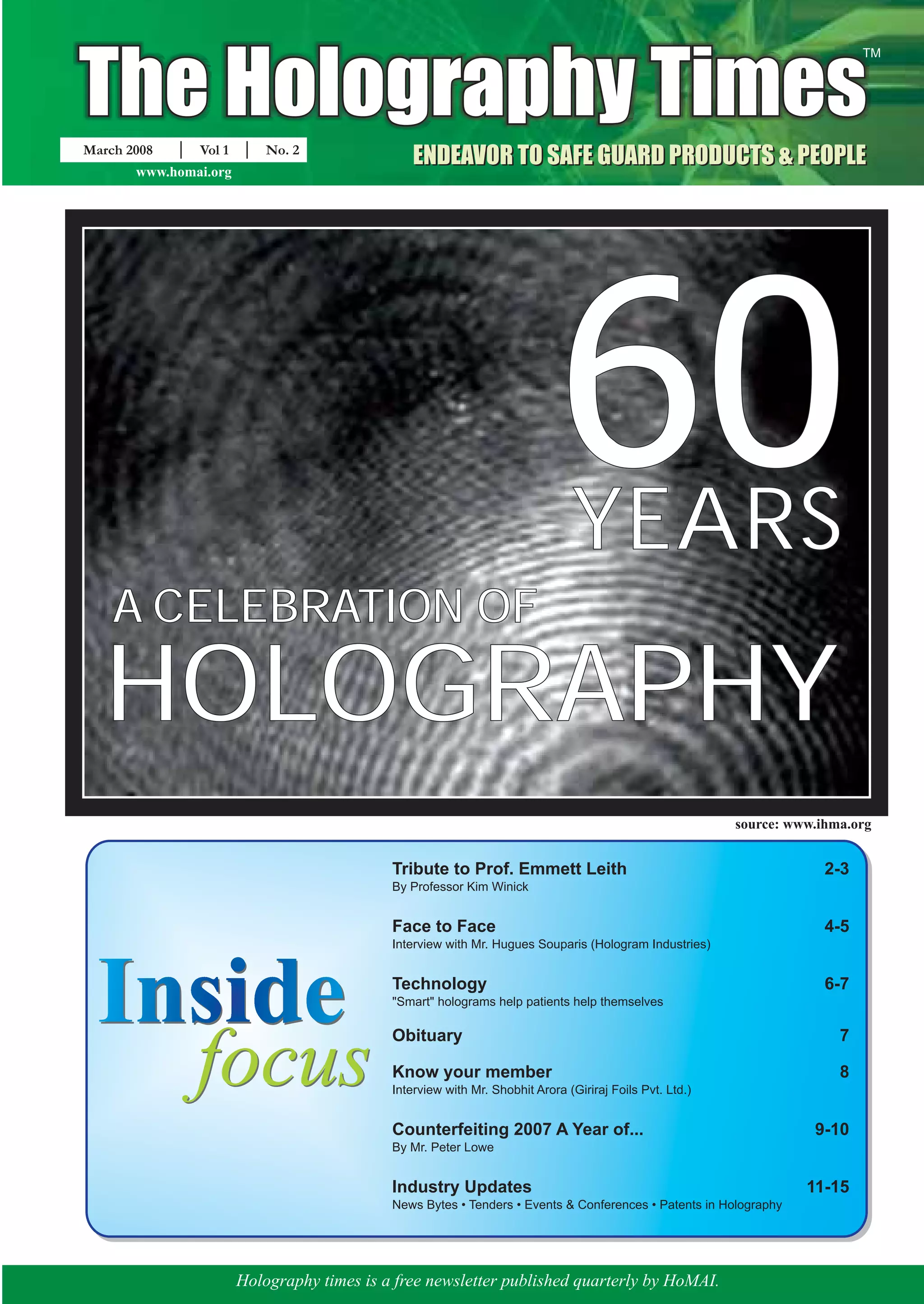
60 
A CELEBRATION OF 
YEARS 
HOLOGRAPHY 
By Professor Kim Winick 
Interview with Mr. Hugues Souparis (Hologram Industries) 
"Smart" holograms help patients help themselves 
Interview with Mr. Shobhit Arora (Giriraj Foils Pvt. Ltd.) 
By Mr. Peter Lowe 
Holography times is a free newsletter published quarterly by HoMAI. 
TM 
Inside 
focus 
source: www.ihma.org 
Tribute to Prof. Emmett Leith 2-3 
Face to Face 4-5 
Technology 6-7 
Obituary 7 
Know your member 8 
Counterfeiting 2007 A Year of... 9-10 
Industry Updates 11-15 
News Bytes • Tenders • Events & Conferences • Patents in Holography
Tribute The Holography Times Prof. Emmett Leith 
The Man behind 3D Holography 
Emmett Leith is recognized today as one of a handful of key innovators in the subject that 
became holography. He can be remembered for distinct accomplishments and 
attributes. During the 1950s, Leith played a crucial role in synthesizing a new subject 
from previously quite separate ones. During the early 1960s he dramatically extended 
the possibilities of wave front reconstruction and, with equal modesty, publicized them. 
His ideas and competence inspired a generation of colleagues at Willow Run 
Laboratories, many of whom went on to contribute to the modern subject, art and 
business of holography, and he displayed an uncommon coherence in his own 
intellectual interests, although his own career mutated from classified work, to 
popularization, and to an academic role. Emmett Leith a scientist who took the concept 
of the hologram and added technology of the laser to create three-dimensional 
photography. Professor Leith and his co-worker Juris Upatnieks invented the three-dimensional 
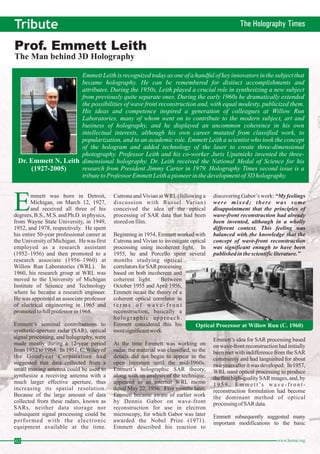
Dr. Emmett N. Leith 
holography. Dr. Leith received the National Medal of Science for his 
research from President Jimmy Carter in 1979. Holography Times second issue is a 
tribute to Professor Emmett Leith a pioneer in the development of3Dholography. 
02 www.homai.org (1927-2005) 
mmett was born in Detroit, 
EMichigan, on March 12, 1927, 
and received all three of his 
degrees, B.S.,M.S. and Ph.D. in physics, 
from Wayne State University, in 1949, 
1952, and 1978, respectively. He spent 
his entire 50-year professional career at 
theUniversity of Michigan. He was first 
employed as a research assistant 
(1952–1956) and then promoted to a 
research associate (1956–1960) at 
Willow Run Laboratories (WRL). In 
1960, his research group at WRL was 
moved to the University of Michigan 
Institute of Science and Technology 
where he became a research engineer. 
He was appointed an associate professor 
of electrical engineering in 1965 and 
promoted to full professor in 1968. 
Emmett’s seminal contributions to 
synthetic-aperture radar (SAR), optical 
signal processing, and holography, were 
made mostly during a 12-year period 
from 1952 to 1964. In 1951, C.Wiley of 
the Goodyear Corporation had 
suggested that data collected from a 
small moving antenna could be used to 
synthesize a receiving antenna with a 
much larger effective aperture, thus 
increasing its spatial resolution. 
Because of the large amount of data 
collected from these radars, known as 
SARs, neither data storage nor 
subsequent signal processing could be 
performed with the electronic 
equipment available at the time. 
Cutrona andVivian atWRL(following a 
discussion with Russel Varian) 
conceived the idea of the optical 
processing of SAR data that had been 
stored on film. 
Beginning in 1954, Emmett worked with 
Cutrona and Vivian to investigate optical 
processing using incoherent light. In 
1955, he and Porcello spent several 
months studying optical 
correlators forSARprocessing 
based on both incoherent and 
coherent light. Between 
October 1955 and April 1956, 
Emmett recast the theory of a 
coherent optical correlator in 
t e r m s o f wa v e - f r o n t 
reconstruction, basically a 
holographic approach. 
Emmett considered this his 
most significantwork. 
Optical Processor atWillow Run (C. 1960) 
At the time Emmett was working on 
radar, the material was classified, so the 
details did not begin to appear in the 
open literature until the mid-1960s. 
Emmett’s holographic SAR theory, 
along with an analysis of the technique, 
appeared as an internal WRL memo 
dated May 22, 1956. Five months later, 
Emmett became aware of earlier work 
by Dennis Gabor on wave-front 
reconstruction for use in electron 
microscopy, for which Gabor was later 
awarded the Nobel Prize (1971). 
Emmett described his reaction to 
discoveringGabor’s work: 
“My feelings 
were mixed; there was some 
disappointment that the principles of 
wave-front reconstruction had already 
been invented, although in a wholly 
different context. This feeling was 
balanced with the knowledge that the 
concept of wave-front reconstruction 
was significant enough to have been 
published in the scientific literature.” 
Emmett’s idea for SAR processing based 
on wave-front reconstruction had initially 
been met with indifference from the SAR 
community and had languished for about 
two years after it was developed. In 1957, 
WRL used optical processing to produce 
the first high-qualitySARimages, and, by 
1 9 5 9 , Emmett’s wa v e - f r o n t - 
reconstruction formulation had become 
the dominant method of optical 
processing ofSARdata. 
Emmett subsequently suggested many 
important modifications to the basic
The Holography Times Tribute 
optical-processingschemethat led tomajor 
improvements in radar performance. 
These modifications included 
simultaneous pulse compression and beam 
sharpening and the introduction (with 
Kozma and Massey) of a tilted-plane 
optical processor. The processing of SAR 
data by optical means remained the 
mainstay of the radar community until well 
into the 1980s when advances in electronic 
computing became available. Gabor’s 
concept of wave-front reconstruction had 
a number of serious deficiencies. In 
particular, i t only worked for 
reconstructing transparencies, and even 
then the quality of the reconstruction was 
limited by the presence of overlapping 
twin images. Between 1956 and 1960, 
Emmett pondered the solution to the twin-image 
problem even as he continued to 
workonSAR. 
When Juris Upatnieks joined the Radar 
and Optics Group at the University of 
Michigan in 1960, he and Emmett began 
working together on the twin-image 
problem, which, based on their 
experience with SAR, they recognized as 
a problem of aliasing. They developed 
the off-axis approach to obviate the twin-image 
problem and explained their 
method in terms of communication 
theory—AM carrier modulation, 
frequency spectrum, side-band filtering, 
etc. They demonstrated their off-axis 
technique by making high-quality 
holograms of grey-scale transparencies. 
Late in 1963, Emmett and Upatnieks 
introduced the technique of diffuse 
illumination to demonstrate the first 
high-quality holograms of three-dimensional 
objects. In Emmett’s own 
words: 
“We…found that the images 
formed from such holograms 
produced startling images, fully 3-D, 
without the need for viewing with 
special glasses, and had all of the 
usual properties of actual objects, 
including full parallax. One could 
move one’s head and peer ehind 
obscuring structures to see what 
was hidden behind, just as if one 
were viewing the actual objects.” 
When they presented their results 
publicly at theAnnual Optical Society 
of America Meeting in the spring of 
1964, they created quite a sensation. 
Emmett Leith was elected to the 
National Academy of Engineering in 
1982. In addition to this honor, he 
received many awards, including the 
National Medal of Science (1979), the 
IEEE Morris Liebmann Memorial 
Award (1968), the Stuart Ballantine 
Medal of the Franklin Institute (1969), 
the R.W. Wood Prize of the Optical 
Society of America (1975), the Frederic 
Ives Medal of the Optical Society of 
America (1985), and the Gold Medal of 
the SPIE (1990). Emmett supervised the 
research of 43 Ph.D. students at 
Michigan, and he regularly taught a 
variety of courses on basic optics and 
optical signal processing. 
Emmett’s work on SAR and 
holography had an enormous 
technical impact and was a major 
driving force in shaping the field of 
optical signal processing. In addition 
to his educational and scientific 
contributions, his work spurred many 
commercial applications that now 
comprise a multi-billion dollar 
industry. Emmett, a humble individual 
by nature, loved his work and 
remained active in his field until the 
time of his death. 
A W A R D M E M B E R & H O N O R S 
IEEE Morris N. Liebmann Memorial Award in 1960 
IEEE Morris Liebmann Memorial Award (1968) 
National Medal of Science in 1979 · 
Member National Academy of Engineering (1982) 
The Herbert Ives Medal of OSA in 1985 
The Progress Medal of the Royal Photographic 
Doctor of Science degree from University of Aberdeen 
Fellow of IEEE, SPIE and the Optical Society of 
Honorary member of the Engineering Society 
Member: National Academy of Engineering. 
By Professor KimWinick 
University of Michigan 
Ballantine Medal (1969) 
The Gold Medal of SPIE 
Society of Britain 
America 
(Detroit) 
EECS Dept., Univ. of Michigan Tel: 734-764-520,Ffax: 734-763-8041 
Email: winick@eecs.umich.edu 
www.homai.org 03
Face to Face The Holography Times 
Interview with 
04 www.homai.org How was Hologram Industries 
established? 
What were the problems you faced 
in your earlier stage and how you 
overcome them? 
What are the key features that 
make HI so successful? 
We also invest in communicating 
with our customers, trying to 
explain what we are doing, why we 
are doing is the interesting & why 
it is secure? 
Security, Innovation and Quality! 
What are the milestones achieved 
by Hologram Industries in last 23 
years? 
“HOLOGRAM INDUSTRIES” 
Well this is a long story. I started 
Hologram Industries in 1984. That 
was my second hologram company. I 
created the first hologram company in 
1981. The name of the first company 
was Media Laser. Media Laser was 
dedicated to silver-halide hologram. 
But at that time the market was little 
bit difficult so I have to stop it as we 
are not making any revenue out of the 
silver halide hologram. Then I stop 
holography for two years from 1982 to 
1984. In 1984 I created Hologram 
Industries with the goal to make both 
silver halide hologram and embossed 
holograms. Our first two year of 
activities was focus only on display 
hologram. Then we make silver halide 
hologram up to 1mmsquare.We make 
hologram, stereogram, animated 
stereogram and whatever, slowly by 
slowly we went into embossing and in 
1989 we began to work into security 
business. From 1993 we stop making 
display holography because of that 
time the communicating business was 
slowing down. So I decided in 1993 to 
concentrate on security & since then 
Hologram Industries is totally focused 
on security. 
Lot's of problems of course. 
Obviously technological problems 
in the beginning of 80's, when I 
started holography you could not 
buy any technology. You have to 
develop everything yourself. I was 
myself in the holographic lab 
developing the holographic table, 
all the process starting from 
scratch. Even after when I begin in 
embossed holography we have to 
develop our own technology. 
Obviously it was difficult from 
financial side, as I am not from a 
rich family. I had no much money 
to invest. So I had to start with very 
little money. Again we had to 
develop lot of things ourselves also 
because we don't have money to 
buy. The third was commercial. At 
the beginning holograms were not 
very well known and it was never 
the case customer came himself. 
Always we had to go see the 
Prospects customers and inform 
them about the hologram. Nobody 
was that time known what the 
hologram is and sometimes they 
were not heard the name of 
hologram. So it was some difficult 
period. Also because I was at that 
time, now we have the company 
which is larger because I could 
start with really nothing. Now days 
i t is more difficult to start 
holography with nothing. 
I think we always try to do our best. 
We always invested a lot in R & D. 
Basically I think that innovation & 
quality are the two key elements, 
and also now I can say Innovation, 
Quality & Security are the three 
elements as we are also operating in 
very secure environment. We 
always have been extremely careful 
about the security of our premises & 
the security of the procedures. 
First it was the beginning of 
in 
1984. After i t was the fi r s t 
involvement in to security in 1989, 
then the decision to concentrate all 
our activities on security in 1993. 
Then in 1998 we put the company 
public & then in the same year we 
w e r e a l s o s e l e c t e d b y t h e 
EUROPEAN CENTRAL BANK 
AGENCY for the origination of the 
Euro bank note. This was the first 
significant recognition of the 
technology that we had developed. 
And then in 2003 when we began to 
market the DID® feature which of 
course is a great technology. So far 
we are the only company offering the 
very high security feature like this. 
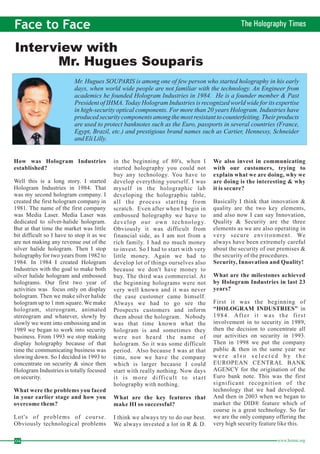
Mr. Hugues Souparis 
Mr. Hugues SOUPARIS is among one of few person who started holography in his early 
days, when world wide people are not familiar with the technology. An Engineer from 
academics he founded Hologram Industries in 1984. He is a founder member & Past 
President of IHMA. Today Hologram Industries is recognized world wide for its expertise 
in high-security optical components. For more than 20 years Hologram. Industries have 
produced security components among the most resistant to counterfeiting. Their products 
are used to protect banknotes such as the Euro, passports in several countries (France, 
Egypt, Brazil, etc.) and prestigious brand names such as Cartier, Hennessy, Schneider 
and Eli Lilly.
The Holography Times Face to Face 
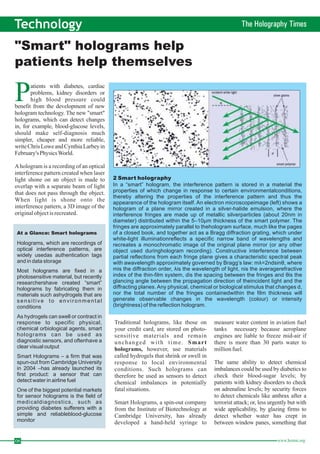
DID®- DID is a one-of-its-kind optical security element, very easily identifiable with the naked eye. It 
reproduces a design made up of two distinct colored elements made visible by direct reflection of light, and 
whose colors are inverted when it is rotated 90° in the plane. It is a zero-order optical microstructure 
combined with thin films.DID®elements are machine-readable and extremely difficult to copy. 
What do you think about the role of 
IHMAin promoting the holography? 
IHMA did play a great role, not 
directly in promoting holography 
because it is a too smaller organization 
to be capable to promote that 
technology worldwide. Nevertheless 
IHMA was very instrumental. 
Ian 
(General Secretary of IHMA) 
bringing together on the international 
level all the technical and commercial 
actor of holography and I thinks that it 
was extremely successful in giving to 
our industry some ethics, giving our 
industry some standard (not technical 
standard), but of course standard of 
behaviours. It is because of IHMAthat 
worldwide companies are known to 
each other. 
I think in a young 
industry like holography it has 
been extremely interesting to bring 
from beginning all the people 
together and have a common 
understanding of what we have in 
hand, what we can do and how we 
have to perfect in order to keep this 
technology the attitude of high tech 
and secure technology. 
Howdo you see the Indian market and 
hologramcompanies developing? 
around without a good structure & 
organization. I think India is an 
example for quite a lot of world in 
holography. I think that HoMAI is a 
very stronger organization. 
What do you think that Indian 
companies need to do be successful 
in European Market? 
What are the new developments 
Holograms Industries doing and 
the future plans for next five years? 
We have lot of development in pipe. 
I cannot reveal the development 
before they are launched obviously. 
We are developing both in ID side 
and in Brand Protection. We are 
developing new products, very 
different that industry has not seen 
so far. . So we have complete new 
generation of product under 
development which we will launch 
in 2 & 3 years. We are spending lot 
m o r e m o n e y i n R & D . 
HOLOGRAM INDUSTRIES was 
always known for R & D. From this 
year we are doubling it before 
it was. 
What is your budget forR&D? 
My budget for R & D is 7 % of my 
turnover. Now we have increased the 
budget to 15 % because turnover is 
increasing higher but definitely it 
will be 10%of budget. 
As a global leader in holography 
where do you think the future of 
holography? 
I know little bit of market about 
India. I visited to India several times 
for my own business. When I was the 
president of IHMA, often I have to 
meet a lot of Indian companies. I 
think that the Holography industry in 
India is very strong and well 
organized. Several Indian companies 
are capable of doing quality business 
& they are concern about the interest 
of the technology for India. India did 
very well. I think again the fact that 
HoMAI presence in India brings to 
Indian industry much better organize 
&much safer organization. 
Like for example; in china where 
there is no such organization and 
there all companies are working all 
Well that I will not tell you 
(Laughing). I don't want to have too 
many Indian companies coming to 
compete with us in Europe. I think 
that not specific to Europe, it's 
specific to be in Industry general. 
India companies have to be very 
much oriented in quality. Obviously 
it was the first attempt that we are 
seeing from Indian companies to 
attack the European Market. I do not 
believe this will be very successful, 
because what European market is 
requiring (I am talking only about 
security market) very high security 
product and the future will be on 
products which are really bringing 
very high security. If people are only 
selling regular metallised animated 
hologram, t h i s w i l l be n o t 
considering any more as high 
security product. The Optical 
technology can bring much more. 
What I am seeing from in India so far is 
mainly Industry leader in India, they 
know how to make embossed 
hologram, how to number it etc. So far I 
have not seen any developments in R & 
D in Indian those companies in optical 
technology. Most of the origination in 
India is using standard equipments, 
either dot-matrix or other type of table 
top equipments or the e-beam Master is 
purchasing from outside. Its very 
standard holography and I did not 
believe that this type of holography has 
a chance to be successful in rest of the 
world, because more and more security 
devices will be sophisticated than 
purely hologram labels. 
As I said the future of holography is 
without hologram. I well be very 
more precise and proactive. If we 
look at the hologram it is a metallic 
rainbow and I believe that this is not 
enough secure, any one can make 
hologram with little effort. I 
believe that there is a lot of future in 
optical security for overt, semi 
covert and overt technology but I 
believe that there i s l o t of 
innovation to make, to come in order 
to maintain our industry, which is 
not for me real holography but 
optical security. I think that going 
in that direction Optical security 
without restricting themselves to 
holography is successful. 
www.homai.org 05
Technology The Holography Times 
"Smart" holograms help 
patients help themselves 
atients with diabetes, cardiac 
Pproblems, kidney disorders or 
high blood pressure could 
06 www.homai.org benefit from the development of new 
hologram technology. The new "smart" 
holograms, which can detect changes 
in, for example, blood-glucose levels, 
should make self-diagnosis much 
simpler, cheaper and more reliable, 
write ChrisLoweand Cynthia Larbey in 
February'sPhysicsWorld. 
Ahologram is a recording of an optical 
interference pattern created when laser 
light shone on an object is made to 
overlap with a separate beam of light 
that does not pass through the object. 
When light is shone onto the 
interference pattern, a 3D image of the 
original object is recreated. 
Traditional holograms, like those on 
your credit card, are stored on photo-sensitive 
materials and remain 
unchanged with time. 
however, use materials 
called hydrogels that shrink or swell in 
response to local environmental 
conditions. Such holograms can 
therefore be used as sensors to detect 
chemical imbalances in potentially 
fatal situations. 
Smart Holograms, a spin-out company 
from the Institute of Biotechnology at 
Cambridge University, has already 
developed a hand-held syringe to 
measure water content in aviation fuel 
tanks necessary because aeroplane 
engines are liable to freeze mid-air if 
there is more than 30 parts water to 
million fuel. 
The same ability to detect chemical 
imbalances could be used by diabetics to 
check their blood-sugar levels; by 
patients with kidney disorders to check 
on adrenaline levels; by security forces 
to detect chemicals like anthrax after a 
terrorist attack; or, less urgently but with 
wide applicability, by glazing firms to 
detect whether water has crept in 
between window panes, something that 
Smart 
holograms, 
At a Glance: Smart holograms 
Holograms, which are recordings of 
optical interference patterns, are 
widely usedas authentication tags 
and in data storage 
Most holograms are fixed in a 
photosensitive material, but recently 
researchershave created “smart” 
holograms by fabricating them in 
materials such ashydrogels that are 
sensitive to environmental 
conditions 
As hydrogels can swell or contract in 
response to specific physical, 
chemical orbiological agents, smart 
holograms can be used as 
diagnostic sensors, and oftenhave a 
clear visual output 
Smart Holograms – a firm that was 
spun-out from Cambridge University 
in 2004 –has already launched its 
first product: a sensor that can 
detect water in airline fuel 
One of the biggest potential markets 
for sensor holograms is the field of 
medicaldiagnostics, such as 
providing diabetes sufferers with a 
simple and reliableblood-glucose 
monitor 
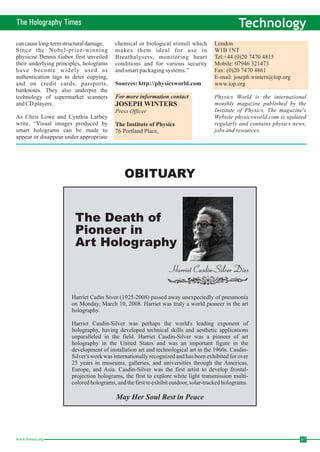
2 Smart holography 
In a “smart” hologram, the interference pattern is stored in a material the 
properties of which change in response to certain environmentalconditions, 
thereby altering the properties of the interference pattern and thus the 
appearance of the hologram itself. An electron microscopeimage (left) shows a 
hologram of a plane mirror created in a silver-halide emulsion, where the 
interference fringes are made up of metallic silverparticles (about 20nm in 
diameter) distributed within the 5–10μm thickness of the smart polymer. The 
fringes are approximately parallel to thehologram surface, much like the pages 
of a closed book, and together act as a Bragg diffraction grating, which under 
white-light illuminationreflects a specific narrow band of wavelengths and 
recreates a monochromatic image of the original plane mirror (or any other 
object used duringhologram recording). Constructive interference between 
partial reflections from each fringe plane gives a characteristic spectral peak 
with awavelength approximately governed by Bragg’s law: mλ=2ndsinθ, where 
mis the diffraction order, λis the wavelength of light, nis the averagerefractive 
index of the thin-film system, dis the spacing between the fringes and θis the 
glancing angle between the propagation direction of theincident light and the 
diffracting planes.Any physical, chemical or biological stimulus that changes d, 
nor the total number of the fringes containedwithin the film thickness will 
generate observable changes in the wavelength (colour) or intensity 
(brightness) of the reflection hologram.
The Holography Times Technology 
can cause long-term structural damage. 
Since the Nobel-prize-winning 
physicist Dennis Gabor first unveiled 
their underlying principles, holograms 
have become widely used as 
authentication tags to deter copying, 
and on credit cards, passports, 
banknotes. They also underpin the 
technology of supermarket scanners 
andCDplayers. 
As Chris Lowe and Cynthia Larbey 
write, “Visual images produced by 
smart holograms can be made to 
appear or disappear under appropriate 
chemical or biological stimuli which 
makes them ideal for use in 
Breathalysers, monitoring heart 
conditions and for various security 
and smart packaging systems.” 
Sources: http://physicsworld.com www.iop.org 
For more information contact 
JOSEPH WINTERS 
Press Officer 
The Institute of Physics 
76 Portland Place, 
London 
W1B 1NT 
Tel:+44 (0)20 7470 4815 
Mobile: 07946 321473 
Fax: (0)20 7470 4861 
E-mail: joseph.winters@iop.org 
Physics World is the international 
monthly magazine published by the 
Institute of Physics. The magazine's 
Website physicsworld.com is updated 
regularly and contains physics news, 
jobs and resources. 
OBITUARY 
The Death of 
Pioneer in 
Art Holography 
Harriet Casdin-SilverDies 
Harriet Cadin Siver (1925-2008) passed away unexpectedly of pneumonia 
on Monday, March 10, 2008. Harriet was truly a world pioneer in the art 
holography. 
Harriet Casdin-Silver was perhaps the world's leading exponent of 
holography, having developed technical skills and aesthetic applications 
unparalleled in the field. Harriet Casdin-Silver was a pioneer of art 
holography in the United States and was an important figure in the 
development of installation art and technological art in the 1960s. Casdin- 
Silver's work was internationally recognized and has been exhibited for over 
25 years in museums, galleries, and universities through the Americas, 
Europe, and Asia. Casdin-Silver was the first artist to develop frontal-projection 
holograms, the first to explore white light transmission multi-colored 
holograms, and the first to exhibit outdoor, solar-tracked holograms. 
May Her Soul Rest in Peace 
www.homai.org 07
Know Your Member The Holography Times 
Interview with Mr. Shobhit Arora 
Post Graduate in cost accounting from Agra University, Mr. Shobhit Arora has set up 
Giriraj Foils Pvt. Ltd.(GFPL) in 1993 in the holy city of VRINDAVAN, the land of Lord 
Krishna. Started with the stamping foil in 1993, GFPL produced tamper evident film 
for hologram industry in 1998. In these 15 years GFPL has emerged as one of the 
leading players in the manufacturing and distribution of premium grade hot stamping 
foil, holographic foils, film's and laminates segment. 08 www.homai.org How was GFPL established and what 
are the problems faced in initial stage? 
What roles do the GFPL play? What 
are the bouquets of products offered 
byGFPL? 
What are the key features that make 
GFPLso successful company in last 15 
years? 
What are the milestones, achieved by 
GFPLin last 15 years? 
What are new developments GFPL is 
doing for hologram industry? What 
would be your company's main focus 
in thenext 5 years? 
GFPL was my dream project. In 1993 
label manufacturers were importing 
stamping foil from outside India and they 
had to pay very high import duty. This 
encouraged us and we established GFPL 
in 1993 to produce stamping Foil in India. 
Within a shortspanof timewewereable to 
provide our customersgoodquality ofraw 
materials at reasonable price. The 
availability of good quality polyester in 
India alsoplayedacrucial role init. 
From 1993 to 1998, Iwas approached by 
few holographers to do similar 
developments for Hologram Industry in 
India. But at that time user group were 
not well-established, since every one had 
different specifications of embossing 
machines.We took this is as a challenge 
and in 1998, started producing tamper 
e v i d e n t f i l m s f o r hologram 
manufacturers. We continuously work 
on the theme “Bring us the problem, we 
customize the solution”. 
GFPL is amongst one of few companies 
to develop Hot Stamping Foil in India. 
Today GFPL is an ISO 9001:2000 
company and has emerged as one of the 
leading player in the films, foils and 
laminates segment and has made a great 
progress in improving qualities and 
developing new types of foils for various 
applications. 
GFPL product line includes a vast 
assortment of metallic silver, gold, 
copper, bronze, metalised foil, 
holographic foil and specially coated 
films. We produce pigmented and 
metalised heat transfers foils for a broad 
range of hot stamp decorating 
applications and industries. Our 
specialty films and foils come in a wide 
assortment of vivid solid colors and light 
polished metal appearances.We have 40 
different customized products in 18 
different colors. 
GFPL strength has been the hard work 
and fore sightedness of the promoters 
and their dedicated team, personalized 
and customized dealings and rapport 
with the Industry stalwarts, zeal for up 
gradation and finding innovative 
technologies to give customized solution 
to our customers. 
Our services are designed as per the 
need of our customers and the same 
have helped us in gaining the 
confidence and support from all of the 
leading hologram manufacturers in 
India. Due to their support and our 
efforts, today GFPL has achieved a 
sales turnover ofUS$ 3million. 
We at GFPL dedicate our growth & 
achievements to our esteemed & 
respected Patrons by whose support, 
guidance & dedication we have reached 
this stage. 
GFPL has created a forte in its arena 
since its inception and our achievements 
speak volume about our standing in the 
market. The first milestone was in 1998 
when we started producing tamper 
evident film for hologram industry. In 
2000 we introduced colored tamper and 
non-tamper evident film to the world of 
holograms. We had won HoMAI 
Excellency awards in 2006 for 
developing new innovative products for 
hologram industry. GFPL had also been 
awarded four times by the Indian 
Government for excellence in Industry. 
Today, GFPL has providing its 
customized solutions to 70% hologram 
manufacturers in India, With the 
capacity of providing 444.00 metric 
tonnes film for holograms and stamping 
foil and 165.00 metric tonnes flexible 
laminate. We have a market share of 
80%in tamper evident films in India. 
We are very much focusing on quality 
and customer satisfaction.With the new 
premises we are spending a capital 
expenditure of US $ 1 million for 
installing 4 head coating machine,1 
slitting machinewithweb cleaning ,UPS 
system fromAROS(Italy),AirHandling 
System for a total dust free 
manufacturing area. We believe in total 
quality management and our every 
product undergoes several quality tests. 
We are further planning to customize the 
stamping film. 
Our focus for the next 5 years is to 
consolidate our position in the domestic as 
well as in the International market.We are 
strengthening our marketing team to 
understand and to work more closely with 
the customers. Our total focus will be on 
development of new films for making 
quality holograms & we have no plans to 
start embossing or any other line at our 
manufacturing facilities. Our total focus 
lies on the film segment of this Security 
base Industry. We are also planning for 
few foreign technological tie-ups to 
furthermarketourproductsworldwide.
The Holography Times Counterfeiting 
2007 A Year of Deliberation, 
Diethylene and Dogs 
Gloom, doom and apprehension 
pervade the financial markets 
as 2007 draws to a close and 
pundits make predictions for the New 
Year. What though in the world of 
counterfeiting and piracy? In all 
probability another good year for those 
who ply this trade, but for enforcers and 
anti counterfeiting entities, what have 
been the high points been and what lies 
ahead in the coming year? 
For those involved in tackling the 
counterfeiting phenomenon, the year got 
off to a good start in January with the 
deliberations ofTheThirdGlobalCongress 
on Combating Counterfeiting and Piracy. 
Hosted by theWorld Intellectual Property 
Organisation(WIPO)inGeneva,morethan 
1200peoplecrammedinto the international 
conference centre, making it by far the 
largest event of its type held in any part of 
the world. Predictably it attracted the great 
and the good from all sectors of the anti 
counterfeiting industry and there were 
plenty of rallying cries for more to be done 
totackletheproblem,mostnotablyfromthe 
heads of WIPO, Interpol and the World 
CustomsOrganisation (WCO).There were 
too, no shortage of both old and new 
suggestions as to how the scourge of 
counterfeiting and piracy could best be 
tackled. Some of the themes covered 
included enhancing cooperation and 
coordination, promoting better legislation 
and enforcement, building capacity, raising 
awareness and health and safety issues. 
Despite the absence of consumer 
associations whose voice was not heard at 
this event, the huge numbers attending the 
Global Congress appear to suggest that anti 
counterfeiting interests worldwide are 
finallygetting togetherandthat there isnow 
at last a critical mass of high level figures 
across the world actively engaged on the 
issueandgrapplingwithpossiblesolutions. 
The next Global Congress will be 
hosted by the WCO in Dubai in 
February 2008. In many ways this is an 
inspired decision, making it the first 
time that the event has been held 
PETER LOWE 
Director-ICC Counterfeiting Intelligence Bureau (CIB) 
Maritime House, 1 Linton Road, Barking, 
Essex IG11 8HG, U.K. 
Tel: +44 20 8591 3000 Fax: +44 20 8594 2833 
Website: www.icc-ccs.org 
outside Europe and emphasising at the 
same time the growing economic and 
political importance of the Gulf States. 
No doubt this will provide an 
o p p o r t u n i t y t o examine the 
counterfeiting and piracy problem as it 
affects Middle Eastern markets and 
perhaps the day is not too far off when 
we will see the Global Congress held in 
a country where counterfeiting is 
endemic, such as China, but don't 
expect that to happen any time soon. 
China always features in any review of 
counterfeiting and piracy quite simply 
because it is by far the largest producer 
in the world of a whole range of fake 
products t h a t a r e consumed 
domestically and exported globally. 
This year China was once again much 
in the news in connection with a vast 
number of counterfeiting incidents. 
Most damaging were the food scares 
affecting a number of different 
products that form part of China's 
$30 billion food and drug export 
trade to North America, Asia and 
Europe each year. Concerns were 
raised when tainted Chinese pet food 
ingredients killed and sickened 
thousands of dogs and cats in the US 
resulting in the largest pet food recall 
in the country's history. 
USregulators also became worried that a 
number of Chinese companies were 
mixing the harmful industrial chemical 
melamine with wheat flour to artificially 
increase protein readings. Then there 
were further damaging revelations about 
a deadly cough syrup that caused the 
deaths of 100 people in Panama. 
Investigators discovered that glycerine 
which should have been in the syrup had 
been substituted in China for the cheaper 
poisonous alternative diethylene glycol. 
As if that was not bad enough, diethylene 
glycol was discovered in toothpaste 
exported from China to Panama, the 
Dominican Republic and Australia 
which in turn triggered a ban by the US 
Food and Drug Administration on 
imports of all toothpaste from China. 
With the safety of Chinese products very 
much in issue throughout the year it was 
perhaps unsurprising to that efforts 
would be made to find individuals to 
shoulder the blame and demonstrate that 
the government was actively addressing 
the situation. Zheng Xiaoyu, China's 
former chief food and drug regulatorwas 
certainly one of the fall guys. Found 
guilty of taking bribes to approve the sale 
of a number of fake drugs, hewas swiftly 
executed. This harsh sentence is a 
striking reminder of how the Chinese 
government deal with those who cause 
harm and damage the country's nameand 
reputation. A scapegoat perhaps, but 
certainly one to “encourager les autres” 
and a signal that even senior officials are 
notimmunefrom justice. 
Measuring the scale of counterfeiting 
has always been a hot topic and the 
keenly awaited report by the OECD in 
the middle of the year was broadly 
welcomed by all sections of the anti 
counterfeiting industry. It represents 
the most comprehensive and thorough 
investigation of the problem ever 
conducted and concluded that the 
international trade in tangible 
counterfeit products could be as much 
as $200 billion annually and the total 
www.homai.org 09
10 www.homai.org Counterfeiting The Holography Times magnitude could be several hundred 
billion dollars more when counterfeit 
and pirated products sold over the 
internet and those produced and sold 
domestically are included. This is 
probably not out of line with the figure 
of $600 billion which our own 
organisation believes to be a 
conservative estimate of the current 
global extent of the problem. 
Although we will never be able to 
measure the phenomenon accurately the 
OECD findings and conclusions are 
nevertheless helpful in the overall 
struggle especially since they state that 
the magnitude and effects of the problem 
are of such significance that they compel 
strong and sustained action from 
governments business and consumers. 
Perhaps reflecting this sentiment, theG8 
leaders when they met in Germany in 
June for their annual meeting, strongly 
reaffirmed their commitment to 
protecting intellectual property rights by 
combating piracy and counterfeiting. 
There were plenty of new initiatives and 
strategies throughout the year. One such 
was the launch of the International 
Authentication Association, bringing 
together a band of companies to promote 
the use of authentication technologies as 
an integral part of an effective strategy to 
protect products documents and their 
users from counterfeiting and fraud and to 
educate government agencies, brand 
owners and others as to the role and use of 
authentication. This comes at time when 
companies appear to be increasingly 
turning to advanced technologies to win 
back control of their brands and ward off 
accidents associated with fakes. Some of 
the latest anti counterfeiting technologies 
take advantage of advances in molecular 
science and technology enabling products 
to be injected with nanotracers, dyedwith 
invisible DNA markers or engraved with 
microscopiclaser etchings. 
Another interesting initiative was the 
launch of the “No trade in fakes supply 
chain tool kit” by the US Chamber of 
Commerce and the Coalition against 
Counterfeiting and Piracy. Posted on 
the web, the document highlights may 
proven strategies that companies use to 
protect their supply chains from 
counterfeiters and modern day pirates 
and includes case studies of aggressive 
techniques that leading companies have 
used to protect their brands. 
On the enforcement front, there were 
thousands of raids and huge seizures of 
counterfeit and pirated product in all 
corners of the world. During the year two 
black Labrador dogs, Lucky and Flo stole 
the limelight when they made their debut 
with dramatic effect in the anti 
counterfeitingarena...Trained inNorthern 
Ireland to sniff out pirate CD's and DVD's 
in hidden compartments, the dogs quickly 
proved their worth by sniffing out $3 
millionworth ofmovie and game discs in 
their first operation. This was soon 
followed by a further successes including 
finding a huge stash of pirated DVD and 
CD discs worth $430,000 in a secret 
compartment in a shop that had eluded a 
human enforcement raiding party. Stung 
bythese losses, pirates apparently put outa 
bounty for the capture or destructionof the 
two animals,which caused the authorities 
to tighten their security.With a tally of 26 
arrests and medals of commendation, the 
two dogs were recently transferred to the 
US where they spearheaded the first 
canine assisted bust in the country when 
premises in New York were raided and a 
substantial haul of fake DVD's were 
seized.We may expect Lucky and Flo and 
other canines to be even more active on 
further raids inthecomingyear. 
In Taiwan enforcers couldn't believe 
their luck when informants in two 
separate movie piracy rings reported 
each other to the Motion Picture 
Association hotline triggering raids 
which put both rings out of business and 
proving the old adage that there is no 
honour amongst thieves! 
There were too a number of unusual 
counterfeiting incidents during the year. 
These included Croatian truffles being 
smuggled in large quantities to Italy in 
order to be passed off as more expensive 
Alba truffles. Other unusual products 
counterfeited included guitars, ball 
bearings, marble, botox, eggs, caviar, 
tower crane sections and coal fly ash (a 
common ingredient in concrete)! The 
opportunism of counterfeiters knows no 
bounds and was once again in the news 
whenthey recentlylaunchedfakeversions 
of Apple's revolutionary iPhones in Asia 
even though the originals are not due to be 
put on the market there until 2008. The 
fakes or “iClones“as they are known look 
just like the real thing and are apparently 
two thirds of the price. It comes as no 
surprise that they are being produced in 
andaroundShenzheninChina. 
A curious tale of counterfeiting 
surfaced recently at a trial in England 
which proves that faking artistic 
works of art is far from a dying craft 
and involved a family that produced 
fake art and artefacts over a 
seventeen year period netting around 
£2 million. It was an unusual case for 
many reasons. The family comprised 
84 year old George Greenhalgh, his 
83 year old wife and their 47 year old 
son Shaun who operated out of a 
council house in Bolton. Their 
speciality was producing counterfeit 
works of art including sculpture and 
antiquities going back to Egyptian 
and Roman times, paintings and 
other works of art. Shaun, a failed 
artist, did most of the work while his 
father, by all accounts a superb 
salesman passed them off to the art 
world who amazingly were taken in. 
The fact that this family were able to 
fool the art world for so long was put 
down to the diversity of the forgeries 
that they produced 
Finally on a personal note 2007 was the 
year that the counterfeiters finally got to 
me or more precisely to my credit card. 
Having implanted a device into the card 
reader at a local petrol station which 
read the magnetic stripe information 
and captured my pin number, at least 
two fake versions of my card were 
created. These were then used rapidly in 
Canada and India, where chip and pin is 
not widely adopted, to make multiple 
cash withdrawals leaving me nursing a 
loss of some £4,500. Fortunately my 
bank was both sympathetic and 
cooperative and reimbursed me without 
too much trouble but others are 
sometimes not so lucky. Whilst 
grateful, I am much more wary, it's a 
reminder that counterfeiting is not a 
victimless crime and vigilance is 
always very much the order of the day. 
Recession or not, another interesting 
anti counterfeiting year lies ahead!
The Holography Times Industry Updates 
News Bytes 
CURRENCY 
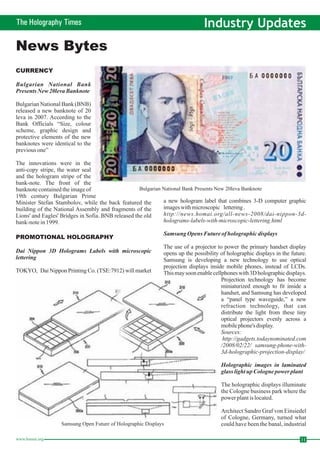
Bulgarian National Bank 
PresentsNew20leva Banknote 
Bulgarian National Bank (BNB) 
released a new banknote of 20 
leva in 2007. According to the 
Bank Officials “Size, colour 
scheme, graphic design and 
protective elements of the new 
banknotes were identical to the 
previous one” 
The innovations were in the 
anti-copy stripe, the water seal 
and the hologram stripe of the 
bank-note. The front of the 
banknote contained the image of 
19th century Bulgarian Prime 
Minister Stefan Stambolov, while the back featured the 
building of the National Assembly and fragments of the 
Lions' and Eagles' Bridges in Sofia. BNB released the old 
bank-note in 1999. 
PROMOTIONAL HOLOGRAPHY 
Bulgarian National Bank Presents New 20leva Banknote 
Dai Nippon 3D Holograms Labels with microscopic 
lettering 
a new hologram label that combines 3-D computer graphic 
images with microscopic lettering . 
http://news.homai.org/all-news-2008/dai-nippon-3d-holograms- 
labels-with-microscopic-lettering.html 
Samsung Opens Future of holographic displays 
The use of a projector to power the primary handset display 
opens up the possibility of holographic displays in the future. 
Samsung is developing a new technology to use optical 
projection displays inside mobile phones, instead of LCDs. 
Thismaysoon enable cellphoneswith 3Dholographic displays. 
Projection technology has become 
miniaturized enough to fit inside a 
handset, and Samsung has developed 
a “panel type waveguide,” a new 
refraction technology, that can 
distribute the light from these tiny 
optical projectors evenly across a 
mobile phone's display. 
Sources: 
http://gadgets.todaynominated.com 
/2008/02/22/ samsung-phone-with- 
3d-holographic-projection-display/ 
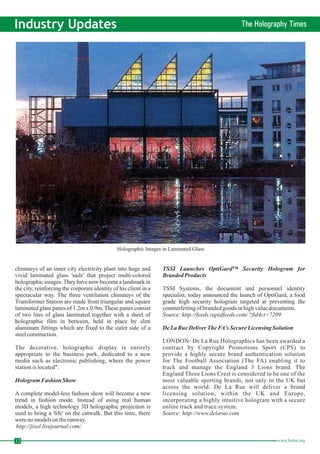
Holographic images in laminated 
glass light upCologne power plant 
TOKYO, DaiNippon Printing Co. (TSE:7912) will market 
The holographic displays illuminate 
the Cologne business park where the 
power plant is located. 
Architect Sandro Graf von Einsiedel 
of Cologne, Germany, turned what 
could have been the banal, industrial 
Samsung Open Future of Holographic Displays 
www.homai.org 11
12 www.homai.org Industry Updates The Holography Times Holographic Images in Laminated Glass 
chimneys of an inner city electricity plant into huge and 
vivid laminated glass 'sails' that project multi-colored 
holographic images. They have now become a landmark in 
the city, reinforcing the corporate identity of his client in a 
spectacular way. The three ventilation chimneys of the 
Transformer Station are made from triangular and square 
laminated glass panes of 1.2m x 0.9m. These panes consist 
of two lites of glass laminated together with a sheet of 
holographic film in between, held in place by slim 
aluminum fittings which are fixed to the outer side of a 
steel construction. 
The decorative, holographic display is entirely 
appropriate to the business park, dedicated to a new 
media such as electronic publishing, where the power 
station is located". 
A complete model-less fashion show will become a new 
trend in fashion mode. Instead of using real human 
models, a high technology 3D holographic projection is 
used to bring a 'life' on the catwalk. But this time, there 
were no models on the runway. 
TSSI Systems, the document and personnel identity 
specialist, today announced the launch of OptiGard, a food 
grade high security hologram targeted at preventing the 
counterfeiting of branded goods or high value documents. 
LONDON- De La Rue Holographics has been awarded a 
contract by Copyright Promotions Sport (CPS) to 
provide a highly secure brand authentication solution 
for The Football Association (The FA) enabling it to 
track and manage the England 3 Lions brand. The 
England Three Lions Crest is considered to be one of the 
most valuable sporting brands, not only in the UK but 
across the world. De La Rue will deliver a brand 
licensing solution, within the UK and Europe, 
incorporating a highly intuitive hologram with a secure 
online track and trace system. 
Hologram Fashion Show 
TSSI Launches OptiGard™ Security Hologram for 
Branded Products 
De La Rue Deliver TheFA's Secure Licensing Solution 
http://jixel.livejournal.com/ 
Source: http://feeds.rapidfeeds.com/ ?fid4ct=7209 
Source: http://www.delarue.com
The Holography Times Industry Updates 
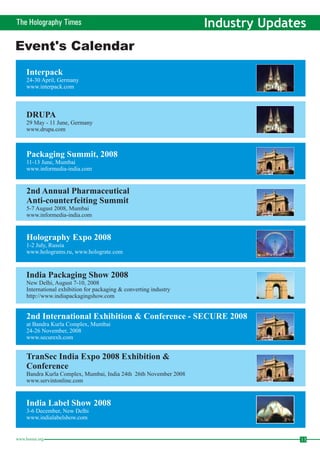
Event's Calendar 
Interpack 
24-30 April, Germany 
www.interpack.com 
DRUPA 
29 May - 11 June, Germany 
www.drupa.com 
Packaging Summit, 2008 
11-13 June, Mumbai 
www.informedia-india.com 
2nd Annual Pharmaceutical 
Anti-counterfeiting Summit 
5-7 August 2008, Mumbai 
www.informedia-india.com 
Holography Expo 2008 
1-2 July, Russia 
www.holograms.ru, www.holograte.com 
India Packaging Show 2008 
New Delhi, August 7-10, 2008 
International exhibition for packaging & converting industry 
http://www.indiapackagingshow.com 
2nd International Exhibition & Conference - SECURE 2008 
at Bandra Kurla Complex, Mumbai 
24-26 November, 2008 
www.securexh.com 
TranSec India Expo 2008 Exhibition & 
Conference 
Bandra Kurla Complex, Mumbai, India 24th 26th November 2008 
www.servintonline.com 
India Label Show 2008 
3-6 December, New Delhi 
www.indialabelshow.com 
www.homai.org 13
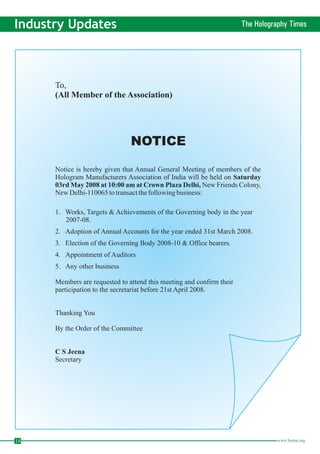
14 www.homai.org Industry Updates The Holography Times To, 
(All Member of the Association) 
NOTICE 
Notice is hereby given that Annual General Meeting of members of the 
Hologram Manufacturers Association of India will be held on 
New Friends Colony, 
NewDelhi-110065 to transact the following business: 
1. Works, Targets &Achievements of the Governing body in the year 
2007-08. 
2. Adoption of Annual Accounts for the year ended 31st March 2008. 
3. Election of the Governing Body 2008-10 & Office bearers. 
4. Appointment of Auditors 
5. Any other business 
Members are requested to attend this meeting and confirm their 
participation to the secretariat before 21st April 2008. 
Thanking You 
By the Order of the Committee 
Secretary 
Saturday 
03rdMay 2008 at 10:00 am at Crown Plaza Delhi, 
C S Jeena
The Holography Times Industry Updates 
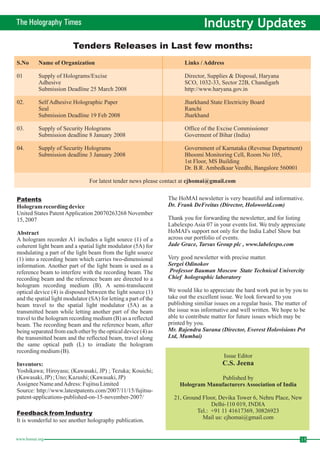
Tenders Releases in Last few months: 
S.No Name of Organization Links / Address 
01 Supply of Holograms/Excise Director, Supplies & Disposal, Haryana 
Adhesive SCO, 1032-33, Sector 22B, Chandigarh 
Submission Deadline 25 March 2008 http://www.haryana.gov.in 
02. Self Adhesive Holographic Paper Jharkhand State Electricity Board 
Seal Ranchi 
Submission Deadline 19 Feb 2008 Jharkhand 
03. Supply of Security Holograms Office of the Excise Commissioner 
Submission deadline 8 January 2008 Goverment of Bihar (India) 
04. Supply of Security Holograms Government of Karnataka (Revenue Department) 
Submission deadline 3 January 2008 Bhoomi Monitoring Cell, Room No 105, 
1st Floor, MS Building 
Dr. B.R. Ambedkaar Veedhi, Bangalore 560001 
cjhomai@gmail.com 
For latest tender news please contact at 
Patents 
Hologram recording device 
United States Patent Application 20070263268 November 
15, 2007 
Abstract 
A hologram recorder A1 includes a light source (1) of a 
coherent light beam and a spatial light modulator (5A) for 
modulating a part of the light beam from the light source 
(1) into a recording beam which carries two-dimensional 
information. Another part of the light beam is used as a 
reference beam to interfere with the recording beam. The 
recording beam and the reference beam are directed to a 
hologram recording medium (B). A semi-translucent 
optical device (4) is disposed between the light source (1) 
and the spatial light modulator (SA) for letting a part of the 
beam travel to the spatial light modulator (5A) as a 
transmitted beam while letting another part of the beam 
travel to the hologram recording medium (B) as a reflected 
beam. The recording beam and the reference beam, after 
being separated from each other by the optical device (4) as 
the transmitted beam and the reflected beam, travel along 
the same optical path (L) to irradiate the hologram 
recording medium (B). 
Inventors: 
Yoshikawa; Hiroyasu; (Kawasaki, JP) ; Tezuka; Kouichi; 
(Kawasaki, JP) ; Uno; Kazushi; (Kawasaki, JP) 
Assignee Name andAdress: Fujitsu Limited 
Source: http://www.latestpatents.com/2007/11/15/fujitsu-patent- 
applications-published-on-15-november-2007/ 
Feedback fromIndustry 
The HoMAI newsletter is very beautiful and informative. 
Dr. Frank DeFreitas (Director, Holoworld.com) 
Thank you for forwarding the newsletter, and for listing 
Labelexpo Asia 07 in your events list.We truly appreciate 
HoMAI's support not only for the India Label Show but 
across our portfolio of events. 
Jade Grace, Tarsus Group plc , www.labelexpo.com 
Very good newsletter with precise matter. 
Sergei Odinokov 
Professor Bauman Moscow State Technical Univercity 
Chief holographic laboratory 
We would like to appreciate the hard work put in by you to 
take out the excellent issue.We look forward to you 
publishing similiar issues on a regular basis. The matter of 
the issue was informative and well written.We hope to be 
able to contribute matter for future issues which may be 
printed by you. 
Mr. Rajendra Surana (Director, Everest Holovisions Pvt 
Ltd, Mumbai) 
Issue Editor 
C.S. Jeena 
Published by 
Hologram Manufacturers Association of India 
It is wonderful to see another holography publication. 
21, Ground Floor, Devika Tower 6, Nehru Place, New 
Delhi-110 019, INDIA 
Tel.: +91 11 41617369, 30826923 
Mail us: cjhomai@gmail.com 
www.homai.org 15
The Holography Times, March 2008, Volume 1, Issue 2

The Holography Times, March 2008, Volume 1, Issue 2

  • 1.
    The Holography Times March 2008 Vol 1 No. 2 www.homai.org EENDEEAVORTTOSAFFEEGUARDPRODUCTTS&PEEOPLLEE 60 A CELEBRATION OF YEARS HOLOGRAPHY By Professor Kim Winick Interview with Mr. Hugues Souparis (Hologram Industries) "Smart" holograms help patients help themselves Interview with Mr. Shobhit Arora (Giriraj Foils Pvt. Ltd.) By Mr. Peter Lowe Holography times is a free newsletter published quarterly by HoMAI. TM Inside focus source: www.ihma.org Tribute to Prof. Emmett Leith 2-3 Face to Face 4-5 Technology 6-7 Obituary 7 Know your member 8 Counterfeiting 2007 A Year of... 9-10 Industry Updates 11-15 News Bytes • Tenders • Events & Conferences • Patents in Holography
  • 2.
    Tribute The HolographyTimes Prof. Emmett Leith The Man behind 3D Holography Emmett Leith is recognized today as one of a handful of key innovators in the subject that became holography. He can be remembered for distinct accomplishments and attributes. During the 1950s, Leith played a crucial role in synthesizing a new subject from previously quite separate ones. During the early 1960s he dramatically extended the possibilities of wave front reconstruction and, with equal modesty, publicized them. His ideas and competence inspired a generation of colleagues at Willow Run Laboratories, many of whom went on to contribute to the modern subject, art and business of holography, and he displayed an uncommon coherence in his own intellectual interests, although his own career mutated from classified work, to popularization, and to an academic role. Emmett Leith a scientist who took the concept of the hologram and added technology of the laser to create three-dimensional photography. Professor Leith and his co-worker Juris Upatnieks invented the three-dimensional Dr. Emmett N. Leith holography. Dr. Leith received the National Medal of Science for his research from President Jimmy Carter in 1979. Holography Times second issue is a tribute to Professor Emmett Leith a pioneer in the development of3Dholography. 02 www.homai.org (1927-2005) mmett was born in Detroit, EMichigan, on March 12, 1927, and received all three of his degrees, B.S.,M.S. and Ph.D. in physics, from Wayne State University, in 1949, 1952, and 1978, respectively. He spent his entire 50-year professional career at theUniversity of Michigan. He was first employed as a research assistant (1952–1956) and then promoted to a research associate (1956–1960) at Willow Run Laboratories (WRL). In 1960, his research group at WRL was moved to the University of Michigan Institute of Science and Technology where he became a research engineer. He was appointed an associate professor of electrical engineering in 1965 and promoted to full professor in 1968. Emmett’s seminal contributions to synthetic-aperture radar (SAR), optical signal processing, and holography, were made mostly during a 12-year period from 1952 to 1964. In 1951, C.Wiley of the Goodyear Corporation had suggested that data collected from a small moving antenna could be used to synthesize a receiving antenna with a much larger effective aperture, thus increasing its spatial resolution. Because of the large amount of data collected from these radars, known as SARs, neither data storage nor subsequent signal processing could be performed with the electronic equipment available at the time. Cutrona andVivian atWRL(following a discussion with Russel Varian) conceived the idea of the optical processing of SAR data that had been stored on film. Beginning in 1954, Emmett worked with Cutrona and Vivian to investigate optical processing using incoherent light. In 1955, he and Porcello spent several months studying optical correlators forSARprocessing based on both incoherent and coherent light. Between October 1955 and April 1956, Emmett recast the theory of a coherent optical correlator in t e r m s o f wa v e - f r o n t reconstruction, basically a holographic approach. Emmett considered this his most significantwork. Optical Processor atWillow Run (C. 1960) At the time Emmett was working on radar, the material was classified, so the details did not begin to appear in the open literature until the mid-1960s. Emmett’s holographic SAR theory, along with an analysis of the technique, appeared as an internal WRL memo dated May 22, 1956. Five months later, Emmett became aware of earlier work by Dennis Gabor on wave-front reconstruction for use in electron microscopy, for which Gabor was later awarded the Nobel Prize (1971). Emmett described his reaction to discoveringGabor’s work: “My feelings were mixed; there was some disappointment that the principles of wave-front reconstruction had already been invented, although in a wholly different context. This feeling was balanced with the knowledge that the concept of wave-front reconstruction was significant enough to have been published in the scientific literature.” Emmett’s idea for SAR processing based on wave-front reconstruction had initially been met with indifference from the SAR community and had languished for about two years after it was developed. In 1957, WRL used optical processing to produce the first high-qualitySARimages, and, by 1 9 5 9 , Emmett’s wa v e - f r o n t - reconstruction formulation had become the dominant method of optical processing ofSARdata. Emmett subsequently suggested many important modifications to the basic
  • 3.
    The Holography TimesTribute optical-processingschemethat led tomajor improvements in radar performance. These modifications included simultaneous pulse compression and beam sharpening and the introduction (with Kozma and Massey) of a tilted-plane optical processor. The processing of SAR data by optical means remained the mainstay of the radar community until well into the 1980s when advances in electronic computing became available. Gabor’s concept of wave-front reconstruction had a number of serious deficiencies. In particular, i t only worked for reconstructing transparencies, and even then the quality of the reconstruction was limited by the presence of overlapping twin images. Between 1956 and 1960, Emmett pondered the solution to the twin-image problem even as he continued to workonSAR. When Juris Upatnieks joined the Radar and Optics Group at the University of Michigan in 1960, he and Emmett began working together on the twin-image problem, which, based on their experience with SAR, they recognized as a problem of aliasing. They developed the off-axis approach to obviate the twin-image problem and explained their method in terms of communication theory—AM carrier modulation, frequency spectrum, side-band filtering, etc. They demonstrated their off-axis technique by making high-quality holograms of grey-scale transparencies. Late in 1963, Emmett and Upatnieks introduced the technique of diffuse illumination to demonstrate the first high-quality holograms of three-dimensional objects. In Emmett’s own words: “We…found that the images formed from such holograms produced startling images, fully 3-D, without the need for viewing with special glasses, and had all of the usual properties of actual objects, including full parallax. One could move one’s head and peer ehind obscuring structures to see what was hidden behind, just as if one were viewing the actual objects.” When they presented their results publicly at theAnnual Optical Society of America Meeting in the spring of 1964, they created quite a sensation. Emmett Leith was elected to the National Academy of Engineering in 1982. In addition to this honor, he received many awards, including the National Medal of Science (1979), the IEEE Morris Liebmann Memorial Award (1968), the Stuart Ballantine Medal of the Franklin Institute (1969), the R.W. Wood Prize of the Optical Society of America (1975), the Frederic Ives Medal of the Optical Society of America (1985), and the Gold Medal of the SPIE (1990). Emmett supervised the research of 43 Ph.D. students at Michigan, and he regularly taught a variety of courses on basic optics and optical signal processing. Emmett’s work on SAR and holography had an enormous technical impact and was a major driving force in shaping the field of optical signal processing. In addition to his educational and scientific contributions, his work spurred many commercial applications that now comprise a multi-billion dollar industry. Emmett, a humble individual by nature, loved his work and remained active in his field until the time of his death. A W A R D M E M B E R & H O N O R S IEEE Morris N. Liebmann Memorial Award in 1960 IEEE Morris Liebmann Memorial Award (1968) National Medal of Science in 1979 · Member National Academy of Engineering (1982) The Herbert Ives Medal of OSA in 1985 The Progress Medal of the Royal Photographic Doctor of Science degree from University of Aberdeen Fellow of IEEE, SPIE and the Optical Society of Honorary member of the Engineering Society Member: National Academy of Engineering. By Professor KimWinick University of Michigan Ballantine Medal (1969) The Gold Medal of SPIE Society of Britain America (Detroit) EECS Dept., Univ. of Michigan Tel: 734-764-520,Ffax: 734-763-8041 Email: winick@eecs.umich.edu www.homai.org 03
  • 4.
    Face to FaceThe Holography Times Interview with 04 www.homai.org How was Hologram Industries established? What were the problems you faced in your earlier stage and how you overcome them? What are the key features that make HI so successful? We also invest in communicating with our customers, trying to explain what we are doing, why we are doing is the interesting & why it is secure? Security, Innovation and Quality! What are the milestones achieved by Hologram Industries in last 23 years? “HOLOGRAM INDUSTRIES” Well this is a long story. I started Hologram Industries in 1984. That was my second hologram company. I created the first hologram company in 1981. The name of the first company was Media Laser. Media Laser was dedicated to silver-halide hologram. But at that time the market was little bit difficult so I have to stop it as we are not making any revenue out of the silver halide hologram. Then I stop holography for two years from 1982 to 1984. In 1984 I created Hologram Industries with the goal to make both silver halide hologram and embossed holograms. Our first two year of activities was focus only on display hologram. Then we make silver halide hologram up to 1mmsquare.We make hologram, stereogram, animated stereogram and whatever, slowly by slowly we went into embossing and in 1989 we began to work into security business. From 1993 we stop making display holography because of that time the communicating business was slowing down. So I decided in 1993 to concentrate on security & since then Hologram Industries is totally focused on security. Lot's of problems of course. Obviously technological problems in the beginning of 80's, when I started holography you could not buy any technology. You have to develop everything yourself. I was myself in the holographic lab developing the holographic table, all the process starting from scratch. Even after when I begin in embossed holography we have to develop our own technology. Obviously it was difficult from financial side, as I am not from a rich family. I had no much money to invest. So I had to start with very little money. Again we had to develop lot of things ourselves also because we don't have money to buy. The third was commercial. At the beginning holograms were not very well known and it was never the case customer came himself. Always we had to go see the Prospects customers and inform them about the hologram. Nobody was that time known what the hologram is and sometimes they were not heard the name of hologram. So it was some difficult period. Also because I was at that time, now we have the company which is larger because I could start with really nothing. Now days i t is more difficult to start holography with nothing. I think we always try to do our best. We always invested a lot in R & D. Basically I think that innovation & quality are the two key elements, and also now I can say Innovation, Quality & Security are the three elements as we are also operating in very secure environment. We always have been extremely careful about the security of our premises & the security of the procedures. First it was the beginning of in 1984. After i t was the fi r s t involvement in to security in 1989, then the decision to concentrate all our activities on security in 1993. Then in 1998 we put the company public & then in the same year we w e r e a l s o s e l e c t e d b y t h e EUROPEAN CENTRAL BANK AGENCY for the origination of the Euro bank note. This was the first significant recognition of the technology that we had developed. And then in 2003 when we began to market the DID® feature which of course is a great technology. So far we are the only company offering the very high security feature like this. Mr. Hugues Souparis Mr. Hugues SOUPARIS is among one of few person who started holography in his early days, when world wide people are not familiar with the technology. An Engineer from academics he founded Hologram Industries in 1984. He is a founder member & Past President of IHMA. Today Hologram Industries is recognized world wide for its expertise in high-security optical components. For more than 20 years Hologram. Industries have produced security components among the most resistant to counterfeiting. Their products are used to protect banknotes such as the Euro, passports in several countries (France, Egypt, Brazil, etc.) and prestigious brand names such as Cartier, Hennessy, Schneider and Eli Lilly.
  • 5.
    The Holography TimesFace to Face DID®- DID is a one-of-its-kind optical security element, very easily identifiable with the naked eye. It reproduces a design made up of two distinct colored elements made visible by direct reflection of light, and whose colors are inverted when it is rotated 90° in the plane. It is a zero-order optical microstructure combined with thin films.DID®elements are machine-readable and extremely difficult to copy. What do you think about the role of IHMAin promoting the holography? IHMA did play a great role, not directly in promoting holography because it is a too smaller organization to be capable to promote that technology worldwide. Nevertheless IHMA was very instrumental. Ian (General Secretary of IHMA) bringing together on the international level all the technical and commercial actor of holography and I thinks that it was extremely successful in giving to our industry some ethics, giving our industry some standard (not technical standard), but of course standard of behaviours. It is because of IHMAthat worldwide companies are known to each other. I think in a young industry like holography it has been extremely interesting to bring from beginning all the people together and have a common understanding of what we have in hand, what we can do and how we have to perfect in order to keep this technology the attitude of high tech and secure technology. Howdo you see the Indian market and hologramcompanies developing? around without a good structure & organization. I think India is an example for quite a lot of world in holography. I think that HoMAI is a very stronger organization. What do you think that Indian companies need to do be successful in European Market? What are the new developments Holograms Industries doing and the future plans for next five years? We have lot of development in pipe. I cannot reveal the development before they are launched obviously. We are developing both in ID side and in Brand Protection. We are developing new products, very different that industry has not seen so far. . So we have complete new generation of product under development which we will launch in 2 & 3 years. We are spending lot m o r e m o n e y i n R & D . HOLOGRAM INDUSTRIES was always known for R & D. From this year we are doubling it before it was. What is your budget forR&D? My budget for R & D is 7 % of my turnover. Now we have increased the budget to 15 % because turnover is increasing higher but definitely it will be 10%of budget. As a global leader in holography where do you think the future of holography? I know little bit of market about India. I visited to India several times for my own business. When I was the president of IHMA, often I have to meet a lot of Indian companies. I think that the Holography industry in India is very strong and well organized. Several Indian companies are capable of doing quality business & they are concern about the interest of the technology for India. India did very well. I think again the fact that HoMAI presence in India brings to Indian industry much better organize &much safer organization. Like for example; in china where there is no such organization and there all companies are working all Well that I will not tell you (Laughing). I don't want to have too many Indian companies coming to compete with us in Europe. I think that not specific to Europe, it's specific to be in Industry general. India companies have to be very much oriented in quality. Obviously it was the first attempt that we are seeing from Indian companies to attack the European Market. I do not believe this will be very successful, because what European market is requiring (I am talking only about security market) very high security product and the future will be on products which are really bringing very high security. If people are only selling regular metallised animated hologram, t h i s w i l l be n o t considering any more as high security product. The Optical technology can bring much more. What I am seeing from in India so far is mainly Industry leader in India, they know how to make embossed hologram, how to number it etc. So far I have not seen any developments in R & D in Indian those companies in optical technology. Most of the origination in India is using standard equipments, either dot-matrix or other type of table top equipments or the e-beam Master is purchasing from outside. Its very standard holography and I did not believe that this type of holography has a chance to be successful in rest of the world, because more and more security devices will be sophisticated than purely hologram labels. As I said the future of holography is without hologram. I well be very more precise and proactive. If we look at the hologram it is a metallic rainbow and I believe that this is not enough secure, any one can make hologram with little effort. I believe that there is a lot of future in optical security for overt, semi covert and overt technology but I believe that there i s l o t of innovation to make, to come in order to maintain our industry, which is not for me real holography but optical security. I think that going in that direction Optical security without restricting themselves to holography is successful. www.homai.org 05
  • 6.
    Technology The HolographyTimes "Smart" holograms help patients help themselves atients with diabetes, cardiac Pproblems, kidney disorders or high blood pressure could 06 www.homai.org benefit from the development of new hologram technology. The new "smart" holograms, which can detect changes in, for example, blood-glucose levels, should make self-diagnosis much simpler, cheaper and more reliable, write ChrisLoweand Cynthia Larbey in February'sPhysicsWorld. Ahologram is a recording of an optical interference pattern created when laser light shone on an object is made to overlap with a separate beam of light that does not pass through the object. When light is shone onto the interference pattern, a 3D image of the original object is recreated. Traditional holograms, like those on your credit card, are stored on photo-sensitive materials and remain unchanged with time. however, use materials called hydrogels that shrink or swell in response to local environmental conditions. Such holograms can therefore be used as sensors to detect chemical imbalances in potentially fatal situations. Smart Holograms, a spin-out company from the Institute of Biotechnology at Cambridge University, has already developed a hand-held syringe to measure water content in aviation fuel tanks necessary because aeroplane engines are liable to freeze mid-air if there is more than 30 parts water to million fuel. The same ability to detect chemical imbalances could be used by diabetics to check their blood-sugar levels; by patients with kidney disorders to check on adrenaline levels; by security forces to detect chemicals like anthrax after a terrorist attack; or, less urgently but with wide applicability, by glazing firms to detect whether water has crept in between window panes, something that Smart holograms, At a Glance: Smart holograms Holograms, which are recordings of optical interference patterns, are widely usedas authentication tags and in data storage Most holograms are fixed in a photosensitive material, but recently researchershave created “smart” holograms by fabricating them in materials such ashydrogels that are sensitive to environmental conditions As hydrogels can swell or contract in response to specific physical, chemical orbiological agents, smart holograms can be used as diagnostic sensors, and oftenhave a clear visual output Smart Holograms – a firm that was spun-out from Cambridge University in 2004 –has already launched its first product: a sensor that can detect water in airline fuel One of the biggest potential markets for sensor holograms is the field of medicaldiagnostics, such as providing diabetes sufferers with a simple and reliableblood-glucose monitor 2 Smart holography In a “smart” hologram, the interference pattern is stored in a material the properties of which change in response to certain environmentalconditions, thereby altering the properties of the interference pattern and thus the appearance of the hologram itself. An electron microscopeimage (left) shows a hologram of a plane mirror created in a silver-halide emulsion, where the interference fringes are made up of metallic silverparticles (about 20nm in diameter) distributed within the 5–10μm thickness of the smart polymer. The fringes are approximately parallel to thehologram surface, much like the pages of a closed book, and together act as a Bragg diffraction grating, which under white-light illuminationreflects a specific narrow band of wavelengths and recreates a monochromatic image of the original plane mirror (or any other object used duringhologram recording). Constructive interference between partial reflections from each fringe plane gives a characteristic spectral peak with awavelength approximately governed by Bragg’s law: mλ=2ndsinθ, where mis the diffraction order, λis the wavelength of light, nis the averagerefractive index of the thin-film system, dis the spacing between the fringes and θis the glancing angle between the propagation direction of theincident light and the diffracting planes.Any physical, chemical or biological stimulus that changes d, nor the total number of the fringes containedwithin the film thickness will generate observable changes in the wavelength (colour) or intensity (brightness) of the reflection hologram.
  • 7.
    The Holography TimesTechnology can cause long-term structural damage. Since the Nobel-prize-winning physicist Dennis Gabor first unveiled their underlying principles, holograms have become widely used as authentication tags to deter copying, and on credit cards, passports, banknotes. They also underpin the technology of supermarket scanners andCDplayers. As Chris Lowe and Cynthia Larbey write, “Visual images produced by smart holograms can be made to appear or disappear under appropriate chemical or biological stimuli which makes them ideal for use in Breathalysers, monitoring heart conditions and for various security and smart packaging systems.” Sources: http://physicsworld.com www.iop.org For more information contact JOSEPH WINTERS Press Officer The Institute of Physics 76 Portland Place, London W1B 1NT Tel:+44 (0)20 7470 4815 Mobile: 07946 321473 Fax: (0)20 7470 4861 E-mail: joseph.winters@iop.org Physics World is the international monthly magazine published by the Institute of Physics. The magazine's Website physicsworld.com is updated regularly and contains physics news, jobs and resources. OBITUARY The Death of Pioneer in Art Holography Harriet Casdin-SilverDies Harriet Cadin Siver (1925-2008) passed away unexpectedly of pneumonia on Monday, March 10, 2008. Harriet was truly a world pioneer in the art holography. Harriet Casdin-Silver was perhaps the world's leading exponent of holography, having developed technical skills and aesthetic applications unparalleled in the field. Harriet Casdin-Silver was a pioneer of art holography in the United States and was an important figure in the development of installation art and technological art in the 1960s. Casdin- Silver's work was internationally recognized and has been exhibited for over 25 years in museums, galleries, and universities through the Americas, Europe, and Asia. Casdin-Silver was the first artist to develop frontal-projection holograms, the first to explore white light transmission multi-colored holograms, and the first to exhibit outdoor, solar-tracked holograms. May Her Soul Rest in Peace www.homai.org 07
  • 8.
    Know Your MemberThe Holography Times Interview with Mr. Shobhit Arora Post Graduate in cost accounting from Agra University, Mr. Shobhit Arora has set up Giriraj Foils Pvt. Ltd.(GFPL) in 1993 in the holy city of VRINDAVAN, the land of Lord Krishna. Started with the stamping foil in 1993, GFPL produced tamper evident film for hologram industry in 1998. In these 15 years GFPL has emerged as one of the leading players in the manufacturing and distribution of premium grade hot stamping foil, holographic foils, film's and laminates segment. 08 www.homai.org How was GFPL established and what are the problems faced in initial stage? What roles do the GFPL play? What are the bouquets of products offered byGFPL? What are the key features that make GFPLso successful company in last 15 years? What are the milestones, achieved by GFPLin last 15 years? What are new developments GFPL is doing for hologram industry? What would be your company's main focus in thenext 5 years? GFPL was my dream project. In 1993 label manufacturers were importing stamping foil from outside India and they had to pay very high import duty. This encouraged us and we established GFPL in 1993 to produce stamping Foil in India. Within a shortspanof timewewereable to provide our customersgoodquality ofraw materials at reasonable price. The availability of good quality polyester in India alsoplayedacrucial role init. From 1993 to 1998, Iwas approached by few holographers to do similar developments for Hologram Industry in India. But at that time user group were not well-established, since every one had different specifications of embossing machines.We took this is as a challenge and in 1998, started producing tamper e v i d e n t f i l m s f o r hologram manufacturers. We continuously work on the theme “Bring us the problem, we customize the solution”. GFPL is amongst one of few companies to develop Hot Stamping Foil in India. Today GFPL is an ISO 9001:2000 company and has emerged as one of the leading player in the films, foils and laminates segment and has made a great progress in improving qualities and developing new types of foils for various applications. GFPL product line includes a vast assortment of metallic silver, gold, copper, bronze, metalised foil, holographic foil and specially coated films. We produce pigmented and metalised heat transfers foils for a broad range of hot stamp decorating applications and industries. Our specialty films and foils come in a wide assortment of vivid solid colors and light polished metal appearances.We have 40 different customized products in 18 different colors. GFPL strength has been the hard work and fore sightedness of the promoters and their dedicated team, personalized and customized dealings and rapport with the Industry stalwarts, zeal for up gradation and finding innovative technologies to give customized solution to our customers. Our services are designed as per the need of our customers and the same have helped us in gaining the confidence and support from all of the leading hologram manufacturers in India. Due to their support and our efforts, today GFPL has achieved a sales turnover ofUS$ 3million. We at GFPL dedicate our growth & achievements to our esteemed & respected Patrons by whose support, guidance & dedication we have reached this stage. GFPL has created a forte in its arena since its inception and our achievements speak volume about our standing in the market. The first milestone was in 1998 when we started producing tamper evident film for hologram industry. In 2000 we introduced colored tamper and non-tamper evident film to the world of holograms. We had won HoMAI Excellency awards in 2006 for developing new innovative products for hologram industry. GFPL had also been awarded four times by the Indian Government for excellence in Industry. Today, GFPL has providing its customized solutions to 70% hologram manufacturers in India, With the capacity of providing 444.00 metric tonnes film for holograms and stamping foil and 165.00 metric tonnes flexible laminate. We have a market share of 80%in tamper evident films in India. We are very much focusing on quality and customer satisfaction.With the new premises we are spending a capital expenditure of US $ 1 million for installing 4 head coating machine,1 slitting machinewithweb cleaning ,UPS system fromAROS(Italy),AirHandling System for a total dust free manufacturing area. We believe in total quality management and our every product undergoes several quality tests. We are further planning to customize the stamping film. Our focus for the next 5 years is to consolidate our position in the domestic as well as in the International market.We are strengthening our marketing team to understand and to work more closely with the customers. Our total focus will be on development of new films for making quality holograms & we have no plans to start embossing or any other line at our manufacturing facilities. Our total focus lies on the film segment of this Security base Industry. We are also planning for few foreign technological tie-ups to furthermarketourproductsworldwide.
  • 9.
    The Holography TimesCounterfeiting 2007 A Year of Deliberation, Diethylene and Dogs Gloom, doom and apprehension pervade the financial markets as 2007 draws to a close and pundits make predictions for the New Year. What though in the world of counterfeiting and piracy? In all probability another good year for those who ply this trade, but for enforcers and anti counterfeiting entities, what have been the high points been and what lies ahead in the coming year? For those involved in tackling the counterfeiting phenomenon, the year got off to a good start in January with the deliberations ofTheThirdGlobalCongress on Combating Counterfeiting and Piracy. Hosted by theWorld Intellectual Property Organisation(WIPO)inGeneva,morethan 1200peoplecrammedinto the international conference centre, making it by far the largest event of its type held in any part of the world. Predictably it attracted the great and the good from all sectors of the anti counterfeiting industry and there were plenty of rallying cries for more to be done totackletheproblem,mostnotablyfromthe heads of WIPO, Interpol and the World CustomsOrganisation (WCO).There were too, no shortage of both old and new suggestions as to how the scourge of counterfeiting and piracy could best be tackled. Some of the themes covered included enhancing cooperation and coordination, promoting better legislation and enforcement, building capacity, raising awareness and health and safety issues. Despite the absence of consumer associations whose voice was not heard at this event, the huge numbers attending the Global Congress appear to suggest that anti counterfeiting interests worldwide are finallygetting togetherandthat there isnow at last a critical mass of high level figures across the world actively engaged on the issueandgrapplingwithpossiblesolutions. The next Global Congress will be hosted by the WCO in Dubai in February 2008. In many ways this is an inspired decision, making it the first time that the event has been held PETER LOWE Director-ICC Counterfeiting Intelligence Bureau (CIB) Maritime House, 1 Linton Road, Barking, Essex IG11 8HG, U.K. Tel: +44 20 8591 3000 Fax: +44 20 8594 2833 Website: www.icc-ccs.org outside Europe and emphasising at the same time the growing economic and political importance of the Gulf States. No doubt this will provide an o p p o r t u n i t y t o examine the counterfeiting and piracy problem as it affects Middle Eastern markets and perhaps the day is not too far off when we will see the Global Congress held in a country where counterfeiting is endemic, such as China, but don't expect that to happen any time soon. China always features in any review of counterfeiting and piracy quite simply because it is by far the largest producer in the world of a whole range of fake products t h a t a r e consumed domestically and exported globally. This year China was once again much in the news in connection with a vast number of counterfeiting incidents. Most damaging were the food scares affecting a number of different products that form part of China's $30 billion food and drug export trade to North America, Asia and Europe each year. Concerns were raised when tainted Chinese pet food ingredients killed and sickened thousands of dogs and cats in the US resulting in the largest pet food recall in the country's history. USregulators also became worried that a number of Chinese companies were mixing the harmful industrial chemical melamine with wheat flour to artificially increase protein readings. Then there were further damaging revelations about a deadly cough syrup that caused the deaths of 100 people in Panama. Investigators discovered that glycerine which should have been in the syrup had been substituted in China for the cheaper poisonous alternative diethylene glycol. As if that was not bad enough, diethylene glycol was discovered in toothpaste exported from China to Panama, the Dominican Republic and Australia which in turn triggered a ban by the US Food and Drug Administration on imports of all toothpaste from China. With the safety of Chinese products very much in issue throughout the year it was perhaps unsurprising to that efforts would be made to find individuals to shoulder the blame and demonstrate that the government was actively addressing the situation. Zheng Xiaoyu, China's former chief food and drug regulatorwas certainly one of the fall guys. Found guilty of taking bribes to approve the sale of a number of fake drugs, hewas swiftly executed. This harsh sentence is a striking reminder of how the Chinese government deal with those who cause harm and damage the country's nameand reputation. A scapegoat perhaps, but certainly one to “encourager les autres” and a signal that even senior officials are notimmunefrom justice. Measuring the scale of counterfeiting has always been a hot topic and the keenly awaited report by the OECD in the middle of the year was broadly welcomed by all sections of the anti counterfeiting industry. It represents the most comprehensive and thorough investigation of the problem ever conducted and concluded that the international trade in tangible counterfeit products could be as much as $200 billion annually and the total www.homai.org 09
  • 10.
    10 www.homai.org CounterfeitingThe Holography Times magnitude could be several hundred billion dollars more when counterfeit and pirated products sold over the internet and those produced and sold domestically are included. This is probably not out of line with the figure of $600 billion which our own organisation believes to be a conservative estimate of the current global extent of the problem. Although we will never be able to measure the phenomenon accurately the OECD findings and conclusions are nevertheless helpful in the overall struggle especially since they state that the magnitude and effects of the problem are of such significance that they compel strong and sustained action from governments business and consumers. Perhaps reflecting this sentiment, theG8 leaders when they met in Germany in June for their annual meeting, strongly reaffirmed their commitment to protecting intellectual property rights by combating piracy and counterfeiting. There were plenty of new initiatives and strategies throughout the year. One such was the launch of the International Authentication Association, bringing together a band of companies to promote the use of authentication technologies as an integral part of an effective strategy to protect products documents and their users from counterfeiting and fraud and to educate government agencies, brand owners and others as to the role and use of authentication. This comes at time when companies appear to be increasingly turning to advanced technologies to win back control of their brands and ward off accidents associated with fakes. Some of the latest anti counterfeiting technologies take advantage of advances in molecular science and technology enabling products to be injected with nanotracers, dyedwith invisible DNA markers or engraved with microscopiclaser etchings. Another interesting initiative was the launch of the “No trade in fakes supply chain tool kit” by the US Chamber of Commerce and the Coalition against Counterfeiting and Piracy. Posted on the web, the document highlights may proven strategies that companies use to protect their supply chains from counterfeiters and modern day pirates and includes case studies of aggressive techniques that leading companies have used to protect their brands. On the enforcement front, there were thousands of raids and huge seizures of counterfeit and pirated product in all corners of the world. During the year two black Labrador dogs, Lucky and Flo stole the limelight when they made their debut with dramatic effect in the anti counterfeitingarena...Trained inNorthern Ireland to sniff out pirate CD's and DVD's in hidden compartments, the dogs quickly proved their worth by sniffing out $3 millionworth ofmovie and game discs in their first operation. This was soon followed by a further successes including finding a huge stash of pirated DVD and CD discs worth $430,000 in a secret compartment in a shop that had eluded a human enforcement raiding party. Stung bythese losses, pirates apparently put outa bounty for the capture or destructionof the two animals,which caused the authorities to tighten their security.With a tally of 26 arrests and medals of commendation, the two dogs were recently transferred to the US where they spearheaded the first canine assisted bust in the country when premises in New York were raided and a substantial haul of fake DVD's were seized.We may expect Lucky and Flo and other canines to be even more active on further raids inthecomingyear. In Taiwan enforcers couldn't believe their luck when informants in two separate movie piracy rings reported each other to the Motion Picture Association hotline triggering raids which put both rings out of business and proving the old adage that there is no honour amongst thieves! There were too a number of unusual counterfeiting incidents during the year. These included Croatian truffles being smuggled in large quantities to Italy in order to be passed off as more expensive Alba truffles. Other unusual products counterfeited included guitars, ball bearings, marble, botox, eggs, caviar, tower crane sections and coal fly ash (a common ingredient in concrete)! The opportunism of counterfeiters knows no bounds and was once again in the news whenthey recentlylaunchedfakeversions of Apple's revolutionary iPhones in Asia even though the originals are not due to be put on the market there until 2008. The fakes or “iClones“as they are known look just like the real thing and are apparently two thirds of the price. It comes as no surprise that they are being produced in andaroundShenzheninChina. A curious tale of counterfeiting surfaced recently at a trial in England which proves that faking artistic works of art is far from a dying craft and involved a family that produced fake art and artefacts over a seventeen year period netting around £2 million. It was an unusual case for many reasons. The family comprised 84 year old George Greenhalgh, his 83 year old wife and their 47 year old son Shaun who operated out of a council house in Bolton. Their speciality was producing counterfeit works of art including sculpture and antiquities going back to Egyptian and Roman times, paintings and other works of art. Shaun, a failed artist, did most of the work while his father, by all accounts a superb salesman passed them off to the art world who amazingly were taken in. The fact that this family were able to fool the art world for so long was put down to the diversity of the forgeries that they produced Finally on a personal note 2007 was the year that the counterfeiters finally got to me or more precisely to my credit card. Having implanted a device into the card reader at a local petrol station which read the magnetic stripe information and captured my pin number, at least two fake versions of my card were created. These were then used rapidly in Canada and India, where chip and pin is not widely adopted, to make multiple cash withdrawals leaving me nursing a loss of some £4,500. Fortunately my bank was both sympathetic and cooperative and reimbursed me without too much trouble but others are sometimes not so lucky. Whilst grateful, I am much more wary, it's a reminder that counterfeiting is not a victimless crime and vigilance is always very much the order of the day. Recession or not, another interesting anti counterfeiting year lies ahead!
  • 11.
    The Holography TimesIndustry Updates News Bytes CURRENCY Bulgarian National Bank PresentsNew20leva Banknote Bulgarian National Bank (BNB) released a new banknote of 20 leva in 2007. According to the Bank Officials “Size, colour scheme, graphic design and protective elements of the new banknotes were identical to the previous one” The innovations were in the anti-copy stripe, the water seal and the hologram stripe of the bank-note. The front of the banknote contained the image of 19th century Bulgarian Prime Minister Stefan Stambolov, while the back featured the building of the National Assembly and fragments of the Lions' and Eagles' Bridges in Sofia. BNB released the old bank-note in 1999. PROMOTIONAL HOLOGRAPHY Bulgarian National Bank Presents New 20leva Banknote Dai Nippon 3D Holograms Labels with microscopic lettering a new hologram label that combines 3-D computer graphic images with microscopic lettering . http://news.homai.org/all-news-2008/dai-nippon-3d-holograms- labels-with-microscopic-lettering.html Samsung Opens Future of holographic displays The use of a projector to power the primary handset display opens up the possibility of holographic displays in the future. Samsung is developing a new technology to use optical projection displays inside mobile phones, instead of LCDs. Thismaysoon enable cellphoneswith 3Dholographic displays. Projection technology has become miniaturized enough to fit inside a handset, and Samsung has developed a “panel type waveguide,” a new refraction technology, that can distribute the light from these tiny optical projectors evenly across a mobile phone's display. Sources: http://gadgets.todaynominated.com /2008/02/22/ samsung-phone-with- 3d-holographic-projection-display/ Holographic images in laminated glass light upCologne power plant TOKYO, DaiNippon Printing Co. (TSE:7912) will market The holographic displays illuminate the Cologne business park where the power plant is located. Architect Sandro Graf von Einsiedel of Cologne, Germany, turned what could have been the banal, industrial Samsung Open Future of Holographic Displays www.homai.org 11
  • 12.
    12 www.homai.org IndustryUpdates The Holography Times Holographic Images in Laminated Glass chimneys of an inner city electricity plant into huge and vivid laminated glass 'sails' that project multi-colored holographic images. They have now become a landmark in the city, reinforcing the corporate identity of his client in a spectacular way. The three ventilation chimneys of the Transformer Station are made from triangular and square laminated glass panes of 1.2m x 0.9m. These panes consist of two lites of glass laminated together with a sheet of holographic film in between, held in place by slim aluminum fittings which are fixed to the outer side of a steel construction. The decorative, holographic display is entirely appropriate to the business park, dedicated to a new media such as electronic publishing, where the power station is located". A complete model-less fashion show will become a new trend in fashion mode. Instead of using real human models, a high technology 3D holographic projection is used to bring a 'life' on the catwalk. But this time, there were no models on the runway. TSSI Systems, the document and personnel identity specialist, today announced the launch of OptiGard, a food grade high security hologram targeted at preventing the counterfeiting of branded goods or high value documents. LONDON- De La Rue Holographics has been awarded a contract by Copyright Promotions Sport (CPS) to provide a highly secure brand authentication solution for The Football Association (The FA) enabling it to track and manage the England 3 Lions brand. The England Three Lions Crest is considered to be one of the most valuable sporting brands, not only in the UK but across the world. De La Rue will deliver a brand licensing solution, within the UK and Europe, incorporating a highly intuitive hologram with a secure online track and trace system. Hologram Fashion Show TSSI Launches OptiGard™ Security Hologram for Branded Products De La Rue Deliver TheFA's Secure Licensing Solution http://jixel.livejournal.com/ Source: http://feeds.rapidfeeds.com/ ?fid4ct=7209 Source: http://www.delarue.com
  • 13.
    The Holography TimesIndustry Updates Event's Calendar Interpack 24-30 April, Germany www.interpack.com DRUPA 29 May - 11 June, Germany www.drupa.com Packaging Summit, 2008 11-13 June, Mumbai www.informedia-india.com 2nd Annual Pharmaceutical Anti-counterfeiting Summit 5-7 August 2008, Mumbai www.informedia-india.com Holography Expo 2008 1-2 July, Russia www.holograms.ru, www.holograte.com India Packaging Show 2008 New Delhi, August 7-10, 2008 International exhibition for packaging & converting industry http://www.indiapackagingshow.com 2nd International Exhibition & Conference - SECURE 2008 at Bandra Kurla Complex, Mumbai 24-26 November, 2008 www.securexh.com TranSec India Expo 2008 Exhibition & Conference Bandra Kurla Complex, Mumbai, India 24th 26th November 2008 www.servintonline.com India Label Show 2008 3-6 December, New Delhi www.indialabelshow.com www.homai.org 13
  • 14.
    14 www.homai.org IndustryUpdates The Holography Times To, (All Member of the Association) NOTICE Notice is hereby given that Annual General Meeting of members of the Hologram Manufacturers Association of India will be held on New Friends Colony, NewDelhi-110065 to transact the following business: 1. Works, Targets &Achievements of the Governing body in the year 2007-08. 2. Adoption of Annual Accounts for the year ended 31st March 2008. 3. Election of the Governing Body 2008-10 & Office bearers. 4. Appointment of Auditors 5. Any other business Members are requested to attend this meeting and confirm their participation to the secretariat before 21st April 2008. Thanking You By the Order of the Committee Secretary Saturday 03rdMay 2008 at 10:00 am at Crown Plaza Delhi, C S Jeena
  • 15.
    The Holography TimesIndustry Updates Tenders Releases in Last few months: S.No Name of Organization Links / Address 01 Supply of Holograms/Excise Director, Supplies & Disposal, Haryana Adhesive SCO, 1032-33, Sector 22B, Chandigarh Submission Deadline 25 March 2008 http://www.haryana.gov.in 02. Self Adhesive Holographic Paper Jharkhand State Electricity Board Seal Ranchi Submission Deadline 19 Feb 2008 Jharkhand 03. Supply of Security Holograms Office of the Excise Commissioner Submission deadline 8 January 2008 Goverment of Bihar (India) 04. Supply of Security Holograms Government of Karnataka (Revenue Department) Submission deadline 3 January 2008 Bhoomi Monitoring Cell, Room No 105, 1st Floor, MS Building Dr. B.R. Ambedkaar Veedhi, Bangalore 560001 cjhomai@gmail.com For latest tender news please contact at Patents Hologram recording device United States Patent Application 20070263268 November 15, 2007 Abstract A hologram recorder A1 includes a light source (1) of a coherent light beam and a spatial light modulator (5A) for modulating a part of the light beam from the light source (1) into a recording beam which carries two-dimensional information. Another part of the light beam is used as a reference beam to interfere with the recording beam. The recording beam and the reference beam are directed to a hologram recording medium (B). A semi-translucent optical device (4) is disposed between the light source (1) and the spatial light modulator (SA) for letting a part of the beam travel to the spatial light modulator (5A) as a transmitted beam while letting another part of the beam travel to the hologram recording medium (B) as a reflected beam. The recording beam and the reference beam, after being separated from each other by the optical device (4) as the transmitted beam and the reflected beam, travel along the same optical path (L) to irradiate the hologram recording medium (B). Inventors: Yoshikawa; Hiroyasu; (Kawasaki, JP) ; Tezuka; Kouichi; (Kawasaki, JP) ; Uno; Kazushi; (Kawasaki, JP) Assignee Name andAdress: Fujitsu Limited Source: http://www.latestpatents.com/2007/11/15/fujitsu-patent- applications-published-on-15-november-2007/ Feedback fromIndustry The HoMAI newsletter is very beautiful and informative. Dr. Frank DeFreitas (Director, Holoworld.com) Thank you for forwarding the newsletter, and for listing Labelexpo Asia 07 in your events list.We truly appreciate HoMAI's support not only for the India Label Show but across our portfolio of events. Jade Grace, Tarsus Group plc , www.labelexpo.com Very good newsletter with precise matter. Sergei Odinokov Professor Bauman Moscow State Technical Univercity Chief holographic laboratory We would like to appreciate the hard work put in by you to take out the excellent issue.We look forward to you publishing similiar issues on a regular basis. The matter of the issue was informative and well written.We hope to be able to contribute matter for future issues which may be printed by you. Mr. Rajendra Surana (Director, Everest Holovisions Pvt Ltd, Mumbai) Issue Editor C.S. Jeena Published by Hologram Manufacturers Association of India It is wonderful to see another holography publication. 21, Ground Floor, Devika Tower 6, Nehru Place, New Delhi-110 019, INDIA Tel.: +91 11 41617369, 30826923 Mail us: cjhomai@gmail.com www.homai.org 15