Rules of Flow Chart
When you going to write a flow chart, keep in mind: G | Sarjan Faraby
 At first give a title.
 Use 6 rectangular/square boxes including the given box.
 Boxes can be horizontal or vertical.
 Use arrow sign between two boxes.
 Use numeric letters serially in each box.
 Start points with capital letters.
 Start your points according to the structure are given bellow:
Structure Example
Verb + ing + noun/noun phrase Enlightening the individual, Broadening our outlook, Ennobling our mind,
Refining our sensibility, Learning about a society’s culture
By + verb + ing + noun/noun phrase By increasing popularity of band and pop music, By traveling by the British,
By using language and music, By using the tools and objects
For + verb + ing + noun/noun Phrase For having a glorious past, For discharging tannery wastes, For discharging
medical wastes, For discharging hospital wastes, For discharging household
wastes, For encroaching of the river
To + verb + noun/noun phrase To tame wild animals, To ride on a Tiger, To defeat a crocodile, To protect
from wild animals, To hold a snake in his hand, To help people cultivate land
Noun + of + noun Phrase Loss of popularity of entertainment, Source of entertainment, Medium of
distance education, Instrument of information, Creation of cultural assault
Noun/noun Phrase Honesty, Integrity, Courage, Responsibility, Graciousness, Gratefulness
Adverbial/preposition + noun/noun phrase By proper planning, For higher education
Verb + Others Born in 1929, Given a diary in 1942, Spent from 1942 to 1944 in hiding, Wrote
diary, Died in 1945, Published the diary in 1947
 Maintain order.
 Writing points precisely avoiding article, adverb etc.
 Avoid punctuation at last of each point.
Now follow an example:
Read the following text and make a flow-chart showing the specialties of Gazi Pir (One is done for you) 2×5=5
According to some myths and legends, Gazi Pir was a Muslim saint who is said to have spread Islam in the parts of Bengal close to
the Sundarbans. He was credited with many miracles. For example, he could supposedly calm dangerous animals and make them
docile. He is usually depicted in paats or scroll paintings riding a fierce-looking Bengal tiger, a snake in his hand, but in no apparent
danger. According to some stories, he also fought crocodiles who threatened the people of a region full of canals and creeks, indeed,
a kind of watery jungle bordering the Bay of Bengal. Because of his alert and vigilant presence, all predatory animals were said to
have been kept within bounds. It was also believed that he enabled villagers to live close to forests and jungles and cultivate their
lands. Consequently, people of these regions would pray to him for protection. The story of Gazi Pir has been preserved in folk
literature as well as art and has been performed in indigenous theatre. In fact, some Gazi paat scrolls are part of the collection of
the British Museum.
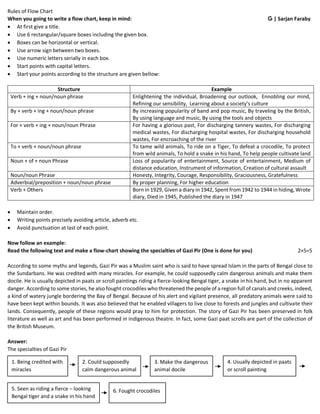
Answer:
The specialties of Gazi Pir
1. Being credited with
miracles
2. Could supposedly
calm dangerous animal
3. Make the dangerous
animal docile
4. Usually depicted in paats
or scroll painting
5. Seen as riding a fierce – looking
Bengal tiger and a snake in his hand
6. Fought crocodiles

HSC Flow Chart Rules

  • 1.
    Rules of FlowChart When you going to write a flow chart, keep in mind: G | Sarjan Faraby  At first give a title.  Use 6 rectangular/square boxes including the given box.  Boxes can be horizontal or vertical.  Use arrow sign between two boxes.  Use numeric letters serially in each box.  Start points with capital letters.  Start your points according to the structure are given bellow: Structure Example Verb + ing + noun/noun phrase Enlightening the individual, Broadening our outlook, Ennobling our mind, Refining our sensibility, Learning about a society’s culture By + verb + ing + noun/noun phrase By increasing popularity of band and pop music, By traveling by the British, By using language and music, By using the tools and objects For + verb + ing + noun/noun Phrase For having a glorious past, For discharging tannery wastes, For discharging medical wastes, For discharging hospital wastes, For discharging household wastes, For encroaching of the river To + verb + noun/noun phrase To tame wild animals, To ride on a Tiger, To defeat a crocodile, To protect from wild animals, To hold a snake in his hand, To help people cultivate land Noun + of + noun Phrase Loss of popularity of entertainment, Source of entertainment, Medium of distance education, Instrument of information, Creation of cultural assault Noun/noun Phrase Honesty, Integrity, Courage, Responsibility, Graciousness, Gratefulness Adverbial/preposition + noun/noun phrase By proper planning, For higher education Verb + Others Born in 1929, Given a diary in 1942, Spent from 1942 to 1944 in hiding, Wrote diary, Died in 1945, Published the diary in 1947  Maintain order.  Writing points precisely avoiding article, adverb etc.  Avoid punctuation at last of each point. Now follow an example: Read the following text and make a flow-chart showing the specialties of Gazi Pir (One is done for you) 2×5=5 According to some myths and legends, Gazi Pir was a Muslim saint who is said to have spread Islam in the parts of Bengal close to the Sundarbans. He was credited with many miracles. For example, he could supposedly calm dangerous animals and make them docile. He is usually depicted in paats or scroll paintings riding a fierce-looking Bengal tiger, a snake in his hand, but in no apparent danger. According to some stories, he also fought crocodiles who threatened the people of a region full of canals and creeks, indeed, a kind of watery jungle bordering the Bay of Bengal. Because of his alert and vigilant presence, all predatory animals were said to have been kept within bounds. It was also believed that he enabled villagers to live close to forests and jungles and cultivate their lands. Consequently, people of these regions would pray to him for protection. The story of Gazi Pir has been preserved in folk literature as well as art and has been performed in indigenous theatre. In fact, some Gazi paat scrolls are part of the collection of the British Museum. Answer: The specialties of Gazi Pir 1. Being credited with miracles 2. Could supposedly calm dangerous animal 3. Make the dangerous animal docile 4. Usually depicted in paats or scroll painting 5. Seen as riding a fierce – looking Bengal tiger and a snake in his hand 6. Fought crocodiles