Grade 12
Diseases of the body systems
Academic Year 2021/2022 – Term 1
Unit-2 Lesson no. 2.1
Lesson name: What are diseases?
Learning
outcome
By the end of the lesson, learners will be
able to:
explain the difference between communicable
and non-communicable diseases.
Keywords
• communicable disease – an infectious disease that can be
passed from one person to another
• acute - a disease or disorder that lasts a short amount of
time, usually less than three months
• chronic - a disease or disorder that lasts three months or
more
• sign - something that can be observed by other people, such
as a skin rash or a
cough
• symptom- a feeling, or physical change experienced by the
patient, such as pain
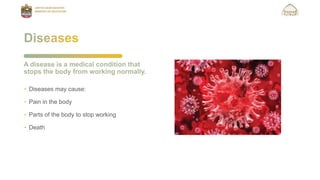
• Diseases may cause:
• Pain in the body
• Parts of the body to stop working
• Death
A disease is a medical condition that
stops the body from working normally.
Communicable
Diseases can be communicable or non-communicable
Non-communicable
• Can be spread from one person to another.
• Examples include:
• Flu
• COVID-19
• Gastroenteritis
• Malaria
• Cannot be passed from one person to
another.
• Examples include:
• Epilepsy
• Hypertension
• Diabetes
• Multiple sclerosis
Acute
Diseases can be acute or chronic
Chronic
• Last a short length of time, usually less than
three months.
• Examples include:
• Flu
• COVID-19
• Gastroenteritis
• Pneumonia
• Last a long time, sometimes even the length
of a person’s life.
• Examples include:
• Asthma
• Allergies
• Diabetes
• Multiple sclerosis
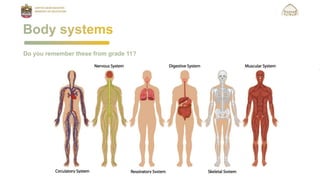
A journey through the human body
Do you remember these from grade 11?
Learning
outcome
By the end of the lesson, learners will be
able to:
explain the difference between communicable
and non-communicable diseases.
Conclusion
Questions
Recap
HS PP G12 2.1.pptx

HS PP G12 2.1.pptx

  • 1.
    Grade 12 Diseases ofthe body systems Academic Year 2021/2022 – Term 1
  • 2.
    Unit-2 Lesson no.2.1 Lesson name: What are diseases?
  • 3.
    Learning outcome By the endof the lesson, learners will be able to: explain the difference between communicable and non-communicable diseases.
  • 4.
    Keywords • communicable disease– an infectious disease that can be passed from one person to another • acute - a disease or disorder that lasts a short amount of time, usually less than three months • chronic - a disease or disorder that lasts three months or more • sign - something that can be observed by other people, such as a skin rash or a cough • symptom- a feeling, or physical change experienced by the patient, such as pain
  • 5.
    • Diseases maycause: • Pain in the body • Parts of the body to stop working • Death A disease is a medical condition that stops the body from working normally.
  • 6.
    Communicable Diseases can becommunicable or non-communicable Non-communicable • Can be spread from one person to another. • Examples include: • Flu • COVID-19 • Gastroenteritis • Malaria • Cannot be passed from one person to another. • Examples include: • Epilepsy • Hypertension • Diabetes • Multiple sclerosis
  • 7.
    Acute Diseases can beacute or chronic Chronic • Last a short length of time, usually less than three months. • Examples include: • Flu • COVID-19 • Gastroenteritis • Pneumonia • Last a long time, sometimes even the length of a person’s life. • Examples include: • Asthma • Allergies • Diabetes • Multiple sclerosis
  • 8.
    A journey throughthe human body
  • 9.
    Do you rememberthese from grade 11?
  • 10.
    Learning outcome By the endof the lesson, learners will be able to: explain the difference between communicable and non-communicable diseases.
  • 11.

Editor's Notes

  • #10 See if students can remember the function of each body system.