ISSN: 2349-7637 (Online) 
Volume-1, Issue-2, September 2014 
RESEARCH HUB – International Multidisciplinary Research 
Journal 
Research Paper 
Available online at: www.rhimrj.com 
HRM’s Role in a Future India 
Prof. D. M. Parmar, 
Head of the Department, 
Department of Commerce, 
Sakhida Arts and Commerce College, 
Limbdi, Gujarat (India) 
________________________________________________________________________________________________________ 
Abstract: Change is a challenge facing managers now and in the future. Manager’s decisions in organizations can affect 
people’s lives. Culture diversity is a reality in all organizations. Un- cultural groups are no longer the norm in workplaces. A 
“world culture” is now evolving. Traditional hierarchical structures, activities, etc in organizations, are being questioned by 
stakeholders. Leaders and change agents’ tasks are to maintain stability and at the same time provide creative adaptation to 
changes in technology, culture, etc of organizations. The results, amongst others, revealed the culture and change aspects in 
organizations of the current position, 2010, and what would be required in 2020. It can be concluded that culture plays an 
important role globally to manage organizations. It is dependent on how change and organization development is approached 
and managed. 
Key Words: Culture, Challenge, Management, Strategies, Change 
________________________________________________________________________________________________________ 
I. INTRODUCTION 
Fundamental changes are taking place in organizations by demand. The global pressure on organizations to stay competitive 
initiates this demand. On the one hand suppliers are demanding quality and cost effective products and on the other hand 
competitors are demanding level playing fields across cultures, globally.1 Organizational culture, cultural changes and 
organizational development across international boundaries have obliged a rethink of the shape and the nature of organizations. 
The multiple stakeholders are questioning the traditional hierarchical structures and demarcations of activities, functions, 
responsibilities, authority and effectiveness of organizations. To accommodate these multiple stakeholders’ needs and interests, 
changes are then implemented. 
Human nature such as culture, habits, tradition and frames of reference are factors to bear in mind before any organization can 
implement any change and also with organizational development. Change in an organizational sense is associated with the 
restructures of organizations, needing to respond to changes in their environments, missions, strategies, culture and technology. 5 
Cultural diversity in workplaces in India is a reality. Care should be taken to design non-threatening participative implementation 
process in a gradual manner. These include changing the culture of an organization. According to managers who were educated in 
the Western tradition will implement Western human resource practices in cultures, which have a different concept of people and 
a different regard for people in organizations. He states further that incompatibilities will be manifested in lack of motivation and 
separation, which will lead to low productivity and labor strife. 
There is a growing interest in the relationship between indigenous and foreign cultures in the practice and development of 
management and organizational change in the transitional economies of the former Soviet block, India and China so-called 
developing countries. 4 In this article, the different practices in some of these countries will be referred to what organizations 
should do in this regard to be sensitive to change, organizational development and culture diversity and its effects. The theoretical 
background to this study is first discussed in the next section. 
II. THEORETICAL BACKGROUND 
The difference between successful organizations and those who fail is their ability to adapt and respond to the pace of change. 
HR managers are increasingly taking on the role of change agent. The introduction of changed or new business and HR strategies 
requires careful implementation and the change agent should be very sensitive for cultural diversity. The importance of cultural 
diversity should not be minimized, since an organization’s culture, as a system of shared values and beliefs, leads people, 
decision-making process and procedures and control systems to interact so as to produce behavioral norms. Culture as well as 
cultural diversity has an impact on every aspect of life, from the way people behave toward one another to their natural 
environment. Cultural diversity in an organization should be recognized and in modern organizations it cannot be over-emphasized. 
Page 1 of 5 
2014, RHIMRJ, All Rights Reserved ISSN: 2349-7637 (Online)
RESEARCH HUB – International Multidisciplinary Research Journal 
Volume-1, Issue-2, September 2014 
The world in which organizations exist, and will be operating in future, is continuously in change in relationships among 
nations, institutions, business partners and organizations change in the makeup of the “haves” and the “have not’s”; change in 
dominant values and norms governing societies; change in the character and culture of business or wealth-producing organizations; 
change in how work is done and change in priorities. The core dilemma for leaders and managers is how to maintain stability and 
at the same time provide creative adaptation to outside forces, change assumptions, technology, working methods, roles, 
relationships and the culture of the organization. Today, these changes are still taking place and there are still more changes to 
come in the future. 
The importance of cross-cultural management is diminishing and he suggests that the world is moving towards a single global 
management culture that is basically Western. In his five-culture study it provided the necessary cultural diversity needed to be 
able to put them into two groups. 10 The first is the two Western cultures of France and the UK and the second group is the Indian, 
Arab, and African cultures. The first group share several commonalities such as autonomy, ambitious and individual financial 
security, achievement and individual initiative. In the second group’s Arab countries, the Islamic religion’s philosophical and 
spiritual beliefs and traditions shape management values. 
An even stronger opinion is from in support of human resources and the importance of its contribution towards the 
profitability of the organizations in India. There are two forms of change: Planned change – where change results from a 
deliberate decision to alter the organization and unplanned change – where alterations may occur as a result of imposed conditions. 
Change is often resisted because it is perceived as leading to loss. 
III. PROBLEM STATEMENT 
In a future India, the anticipated changes in the business environment are of great concern for managers and business owners. 
The role of human resource departments in organizational development and the management of cultural changes, to stay globally 
competitive, are the reasons for undertaking this research. Some solutions are identified and presented in this article. 
IV. OBJECTIVES OF THE RESEARCH 
To identify possible answers and solutions to the future changes in businesses is the main objective of this research. For 
Indian businesses, managers and human resources practitioners it is vital to know about all these future changes to keep and 
remain globally competitive. Strategic planning is the other area in which they must excel to be one step ahead of their 
competitors. 
V. METHODOLOGY 
Use of secondary data from old research paper/project, books, magazine, seminar notes and websites, all results/prediction are 
VI. RESULTS 
Results were recorded to reflect quality of secondary data. Note must be taken that due to the extensive research that was 
done, not all the results could be discussed in this article and only the aforementioned possibilities are given. The responses were 
compared in terms of the 2010 result and the envisaged importance in 2020. 
VII. ANALYSIS 
For the purpose of this article, The importance of this information is that most large companies in India have a human 
resource department. More than two thirds of the respondents in this study are therefore human resource practitioners that make 
their responses very valuable and useable to predict their future role in any changes in organizations. 
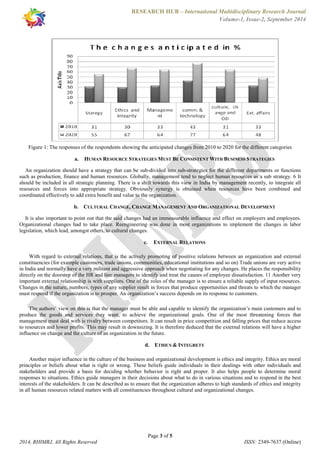
The changes anticipated by the respondents for 2020 as opposed to the current situation in 2010, is reflected in this article. 
The results reflect the responsibility for human resources to be shared by the human resources function and line management with 
regard to specific responsibility for strategy, culture change and organizational development in an organization. Strategic 
management has now developed to such an extent that its primary value is to help the organization operate successfully in a 
dynamic environment. 7 Therefore, the results also reflect the respondents’ views on who is mainly responsible for business 
strategies in the organization. Communication, ethics and integrity, and external relations are the other important areas the results 
reflect below. Figure 1: 
Page 2 of 5 
mentioned in this paper. 
2014, RHIMRJ, All Rights Reserved ISSN: 2349-7637 (Online)
RESEARCH HUB – International Multidisciplinary Research Journal 
Volume-1, Issue-2, September 2014 
Figure 1: The responses of the respondents showing the anticipated changes from 2010 to 2020 for the different categories 
a. HUMAN RESOURCE STRATEGIES MUST BE CONSISTENT WITH BUSINESS STRATEGIES 
An organization should have a strategy that can be sub-divided into sub-strategies for the different departments or functions 
such as production, finance and human resources. Globally, management tend to neglect human resources as a sub strategy. 6 It 
should be included in all strategic planning. There is a shift towards this view in India by management recently, to integrate all 
resources and forces into appropriate strategy. Obviously synergy is obtained when resources have been combined and 
coordinated effectively to add extra benefit and value to the organization. 
b. CULTURAL CHANGE, CHANGE MANAGEMENT AND ORGANIZATIONAL DEVELOPMENT 
It is also important to point out that the said changes had an immeasurable influence and effect on employers and employees. 
Organizational changes had to take place. Reengineering was done in most organizations to implement the changes in labor 
legislation, which lead, amongst others, to cultural changes. 
c. EXTERNAL RELATIONS 
With regard to external relations, that is the actively promoting of positive relations between an organization and external 
constituencies (for example customers, trade unions, communities, educational institutions and so on) Trade unions are very active 
in India and normally have a very militant and aggressive approach when negotiating for any changes. He places the responsibility 
directly on the doorstep of the HR and line managers to identify and treat the causes of employee dissatisfaction. 11 Another very 
important external relationship is with suppliers. One of the roles of the manager is to ensure a reliable supply of input resources. 
Changes in the nature, numbers, types of any supplier result in forces that produce opportunities and threats to which the manager 
must respond if the organization is to prosper. An organization’s success depends on its response to customers. 
The authors’ view on this is that the manager must be able and capable to identify the organization’s main customers and to 
produce the goods and services they want, to achieve the organizational goals. One of the most threatening forces that 
management must deal with is rivalry between competitors. It can result in price competition and falling prices that reduce access 
to resources and lower profits. This may result in downsizing. It is therefore deduced that the external relations will have a higher 
influence on change and the culture of an organization in the future. 
d. ETHICS & INTEGRETY 
Another major influence in the culture of the business and organizational development is ethics and integrity. Ethics are moral 
principles or beliefs about what is right or wrong. These beliefs guide individuals in their dealings with other individuals and 
stakeholders and provide a basis for deciding whether behavior is right and proper. It also helps people to determine moral 
responses to situations. Ethics guide managers in their decisions about what to do in various situations and to respond in the best 
interests of the stakeholders. It can be described as to ensure that the organization adheres to high standards of ethics and integrity 
in all human resources related matters with all constituencies throughout cultural and organizational changes. 
Page 3 of 5 
2014, RHIMRJ, All Rights Reserved ISSN: 2349-7637 (Online)
RESEARCH HUB – International Multidisciplinary Research Journal 
Volume-1, Issue-2, September 2014 
e. EFFECTIVE COMMUNICATION & TECHNOLOGY 
Effective communication and technology in an organization was one of the most discussed issues previously. In this research 
it is clear from the respondents that effective communication and technology will ensure that employees understand the future 
business directions, the vision, the goals and objectives, the future challenges and strategic planning and the influence that well 
informed employees’ positive attitudes can have on business issues. 
Two phases of communication i.e. the transmission phase (information is shared between two or more individuals) and the 
feedback phase, where a common understanding is assured. They also warn against ineffective communication because the 
organization’s performance will suffer and any competitive advantage is most likely to be lost. It can also lead to serious accidents 
or loss of a life. They conclude by saying that effective communication is so important that managers must ensure that their 
subordinates are effective communicators and then the organization is most likely to perform highly and gain competitive 
advantage. 
f. THE IMPORTANCE OF MANAGEMENT’S ROLE 
Change occurs because new realities in the organization replace old ones. Successful change requires unfreezing the status 
quo, a movement to a new state or structure and re-freezing the new change to make it permanent. The commitment of top 
management for and during changing is crucial. 7 Change has to be managed because employees can perceive it as a threat to their 
self-interest on the one hand and on the other it can be beneficial such as a salary increase. Managers are central figures in 
organizational change. As change agents they have a proactive role in anticipating and shaping the environment for change. In the 
research done, the respondents supported this important role of managers as change agents in implementing human resource 
programmes for cultural changes, organizational changes and organizational development. Management will have to provide 
support, competency development, reinforcing the desired behaviors’ and providing emotional security to help the employees 
cope with the changes. 
VIII. CONCLUSION AND IMPLECATIONS 
It is concluded that the results support the fact that cultural change, managers’ role in changes, strategic planning and change 
in organizations is of great concern to management. Management and their roles will undoubtedly change from 2010 to 2020 and 
the manager of 2020 will have to be able to cope with all these changes. It is not just the role and responsibilities of human 
resources managers that will change in the future but also the traditional roles of managers. 
· They will have to be the change agents and leaders with implementing all the programmes and practices for these 
· With the political changes that have taken place in India recently, managers will have to be sensitive in communicating 
and negotiating changes with trade unions to avoid labor unrest and demoralized union members. 
· They will have to keep these trade unions and all other stakeholders informed and ensure to promote their external 
· There is a drive for achieving a win-win ideal with a surge in coaching, mentoring, leadership development as well as 
personal development, which can include organizational development. 
· Culture, change and organizational development involve guiding, direction, influencing and then initiating of the action. 
· The leader/manager/change agent must have vision and judgment to have these changes smoothly implemented. 
· India has a diverse workforce coming from, not only overseas countries or from neighboring countries such as China, 
Pakistan, Sri Lanka & others but the local employees are from different tribes and clans. 
· Indian organizations employ thousands of these citizens from neighboring states. 
· With the more than 22 official languages in the country, it becomes a very difficult task for any manager to accommodate 
· The 2020 manager, therefore, will have to be ultra sensitive to each and every culture. 
· The challenges posed by diversity and change demand human resource managers intervene proactively by recognizing 
the nature of these two forces and implementing the necessary strategies to channel them in a positive direction. 
Leadership is the key to create and sustain a successful organization in the twenty first century, 8 A new employee that will 
have to know more about both leadership and management than did their previous decade’s counterparts. Leadership for a 
Page 4 of 5 
changes. 
relationships to have a positive workforce. 
11 
all cultures. 
2014, RHIMRJ, All Rights Reserved ISSN: 2349-7637 (Online)
RESEARCH HUB – International Multidisciplinary Research Journal 
Volume-1, Issue-2, September 2014 
successful business by saying that the congruence between culture, strategy and managerial style is important because it facilitates 
organizational efficiency. 
In summary it can be said that poor leadership leads to failed businesses, job losses, customers and financial interests that are 
hurt and careers derailed. In particular, cultural diversity must be recognized as an important form of diversity. 
.REFERENCES 
1. Management Today. Vol 18 No 9 pp. 32-33. 
2. Eight annual HR conference, HR vision 2020, 19th sep, 2011 at 9.30 from AMA 
3. Stone, R. J. 2005. Human resource management. Singapore. Kyodo Printing Co. Swinepoxes, B. J. (Ed). Erasmus, B.J., VanWyk, M. 
& Schenk, H. 2003. Indian human resource management: Theory and practice. (3rd ed.) Cape Town: Juta & Co. Ltd. 
4. Batra, G. S. 1996. “Human resource auditing as a tool of human resource valuation: Interface and emerging practices”, Managerial 
5. www.wikipedia.com 
6. www.google.com/hrvision2020 
7. www.amaindia.org/training programes/hr-conferance.htm 
8. http://planning –commission.nic.in/reports/genrep/pl_vsn2020.pgf 
Page 5 of 5 
Auditing Journal, Vol 11 No 8, pp23-30. 
2014, RHIMRJ, All Rights Reserved ISSN: 2349-7637 (Online)

HRM’s Role in a Future India

  • 1.
    ISSN: 2349-7637 (Online) Volume-1, Issue-2, September 2014 RESEARCH HUB – International Multidisciplinary Research Journal Research Paper Available online at: www.rhimrj.com HRM’s Role in a Future India Prof. D. M. Parmar, Head of the Department, Department of Commerce, Sakhida Arts and Commerce College, Limbdi, Gujarat (India) ________________________________________________________________________________________________________ Abstract: Change is a challenge facing managers now and in the future. Manager’s decisions in organizations can affect people’s lives. Culture diversity is a reality in all organizations. Un- cultural groups are no longer the norm in workplaces. A “world culture” is now evolving. Traditional hierarchical structures, activities, etc in organizations, are being questioned by stakeholders. Leaders and change agents’ tasks are to maintain stability and at the same time provide creative adaptation to changes in technology, culture, etc of organizations. The results, amongst others, revealed the culture and change aspects in organizations of the current position, 2010, and what would be required in 2020. It can be concluded that culture plays an important role globally to manage organizations. It is dependent on how change and organization development is approached and managed. Key Words: Culture, Challenge, Management, Strategies, Change ________________________________________________________________________________________________________ I. INTRODUCTION Fundamental changes are taking place in organizations by demand. The global pressure on organizations to stay competitive initiates this demand. On the one hand suppliers are demanding quality and cost effective products and on the other hand competitors are demanding level playing fields across cultures, globally.1 Organizational culture, cultural changes and organizational development across international boundaries have obliged a rethink of the shape and the nature of organizations. The multiple stakeholders are questioning the traditional hierarchical structures and demarcations of activities, functions, responsibilities, authority and effectiveness of organizations. To accommodate these multiple stakeholders’ needs and interests, changes are then implemented. Human nature such as culture, habits, tradition and frames of reference are factors to bear in mind before any organization can implement any change and also with organizational development. Change in an organizational sense is associated with the restructures of organizations, needing to respond to changes in their environments, missions, strategies, culture and technology. 5 Cultural diversity in workplaces in India is a reality. Care should be taken to design non-threatening participative implementation process in a gradual manner. These include changing the culture of an organization. According to managers who were educated in the Western tradition will implement Western human resource practices in cultures, which have a different concept of people and a different regard for people in organizations. He states further that incompatibilities will be manifested in lack of motivation and separation, which will lead to low productivity and labor strife. There is a growing interest in the relationship between indigenous and foreign cultures in the practice and development of management and organizational change in the transitional economies of the former Soviet block, India and China so-called developing countries. 4 In this article, the different practices in some of these countries will be referred to what organizations should do in this regard to be sensitive to change, organizational development and culture diversity and its effects. The theoretical background to this study is first discussed in the next section. II. THEORETICAL BACKGROUND The difference between successful organizations and those who fail is their ability to adapt and respond to the pace of change. HR managers are increasingly taking on the role of change agent. The introduction of changed or new business and HR strategies requires careful implementation and the change agent should be very sensitive for cultural diversity. The importance of cultural diversity should not be minimized, since an organization’s culture, as a system of shared values and beliefs, leads people, decision-making process and procedures and control systems to interact so as to produce behavioral norms. Culture as well as cultural diversity has an impact on every aspect of life, from the way people behave toward one another to their natural environment. Cultural diversity in an organization should be recognized and in modern organizations it cannot be over-emphasized. Page 1 of 5 2014, RHIMRJ, All Rights Reserved ISSN: 2349-7637 (Online)
  • 2.
    RESEARCH HUB –International Multidisciplinary Research Journal Volume-1, Issue-2, September 2014 The world in which organizations exist, and will be operating in future, is continuously in change in relationships among nations, institutions, business partners and organizations change in the makeup of the “haves” and the “have not’s”; change in dominant values and norms governing societies; change in the character and culture of business or wealth-producing organizations; change in how work is done and change in priorities. The core dilemma for leaders and managers is how to maintain stability and at the same time provide creative adaptation to outside forces, change assumptions, technology, working methods, roles, relationships and the culture of the organization. Today, these changes are still taking place and there are still more changes to come in the future. The importance of cross-cultural management is diminishing and he suggests that the world is moving towards a single global management culture that is basically Western. In his five-culture study it provided the necessary cultural diversity needed to be able to put them into two groups. 10 The first is the two Western cultures of France and the UK and the second group is the Indian, Arab, and African cultures. The first group share several commonalities such as autonomy, ambitious and individual financial security, achievement and individual initiative. In the second group’s Arab countries, the Islamic religion’s philosophical and spiritual beliefs and traditions shape management values. An even stronger opinion is from in support of human resources and the importance of its contribution towards the profitability of the organizations in India. There are two forms of change: Planned change – where change results from a deliberate decision to alter the organization and unplanned change – where alterations may occur as a result of imposed conditions. Change is often resisted because it is perceived as leading to loss. III. PROBLEM STATEMENT In a future India, the anticipated changes in the business environment are of great concern for managers and business owners. The role of human resource departments in organizational development and the management of cultural changes, to stay globally competitive, are the reasons for undertaking this research. Some solutions are identified and presented in this article. IV. OBJECTIVES OF THE RESEARCH To identify possible answers and solutions to the future changes in businesses is the main objective of this research. For Indian businesses, managers and human resources practitioners it is vital to know about all these future changes to keep and remain globally competitive. Strategic planning is the other area in which they must excel to be one step ahead of their competitors. V. METHODOLOGY Use of secondary data from old research paper/project, books, magazine, seminar notes and websites, all results/prediction are VI. RESULTS Results were recorded to reflect quality of secondary data. Note must be taken that due to the extensive research that was done, not all the results could be discussed in this article and only the aforementioned possibilities are given. The responses were compared in terms of the 2010 result and the envisaged importance in 2020. VII. ANALYSIS For the purpose of this article, The importance of this information is that most large companies in India have a human resource department. More than two thirds of the respondents in this study are therefore human resource practitioners that make their responses very valuable and useable to predict their future role in any changes in organizations. The changes anticipated by the respondents for 2020 as opposed to the current situation in 2010, is reflected in this article. The results reflect the responsibility for human resources to be shared by the human resources function and line management with regard to specific responsibility for strategy, culture change and organizational development in an organization. Strategic management has now developed to such an extent that its primary value is to help the organization operate successfully in a dynamic environment. 7 Therefore, the results also reflect the respondents’ views on who is mainly responsible for business strategies in the organization. Communication, ethics and integrity, and external relations are the other important areas the results reflect below. Figure 1: Page 2 of 5 mentioned in this paper. 2014, RHIMRJ, All Rights Reserved ISSN: 2349-7637 (Online)
  • 3.
    RESEARCH HUB –International Multidisciplinary Research Journal Volume-1, Issue-2, September 2014 Figure 1: The responses of the respondents showing the anticipated changes from 2010 to 2020 for the different categories a. HUMAN RESOURCE STRATEGIES MUST BE CONSISTENT WITH BUSINESS STRATEGIES An organization should have a strategy that can be sub-divided into sub-strategies for the different departments or functions such as production, finance and human resources. Globally, management tend to neglect human resources as a sub strategy. 6 It should be included in all strategic planning. There is a shift towards this view in India by management recently, to integrate all resources and forces into appropriate strategy. Obviously synergy is obtained when resources have been combined and coordinated effectively to add extra benefit and value to the organization. b. CULTURAL CHANGE, CHANGE MANAGEMENT AND ORGANIZATIONAL DEVELOPMENT It is also important to point out that the said changes had an immeasurable influence and effect on employers and employees. Organizational changes had to take place. Reengineering was done in most organizations to implement the changes in labor legislation, which lead, amongst others, to cultural changes. c. EXTERNAL RELATIONS With regard to external relations, that is the actively promoting of positive relations between an organization and external constituencies (for example customers, trade unions, communities, educational institutions and so on) Trade unions are very active in India and normally have a very militant and aggressive approach when negotiating for any changes. He places the responsibility directly on the doorstep of the HR and line managers to identify and treat the causes of employee dissatisfaction. 11 Another very important external relationship is with suppliers. One of the roles of the manager is to ensure a reliable supply of input resources. Changes in the nature, numbers, types of any supplier result in forces that produce opportunities and threats to which the manager must respond if the organization is to prosper. An organization’s success depends on its response to customers. The authors’ view on this is that the manager must be able and capable to identify the organization’s main customers and to produce the goods and services they want, to achieve the organizational goals. One of the most threatening forces that management must deal with is rivalry between competitors. It can result in price competition and falling prices that reduce access to resources and lower profits. This may result in downsizing. It is therefore deduced that the external relations will have a higher influence on change and the culture of an organization in the future. d. ETHICS & INTEGRETY Another major influence in the culture of the business and organizational development is ethics and integrity. Ethics are moral principles or beliefs about what is right or wrong. These beliefs guide individuals in their dealings with other individuals and stakeholders and provide a basis for deciding whether behavior is right and proper. It also helps people to determine moral responses to situations. Ethics guide managers in their decisions about what to do in various situations and to respond in the best interests of the stakeholders. It can be described as to ensure that the organization adheres to high standards of ethics and integrity in all human resources related matters with all constituencies throughout cultural and organizational changes. Page 3 of 5 2014, RHIMRJ, All Rights Reserved ISSN: 2349-7637 (Online)
  • 4.
    RESEARCH HUB –International Multidisciplinary Research Journal Volume-1, Issue-2, September 2014 e. EFFECTIVE COMMUNICATION & TECHNOLOGY Effective communication and technology in an organization was one of the most discussed issues previously. In this research it is clear from the respondents that effective communication and technology will ensure that employees understand the future business directions, the vision, the goals and objectives, the future challenges and strategic planning and the influence that well informed employees’ positive attitudes can have on business issues. Two phases of communication i.e. the transmission phase (information is shared between two or more individuals) and the feedback phase, where a common understanding is assured. They also warn against ineffective communication because the organization’s performance will suffer and any competitive advantage is most likely to be lost. It can also lead to serious accidents or loss of a life. They conclude by saying that effective communication is so important that managers must ensure that their subordinates are effective communicators and then the organization is most likely to perform highly and gain competitive advantage. f. THE IMPORTANCE OF MANAGEMENT’S ROLE Change occurs because new realities in the organization replace old ones. Successful change requires unfreezing the status quo, a movement to a new state or structure and re-freezing the new change to make it permanent. The commitment of top management for and during changing is crucial. 7 Change has to be managed because employees can perceive it as a threat to their self-interest on the one hand and on the other it can be beneficial such as a salary increase. Managers are central figures in organizational change. As change agents they have a proactive role in anticipating and shaping the environment for change. In the research done, the respondents supported this important role of managers as change agents in implementing human resource programmes for cultural changes, organizational changes and organizational development. Management will have to provide support, competency development, reinforcing the desired behaviors’ and providing emotional security to help the employees cope with the changes. VIII. CONCLUSION AND IMPLECATIONS It is concluded that the results support the fact that cultural change, managers’ role in changes, strategic planning and change in organizations is of great concern to management. Management and their roles will undoubtedly change from 2010 to 2020 and the manager of 2020 will have to be able to cope with all these changes. It is not just the role and responsibilities of human resources managers that will change in the future but also the traditional roles of managers. · They will have to be the change agents and leaders with implementing all the programmes and practices for these · With the political changes that have taken place in India recently, managers will have to be sensitive in communicating and negotiating changes with trade unions to avoid labor unrest and demoralized union members. · They will have to keep these trade unions and all other stakeholders informed and ensure to promote their external · There is a drive for achieving a win-win ideal with a surge in coaching, mentoring, leadership development as well as personal development, which can include organizational development. · Culture, change and organizational development involve guiding, direction, influencing and then initiating of the action. · The leader/manager/change agent must have vision and judgment to have these changes smoothly implemented. · India has a diverse workforce coming from, not only overseas countries or from neighboring countries such as China, Pakistan, Sri Lanka & others but the local employees are from different tribes and clans. · Indian organizations employ thousands of these citizens from neighboring states. · With the more than 22 official languages in the country, it becomes a very difficult task for any manager to accommodate · The 2020 manager, therefore, will have to be ultra sensitive to each and every culture. · The challenges posed by diversity and change demand human resource managers intervene proactively by recognizing the nature of these two forces and implementing the necessary strategies to channel them in a positive direction. Leadership is the key to create and sustain a successful organization in the twenty first century, 8 A new employee that will have to know more about both leadership and management than did their previous decade’s counterparts. Leadership for a Page 4 of 5 changes. relationships to have a positive workforce. 11 all cultures. 2014, RHIMRJ, All Rights Reserved ISSN: 2349-7637 (Online)
  • 5.
    RESEARCH HUB –International Multidisciplinary Research Journal Volume-1, Issue-2, September 2014 successful business by saying that the congruence between culture, strategy and managerial style is important because it facilitates organizational efficiency. In summary it can be said that poor leadership leads to failed businesses, job losses, customers and financial interests that are hurt and careers derailed. In particular, cultural diversity must be recognized as an important form of diversity. .REFERENCES 1. Management Today. Vol 18 No 9 pp. 32-33. 2. Eight annual HR conference, HR vision 2020, 19th sep, 2011 at 9.30 from AMA 3. Stone, R. J. 2005. Human resource management. Singapore. Kyodo Printing Co. Swinepoxes, B. J. (Ed). Erasmus, B.J., VanWyk, M. & Schenk, H. 2003. Indian human resource management: Theory and practice. (3rd ed.) Cape Town: Juta & Co. Ltd. 4. Batra, G. S. 1996. “Human resource auditing as a tool of human resource valuation: Interface and emerging practices”, Managerial 5. www.wikipedia.com 6. www.google.com/hrvision2020 7. www.amaindia.org/training programes/hr-conferance.htm 8. http://planning –commission.nic.in/reports/genrep/pl_vsn2020.pgf Page 5 of 5 Auditing Journal, Vol 11 No 8, pp23-30. 2014, RHIMRJ, All Rights Reserved ISSN: 2349-7637 (Online)