1
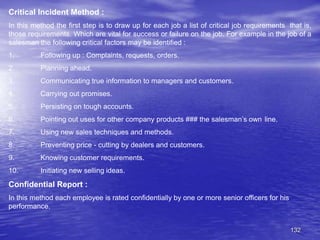
HUMAN RESOURCE MANAGEMET
MBA TERM-III
Prof. R.K.Patra
2
PERSON HUMAN
P = PECULIARITIES/PERISHABLE H = HEADS
E = EMOTIONS U = UGRES OF HIGHER NATURE
R = RELAXING ATTITUDE M = MEMORY LIFE SAMPLES
S = SENSITIVITY A = ANALYTICAL ABILITY
O = OBJECTIVES OF INDIVIDUALS N = NORMS
N = NORMS =================
R = RECRUITMENT
E= ENABLING
S= SOUL
O= OUTSOURCING
U= UNDERSTANDING
R= RETURN
C= CULTURE
E= EFFECTIVE
3
• They say…
• “If you’re planning for one year,
grow rice.
• If you’re planning for 20 years,
grow trees.
• If you’re planning for centuries,
grow human resource.”
• -Ancient Chinese Proverb
4
Management : Mary Parker Follett - “The art of getting things
done through people”. But management is much more and can be
termed as “that field of human behaviour in which managers plan,
organise, staff, direct and control human, physical and financial
resources and group objectives with optimum efficiency and
effectiveness.
Concept of HRM :
Human Resource is the total knowledge, skills, creative abilities,
talents and aptitudes of an organisation’s workforce, as well as the
value, attitudes and beliefs of the individuals involved.
In simple sense, human resource management means
employing people, developing their resources, utilising,
maintaining and compensating their services in tune with
the job and organisational requirements.
Resource - Future Potential
Human - are regarded as human factor, human asset, human
capital.
5
Importance of Human Factor :
* This is the only resource which can produce
unlimited amounts through better ideas.
* It is only this resource which appreciates in
value with the passage of time.
* It is this resource only which can contribute
to sustained competitive advantage through
facilitating the development of competencies
that are organisation specific and difficult to
imitate.
* It is this resource only which can organise
itself into unions and militate against the
undesirable actions of the employer.
6
Evolution of HRM
•Pre-Independence Post Independence Present
•(Royal Commission) Factories Act, 1948 PM/LWO/Safety Officer/PRO/HRD/
HRM/KM/ME/Competency Manager/
The Royal Commission of Labour in India (1931) under the Chairmanship of
J.N.Whitley recommended the abolition of the ‘Jobber’ system and the
appointment of Labour Officers in Industrial Enterprises to perform the
recruitment function as well as look after the welfare of the employees. After
Independence, the Labour Welfare Officer was identified with the Personnel
Manager created by legislation Under Section 49 of the Factories Act, 1948.
The role of a personnel manager was more of a custodian of personnel policy
implementation and compliance to different Acts of the Factories law. Evolving
along the years, a new approach - the HRM has emerged, which focuses more
on developmental aspects of human resource with a pragmatic, flexible
approach.
7
IS HRM a Profession ? What is Profession
 Existence of an organised and systematic knowledge.
 Formalised methods acquiring training.
 Existence of an association with professionalisation as its goal.
 Existence of an ethical code to regulate the behaviour of the members of the profession.
 Charging of fees based on service but with due regard for the procreating of service over
the desire for monetary reward.
Professional Institutes :
(1) NIPM, Kolkata.
(2) National HRD Network, Jamshedpur.
(3) Indian Society for Training & Development, New Delhi.
(4) Indian Society for Applied Behavioural Science New Delhi.
(5) Indian Society for Individual and Social Development.
8
HRM FUNCTIONS
• Managerial Functions
1. Planning
2. Organising
3. Directing
4. Co-ordinating
5. Controlling
• Operative Functions
1. Employment
a. Job analysis, Job
Description
b. HRP
c. Recruitment
d. Selection
e. Placement
f. Induction &
Orientation
9
Contd…
2.Human Resource
Development
a. Performance Appraisal
b. Potential Appraisal
c. Training
d. Management Development
e. Career planning & Devp.
f. OD
3. Compensation
a. Job Evaluation
b. Wage & salary admin.
c. Incentives
d. Bonus
e. Fringed Benefits
f. Social security
measures
4. Human
Relations(
Various policies)
5.Effectiveness of
HRM
a. Organisational Health
b. HRA
c. HR Audit
d. HR Research
10
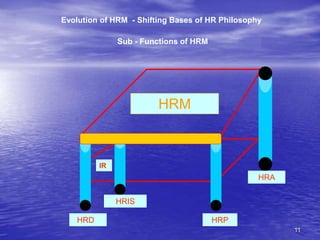
11
HRM
IR
HRD
HRIS
HRP
HRA
Evolution of HRM - Shifting Bases of HR Philosophy
Sub - Functions of HRM
12
1. Human Resources Planning (HRP) :
This took care of the optional allocation and
utilization of the human resource. How it was concerned
with the needs of the organisation and establishing ways
and means to meet these needs so that the objectives of
the organisation are met and production continues
unhampered. Recruitment , promotion, transfers and
resignations were to be dealt with by this sub-function.
2. Human Resources Administration (HRA) : This
took care of the erstwhile establishment function in
some parts and the legal compliance function in others.
It had to make sure that all the returns were filled up
and submitted to the concerned authorities in order and
in time. Peripheral functions as sanity, canteen, crèche
and conveniences would also fall under its purview.
13
3. Human Resources Development (HRD) :
This was the most proactive sub-functions of the
specialisation. It began at the level of training
need identification, conducting climate surveys and
actually conducting training programmes. Training
was an ongoing but short-term process while
organisational development was goal-directed and
long term. Both had a direct role in the
organisation corporate culture building.
4 Industrial Relations (IR) : This was essentially
related to power relationships between the owners
of capital and the dispensers of labour. It is not a
systems concept. A la Dunlop or a process or
regulation concept a la Hyman.
14
5. Human Resources Information Systems (HRIS) : This was
the bloodline of the specialisation for it stored information and
rendered it easily accessible so that decision-making could be
facilitated. The keywords were a balance between secrecy and
transparency.
6. Human Resources Management (HRM) : This is the
smooth and shining tabletop, which is propped up by the four legs.
It is smooth denoting the fact that the organisational objectives
are achieved smoothly. It is shining to denote that there is
efficiency in the achievement of these objectives. It is stable
denoting that the processes are efficiently utilised for the
achievement of these objectives. The shine, the stability and the
smoothness is on the core competencies. Its brittleness is brought
about by the fact that we are dealing with the human being whose
subjective self very often overpowers his objective self in all
walks of life.
15
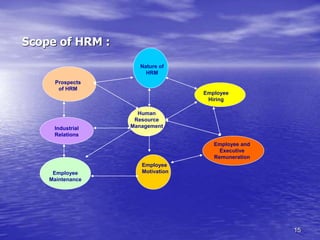
Scope of HRM :
Nature of
HRM
Prospects
of HRM
Human
Resource
Management
Employee
Hiring
Industrial
Relations
Employee
Maintenance
Employee
Motivation
Employee and
Executive
Remuneration
16
Objectives of HRM :
To create and utilise an able and motivated workforce,
to accomplish the basic organisational goals.
 To establish and maintain sound organisational
structure and desirable working relationships among all
the members of the organisation.
 To secure the integration of individual and groups
within the organisation by co-ordination of the individual
and group goals with those of the organisation.
 To create facilities and opportunities for individual or
group development so as to match it with the growth of
the organisation.
 To attain an effective utilisation of human resources in
the achievement of organisational goals.
 To identify and satisfy individual and group needs by
providing adequate and equitable wages, incentives,
employee benefits and social security and measures for
challenging work, prestige, recognition, security, status,
etc.
17
 To maintain high employee morale and sound
human relations by sustaining and improving the
various conditions and facilities.
 To strengthen and appreciate the human
assets continuously by providing training and
developmental programmes.
 To consider and contribute to the minimisation
of social-economic evils such as unemployment,
under-employment, inequalities in the distribution
of income and wealth and to improve the welfare
of the society by providing employment
opportunities to women and disadvantaged
sections of the society etc.
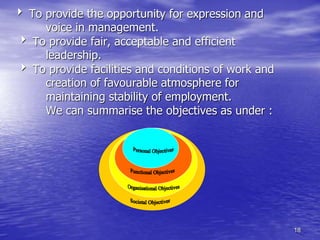
18
 To provide the opportunity for expression and
voice in management.
 To provide fair, acceptable and efficient
leadership.
 To provide facilities and conditions of work and
creation of favourable atmosphere for
maintaining stability of employment.
We can summarise the objectives as under :
19
Societal Objectives : To be ethically and socially
responsible to the needs and challenges of the
society while minimising the negative impact of
such demands upon the organisation. The failure of
organisations to use their resources for the society’s
benefit in ethical ways may lead to retractions. For
example, the society may limit HR decisions through
laws that enforce reservation in hiring and laws that
address discrimination, safety or other such areas of
societal concern.
Organisational Objectives : To recognise the
role of HRM is not an end in itself. It is only a
means to assist the organisation with its primary
objectives. Simply stated, the department exists to
serve the rest of the organisation.
20
Functional Objectives : To maintain the
department’s contribution at a level appropriate to
the organsiation’s needs. Resources are wasted
when HRM is either more or lees sophisticated to
suit the organisation’s demands. The department’s
level of service must be tailored to fit the
organisation it serves.
Personal Objectives : To assist employees in
achieving their personal goals, at least in-sofar as
these goals enhance the individual’s contribution to
the organisation. Personal objectives of employees
must be met if workers are to be maintained,
retained and motivated. Otherwise, employee
performance and satisfaction may decline and
employee may leave the organisation.
21
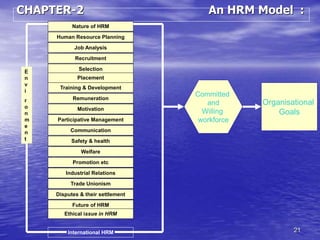
CHAPTER-2 An HRM Model :
Nature of HRM
Human Resource Planning
Selection
Job Analysis
Recruitment
Placement
Training & Development
Remuneration
Motivation
Safety & health
Communication
Participative Management
Welfare
Promotion etc
Future of HRM
Industrial Relations
Trade Unionism
Disputes & their settlement
Ethical issue in HRM
International HRM
E
n
v
i
r
o
n
m
e
n
t
Committed
and
Willing
workforce
Organisational
Goals
22
Emerging Challenges and Future of HRM
in India (Prospects) :
With liberalisation of the Indian economy, many
changes are taking place in the corporate sector. There
is pressure on Indian industry to perform - produce
quality goods and provide quality services. With
increased competition, there is need to become cost -
effective and upgrade work methods, work norms,
technical and managerial skills and employee motivation
to face the challenges. As a congruence, one can expect
several cultural and economic changes of great
significance in human resource management to sweep
through the country in the coming years.
.
23
(i) Greater Involvement in Development Planning :
Our future human resource manager will have to be more of a
development man than a more administrator of HRM services. With this
object he/she will have to get very much involved in basic organisational
planning, keep pace with social, political and economic factors which can
affect the internal situation of the company and advise management in the
relationship between these factors and the achievement of organisational
goals. He will have to engage himself in planning and meaningful HRM
research and stimulate his fellow managers to anticipate employee problems
which might arise from the introduction of changes in HRM policies,
manufacture procedures or labour- management agreements. He will actively
seek to place human resource management in the hands of the line
managers by means of education and selling efforts. He will conduct attitude
surveys informally, if possible to check on current management practices with
a desire to assisting line managers to improve upon them. He will have to be
most cost conscious so that all HRM proposals are made keeping the cost
factor in mind. Lastly, he will have to examine and assess the functioning of
his own department.
24
(ii) Change in HRM Policies :
The ratio of educated to uneducated employed labour
force has been growing in India in recent years. The aspirations
and needs of educated people differ from those of uneducated
people. Hence, existing H.R.M. Polices and procedures, many of
which were probably developed years ago when uneducated
workers predominated, would no longer be adequate for a better
educated. Workforce which would demand greater autonomy and
discretion in the workplace. Similarly, the sex composition of the
workers has been changing. Earlier, women were recruited mainly
as labour in agriculture. Now they are increasingly occupying white
collar and managerial positions. These women are beginning to
resist discrimination shown against them in matters of promotion.
Enquiries have revealed that there exist ‘psychological barriers’
in the minds of many men which account for this discrimination.
These psychological barriers act like glass walls or glass ceilings.
They permit women employees to see the prospects of promotion
on the opposite side but they do not allow them to walk through
the barriers. Interventions will have to be worked out to remove
these psychological barriers.
25
The present exit policy of some public
sector units (under which attractive financial
benefits are offered to those employees who
request for early retirement) is, besides
increasing the government burden of retirement
payments, creating a dependency culture that is
disastrous for society. The policy may have to be
reviewed in future. The better course for a unit
would be to find alternative jobs for its surplus
manpower. e.g., those removed from core jobs
may be given peripheral jobs so far handled by
outside agencies.
26
(iii) Change in Manpower : On account of an easy
access to better educational and employment
opportunities, minority groups and scheduled castes and
tribes would become an important source of manpower in
future with the result that the manpower planning of
every organisation will have to take account of the
potential availability of talent and ability in these groups.
Simultaneously, child labour will have to be abolished.
(iv) Re-training of Workers : With rapid technological
advancements many old skills are becoming obsolete at a
historically unprecedented rate and making it difficult for
laid-off workers, especially above 40 to find work for years
on end. The new information technology is fast replacing
several clerical and supervisory jobs. Similarly, outsourcing
is reducing the number of jobs in the production area. The
solution would lie in re-training these workers in new
knowledge, skills and attitudes.
27
(v) Greater Importance of Occupational Health and
Safety Programmes :Under legislative pressure future
H.R. managers will have to become more health and
safety conscious making full use of research in
ergonomics and in the behavioural sciences.
(vi) Greater Attention to the Human Problem of
Adjustment to New Work Ethics : The future H.R.
manager will have to become progressively familiar with
Organisational Development (O.D.) which is concerned
with the change process when a need for some change
within the organisation is seen as necessary. Most people
in India are not accustomed to the rigid demands of an
industrial system. They are not prepared for the rigorous
timing and discipline, precise division of labour, rational
forms of action, and impersonal styles of supervision and
control that prevail in advanced work systems. Long-run
evvironmental forces, using behavioural understanding,
will be required to establish new work ethics of this
magnitude.
28
.
(ix) Check on Rising Money Wages : The entry of multinationals and
international companies have thrown the wage field haywire in India. In
future the necessary parameters of wage rise will have to be defined.
People will have to be taught to value a closer connection between pay
and performance. The emphasis on performance will also mean that age
will no longer be considered as a basis for promotions. And older people
will accept reporting to younger bosses.
(x) New Quality Standards : The human resource manager would be
called upon to help line managers in the setting up and enforcement of
good quality standards. It will soon be realised that improving
manufacturing operations by investment in extensive computerisation etc.
by themselves will create only “local optimums”. To achieve world quality
standards new work ethics will have to be developed. This would require
workers’ commitment. The human resource manager will have to make
efforts to get workers’ mind and heart dedicated to work. Training will
have to be geared up to bring about change in attitudes of people and not
merely in their knowledge and skills. The grievance handling procedure
will have to be more effective and quick. Suggestion schemes will have to
be made an important vehicle for employees to participate and contribute.
Quality Circles and Task Forces for problem solving will have to be
encouraged.
29
(vii) Better Performance Appraisal Devices : Traditionally,
people are evaluated on the basis of results only. But this is unfair
in those cases where the poor results are due to various other
factors such as non-availability of resources or defective system.
Hence, in future the appraisal will have to be based on the efforts
also.
(viii) Greater Importance of Intrinsic Motivation : Many
psychological rewards such as interesting and challenging work,
autonomy and participation would work as better motivations.
(ix) Check on Rising Money Wages : The entry of
multinationals and international companies have thrown the wage
field haywire in India. In future the necessary parameters of wage
rise will have to be defined. People will have to be taught to value
a closer connection between pay and performance. The emphasis
on performance will also mean that age will no longer be
considered as a basis for promotions. And older people will accept
reporting to younger bosses.
30
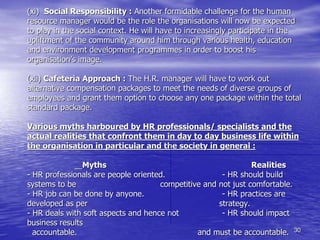
(xi) Social Responsibility : Another formidable challenge for the human
resource manager would be the role the organisations will now be expected
to play in the social context. He will have to increasingly participate in the
upliftment of the community around him through various health, education
and environment development programmes in order to boost his
organisation’s image.
(xii) Cafeteria Approach : The H.R. manager will have to work out
alternative compensation packages to meet the needs of diverse groups of
employees and grant them option to choose any one package within the total
standard package.
Various myths harboured by HR professionals/ specialists and the
actual realities that confront them in day to day business life within
the organisation in particular and the society in general :
Myths Realities
- HR professionals are people oriented. - HR should build
systems to be competitive and not just comfortable.
- HR job can be done by anyone. - HR practices are
developed as per strategy.
- HR deals with soft aspects and hence not - HR should impact
business results
accountable. and must be accountable.
31
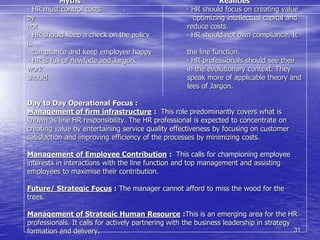
Myths Realities
- HR must control costs . - HR should focus on creating value
by optimizing intellectual capital and
not reduce costs.
- HR should keep a check on the policy - HR should not own compliance. It
is
compliance and keep employee happy the line function.
- HR is full of newfade and Jargon. - HR professionals should see their
work in the evolutionary context. They
should speak more of applicable theory and
lees of Jargon.
Day to Day Operational Focus :
Management of firm infrastructure : This role predominantly covers what is
known as line HR responsibility. The HR professional is expected to concentrate on
creating value by entertaining service quality effectiveness by focusing on customer
satisfaction and improving efficiency of the processes by minimizing costs.
Management of Employee Contribution : This calls for championing employee
interests in interactions with the line function and top management and assisting
employees to maximise their contribution.
Future/ Strategic Focus : The manager cannot afford to miss the wood for the
trees.
Management of Strategic Human Resource :This is an emerging area for the HR
professionals. It calls for actively partnering with the business leadership in strategy
formation and delivery.
32
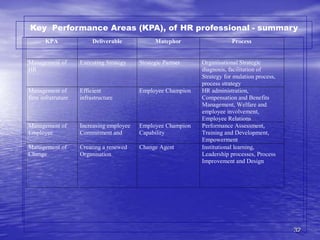
Key Performance Areas (KPA), of HR professional - summary
KPA Deliverable Matephor Process
Management of
HR
Executing Strategy Strategic Partner Organisational Strategic
diagnosis, facilitation of
Strategy for mulation process,
process strategy
Management of
firm infratruture
Efficient
infrastructure
Employee Champion HR administration,
Compensation and Benefits
Management, Welfare and
employee involvement,
Employee Relations
Management of
Employee
Increasing employee
Commitment and
Employee Champion
Capability
Performance Assessment,
Training and Development,
Empowerment
Management of
Change
Creating a renewed
Organisation
Change Agent Institutional learning,
Leadership processes, Process
Improvement and Design
33
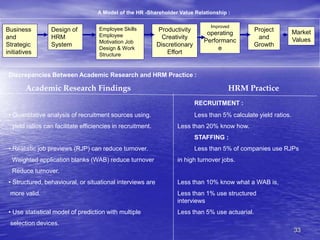
A Model of the HR -Shareholder Value Relationship :
Business
and
Strategic
initiatives
Design of
HRM
System
Employee Skills
Employee
Motivation Job
Design & Work
Structure
Productivity
Creativity
Discretionary
Effort
Improved
operating
Performanc
e
Project
and
Growth
Market
Values
Discrepancies Between Academic Research and HRM Practice :
Academic Research Findings HRM Practice
RECRUITMENT :
• Quantitative analysis of recruitment sources using. Less than 5% calculate yield ratios.
yield ratios can facilitate efficiencies in recruitment. Less than 20% know how.
STAFFING :
• Realistic job previews (RJP) can reduce turnover. Less than 5% of companies use RJPs
Weighted application blanks (WAB) reduce turnover in high turnover jobs.
Reduce turnover.
• Structured, behavioural, or situational interviews are Less than 10% know what a WAB is,
more valid. Less than 1% use structured
interviews
• Use statistical model of prediction with multiple Less than 5% use actuarial.
selection devices.
34
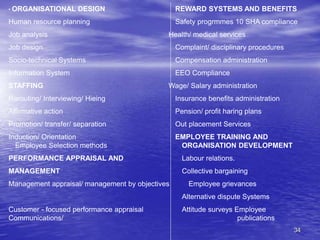
• ORGANISATIONAL DESIGN REWARD SYSTEMS AND BENEFITS
Human resource planning Safety progrmmes 10 SHA compliance
Job analysis Health/ medical services
Job design Complaint/ disciplinary procedures
Socio-technical Systems Compensation administration
Information System EEO Compliance
STAFFING Wage/ Salary administration
Rerouting/ Interviewing/ Hieing Insurance benefits administration
Affirmative action Pension/ profit haring plans
Promotion/ transfer/ separation Out placement Services
Induction/ Orientation EMPLOYEE TRAINING AND
Employee Selection methods ORGANISATION DEVELOPMENT
PERFORMANCE APPRAISAL AND Labour relations.
MANAGEMENT Collective bargaining
Management appraisal/ management by objectives Employee grievances
Alternative dispute Systems
Customer - focused performance appraisal Attitude surveys Employee
Communications/ publications
35
HEALTH AND SAEETY PRODUCTIVITY IMPROVEMENT PROGRAMME
OSHA compliance TQM programmes
Accident prevention Productivity/ enhancement programes
Stress reduction Suggestion Systems
Wellness programmes Quality Circles
Employee assistance/ Counselling Team building
programmes
36
WHAT IS ENVIRONMENT ?
Environment refers to all external factors which have a bearing on
the functioning of the business.
RELATIONSHIP BETWEEN BUSINESS AND IT’
ENVIRONMENT : Two Types
Business Environment at two levels
Internal Environment or External Environment or
Controllable factors Uncontrollable factors
• Value System
• Mission & Objectives Micro Macro
• Management Structure & Nature
• Internal Power Relationship Suppliers Economic Environs
• Human Resources Customers Political and Govt.
Environment
• Company Image and Brand Equity Marketing Socio-cultural
Intermediaries Environment
• Physical Assets & Facilities Financiers Demographic
Environment
• R & D and Technological Capabilities Publics Natural
Environment
• Marketing Resources Physical and
Technology logical Environment
• Financial Factors International
Environment
37
Steps in Job Analysis Process and its Relationship to
HRM and Job Design :
Step 1
Examine the total
organisation and the fit
of each job
Step 2
Determine how job
analysis information will
be used
Step 3
Select jobs to be
analysed
Step 4
Collect data by using
acceptable job analysis
techniques
Step 5
Prepare job description
Step 6
Prepare job specification
Use information from Steps 1- 6
- Job design
- Planning
- Recruitment
- Selection and
training
- Performance
evaluation
- Compensation
- EEO Compliance
- Follow-up
evaluation
CHAPTER-3
JOB DESIGN, DESCRPTION &SPECIFICATION
38
JOB ANALYSIS AND ROLE
DESCRIPTION
* Job analysis is a systematic process of
gathering information about a job.
* Job analysis provides answers to
question.
* How much time is taken to complete
important tasks ?
* Which tasks are grouped together.
* How can a job be designed or structured
so that the employee’s performance
can be enhanced ?
39
* What kinds of behaviours are needed to
perform the job ?
* What kind of person (in terms of traits
and experience) is best suited for the
job ?
* How can the information acquired by a
job analysis be used in the development
of HRM programmes ?
The following terms are used interchangeably by
people who are unfamiliar with job analysis. The
below definitions will give a clear idea.
40
Job Analysis : A purposeful, systematic
process for collecting information on the
important work - related aspects of a job. The
major products of Job Analysis are as under :
Job Description :The principal product of a
job analysis. It represents a written summary
of the job as an identifiable organisational unit.
Job Specification : A written explanation of
the knowledge, skills, abilities, traits, and
other characteristics (KSAOs) necessary for
effective performance on a given job.
41
Knowledge : Refers to an organised body of
information, usually of a factual or a
procedural nature applied directly to the
performance of a function. For example
computer programmers may need knowledge
of specific languages such a Java.
An Ability : Refers to a demonstrated
competence to perform an observable
behaviour or a behaviour that results in an
observable product. Police officers, for
example are required to possess the physical
ability to apprehend and detain a suspect.
42
A Skill :
A skill is a competence to perform a learned,
psychomotor act and may include a manual, verbal,
or mental manipulation of data, people or things.
Other Characteristics :
Include personality factors (attitudes,) aptitudes, or
physical or mental traits needed to perform the job.
43
Characteristics of Job Analysis :
 It should yield a thorough clear job description.
 The frequency and important of task behaviours should be assessed.
 It must allow for an accurate assessment of the Knowledge, Skills, Abilities
and other characteristics (KSAOs) required by the job.
 It must yield information about the relationship between job duties and these
KSAOs. That is it must clearly determine which KSAOs are important for
each job duties.
In addition to helping organisations satisfy their legal requirements, job analysis is
closely tied to HRM programmes and activities. It is used extensively in each of the
following areas :
44
Four Methods of Job Analysis
1. Recruitment and Selection 1. Observation
2. Teaching and Development 2. Interview
3. Compensation 3. Questionnaire
4. Strategic Planning 4. Job incumbent diaries or log
Who Should Conduct the Job Analysis :
Internal as well as external experts.
Job Analysis Information Format (JAIF)
Your job title - Code - Date -
Class title - Facility - Supervisor’s title
Prepared by - Supervisor’s Name - Hours worked AM to AM
PM to PM
45
1. What is the general purpose of your job ?
2. What was your last job ? If it was in another
organisation please name it.
3. To what job would you normally expected to be
promoted ?
4. If you regularly supervise others, those activities that are
part of your supervisory duties.
5. If you supervise others, please check those
activities that are part of your supervisory duties.
46
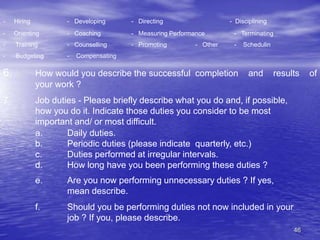
- Hiring - Developing - Directing - Disciplining
- Orienting - Coaching - Measuring Performance - Terminating
- Training - Counselling - Promoting - Other - Schedulin
- Budgeting - Compensating
6. How would you describe the successful completion and results of
your work ?
7. Job duties - Please briefly describe what you do and, if possible,
how you do it. Indicate those duties you consider to be most
important and/ or most difficult.
a. Daily duties.
b. Periodic duties (please indicate quarterly, etc.)
c. Duties performed at irregular intervals.
d. How long have you been performing these duties ?
e. Are you now performing unnecessary duties ? If yes,
mean describe.
f. Should you be performing duties not now included in your
job ? If you, please describe.
47
8. Education please check the balance that indicates the educational
requirements for the job, not your own educational background.
a - No formal education required
b - Less than high school diploma
c - High School diploma or equivalent.
d - 2 year college certificate or equivalent.
e - 4 year college degree.
f - Education beyond undergraduate degree and/ or professional
license.
- List advanced courses or specific license or certificate
required.
- Please indicate the education you had when you were
placed on this job.
9 Experience. Please choose the amount needed to perform your job.
48
- a - None
b - Less than one month
c - One month to less than six months
d - Six month to one year
e - One to three years
f - Three to five years
g - Five to 10 years
h - Over 10 years
Please indicate the experience you had when you were placed on this job.
49
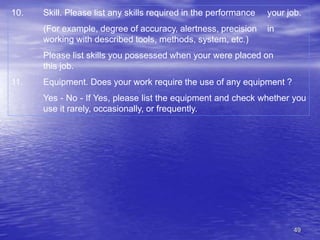
10. Skill. Please list any skills required in the performance your job.
(For example, degree of accuracy, alertness, precision in
working with described tools, methods, system, etc.)
Please list skills you possessed when your were placed on
this job.
11. Equipment. Does your work require the use of any equipment ?
Yes - No - If Yes, please list the equipment and check whether you
use it rarely, occasionally, or frequently.
50
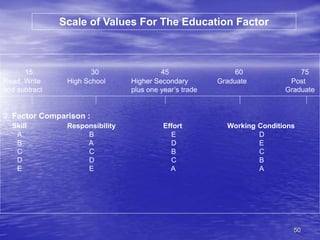
15 30 45 60 75
Read, Write High School Higher Secondary Graduate Post
and subtract plus one year’s trade Graduate
2. Factor Comparison :
Skill Responsibility Effort Working Conditions
A B E D
B A D E
C C B C
D D C B
E E A A
Scale of Values For The Education Factor
51
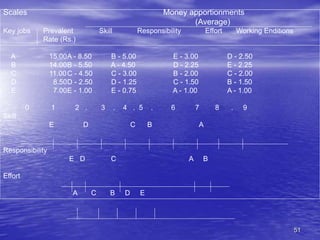
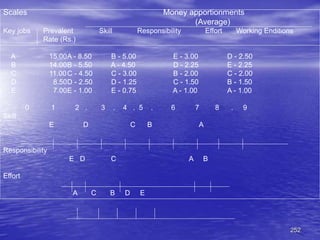
Scales Money apportionments
(Average)
Key jobs Prevalent Skill Responsibility Effort Working Enditions
Rate (Rs.)
A 15.00A - 8.50 B - 5.00 E - 3.00 D - 2.50
B 14.00B - 5.50 A - 4.50 D - 2.25 E - 2.25
C 11.00C - 4.50 C - 3.00 B - 2.00 C - 2.00
D 8.50D - 2.50 D - 1.25 C - 1.50 B - 1.50
E 7.00E - 1.00 E - 0.75 A - 1.00 A - 1.00
0 1 2 . 3 . 4 . 5 . 6 7 8 . 9
Skill
E D C B A
Responsibility
E D C A B
Effort
A C B D E
52
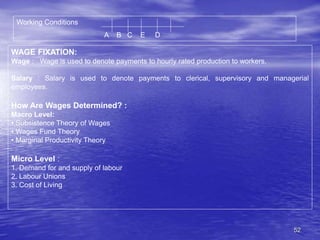
Working Conditions
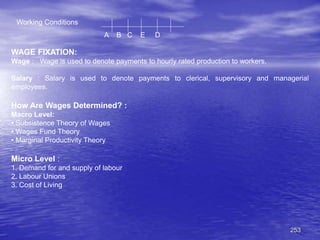
A B C E D
WAGE FIXATION:
Wage : Wage is used to denote payments to hourly rated production to workers.
Salary : Salary is used to denote payments to clerical, supervisory and managerial
employees.
How Are Wages Determined? :
Macro Level:
• Subsistence Theory of Wages
• Wages Fund Theory
• Marginal Productivity Theory
Micro Level :
1. Demand for and supply of labour
2. Labour Unions
3. Cost of Living
53
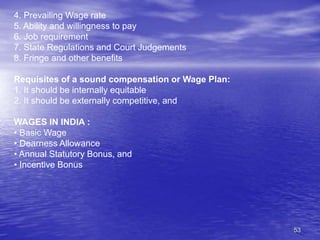
4. Prevailing Wage rate
5. Ability and willingness to pay
6. Job requirement
7. State Regulations and Court Judgements
8. Fringe and other benefits
Requisites of a sound compensation or Wage Plan:
1. It should be internally equitable
2. It should be externally competitive, and
WAGES IN INDIA :
• Basic Wage
• Dearness Allowance
• Annual Statutory Bonus, and
• Incentive Bonus
54
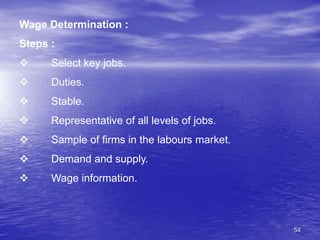
Wage Determination :
Steps :
 Select key jobs.
 Duties.
 Stable.
 Representative of all levels of jobs.
 Sample of firms in the labours market.
 Demand and supply.
 Wage information.
55
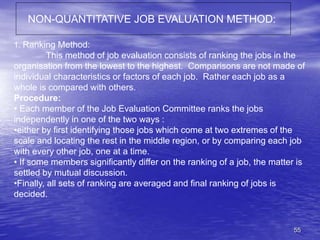
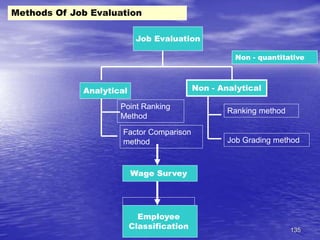
NON-QUANTITATIVE JOB EVALUATION METHOD:
1. Ranking Method:
This method of job evaluation consists of ranking the jobs in the
organisation from the lowest to the highest. Comparisons are not made of
individual characteristics or factors of each job. Rather each job as a
whole is compared with others.
Procedure:
• Each member of the Job Evaluation Committee ranks the jobs
independently in one of the two ways :
•either by first identifying those jobs which come at two extremes of the
scale and locating the rest in the middle region, or by comparing each job
with every other job, one at a time.
• If some members significantly differ on the ranking of a job, the matter is
settled by mutual discussion.
•Finally, all sets of ranking are averaged and final ranking of jobs is
decided.
56
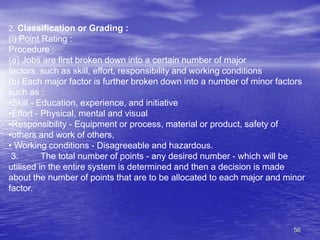
2. Classification or Grading :
(i) Point Rating :
Procedure :
(a) Jobs are first broken down into a certain number of major
factors such as skill, effort, responsibility and working conditions
(b) Each major factor is further broken down into a number of minor factors
such as :
•Skill - Education, experience, and initiative
•Effort - Physical, mental and visual
•Responsibility - Equipment or process, material or product, safety of
•others and work of others,
• Working conditions - Disagreeable and hazardous.
3. The total number of points - any desired number - which will be
utilised in the entire system is determined and then a decision is made
about the number of points that are to be allocated to each major and minor
factor.
57
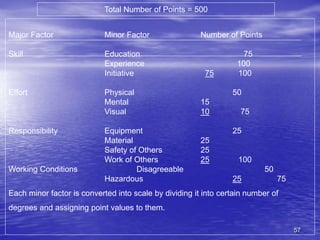
Major Factor Minor Factor Number of Points
Skill Education 75
Experience 100
Initiative 75 100
Effort Physical 50
Mental 15
Visual 10 75
Responsibility Equipment 25
Material 25
Safety of Others 25
Work of Others 25 100
Working Conditions Disagreeable 50
Hazardous 25 75
Each minor factor is converted into scale by dividing it into certain number of
degrees and assigning point values to them.
Total Number of Points = 500
58
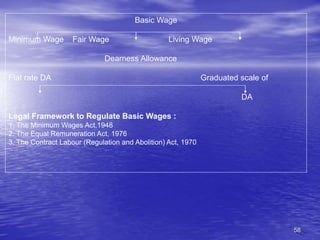
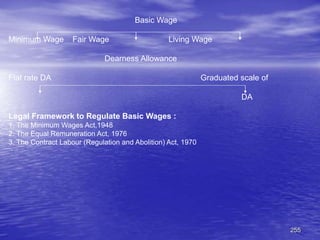
Basic Wage
Minimum Wage Fair Wage Living Wage
Dearness Allowance
Flat rate DA Graduated scale of
DA
Legal Framework to Regulate Basic Wages :
1. The Minimum Wages Act,1948
2. The Equal Remuneration Act, 1976
3. The Contract Labour (Regulation and Abolition) Act, 1970
59
HUMAN RESOURCEPLANNING
HRP is both process and set of plans. It is
how organizations asses the future supply
of and demand for human resources. In
addition an effective HR plan also provides
mechanism to elementary gaps that may
exist between supply and demand.
CHAPTER-04
60
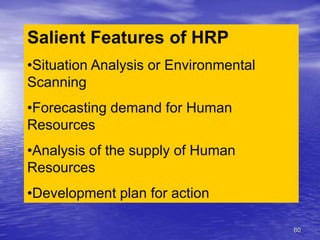
Salient Features of HRP
•Situation Analysis or Environmental
Scanning
•Forecasting demand for Human
Resources
•Analysis of the supply of Human
Resources
•Development plan for action
61
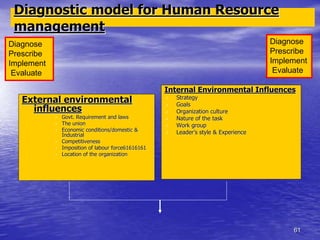
Diagnostic model for Human Resource
management
External environmental
influences
• Govt. Requirement and laws
• The union
• Economic conditions/domestic &
Industrial
• Competitiveness
• Imposition of labour force61616161
• Location of the organization
Internal Environmental Influences
• Strategy
• Goals
• Organization culture
• Nature of the task
• Work group
• Leader’s style & Experience
Diagnose
Prescribe
Implement
Evaluate
Diagnose
Prescribe
Implement
Evaluate
62
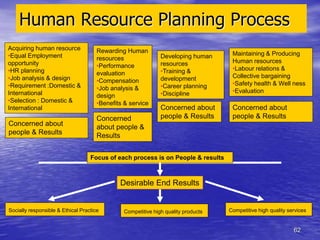
Human Resource Planning Process
Acquiring human resource
•Equal Employment
opportunity
•HR planning
•Job analysis & design
•Requirement :Domestic &
International
•Selection : Domestic &
International
Rewarding Human
resources
•Performance
evaluation
•Compensation
•Job analysis &
design
•Benefits & service
Developing human
resources
•Training &
development
•Career planning
•Discipline
Maintaining & Producing
Human resources
•Labour relations &
Collective bargaining
•Safety health & Well ness
•Evaluation
Concerned about
people & Results
Concerned
about people &
Results
Concerned about
people & Results
Concerned about
people & Results
Focus of each process is on People & results
Socially responsible & Ethical Practice Competitive high quality products Competitive high quality services
Desirable End Results
63
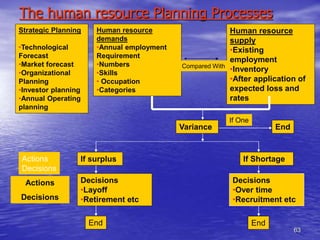
The human resource Planning Processes
Strategic Planning
•Technological
Forecast
•Market forecast
•Organizational
Planning
•Investor planning
•Annual Operating
planning
Human resource
demands
•Annual employment
Requirement
•Numbers
•Skills
• Occupation
•Categories
Human resource
supply
•Existing
employment
•Inventory
•After application of
expected loss and
rates
Compared With
Variance
If One
End
If surplus
Decisions
•Layoff
•Retirement etc
End
If Shortage
Decisions
•Over time
•Recruitment etc
End
Actions
Decisions
Actions
Decisions
b) Statistical techniques : There are two types of statistical
techniques useful for human resource planning, viz : i)ratio
trend analysis, and ii) econometric models
i) Ratio trend analysis : Under this method, the ratios are
calculated, for the past data relating to number of employees
of each category and production level, sales level, activity
level/work load level and direct employees and indirect
employees. Furture production level, sales level, activity
level/work load are estimated with an allowance for changes in
organisation, methods and jobs.
• Future ratios are also estimated with an allowance for
changes in organisation, methods and jobs. Future ratios
are also estimated when there are changes to come in
organisation and human resources. Then future human
resource is calculated on the basis of established ratios.
The following example gives clear idea.
• Present level of production (1-1-12) 2,000 units
• Present number of Foremen (1-1-12) 4
• Ratio is 4:2000, i.e. 1:5900
• Estimates production on (1-1-13)=5,000
units
• Foremen required as on (1-1-13)= 5000 = 10
• (without giving any provision 500
• for changes)
• FUTURE CHANGES INCLUDE :
• Due to decline in physical stamina of employees,
change in values and increase in social activities it is
estimated that the future ratio would be 1:420. The
foremen required as on 1-1-2013 = 6.
• Ii)Econometric Models : Econometric models for human
resource planning are built up by analysing the past
statistical data and by bringing the relationship among
variables. These variables include those factors which
affect manpower requirement directly and indirectly like
investment, production, sales, activities/work load, etc.
The econometric model or formula is used to forecast
manpower needs based on movements in various
variables.
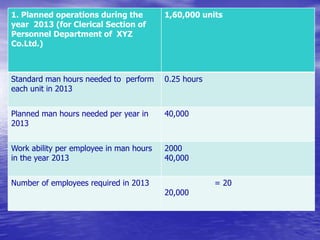
• C) Work Study Techniques : These techniques are more
suitable where the volume of work is easily measurable.
Under this method, total production and activities in terms
of clear units are estimated in a year. Man hours required to
produce/perform each unit is calculated. Work ability of
each employee is estimated in terms of man hours after
giving due weightage to absenteeism, rest, etc. Then the
required number of employees is calculated. The following
example gives clear idea
1. Planned operations during the
year 2013 (for Clerical Section of
Personnel Department of XYZ
Co.Ltd.)
1,60,000 units
Standard man hours needed to perform
each unit in 2013
0.25 hours
Planned man hours needed per year in
2013
40,000
Work ability per employee in man hours
in the year 2013
2000
40,000
Number of employees required in 2013 = 20
20,000
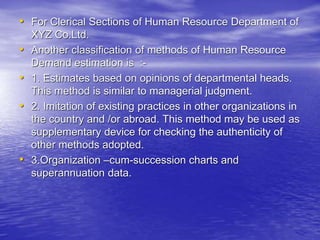
• For Clerical Sections of Human Resource Department of
XYZ Co.Ltd.
• Another classification of methods of Human Resource
Demand estimation is :-
• 1. Estimates based on opinions of departmental heads.
This method is similar to managerial judgment.
• 2. Imitation of existing practices in other organizations in
the country and /or abroad. This method may be used as
supplementary device for checking the authenticity of
other methods adopted.
• 3.Organization –cum-succession charts and
superannuation data.
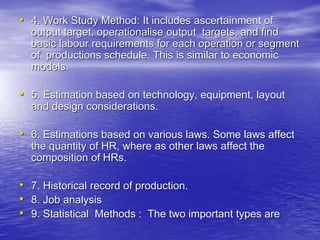
• 4. Work Study Method: It includes ascertainment of
output target, operationalise output targets, and find
basic labour requirements for each operation or segment
of productions schedule. This is similar to economic
models.
• 5. Estimation based on technology, equipment, layout
and design considerations.
• 6. Estimations based on various laws. Some laws affect
the quantity of HR, where as other laws affect the
composition of HRs.
• 7. Historical record of production.
• 8. Job analysis
• 9. Statistical Methods : The two important types are
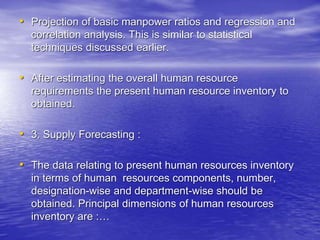
• Projection of basic manpower ratios and regression and
correlation analysis. This is similar to statistical
techniques discussed earlier.
• After estimating the overall human resource
requirements the present human resource inventory to
obtained.
• 3. Supply Forecasting :
• The data relating to present human resources inventory
in terms of human resources components, number,
designation-wise and department-wise should be
obtained. Principal dimensions of human resources
inventory are :…
• i) Head counts regarding total, department-wise, sex-
wise, designation-wise, skill-wise, pay roll-wise etc.
• Ii) Job Family Inventory : It includes number and
category of employees of each job family, i.e. all jobs
related to same category like clerks, cashiers, typists,
stenos, etc, each sub job family, i.e. all jobs having
common job characteristics (skill, qualification, similar
operations) like production engineer (mechanical) and
maintenance engineer (mechanical) and broad job
families like general administration, production, etc.
• Iii) Age Inventory : It includes age-wise number and
category of employees. It indicates age wise imbalance
in present inventory which can be correlated in future
selections and promotions.
73
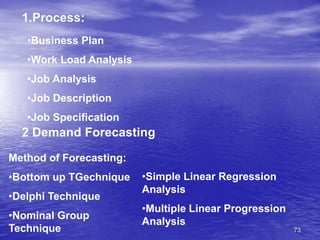
1.Process:
•Business Plan
•Work Load Analysis
•Job Analysis
•Job Description
•Job Specification
2 Demand Forecasting
Method of Forecasting:
•Bottom up TGechnique
•Delphi Technique
•Nominal Group
Technique
•Simple Linear Regression
Analysis
•Multiple Linear Progression
Analysis
74
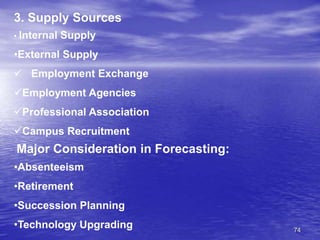
3. Supply Sources
• Internal Supply
•External Supply
 Employment Exchange
Employment Agencies
Professional Association
Campus Recruitment
Major Consideration in Forecasting:
•Absenteeism
•Retirement
•Succession Planning
•Technology Upgrading
75
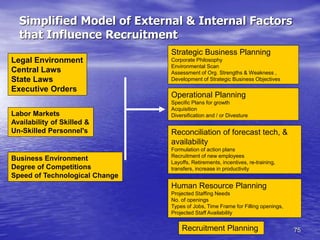
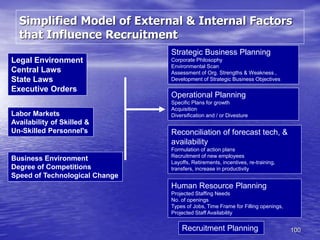
Simplified Model of External & Internal Factors
that Influence Recruitment
Legal Environment
Central Laws
State Laws
Executive Orders
Labor Markets
Availability of Skilled &
Un-Skilled Personnel's
Business Environment
Degree of Competitions
Speed of Technological Change
Strategic Business Planning
Corporate Philosophy
Environmental Scan
Assessment of Org. Strengths & Weakness ,
Development of Strategic Business Objectives
Operational Planning
Specific Plans for growth
Acquisition
Diversification and / or Divesture
Human Resource Planning
Projected Staffing Needs
No. of openings
Types of Jobs, Time Frame for Filling openings,
Projected Staff Availability
Reconciliation of forecast tech, &
availability
Formulation of action plans
Recruitment of new employees
Layoffs, Retirements, incentives, re-training,
transfers, increase in productivity
Recruitment Planning
76
CHAPTER-05
RECRUITMENT & SELECTION
77
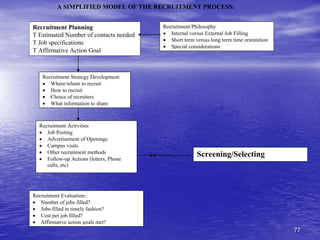
A SIMPLIFIED MODEL OF THE RECRUITMENT PROCESS:
Recruitment Planning
 Estimated Number of contacts needed
 Job specifications
 Affirmative Action Goal
Recruitment Philosophy
 Internal versus External Job Filling
 Short term versus long term time orientation
 Special considerations
Recruitment Strategy Development
 Where/whom to recruit
 How to recruit
 Choice of recruiters
 What information to share
Recruitment Activities
 Job Posting
 Advertisement of Openings
 Campus visits
 Other recruitment methods
 Follow-up Actions (letters, Phone
calls, etc)
Screening/Selecting
Employees
Recruitment Evaluation::
 Number of jobs filled?
 Jobs filled in timely fashion?
 Cost per job filled?
 Affirmative action goals met?
78
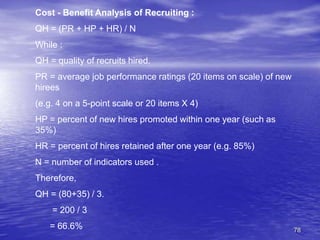
Cost - Benefit Analysis of Recruiting :
QH = (PR + HP + HR) / N
While :
QH = quality of recruits hired.
PR = average job performance ratings (20 items on scale) of new
hirees
(e.g. 4 on a 5-point scale or 20 items X 4)
HP = percent of new hires promoted within one year (such as
35%)
HR = percent of hires retained after one year (e.g. 85%)
N = number of indicators used .
Therefore,
QH = (80+35) / 3.
= 200 / 3
= 66.6%
79
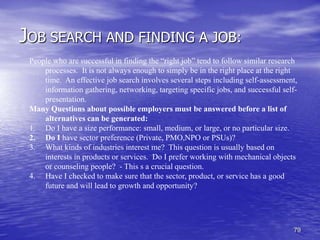
JOB SEARCH AND FINDING A JOB:
People who are successful in finding the “right job” tend to follow similar research
processes. It is not always enough to simply be in the right place at the right
time. An effective job search involves several steps including self-assessment,
information gathering, networking, targeting specific jobs, and successful self-
presentation.
Many Questions about possible employers must be answered before a list of
alternatives can be generated:
1. Do I have a size performance: small, medium, or large, or no particular size.
2. Do I have sector preference (Private, PMO,NPO or PSUs)?
3. What kinds of industries interest me? This question is usually based on
interests in products or services. Do I prefer working with mechanical objects
or counseling people? - This s a crucial question.
4. Have I checked to make sure that the sector, product, or service has a good
future and will lead to growth and opportunity?
80
•Prepare a list of prospective employer
•Prepare a cover letter and resume in-terms of
importance.
• Position you seek
•Your specific job objectives
•Your career objectives
•Reason you seek employment
•An indication that you know something
about the organisation.
81
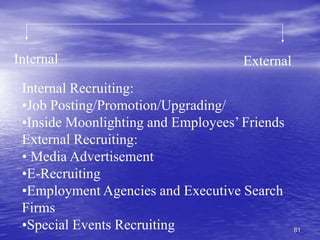
Internal External
Internal Recruiting:
•Job Posting/Promotion/Upgrading/
•Inside Moonlighting and Employees’ Friends
External Recruiting:
• Media Advertisement
•E-Recruiting
•Employment Agencies and Executive Search
Firms
•Special Events Recruiting
82
•Summer Internship
•College Recruiting
ALTERNATIVES TO RECRUITMENT:
•Overtime
•Employee Leasing
•Temporary Employment
EVALUATION AND CONTROL:
•Evaluation and control is necessary as
considerable costs are incurred in the recruitment
process. The costs generally incurred are :
•Salaries for recruiters
•Management and professional time spent on
preparing job description, job specifications,
83
Advertisement, agency liaisoning and so forth.
•Cost of advertisements or other recruitment
methods i.e. agency fees.
•Cost of producing supporting literature.
•Recruitment overhead and administrative
expenses.
•Costs of overtime and outsourcing while the
vacancies remain unfilled.
•Cost of recruiting suitable candidates for the
selection process.
84
EVALUATION OF RECRUITMENT PROCESS:
• The recruitment process has the objective of
searching for and obtaining applications from
job-seekers in sufficient numbers and quality.
The evaluation might include :
1. Return rate of applications sent out.
2. Number of suitable candidates for selection.
3. Retention and performance of candidates
seelected.
4. Cost of the recruitment process.
5. Time lapsed data(TLD)
6. Comments on image projected.
85
EVALUATION OF RECRUITMENT METHODS:
1. No.of initial inquiries received which resulted in
completed application forms.
METHODS OFMANPOWER SEARCH:
• Searching : Once a recruiting plan and strategy are worked
out, the search process begins. The following steps are involved
in manpower search:
(1)Source Activation
(2)Selling
Source Activation : Sources a nd research
methods are activated by the issuance of
employee requisition. This means that no actual
recruiting takes place until line managers have
86
Verified that a vacancy does exist or will exist.
SELLING :
•A second issue to be addressed in the searching
process concerned communications. On one hand,
they want to do whatever they can to attract
prospective applicants. On the other, they must
request the temptation of overselling their virtues.
•Low credibility selling and high credibility
selling.
•Selection of medium or media needs to be done
with a lot of care.
87
PROCESSES:
•Advertisement
•Screening
•Regret letters
•Call letters
•Selection Committee formation
•Conduct of Interview
•Selection
88
Role Analysis Technique (RAT) :
Since managerial job descriptions centre around mostly intangible duties and
relationships, they often leaves many things unsaid and unclear. For example, they
may not say anything about the discretionary aspect of a management job or about
the behavioural expectations which others have from the manger, and so on. To
overcome the shortcoming, the use of Role Analysis Technique may be used.
Following are the Steps :
1. The manger defines his task consisting of the prescribed and
discretionary elements. Other role incumbents and his immediate
superior question him on the definition of his task, if there is
confusion in their perceptions, the ambiguity is cleared.
2. The manager lists his expectations from each of those other
roles in the group which he feels most directly affect his own work.
Others in the group also state their expectations and after
discussion all of them arrive at an agreement among themselves
on their mutual expectations.
3. The manager then writes up his role which consists of all aspects
of his work. The technique allows the managerial group to work
out inter-personal problems more effectively then is otherwise
possible through a job description.
89
Main activities/ tasks.
Special requirements (tools and equipment used, external contacts, etc.)
other features of job : Shift or night work, travelling, working condition etc.
Location of job.
Part - II - Job Specification
Knowledge and Skills.
Educational qualifications and special training.
Experience.
Personality requirements.
Physical requirements.
Other requirements.
Age.
Travel.
Analysis by Approach by
90
6. Materials used.
7. Reports and records made.
8. Relation of the job to other jobs.
9. Education (general, technical and on the job) required.
10. Experience (type and duration) required.
11. Physical effort required.
12. Mental effort required.
13. Visual attention required.
14. Responsibility (in-terms of typical damage, money value and normal
consequences) for equipment, tools, materials and records and reports.
15. Discomforts.
16. Hazards (in terms of typical injury and preventive measures taken).
17. Supervision (Close or general) given.
18. Supervision (Close or general) received.
19. Any other details (e.g. Number of person - men and women - employee).
91
Equipment Rarely Occasionally Frequently
a.
b.
c.
d.
Various points on which information may be gathered for job analysis are as follows :
1. Job Title.
2. Alternate Title.
3. Work Performed.
4. Equipment used.
5. Tools used.
92
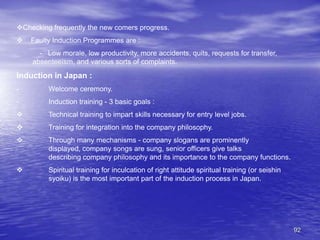
Checking frequently the new comers progress.
 Faulty Induction Programmes are :
- Low morale, low productivity, more accidents, quits, requests for transfer,
absenteeism, and various sorts of complaints.
Induction in Japan :
- Welcome ceremony.
- Induction training - 3 basic goals :
 Technical training to impart skills necessary for entry level jobs.
 Training for integration into the company philosophy.
 Through many mechanisms - company slogans are prominently
displayed, company songs are sung, senior officers give talks
describing company philosophy and its importance to the company functions.
 Spiritual training for inculcation of right attitude spiritual training (or seishin
syoiku) is the most important part of the induction process in Japan.
93
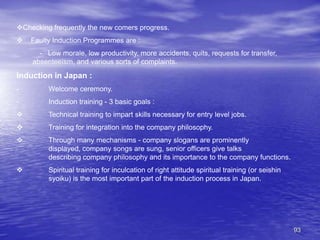
Checking frequently the new comers progress.
 Faulty Induction Programmes are :
- Low morale, low productivity, more accidents, quits, requests for transfer,
absenteeism, and various sorts of complaints.
Induction in Japan :
- Welcome ceremony.
- Induction training - 3 basic goals :
 Technical training to impart skills necessary for entry level jobs.
 Training for integration into the company philosophy.
 Through many mechanisms - company slogans are prominently
displayed, company songs are sung, senior officers give talks
describing company philosophy and its importance to the company functions.
 Spiritual training for inculcation of right attitude spiritual training (or seishin
syoiku) is the most important part of the induction process in Japan.
94
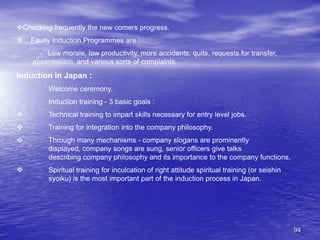
Checking frequently the new comers progress.
 Faulty Induction Programmes are :
- Low morale, low productivity, more accidents, quits, requests for transfer,
absenteeism, and various sorts of complaints.
Induction in Japan :
- Welcome ceremony.
- Induction training - 3 basic goals :
 Technical training to impart skills necessary for entry level jobs.
 Training for integration into the company philosophy.
 Through many mechanisms - company slogans are prominently
displayed, company songs are sung, senior officers give talks
describing company philosophy and its importance to the company functions.
 Spiritual training for inculcation of right attitude spiritual training (or seishin
syoiku) is the most important part of the induction process in Japan.
95
Activities of induction programme includes :
Group lectures, individual interviews with key people, & company films.
The complete induction programme is generally divided into 2 phases :
By Personnel Department Buddy System or the Sponsor
System (introduction is done by
the supervisor)
A seven step Buddy System programme includes :
 Greeting the new comer cordially.
 Telling the new comer his duties.
 Explaining the importance of his job in relation to other jobs of the department.
 Introducing the new comer to the person with whom he will get training.
 Telling the new comer what to do if he :
- Has a problem in understanding the wage/ salary system.
- Has a medical problem.
- Feels that working conditions are unsafe or unwelcome.
- Does not get on with his co-workers.
- Is bullied or harassed.
- Has a complaint.
- Does not receive adequate training.
96
- Final decision by the line mangers concerned.
- Employment/ Joining.
Induction and Socialisation :
- Placement.
- Induction - two objectives.
(1) Familiarising the new employee with his new surroundings and company rules
and regulations and
(2) Integrating his personal goals with the organisational goals.
The following information is commonly pass on to the new employee loves the following
subjects :
1. Company history, products and major operations.
2. Geography of the plant.
3. Structure of the organisation and functions of various deptts.
4. General company polices and regulations regarding wages and payment, hours
of work and overtime, safety clothing and pasking.
. Economic and recreational services available .
6. Opportunities for promotion and transfer, performance appraisal and
suggestions system.
7. First impression should be the last impression.
97
Types of Interviews :
(i) Preliminary Interview (a) Informal interview
(b) Unstructured interview
(ii) Core Interview (a) Background information interview
(b) Job and Probing Interview.
(c) Stress Interview.
(d) The group discussion Interview.
(e) Formal and Structured Interview.
(f) Panel Interview.
(g) Depth Interview.
Decision Making :
- To prepare a panel of prospective candidates.
- Issues of offer letter.
- Reference checks.
98
Wonderlic Personnel Test - 50 questions, covering a variety of areas including vocabulam, mathematics,
spatial relations, perceptual speed, analysis, and miscellaneous topics. Eg : used is the opposite of :
(a) Rare (b) Habitual (c) Regular (d) Stanch (e) always
- Bennett Mechanical Comprehension Test (BMTC) : Consists of mainly pictures depicting mechanical
situations with questions pertaining to the situations.
Minnesota Clerical Test (MCT) : - requires test takers to quickly compare either names or numbers and so
indicate pairs that are the same.
Attracting and Selecting Employees :
Typical Selection Decision Process :
- Step 1 step 4
- Step 2 step 5
- Step 3
-
-
Preliminary Screening application blank and interview
-
Employment Interview
Employment Test
Background and
reference checks
Selection Decision
Step 6
Physical Examination
99
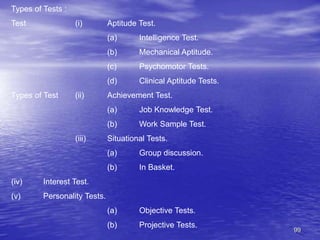
Types of Tests :
Test (i) Aptitude Test.
(a) Intelligence Test.
(b) Mechanical Aptitude.
(c) Psychomotor Tests.
(d) Clinical Aptitude Tests.
Types of Test (ii) Achievement Test.
(a) Job Knowledge Test.
(b) Work Sample Test.
(iii) Situational Tests.
(a) Group discussion.
(b) In Basket.
(iv) Interest Test.
(v) Personality Tests.
(a) Objective Tests.
(b) Projective Tests.
100
Simplified Model of External & Internal Factors
that Influence Recruitment
Legal Environment
Central Laws
State Laws
Executive Orders
Labor Markets
Availability of Skilled &
Un-Skilled Personnel's
Business Environment
Degree of Competitions
Speed of Technological Change
Strategic Business Planning
Corporate Philosophy
Environmental Scan
Assessment of Org. Strengths & Weakness ,
Development of Strategic Business Objectives
Operational Planning
Specific Plans for growth
Acquisition
Diversification and / or Divesture
Human Resource Planning
Projected Staffing Needs
No. of openings
Types of Jobs, Time Frame for Filling openings,
Projected Staff Availability
Reconciliation of forecast tech, &
availability
Formulation of action plans
Recruitment of new employees
Layoffs, Retirements, incentives, re-training,
transfers, increase in productivity
Recruitment Planning
HR/CURRENT TRENDS
Recruiting Sites:
Career Builder: http://www.careerbuilder.com
Employment Guide: http://www.employmentguide.com
Jobs and Employers: http://www. Flipdog.com
Hot Jobs: http://www.hotjobs.com
Job Track: http://www.jobtrack.com
Job Web: http://www.jobweb.com
Monster.com:http://www.monster.com
Net-Temps:http://www.nettemps.com
Spherion: http://www.spherion.com
Naukari: http://naukari.com
Hotbot:http://www.hotbot.com
Hireright: http://www.hireright.com
Naceweb: http:// www.naceweb.org
101
102
CHAPTER-06
TRAINING & DEVELOPMENT
103
MANPOWER TRAINING AND DEVELOPMENT :
“Give a man a fish, he will eat it. Train a man to fish, he will
feed his family”.
Difference between Training, Education and Development :
- Training is concerned with imparting specific skills for particular purposes.
- Education is concerned with increasing general knowledge and understanding of
the employees total environment.
- Development - its aim is to improve the overall personality of an individual.
Objectives of Training :
 To train the employee in the organisation’s culture pattern.
 To train the employee to increase his quantity and quality of output.
 This may involve improvement in work methods or skills.
 To train the employee for promotion to higher jobs.
 To train the employee to avoid social mistakes.
 To train the employee towards letter job adjustment and high morale.
 To reduce supervision, wastage and accidents.
104
(i) Intranets (CD-ROM based training).
(j) Multi-Media--based training (MBT)
(k) Virtual Reality (VR)
(l) Distance learning
(m) Govt. Alliance for Training and Education (GATE)
(n) Govt. Education and Training Network (GETN)
Development : Individual Techniques.
 Goal setting - Goal setting Techniques.
 Diagnosis.
 Preparing the employees for action plans.
 Emphasising the attributes of goals that should be understood by a manager and
subordinates.
 Conducting intermediate reviews to make necessary adjustments in established goals and
 Performing a final review to check the goals get, modified, and accomplished.
Development : A Group Technique - Team Building :
1. Team Skills Workshop.
2. Data Collection.
3. Action Confrontation.
4. Action Planning.
5. Team Building.
6. Inter group team building.
Development : An Organisation - Wide Technique :
 TQM -
 What is meant by TQM.
 Why it is important.
 How it will be accomplished.
 Why the CEO is involved and committed.
 What benefits will be achieved.
105
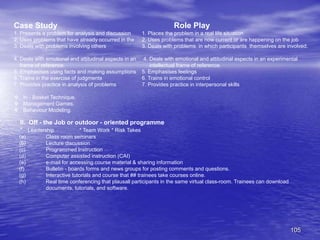
Case Study Role Play
1. Presents a problem for analysis and discussion 1. Places the problem in a real life situation
2. Uses problems that have already occurred in the 2. Uses problems that are now current or are happening on the job
3. Deals with problems involving others 3. Deals with problems in which participants themselves are involved.
4. Deals with emotional and attitudinal aspects in an 4. Deals with emotional and attitudinal aspects in an experimental
frame of reference. intellectual frame of reference.
5. Emphasises using facts and making assumptions 5. Emphasises feelings
6. Trains in the exercise of judgments 6. Trains in emotional control
7. Provides practice in analysis of problems 7. Provides practice in interpersonal skills
 In - Basket Technique.
 Management Games.
 Behaviour Modeling.
II. Off - the Job or outdoor - oriented programme
* Leadership * Team Work * Risk Takes
(a) Class room seminars
(b) Lecture discussion
(c) Programmed Instruction
(d) Computer assisted instruction (CAI)
(e) e-mail for accessing course material & sharing information
(f) Bulletin - boards forms and news groups for posting comments and questions.
(g) Interactive tutorials and course that ## trainees take courses online.
(h) Real time conferencing that plausall participants in the same virtual class-room. Trainees can download
documents, tutorials, and software.
106
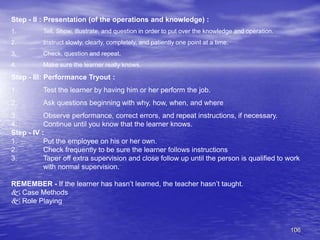
Step - II : Presentation (of the operations and knowledge) :
1. Tell, Show, illustrate, and question in order to put over the knowledge and operation.
2. Instruct slowly, clearly, completely, and patiently one point at a time.
3. Check, question and repeat.
4. Make sure the learner really knows.
Step - III: Performance Tryout :
1. Test the learner by having him or her perform the job.
2. Ask questions beginning with why, how, when, and where
3. Observe performance, correct errors, and repeat instructions, if necessary.
4. Continue until you know that the learner knows.
Step - IV :
1. Put the employee on his or her own.
2. Check frequently to be sure the learner follows instructions
3. Taper off extra supervision and close follow up until the person is qualified to work
with normal supervision.
REMEMBER - If the learner has hasn’t learned, the teacher hasn’t taught.
 Case Methods
 Role Playing
107
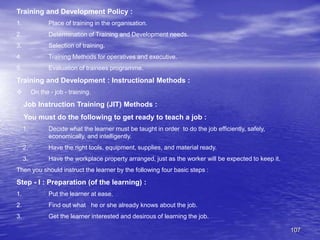
Training and Development Policy :
1. Place of training in the organisation.
2. Determination of Training and Development needs.
3. Selection of training.
4. Training Methods for operatives and executive.
5. Evaluation of trainees programme.
Training and Development : Instructional Methods :
 On the - job - training.
Job Instruction Training (JIT) Methods :
You must do the following to get ready to teach a job :
1. Decide what the learner must be taught in order to do the job efficiently, safely,
economically, and intelligently.
2. Have the right tools, equipment, supplies, and material ready.
3. Have the workplace property arranged, just as the worker will be expected to keep it.
Then you should instruct the learner by the following four basic steps :
Step - I : Preparation (of the learning) :
1. Put the learner at ease.
2. Find out what he or she already knows about the job.
3. Get the learner interested and desirous of learning the job.
108
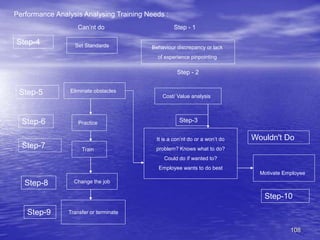
Performance Analysis Analysing Training Needs :
Can’nt do Step - 1
Step - 2
Set Standards Behaviour discrepancy or lack
of experience pinpointing
Eliminate obstacles
Cost/ Value analysis
It is a con’nt do or a won’t do
problem? Knows what to do?
Could do if wanted to?
Employee wants to do best
Practice
Train
Change the job
Motivate Employee
Transfer or terminate
Step-3
Step-4
Step-5
Step-6
Step-7
Step-8
Step-9
Step-10
Wouldn't Do
109
Learning Theory and Training :
 The trainee must be motivated to learn.
 The trainee must be able to learn.
 The learning must be reinforced.
 The material presented must be meaningful.
 The material must be communicated effectively.
 The material taught must transfer to the job.
Learning Organisations : Where people continually expand, their capacity to create the results they truly desire, where new and expansive
patterns of thinking are nurtured, where collective aspiration is get free, and where people are continually learning how to learn together.
110
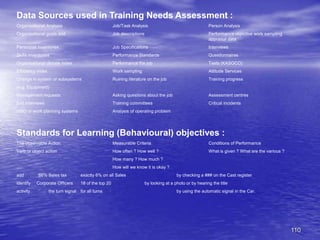
Data Sources used in Training Needs Assessment :
Organisational Analysis Job/Task Analysis Person Analysis
Organisational goals and Job descriptions Performance objective work sampling
appraisal data
Personnel inventories Job Specifications Interviews
Skills inventories Performance Standards Questionnaires
Organisational climate index Performance the job Tests (KASOCO)
Efficiency index Work sampling Attitude Services
Change in system or subsystems Ruining literature on the job Training progress
(e.g. Equipment)
Management requests Asking questions about the job Assessment centres
Exit interviews Training committees Critical incidents
MBO or work planning systems Analysis of operating problem
Standards for Learning (Behavioural) objectives :
The observable Action Measurable Criteria Conditions of Performance
Verb or object action How often ? How well ? What is given ? What are the various ?
How many ? How much ?
How will we know it is okay ?
add 66% Sales tax exactly 6% on all Sales by checking a ### on the Cast register
identify Corporate Officers 18 of the top 20 by looking at a photo or by hearing the title
activity the turn signal for all turns by using the automatic signal in the Car.
111
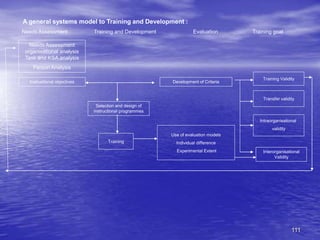
A general systems model to Training and Development :
Needs Assessment Training and Development Evaluation Training goal
Needs Assessment
organisational analysis
Task and KSA analysis
Person Analysis
Instructional objectives Development of Criteria
Selection and design of
instructional programmes
Interorganisational
Validity
Use of evaluation models
Individual difference
Experimental Extent
Training
Training Validity
Transfer validity
Intraorganisational
validity
112
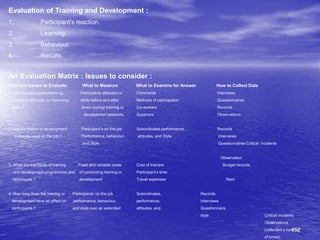
Evaluation of Training and Development :
1. Participant’s reaction.
2. Learning.
3. Behaviour.
4. Results.
An Evaluation Matrix : Issues to consider :
Relevant Issues to Evaluate What to Measure What to Examine for Answer How to Collect Data
1. Are the participants learning, Participants attitudes or Comments Interviews
changing attitudes, or improving skills before and after Methods of participation Questionnaires
skills ? (even during) training or Co-workers Records
development sessions. Superiors Observations
2. Are the trainer or development Participant’s on the job Subordinates performance, Records
materials used on the job ? Performance, behaviour, attitudes, and Style Interviews
and Style Questionnaires Critical incidents
Observation
3. What are the Costs of training Fixed and variable costs Cost of trainers Budget records
and development programmes and of conducting training or Participant’s time
techniques ? development Travel expenses Rent
4. How long does the training or Participants’ on the job Subordinates, Records
development have an effect on performance, behaviour, performance, Interviews
participants ? and style over an extended attitudes, and Questionnaire
style Critical incidents
Observations
(collected a number
of times).
113
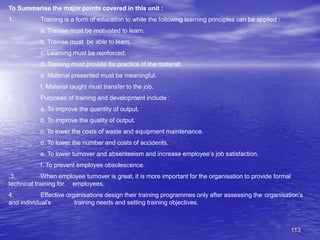
To Summarise the major points covered in this unit :
1. Training is a form of education to while the following learning principles can be applied :
a. Trainee must be motivated to learn.
b. Trainee must be able to learn.
c. Learning must be reinforced.
d. Training must provide for practice of the material.
e. Material presented must be meaningful.
f. Material taught must transfer to the job.
2. Purposes of training and development include :
a. To improve the quantity of output.
b. To improve the quality of output.
c. To lower the costs of waste and equipment maintenance.
d. To lower the number and costs of accidents.
e. To lower turnover and absenteeism and increase employee’s job satisfaction.
f. To prevent employee obsolescence.
.3. When employee turnover is great, it is more important for the organisation to provide formal
technical training for employees.
4. Effective organisations design their training programmes only after assessing the organisation’s
and individual’s training needs and setting training objectives.
114
5. Training approaches for employees include.
a. On-the-job training (for mangers, these include coaching and
counseling, transitory experiences, and transfers and rotation).
b. Off-the-job training (discussion, programmed instruction, and computer
assisted technologies including critical reality, multimedia-based training,
distance learning, and interactive video training).
6. Management development is the process by which mangers gain the
experience, skills, and attitudes to become or remain successful leaders
in this organisation.
7. Management and professional development is designed to reduce
obsolescence and to increase employees’ satisfaction and productivity.
8. The final phase of any training and development programme should be evaluation.
However, this phase is often bypassed by organisations. Also, there are some
cases where rigorous evaluation may not illustrate qualitative improvements.
115
Chapter-07
PERFORMANCE MANAGEMENT SYSTEM
116
PERFORMANCE APPRAISAL
Meaning :
Performance appraisal can be described as an important tool by which the organisations :
 Measure their employees’ performance against certain laid down standards.
 Take corrective steps through training, interventions or placement decisions.
 Reward good performance and
 Attempt to raise the employee performance to a higher level.
117
Purposes of Appraisal :
1. It can serve as a basis for job change or promotion.
2. By identifying strengths and weaknesses of an employee it serves as a
guide for formulating a suitable training and development programme to
improve his quality of performance in his present work.
3. It serves as an feedback to the employee.
4. It serves as an important incentive to all the employees who are by the existence
of an appraisal system assured of the management’s continued interest in them
and of their entinuous possibility to develop.
5. The existence of a regular appraisal system tends to make the
supervisors and executives more observant of their subordinates.
6. Performance appraisal often provides the rational foundation for the payment of
price work wages, bonus, etc.
7. Performance appraisal serves as means for evaluating the effectiveness
of devices used for the selection and classification of workers.
8. Permanent performance appraisal records of employees help
management to give up sole reliance upon personal knowledge of person
who may be shifted.
118
Who can Appraise :
1. The immediate manager.
2. Other managers familiar with the employees work.
3. A higher level manger.
4. Personnel department specialist.
5. The employees peers.
6. Service users.
7. The employees himself.
8. The employees subordinates.
Designing an Appraisal System :
The process of designing an appraisal system should involve managers, employees, HR
professionals and both internal and external customers in making decision about each of the
following issues :
 Measurement Content.
 Measurement Process.
 Defining the rater (i.e. Who should rate performances).
 Defining the rater (i.e. The level of performance to rate).
 Administrative characteristics.
119
Essential of a good Appraisal System under HRD :
1. It must be easily understandable.
2. It must be data based.
3. It must have the support of all line people who administer it.
4. The system should be both valid and reliable.
5. The system should have Built - in - Incentive.
6. The system should be open and participative.
7. The system should focus more on the development and growth of employees.
8. The system should be periodically evaluated to be sure that it is continuing
to meet its goals.
Management by objectives (MBO) :
Under this technique the performance goals of a manager are get in collaboration with his
support at the start of the appraisal period.
Elements of MBO :
1. Setting objectives.
2. Tracking progress.
3. Recycling.
120
Measurement Process :
 Type of Measurement Scale - highest or lowest.
 Types of Rating instruments - there are three basic ways in which raters can
make performance assessments :
(1)They can make comparisons among raters’ performance.
(2)They can make comparisons among anchors or performance level ### and select
one most descriptive of the person being appraisal, and
(3)They can make comparisons of individuals.
Performance Appraisal Methods Ranking Method :
 Ranking Method.
 Rating Scale Method.
 Check List Method.
 Forced Choice Method.
 Field Review.
 Critical incident Technique.
 Confidential Report.
 Essay Appraisal.
121
Post - Appraisal Interview :
The performance appraisal of an employee is generally followed up by an interview which
serves as a feedback for him. The main objectives of this feedback interview are :
(a) To bring in more classify in the roles of the supervisor and the employee.
(b) To increase the supervisor’s awareness of all those factors which facilitate or retard
the achievement of desired goals by the employee.
(c) To provide employee with an opportunity to release his tensions and stare his
anxieties.
(d) To provide employee with an opportunity to realise his strengths, weakness,
achievements and failures so that he gets a duper insight into his behaviour.
(e) To sharpen the behavioural skills of both the supervisor and the employee.
(f) To encourage employee to get goals for further development.
Generally, there are three types of appraisal interview as under :
1. Tell and Sell.
2. Tell and listen.
3. Problem solving Interview (or counselling).
122
Self Appraisal Form- A Model
Name: Department
Designation: Employee Code No:
Qualification: Scale of pay and Total:
Category/Group: Salary:
1. Specify the nature of supervision received from the
superior.
2. Indicate your relationship with your superior.
3. Number of subordinates.
4. Indicate Name & Designation of Immediate superior.
5. the nature of duties of your subordinates.
6. Specify the nature of followerships of your subordinates.
7. Indicate the level of co-operation received from your sub-
ordinates.
8. How many times your sub-ordinates refused your orders.
123
9. Do your subordinates appreciate your style of Leadership?
10. Do you maintain sound human relations with your subordinates.
11. Do you attend to your work punctually?
12. Specify the level of your self-expression both written or oral.
13. Indicate your level of work with others
14. Do you prefer team management?
15. Specify the nature and level of your initiative.
16. To what extent you know about your job and the organisation.
17. Specify the level of your technical and other skills.
18. Indicate your ability to understand new things.
19. Comment about your level and nature of judgments skills.
20. Identify the areas of work to which you are best suited.
124
21. Comment about your level and nature of judgments skills.
22. Do you have skills of integrity?
23. Do you have ability to accept the responsibility?
24. List out your achievements during the present year.
25. Would like to develop yourself? If yes, specify the areas of
technical, marginal and human relations areas.
26. Are you interested in specialized jobs or generalized jobs?
27. Indicate the improvements in your work performance.
28. To what extent you availed the leave facility?
29. Specify your participation in extra curricular activities.
30. Provide any other related information.
125
Name Department No.
Designation
S. Content Points
No. 1 2 3 4 5
1. Attitude
2. Job Knowledge
3. Quality of Work
4. Dependability
5. Initiative
6. Industriousness
7. Cooperativeness
8. Quality of work
9. Coordination
No interest in work,
Constant
Complainer
Indifference to
Instructions
carelessness
Interest in work
Accepts opinions
and advice of
others
Enthusiastic
about job, fellow-
workers And
company
Enthusiastic,
opinions and
advice sought
by others
Serious, gaps in
knowledge
Has a
satisfactory
knowledge of
routine matters
Is well
informed on
all matters of
job
Has good
knowledge
of all aspects
of job
Exceptional
understanding of
job standing of
Job
126
Column I (Best)
1
2
3
4
5
6
7
8
9
10
. . . . . . . .
. . . . . . . .
. . . . . . . .
. . . . . . . .
. . . . . . . .
. . . . . . . .
. . . . . . . .
. . . . . . . .
. . . . . . . .
. . . . . . . .
127
Column II (Best)
11
12
13
14
15
16
17
18
19
20
. . . . . . . .
. . . . . . . .
. . . . . . . .
. . . . . . . .
. . . . . . . .
. . . . . . . .
. . . . . . . .
. . . . . . . .
. . . . . . . .
. . . . . . . .
128
Paired Comparison Method
A B C D E
A
B
C
D
E
A A A A
C D E
C E
E
To Compute Employee’s Positive evaluations:
No of positive Evaluation
Total No of Evaluation
=
* 100 Employee’s % Superior evaluation
Employee A Employee B Employee C Employee D
(4/4)*100=100% (0/4)*100=0% (2/4)*100=50% (3/4)*100=75%
129
Forced Distribution Method
Forced Dist ribut ions on a
Bell shaped Curve
Sc o r e s
Nu
m
be
r
of
E
m
pl
oy
ee
s
130
Sample BARS for an Employee Relations Specialist.
Rating
Extremely good
Good Performance
Slightly good
performance
Neither poor nor good
performance
Slightly poor
performance
Poor performance
Extremely poor
performance
Performance
7
6
5
4
3
2
1
Behavior
This cashier would be expected to know the past Indian
current exchange rates of rupee with any currency, and all
about Indian and foreign currency.
You can expect this cashier to know the present exchange
rates of rupee with all foreign currencies
You can expect this cashier to know the present exchange
rates of rupee with hard currencies only and all about
Indian currency
You can expect this cashier nothing about foreign currency
but all about Indian currency
When worked in the busy timings of busy branches, he
cannot distinguish the currency issued by RBI and currency
issued by others
Cannot distinguish the currency issued by RBI and others
when worked in Metropolitan branches
Cannot distinguish the currency issued by RBI and others
at all. Confuses even with different Indian currency notes
131
Essay Appraisal :
In this technique, the rater who may be the former employer, teacher or associate of the
candidate is requested to give in writing an informed and honest amount of the candidates’
strengths, weakness, potentials, and so on :
Limitations of Traditional Appraisal Methods :
1. Emphasis on Human performance without regard for Human Values.
2. Halo Effect.
3. Hyper critical or “Horns” Effect.
4. Control tendency and briency.
5. Reluctance to “play good”.
6. Defensiveness of employees.
132
Critical Incident Method :
In this method the first step is to draw up for each job a list of critical job requirements that is,
those requirements. Which are vital for success or failure on the job. For example in the job of a
salesman the following critical factors may be identified :
1. Following up : Complaints, requests, orders.
2. Planning ahead.
3. Communicating true information to managers and customers.
4. Carrying out promises.
5. Persisting on tough accounts.
6. Pointing out uses for other company products ### the salesman’s own line.
7. Using new sales techniques and methods.
8. Preventing price - cutting by dealers and customers.
9. Knowing customer requirements.
10. Initiating new selling ideas.
Confidential Report :
In this method each employee is rated confidentially by one or more senior officers for his
performance.
133
Standards or Category Notations used Rating Scale :
Numerical, descriptive, man - to - man, behaviour sample.
Check list Methods :
Rater is asked to place a Plus sign, Minus sign, question mask in front of each statement,
depending respectively, on whether he feels the description applies, does not apply, or there is
doubt.
Forced Choice Methods :
Group I : 1. Always criticises .
2. Carries out orders by “passing the back”.
3. Knows his job and perform it well.
4. Plays no favorites.
Group II : 1. Cannot assume responsibilities.
2. Knows how and when to delegate.
3. Offers suggestions.
4. Too easily changes his ideas.
Field Review :
The personnel officer meets small groups of raters from each supervisor unit and goes over
each employees’ rating with them to
(a) Identify areas of inter - rater disagreement.
(b) Help the group arrive at a consensus, and similarly.
134
Wage Determination :
Steps :
 Select key jobs.
 Duties.
 Stable.
 Representative of all levels of jobs.
 Sample of firms in the labours market.
 Demand and supply.
 Wage information.
135
Job Evaluation
Analytical Non - Analytical
Non - quantitative
Wage Survey
Employee
Classification
Point Ranking
Method
Factor Comparison
method
Ranking method
Job Grading method
Methods Of Job Evaluation
136
Objectives of Job Evaluation :
 To gather data and information relating to job description, job specification and employee
specifications of various jobs in an organisation.
 To compare the duties, responsibilities and demands of a job with that of other jobs.
 To determine the hierarchy and place of various jobs in an organisation.
 To determine the ranks or grades of various jobs.
 To ensure fair and equitable wages on the basis of relative worth or value of jobs.
 To menimise wages discrimination based on sex, age, caste, region, religion, etc.
Alternative to Job Evaluation :
Employees instead of waiting for
instructions from supervisors ‘how well on
employee makes decisions’ should form
the basis for job evaluation
137
Job Analysis
Job Specifications
Job Description
Objectives of
Job Evaluation
Job Evaluation
programme
Contd…..
138
Job Evaluation :
Job evaluation is the process of analysing and assessing the relative worth or money value of jobs.
Jobs are ranked and net the job holders.
Difference between Job Evaluation and Performance Appraisal :
Job Evaluation
1. The Job is rated keeping in view such
factors as responsibility, qualification.
Experience, working condition etc
required for performance of the job.
2. Job is rated before the employee is
appointed to occupy it.
3. The purpose is to establish satisfactory
differential.
4. It is not compulsory for many
organisations carry on with out it.
Where it is followed, it is mainly to
lower level jobs.
5. Job evaluation committee ( comprising
internal and external experts) is
constituted for the purpose of
evaluation.
Performance Appraisal
1. Employee is rated on the basis of his/her
performance
2. Evaluation takes place has been tired and
placed on a job.
3. The purpose to effect promotion, offer wage,
reward, award, punishments, asses training
needs, resort to lay-off, transfer etc.
4. Compulsory. It is done regularly for all jobs
5. Appraisal is done by the employees
themselves, Boss, superiors, group of people
or combination of all these.
139
Scope of Job Evaluation :
As per theory, job evaluation is universal. In practice, the technique of job evaluation is followed in
a few companies and that too hourly for rated jobs.
Job Evaluation Process :
140
1. Group effectiveness :
outstanding very good good satisfactory unsatisfactory
2. Ability to develop subordinates :
outstanding very good good satisfactory unsatisfactory
3. Potential Capability :
outstanding very good good satisfactory unsatisfactory
4. Training Needs :
Promotion
Advantage of Promotion Schemes.
Criterion of Promotion - Merit vs. Seniority.
141
Benefits of MBO :
1. It sparks more effective planning and helps develop effective control.
2. It reveals organisational deficiencies such as overlapping of authority,
ineffective delegation and communication. Etc.
3. It elicits people’s commitment for performances.
4. It furnishes objectivity and reduces the element of pure judgement.
5. It is a more positive technique because in it the emphasis is shifted from the
appraisal of an employee’s weakness to the analysis of his strengths.
6. It facilitates coordination and eliminates sub-optimisation of goals.
7. It helps in the identification of non-performance.
Potential Appraisal :
It tells about an employee’s capability to successfully assume a new role in future
following his promotion.
How is Potential Appraisal Done ?
Like the P.A. P.E. Is also done by the employee’s supervisors. Potential appraisal may
be either regularly (annually) or as and when some post falls vacant. Following is the
format
142
CHAPTER- 08
POTENTIAL APPRAISAL AND SUCCESSION
PLANNING
NEED FOR POTENTIAL APPRAISAL:
It is different from performance appraisal which tells about
an employee’s present performance in his existing role are
generally unsatisfactory if the nature of roles,
responsibilities and functions of the higher post are
substantially different from those of the posts held by the
promotee now. In such cases performance appraisal is an
indicator of an employees future success in higher role only
to the extent that the duties and responsibilities involved in
the two roles are common. If the employee’s would be role
is going to be different from his present role, potential
appraisal needs to be done.
143
HOW IS POTENTIAL APPRAISAL DONE?:
Like the performance appraisal, potential appraisal is also done by the
employee’s supervisor who has had the opportunity to observe the
employee for sometime.
PART-III of P.A. Form of MARUTI UDYOG LTD. Solicits information to
assess the future potential and ability of it’s L8 and above categories for
higher responsibility – L13:
(1)Group Effectiveness (Maintaining and improving morale of the group
and helping its identification:
Outstanding Very Good Good Satisfactory Unsatisfactory
144
2. Ability to Develop Subordinates:
Outstanding Very Good Good Satisfactory Unsatisfactory
3. Potential Capability :
Outstanding Very Good Good Satisfactory Unsatisfactory
4. Training Needs :
- Training is mainly needed for “Blue-eyed” Jobs.
145
Promotions:
- Dry Promotion- no increase in pay
- Decorative Promotion – new and longer
title to get rid of their incompetent
employees.
- Vertical Promotion – from one rank to next
higher rank in the same department.
- Horizontal Promotion – employees are
promoted to higher ranks in other
departments as well.
146
Advantages of Promotion Schemes :
1.Provide greater personal satisfaction and prestige.
2.To ‘freeze’ inefficient personnel.
3.Recognise better employees.
4.Generate within an organisation beneficial
Pressures on work performance and desired
behaviour of all its members.
5. They serve as an orderly, logical and prompt
Source of recruitment for management to fill
Vacancies as they arise.
147
Criterion of Promotion :
-Seniority-cum-Merit
-Merit Vs. Seniority
148
SUCCESSION PLANNING :
One variant of career planning is succession planning. This type of
planning is usually done for some senior positions only. It aims at identifying those
individuals who stand a chance of succeeding an executive on his retirement or
death. These individuals are known as ‘Stars’, ‘fast trackers’, ‘listers’, ‘new
generation leaders’ or ‘high pots’(potentials).
SUCCESSION PLAN IN A COMPANY:
Name Current Designation Age When promotable
(Colour Code)
1.Mr. M Director(Production) 56 Blue
2. Mr. N Director(Marketing) 53 Red
3. Mr. O Director(Planning) 54 Green
4. Mr. P Director(Personnel) 51 White
5. Mr. Q Director(Finance) 55 White
COLOUR CODE :
Green : Ready now
Blue : Ready in 3 to 5 years
Red : Ready in 1 to 2 years
White : Not lively to be qualified
149
Steps in Succession Planning :
(1) Identifying key positions for which succession needs to be planned.
(2) Identifying the essential requirements in a person for filling each these
positions. Like educational qualifications, experience, general leadership
qualities etc.
(3) Identify a set of 2 or 3 people who can succeed in the position
(4) Next step is to let the key high potential employees know that they are high
potential.
DEMOTIONS:
TRANSFERS:
SEPERATIONS
Layoffs Retrenchment Golden Retirement Absenteeism
150
CHAPTER-9
151
CAREER PLANNING
A career plan is a blue print in which the entire career of employees
is mapped out from the point of their entry into the point of their
retirement from the organisation. From this blue print employees
know about the career paths they can follow and the training and
development facilities which are available to them for preparing them
for higher responsibilities.
BENEFITS OF CAREER PLANNING :
It motivates employees to avail of the training and development
facilities.
It increases employees’ loyalty to the organisation because they are
convinced about the organisation’s care for them and can integrate
their goals with organisational goals.
It encourages employees to remain in the organisation.
It creates organisation’s better image in the employment market.
152
QUESTION:
My company is undertaking a Job Evaluation exercise, along with
competency mapping. Competency mapping is an area which has
been least explored in India.I would like relevant information on
Competency mapping , along with references so as to develop my
skills.
153
ANSWER
Competency Mapping is a process of identify key competencies
for an organization and/or a job and incorporating those
competencies throughout the various processes (i.e. job
evaluation, training, recruitment) of the organization. To ensure we
are both on the same page, we would define a competency as a
behavior (i.e. communication, leadership) rather than a skill or
ability.
The steps involved in competency mapping with an end result of
job evaluation include the following:
1) Conduct a job analysis by asking incumbents to complete a
position information questionnaire(PIQ). This can be provided for
incumbents to complete, or you can conduct one-on-one
interviews using the PIQ as a guide. A sample PIQ that we use
when conducting this step with our clients was provided to this
client. The primary goal is to gather from incumbents what they
feel are the key behaviors necessary to perform their respective
jobs.
154
2) Using the results of the job analysis, you are ready to develop a
competency based job description. A sample of a competency based job
description generated from the PIQ was provided to this client. This was
developed after carefully analyzing the input from the represented group
of incumbents and converting it to standard competencies.
3) With a competency based job description, you are on your way to
begin mapping the competencies throughout your human resources
processes. The competencies of the respective job description become
your factors for assessment on the performance evaluation. Using
competencies will help guide you to perform more objective evaluations
based on displayed or not displayed behaviors.
4) Taking the competency mapping one step further, you can use the
results of your evaluation to identify in what competencies individuals
need additional development or training. This will help you focus your
training needs on the goals of the position and company and help your
employees develop toward the ultimate success of the organization.
155
It contributes to manpower planning as well as to organisational
development.
STEPS IN CAREER PLANNING:Preparation of manpower plan
showing future replacement needs and long-term potential of
different categories of employees.
•Building career paths or ladders for each category of
employees. For example :
(a) Regional Manager Chief Manager Zonal Manager
(b) Lecturer Assistant Professor Associate Prof Professor
(c) Welfare Officer Personnel Officer Personnel Manager
3. Identifying employees (through performance and potential
appraisal) who have the necessary ability and willingness to
climb up the ladder.
156
4. Formulation and implementation of training and development
plans, appraisal interviews, counseling etc.to prepare employees
for higher rungs of their career ladders.
5. Periodical review of the career development plan by finding
answers (through brain storming sessions or surveys) to the
following questions:
Are the job descriptions proper?
Has any square peg been put in a round hole?
Are the future manpower projections valid?
Are the training programmes enabling employees to
climb up their career ladder?
157
Career Stages and Important Needs :
Important Needs Safety, Security Achievement Esteem, Sub Sub -
Psychological esteem, autonomy actualisation
actuatisation
Age
Career Stage Apprenticeship Advancement Maintenance
Strategic
Stage 1 Exploration Transition Period
Stage 2 Establishment Begins to search for work
Stage 3 Mid Career Stage Major Challenge
Stage 4 Late Career No longer learning
Career Choice and Personality :
- Realistic.
- Investigative.
- Artistic.
- Social.
- Enterprising.
- Conventional.
Thinking
158
Conventional( C )
People who like to
Work with data or have
Clerical or numerical
Ability-like carrying
things outin detail or following
Through on others’ instruction
Social (S)
People who are skilled
With words and like to
Work with people-to inform,
enlighten,help,train,develop, or
Cure them
Investigative (I)
People who like to
Observe,learn,investigate,
Analyse,evaluate, or solve
problems
Enterprising (E)
People who like to work
With people-by influencing,
Persuading,performing,
Leading, or managing for
Organisational goals
Or economic growth
Artistic (A)
People who have artistic,
Innovative, or institutional
Abilities, and like to work
In unstructured situations,
using their imagination
Or creativity
Realistic (R)
People who have athletic
Or mechanical ability
And prefer to work
With objects,machines
Tools,plants
Or animals or to
be outdoors
159
160
Dual Career :
Career Planning Process :
Individual Needs Personal counselling Individual development
and aspirations and assessment efforts
Placement
on career path
Organisational Needs Personnel Planning Formal Trainees and
and opportunities and Career Information and Development
Programme
Feedback
Matching Matching
161
Career Counselling :
Informal - By supervisors, performance evaluation
Formal Counselling :
- Problem Analysis.
- Communications.
- Goal Setting.
- Making decisions and handling conflicts.
- Selecting, training and motivating employees.
- Controlling employees.
- Interpersonal Competence.
- Use of time.
162
CAREER ANCHORS:
 Managerial Competence
 Technical functional competence
 Search for Security
 Desire for creating and developing something new
 Freedom of Independence
CAREER MARRIAGES:
PRE-REQUISITES FOR SUCCESS OF CAREER PLANNING:
1. Support of top management
2. Expanding enterprise to provide opportunities for promotion
3. Motivated employees interested in their advancement
4. Fair promotion policy
5. Counselling services for employees who do not know which career paths they should
choose considering their interest, skill and performance in the work that they are
already doing.
6. Training facilities
7. Availability of necessary data such as job descriptions and personnel inventory
required for charting career paths and identifying future manpower needs.
8. Wide publicity of the plan.
163
CAREER DEVELOPMENT:
There are four steps in Career Development:
(1) Needs - defining the present system
(2) Vision - Determining new directions and possibilities
(3) Action Plan - deciding on practical first steps, and
(4) Results - maintaining the change.
CAREER DEVELOPMENT ACTIONS:
(1) Job performance
(2) Exposure
(3) Resignations
(4) Change the Job
(5) Career Guidance
A Model of organisational career development :
164
Organisational Carreer
Development
Individual Institutional
Career Planning Career Management
165
Sub Process Sub Process
- Occeepational choice - Recruitment and selection
- Organisational choice - Human resource allocation
- Choice of job assignment - Appraisal and evaluation
- Career sub - development - Training and development
Career : The sequence of a person’s work related activities and behaviours
and associated attitudes, values, and aspirations over the Span of one’s life..
Organisational Career Development : The outcomes emanating from the
interaction of individual career planning and institutional career management
process.
166
Career Planning : A deliberate process for :
(1) Becoming aware of self - opportunities, constraints,
choices, and consequences.
(2) Identifying career - Related goals, and
(3) Programming of work, education, and related developmental
experiences to provide the direction, timing, and sequence of
steps to attain a specific career goal.
Career Management : An ongoing process of preparing,
implementing and monitoring career plans undertaken by the
individual alone or in concert with the organisations career
system.
167
CONCEPT OF COMPETENCY :
BRITISH AND AMERICAN APPROACH :
The Americans prefer to use the term ‘competency’,.
While British prefer to use the term ‘competence’.
American approach is individual oriented. Americans
consider the characteristics of individuals casually
related to superior performance on the job, while British
approach is to take competencies as the job, task and
outcome requirements.
COMPONENTS OF COMPETENCY:
Competency is a cluster of knowledge, skill, ability,
motive, talent and trait, self concept, attitude, values etc.
168
COMPETENCY MAPPING FRAMEWORK:
Level 1: Builds Relationships Internally
Adapts personal style to develop relationships with colleagues
Adapts form and presentation of information to meet needs of the audience.
Identifies and maintains regular contact with individuals who depend on or
who influence own work
WORKING
WITH
PEOPLE:
Managing
relationships
Level 2 : Builds relationships externally
Takes account of the impact of own role on the needs of external contacts.
Maintains regular two-way communication with external contacts.
Identifies and nurtures external contacts who can contribute to the business.
Level 3: Maintains External Networks
Takes account of different cultural styles and values when dealing with
external organizations.
Actively manages external contacts as a business network.
Identifies and makes use of events for developing external network.
169
WORKING WITH
PEOPLE:
Teamworking
Level 2 : Builds relationships externally
Takes account of the impact of own role on the needs of external contacts.
Maintains regular two-way communication with external contacts.
Identifies and nurtures external contacts who can contribute to the business.
Level 3: Maintains External Networks
Takes account of different cultural styles and values when dealing with external
organizations.
Actively manages external contacts as a business network.
Identifies and makes use of events for developing external network.
Level 1: Is a Team Member
Encourages colleagues to contribute in teams.
Listens and gives credit to contributions which others make in teams.
Shares in learning and information with colleagues.
Level 2 : Supports Team Members
Encourages all team members to make useful contributions.
Identifies when team members need support, and provides it.
Responds positively to the contributions of other team members.
Level 3: Provides Direction For the Team
Uses knowledge of individuals’strengths, interests and development needs to delegate
tasks.
Provides regular feedback to the team
Ensures that team members understand their individual and collective
170
WORKING WITH
PEOPLE:
Influencing
Level 1: Projects a Positive Image
Presents Oral and written communication succinctly and with regard to its impact on
the recipient.
Presents self in a manner appropriate to the situation.
Refers positively to the organization, its people and its services.
Level 2: Influencing the Thinking of Others
Presents relevant and well-reasoned arguments.
Presents own points of view with conviction.
Adapts and develops arguments to achieve results desired.
Level 3: Changes the Opinions of Others
Approaches negotiations with the objective of achieving a win-win
outcome.
Ensures that people likely to be affected by any new activity have been
involved in developing the activity.
Elicits views of others and uses them to develop counter-arguments or new
positions.
171
WORKING WITH
INFORMATION:
Gathering and analyzing
information
Level 1: Gathers and Maintains Information
Identifies and uses appropriate sources of information.
Accurately identifies the type and form of information required.
Obtains relevant information and maintains it in appropriate formats.
Level 2: Checks and Analyses Information
Establishes accuracy and relevance of information.
Extracts key patterns and trends from information
Identifies links between different sets of information
Simplifies information for interpretation and presentation.
Level 3 : Uses Information to Analyse the Business.
Uses a range of information to evaluate business performance.
Identifies new opportunities for the business.
Makes predictions for business performance. from trends in business and market information.
172
WORKING WITH
INFORMATION:
Decision Making
Level 1: Day-to-Day Decisions
Follows pre-set procedures where required.
Obtains and uses necessary information to make decisions.
Regularly reviews and agrees scope of decision-making for their role.
Refers decision to others when appropriate
Level 2: Ensure that Decisions Are Made
Seeks buy-in for decisions where appropriate
Makes unpopular decisions when required.
Takes responsibility for making decisions where necessary to move things forward.
Level 3: High-Level Decision Making
Decisions contain acceptable levels of risk.
Decisions made with limited information when appropriate.
Argues for support for decisions at all levels.
173
DEVELOPING THE
BUSINESS:
Personal Development
Level 1: Develops Self
Builds own knowledge of the organization, its people and its services.
Seeks opportunities to develop own skills.
Accepts feedback constructively
Regularly reviews and updates personal development plans.
Level 2: Develops Others
Agrees and implements “SMART’ development action plans.
Seeks and gives constructive feedback.
Provides support for individuals when putting learning into practice.
Regularly reviews progress on development
Level 3: Develops a Culture for Learning
Ensures that development plans and activities contribute to business
needs.
Ensures that processes and procedures encourage learning.
Ensures that resources are available to support learning at all levels in
the organization.
174
DEVELOPING THE
BUSINESS: Generating
and Building on Ideas
Level 1: Participates in the Generation of Ideas
Actively participates in events for generating ideas.
Positively Questions Established ways of doing things.
Actively listens to and considers ideas presented by others.
Level 2: Develops Ideas into Solutions
Develops New Processes or practices to accommodate new ideas.
Assesses feasibility of ideas for the business.
Promotes leading ideas with energy and enthusiasm.
Level 3: Encourages an Environment for Developing Ideas.
Provides opportunities and resources for people to share ideas.
Provides constructive feedback on how ideas are being progressed.
Provides support for all individuals to offer constructive criticism of new
or established ideas.
175
ACHIEVING RESULTS
:
Planning
Level 1: Prioritises Day-to-Day Workload
Develops Daily Work Plans from Job Objectives.
Accurately Prioritises Key Tasks.
Avoids Negative Impact of Own actions on Others.
Level 2: Plans to Meet Departmental Objectives
Accurately estimates resources to achieve plans.
Builds alternative actions into plans to deal with likely contingencies.
Communicates Plans to relevant people.
Level 3: Converts Organisational Plans into Departmental Plan.
Identifies contribution department can make to organizational objectives.
Identifies activities and resources required to meet new objectives.
Integrates departmental plan with activities of other departments.
Level 4: Develops Organisational Plans
Contributes to the development of a vision for the organization.
Identifies strategic activities to achieve the vision.
Continually reviews and updates strategies as necessary
176
ACHIEVING
RESULTS:
Deadline Management
(Time Management)
Level 1: Takes Responsibility for Tasks
Takes responsibility to ensure commitments are met.
Regularly reviews progress of tasks.
Keeps people informed of progress on his/her tasks.
Evaluates completed tasks.
Level 2: Manages Resources Effectively
Briefs others of expectations and their responsibilities.
Informs other departments of commitments.
Agrees changes to plans.
177
ACHIEVING
RESULTS:
Objective Setting
Level 1: Contributes to Setting of Individual Objectives.
Ensures that objectives are achievable within already agreed
commitments.
Agrees appropriate success and measurement criteria.
Identifies and highlights potential obstacles in achieving objectives.
Level 2 : Sets Responsibilities
Identifies and sets clear objectives
Establishes success and measurement criteria
Enrolls the support of others for achieving objectives
Reviews and adapts objectives to meet changing needs
Level 3: Ensures that Objectives Contribute to Organisational Goals.
Uses organizational goals to evaluate and prioritise objectives.
Continually evaluates appropriateness of objectives at all levels.
Delegates objectives appropriately.
178
Effective Management :
1. How Does Time go ?
• In useful Activities.
• Routine Work.
• Special Assignments.
• Futuristic Work.
• New Projects started at one’s own initiative.
2. In Time Wasters.
• External Interceptions.
• Personal.
• Lack of Focus.
• Failure to look Ahead.
• Failure to Delegate.
• Failure to communicate.
3. How to Improve useful work :
• Identify your tasks.
• Select key result areas.
• Allocate Time for each task.
• Measure how you spend your Time & Compare with Plan.
179
4. Distinguish Between Tasks that you :
• Must do.
• Should do.
• Would like to do.
5. Major Time Wasters :
• Interceptions – Visitors – Phone.
• Meetings.
• Crises.
• Lack of objectives, priority & Deadlines.
• Personal Disorganisation.
• Ineffective Delegation.
• Doing too many things at once.
• Lane of clear communication.
• Indecision.
• Inability to say “No”.
• Leaving Tasks unfinished.
• Lack of sub Discipline.
180
Career Planning Questions
•In terms of career planning, where do you see yourself five
years from now?
•What are your future career plans?
•Who or what in your life would say influenced you most with
regard to your career objectives?
•Why do you think you would like to work for our
company/organization?
•Do you prefer a large company/organization or a small one?
Why?
•What are the disadvantages of your chosen field?
•What are some of the things you would like to avoid in a job or
career? Why?
•What qualifications do you have that would make you
successful in this field?
181
•What skills have you developed at university that would be
applicable to this job?
•What personal characteristics are necessary for success in
your chosen field?
•Why should I hire you and not the five other persons I will be
interviewing shortly for the same job?
•What have you done that shows initiative and willingness to
work?
•Do you prefer any geographic location? Why?
•What do you know about our company?
•What are your ideas about salary?
•What job in our company do you want to work towards?
182
Chapter-10
Assessment & Development Centre
183
Organising and Planning : - to create strategies for self and
others to accomplish Specific results.
Perception and Analysis – to identify, assimilate, and
comprehend the critical elements of a situation, to identify
alternative courses of action.
Decision Making – to use logical and sound judgment in
use of resources,
To adequately assess a situation and make a sound and logical
determination of an appropriate course of action based
on the facts available.
Oral and Non-Verbal Communication – to present information
to others concisely and without ambiguity to articulate clearly,
to use appropriate voice inflection, Grammar and vocabulary.
184
Adaptability – to modify courses of action to accommodate
situational changes, to vary behavior in-accordance with
changes in human and interpersonal factors.
Written Communication – to present and express information
in writing, Employing unambiguous, concise, and effective
language.
Decisiveness – to make frequent decisions, to make
decisions spanning many different areas, to render judgments,
take action, make commitments, to react Quickly to
situational changes.
185
Some of the Most Common Assessment Exercises:
-In Basket Training
-Leaderless Group Discussion
-Oral Presentation
-Role Playing
-Customer-Situation Analysis
-Employee Discussion
-Problem Analysis
186
The following Elements are essential for a process to
be considered as Assessment Centre :
 A job analysis of relevant behaviour to determine
attributes, skills etc
 Techniques used must be validated to assess the
dimensions of Skills and abilities.
 Multiple assessment techniques must be used.
 Assessment techniques must include job related
simulations.
 Multiple assessors must be used for each assessee.
 Assessors must be thoroughly trained.
 Behavioural observations by assessors must be
classified into some meaningful and relevant categories
of attributes, skills, and abilities etc.
187
 Systematic procedures should be used to record
observations.
 Assessors must prepare a report.
 All information generated must be integrated either by
discussion or application of statistical techniques.
Benefits of Assessment Center :
1. It helps in identifying early the supervisory/managerial potential and
gives sufficient Lead time for training for training before the person
occupies the new position.
2. It helps in identifying training and development needs.
3. Assessors who are generally senior managers in the organisation
find the Training for assessor as a relevant experience to know their
organisation little better.
4.The assessment center exercise provides an opportunity for the
organisation to Review its HRM policies.
188
Three Main Functions :
1. It helps in the selection of candidates and confirming
their potential
1. It assists in Target Development.
2. It guides in Career Development.
189
What is the Validity and Adverse Impact of
Assessment Centers and Other Performance Tests ? :
Interviews
What Factors Affect the Validity of Interviews ? :
1. Attributes of the Applicant – the integrity, motives, and
Physical characteristics of the job applicant.
2. Attributes of the Interviewer(s) – the motives, previous learning,
Personality, and physical characteristics of the interviewer(s).
3. Attributes of the Situation – the environmental conditions such
as time, noise, light, heat
190
Applicant Attributes that Cause Rating Bias :
-Gender Bias
-First Impression Effect
-Contrast effect
-Non-verbal communication
-Physical attractiveness
What is the Validity of Employment Interviews?
-First Impressions
-Stereotypes
-Lack of adequate job information
-Different information utilisation,
-Different questioning content, and
-Lack of interviewer knowledge regarding the requirements of
job to be filled.
191
Interviewer Attributes that Cause Rating Bias :
-Similarity effect
-Liability
-Ideal stereotype
-Information favorability
-Information utilisation
Situational Attributes that Cause Rating Bias :
-Job information
-Applicant information
-Decision time
192
How Do We Improve the Validity of Interviews? :
1. Use Job Information
2. Reduce Rating Bias
3. Communicate Effectively
This Training Should Focus on the Following:
1. Use of interview guides and outlines
2. Exchange of information
3. Situational or Behavioral
What are the Major Types of Interviews ?:
- Structured
- Unstructured
193
Combining Data from Various Staffing Methods :
Personnel Selection for Overseas Assignments:
1. Inability of the Manager’s Spouse to adjust to the new environment.
2. The manager’s inability to adapt to a new culture and environment.
3. The manager’s personality or emotional immaturity.
4. The manager’s inability to cope with new overseas responsibilities.
5. The manager’s lack of technical competence.
6. The manager’s lack of motivation to work overseas.
194
You have been appointed as HR Manager of Wipro at one of the offices at Bangalore.
Looking at your talent and academic records, management has assigned you to work
independently. In the month of February 2005, you are required to prepare salary
slip of 50 IT Engineers. What are the overheads you are likely to consider for
preparing the salary slip?
You have been appointed as Recruitment Executive in ABC Manpower Consulting
Firm. As a fresher, what will be your role to act as a recruitment incharge of ABC for
various Engeering Institute campuses?
After you are passing from the Institute, which sector (Pharma
/Banking/Insurance/IT/Telecom or any other) would you like to join and why?
If you will not get a job after passing from the Institute because of sudden boon in
the Market, what are the options left for you? (Suicide/Struggle/Join in Politics)
If you are the CAO of IBAT School of Management, Bangalore Campus, what would
be your priorities to reduce the grievance (Hostel Facility/Transport/Canteen (Shiva
Reddy removal) etc) from the students?
195
After passing, suddenly you find a dilemma in you career;
To join in the job got through campus which is not so lucrative…
To get marry to IIM pass out who is well settled at UK (Woh!!!!)
You have taken appointment from General Manger, HR,HDFC,Bnaglore
to meet and to approach him to select you for OJT. How would you
convince him to select you? Keep in your mind that HDFC only take from
top notch Institute.
Define Excellence? What would be your strategy to achieve excellence in
your career?
You are the Head of a Marketing Team. Due to your hard effort and
Leadership quality, your team has achieved the target. To whom would
you like to give the credit for the success? (Yourself/Team/Management
policy)
If ICICI Bank has ask to join as Branch Manger for openning a branch at
remote area of Kalahandi/Jharkhanda what will be your strategy for
Human Resource as well as market the ICICI Products
196
Motivation At Work
Chapter-11
197
Definition of Motivation
Motivation refers to the focus within a person that
affect his or her direction, intensity and persistence of
voluntary behavior.
Motivated employees are willing to exert a particular
level of effort (intensity), for a certain amount of time
(persistence) toward a particular goal (direction).
198
LINKAGE BETWEEN MOTIVES AND ACTION
Reevaluation
of Needs
Rewards or
Punishments
Evaluation of
Performance
Need
Deficiency
Search and
Choice of
Strategy
Goal Directed
Behaviour
Environment Incentive
(Culture) (+ / -ve)
Motives
(Expressed Needs)
Want Perception
Action
What is Motivation ?
199
200
Achievement is a combination of attitudes,
interest knowing how to learn plus numerous
skills that cannot be measured. The education
places values on measurable skills only.
Others are ignored.
Motivation is Education
Education without motivation produces a status-
quo life style.
201
Three Elements of Motivation
4
Motivation
Creative Freedom
Fulfuill a Need or Dream
Ideas - Projects - Goals
Learn from Failure
Learn to bounce back
Overcome barriers
Love to Learn
Accept Risk
Seek Opportunity
202
DIFFERENCE BETWEEN MOTIVATION
AND INCENTIVE
• For example, productivity – linked bonus, or every
10% increase in production
• Motivation is “will–to–do” and is individual oriented.
For example, promoting employee with outstanding
performance, job enticement and empowerment are
motivational Strategies. Incentives, is something
introduced in work environment to encourage workers
to accomplish their personal goals.
203
MOTIVATIONAL THEORIES
MANIFESTNEEDSTHEORY
ACHIEVEMENT MOTIVATIONTHEORY
ALDERFER'SERGTHEORY
HERZBERGSTWOFACTORTHEORY
MASLOW'SNEEDHIERARCHY
CONTENTTHEORIES
SCIENTIFICMGT HUMANRELATIONSMODEL
PORTER'SPERFORMANCE SATISFACTION
ADAM'SEQUITYTHEORY
VROOM'SEXPECTANCYMODEL
PROCESSTHEORIES
EarlyTheories
REINFORCEMENT
CONTEMPORARY THEORIES
Theories
204
205
Comparing Motivation Theories
Motivation
Theory
Type Central Idea
Maslow’s
Needs
Hierarchy
Content People try to satisfy a higher need when a
lower need is fulfilled (Satisfaction –
Progression)
Alderfer’s
ERG Theory
Content Satisfaction – Progression. Also people focus
on a lower need if unable to satisfy a higher
need (Frustration – Regression)
Herzbrg’s
Motivator –
Hygiene
theory
Content Motivation (Job Content, Recognition),
motivate and satisfy, whereas hygiene factors
(eork relations, work environment) can create
or reduce dissatisfaction but do not motivate.
McClelland’s
Learned
Needs
Theory
Content Some needs are learned rather than
instinctive and more than one need can
motivate at the same time.
206
Comparing Motivation Theories
Motivation
Theory
Type Central Idea
Expectancy
Theory
Process Motivation is determined by
perceived expectancies,
outcome values and a rational
decision making process
Equity Theory Process Perceived equity is formed from
outcome/input ratios with a
comparison with others and
people are motivated to reduce
perceived inequalities.
Goal setting Process Clear, relevant goals increase
motivation and performance by
stretching the intensity and
persistence of effort and by
clarifying role perceptions.
207
Motivational Cycle
1. A Driving State
5. Building up of
the driving state
again after sometime
2. The goal directed
behaviour initiated
by the driving state
3. The attainment of
an appropriate goal
4. The reduction of the
driving state and
subjective satisfaction
and relief
208
ABRAHAM MASLOW’S HIERARCHY NEEDS
Base Salary
SELF
ACTUALISATION
SELF ESTEEM
NEEDS
SAFETY NEEDS
BELONGINGNESS
NEEDS
PHYSIOLOGICAL NEEDS
General
Examples
Organisational
Examples
Achievement Challenging Job
Status Job Title
Love
Friends in Work
Groups
Stability Pension Plan
Existence
209
Employee Competencies:
Competencies are the characteristics of people that lead to
superior performance. Along with natural and learned abilities,
competencies include the person's values and personality traits.
Competence triangle
Technical/Professional
(To a Particular role)
Human Competence
(Team work,
communication,cultural
awareness)
Business Competence
(Understanding the business.
It includes language skills,
customer skills and general
knowledge
Motivations Applications
210
211
Types of Motivators
Positive Motivation
Monetary
Motivators
Non-Monetary
Negative Motivation
Punishment
Suspension
Demotion
Wage Cut
Wages or Salaries
Pay increments
Profit Sharing
Leave with Pay
Medical re-imbursements
Company paid insurance
Bonus
Housing facilities
Retirement benefits
Opportunity for growth
Status
Recognition of Work
Knowledge of Result
Job Satisfaction
Job Security
Fair Promotion
Congenial Work Environment
Honest & Competent Leader
Efficient Organization
Efficient system of Grievance Redressal
Freedom of Association, Mobility & Expression
Democratic Management techniques/Participation
Competition
Suggestion System
Job Enrichment
212
Classification of Positive Motivation
Positive Motivation
Non-Monetary Incentive
Monetary Incentive
Wages & Salaries
Pay increments
Profit sharing
Leave with Pay
Medical re-imbursement
Company paid insurance
Bonus
Housing facilities
Retirement benefits
Suggestion system
Competition
Democratic Management techniques
Opportunity for growth
Status
Recognition of Work/Praise
Knowledge of ----
Job satisfaction
Job security
Fair promotion
Honest & Competent leader
Efficient organization, coordination & control
Efficient system of grievance redressal
Freedom of association, mobility, expression
Job enrichment
213
Job Design and Work Motivation
Critical
psychological
status
Core job
characteristics
Outcomes
Skill variety
Task identity
Task significance
Experienced
meaningfulness
Autonomy
Experienced
responsibility
Job feedback Knowledge of results
Work motivation
Growth satisfaction
General satisfaction
Work effectiveness
Individual differences
Knowledge & Skill
Context satisfaction
Growth & Strength
214
Motivating yourself through Self-Leadership
Personal goal setting
Constructive thought patterns
Designing natural rewards
Self-monitoring
Self-reinforcement
215
MOTIVATION AND MORALE
Moral is dependent on the following factors :
 Feeling of togetherness.
 A Clear goal or objective to be achieved.
 Expectation of success towards the attainment of the goal.
 Feeling that each member has a meaningful task to perform for
achieving the goal.
 Supportive and Stimulative Leadership.
216
REALTIONSHIP BETWEEN
PERFORMANCE AND MOTIVATION
Equitability Motivation
Motivation
Performance Rewards
Competence
Abilities Resources
Role Perception
217
RELATIONSHIP BETWEEN
INCENTIVS AND MOTIVATION
 Establish high standards of
performance.
 Develop appraisal systems focused on job
specific, result oriented.
 Train supervisors in the mechanics of
performance appraisal.
 Relate rewards closely to performance.
 Use a wide range of incentives.
218
MOTIVATIONAL TECHNIQUES IN
PRACTICE
 Management by objectives (MBO).
 Behaviour Modification.
 Employee Involvement.
 Participative Management.
 Board of Representatives.
 Quality Circle.
 Viable Pay Programmes.
 Profit Sharing Plans.
 Gain Sharing.
 Skill Based Pay.
 Flexible Benefits.
 Comparable Worth.
219
CHAPTER-12
COMPENSATION
MANAGEMENT
220
• Compensation Strategy
• Capitalism and Knowledge in a global
economic
• Compensation and organisational
strategy
• Integrating knowledge and skill
requirements, organisation
compensation & employee income.
• Life style and compensation
221
• Pay and social class
• Social structure in income
• Establising class family income limits.
222
• Objectives of Payment of Wages
Legislation
• Payment in kind
• When paid in cash, payment in illegal
tender
• Arbitrary Deductions
• Irregular Payment and Non-payment
alltogether.
• Payments of wages Act 1936
223
i) Ensuring regularity of payment
ii) Ensuring payment in legal tender
iii) Preventing arbitrary deductions.
iv) Restricting employer’s right to impose
fines; and
v) Providing remedy to workers.
SCOPES :
• Definition of Wages
• Responsibilities of wage payment
• Fixation of wage period
• Time of payment of wages.
• Payment in legal tender
• Permissible or authorised deductions.
224
i) Deductions for fines
ii) Deduction for absence from duty
iii) Deduction for damage or loss
iv) Deductions for house accommodation
and services rendered.
v) Deductions for recovery of advances or
for adjustment of over payment for
wages.
vi) Deductions for recovery of loans
vii) Deductions of income tax
viii) Deductions required to be made by the
order of a court.
225
ix) Deductions for subscription to and for
repayment of advances.
x) Deductions for payment to co-operative
societies and insurance scheme.
xi) Deductions for payment of insurance premia
xii) Deductions for recovery of losses sustained.
xiii) Deductions for recovery of losses
xiv) Deductions for recovery of losses
sustained.
xv) Deductions, on the written authorisation of
the employed person
xvi) Deductions with the written authorities
of the employed person
xvii) Deductions, with the written authorisation
of the employed person
xviii) Deductions for contributions to any
insurance scheme.
226
What is Compensation ?:
The term compensation refers to all forms of financial
returns and tangible benefits that employees receive as
part of an employment relationship. Beyond this, pure
economic exchange model, compensation may also be
viewed as :
(a)A system of rewards that motivates employees to
perform;
(b) a critical communications device through which
organisations convey and reinforce the values, culture,
and the behaviour they require; and
(c) an important mechanism that enables organisations to
achieve their business objectivs.
227
Characteristics of an Effective Compensation System :
1. It enables an organisation to attract and retain qualified
(and necessary) workers;
2. It complies with Government regulations;
3. It motivates employees, fosters a feeling of equity, and provides
direction to their efforts.
4. It communicates and reinforces an organisation’s culture, values,
And Competitive strategy.
5. It’s cost structure reflects the organisation’s ability to pay.
228
TYPES OF COMPENSATION:
• Direct Compensation
• Financial remuneration-usually
cash, and includes such elements
as base salary, overtime pay, shift
differentials, bonuses, sales
commissions, and so on
• Indirect Compensation
• Refers to the general
category of employee
benefits, including
mandated protection
programmes, health, life,
and other insurance,
holiday, vacation, and sick
leaves, executive
perquisites, and so on
(1) The Wage &
Salary Program.
(base salary,OT
Pay, shift
differentials
(2) Pay that is
Contingent on
Performance(merit
Increases,Bonuses,
gain-Sharing,
commision etc.)
229
Traditional Approach to Compensation :
Job Analysis
*To discover nature of duties Performed.
*To clarify Authority and responsibility.
* To determine KASOCs
Job Documentation
•To record job information
•Typical content
•Job summary
•Specific jobs
•KASOCs
Job Rating Prepare to
Survey
*Identify Benchmark positions
*Select Information Sources
Create Job
With
hierarchy
Conduct
survey
*Apply job
Evaluation
instrument
*Sore-
Thumbing
*Check for
Evidence
Of bias
Analyse
Market Data
Reconcile
Intl.& Extl.
considerations
Develop Pay
Structure
Choose comparaters
•what information is needed
•Document Survey
Select Methods for Analysis
230
231
232
233
What is Job Evaluation ? : - is defined as the systematic
process of assessing the value of each job in-relation to other
Jobs in an organisation.
Steps for Job Evaluation :
(1)Job Analysis
(2)Job Documentation
(3)Job Rating
What is External Equity?:
234
Wage System in India
Macro-Economic considerations and Public Policy:
There should be no exploitation and returns should
be distributed.
 Statutory minimum wages
Equal pay
Wage differentials
Wages and salaries should be regulated to remove
disparities.
 Remuneration should be linked to productivity
There should be compensations for any rise in the
cost of living.
235
Fair wages should be determined over & above
minimum wages.
Who can not pay minimum wages has no right to
exist
Wages should be determined on the basis of basic
needs.
A living wage should be secured
 The Payment of Wages Act, 1936:
 Coverage
 Definition of Factory and Industrial Establishment
 Responsibility for payment of wages
 Fixation of wage period
236
 Deductions
 Penalties
 Contracting out
 Payment of undisbursed wages
Minimum Wages Act, 1948:
Fixing of minimum wages
Minimum rates of wages
Procedure for fixing and revising minimum wages
Working hours
Over time
237
Employer’s obligation
Exemptions
Content of minimum wages
Different categories
Employees Stok Option Profit Sharing
(ESOPS)
The Payment of Bonus Act, 1965:
 Eligibility
Disqualification for bonus
Payment of minimum bonus
Payment of maximum bonus
238
Proportionate reduction in bonus
Computation of working days
Set-on and set-off of allocable surplus
Special provisions for new establishments
Customary interim bonus
Deduction from bonus
Time limit for the payment of bonus
Application of the Act to public-sector
establishments
Reference of disputes related to bonus
Maintenance of registers, records, etc
Penalty
Bonus linked with productivity
239
 Expenditure from bonus payment
 Employees exempted from the Act
INSTITUTIONAL FRAMEWORK:
 Unilateral Wage Fixation
 Bi-partite Wage Fixations
 Wage Boards
 Constitution of the Wage Board – Tripartite in
nature
 Functions of the Wage Board
 Procedure of the Wage Board
 Criteria for the award
240
 Award of the Wage Board
 Enforcement of the Award
Pay Commission
Third Party Wage Fixation
Arbitration
Adjudication
National Wage Policy
 Wage Policy at the Company Level:
 Attraction and Retention
 Internal Equity
 External Equity
241
 Personal Equity
 Ability to Pay
 Pay and Performance
 Labour Costs and Productivity
 Cost of Living
 Merit and Seniority Progression
 Motivation
 Integrity
PAY STRUCTURES:
 Managerial and professional; top, middle, and junior
 Technical/supervisory
242
 Administrative and clerical (Staff)
 Manual (workers); highly skilled, skilled, semi-
skilled, and un-skilled
Components of a Pay Structure:
 DA, HRA, supply of light, water, medical attendance,
or other amenities, or of any concessional supply of
food grains or other articles;
 Any traveling concessions; and
 Any commission payable on the promotion of sales
or business or both
 It Does not include:
 Any bonus
 Any contribution paid or payable by the employer to
any
243
Pension fund or provident fund
 Any gratuity payable on the termination of his/her
service
Contemporary Issues in Wage System:
 Divergent concerns of different stakeholders are a
major issue.
 Problems in ensuring legal compliance for minimum
wage legislation
 Increasing inequity/disparity among employees at the
same and different skill levels and different sectors.
 Cost cutting competition results in lowering labour
standards
 Wage differentials are not based on skill differentials
but ownership, business strategy and sect oral
differences
244
 Distortions in executive and managerial
remuneration relate to high disparity between the
lowest and highest paid employees.
 Frequent changes in tax provisions raise complex
issues in tax planning,
 Differing preferences of old and new employees
245
How Do You Compile Market Data? :
What, if the Organisation Chooses to Conduct It’s Own Survey?:
- How to Develop the Final Structure?
- Assessing the Traditional Approach
CURRENT TRENDS IN SALARY ADMINISTRATION:
(1)Broad Banding
(2)Pay for Knowledge, capability, or competence
(3)Team Pay Plans
GOVT. INFLUENCE ON COMPENSATION ISSUES:
1. Minimum Wage
2. Hours of Work (including overtime provision)
3. Child Labour
4. Equal Pay
246
INDIRECT COMPENSATION: EMPLOYEE BENEFITS:
Five Categories of Employee Benefits:
(1)Govt. Mandated programmes including Social Security,
Unemployment Insurance, Worker’s Compensation, and certain State
Mandated disability programmes.
(2) Employee Welfare Plans including all forms of health care plans,
Survivor benefits, and Disability programmes.
(3) Pension Plans and other long-term capital accummulation
Programmes including bonus, gain sharing plans, and other thrift
And savings plans.
(4) Time-off plans (whether paid or unpaid) such as vacation, personal
Days, sabbaticals, and family leaves.
247
Characteristics of an Effective Compensation System :
1.It enables an organisation to attract and retain
qualified (and necessary) workers;
2. It complies with Government regulations;
3. It motivates employees, fosters a feeling of
equity, and provides direction to their efforts.
4. It communicates and reinforces an organisation’s
culture, values, and Competitive strategy.
5. It’s cost structure reflects the organisation’s
ability to pay.
248
What is Job Evaluation ? : - is defined as the systematic
process of assessing the value of each job in-relation to other
Jobs in an organisation.
Steps for Job Evaluation :
(1)Job Analysis
(2)Job Documentation
(3)Job Rating
What is External Equity?:
249
COMMUNICATE THE BENEFITS OF THE PROGRAMMES:
INTERNATIONAL COMPENSATION:
(1)Parent Country Nationals (PCNs)
(2)Third-Country Nationals (TCNs)
(3)Host-Country Nationals(HCNs)
250
(5) Employee Services, which include tuition reimbursement plans, child/
Family care, housing and relocation services, employee assistance
Programmes.
-COMMUNICATE THE BENEFITS OF THE PROGRAMMES:
- INTERNATIONAL COMPENSATION:
(1)Parent Country Nationals (PCNs)
(2)Third-Country Nationals (TCNs)
(3)Host-Country Nationals(HCNs)
251
Developing an Expatriate Compensation Package
The Major Position Factors:
(1)Base Salary, (2) Incentive Bonus, (3) Periodic Salary Increase,
(4) Deputation Allowance, (5) Travel Allowance etc.
The Major Local Factors
Individualised Compensation Package
252
Scales Money apportionments
(Average)
Key jobs Prevalent Skill Responsibility Effort Working Enditions
Rate (Rs.)
A 15.00A - 8.50 B - 5.00 E - 3.00 D - 2.50
B 14.00B - 5.50 A - 4.50 D - 2.25 E - 2.25
C 11.00C - 4.50 C - 3.00 B - 2.00 C - 2.00
D 8.50D - 2.50 D - 1.25 C - 1.50 B - 1.50
E 7.00E - 1.00 E - 0.75 A - 1.00 A - 1.00
0 1 2 . 3 . 4 . 5 . 6 7 8 . 9
Skill
E D C B A
Responsibility
E D C A B
Effort
A C B D E
253
Working Conditions
A B C E D
WAGE FIXATION:
Wage : Wage is used to denote payments to hourly rated production to workers.
Salary : Salary is used to denote payments to clerical, supervisory and managerial
employees.
How Are Wages Determined? :
Macro Level:
• Subsistence Theory of Wages
• Wages Fund Theory
• Marginal Productivity Theory
Micro Level :
1. Demand for and supply of labour
2. Labour Unions
3. Cost of Living
254
4. Prevailing Wage rate
5. Ability and willingness to pay
6. Job requirement
7. State Regulations and Court Judgements
8. Fringe and other benefits
Requisites of a sound compensation or Wage Plan:
1. It should be internally equitable
2. It should be externally competitive, and
WAGES IN INDIA :
• Basic Wage
• Dearness Allowance
• Annual Statutory Bonus, and
• Incentive Bonus
255
Basic Wage
Minimum Wage Fair Wage Living Wage
Dearness Allowance
Flat rate DA Graduated scale of
DA
Legal Framework to Regulate Basic Wages :
1. The Minimum Wages Act,1948
2. The Equal Remuneration Act, 1976
3. The Contract Labour (Regulation and Abolition) Act, 1970
256
CHAPTER-13
REWARD SYSTEM
WHAT IS REWARD?:
An incentive or a reward can be anything that attracts the worker’s
attention and stimulates him to work.
Purpose of Reward:
1. To provide positive reinforcement and motivate employees for
achieving outstanding performance.
2. Not money but recognition and self-satisfaction.
3. Personality Development
4. Corporate rewards influence the behaviour of employees through
an internal impact on the organisation and external impact on the
Organisation.
257
Internal Purposes :
-Reward attempts to motivate job performance through a
Selective distribution.
-Intrinsic reward creates a sense of security, increases work outcome, leads
Completion of some process and allows the individual to use a variety of
developed skills and abilities.
External Purposes:
-The external purpose of the reward system is to attract a large number of
Labourers who are skilled and proficient in the respective jobs.
-The extrinsic rewards includes many fringe benefits, profit sharing and
Incentive plans, professional and organisation promotions, friendship,
Supervision, and compensation.
258
BASES FOR REWARD SYSTEM:
-Cost of living, merits, seniority, responsibility, real income and so on.
MODEL OF REWARD SYSTEMS:
-The decision to perform, decision to join, and remain in the job, reward and
performance, money and turnover are important relative factors determining
the model of the reward system.
PERFORMANCE :
People expect rewards when they reach an expected level of performance.
Reward is instrumental for evaluating performance.
JOINING THE ORGANISATION:
People join and remain in the organisation in anticipation of rewards, if they
find rewards according to their expectations, they remain in the organisation.
259
MONEY:
Employees prefer reward in the form of money. Wage incentive is
Instrumental for a higher performance.
ATTENDANCE:
The attendance of the employees is also associated with the reward system.
A high performer prefers attending the field and factory regularly to get
more rewards.
CAREER AND CORPORATE DEVELOPMENT:
Careers are sequences of jobs, unfolding the various opportunities of life. People
move from one profession to a better profession or from lower level to a
higher level in the same profession as time passes.
PRACTICAL PROBLEMS:
260
CHAPTER-14
ORGANISATION DEVELOPMENT
WHAT IS OD ?: is a long-range effort to improve an organisation’s problem
solving and renewal processes, particularly through a more effective and
Collaborative management of organisation culture – with special emphasis on the
Culture of formal work teams – with the assistance of a change agent, or a
Catalyst and the use of the theory and technology of applied behaviour science,
Including action research.
Characteristics of OD :
1. Focuses on the whole organisation to assure that all parts of the
organisation are well coordinated.
2. OD is concerned with the interaction and interrelation among the
Various sub-systems.
3. OD used one or more change agents who stimulate and co-ordinate
a group.
261
4. OD is concerned with problem-solving approach.
5. OD emphasises learning by experience.
6. OD utilises group processes like group discussion,
intergroup conflicts,Collaboration, and co-operation.
7. OD provides feedback data and information to the participants.
8. OD is a long-term approach to improve the overall
Organisational effectiveness.
9. OD is research based as most of its interventions are based on
research findings.
262
VALUES OF OD MOVEMENT:
1.People are basically good.
2.Need for confirmation and support.
3.Accepting differences among people.
4.Expressing feelings and emotions.
5.Authenticity
6.Fostering co-operation.
7.Giving attention
8.Confronting conflict.
263
OBJECTIVES OF OD :
1. To increase openness of communication among people
2. To increase commitment, self-direction and self-control
3. To encourage people who are at the helm of affairs
4. To involve the members in the process of analysis and
implementation.
5. To encourage the confrontation regarding organisational
Problems with a view to arrive at effective decisions.
6. To enhance the personal enthusiasm and satisfaction levels.
7. To increase the level of trust and support among employees.
8. To develop strategic solutions with higher frequency.
9. To increase the level of individual and group responsibility in
planning and execution.
264
THE OD PROCESS :
1.Initial Diagnosis
2.Data collection
3.Data Feedback and Confrontation
4.Selection and Design of Interventions
5.Implementation of Interventions
6.Action Planning and Problem Solving
7.Team Building
8.Inter-group Development
9.Evaluation and Follow-up.
265
THE OD INTERVENTIONS/TECHNIQUES:
1. Survey Feedback
2. Process Consultation
3. Goal Setting and Planning
4. Managerial Grid
SIX PHASES OF GRID OD :
1. Studying the Grid as a theoretical knowledge to understand th
human behaviour in the organisation.
2. Team Work Development.
3. Inter-group Development
4. Creation of an ideal strategic model for the organisation.
5. Implementation of strategic model.
6. Critical evaluation of the model and making necessary
adjustments for successful implementation.
266
MANAGEMENT BY OBJECTIVES :
What is MBO?: MBO is a process by which managers at different levels and
their subordinates work together in identifying goals and establishing objectives
consistent with the organisational goals and attaining them. Thus, MBO is not only
An aid to planning but also motivating factor.
MBO Type Programmes :
(1) Management by Results; (2) Goals Management; (3) Work Planning and Review;
(4) Goals and Controls; (5) Appraising by Results.
267
THE PROCESS OF MBO :
(1) Preliminary Setting of Objectives at the Top;
(2) Classification of Organisational Goals
(3) Setting of subordinate objectives;
(4) Recycling of Objectives;
(5) Performance Appraisal.
PRE-REQUISITES FOR INSTALLING AN MBO PROGRAMME:
1. The purpose and area of MBO should be defined clearly.
2. Since the top management plays a crucial role, its favourable attitude and
Support is must.
3. The people who will be involved in the programme should be prepared mentally
and physically for it.
268
(4) Participation of superiors and subordinates in setting organisational objectives,
Progress review, performance appraisal is necessary.
(5) Each employee should be provided with feedback information for self-
direction and self-control.
(6) The MBO programmes should be implemented at all levels including the
Departmental level and it’s grass-root level
SENSITIVITY TRAINING OR LABORATORY TRAINING :
-Team Building
-Job Enrichment
-Changes in Organisational Structure
-Participative Management and Quality Circle
-Use of a Consultant.
269
BENEFITS OF OD :
-Performance Improvements, Job Specification and self-change.
-Group performance will be enhanced.
-OD programmes encourage team work, communication skills, co-operation,
Inter-personal relations, openness etc.
-OD Programmes contribute to the change in behaviour, values, attitudes,
Perceptions etc. by enabling the employees to understand about
themselves and others in the group and organisation.
270
CHAPTER- 15
PARTICIPATION AND
COMMUNICATION
CONCEPT OF WORKER’S PARTICIPATION :
It is a mental and emotional involvement of a person in a group situation which
encourages him to contribute to goals and share responsibilities in them.
INDUSTRIAL DEMOCRACY:
Worker’s Control----- Joint Management --- Joint Consultation
Workplace consultation ---- Management Supremacy
Levels of Participation :
(a) Shop level; (b) Department Level; (c) Top Level
271
OBJECTIVES OF WORKER’S PARTICIPATION IN MANAGEMENT:
(1) To promote increased productivity for the advantage of the organisation,
Workers, and society at large.
(2) To provide a better understanding to employees about their role and place
In the process of organisational goal attainment.
(3) To satisfy the worker’s social and esteem needs,
(4) To strengthen labour management co-operation,
(5) To develop social education for effective solidarity among the working
Community.
(6) An ideological point of view to develop self-management in industry.
(7) An instrument for improving efficiency of the company and establishing
harmonious industrial relations.
272
(8) To build the most dynamic human resource
(9) To build the nation through entrepreneurship and economic development.
PARTICIPATION AND MOTIVATION:
Participation ------ Autonomy ----- Increasing Motivation
Essential Conditions for Successful Working of WPM :
1. Impartial attitude and outlook of the parties,
2. Both parties should have a genuine faith in the system and each other, and
be willing to work together.
3. The experiment of labour participation must be given a wide publicity.
4. Participation should be real.
5. Objectives to be achieved should not be unrealistically high, vague
Or ambiguous.
6. Form, coverage, extent and level of participation should grow in-response to
Specific environment, capacity, and interest of the parties concerned.
273
7. Participation must work as complimentary body and help collective
bargaining.
8. Institutional participation should be discouraged.
9. There should be a strong Trade Union.
10. A peaceful atmosphere.
11. Authority should be centralised through democratic management process.
12. Programmes for training and development should be developed
Comprehensively.
13. Progressive Personnel Policies should encourage growth of individual
Workers.
14. Management should be prepared to give all information related to the
Industry and labours.
15. The workers should become aware of their responsibilities.
16. The follow-up action on the decisions of the participating forums should be ensured.
274
17. Effective two-way communication is a must.
FORMS OF WPM:
(i) Works Committee; (ii) Joint Management Councils;
(iii) Joint Councils, (iv) Shop Councils,
(v) Unit Councils, (vi) Worker’s Directors
(i) WORKS COMMITTEE (1947):
- Evolution as per IDA, 1949
Structure: President:1; VP –1, Secretary – 1, Joint. Secretary-1
- Total strength – should not exceed 20
- Tenure – 2 years
- President – Nominee of Employer
- VP – Worker’s Representative
275
FUNCTIONS:-Consultative in nature.
(i) Conditions of work such as ventilation, lighting, temperature and
Sanitation including latrines and urinals.
(ii) Amenities such as drinking water, canteens, dining rooms, medical and
Health services.
(iii) Safety and accident prevention, occupational diseases and protective
Equipment.
(iv) Adjustment of festival and national holidays.
(v) Administration of welfare and fine funds.
(vi) Educational and recreational activities.
(vii) Promotion of thrift and savings, and
(viii) Implementation and review of decisions arrived at the meetings of
Works Committees.
276
ITEMS NOT COVERED:
-Wages and allowances, bonuses and profit-sharing, rationalisation, and
Workload, fixation of a standard labour force, programmee of planning &
Development, retrenchment and lay-off, victimisation for trade union
Activities, retirement benefits, PF & Gratuity, quantum of leave and holidays,
Incentive schemes of housing and transport services.
Loopholes:
1. Lack of interest among workers because of minor functions and exclusion
Of wages and allowances.
2. Lack of competence of the committee.
3. Employer consider the committees as substitutes for collective bargaining
And bypass unions.
4. Inferiority complex feeling of employers.
5. Inter-Union rivalries.
6. The recommendation is advisory in nature.
277
PRE-REQUISITES OF SUCCESS:
1. More responsive attitude on the part of management.
2. Adequate support from Trade Union.
3. Proper appreciation of the scope and the functions of the
Works Committee.
4. Whole-hearted implementation of the recommendations of the
Works committee.
5. Proper coordination.
2. JOINT MANAGEMENT COUNCIL (1958):
-Coverage: In any Industry where 500 or more are employed.
-Participant : Bipartite – Employer & Employee’s representative.
- Ratio : Equal representation but not exceeding 12.
- Duration: 02 years.
278
OBJECTIVES:
(i) To increase the association of employers and employees
(ii) To improve the operational efficiency of the workers
(iii) To provide welfare facilities to workers
(iv) To educate workers so that they are well-equipped to participate
In the schemes; and
(v) To satisfy the psychological needs of workers.
FUNCTIONS:
1. To be consulted on matters like Standing Orders, introduction of new
Methods of production and closure, reduction in or cessation of production.
2. Right to receive information, discuss and give suggestions on general
Economic situation, state of the market, production and sales programmes,
Organisation and general running of the concern, methods of manufacture and
Work, annual balance sheet and profit and loss statement.
279
3. To shoulder administrative responsibilities like maintaining welfare
Measures, safety measure, training schemes, working hours,
Payment of rewards, etc.
REASON OF FAILURE:
1. Workers’ representatives on these councils eel dissatisfied with their
role as decision-makers in-respect of welfare activities only.
2. Trade unions fear that the Joint Management Councils where the
Workers are likely to more amenable to the influence of the employers
would Weaken the Union’s hold over the workers.
280
3. JOINT COUNCILS (1976):
-Coverage : Any Industry employing 500 or more employees.
Constitution:
-The Chief Executive of the Unit becomes the Chairman,
- Worker’s members of the Council nominate Vice Chairman.
-The Joint Council appoints the Secretary and the Secretary is responsible
for discharging the functions of the Joint Council.
Tenure : 02 years
-The JC will meet once in four months but the periodicity of the meeting
Varies from unit to unit, it may be once in a month, quarter, etc.
-The decisions taken at the J.C. meeting are by the process of consensus
and the management shall implement the decisions within one month.
281
4. SHOP COUNCILS(1975):
-Coverage: All manufacturing & Mining Industries employing 500 or more
employees.
1. There shall be a shop council for each department, or one council for
more than one department or shop.
2. Equal representation.
3. The employer shall decide in consultation with the recognised union or the
Various registered trade unions or workers, as the case may be.
4. The number of members of each council may be determined by the employer
In consultation with the employee’s union, but the total number may not
Generally exceed 12.
5. The decisions has to be based on consensus, not voting.
6. Every decisions of a shop council shall be implemented by the parties
Concerned within a period of one month.
282
7. Such decisions of a shop council which have a bearing on another shop,
Or the undertaking or establishment as a whole will be referred to the
Joint Council for consideration and decision.
8. A shop council once formed, shall function for a period of 02 years.
9. The council shall meet as frequently as is necessary ands at least once
In a month.
10. The Chairman of the shop council shall be a nominee of the Management,
The worker-members of the Council shall elect a Vice Chairman.
FUNCTIONS:
(i) Assistance to management in achieving monthly/yearly production targets.
(ii) Improvement in production, efficiency, reduce wastage, optimum
Utilisation of resources.
(iii) Study of absenteeism in the shops.
(iv) Safety measures.
283
(v)Assistance in maintaining general discipline in the shop.
(vi) Lighting, ventilation, noise, dust, reduction of fatigue.
(vii) Welfare and health measures.
(viii) Ensuring two-way communication.
NEW SCHEME ON WORKER PARTICIPATION(1983):
1. The operation of this scheme has been restricted to Centre PSU’s only.
Departmentally-run undertakings have been excluded.
2. The scheme is to operate at the shop-floor and plant levels. It provides
for equal representation to both the parties.
3. Different categories of workers such as skilled, unskilled, technical and
Non-technical supervisory, and non-supervisory are to be represented at
both shop floor and plant levels. Managerial personnel are to be excluded.
4. The exact number of representatives depend on the size of the workforce
and has to be decided by discussion with unions.
284
5. Representation is to be given to women workers where they constitute
10% or more of the total workforce.
6. The scheme has universal applicability irrespective of the number of
Workers employed.
7. Functions of the participative forums at various levels have been made
More elaborate.
8. Operational Areas: planning, implementing and review of monthly targets and
Schedules, storage and inventories, housekeeping, quality and technological
Improvement, machine utilisation and development of new products.
9. Economic and Financial Areas: P&L statement, B.S, review of
Operating expenses, financial results, plant performance in financial terms.
10. Personnel Matters: Absenteeism, special problems of women workers,
Scheduling training programmes, administration of social security.
285
11. Welfare Areas : Implementation of welfare scheme, medical benefits,
and transport facilities, safety measures, sports and games, housing,
Township administration, canteen, control of gambling, drinking,
indebtedness etc.
12. Environmental Areas:
13. Worker Shareholder Scheme.
14. Quality Circle.
15. Worker’s Directors.
-Working of WPM in India:
-Suggestions for the Success of WPM
286
CHAPTER-16
LABOUR (INDUSTRIAL) RELATIONS
287
INDUSTRIAL RELATIONS
- Means the Collective Relationship between management, employees and
government in any industrial or non - industrial organisation.
Principal Actors (or Interest groups) in Industrial Relations :
Significance of good Industrial Relation :
•To help the economic progress of the country.
•To help establishing and maintaining true industrial democracy.
•To help management both in the formulating of informed labour relations polices and
their translation into action.
•To encourage collective bargaining.
•To help govt. in making laws for adding unfair practices of unions and employees.
•To boost the discipline and morale of workers.
Employee
Management
Government
288
HRM Functions-Legal
Frame Work of HRM
Staffing
Compensation &
Rewards
Employee
Development
Employee
Maintenance
Employee
Relations
•Child Labour
(Prohibition and
Regulation) Act,1986
•The Employment
Exchange (Compulsory
Notification of
Vacancies) Act,1959
•The Apprentice
Act,1961
•The contract Labor
(Regulation &
Abolition)1970
•Bonded Labour
System (Abolition)
Act,1976
•The Payment
of Wages Act
1936
•The Minimum
Wages
Act,1948
•The Payment
of Bonus
Act,1965/1995
•The Equal
Remuneration
Act, 1976
•The Factories Act
1948
•The Mines Act,1952
•The Employees
Provident Fund &
Misc. Provision 1959
•The ESI Act 1948
•The Payment of
Gratuity Act 1972
•The Workmen’s
Compensation Act
1923
•The Maternity
Benefit Act,1961
•The Trade
Unions
Act,1926
•The IDA,1947
•The Industrial
Employment
(Standing
Orders
Act)1946
•The Sales
Promotions
Employees
(Conditions of
Service)
Act,1976
289
Causes for Poor Industrial Relations :
1. Uninterested nature of work.
2. Political nature of Unions.
3. Poor wages.
4. Occupational instability.
5. Poor organisational climate.
Effects of Poor Industrial Relation :
- A lot of privation for the workers.
- Reduction in output and profits for industries.
- High prices and inconvenience for the general public.
- An atmosphere of mutual distrust and suspicion.
- Reduction in national dividend due to reduced production for the country as a
while.
290
Suggestion to Improve IR
Both Management and Union should develop constructive
attitude towards each other.
All the basic policy and procedures relating to IR should be
clear to everybody in the organisation and to the union leaders.
The personnel manager should remove any distrust by
convincing the Union of the companies integrity and his own
sincerity and honesty.
The personnel Manager should not vie with the union to gain
the workers loyalty.
Management should encourage right kind of Union leadership.
After the settlement is reached the agreement should be
properly administered.
291
Development of Trust-How Done!
A.Competencies are to be built in the two parties as under
a) Knowledge
 About rules of the work place
 About the legal frame work of IR
 About the commitments made in various settlement and awards
 About the emerging environment scenario, customs and practices
 About workers sociology and problems of worker
b. Skills
 Leadership Skills
 Interpersonal Skills
 Problem Solving Skills
 Negotiation Skills
292
c. Attitudes
 Positive beliefs about each other
 Faith in participative mechanism
 Flexibility and resilience
B.Process Development:
Process means the “ How” aspect. Eg: How decisions have arrived at, How
negotiations are conducted, How information is shared with the union, how
goals are set.
293
HRD/OD Intervention
Following are the list of possible intervention for tackling specific IR
Problems
IR Problems:
•Allignation of Employees
•Problem of Discipline
•Lack of Knowledge about rules
and regulation
Intervention:
•Training
•Work Redesign
•Job Enrichment
•Counselling
•Review of Disciplinary Machinary
•Training
•Training
•Ensuring effective Communication
294
•Delay in Personnel Decision
Making
•Mistrust between
Management and Union
•Lack of Collaboration
•Research for Identifying the
causes of Delay
•Reorganization of Personnel
Function
•Survey Research
•Information Sharing
•Union Management Interface
•Collaborative Projects (Say
on..Employee
Walfare,Education etc.)
295
EMPLOYEE
MEANING : Recognizing and releasing into the organisation the power that
people have in their wealth of useful knowledge and internal motivation.
- Empowerment is the authority to make decisions within one’s area of
responsibility without first having to get approval from someone else.
CHARACTERISTICS OF EMPOWERMENT :
- Employees are encouraged to use their own initiative “Just do it”.
- Empowered employees are given not only the authority, but also the
resources, so they are able to make decisions and have the power to get
them implemented.
- Create a shared purpose among employees, encouraging greater
collaboration, and most importantly, delivering entranced value to
customers.
- Innovation implications.
- Access to information.
- Accountability and responsibility.
296
PUTTING EMPOWERMENT INTO ACTION :
Two common approaches are :
(1) “Kaizen” and Just do it (Continuous improvement).
(2) Trust building.
The Principles are :
- Discard conventional, fixed ideas about doing work.
- Think about how to do it rather than why it cannot be done.
- Start by questioning current practices.
- Begin to make improvements immediately even if any 50% of then can
be completed and
- Correct mistakes immediately.
- Trust building.
297
STAGES OF EMPOWERMENT :
Identifying conditions of powerlessness
Implement empowerment strategies and
techniques
Remove condition of powerlessness and
provide self-efficacy information
Feeling of empowerment generated
Empowerment result in performance
298
STRATEGY FOR EMPOWERING EMPLOYEES :
-Delegate responsibility along with authority.
-Replace the role of managerial ‘parent’ role with that of ‘partner’ role.
Have tolerance for mistakes committed by subordinates. Demonstrate the
tolerance through deeds and words.
-Share information with subordinates empowered employees need sufficient
information to get full perspective.
-Allow teams to form Teams are the best vehicles to empowerment.
-Performance feedback is always important. It is particularly important for
newly empowered employees. Feedback entrance learning and can provide
needed assurance that the job is being mastered.
-SIX DIMENSIONS OF EMPOWERMENT :
- Communication.
- Value of people.
- Ambiguity.
- Concept of power.
- Learning.
299
FACTORS AFFECTING EMPOWERMENT :
- Technology.
- Customers.
- Organisation.
EMPOWERMENT CYCLE :
Stage - I : Recall depowering and empowering experiences.
Stage - II : Discuss reasons for development and empowerment.
Stage - III : Choose one issue, problem or project, to work on.
Stage - IV : Identify potential power basis :
- Legitimate power.
- Reward power.
- Coercive power.
- Expert power.
- Referent power.
Stage - V : Develop and implement action plans.
300
BENEFITS OF EMPOWERMENT :
- Encourages proactively problem solving.
- Accepting challenge.
- Innovation.
- Continuous improvement.
- Optimum utilisation of employees.
- A high degree of employee motivation.
- Enhancement of business performance.
- Enablement.
301
CHAPTER-17
DISPUTES & GRIEVANCES
302
• Lets travel to the land of Labour Laws!!!
• Your baggage must include:
Concentration
A cup of Coffee to help you
concentrate
• Journey pay-off(s):
Knowledge - Specialization
Comfort - Fun
303
REGULATORY MECHANISMS
INTRODUCTION:
To regulate…
• The standards to protect the Industrial
Workers.
•Industrial relations
•To provide a measure of social security in
keeping with the ideals set out in our
Constitution.
304
Historical Background in India
• In India, the earlier pre-independence legislations
had,by and large,been regulatory and prescriptive in the
matter of safety and working conditions,on the other
hand,the post-independence and the post –constitution
period has not only witnessed the blossoming of labour
legislation in the important areas of social security and
welfare but also recognised the need for dealing with the
problems of the relatively more disorganized and
DIsadvantaged sections of the workforce.
305
Historical Background in India
• The Unique role assigned to the Supreme Court and
High Courts under the constitution through the power of
judicial review has tended to revolutionise the
approaches and interpretations which used to be
adopted by the governments and employers prior to the
constitution.
306
Important Labour laws
• The Industrial Employment (standing Orders) Act,1946.
• The Factories Act,1948.
• The Industrial Disputes Act,1947.
• The Payment of Wages Act,1936.
• The Minimum Wages Act,1948.
• The Payment of Bonus Act,1965.
• The Workmen’s Compensation Act,1923.
• The Employee State Insurance Act,1948.
• The Employee Provident Fund Act,1952.
• The Payment of Gratuity Act,1972.
• The Apprentices Act,1961.
• The Contract labour9regulations & abolition) Act,1970.
307
Delhi Shops and Establishments Act,1954
• Registration Process
• Change to be communicated to Chief inspector
• Employment of adults,hours of work
• Restriction on Double employment
• Spread Over
• Prohibition of Employment of Children’s
• Close Day
• Wages of holiday
• Deductions may be done
308
Delhi Shops and Establishments Act,1954
• Leave
• Wages during leave
• Cleanliness
• Lighting and Ventilation
• Precautions against Fire
• Accidents
• Notice of Dismissal
309
The industrial Employment(Standing
Orders)Act,1946.
• Objects and Scope:
• The Act came into force in April 1946 and extends to
the whole of India.
• The Object of the Act is to regulate the conditions of
recruitment,discharge,disciplinary action,holidays,etc.
• This Act extends to the Industrial Establishments
employing 50 or more employees.
310
Main Provisions
• Procedure for submission of draft Standing Order,
• Condition Of Certification,
• Date of operation and display of these orders,
• Procedure for modifications,
• Machinery for implementation of the Act.
311
Salient Features
• The Act Provided Modal Standing Orders
covering following aspects of conditions of
employment:
• Working Hours(including shift work and overtime)
• Attendance rules and regulations
• Holidays and leave
• Payment of wages
• Deduction from wages
• Payment of Bonus
• Increments and promotions
• Transfer
• Discipline,etc.
312
Administration
• The machinery for the implementation of the Act
consists of the following:
• The Certifying Officer: The Labour Commissioner or an
officer appointed for the purpose has to discharge the
functions of the Certifying Officer
• The Appellate Authority: It is an Industrial Court
established under the Act.
313
The Factories Act,1948
• Objects and Scope:
• To ensure adequate Safety measures and to promote
the Health & welfare of the Workers employed in the
factories.
• To prevent haphazard growth of Factories through the
provisions therein relating to approval of Plans by the
Chief Inspector of Factories before the…
314
The Factories Act,1948
• Objects and Scope:
• …erection of a Factory Building is started.
• It extends to whole of the India and applies to all
establishments employing 10 or more workers where
power is used and to establishments employing 20 or
more workers where power is not used.
315
Main Provisions
• The main provisions of the Act includes;
• Health,
• Safety,
• Welfare,
• Hours of Work,
• Employment of young persons and women,
• Annual Leave with wages,
• Occupational diseases,
• Enforcement,
• Penalties for Offences.
316
Salient Features
• ‘Workers’ includes any person [employed,directly or by
or through any agency(including a contractor) with or
without the knowledge of the principal employer,whether
for remuneration or not],in any manufacturing
process,or in cleaning any part of the machinery or
premises used for a manufacturing process,or in any
other kind of work incidental to,or…
317
Salient Features
• …connected with,the manufacturing process,or the
subject of the manufacturing process,[but does not
include any member of the armed forces of the union];
• Health includes the establishing the Standard in
cleanliness,disposal of wastes and effluents,dust and
fume,artificial
humidification,overcrowding,lighting,Drinking
Water,Latrines and urinals and Spittooms.
318
Salient Features
• Safety includes ensuring the fencing of machinery,work
on or near machinery in motion,employment of young
persons on dangerous machines,striking gear and
devices for cutting off power,casing of new
machinery,hoists and lifts,lifting machines,chains,ropes
and lifting tackles,pressure plants,protection of…
319
Salient Features
• …eyes,protection against dangerous fumes,gases,precautions in
case of fire,safety of building and machinery and Safety Officers.
• Under safety we have to get the Safety Policy of the Company
comprising Emergency Standards approved from the Chief Inspector
of Factories.and also disclosure of information about the hazards
includes in the process,shoulder the responsibility in relation to
hazardous process and to warn workers about the danger.
320
Salient Features
• Workers participation in Safety management is also to be
ensured.
• Welfare includes ensuring the facilities for storing and
drying,sitting,firstaid appliances,canteens,shelters,rest
rooms and lunch rooms,creches and Welfare Officer.
• Working hours of Adults specifies the duration of
working in the factory including daily hours,interval…
321
Salient Features
• …for rest,spread over,night shift,extra wages for
overtime,restriction on double employment,register of
adult workers
• The chapter Employment of Young persons includes the
check on the employment of the young persons at the
dangerous places.
• Annual leave with wages includes the provision for
earned leaves against actual working days.
322
Salient Features
• Penalties and procedure provides that in any
contravention of the provisions in general will be
penalized with 2 years imprisonment or a fine up to 1
lakh rupees or both.In case of continued contravention
Rs.1000-per day.
• In specific case(41B,41C,41H) the penalty extends to an
imprisonment,up to seven years & a fine of Rs.2 lakh or
both.in case of continued offences,the fine may extend
up to Rs.5000-per day.
323
Returns/Compliances
• To get site plan approved DONE
• To Obtain stability certificate DONE
• To Obtain Factory License DONE
• TO GET RENEWAL OF LICENSE DUE ON JAN 2003
• TO GET REGISTRATION FOR BOILERS DONE
• TO GET PROVISIONAL ORDER UNDER SEC 9 DONE
• TO GET CERTIFICATE FOR USE OF A BOILER TO BE
RENWED BEFORE 24.11.2001
324
The Industrial disputes act,1947.
Objects
• It aims at bringing in conflicts between employer and
employee to an amicable settlement.
• Provides a machinery for peaceful functioning and
promotes harmonious relations between Employers and
Employees.
325
Salient features
• It encourages collective bargaining so long as the
Industrial peace is not disturbed.
• Provides the machinery set up to maintain and sustain
the peace.
• Provides the procedure for prior permission from
Appropriate Govt for layoff and retrenchment or closure
in which 100 employees are working.
• Provides the check on unfair labour practices on the part
of an employer as well as a trade union or the workers.
326
Main provisions:
• The main provisions of the Act as amended up-to-date
relate to;
• Works Committee,
• Conciliation and adjudication machinery,
• Strikes and Lockouts,
• Lay-off,retrenchment
327
Main definitions:
• ‘Closure’; means permanent closing down of a place of
employment or part thereof.
• ‘Industrial Dispute’: any dispute or difference between
employer and employers,or between employers and
workmen,or between workmen and workmen,which is
connected with the employment or with the conditions of
labour,of any person.
328
Main definitions:
• ‘ ‘Lock Out’: means the (temporary closing of a place of
employment) or the suspension of work,or the refusal by
an employer to continue to employ and number of
persons employed by him.
• ‘Retrenchment‘: means the termination of the services
by the employer for any reason whatsoever, otherwise
than as a punishment inflicted by way of disciplinary
action.
329
• ‘Strike’: means a cessation of work by a body of persons
employed in any industry,acting in combination or a
concerted refusal ,or a refusal under a common
understanding ,or any no of persons who are or have
been so employed to continue to work or to accept
employment.
• Ingredients of Strike :I)Plurality of workmen,ii)Cessation
of work or refusal to do work and iii)Combined or
concerted action.
Main definitions
330
• Works Committees: The establishment employ more
than 100 employees are required to constitute works
committee in order to preserve amity and good relations
between employers and employees and ,to that end,to
comment upon matters of their common interest or
concern and endeavour to compose any material
difference of opinion in respect of such matters.The
main thing while electing the committee is to keep equal
representation from employer as well as no. of
employees.
Main definitions
331
Strikes and Lock out:
No workmen who is employed in an employed in an
industrial establishment shall go on strike in breach of
contract and no employer of any such workman shall
declare a lockout :
• During the pendency of conciliation proceeding and seven
days after the conclusion.
• During the pendency before Labour court arbitration and
two months after the conclusion.
332
Strikes and Lock out:
During any period settlement /award in operation
and any of the matters covered in the same.
• A lock out declared in consequence of illegal strike
or a strike declared in consequence of an illegal
lock-out shall not be deemed to be illegal.
333
Lay-Off
• Lay-off for a day occurring when work is denied within
two hours of his presenting himself for work.
• Lay-off for one –half of day occurring when work is
denied in the first half of the shift but the workman is
called in the second half of the shift.
• The compensation for lay-off to be paid at the @ 50% of
the total of the basic wages and dearness allowance.
• A maximum of 45 days in any twelve months of a
calendar year can be declared as lay-off.
334
Lay-Off
• In case of more then 45 days any compensation in name
of lay-off will not be paid to the workmen provided if
there is any agreement regarding it.
• Lay-off more then 45 days provide a base for
retrenchment .
• In that case the compensation paid against lay-off paid
to the concerned workman will be set-off against the
compensation payable for retrenchment.
335
Retrenchment
• Discharge of surplus Labour or staff or removal of ‘dead
weight of uneconomic surplus’.
• Condition precedent: One month notice with reasons or
wages in lieu of it.
• Compensation equal to fifteen days average pay for
every completed year of service.
• The rule is last come first go.
• In case 100 or more employees the notice is to be given
for three months or wages in lieu of it.
336
Conciliation and Adjudification machinery
• It includes
i) Conciliation and Courts of enquiry.
ii) Adjudication
iii) Arbitration
iv) Miscellaneous Provisions (regarding the
change in service conditions with out giving
notice of 21 days)
337
Process of Disciplinary Action
• The misconduct must be established .
• Issue and service of a charge-sheet calling upon the
employee to submit an explanation,
• Consideration of the explanation,
• Notice of Enquiry into the charges in case of
unsatisfactory explanation,
• Suspension with or without pay,pending enquiry if
needed
338
Process of Disciplinary Action
• Enquiry into the charge
i) deciding as to who should conduct
ii) deciding how to proceed
iii) deciding about the order of
examining witnesses
• Recording of findings by the enquiry officer,
• Punishment-decision,
• Communication of punishment
339
Dismissal in other countries
• US :Considered to be management`s prerogative to
discipline and discharge a worker for a ‘just cause’.
• UK :Employer has the right to dismiss or discharge an
employee.Compensation payable may be up to an
amount equal to two years wages or salary.
• France :Dismissal can be effected with the prior approval
of the State Manpower Service.The reward of the Court
is compensation and not reinstatement.
• Italy :Same as France except reinstatement .
• Australia :Right to hire and fire,if properly exercised,is
regarded as an employer’s prerogative.
340
The Payments of wages Act,1936.
• Object :
• To regulate the payment of wages to certain
classes of persons employed in the industry.
• Provides for the responsibility for the payment of
wages, fixation of wage period, time & mode of
payment of wages, permissible deduction.
• The Act applies to the persons getting 1600/- &
less per month.
341
Main provision:
• Timely payment of wages i.e.. 7th of the month & incase
more than thousand workers 10th day of the month.
• Deduction from the wages.( total amount of deduction
should not exceed 50% of wage of the employed
person)
• Deduction for damage & loss.
• The registers of wages, fines, deduction for damage or
loss & register of advances to be maintained by the
employer.
342
Minimum wages Act, 1948
• Object:
To provide for fixing minimum rates of
wages in certain employments to achieve
social justice & to prevent exploitation of
laborers in terms of wages.
343
Main Provisions-
• The Act provides for
• The minimum time rates.
• The minimum piece rates.
• The guaranteed time rates.
• Overtime rates for different occupations for
adults, adolescents, children's & apprentices.
344
Salient features
• The minimum rates of wages consists of:
• Basic rate of wages & cost of living allowances.
• Basic rate of wages with or without cost of living
allowance & cash value of concessions for supplies of
essential commodities.
• An all inclusive rates.
• Wages must be paid in cash.
• Extra wages for overtime with the double rate of his
actual wages.
345
Registers & Return
• Register of wages
• Register of overtime
• Muster roll
• Register of fines
• Register for deduction for damages or loss
• Exhibit an extract of the Act & rules in the
language understood by the majority of
employees
• Annual return to the Labour commissioner
346
The payment of bonus Act, 1965
. Objects:
• The purpose of the Act is to make
payment of bonus to workmen in certain
categories a statutory obligation
• Applicable in the factories employing 20 or
more persons
347
Main provisions:
• The main provisions of the Act, inter alias relates
to :
• Eligibility for bonus
• Payment of minimum and maximum bonus.
• Time limits of bonus
• Deduction from bonus
• Computation of gross profits & available
allocable surplus etc
348
Eligibility for bonus:
• The person who presents themselves in the
accounting year for 30 days will be eligible for
getting bonus.
• An employee drawing Rs. 3500/- or less (
basic+dearness allowance)
• Infancy period for new establishments is 5 years
but if before five years the establishment gain
profit the bonus is payable which will be
exempted from the set on and set off provisions
349
• The minimum limit for bonus has been
fixed is 8.33% and Maximum is 20%
• The bonus should be distributed within 8
months after being due.
• The minimum bonus is to be paid even if
the organization incurs loss.
350
The workman's compensation Act,1923
• Objective:
• The act seeks to impose an obligation upon employers to
pay compensation to workers for accidents arising out of
& in course of employment, resulting in death or total or
partial disablement for a period exceeding 3 days
• It is also payable for some occupational diseases
contracted by workman during the course of their
occupation
• Applicability: The Act is not applicable to 1. Casual
workers, 2. Those employed in armed forces, 3. Where
the employees are covered under ESIC Act.
351
Main provisions:
• The main provision under the Act relate to:
• Entitlement : The minimum compensation in the case of
death in no circumstances will be less than Rs. 50,000/-
• Rates: An amount equal to 50% of monthly wages of the
deceased multiplied by relevant factor ( as per schedule
iv)
• Coverage of dependents
• Distribution of compensation
352
The Employees State Insurance
Act,1948.
• Object: The Act provides certain cash benefits to
employees in case of sickness, maternity
benefits, an employment injury etc.
• It extends to the establishments employing 10
or more employees & earning wages up to
Rs.6500/- per month.
353
Main provision:
• Registration of factories or Establishments
• Contributions to complete declaration for m
• Submission of declaration form
• To maintain register of employees in form-7 To
maintain accident book
• To report accident to nearest local office
• Punishment for default .
For defaults
• Less than two months = 5%
• Less than four months=10%
• Less than six months=15%
• Six months & above=25%
354
Returns to be submitted
• Declaration form(Form no1) to be filled at the time of
joining and to be send to Local office within 10 days to
get the registration under the Act.
• Two half yearly return to be submitted to Local office
ie.April to Sept & Oct to March of the financial year.
• Deduction to be submitted up to 21st of every Month
355
The Employees Provident Fund & Miscellaneous
Provisions Act,1952.
• Object:
The purpose is to make some provision for the future of
the industrial workers after he retires or for his
dependents in case of his early death.
• It extends to the establishments employing 20 or more
persons.
356
Main provisions:
• Contribution of the employees
• Submission of the contribution
• The maximum limit of coverage
• Pension scheme
• Submission of returns & forms
• Penalty in default
357
Contribution:
• The employee has to contribute 12% of his basic +
DA
• The employer has to contribute equal t0 the
employee contribution
• 1.61% of the total wages has to pay to provident
fund as admin.charges by employer only
• Contribution to be submitted before 15th of every
month.
• The distribution of the contribution is as follows:
• EPF FPF Admin.
12%+3.67 8.33% 1.61%
358
Returns to be submitted:
To furnish return of ownership to Regional Commissioner DONE
To deposit employer & employee contributions BEING DONE
To file statements of contributions BEING DONETIMELY
To file return of employees qualifying for member ship for
the first time
BEING DONETIMELY
To file return of members living service BEING DONETIMELY
To file consolidated statement of contribution 30th April of the
fillowing year
To obtain declaration formeach employee BEING DONE
To send intimation of change of ownership to regional
commissioner
DONE
359
Pension Scheme
• The minimum eligibility period for getting pension is 10
years of contribution.
• 8.33% of the deduction goes in to this A/c.
• The formula for calculation is equal to the total length of
service X Last wages drawn divided by seventy.
360
The payment of gratuity Act,1972
• Object:
The origin of gratuity was in the nature of
a gift. It was a gratuitous payment. The
concept of social justice altered and made
it a statutory social obligation of the
employer.
361
Main provisions:
• Continuous service
• Controlling Authority
• Nomination
• Recovery of gratuity
• Protection of gratuity
• Payment of gratuity
• Determination of the amount of gratuity
362
Explosive Act,
• TO GET LICENSE TO IMPORT AND STORE
PETROLEUM IN INSTALLATION
• TO GET RENEWED THE LICENSE FOR 14 KL & 50 KL
DIESELTANK(PETROLIUM CLASS B)
• TO GET THE LICENSE FOR FURNACE OIL(CLASS C)
• TO GET RENEWED THE LICENSE FOR FO
• TO GET THE LICENSE TO STORAGE FOR
HELIUM,CARBON DI OXIDE,AND HYDROGEN IN
FORM OF COMPRESSED GAS CYLINDERS
363
Explosive Act,
• TO GET THE LICENSE RENEWED FOR STORAGE OF
COMPRESSED GAS.
• TO GET THE LICENSE FOR STORAGE OF COMPRESSED
GAS IN PRESSURE VESSEL (LIQOXYGEN,NITROGEN, &
ARGON.)
• TO GET THE LICENSE RENEWED FOR PRESSURE
VESSELS
364
CONTENTS
 CONFLICT – WHAT DOES IT MEAN?
 CLASSIFICATION OF INDUSTRIAL CONFLICT
 INDUSTRIAL CONFLICTS AND ITS FEATURES
 STAGES OF CONFLICT
 CAUSES OF INDUSTRIAL CONFLICTS
 MANIFESTATION OF CONFLICT
 TYPES OF INDUSTRIAL CONFLICTS
 STRIKE
 LOCK OUTS
 SETTLEMENT OF CONFLICTS
 INDUSTRIAL CONFLICT SETTLEMENT MACHINERY
Bi-partite & Tri-partite Bodies
 ILLEGAL STRIKES AND LOCK OUTS
 PREVENTION OF INDUSTRIAL CONFLICTS
 SUGGESTIONS TO MAKE ADJUDICATION EFFECTIVE
365
CONFLICT – WHAT DOES IT MEAN?
• Diversified goals of management and labour results in dispute of interest and
consequently leads to industrial conflict.
• DEFINITION OF INDUSTRY –
“Industry” means any systematic activity carried on by co-operation between
an employer and his workmen (whether such workmen are employed by
such employer directly or by or through any agency including a contractor)
for the production supply or distribution of goods or services with a view to
satisfy human wants or wishes (not being wants or wishes which are merely
spiritual in nature).
(Leading Case: Bangalore Water Supply and Sewerage Board vs A. Rajappa
AIR
1978 sc 548 per Krishna Iyer J at p 558)
366
Definition Of Worker
The Factories Act, 1948 under its Section 2(1) defines worker
to mean a person employed, directly or by or through any
agency including a contractor with or without the knowledge
of the principal employer whether for remuneration or not in
any manufacturing process or in any other kind of work
identical to, or connected with the manufacturing process, or
the subject of the manufacturing process but does not include
any member of the armed forces of Union.
(Leading Case:
R.G. Makwana Vs. Gujarat State Road Transport Corporation )
Classification of Industrial Conflict
Grievance
Disputes
Unfair Labour
Practices
Recognition
Of Disputes
Interest
Disputes
367
INDUSTRIAL CONFLICTS:
Disputes in Industry Can take place :
 Between Employer and Employees
 Between Employers and Workmen
 Between Workmen and Workmen
FEATURES OF INDUSTRIAL CONFLICTS:
(1) Cost Benefit Consciousness on the part of Labour
(2) Labour Pressure by the Management Pressure of
Lock-out.
(3) Political Strikes
(4) Rigid Attitude Of Both Employer & Employee
368
STAGES OF CONFLICT:
• According to Pondy every conflict passes through five stages:
Perceived conflict
Latent conflict
Conflict
Manifest Conflict
Felt conflict
369
CAUSES OF INDUSTRIAL CONFLICTS:
 INDUSTRIAL FACTORS
 MANAGEMENT’S ATTITUDE TOWARDS WORKERS
 GOVERNMENT MACHINERY; AND
 OTHER CAUSES:
 Affiliation of trade unions with the political
parties.
 Political instability;
 Other potential reasons like character
crises, values etc.
370
Manifestation of organized group Conflict (Union
Management Conflict)
Manifestation of individual and unorganized
conflict
Manifestation of
Unions
Manifestation of
Management
Workers Management
Non-cooperation Unwillingness to
negotiate
Unorganised withholding
of efforts
Autocratic supervision
Arguments Termination Intentional waste &
inefficiency
Over-strict discipline
Hostility Demotion Labour turnover Penalties
Stresses and tension Lay-offs
Absenteeism,
Complains
Unnecessary firing
Unwillingness to
negotiate
Lock-outs Demotion
Manifestation of Conflict
Resentments Instances of Breaking
of rules
Lay-offs
Absenteeism
Strikes Lock-outs
Work – to - Rule
Demonstration,
Morcha, Gherao
Loss of Production
Strike
371
STRIKE MEANS :
(1) There must be cessation of work;
(2) The cessation of work must be by a body of persons employed in any industry;
(3) The strikers must have been acting in combination;
(4) The strikers must be working in any establishment which can be called industry
within the meaning of Section 2(j); or
(5) There must be a concerted refusal; or
(6) Refusal under a common understanding of any number of persons who are or
have been so employed to continue to work or to accept employment;
(7) They must stop work for some demands relating to employment, non-employment
or the conditions of labour of the workmen.
(Leading Case: Buckingham and Carnatic Company, Ltd. V. Workers of the
Buckingham and Carnatic Co. Ltd)
STRIKE
372
LOCK OUTS
Lock out means the temporary closing of a place of
employment; or the suspension of work, or the refusal by an
employer to continue to employ any number of persons
employed by him.
(Leading case : Hamidia Match Manufacturing Co. Ltd, Vs.
State of Bhopal )
373
SETTLEMENT OF CONFLICTS
Methods of Settlement of Industrial Conflicts
Investigation Mediation Conciliation Voluntary
Arbitration
Compulsory
Arbitration/
Adjudication
374
INDUSTRIAL CONFLICT SETTLEMENT MACHINERY:
Works
Committee
Conciliation
Officer
Board of
Conciliation
Court of
Inquiry
Arbitration
(Voluntary)
Bi-Partite Bodies
Adjudication
Tri-Partite Bodies
Labour Courts Industrial
Tribunal
National
Tribunal
375
LABOUR WELFARE OFFICER
Labour Welfare
Functions
Labour Administration
Functions
Labour Relations
Functions
Advice & Assistance in implementing
legislative and non-legislative
provisions relating to:
1. Health and Safety
2. Working conditions
3. Sanitation and cleanliness
4. Recreation
5. Welfare amenities
6. Workers’ Education
7. Services like cooperatives, grain
shops, housing cooperatives.
8. Formation of welfare Committees
9. Housing
10.Implementation of Welfare Acts.
These may cover:
1. Organisational
discipline
2. Safety & medical
administration
3. Wage & Salary
administration
4. Administration of
legislation covering
Industrial Relations
These may consist of :
1 Administration of
Standing Orders
2 .Settlement of
Grievances
3. Settlement of Disputes
through statutory
procedures
4. Trade Unions and
Union Management
Relations
5. Steps to increase
productive efficiency
376
ILLEGAL STRIKES AND LOCK OUTS :
Section 24 of the Industrial Disputes Act provides that a strike or a lock out shall
be illegal in the following circumstances :
 if it is commenced or declared in contravention of Section 22; or (Sec.22: there shall be no
strike or lock out in a public utility service)
 if it is commenced or declared in contravention of Section 23; or(Sec.23: no workmen who
is employed in any industrial establishment shall go on strike in breach of a contract and no
employer of any such workmen shall declare a lock out)
 if it is continued in contravention of an order made under Section 10(3); or(Sec.10(3):
where an industrial dispute has been referred to a Board, Labour Court, Tribunal, or National
Tribunal under this Section, the appropriate Government may by order prohibit the
continuance of any strike or lock out in-connection with such disputes which may be in
existence on the date of the reference)
 if it is continued in contravention of an order made under Section 10-A(4-A) (Sec.10-A(4-A)
: where an industrial dispute has been referred to arbitration and a notification has been
issued under Sub-Section (3-A), the appropriate Government by order, prohibit the
continuance of any strike or lock out in connection with such dispute which may be in
existence on the date of the reference)
377
Prevention Of Industrial Conflicts
Labour
Welfare
officer
Tripartite
and
Bipartite
Bodies
Standing
orders
Grievance
Procedure
Joint
Consultation
Collective
Bargaining
Strong
Trade
Unions
Labour Co-
partnership and
profit sharing
Joint
Consultation
378
Conciliation
“The practice by which the services of neutral third
party are used in a dispute as a means of helping
the disputing parties to reduce the extent of their
differences and to arrive at an amicable settlement
or agreed solution”.
Conciliation officer
 Appointed by appropriate Govt.
 Suggestion body
 Report to Govt.- within 14 days
 Labour officer as conciliation officer
for industries < 20
379
Board of Conciliation
 Appointed by appropriate Govt.
 Adhoc body
 Chairman (independent) +2-4 persons
 Report to Govt.- within 2 Months
No Strikes/lockouts during conciliation and/or within 7 days after conclusion
Arbitration
 Means of securing an award though third
party.
 Before adjudication under ID 1947 Act.
 Award have same legal force as the
judgement of Labour court or Tribunal
380
Adjudication
It is a process of dispute settlement wherein
the Govt. submits the case to a competent
authority and enforces its award on the
parties.
381
SUGGESTIONS TO MAKE ADJUDICATION EFFECTIVE:
• The recognition of trade unions, by methods to be decided by an
independent authority like the Industrial Relations Commission;
• To bring about changes in the existing machinery, a permanent
machinery, entirely independent of administration, should replace the
existing ad-hoc machinery;
•This machinery – National Industrial Relations Commission – should be
appointed by the Central Government is the appropriate authority – to deal
with such disputes which involve questions of national importance or
which are likely to affect the interest of establishments situated in more
than one state, that is, disputes which are at present dealt with by National
Tribunals;
•There should be an Industrial Relations Commission in each State for
settlement of disputes for which the State Government is the appropriate
authority. The IRCs at the Central and State levels should perform three
functions : adjudication, conciliation, and certification of unions as
representative unions;
382
SUGGESTIONS TO MAKE ADJUDICATION EFFECTIVE:
• If negotiations fail and the parties approach the IRC, it will help them in
choosing an arbitrator, or after service of strike/lock-out notice either party
may approach it for naming a conciliator. On the failure of collective
bargaining and when parties do not agree to arbitration, either party ‘shall’,
in case of essential services/industries, notify the IRC of the failure of such
negotiation where upon the IRC shall adjudicate and its award shall be final
and binding upon the parties. In other case, the IRC may offer to the parties
its good offices for settlement;
• If after the expiry of notice period, no settlement is reached, the parties
will be free to resort to direct action; if such action continues for 30 days, it
will be incumbent on the IRC to intervene and arrange for settlement of
industrial dispute;
• Labour Courts to be set up to deal with “disputes relating to rights and
obligations, interpretation and implementation of awards of either the
National or State IRC and claims arising cost of rights and obligations, as
well as disputes in regard to unfair labour practice and the like”;
• For settlement of disputes in smaller units or where unorganised workers
are involved, the Labour Commissioner should intervene”.
383
Prevention and Settlement of Disputes :
- Industrial Disputes Act, 1947.
Aims & objectives.
- The act prohibits illegal strike.
- The act lays down law relating to lay off retrenchment and closure.
- The act prohibits change in the conditions of service of a worker change necessary
in case of govt. regulation.
- Wages including period and mode of payment.
- Contributions payable by employer to PF, Pension fund or any other fund for benefit
of the workmen.
- Hours of work and rest intervals.
- Leave with wages and rest intervals.
- Starting, alternation or discontinuance of shift working other than in according with
standing orders.
- Rationalisation, standerdisation or important of plant techniques with is likely to lead
to retrenchment.
- Any increase or reduction in the number of persons employed to be employed.
384
Authorities for Settling Disputes :
Authority Mode of Settlement
1. Works committee Consultation
2. Conciliation officers
3. Board of conciliation Conciliation
4. Count of Enquiry Enquiry
5. Labour Court, Tribunal Adjudication
and National Tribunal
Statutory Machinery for Settlement of Disputes :
1. Works committee :
Jurisdiction : Where 100 or more employees are employed or have been employed
on any day in the preceding 12 months.
Constitution : Equal representation - 20 from each
Period = 2 years.
Function : Purely a consultative today. Its primary duty is to promote measures for
securing and preserving amity and good relationship, to comment upon matters of
common interest.
385
2. Conciliation officer :
Appointment : By appropriate govt. by notification in the official gayety.
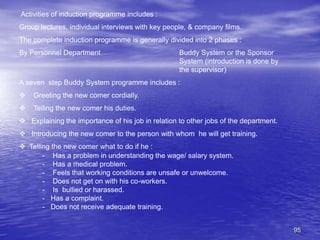
At the state level commissioners of labour, additional commissioners & the Dy.
Commissioners of labour are appointed as conciliation officers.
Function : To look into the disputes arising in undertaking employing more than
20 workmen.
A concilation officer’s intervention in a dispute may be either mandatory or discretionary. It is
mandatory where the dispute is related to some public utility services. It is discretionary
where the dispute is related to some non - public utility senesce undertaking.
The settlement arrived at in the conciliation proceedings is finding on the following 4
categories of persons :
Board of Conciliation :
The appropriate govt. may by notification in the official gazette constitute a Board of
conciliation for promoting settlement of an industrial dispute.
Constitution : One chairman and 2 or 4 other members.
The chairman must be an independent person, the members should be appointed in equal
numbers on the recommendation of the parties to the dispute. In lass of failure by parties, the
govt. must appoint the members.
386
Court of Enquiry :
The appropriate govt. can constitute a court of enquiry. The main difference between
board and a court his in the object with which these are constituted. In lass of Board, the
fundamental object is to promote the settlement of an industrial dispute. In lass of a court
the primary object is to inquire into and reveal the causes of an industrial dispute. A court
is no more than a fact finding machinery. It dose not care much for promoting the
settlement of disputes.
Labour Court, Industrial Tribunal and National Tribunal :
- Three tier machinery.
- Appropriate govt.
Constitution :
One presiding officer.
Functions of labour court :
- The proprietary or legality of an order passed by an employer under the
standing orders.
- Discharge or dismissal of workmen including reinstatement of or grant of relief
to any customary concession or privilege.
387
- Withdraw of any customary concession or privilege.
- Illegality or otherwise of a strike or lock out and
- All matters other than those specified to be within the jurisdiction of
Industrial Tribunals.
Function of Industrial Tribunal :
- Wages, including the period and mode of payment.
- Compensatory and other allowances.
- Hours of work and rest intervals.
- Leave with wages and holidays.
- Bonus, profit sharing, provident fund and gratuity.
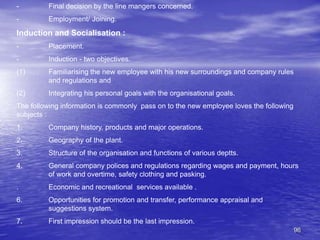
- Shift working, otherwise than in according with standing orders.
- Classification by grades.
- Rules of disciplines.
- Retrenchment of workmen and closure of establishment and
- Any other matter that may be prescribed.
Function of National Tribunal :
The National Tribunal can be constituted by the central govt. to deal with a dispute which in
the opinion of the national importance or is of such a nature that industrial establishments
situation in more than are status are likely to be interested in or affected by such dispute.
388
TRADE UNION ACT, 1926
 Art - 19 - Right to speech, to form association.
 Philosophy of Trade Union :
 History of Trade Union Movement :
 Royal Commission on Trade Unions, 1867 - 69 :
 History of Trade Union Movement in India :
1st Period - 1875 - 1919.
2nd Period - 1919 - 1947.
3rd Period - 1947 - 1970.
4th Period - 1972 - 1990.
5th Period - 1990 - as on date.
 Aims and Objects - Extent & commencement of the Trade Unions Act, 1926.
 Recognition of Trade Unions -
 Definition & Nature of Trade Unions :
“Trade Unions are voluntary organisations of workers formed to promote and protect their
interests by collective action”.
 Statutory Definition & Nature of Trade Unions :
“ Trade Union means any combination whether temporary or permanent, formed primarily for
the purpose of regulating the relations between workmen and employers and employers or for
imposing respective conditions on the conduct of any trade or business, and includes any
federation of two or more Trade Unions.
389
Legal character of a Registered Trade Union :
 Appointment of Registrar :
 Mode of Registration :
 Application of Registration :
Contents of the Copy of Rules :
Significance of Rules of Trade Unions :
Power to call for further particulars and to require alteration of name :
Registration Certificate :
Cancellation of registration - according to sec. 10 of the T.U. Act. :
(a) On the application of Trade Unions.
(b) At the will of the Registrar.
Provisions pertaining to appeal :
390
Jurisdiction of the Court :
(a) High Court of Original Nature.
(b) In such court not inferior to the court of an Additional or Assistant Judge
of a Principal Civil Court of original jurisdiction.
Power of the Appellate Court :
Procedure to be followed by the Appellate Court :
Rights and liabilities of a Registered Trade Union :
(a) Rights granted to it as a legal person.
(b) Right to spend general funds.
(c) Right to constitute of a separate political fund.
(d) Right to change its name.
(e) Right to amalgamate.
Effects of Change of Name and of amalgamation :
Rights of Trade Unions in-respect of industrial matters :
Liabilities and Duties of a registered Trade Union :
391
Liabilities and Duties of a registered Trade Union :
(1) Duty to make provisions in the rules of certain matters.
(2) Duty to constitute executive as required.
(3) Duty to spend general funds as required.
(4) Duty to constitute a separate political fund.
(5) Duty to provide access to books of Trade Unions.
(6) Duty to send notice to the Registrar.
(7) Duty to file Returns.
Privilege and Immunities of a Registered Trade Union :
(1) Immunity from criminal liability
(2) Immunity from civil liability
(3) Privilege to make agreements in restraint of trade
Miscellaneous Matters:
Dissolution of Registered Trade Union
Penalties and Procedure:
(1) Failure to submit returns
(2) Supplying false information regarding Trade Union
(3) Cognizance of offences
FUTURE ROLE OF TRADE UNIONS :
 Communication.
 Counseling.
 Education and Training.
 Welfare.
392
 Family and Vocational guidance.
 Research.
 Team Building.
 Employee Ownership.
 New Workforce
OBSTACLES IN THE GROWTH OF STRONG TRADE UNION:
 Outside leadership.
 Workers’ poverty.

 Difference of Caste, religion; language.
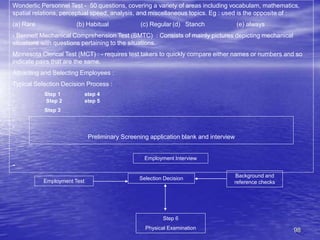
 Many workers relationship with their employers is still conditioned by a paternal outlook.
 The labour organisations in India have to contend with opposition of employers.
 Different shades of political opinion.
Shortcomings of the Trade Union Act., 1926
DISPUTE RESOLUTION AND GRIEVANCE MANAGEMENT
Meaning : Grievance means any discontent or dissatisfaction, whether expressed or not and
whether valid or not, arising out of anything connected with the company that an employee
thinks, believes or even feels, is unfair, unjust or inequitable.
The Characteristics of Grievance is as under :
(1) The discontent must arise out of something connected with the company.
(2) The discontent may be expressed or implied.
(3) The discontent may be valid, legitimate and rational or untrue or completely ludicrous.
393
DIFFERENCE BETWEEN A GRIEVANCE AND A DISPUTE:
• Being an individual’s feeling of injustice, grievance is always small in dimension. Dispute is
always big in dimension, results as it does from the collective action of several individuals.
• Grievance can be both expressed or unexpressed. A dispute is always expressed. It is the
manifestation of some conflict.
• Grievance is the early stage of a dispute. If ignored by the management and allowed to
accumulate and grow, it later on turns into a dispute.
• There does not exist any statutory machinery for settling grievances but there is the Industrial
Disputes Act which lays down machinery for the settlement of disputes.
•CAUSES OF GRIEVANCES :
(A) Grievances resulting may broadly be classified in the following categories :
(a) Improper matching of the worker with the job.
(b) Changes in schedules or procedures.
(c) Non - availability of proper tools, machines and equipment for doing the job.
(d) Tight production standards.
(e) Bad physical conditions of workplace.
(f) Failure to maintain proper discipline (excessive discipline or lack of it, both are equally
harmful)
(g) Poor relationship with the supervisor.
(B) Grievances resulting from management policy :
(a) Wages payment and job rates.
(b) Leave.
(c) Overtime.
(d) Seniority.
(e) Transfer.
394
(f) Promotion, demotion and discharges.
(g) Lack of career planning and employee development plan.
(h) Hostility toward a labour union.
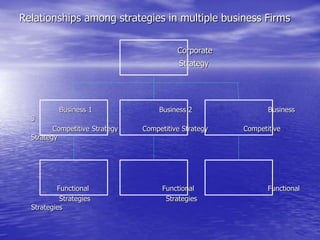
(C) Grievances resulting from alleged violation of :
(a) The collective bargaining agreement.
(b) Central or State laws.
(c) Past practice.
(d) Company rules.
(e) Management’s responsibility.
(D) Grievances resulting from personal maladjustment :
(a) Over - ambition.
(b) Excessive self-esteem
(c) Impractical attitude to life, etc.
HOW TO KNOW ABOUT GRIEVANCES:
• Exit Interview
• Gripe Boxes
• Opinion Surveys etc.
• Open - door - Policy.
395
GRIEVANCE PROCEDURE :
 Machinery for Handling Grievances.
A FOUR - STEP GRIEVANCE PROCEDURE
Arbitration
Top Union Leaders
Top Management
Middle Management
Front Line Supervisor
Middle Level Union Leaders
Union Representative
Aggrieved Employee
396
BENEFITS OF A GRIEVANCE PROCEDURE :
1. It brings grievances into the open.
2. It helps in preventing grievances from assuming big proportions.
3. It provides employees a formalised means of emotional release for their
dissatisfactions.
4. It helps in establishing and maintaining a work culture or way of life.
5. It acts as a check upon arbitrary and capricious management action.
DESIRABLE FEATURES OF A GRIEVANCE PROCEDURE
A grievance procedure should incorporate the following features :
1. Conformity with Existing Legislation.
2. Acceptability.
3. Simplicity.
4. Promptness.
5. Training.
6. Follow-up.
POINTS TO BE REMEMBERED WHEN HANDLING A GRIEVANCE :
1. Every grievance must be considered important.
2. A grievance should not be postponed in the hope that people will “see the light”
themselves.
3. All grievances should be put in writing.
4. All relevant facts about a grievance should be gathered by the management and their
proper records maintained.
397
5. The worker should be given free time off to pursue his grievance.
6. Management should make a list of all solutions and later evaluate them one by one in
terms of their total effect.
7. Decision once reached should be communicated to the employee and acted upon by the
management.
8. Follow-up must be done by the management.
SETTLEMENT OF GRIEVANCES IN INDIAN INDUSTRIES :
Model Grievance Procedure :
 An aggrieved worker shall first present his grievance verbally in person to the officer
designated by the management.
 If the worker is not satisfied with the decision of this officer or fails to receive an answer
within the stipulated period, he shall, either in person or accompanied by his
departmental representative, present his grievance to the head of the department.
 If the decision of the departmental head is unsatisfactory, the aggrieved worker may
request for the forwarding of his grievance to the Grievance Committee.
 The worker shall have the right to appeal to management for a revision.
 If no agreement is still possible the union and the management may refer the grievance
to voluntary arbitration.
Strategic Human Resource
Management
Strategic Human Resource
Management
• SHRM is part of strategic planning
• Strategic Plan : The Company’s plan for
how it will match its internal strengths and
weaknesses with its external opportunities
and threats to maintain a competitive
advantage
• Essence is to ask “ Where are we now as
a business, where we want to be, and
how should we get there”
• Then formulates specific strategies
(Human resources and other) to take the
company from where it is now to where
he or she wants it to be
• Strategy : The company’s long term plan
for how it will balance its internal
strengths and weaknesses with its
external opportunities and threats to
maintain a competitive advantage
• SHRM means formulating and executing
human resource policies and practices that
produce the employee competencies and
behaviors the company needs to achieve
its strategic aims
• E.g. Ford
Traditional View
Personnel
•Staffing
•Pay
•Training
Research &
Development
Finance
Production Marketing
Need and Importance
• Changing demand from customers or the
market place
• New technology and increasing pressure
from competitors (Philip Mirvis)
• Changes in the basic business
environment (Randall Schuler)
• High levels of uncertainty about basic
business conditions
• Rising costs
• Rapid technological change
• Changing demographics
• More limited supplies of highly trained
labor
• Rapidly changing government legislation
and regulations
• Increased globalization of industries
Strategic Management Process
• Strategy : The company’s long term plan for
how it will balance its internal strengths and
weaknesses with its external opportunities
and threats to maintain a competitive
advantage
• Strategic Management : The process of
identifying and executing the organization’s
mission by matching its capabilities with the
demands of its environment
• Essence of strategic planning - “ Where
are we now as a business, where we want
to be, and how should we get there”
• Steps in Strategic Management
• SM entails both strategic planning and
implementation
• The process of identifying and executing
the organization’s strategic plan, by
matching the company’s capabilities with
the demands of its environment
• SM process consist of 7 steps
• 1-5, strategic planning
• 6-7, implementation
• Step1 - define the current Business
• Choose the terrain on which it will
compete – what product it will sell, where
it will sell them, how to differentiate
products from its competitors
• E.g Rolex and Seiko
• Managers use statements like
• Vision – A general statement of its
intended direction that evokes emotional
feelings in organization members
• Broad terms – “what we want to become”
• Gives the direction
• What the business should be
• Mission – What our main task are now
• Spells out who the company is, what it
does, and where it’s headed
• Step 2 – Perform external and internal
audits
• Analyzing external and internal situations
• SWOTs
• SWOT analysis
• SWOT chart
• Strengths Weakness
*Strong R&D *Aging Machinery
• Opportunities Threats
*Expanding Market * Merger of
Competitors
• Step 3 : Formulate new Business and
mission statements
• Based on situation analysis
• What should our business be
• What products
• Where it will sell
• How to differentiate from competitors
• New vision and mission
• Step 4 : Translate the mission into
strategic goals
• Operationalizing the mission for managers
– strategic goals
• For each department
• Step 5 : Formulate strategies to achieve
the strategic goals
• Strategies, Course of action – how to
move from the current business to what it
wants to
• Strategies act as bridge between these
two
• Step 6 : Implement the strategies
• Translating strategies into action
• Hiring, firing people, building plants,
adding products, product lines
• This include managerial functions like
Planning, organizing, staffing, leading, and
controlling
• Step 7 : Evaluate performance
• Management Monitors the extend to which
the firm meeting its strategic goals
• Strategic Control – keep strategy up to
date
• According to the environmental changes
• Competitors action
Types of Strategies
Three types of strategic planning
A)Corporate strategy
• Company wide level (corporate level)
• Pepsico runs pepsi, fritto lay, and pizza hut,
so needs a corporate level strategy
• Diversification- expand by adding new
product lines
• Vertical integration – expands by producing
its own raw material
Relationships among strategies in multiple business Firms
Corporate
Strategy
Business 1 Business 2 Business
3
Competitive Strategy Competitive Strategy Competitive
Strategy
Functional Functional Functional
Strategies Strategies
Strategies
• Consolidation – reducing the company’s
size
• Geographic expansion – taking business
abroad
B)Competitive Strategy (Business level )
E.g., Pizza hut
• Next level down, each of the business
need
• How to build and strengthen the
business’s long term competitive position
in the market place
• How pizza hut will compete with Papa
John’s
• Strategies like
• Cost leadership, low cost leader, dell by
direct selling
• Differentiation, Firm seeks to be unique,
Toyota by quality, woodland/timberland
by adventure shoes
• Focusers, Carve out a market niche, like
ferrari, by providing products and services
customers can get in no other way
• Functional strategy
• Business composed of departments –
manufacturing, selling, finance, HRM
• This identify the basic courses of action
that each department will pursue in order
to help the business attain its competitive
goals

HRM-FINAL-II.ppt

  • 1.
    1 HUMAN RESOURCE MANAGEMET MBATERM-III Prof. R.K.Patra
  • 2.
    2 PERSON HUMAN P =PECULIARITIES/PERISHABLE H = HEADS E = EMOTIONS U = UGRES OF HIGHER NATURE R = RELAXING ATTITUDE M = MEMORY LIFE SAMPLES S = SENSITIVITY A = ANALYTICAL ABILITY O = OBJECTIVES OF INDIVIDUALS N = NORMS N = NORMS ================= R = RECRUITMENT E= ENABLING S= SOUL O= OUTSOURCING U= UNDERSTANDING R= RETURN C= CULTURE E= EFFECTIVE
  • 3.
    3 • They say… •“If you’re planning for one year, grow rice. • If you’re planning for 20 years, grow trees. • If you’re planning for centuries, grow human resource.” • -Ancient Chinese Proverb
  • 4.
    4 Management : MaryParker Follett - “The art of getting things done through people”. But management is much more and can be termed as “that field of human behaviour in which managers plan, organise, staff, direct and control human, physical and financial resources and group objectives with optimum efficiency and effectiveness. Concept of HRM : Human Resource is the total knowledge, skills, creative abilities, talents and aptitudes of an organisation’s workforce, as well as the value, attitudes and beliefs of the individuals involved. In simple sense, human resource management means employing people, developing their resources, utilising, maintaining and compensating their services in tune with the job and organisational requirements. Resource - Future Potential Human - are regarded as human factor, human asset, human capital.
  • 5.
    5 Importance of HumanFactor : * This is the only resource which can produce unlimited amounts through better ideas. * It is only this resource which appreciates in value with the passage of time. * It is this resource only which can contribute to sustained competitive advantage through facilitating the development of competencies that are organisation specific and difficult to imitate. * It is this resource only which can organise itself into unions and militate against the undesirable actions of the employer.
  • 6.
    6 Evolution of HRM •Pre-IndependencePost Independence Present •(Royal Commission) Factories Act, 1948 PM/LWO/Safety Officer/PRO/HRD/ HRM/KM/ME/Competency Manager/ The Royal Commission of Labour in India (1931) under the Chairmanship of J.N.Whitley recommended the abolition of the ‘Jobber’ system and the appointment of Labour Officers in Industrial Enterprises to perform the recruitment function as well as look after the welfare of the employees. After Independence, the Labour Welfare Officer was identified with the Personnel Manager created by legislation Under Section 49 of the Factories Act, 1948. The role of a personnel manager was more of a custodian of personnel policy implementation and compliance to different Acts of the Factories law. Evolving along the years, a new approach - the HRM has emerged, which focuses more on developmental aspects of human resource with a pragmatic, flexible approach.
  • 7.
    7 IS HRM aProfession ? What is Profession  Existence of an organised and systematic knowledge.  Formalised methods acquiring training.  Existence of an association with professionalisation as its goal.  Existence of an ethical code to regulate the behaviour of the members of the profession.  Charging of fees based on service but with due regard for the procreating of service over the desire for monetary reward. Professional Institutes : (1) NIPM, Kolkata. (2) National HRD Network, Jamshedpur. (3) Indian Society for Training & Development, New Delhi. (4) Indian Society for Applied Behavioural Science New Delhi. (5) Indian Society for Individual and Social Development.
  • 8.
    8 HRM FUNCTIONS • ManagerialFunctions 1. Planning 2. Organising 3. Directing 4. Co-ordinating 5. Controlling • Operative Functions 1. Employment a. Job analysis, Job Description b. HRP c. Recruitment d. Selection e. Placement f. Induction & Orientation
  • 9.
    9 Contd… 2.Human Resource Development a. PerformanceAppraisal b. Potential Appraisal c. Training d. Management Development e. Career planning & Devp. f. OD 3. Compensation a. Job Evaluation b. Wage & salary admin. c. Incentives d. Bonus e. Fringed Benefits f. Social security measures 4. Human Relations( Various policies) 5.Effectiveness of HRM a. Organisational Health b. HRA c. HR Audit d. HR Research
  • 10.
  • 11.
    11 HRM IR HRD HRIS HRP HRA Evolution of HRM- Shifting Bases of HR Philosophy Sub - Functions of HRM
  • 12.
    12 1. Human ResourcesPlanning (HRP) : This took care of the optional allocation and utilization of the human resource. How it was concerned with the needs of the organisation and establishing ways and means to meet these needs so that the objectives of the organisation are met and production continues unhampered. Recruitment , promotion, transfers and resignations were to be dealt with by this sub-function. 2. Human Resources Administration (HRA) : This took care of the erstwhile establishment function in some parts and the legal compliance function in others. It had to make sure that all the returns were filled up and submitted to the concerned authorities in order and in time. Peripheral functions as sanity, canteen, crèche and conveniences would also fall under its purview.
  • 13.
    13 3. Human ResourcesDevelopment (HRD) : This was the most proactive sub-functions of the specialisation. It began at the level of training need identification, conducting climate surveys and actually conducting training programmes. Training was an ongoing but short-term process while organisational development was goal-directed and long term. Both had a direct role in the organisation corporate culture building. 4 Industrial Relations (IR) : This was essentially related to power relationships between the owners of capital and the dispensers of labour. It is not a systems concept. A la Dunlop or a process or regulation concept a la Hyman.
  • 14.
    14 5. Human ResourcesInformation Systems (HRIS) : This was the bloodline of the specialisation for it stored information and rendered it easily accessible so that decision-making could be facilitated. The keywords were a balance between secrecy and transparency. 6. Human Resources Management (HRM) : This is the smooth and shining tabletop, which is propped up by the four legs. It is smooth denoting the fact that the organisational objectives are achieved smoothly. It is shining to denote that there is efficiency in the achievement of these objectives. It is stable denoting that the processes are efficiently utilised for the achievement of these objectives. The shine, the stability and the smoothness is on the core competencies. Its brittleness is brought about by the fact that we are dealing with the human being whose subjective self very often overpowers his objective self in all walks of life.
  • 15.
    15 Scope of HRM: Nature of HRM Prospects of HRM Human Resource Management Employee Hiring Industrial Relations Employee Maintenance Employee Motivation Employee and Executive Remuneration
  • 16.
    16 Objectives of HRM: To create and utilise an able and motivated workforce, to accomplish the basic organisational goals.  To establish and maintain sound organisational structure and desirable working relationships among all the members of the organisation.  To secure the integration of individual and groups within the organisation by co-ordination of the individual and group goals with those of the organisation.  To create facilities and opportunities for individual or group development so as to match it with the growth of the organisation.  To attain an effective utilisation of human resources in the achievement of organisational goals.  To identify and satisfy individual and group needs by providing adequate and equitable wages, incentives, employee benefits and social security and measures for challenging work, prestige, recognition, security, status, etc.
  • 17.
    17  To maintainhigh employee morale and sound human relations by sustaining and improving the various conditions and facilities.  To strengthen and appreciate the human assets continuously by providing training and developmental programmes.  To consider and contribute to the minimisation of social-economic evils such as unemployment, under-employment, inequalities in the distribution of income and wealth and to improve the welfare of the society by providing employment opportunities to women and disadvantaged sections of the society etc.
  • 18.
    18  To providethe opportunity for expression and voice in management.  To provide fair, acceptable and efficient leadership.  To provide facilities and conditions of work and creation of favourable atmosphere for maintaining stability of employment. We can summarise the objectives as under :
  • 19.
    19 Societal Objectives :To be ethically and socially responsible to the needs and challenges of the society while minimising the negative impact of such demands upon the organisation. The failure of organisations to use their resources for the society’s benefit in ethical ways may lead to retractions. For example, the society may limit HR decisions through laws that enforce reservation in hiring and laws that address discrimination, safety or other such areas of societal concern. Organisational Objectives : To recognise the role of HRM is not an end in itself. It is only a means to assist the organisation with its primary objectives. Simply stated, the department exists to serve the rest of the organisation.
  • 20.
    20 Functional Objectives :To maintain the department’s contribution at a level appropriate to the organsiation’s needs. Resources are wasted when HRM is either more or lees sophisticated to suit the organisation’s demands. The department’s level of service must be tailored to fit the organisation it serves. Personal Objectives : To assist employees in achieving their personal goals, at least in-sofar as these goals enhance the individual’s contribution to the organisation. Personal objectives of employees must be met if workers are to be maintained, retained and motivated. Otherwise, employee performance and satisfaction may decline and employee may leave the organisation.
  • 21.
    21 CHAPTER-2 An HRMModel : Nature of HRM Human Resource Planning Selection Job Analysis Recruitment Placement Training & Development Remuneration Motivation Safety & health Communication Participative Management Welfare Promotion etc Future of HRM Industrial Relations Trade Unionism Disputes & their settlement Ethical issue in HRM International HRM E n v i r o n m e n t Committed and Willing workforce Organisational Goals
  • 22.
    22 Emerging Challenges andFuture of HRM in India (Prospects) : With liberalisation of the Indian economy, many changes are taking place in the corporate sector. There is pressure on Indian industry to perform - produce quality goods and provide quality services. With increased competition, there is need to become cost - effective and upgrade work methods, work norms, technical and managerial skills and employee motivation to face the challenges. As a congruence, one can expect several cultural and economic changes of great significance in human resource management to sweep through the country in the coming years. .
  • 23.
    23 (i) Greater Involvementin Development Planning : Our future human resource manager will have to be more of a development man than a more administrator of HRM services. With this object he/she will have to get very much involved in basic organisational planning, keep pace with social, political and economic factors which can affect the internal situation of the company and advise management in the relationship between these factors and the achievement of organisational goals. He will have to engage himself in planning and meaningful HRM research and stimulate his fellow managers to anticipate employee problems which might arise from the introduction of changes in HRM policies, manufacture procedures or labour- management agreements. He will actively seek to place human resource management in the hands of the line managers by means of education and selling efforts. He will conduct attitude surveys informally, if possible to check on current management practices with a desire to assisting line managers to improve upon them. He will have to be most cost conscious so that all HRM proposals are made keeping the cost factor in mind. Lastly, he will have to examine and assess the functioning of his own department.
  • 24.
    24 (ii) Change inHRM Policies : The ratio of educated to uneducated employed labour force has been growing in India in recent years. The aspirations and needs of educated people differ from those of uneducated people. Hence, existing H.R.M. Polices and procedures, many of which were probably developed years ago when uneducated workers predominated, would no longer be adequate for a better educated. Workforce which would demand greater autonomy and discretion in the workplace. Similarly, the sex composition of the workers has been changing. Earlier, women were recruited mainly as labour in agriculture. Now they are increasingly occupying white collar and managerial positions. These women are beginning to resist discrimination shown against them in matters of promotion. Enquiries have revealed that there exist ‘psychological barriers’ in the minds of many men which account for this discrimination. These psychological barriers act like glass walls or glass ceilings. They permit women employees to see the prospects of promotion on the opposite side but they do not allow them to walk through the barriers. Interventions will have to be worked out to remove these psychological barriers.
  • 25.
    25 The present exitpolicy of some public sector units (under which attractive financial benefits are offered to those employees who request for early retirement) is, besides increasing the government burden of retirement payments, creating a dependency culture that is disastrous for society. The policy may have to be reviewed in future. The better course for a unit would be to find alternative jobs for its surplus manpower. e.g., those removed from core jobs may be given peripheral jobs so far handled by outside agencies.
  • 26.
    26 (iii) Change inManpower : On account of an easy access to better educational and employment opportunities, minority groups and scheduled castes and tribes would become an important source of manpower in future with the result that the manpower planning of every organisation will have to take account of the potential availability of talent and ability in these groups. Simultaneously, child labour will have to be abolished. (iv) Re-training of Workers : With rapid technological advancements many old skills are becoming obsolete at a historically unprecedented rate and making it difficult for laid-off workers, especially above 40 to find work for years on end. The new information technology is fast replacing several clerical and supervisory jobs. Similarly, outsourcing is reducing the number of jobs in the production area. The solution would lie in re-training these workers in new knowledge, skills and attitudes.
  • 27.
    27 (v) Greater Importanceof Occupational Health and Safety Programmes :Under legislative pressure future H.R. managers will have to become more health and safety conscious making full use of research in ergonomics and in the behavioural sciences. (vi) Greater Attention to the Human Problem of Adjustment to New Work Ethics : The future H.R. manager will have to become progressively familiar with Organisational Development (O.D.) which is concerned with the change process when a need for some change within the organisation is seen as necessary. Most people in India are not accustomed to the rigid demands of an industrial system. They are not prepared for the rigorous timing and discipline, precise division of labour, rational forms of action, and impersonal styles of supervision and control that prevail in advanced work systems. Long-run evvironmental forces, using behavioural understanding, will be required to establish new work ethics of this magnitude.
  • 28.
    28 . (ix) Check onRising Money Wages : The entry of multinationals and international companies have thrown the wage field haywire in India. In future the necessary parameters of wage rise will have to be defined. People will have to be taught to value a closer connection between pay and performance. The emphasis on performance will also mean that age will no longer be considered as a basis for promotions. And older people will accept reporting to younger bosses. (x) New Quality Standards : The human resource manager would be called upon to help line managers in the setting up and enforcement of good quality standards. It will soon be realised that improving manufacturing operations by investment in extensive computerisation etc. by themselves will create only “local optimums”. To achieve world quality standards new work ethics will have to be developed. This would require workers’ commitment. The human resource manager will have to make efforts to get workers’ mind and heart dedicated to work. Training will have to be geared up to bring about change in attitudes of people and not merely in their knowledge and skills. The grievance handling procedure will have to be more effective and quick. Suggestion schemes will have to be made an important vehicle for employees to participate and contribute. Quality Circles and Task Forces for problem solving will have to be encouraged.
  • 29.
    29 (vii) Better PerformanceAppraisal Devices : Traditionally, people are evaluated on the basis of results only. But this is unfair in those cases where the poor results are due to various other factors such as non-availability of resources or defective system. Hence, in future the appraisal will have to be based on the efforts also. (viii) Greater Importance of Intrinsic Motivation : Many psychological rewards such as interesting and challenging work, autonomy and participation would work as better motivations. (ix) Check on Rising Money Wages : The entry of multinationals and international companies have thrown the wage field haywire in India. In future the necessary parameters of wage rise will have to be defined. People will have to be taught to value a closer connection between pay and performance. The emphasis on performance will also mean that age will no longer be considered as a basis for promotions. And older people will accept reporting to younger bosses.
  • 30.
    30 (xi) Social Responsibility: Another formidable challenge for the human resource manager would be the role the organisations will now be expected to play in the social context. He will have to increasingly participate in the upliftment of the community around him through various health, education and environment development programmes in order to boost his organisation’s image. (xii) Cafeteria Approach : The H.R. manager will have to work out alternative compensation packages to meet the needs of diverse groups of employees and grant them option to choose any one package within the total standard package. Various myths harboured by HR professionals/ specialists and the actual realities that confront them in day to day business life within the organisation in particular and the society in general : Myths Realities - HR professionals are people oriented. - HR should build systems to be competitive and not just comfortable. - HR job can be done by anyone. - HR practices are developed as per strategy. - HR deals with soft aspects and hence not - HR should impact business results accountable. and must be accountable.
  • 31.
    31 Myths Realities - HRmust control costs . - HR should focus on creating value by optimizing intellectual capital and not reduce costs. - HR should keep a check on the policy - HR should not own compliance. It is compliance and keep employee happy the line function. - HR is full of newfade and Jargon. - HR professionals should see their work in the evolutionary context. They should speak more of applicable theory and lees of Jargon. Day to Day Operational Focus : Management of firm infrastructure : This role predominantly covers what is known as line HR responsibility. The HR professional is expected to concentrate on creating value by entertaining service quality effectiveness by focusing on customer satisfaction and improving efficiency of the processes by minimizing costs. Management of Employee Contribution : This calls for championing employee interests in interactions with the line function and top management and assisting employees to maximise their contribution. Future/ Strategic Focus : The manager cannot afford to miss the wood for the trees. Management of Strategic Human Resource :This is an emerging area for the HR professionals. It calls for actively partnering with the business leadership in strategy formation and delivery.
  • 32.
    32 Key Performance Areas(KPA), of HR professional - summary KPA Deliverable Matephor Process Management of HR Executing Strategy Strategic Partner Organisational Strategic diagnosis, facilitation of Strategy for mulation process, process strategy Management of firm infratruture Efficient infrastructure Employee Champion HR administration, Compensation and Benefits Management, Welfare and employee involvement, Employee Relations Management of Employee Increasing employee Commitment and Employee Champion Capability Performance Assessment, Training and Development, Empowerment Management of Change Creating a renewed Organisation Change Agent Institutional learning, Leadership processes, Process Improvement and Design
  • 33.
    33 A Model ofthe HR -Shareholder Value Relationship : Business and Strategic initiatives Design of HRM System Employee Skills Employee Motivation Job Design & Work Structure Productivity Creativity Discretionary Effort Improved operating Performanc e Project and Growth Market Values Discrepancies Between Academic Research and HRM Practice : Academic Research Findings HRM Practice RECRUITMENT : • Quantitative analysis of recruitment sources using. Less than 5% calculate yield ratios. yield ratios can facilitate efficiencies in recruitment. Less than 20% know how. STAFFING : • Realistic job previews (RJP) can reduce turnover. Less than 5% of companies use RJPs Weighted application blanks (WAB) reduce turnover in high turnover jobs. Reduce turnover. • Structured, behavioural, or situational interviews are Less than 10% know what a WAB is, more valid. Less than 1% use structured interviews • Use statistical model of prediction with multiple Less than 5% use actuarial. selection devices.
  • 34.
    34 • ORGANISATIONAL DESIGNREWARD SYSTEMS AND BENEFITS Human resource planning Safety progrmmes 10 SHA compliance Job analysis Health/ medical services Job design Complaint/ disciplinary procedures Socio-technical Systems Compensation administration Information System EEO Compliance STAFFING Wage/ Salary administration Rerouting/ Interviewing/ Hieing Insurance benefits administration Affirmative action Pension/ profit haring plans Promotion/ transfer/ separation Out placement Services Induction/ Orientation EMPLOYEE TRAINING AND Employee Selection methods ORGANISATION DEVELOPMENT PERFORMANCE APPRAISAL AND Labour relations. MANAGEMENT Collective bargaining Management appraisal/ management by objectives Employee grievances Alternative dispute Systems Customer - focused performance appraisal Attitude surveys Employee Communications/ publications
  • 35.
    35 HEALTH AND SAEETYPRODUCTIVITY IMPROVEMENT PROGRAMME OSHA compliance TQM programmes Accident prevention Productivity/ enhancement programes Stress reduction Suggestion Systems Wellness programmes Quality Circles Employee assistance/ Counselling Team building programmes
  • 36.
    36 WHAT IS ENVIRONMENT? Environment refers to all external factors which have a bearing on the functioning of the business. RELATIONSHIP BETWEEN BUSINESS AND IT’ ENVIRONMENT : Two Types Business Environment at two levels Internal Environment or External Environment or Controllable factors Uncontrollable factors • Value System • Mission & Objectives Micro Macro • Management Structure & Nature • Internal Power Relationship Suppliers Economic Environs • Human Resources Customers Political and Govt. Environment • Company Image and Brand Equity Marketing Socio-cultural Intermediaries Environment • Physical Assets & Facilities Financiers Demographic Environment • R & D and Technological Capabilities Publics Natural Environment • Marketing Resources Physical and Technology logical Environment • Financial Factors International Environment
  • 37.
    37 Steps in JobAnalysis Process and its Relationship to HRM and Job Design : Step 1 Examine the total organisation and the fit of each job Step 2 Determine how job analysis information will be used Step 3 Select jobs to be analysed Step 4 Collect data by using acceptable job analysis techniques Step 5 Prepare job description Step 6 Prepare job specification Use information from Steps 1- 6 - Job design - Planning - Recruitment - Selection and training - Performance evaluation - Compensation - EEO Compliance - Follow-up evaluation CHAPTER-3 JOB DESIGN, DESCRPTION &SPECIFICATION
  • 38.
    38 JOB ANALYSIS ANDROLE DESCRIPTION * Job analysis is a systematic process of gathering information about a job. * Job analysis provides answers to question. * How much time is taken to complete important tasks ? * Which tasks are grouped together. * How can a job be designed or structured so that the employee’s performance can be enhanced ?
  • 39.
    39 * What kindsof behaviours are needed to perform the job ? * What kind of person (in terms of traits and experience) is best suited for the job ? * How can the information acquired by a job analysis be used in the development of HRM programmes ? The following terms are used interchangeably by people who are unfamiliar with job analysis. The below definitions will give a clear idea.
  • 40.
    40 Job Analysis :A purposeful, systematic process for collecting information on the important work - related aspects of a job. The major products of Job Analysis are as under : Job Description :The principal product of a job analysis. It represents a written summary of the job as an identifiable organisational unit. Job Specification : A written explanation of the knowledge, skills, abilities, traits, and other characteristics (KSAOs) necessary for effective performance on a given job.
  • 41.
    41 Knowledge : Refersto an organised body of information, usually of a factual or a procedural nature applied directly to the performance of a function. For example computer programmers may need knowledge of specific languages such a Java. An Ability : Refers to a demonstrated competence to perform an observable behaviour or a behaviour that results in an observable product. Police officers, for example are required to possess the physical ability to apprehend and detain a suspect.
  • 42.
    42 A Skill : Askill is a competence to perform a learned, psychomotor act and may include a manual, verbal, or mental manipulation of data, people or things. Other Characteristics : Include personality factors (attitudes,) aptitudes, or physical or mental traits needed to perform the job.
  • 43.
    43 Characteristics of JobAnalysis :  It should yield a thorough clear job description.  The frequency and important of task behaviours should be assessed.  It must allow for an accurate assessment of the Knowledge, Skills, Abilities and other characteristics (KSAOs) required by the job.  It must yield information about the relationship between job duties and these KSAOs. That is it must clearly determine which KSAOs are important for each job duties. In addition to helping organisations satisfy their legal requirements, job analysis is closely tied to HRM programmes and activities. It is used extensively in each of the following areas :
  • 44.
    44 Four Methods ofJob Analysis 1. Recruitment and Selection 1. Observation 2. Teaching and Development 2. Interview 3. Compensation 3. Questionnaire 4. Strategic Planning 4. Job incumbent diaries or log Who Should Conduct the Job Analysis : Internal as well as external experts. Job Analysis Information Format (JAIF) Your job title - Code - Date - Class title - Facility - Supervisor’s title Prepared by - Supervisor’s Name - Hours worked AM to AM PM to PM
  • 45.
    45 1. What isthe general purpose of your job ? 2. What was your last job ? If it was in another organisation please name it. 3. To what job would you normally expected to be promoted ? 4. If you regularly supervise others, those activities that are part of your supervisory duties. 5. If you supervise others, please check those activities that are part of your supervisory duties.
  • 46.
    46 - Hiring -Developing - Directing - Disciplining - Orienting - Coaching - Measuring Performance - Terminating - Training - Counselling - Promoting - Other - Schedulin - Budgeting - Compensating 6. How would you describe the successful completion and results of your work ? 7. Job duties - Please briefly describe what you do and, if possible, how you do it. Indicate those duties you consider to be most important and/ or most difficult. a. Daily duties. b. Periodic duties (please indicate quarterly, etc.) c. Duties performed at irregular intervals. d. How long have you been performing these duties ? e. Are you now performing unnecessary duties ? If yes, mean describe. f. Should you be performing duties not now included in your job ? If you, please describe.
  • 47.
    47 8. Education pleasecheck the balance that indicates the educational requirements for the job, not your own educational background. a - No formal education required b - Less than high school diploma c - High School diploma or equivalent. d - 2 year college certificate or equivalent. e - 4 year college degree. f - Education beyond undergraduate degree and/ or professional license. - List advanced courses or specific license or certificate required. - Please indicate the education you had when you were placed on this job. 9 Experience. Please choose the amount needed to perform your job.
  • 48.
    48 - a -None b - Less than one month c - One month to less than six months d - Six month to one year e - One to three years f - Three to five years g - Five to 10 years h - Over 10 years Please indicate the experience you had when you were placed on this job.
  • 49.
    49 10. Skill. Pleaselist any skills required in the performance your job. (For example, degree of accuracy, alertness, precision in working with described tools, methods, system, etc.) Please list skills you possessed when your were placed on this job. 11. Equipment. Does your work require the use of any equipment ? Yes - No - If Yes, please list the equipment and check whether you use it rarely, occasionally, or frequently.
  • 50.
    50 15 30 4560 75 Read, Write High School Higher Secondary Graduate Post and subtract plus one year’s trade Graduate 2. Factor Comparison : Skill Responsibility Effort Working Conditions A B E D B A D E C C B C D D C B E E A A Scale of Values For The Education Factor
  • 51.
    51 Scales Money apportionments (Average) Keyjobs Prevalent Skill Responsibility Effort Working Enditions Rate (Rs.) A 15.00A - 8.50 B - 5.00 E - 3.00 D - 2.50 B 14.00B - 5.50 A - 4.50 D - 2.25 E - 2.25 C 11.00C - 4.50 C - 3.00 B - 2.00 C - 2.00 D 8.50D - 2.50 D - 1.25 C - 1.50 B - 1.50 E 7.00E - 1.00 E - 0.75 A - 1.00 A - 1.00 0 1 2 . 3 . 4 . 5 . 6 7 8 . 9 Skill E D C B A Responsibility E D C A B Effort A C B D E
  • 52.
    52 Working Conditions A BC E D WAGE FIXATION: Wage : Wage is used to denote payments to hourly rated production to workers. Salary : Salary is used to denote payments to clerical, supervisory and managerial employees. How Are Wages Determined? : Macro Level: • Subsistence Theory of Wages • Wages Fund Theory • Marginal Productivity Theory Micro Level : 1. Demand for and supply of labour 2. Labour Unions 3. Cost of Living
  • 53.
    53 4. Prevailing Wagerate 5. Ability and willingness to pay 6. Job requirement 7. State Regulations and Court Judgements 8. Fringe and other benefits Requisites of a sound compensation or Wage Plan: 1. It should be internally equitable 2. It should be externally competitive, and WAGES IN INDIA : • Basic Wage • Dearness Allowance • Annual Statutory Bonus, and • Incentive Bonus
  • 54.
    54 Wage Determination : Steps:  Select key jobs.  Duties.  Stable.  Representative of all levels of jobs.  Sample of firms in the labours market.  Demand and supply.  Wage information.
  • 55.
    55 NON-QUANTITATIVE JOB EVALUATIONMETHOD: 1. Ranking Method: This method of job evaluation consists of ranking the jobs in the organisation from the lowest to the highest. Comparisons are not made of individual characteristics or factors of each job. Rather each job as a whole is compared with others. Procedure: • Each member of the Job Evaluation Committee ranks the jobs independently in one of the two ways : •either by first identifying those jobs which come at two extremes of the scale and locating the rest in the middle region, or by comparing each job with every other job, one at a time. • If some members significantly differ on the ranking of a job, the matter is settled by mutual discussion. •Finally, all sets of ranking are averaged and final ranking of jobs is decided.
  • 56.
    56 2. Classification orGrading : (i) Point Rating : Procedure : (a) Jobs are first broken down into a certain number of major factors such as skill, effort, responsibility and working conditions (b) Each major factor is further broken down into a number of minor factors such as : •Skill - Education, experience, and initiative •Effort - Physical, mental and visual •Responsibility - Equipment or process, material or product, safety of •others and work of others, • Working conditions - Disagreeable and hazardous. 3. The total number of points - any desired number - which will be utilised in the entire system is determined and then a decision is made about the number of points that are to be allocated to each major and minor factor.
  • 57.
    57 Major Factor MinorFactor Number of Points Skill Education 75 Experience 100 Initiative 75 100 Effort Physical 50 Mental 15 Visual 10 75 Responsibility Equipment 25 Material 25 Safety of Others 25 Work of Others 25 100 Working Conditions Disagreeable 50 Hazardous 25 75 Each minor factor is converted into scale by dividing it into certain number of degrees and assigning point values to them. Total Number of Points = 500
  • 58.
    58 Basic Wage Minimum WageFair Wage Living Wage Dearness Allowance Flat rate DA Graduated scale of DA Legal Framework to Regulate Basic Wages : 1. The Minimum Wages Act,1948 2. The Equal Remuneration Act, 1976 3. The Contract Labour (Regulation and Abolition) Act, 1970
  • 59.
    59 HUMAN RESOURCEPLANNING HRP isboth process and set of plans. It is how organizations asses the future supply of and demand for human resources. In addition an effective HR plan also provides mechanism to elementary gaps that may exist between supply and demand. CHAPTER-04
  • 60.
    60 Salient Features ofHRP •Situation Analysis or Environmental Scanning •Forecasting demand for Human Resources •Analysis of the supply of Human Resources •Development plan for action
  • 61.
    61 Diagnostic model forHuman Resource management External environmental influences • Govt. Requirement and laws • The union • Economic conditions/domestic & Industrial • Competitiveness • Imposition of labour force61616161 • Location of the organization Internal Environmental Influences • Strategy • Goals • Organization culture • Nature of the task • Work group • Leader’s style & Experience Diagnose Prescribe Implement Evaluate Diagnose Prescribe Implement Evaluate
  • 62.
    62 Human Resource PlanningProcess Acquiring human resource •Equal Employment opportunity •HR planning •Job analysis & design •Requirement :Domestic & International •Selection : Domestic & International Rewarding Human resources •Performance evaluation •Compensation •Job analysis & design •Benefits & service Developing human resources •Training & development •Career planning •Discipline Maintaining & Producing Human resources •Labour relations & Collective bargaining •Safety health & Well ness •Evaluation Concerned about people & Results Concerned about people & Results Concerned about people & Results Concerned about people & Results Focus of each process is on People & results Socially responsible & Ethical Practice Competitive high quality products Competitive high quality services Desirable End Results
  • 63.
    63 The human resourcePlanning Processes Strategic Planning •Technological Forecast •Market forecast •Organizational Planning •Investor planning •Annual Operating planning Human resource demands •Annual employment Requirement •Numbers •Skills • Occupation •Categories Human resource supply •Existing employment •Inventory •After application of expected loss and rates Compared With Variance If One End If surplus Decisions •Layoff •Retirement etc End If Shortage Decisions •Over time •Recruitment etc End Actions Decisions Actions Decisions
  • 64.
    b) Statistical techniques: There are two types of statistical techniques useful for human resource planning, viz : i)ratio trend analysis, and ii) econometric models i) Ratio trend analysis : Under this method, the ratios are calculated, for the past data relating to number of employees of each category and production level, sales level, activity level/work load level and direct employees and indirect employees. Furture production level, sales level, activity level/work load are estimated with an allowance for changes in organisation, methods and jobs.
  • 65.
    • Future ratiosare also estimated with an allowance for changes in organisation, methods and jobs. Future ratios are also estimated when there are changes to come in organisation and human resources. Then future human resource is calculated on the basis of established ratios. The following example gives clear idea. • Present level of production (1-1-12) 2,000 units • Present number of Foremen (1-1-12) 4 • Ratio is 4:2000, i.e. 1:5900 • Estimates production on (1-1-13)=5,000 units • Foremen required as on (1-1-13)= 5000 = 10 • (without giving any provision 500 • for changes)
  • 66.
    • FUTURE CHANGESINCLUDE : • Due to decline in physical stamina of employees, change in values and increase in social activities it is estimated that the future ratio would be 1:420. The foremen required as on 1-1-2013 = 6. • Ii)Econometric Models : Econometric models for human resource planning are built up by analysing the past statistical data and by bringing the relationship among variables. These variables include those factors which affect manpower requirement directly and indirectly like investment, production, sales, activities/work load, etc. The econometric model or formula is used to forecast manpower needs based on movements in various variables.
  • 67.
    • C) WorkStudy Techniques : These techniques are more suitable where the volume of work is easily measurable. Under this method, total production and activities in terms of clear units are estimated in a year. Man hours required to produce/perform each unit is calculated. Work ability of each employee is estimated in terms of man hours after giving due weightage to absenteeism, rest, etc. Then the required number of employees is calculated. The following example gives clear idea
  • 68.
    1. Planned operationsduring the year 2013 (for Clerical Section of Personnel Department of XYZ Co.Ltd.) 1,60,000 units Standard man hours needed to perform each unit in 2013 0.25 hours Planned man hours needed per year in 2013 40,000 Work ability per employee in man hours in the year 2013 2000 40,000 Number of employees required in 2013 = 20 20,000
  • 69.
    • For ClericalSections of Human Resource Department of XYZ Co.Ltd. • Another classification of methods of Human Resource Demand estimation is :- • 1. Estimates based on opinions of departmental heads. This method is similar to managerial judgment. • 2. Imitation of existing practices in other organizations in the country and /or abroad. This method may be used as supplementary device for checking the authenticity of other methods adopted. • 3.Organization –cum-succession charts and superannuation data.
  • 70.
    • 4. WorkStudy Method: It includes ascertainment of output target, operationalise output targets, and find basic labour requirements for each operation or segment of productions schedule. This is similar to economic models. • 5. Estimation based on technology, equipment, layout and design considerations. • 6. Estimations based on various laws. Some laws affect the quantity of HR, where as other laws affect the composition of HRs. • 7. Historical record of production. • 8. Job analysis • 9. Statistical Methods : The two important types are
  • 71.
    • Projection ofbasic manpower ratios and regression and correlation analysis. This is similar to statistical techniques discussed earlier. • After estimating the overall human resource requirements the present human resource inventory to obtained. • 3. Supply Forecasting : • The data relating to present human resources inventory in terms of human resources components, number, designation-wise and department-wise should be obtained. Principal dimensions of human resources inventory are :…
  • 72.
    • i) Headcounts regarding total, department-wise, sex- wise, designation-wise, skill-wise, pay roll-wise etc. • Ii) Job Family Inventory : It includes number and category of employees of each job family, i.e. all jobs related to same category like clerks, cashiers, typists, stenos, etc, each sub job family, i.e. all jobs having common job characteristics (skill, qualification, similar operations) like production engineer (mechanical) and maintenance engineer (mechanical) and broad job families like general administration, production, etc. • Iii) Age Inventory : It includes age-wise number and category of employees. It indicates age wise imbalance in present inventory which can be correlated in future selections and promotions.
  • 73.
    73 1.Process: •Business Plan •Work LoadAnalysis •Job Analysis •Job Description •Job Specification 2 Demand Forecasting Method of Forecasting: •Bottom up TGechnique •Delphi Technique •Nominal Group Technique •Simple Linear Regression Analysis •Multiple Linear Progression Analysis
  • 74.
    74 3. Supply Sources •Internal Supply •External Supply  Employment Exchange Employment Agencies Professional Association Campus Recruitment Major Consideration in Forecasting: •Absenteeism •Retirement •Succession Planning •Technology Upgrading
  • 75.
    75 Simplified Model ofExternal & Internal Factors that Influence Recruitment Legal Environment Central Laws State Laws Executive Orders Labor Markets Availability of Skilled & Un-Skilled Personnel's Business Environment Degree of Competitions Speed of Technological Change Strategic Business Planning Corporate Philosophy Environmental Scan Assessment of Org. Strengths & Weakness , Development of Strategic Business Objectives Operational Planning Specific Plans for growth Acquisition Diversification and / or Divesture Human Resource Planning Projected Staffing Needs No. of openings Types of Jobs, Time Frame for Filling openings, Projected Staff Availability Reconciliation of forecast tech, & availability Formulation of action plans Recruitment of new employees Layoffs, Retirements, incentives, re-training, transfers, increase in productivity Recruitment Planning
  • 76.
  • 77.
    77 A SIMPLIFIED MODELOF THE RECRUITMENT PROCESS: Recruitment Planning  Estimated Number of contacts needed  Job specifications  Affirmative Action Goal Recruitment Philosophy  Internal versus External Job Filling  Short term versus long term time orientation  Special considerations Recruitment Strategy Development  Where/whom to recruit  How to recruit  Choice of recruiters  What information to share Recruitment Activities  Job Posting  Advertisement of Openings  Campus visits  Other recruitment methods  Follow-up Actions (letters, Phone calls, etc) Screening/Selecting Employees Recruitment Evaluation::  Number of jobs filled?  Jobs filled in timely fashion?  Cost per job filled?  Affirmative action goals met?
  • 78.
    78 Cost - BenefitAnalysis of Recruiting : QH = (PR + HP + HR) / N While : QH = quality of recruits hired. PR = average job performance ratings (20 items on scale) of new hirees (e.g. 4 on a 5-point scale or 20 items X 4) HP = percent of new hires promoted within one year (such as 35%) HR = percent of hires retained after one year (e.g. 85%) N = number of indicators used . Therefore, QH = (80+35) / 3. = 200 / 3 = 66.6%
  • 79.
    79 JOB SEARCH ANDFINDING A JOB: People who are successful in finding the “right job” tend to follow similar research processes. It is not always enough to simply be in the right place at the right time. An effective job search involves several steps including self-assessment, information gathering, networking, targeting specific jobs, and successful self- presentation. Many Questions about possible employers must be answered before a list of alternatives can be generated: 1. Do I have a size performance: small, medium, or large, or no particular size. 2. Do I have sector preference (Private, PMO,NPO or PSUs)? 3. What kinds of industries interest me? This question is usually based on interests in products or services. Do I prefer working with mechanical objects or counseling people? - This s a crucial question. 4. Have I checked to make sure that the sector, product, or service has a good future and will lead to growth and opportunity?
  • 80.
    80 •Prepare a listof prospective employer •Prepare a cover letter and resume in-terms of importance. • Position you seek •Your specific job objectives •Your career objectives •Reason you seek employment •An indication that you know something about the organisation.
  • 81.
    81 Internal External Internal Recruiting: •JobPosting/Promotion/Upgrading/ •Inside Moonlighting and Employees’ Friends External Recruiting: • Media Advertisement •E-Recruiting •Employment Agencies and Executive Search Firms •Special Events Recruiting
  • 82.
    82 •Summer Internship •College Recruiting ALTERNATIVESTO RECRUITMENT: •Overtime •Employee Leasing •Temporary Employment EVALUATION AND CONTROL: •Evaluation and control is necessary as considerable costs are incurred in the recruitment process. The costs generally incurred are : •Salaries for recruiters •Management and professional time spent on preparing job description, job specifications,
  • 83.
    83 Advertisement, agency liaisoningand so forth. •Cost of advertisements or other recruitment methods i.e. agency fees. •Cost of producing supporting literature. •Recruitment overhead and administrative expenses. •Costs of overtime and outsourcing while the vacancies remain unfilled. •Cost of recruiting suitable candidates for the selection process.
  • 84.
    84 EVALUATION OF RECRUITMENTPROCESS: • The recruitment process has the objective of searching for and obtaining applications from job-seekers in sufficient numbers and quality. The evaluation might include : 1. Return rate of applications sent out. 2. Number of suitable candidates for selection. 3. Retention and performance of candidates seelected. 4. Cost of the recruitment process. 5. Time lapsed data(TLD) 6. Comments on image projected.
  • 85.
    85 EVALUATION OF RECRUITMENTMETHODS: 1. No.of initial inquiries received which resulted in completed application forms. METHODS OFMANPOWER SEARCH: • Searching : Once a recruiting plan and strategy are worked out, the search process begins. The following steps are involved in manpower search: (1)Source Activation (2)Selling Source Activation : Sources a nd research methods are activated by the issuance of employee requisition. This means that no actual recruiting takes place until line managers have
  • 86.
    86 Verified that avacancy does exist or will exist. SELLING : •A second issue to be addressed in the searching process concerned communications. On one hand, they want to do whatever they can to attract prospective applicants. On the other, they must request the temptation of overselling their virtues. •Low credibility selling and high credibility selling. •Selection of medium or media needs to be done with a lot of care.
  • 87.
  • 88.
    88 Role Analysis Technique(RAT) : Since managerial job descriptions centre around mostly intangible duties and relationships, they often leaves many things unsaid and unclear. For example, they may not say anything about the discretionary aspect of a management job or about the behavioural expectations which others have from the manger, and so on. To overcome the shortcoming, the use of Role Analysis Technique may be used. Following are the Steps : 1. The manger defines his task consisting of the prescribed and discretionary elements. Other role incumbents and his immediate superior question him on the definition of his task, if there is confusion in their perceptions, the ambiguity is cleared. 2. The manager lists his expectations from each of those other roles in the group which he feels most directly affect his own work. Others in the group also state their expectations and after discussion all of them arrive at an agreement among themselves on their mutual expectations. 3. The manager then writes up his role which consists of all aspects of his work. The technique allows the managerial group to work out inter-personal problems more effectively then is otherwise possible through a job description.
  • 89.
    89 Main activities/ tasks. Specialrequirements (tools and equipment used, external contacts, etc.) other features of job : Shift or night work, travelling, working condition etc. Location of job. Part - II - Job Specification Knowledge and Skills. Educational qualifications and special training. Experience. Personality requirements. Physical requirements. Other requirements. Age. Travel. Analysis by Approach by
  • 90.
    90 6. Materials used. 7.Reports and records made. 8. Relation of the job to other jobs. 9. Education (general, technical and on the job) required. 10. Experience (type and duration) required. 11. Physical effort required. 12. Mental effort required. 13. Visual attention required. 14. Responsibility (in-terms of typical damage, money value and normal consequences) for equipment, tools, materials and records and reports. 15. Discomforts. 16. Hazards (in terms of typical injury and preventive measures taken). 17. Supervision (Close or general) given. 18. Supervision (Close or general) received. 19. Any other details (e.g. Number of person - men and women - employee).
  • 91.
    91 Equipment Rarely OccasionallyFrequently a. b. c. d. Various points on which information may be gathered for job analysis are as follows : 1. Job Title. 2. Alternate Title. 3. Work Performed. 4. Equipment used. 5. Tools used.
  • 92.
    92 Checking frequently thenew comers progress.  Faulty Induction Programmes are : - Low morale, low productivity, more accidents, quits, requests for transfer, absenteeism, and various sorts of complaints. Induction in Japan : - Welcome ceremony. - Induction training - 3 basic goals :  Technical training to impart skills necessary for entry level jobs.  Training for integration into the company philosophy.  Through many mechanisms - company slogans are prominently displayed, company songs are sung, senior officers give talks describing company philosophy and its importance to the company functions.  Spiritual training for inculcation of right attitude spiritual training (or seishin syoiku) is the most important part of the induction process in Japan.
  • 93.
    93 Checking frequently thenew comers progress.  Faulty Induction Programmes are : - Low morale, low productivity, more accidents, quits, requests for transfer, absenteeism, and various sorts of complaints. Induction in Japan : - Welcome ceremony. - Induction training - 3 basic goals :  Technical training to impart skills necessary for entry level jobs.  Training for integration into the company philosophy.  Through many mechanisms - company slogans are prominently displayed, company songs are sung, senior officers give talks describing company philosophy and its importance to the company functions.  Spiritual training for inculcation of right attitude spiritual training (or seishin syoiku) is the most important part of the induction process in Japan.
  • 94.
    94 Checking frequently thenew comers progress.  Faulty Induction Programmes are : - Low morale, low productivity, more accidents, quits, requests for transfer, absenteeism, and various sorts of complaints. Induction in Japan : - Welcome ceremony. - Induction training - 3 basic goals :  Technical training to impart skills necessary for entry level jobs.  Training for integration into the company philosophy.  Through many mechanisms - company slogans are prominently displayed, company songs are sung, senior officers give talks describing company philosophy and its importance to the company functions.  Spiritual training for inculcation of right attitude spiritual training (or seishin syoiku) is the most important part of the induction process in Japan.
  • 95.
    95 Activities of inductionprogramme includes : Group lectures, individual interviews with key people, & company films. The complete induction programme is generally divided into 2 phases : By Personnel Department Buddy System or the Sponsor System (introduction is done by the supervisor) A seven step Buddy System programme includes :  Greeting the new comer cordially.  Telling the new comer his duties.  Explaining the importance of his job in relation to other jobs of the department.  Introducing the new comer to the person with whom he will get training.  Telling the new comer what to do if he : - Has a problem in understanding the wage/ salary system. - Has a medical problem. - Feels that working conditions are unsafe or unwelcome. - Does not get on with his co-workers. - Is bullied or harassed. - Has a complaint. - Does not receive adequate training.
  • 96.
    96 - Final decisionby the line mangers concerned. - Employment/ Joining. Induction and Socialisation : - Placement. - Induction - two objectives. (1) Familiarising the new employee with his new surroundings and company rules and regulations and (2) Integrating his personal goals with the organisational goals. The following information is commonly pass on to the new employee loves the following subjects : 1. Company history, products and major operations. 2. Geography of the plant. 3. Structure of the organisation and functions of various deptts. 4. General company polices and regulations regarding wages and payment, hours of work and overtime, safety clothing and pasking. . Economic and recreational services available . 6. Opportunities for promotion and transfer, performance appraisal and suggestions system. 7. First impression should be the last impression.
  • 97.
    97 Types of Interviews: (i) Preliminary Interview (a) Informal interview (b) Unstructured interview (ii) Core Interview (a) Background information interview (b) Job and Probing Interview. (c) Stress Interview. (d) The group discussion Interview. (e) Formal and Structured Interview. (f) Panel Interview. (g) Depth Interview. Decision Making : - To prepare a panel of prospective candidates. - Issues of offer letter. - Reference checks.
  • 98.
    98 Wonderlic Personnel Test- 50 questions, covering a variety of areas including vocabulam, mathematics, spatial relations, perceptual speed, analysis, and miscellaneous topics. Eg : used is the opposite of : (a) Rare (b) Habitual (c) Regular (d) Stanch (e) always - Bennett Mechanical Comprehension Test (BMTC) : Consists of mainly pictures depicting mechanical situations with questions pertaining to the situations. Minnesota Clerical Test (MCT) : - requires test takers to quickly compare either names or numbers and so indicate pairs that are the same. Attracting and Selecting Employees : Typical Selection Decision Process : - Step 1 step 4 - Step 2 step 5 - Step 3 - - Preliminary Screening application blank and interview - Employment Interview Employment Test Background and reference checks Selection Decision Step 6 Physical Examination
  • 99.
    99 Types of Tests: Test (i) Aptitude Test. (a) Intelligence Test. (b) Mechanical Aptitude. (c) Psychomotor Tests. (d) Clinical Aptitude Tests. Types of Test (ii) Achievement Test. (a) Job Knowledge Test. (b) Work Sample Test. (iii) Situational Tests. (a) Group discussion. (b) In Basket. (iv) Interest Test. (v) Personality Tests. (a) Objective Tests. (b) Projective Tests.
  • 100.
    100 Simplified Model ofExternal & Internal Factors that Influence Recruitment Legal Environment Central Laws State Laws Executive Orders Labor Markets Availability of Skilled & Un-Skilled Personnel's Business Environment Degree of Competitions Speed of Technological Change Strategic Business Planning Corporate Philosophy Environmental Scan Assessment of Org. Strengths & Weakness , Development of Strategic Business Objectives Operational Planning Specific Plans for growth Acquisition Diversification and / or Divesture Human Resource Planning Projected Staffing Needs No. of openings Types of Jobs, Time Frame for Filling openings, Projected Staff Availability Reconciliation of forecast tech, & availability Formulation of action plans Recruitment of new employees Layoffs, Retirements, incentives, re-training, transfers, increase in productivity Recruitment Planning
  • 101.
    HR/CURRENT TRENDS Recruiting Sites: CareerBuilder: http://www.careerbuilder.com Employment Guide: http://www.employmentguide.com Jobs and Employers: http://www. Flipdog.com Hot Jobs: http://www.hotjobs.com Job Track: http://www.jobtrack.com Job Web: http://www.jobweb.com Monster.com:http://www.monster.com Net-Temps:http://www.nettemps.com Spherion: http://www.spherion.com Naukari: http://naukari.com Hotbot:http://www.hotbot.com Hireright: http://www.hireright.com Naceweb: http:// www.naceweb.org 101
  • 102.
  • 103.
    103 MANPOWER TRAINING ANDDEVELOPMENT : “Give a man a fish, he will eat it. Train a man to fish, he will feed his family”. Difference between Training, Education and Development : - Training is concerned with imparting specific skills for particular purposes. - Education is concerned with increasing general knowledge and understanding of the employees total environment. - Development - its aim is to improve the overall personality of an individual. Objectives of Training :  To train the employee in the organisation’s culture pattern.  To train the employee to increase his quantity and quality of output.  This may involve improvement in work methods or skills.  To train the employee for promotion to higher jobs.  To train the employee to avoid social mistakes.  To train the employee towards letter job adjustment and high morale.  To reduce supervision, wastage and accidents.
  • 104.
    104 (i) Intranets (CD-ROMbased training). (j) Multi-Media--based training (MBT) (k) Virtual Reality (VR) (l) Distance learning (m) Govt. Alliance for Training and Education (GATE) (n) Govt. Education and Training Network (GETN) Development : Individual Techniques.  Goal setting - Goal setting Techniques.  Diagnosis.  Preparing the employees for action plans.  Emphasising the attributes of goals that should be understood by a manager and subordinates.  Conducting intermediate reviews to make necessary adjustments in established goals and  Performing a final review to check the goals get, modified, and accomplished. Development : A Group Technique - Team Building : 1. Team Skills Workshop. 2. Data Collection. 3. Action Confrontation. 4. Action Planning. 5. Team Building. 6. Inter group team building. Development : An Organisation - Wide Technique :  TQM -  What is meant by TQM.  Why it is important.  How it will be accomplished.  Why the CEO is involved and committed.  What benefits will be achieved.
  • 105.
    105 Case Study RolePlay 1. Presents a problem for analysis and discussion 1. Places the problem in a real life situation 2. Uses problems that have already occurred in the 2. Uses problems that are now current or are happening on the job 3. Deals with problems involving others 3. Deals with problems in which participants themselves are involved. 4. Deals with emotional and attitudinal aspects in an 4. Deals with emotional and attitudinal aspects in an experimental frame of reference. intellectual frame of reference. 5. Emphasises using facts and making assumptions 5. Emphasises feelings 6. Trains in the exercise of judgments 6. Trains in emotional control 7. Provides practice in analysis of problems 7. Provides practice in interpersonal skills  In - Basket Technique.  Management Games.  Behaviour Modeling. II. Off - the Job or outdoor - oriented programme * Leadership * Team Work * Risk Takes (a) Class room seminars (b) Lecture discussion (c) Programmed Instruction (d) Computer assisted instruction (CAI) (e) e-mail for accessing course material & sharing information (f) Bulletin - boards forms and news groups for posting comments and questions. (g) Interactive tutorials and course that ## trainees take courses online. (h) Real time conferencing that plausall participants in the same virtual class-room. Trainees can download documents, tutorials, and software.
  • 106.
    106 Step - II: Presentation (of the operations and knowledge) : 1. Tell, Show, illustrate, and question in order to put over the knowledge and operation. 2. Instruct slowly, clearly, completely, and patiently one point at a time. 3. Check, question and repeat. 4. Make sure the learner really knows. Step - III: Performance Tryout : 1. Test the learner by having him or her perform the job. 2. Ask questions beginning with why, how, when, and where 3. Observe performance, correct errors, and repeat instructions, if necessary. 4. Continue until you know that the learner knows. Step - IV : 1. Put the employee on his or her own. 2. Check frequently to be sure the learner follows instructions 3. Taper off extra supervision and close follow up until the person is qualified to work with normal supervision. REMEMBER - If the learner has hasn’t learned, the teacher hasn’t taught.  Case Methods  Role Playing
  • 107.
    107 Training and DevelopmentPolicy : 1. Place of training in the organisation. 2. Determination of Training and Development needs. 3. Selection of training. 4. Training Methods for operatives and executive. 5. Evaluation of trainees programme. Training and Development : Instructional Methods :  On the - job - training. Job Instruction Training (JIT) Methods : You must do the following to get ready to teach a job : 1. Decide what the learner must be taught in order to do the job efficiently, safely, economically, and intelligently. 2. Have the right tools, equipment, supplies, and material ready. 3. Have the workplace property arranged, just as the worker will be expected to keep it. Then you should instruct the learner by the following four basic steps : Step - I : Preparation (of the learning) : 1. Put the learner at ease. 2. Find out what he or she already knows about the job. 3. Get the learner interested and desirous of learning the job.
  • 108.
    108 Performance Analysis AnalysingTraining Needs : Can’nt do Step - 1 Step - 2 Set Standards Behaviour discrepancy or lack of experience pinpointing Eliminate obstacles Cost/ Value analysis It is a con’nt do or a won’t do problem? Knows what to do? Could do if wanted to? Employee wants to do best Practice Train Change the job Motivate Employee Transfer or terminate Step-3 Step-4 Step-5 Step-6 Step-7 Step-8 Step-9 Step-10 Wouldn't Do
  • 109.
    109 Learning Theory andTraining :  The trainee must be motivated to learn.  The trainee must be able to learn.  The learning must be reinforced.  The material presented must be meaningful.  The material must be communicated effectively.  The material taught must transfer to the job. Learning Organisations : Where people continually expand, their capacity to create the results they truly desire, where new and expansive patterns of thinking are nurtured, where collective aspiration is get free, and where people are continually learning how to learn together.
  • 110.
    110 Data Sources usedin Training Needs Assessment : Organisational Analysis Job/Task Analysis Person Analysis Organisational goals and Job descriptions Performance objective work sampling appraisal data Personnel inventories Job Specifications Interviews Skills inventories Performance Standards Questionnaires Organisational climate index Performance the job Tests (KASOCO) Efficiency index Work sampling Attitude Services Change in system or subsystems Ruining literature on the job Training progress (e.g. Equipment) Management requests Asking questions about the job Assessment centres Exit interviews Training committees Critical incidents MBO or work planning systems Analysis of operating problem Standards for Learning (Behavioural) objectives : The observable Action Measurable Criteria Conditions of Performance Verb or object action How often ? How well ? What is given ? What are the various ? How many ? How much ? How will we know it is okay ? add 66% Sales tax exactly 6% on all Sales by checking a ### on the Cast register identify Corporate Officers 18 of the top 20 by looking at a photo or by hearing the title activity the turn signal for all turns by using the automatic signal in the Car.
  • 111.
    111 A general systemsmodel to Training and Development : Needs Assessment Training and Development Evaluation Training goal Needs Assessment organisational analysis Task and KSA analysis Person Analysis Instructional objectives Development of Criteria Selection and design of instructional programmes Interorganisational Validity Use of evaluation models Individual difference Experimental Extent Training Training Validity Transfer validity Intraorganisational validity
  • 112.
    112 Evaluation of Trainingand Development : 1. Participant’s reaction. 2. Learning. 3. Behaviour. 4. Results. An Evaluation Matrix : Issues to consider : Relevant Issues to Evaluate What to Measure What to Examine for Answer How to Collect Data 1. Are the participants learning, Participants attitudes or Comments Interviews changing attitudes, or improving skills before and after Methods of participation Questionnaires skills ? (even during) training or Co-workers Records development sessions. Superiors Observations 2. Are the trainer or development Participant’s on the job Subordinates performance, Records materials used on the job ? Performance, behaviour, attitudes, and Style Interviews and Style Questionnaires Critical incidents Observation 3. What are the Costs of training Fixed and variable costs Cost of trainers Budget records and development programmes and of conducting training or Participant’s time techniques ? development Travel expenses Rent 4. How long does the training or Participants’ on the job Subordinates, Records development have an effect on performance, behaviour, performance, Interviews participants ? and style over an extended attitudes, and Questionnaire style Critical incidents Observations (collected a number of times).
  • 113.
    113 To Summarise themajor points covered in this unit : 1. Training is a form of education to while the following learning principles can be applied : a. Trainee must be motivated to learn. b. Trainee must be able to learn. c. Learning must be reinforced. d. Training must provide for practice of the material. e. Material presented must be meaningful. f. Material taught must transfer to the job. 2. Purposes of training and development include : a. To improve the quantity of output. b. To improve the quality of output. c. To lower the costs of waste and equipment maintenance. d. To lower the number and costs of accidents. e. To lower turnover and absenteeism and increase employee’s job satisfaction. f. To prevent employee obsolescence. .3. When employee turnover is great, it is more important for the organisation to provide formal technical training for employees. 4. Effective organisations design their training programmes only after assessing the organisation’s and individual’s training needs and setting training objectives.
  • 114.
    114 5. Training approachesfor employees include. a. On-the-job training (for mangers, these include coaching and counseling, transitory experiences, and transfers and rotation). b. Off-the-job training (discussion, programmed instruction, and computer assisted technologies including critical reality, multimedia-based training, distance learning, and interactive video training). 6. Management development is the process by which mangers gain the experience, skills, and attitudes to become or remain successful leaders in this organisation. 7. Management and professional development is designed to reduce obsolescence and to increase employees’ satisfaction and productivity. 8. The final phase of any training and development programme should be evaluation. However, this phase is often bypassed by organisations. Also, there are some cases where rigorous evaluation may not illustrate qualitative improvements.
  • 115.
  • 116.
    116 PERFORMANCE APPRAISAL Meaning : Performanceappraisal can be described as an important tool by which the organisations :  Measure their employees’ performance against certain laid down standards.  Take corrective steps through training, interventions or placement decisions.  Reward good performance and  Attempt to raise the employee performance to a higher level.
  • 117.
    117 Purposes of Appraisal: 1. It can serve as a basis for job change or promotion. 2. By identifying strengths and weaknesses of an employee it serves as a guide for formulating a suitable training and development programme to improve his quality of performance in his present work. 3. It serves as an feedback to the employee. 4. It serves as an important incentive to all the employees who are by the existence of an appraisal system assured of the management’s continued interest in them and of their entinuous possibility to develop. 5. The existence of a regular appraisal system tends to make the supervisors and executives more observant of their subordinates. 6. Performance appraisal often provides the rational foundation for the payment of price work wages, bonus, etc. 7. Performance appraisal serves as means for evaluating the effectiveness of devices used for the selection and classification of workers. 8. Permanent performance appraisal records of employees help management to give up sole reliance upon personal knowledge of person who may be shifted.
  • 118.
    118 Who can Appraise: 1. The immediate manager. 2. Other managers familiar with the employees work. 3. A higher level manger. 4. Personnel department specialist. 5. The employees peers. 6. Service users. 7. The employees himself. 8. The employees subordinates. Designing an Appraisal System : The process of designing an appraisal system should involve managers, employees, HR professionals and both internal and external customers in making decision about each of the following issues :  Measurement Content.  Measurement Process.  Defining the rater (i.e. Who should rate performances).  Defining the rater (i.e. The level of performance to rate).  Administrative characteristics.
  • 119.
    119 Essential of agood Appraisal System under HRD : 1. It must be easily understandable. 2. It must be data based. 3. It must have the support of all line people who administer it. 4. The system should be both valid and reliable. 5. The system should have Built - in - Incentive. 6. The system should be open and participative. 7. The system should focus more on the development and growth of employees. 8. The system should be periodically evaluated to be sure that it is continuing to meet its goals. Management by objectives (MBO) : Under this technique the performance goals of a manager are get in collaboration with his support at the start of the appraisal period. Elements of MBO : 1. Setting objectives. 2. Tracking progress. 3. Recycling.
  • 120.
    120 Measurement Process : Type of Measurement Scale - highest or lowest.  Types of Rating instruments - there are three basic ways in which raters can make performance assessments : (1)They can make comparisons among raters’ performance. (2)They can make comparisons among anchors or performance level ### and select one most descriptive of the person being appraisal, and (3)They can make comparisons of individuals. Performance Appraisal Methods Ranking Method :  Ranking Method.  Rating Scale Method.  Check List Method.  Forced Choice Method.  Field Review.  Critical incident Technique.  Confidential Report.  Essay Appraisal.
  • 121.
    121 Post - AppraisalInterview : The performance appraisal of an employee is generally followed up by an interview which serves as a feedback for him. The main objectives of this feedback interview are : (a) To bring in more classify in the roles of the supervisor and the employee. (b) To increase the supervisor’s awareness of all those factors which facilitate or retard the achievement of desired goals by the employee. (c) To provide employee with an opportunity to release his tensions and stare his anxieties. (d) To provide employee with an opportunity to realise his strengths, weakness, achievements and failures so that he gets a duper insight into his behaviour. (e) To sharpen the behavioural skills of both the supervisor and the employee. (f) To encourage employee to get goals for further development. Generally, there are three types of appraisal interview as under : 1. Tell and Sell. 2. Tell and listen. 3. Problem solving Interview (or counselling).
  • 122.
    122 Self Appraisal Form-A Model Name: Department Designation: Employee Code No: Qualification: Scale of pay and Total: Category/Group: Salary: 1. Specify the nature of supervision received from the superior. 2. Indicate your relationship with your superior. 3. Number of subordinates. 4. Indicate Name & Designation of Immediate superior. 5. the nature of duties of your subordinates. 6. Specify the nature of followerships of your subordinates. 7. Indicate the level of co-operation received from your sub- ordinates. 8. How many times your sub-ordinates refused your orders.
  • 123.
    123 9. Do yoursubordinates appreciate your style of Leadership? 10. Do you maintain sound human relations with your subordinates. 11. Do you attend to your work punctually? 12. Specify the level of your self-expression both written or oral. 13. Indicate your level of work with others 14. Do you prefer team management? 15. Specify the nature and level of your initiative. 16. To what extent you know about your job and the organisation. 17. Specify the level of your technical and other skills. 18. Indicate your ability to understand new things. 19. Comment about your level and nature of judgments skills. 20. Identify the areas of work to which you are best suited.
  • 124.
    124 21. Comment aboutyour level and nature of judgments skills. 22. Do you have skills of integrity? 23. Do you have ability to accept the responsibility? 24. List out your achievements during the present year. 25. Would like to develop yourself? If yes, specify the areas of technical, marginal and human relations areas. 26. Are you interested in specialized jobs or generalized jobs? 27. Indicate the improvements in your work performance. 28. To what extent you availed the leave facility? 29. Specify your participation in extra curricular activities. 30. Provide any other related information.
  • 125.
    125 Name Department No. Designation S.Content Points No. 1 2 3 4 5 1. Attitude 2. Job Knowledge 3. Quality of Work 4. Dependability 5. Initiative 6. Industriousness 7. Cooperativeness 8. Quality of work 9. Coordination No interest in work, Constant Complainer Indifference to Instructions carelessness Interest in work Accepts opinions and advice of others Enthusiastic about job, fellow- workers And company Enthusiastic, opinions and advice sought by others Serious, gaps in knowledge Has a satisfactory knowledge of routine matters Is well informed on all matters of job Has good knowledge of all aspects of job Exceptional understanding of job standing of Job
  • 126.
    126 Column I (Best) 1 2 3 4 5 6 7 8 9 10 .. . . . . . . . . . . . . . . . . . . . . . . . . . . . . . . . . . . . . . . . . . . . . . . . . . . . . . . . . . . . . . . . . . . . . . . . . . . . . . .
  • 127.
    127 Column II (Best) 11 12 13 14 15 16 17 18 19 20 .. . . . . . . . . . . . . . . . . . . . . . . . . . . . . . . . . . . . . . . . . . . . . . . . . . . . . . . . . . . . . . . . . . . . . . . . . . . . . . .
  • 128.
    128 Paired Comparison Method AB C D E A B C D E A A A A C D E C E E To Compute Employee’s Positive evaluations: No of positive Evaluation Total No of Evaluation = * 100 Employee’s % Superior evaluation Employee A Employee B Employee C Employee D (4/4)*100=100% (0/4)*100=0% (2/4)*100=50% (3/4)*100=75%
  • 129.
    129 Forced Distribution Method ForcedDist ribut ions on a Bell shaped Curve Sc o r e s Nu m be r of E m pl oy ee s
  • 130.
    130 Sample BARS foran Employee Relations Specialist. Rating Extremely good Good Performance Slightly good performance Neither poor nor good performance Slightly poor performance Poor performance Extremely poor performance Performance 7 6 5 4 3 2 1 Behavior This cashier would be expected to know the past Indian current exchange rates of rupee with any currency, and all about Indian and foreign currency. You can expect this cashier to know the present exchange rates of rupee with all foreign currencies You can expect this cashier to know the present exchange rates of rupee with hard currencies only and all about Indian currency You can expect this cashier nothing about foreign currency but all about Indian currency When worked in the busy timings of busy branches, he cannot distinguish the currency issued by RBI and currency issued by others Cannot distinguish the currency issued by RBI and others when worked in Metropolitan branches Cannot distinguish the currency issued by RBI and others at all. Confuses even with different Indian currency notes
  • 131.
    131 Essay Appraisal : Inthis technique, the rater who may be the former employer, teacher or associate of the candidate is requested to give in writing an informed and honest amount of the candidates’ strengths, weakness, potentials, and so on : Limitations of Traditional Appraisal Methods : 1. Emphasis on Human performance without regard for Human Values. 2. Halo Effect. 3. Hyper critical or “Horns” Effect. 4. Control tendency and briency. 5. Reluctance to “play good”. 6. Defensiveness of employees.
  • 132.
    132 Critical Incident Method: In this method the first step is to draw up for each job a list of critical job requirements that is, those requirements. Which are vital for success or failure on the job. For example in the job of a salesman the following critical factors may be identified : 1. Following up : Complaints, requests, orders. 2. Planning ahead. 3. Communicating true information to managers and customers. 4. Carrying out promises. 5. Persisting on tough accounts. 6. Pointing out uses for other company products ### the salesman’s own line. 7. Using new sales techniques and methods. 8. Preventing price - cutting by dealers and customers. 9. Knowing customer requirements. 10. Initiating new selling ideas. Confidential Report : In this method each employee is rated confidentially by one or more senior officers for his performance.
  • 133.
    133 Standards or CategoryNotations used Rating Scale : Numerical, descriptive, man - to - man, behaviour sample. Check list Methods : Rater is asked to place a Plus sign, Minus sign, question mask in front of each statement, depending respectively, on whether he feels the description applies, does not apply, or there is doubt. Forced Choice Methods : Group I : 1. Always criticises . 2. Carries out orders by “passing the back”. 3. Knows his job and perform it well. 4. Plays no favorites. Group II : 1. Cannot assume responsibilities. 2. Knows how and when to delegate. 3. Offers suggestions. 4. Too easily changes his ideas. Field Review : The personnel officer meets small groups of raters from each supervisor unit and goes over each employees’ rating with them to (a) Identify areas of inter - rater disagreement. (b) Help the group arrive at a consensus, and similarly.
  • 134.
    134 Wage Determination : Steps:  Select key jobs.  Duties.  Stable.  Representative of all levels of jobs.  Sample of firms in the labours market.  Demand and supply.  Wage information.
  • 135.
    135 Job Evaluation Analytical Non- Analytical Non - quantitative Wage Survey Employee Classification Point Ranking Method Factor Comparison method Ranking method Job Grading method Methods Of Job Evaluation
  • 136.
    136 Objectives of JobEvaluation :  To gather data and information relating to job description, job specification and employee specifications of various jobs in an organisation.  To compare the duties, responsibilities and demands of a job with that of other jobs.  To determine the hierarchy and place of various jobs in an organisation.  To determine the ranks or grades of various jobs.  To ensure fair and equitable wages on the basis of relative worth or value of jobs.  To menimise wages discrimination based on sex, age, caste, region, religion, etc. Alternative to Job Evaluation : Employees instead of waiting for instructions from supervisors ‘how well on employee makes decisions’ should form the basis for job evaluation
  • 137.
    137 Job Analysis Job Specifications JobDescription Objectives of Job Evaluation Job Evaluation programme Contd…..
  • 138.
    138 Job Evaluation : Jobevaluation is the process of analysing and assessing the relative worth or money value of jobs. Jobs are ranked and net the job holders. Difference between Job Evaluation and Performance Appraisal : Job Evaluation 1. The Job is rated keeping in view such factors as responsibility, qualification. Experience, working condition etc required for performance of the job. 2. Job is rated before the employee is appointed to occupy it. 3. The purpose is to establish satisfactory differential. 4. It is not compulsory for many organisations carry on with out it. Where it is followed, it is mainly to lower level jobs. 5. Job evaluation committee ( comprising internal and external experts) is constituted for the purpose of evaluation. Performance Appraisal 1. Employee is rated on the basis of his/her performance 2. Evaluation takes place has been tired and placed on a job. 3. The purpose to effect promotion, offer wage, reward, award, punishments, asses training needs, resort to lay-off, transfer etc. 4. Compulsory. It is done regularly for all jobs 5. Appraisal is done by the employees themselves, Boss, superiors, group of people or combination of all these.
  • 139.
    139 Scope of JobEvaluation : As per theory, job evaluation is universal. In practice, the technique of job evaluation is followed in a few companies and that too hourly for rated jobs. Job Evaluation Process :
  • 140.
    140 1. Group effectiveness: outstanding very good good satisfactory unsatisfactory 2. Ability to develop subordinates : outstanding very good good satisfactory unsatisfactory 3. Potential Capability : outstanding very good good satisfactory unsatisfactory 4. Training Needs : Promotion Advantage of Promotion Schemes. Criterion of Promotion - Merit vs. Seniority.
  • 141.
    141 Benefits of MBO: 1. It sparks more effective planning and helps develop effective control. 2. It reveals organisational deficiencies such as overlapping of authority, ineffective delegation and communication. Etc. 3. It elicits people’s commitment for performances. 4. It furnishes objectivity and reduces the element of pure judgement. 5. It is a more positive technique because in it the emphasis is shifted from the appraisal of an employee’s weakness to the analysis of his strengths. 6. It facilitates coordination and eliminates sub-optimisation of goals. 7. It helps in the identification of non-performance. Potential Appraisal : It tells about an employee’s capability to successfully assume a new role in future following his promotion. How is Potential Appraisal Done ? Like the P.A. P.E. Is also done by the employee’s supervisors. Potential appraisal may be either regularly (annually) or as and when some post falls vacant. Following is the format
  • 142.
    142 CHAPTER- 08 POTENTIAL APPRAISALAND SUCCESSION PLANNING NEED FOR POTENTIAL APPRAISAL: It is different from performance appraisal which tells about an employee’s present performance in his existing role are generally unsatisfactory if the nature of roles, responsibilities and functions of the higher post are substantially different from those of the posts held by the promotee now. In such cases performance appraisal is an indicator of an employees future success in higher role only to the extent that the duties and responsibilities involved in the two roles are common. If the employee’s would be role is going to be different from his present role, potential appraisal needs to be done.
  • 143.
    143 HOW IS POTENTIALAPPRAISAL DONE?: Like the performance appraisal, potential appraisal is also done by the employee’s supervisor who has had the opportunity to observe the employee for sometime. PART-III of P.A. Form of MARUTI UDYOG LTD. Solicits information to assess the future potential and ability of it’s L8 and above categories for higher responsibility – L13: (1)Group Effectiveness (Maintaining and improving morale of the group and helping its identification: Outstanding Very Good Good Satisfactory Unsatisfactory
  • 144.
    144 2. Ability toDevelop Subordinates: Outstanding Very Good Good Satisfactory Unsatisfactory 3. Potential Capability : Outstanding Very Good Good Satisfactory Unsatisfactory 4. Training Needs : - Training is mainly needed for “Blue-eyed” Jobs.
  • 145.
    145 Promotions: - Dry Promotion-no increase in pay - Decorative Promotion – new and longer title to get rid of their incompetent employees. - Vertical Promotion – from one rank to next higher rank in the same department. - Horizontal Promotion – employees are promoted to higher ranks in other departments as well.
  • 146.
    146 Advantages of PromotionSchemes : 1.Provide greater personal satisfaction and prestige. 2.To ‘freeze’ inefficient personnel. 3.Recognise better employees. 4.Generate within an organisation beneficial Pressures on work performance and desired behaviour of all its members. 5. They serve as an orderly, logical and prompt Source of recruitment for management to fill Vacancies as they arise.
  • 147.
    147 Criterion of Promotion: -Seniority-cum-Merit -Merit Vs. Seniority
  • 148.
    148 SUCCESSION PLANNING : Onevariant of career planning is succession planning. This type of planning is usually done for some senior positions only. It aims at identifying those individuals who stand a chance of succeeding an executive on his retirement or death. These individuals are known as ‘Stars’, ‘fast trackers’, ‘listers’, ‘new generation leaders’ or ‘high pots’(potentials). SUCCESSION PLAN IN A COMPANY: Name Current Designation Age When promotable (Colour Code) 1.Mr. M Director(Production) 56 Blue 2. Mr. N Director(Marketing) 53 Red 3. Mr. O Director(Planning) 54 Green 4. Mr. P Director(Personnel) 51 White 5. Mr. Q Director(Finance) 55 White COLOUR CODE : Green : Ready now Blue : Ready in 3 to 5 years Red : Ready in 1 to 2 years White : Not lively to be qualified
  • 149.
    149 Steps in SuccessionPlanning : (1) Identifying key positions for which succession needs to be planned. (2) Identifying the essential requirements in a person for filling each these positions. Like educational qualifications, experience, general leadership qualities etc. (3) Identify a set of 2 or 3 people who can succeed in the position (4) Next step is to let the key high potential employees know that they are high potential. DEMOTIONS: TRANSFERS: SEPERATIONS Layoffs Retrenchment Golden Retirement Absenteeism
  • 150.
  • 151.
    151 CAREER PLANNING A careerplan is a blue print in which the entire career of employees is mapped out from the point of their entry into the point of their retirement from the organisation. From this blue print employees know about the career paths they can follow and the training and development facilities which are available to them for preparing them for higher responsibilities. BENEFITS OF CAREER PLANNING : It motivates employees to avail of the training and development facilities. It increases employees’ loyalty to the organisation because they are convinced about the organisation’s care for them and can integrate their goals with organisational goals. It encourages employees to remain in the organisation. It creates organisation’s better image in the employment market.
  • 152.
    152 QUESTION: My company isundertaking a Job Evaluation exercise, along with competency mapping. Competency mapping is an area which has been least explored in India.I would like relevant information on Competency mapping , along with references so as to develop my skills.
  • 153.
    153 ANSWER Competency Mapping isa process of identify key competencies for an organization and/or a job and incorporating those competencies throughout the various processes (i.e. job evaluation, training, recruitment) of the organization. To ensure we are both on the same page, we would define a competency as a behavior (i.e. communication, leadership) rather than a skill or ability. The steps involved in competency mapping with an end result of job evaluation include the following: 1) Conduct a job analysis by asking incumbents to complete a position information questionnaire(PIQ). This can be provided for incumbents to complete, or you can conduct one-on-one interviews using the PIQ as a guide. A sample PIQ that we use when conducting this step with our clients was provided to this client. The primary goal is to gather from incumbents what they feel are the key behaviors necessary to perform their respective jobs.
  • 154.
    154 2) Using theresults of the job analysis, you are ready to develop a competency based job description. A sample of a competency based job description generated from the PIQ was provided to this client. This was developed after carefully analyzing the input from the represented group of incumbents and converting it to standard competencies. 3) With a competency based job description, you are on your way to begin mapping the competencies throughout your human resources processes. The competencies of the respective job description become your factors for assessment on the performance evaluation. Using competencies will help guide you to perform more objective evaluations based on displayed or not displayed behaviors. 4) Taking the competency mapping one step further, you can use the results of your evaluation to identify in what competencies individuals need additional development or training. This will help you focus your training needs on the goals of the position and company and help your employees develop toward the ultimate success of the organization.
  • 155.
    155 It contributes tomanpower planning as well as to organisational development. STEPS IN CAREER PLANNING:Preparation of manpower plan showing future replacement needs and long-term potential of different categories of employees. •Building career paths or ladders for each category of employees. For example : (a) Regional Manager Chief Manager Zonal Manager (b) Lecturer Assistant Professor Associate Prof Professor (c) Welfare Officer Personnel Officer Personnel Manager 3. Identifying employees (through performance and potential appraisal) who have the necessary ability and willingness to climb up the ladder.
  • 156.
    156 4. Formulation andimplementation of training and development plans, appraisal interviews, counseling etc.to prepare employees for higher rungs of their career ladders. 5. Periodical review of the career development plan by finding answers (through brain storming sessions or surveys) to the following questions: Are the job descriptions proper? Has any square peg been put in a round hole? Are the future manpower projections valid? Are the training programmes enabling employees to climb up their career ladder?
  • 157.
    157 Career Stages andImportant Needs : Important Needs Safety, Security Achievement Esteem, Sub Sub - Psychological esteem, autonomy actualisation actuatisation Age Career Stage Apprenticeship Advancement Maintenance Strategic Stage 1 Exploration Transition Period Stage 2 Establishment Begins to search for work Stage 3 Mid Career Stage Major Challenge Stage 4 Late Career No longer learning Career Choice and Personality : - Realistic. - Investigative. - Artistic. - Social. - Enterprising. - Conventional. Thinking
  • 158.
    158 Conventional( C ) Peoplewho like to Work with data or have Clerical or numerical Ability-like carrying things outin detail or following Through on others’ instruction Social (S) People who are skilled With words and like to Work with people-to inform, enlighten,help,train,develop, or Cure them Investigative (I) People who like to Observe,learn,investigate, Analyse,evaluate, or solve problems Enterprising (E) People who like to work With people-by influencing, Persuading,performing, Leading, or managing for Organisational goals Or economic growth Artistic (A) People who have artistic, Innovative, or institutional Abilities, and like to work In unstructured situations, using their imagination Or creativity Realistic (R) People who have athletic Or mechanical ability And prefer to work With objects,machines Tools,plants Or animals or to be outdoors
  • 159.
  • 160.
    160 Dual Career : CareerPlanning Process : Individual Needs Personal counselling Individual development and aspirations and assessment efforts Placement on career path Organisational Needs Personnel Planning Formal Trainees and and opportunities and Career Information and Development Programme Feedback Matching Matching
  • 161.
    161 Career Counselling : Informal- By supervisors, performance evaluation Formal Counselling : - Problem Analysis. - Communications. - Goal Setting. - Making decisions and handling conflicts. - Selecting, training and motivating employees. - Controlling employees. - Interpersonal Competence. - Use of time.
  • 162.
    162 CAREER ANCHORS:  ManagerialCompetence  Technical functional competence  Search for Security  Desire for creating and developing something new  Freedom of Independence CAREER MARRIAGES: PRE-REQUISITES FOR SUCCESS OF CAREER PLANNING: 1. Support of top management 2. Expanding enterprise to provide opportunities for promotion 3. Motivated employees interested in their advancement 4. Fair promotion policy 5. Counselling services for employees who do not know which career paths they should choose considering their interest, skill and performance in the work that they are already doing. 6. Training facilities 7. Availability of necessary data such as job descriptions and personnel inventory required for charting career paths and identifying future manpower needs. 8. Wide publicity of the plan.
  • 163.
    163 CAREER DEVELOPMENT: There arefour steps in Career Development: (1) Needs - defining the present system (2) Vision - Determining new directions and possibilities (3) Action Plan - deciding on practical first steps, and (4) Results - maintaining the change. CAREER DEVELOPMENT ACTIONS: (1) Job performance (2) Exposure (3) Resignations (4) Change the Job (5) Career Guidance A Model of organisational career development :
  • 164.
  • 165.
    165 Sub Process SubProcess - Occeepational choice - Recruitment and selection - Organisational choice - Human resource allocation - Choice of job assignment - Appraisal and evaluation - Career sub - development - Training and development Career : The sequence of a person’s work related activities and behaviours and associated attitudes, values, and aspirations over the Span of one’s life.. Organisational Career Development : The outcomes emanating from the interaction of individual career planning and institutional career management process.
  • 166.
    166 Career Planning :A deliberate process for : (1) Becoming aware of self - opportunities, constraints, choices, and consequences. (2) Identifying career - Related goals, and (3) Programming of work, education, and related developmental experiences to provide the direction, timing, and sequence of steps to attain a specific career goal. Career Management : An ongoing process of preparing, implementing and monitoring career plans undertaken by the individual alone or in concert with the organisations career system.
  • 167.
    167 CONCEPT OF COMPETENCY: BRITISH AND AMERICAN APPROACH : The Americans prefer to use the term ‘competency’,. While British prefer to use the term ‘competence’. American approach is individual oriented. Americans consider the characteristics of individuals casually related to superior performance on the job, while British approach is to take competencies as the job, task and outcome requirements. COMPONENTS OF COMPETENCY: Competency is a cluster of knowledge, skill, ability, motive, talent and trait, self concept, attitude, values etc.
  • 168.
    168 COMPETENCY MAPPING FRAMEWORK: Level1: Builds Relationships Internally Adapts personal style to develop relationships with colleagues Adapts form and presentation of information to meet needs of the audience. Identifies and maintains regular contact with individuals who depend on or who influence own work WORKING WITH PEOPLE: Managing relationships Level 2 : Builds relationships externally Takes account of the impact of own role on the needs of external contacts. Maintains regular two-way communication with external contacts. Identifies and nurtures external contacts who can contribute to the business. Level 3: Maintains External Networks Takes account of different cultural styles and values when dealing with external organizations. Actively manages external contacts as a business network. Identifies and makes use of events for developing external network.
  • 169.
    169 WORKING WITH PEOPLE: Teamworking Level 2: Builds relationships externally Takes account of the impact of own role on the needs of external contacts. Maintains regular two-way communication with external contacts. Identifies and nurtures external contacts who can contribute to the business. Level 3: Maintains External Networks Takes account of different cultural styles and values when dealing with external organizations. Actively manages external contacts as a business network. Identifies and makes use of events for developing external network. Level 1: Is a Team Member Encourages colleagues to contribute in teams. Listens and gives credit to contributions which others make in teams. Shares in learning and information with colleagues. Level 2 : Supports Team Members Encourages all team members to make useful contributions. Identifies when team members need support, and provides it. Responds positively to the contributions of other team members. Level 3: Provides Direction For the Team Uses knowledge of individuals’strengths, interests and development needs to delegate tasks. Provides regular feedback to the team Ensures that team members understand their individual and collective
  • 170.
    170 WORKING WITH PEOPLE: Influencing Level 1:Projects a Positive Image Presents Oral and written communication succinctly and with regard to its impact on the recipient. Presents self in a manner appropriate to the situation. Refers positively to the organization, its people and its services. Level 2: Influencing the Thinking of Others Presents relevant and well-reasoned arguments. Presents own points of view with conviction. Adapts and develops arguments to achieve results desired. Level 3: Changes the Opinions of Others Approaches negotiations with the objective of achieving a win-win outcome. Ensures that people likely to be affected by any new activity have been involved in developing the activity. Elicits views of others and uses them to develop counter-arguments or new positions.
  • 171.
    171 WORKING WITH INFORMATION: Gathering andanalyzing information Level 1: Gathers and Maintains Information Identifies and uses appropriate sources of information. Accurately identifies the type and form of information required. Obtains relevant information and maintains it in appropriate formats. Level 2: Checks and Analyses Information Establishes accuracy and relevance of information. Extracts key patterns and trends from information Identifies links between different sets of information Simplifies information for interpretation and presentation. Level 3 : Uses Information to Analyse the Business. Uses a range of information to evaluate business performance. Identifies new opportunities for the business. Makes predictions for business performance. from trends in business and market information.
  • 172.
    172 WORKING WITH INFORMATION: Decision Making Level1: Day-to-Day Decisions Follows pre-set procedures where required. Obtains and uses necessary information to make decisions. Regularly reviews and agrees scope of decision-making for their role. Refers decision to others when appropriate Level 2: Ensure that Decisions Are Made Seeks buy-in for decisions where appropriate Makes unpopular decisions when required. Takes responsibility for making decisions where necessary to move things forward. Level 3: High-Level Decision Making Decisions contain acceptable levels of risk. Decisions made with limited information when appropriate. Argues for support for decisions at all levels.
  • 173.
    173 DEVELOPING THE BUSINESS: Personal Development Level1: Develops Self Builds own knowledge of the organization, its people and its services. Seeks opportunities to develop own skills. Accepts feedback constructively Regularly reviews and updates personal development plans. Level 2: Develops Others Agrees and implements “SMART’ development action plans. Seeks and gives constructive feedback. Provides support for individuals when putting learning into practice. Regularly reviews progress on development Level 3: Develops a Culture for Learning Ensures that development plans and activities contribute to business needs. Ensures that processes and procedures encourage learning. Ensures that resources are available to support learning at all levels in the organization.
  • 174.
    174 DEVELOPING THE BUSINESS: Generating andBuilding on Ideas Level 1: Participates in the Generation of Ideas Actively participates in events for generating ideas. Positively Questions Established ways of doing things. Actively listens to and considers ideas presented by others. Level 2: Develops Ideas into Solutions Develops New Processes or practices to accommodate new ideas. Assesses feasibility of ideas for the business. Promotes leading ideas with energy and enthusiasm. Level 3: Encourages an Environment for Developing Ideas. Provides opportunities and resources for people to share ideas. Provides constructive feedback on how ideas are being progressed. Provides support for all individuals to offer constructive criticism of new or established ideas.
  • 175.
    175 ACHIEVING RESULTS : Planning Level 1:Prioritises Day-to-Day Workload Develops Daily Work Plans from Job Objectives. Accurately Prioritises Key Tasks. Avoids Negative Impact of Own actions on Others. Level 2: Plans to Meet Departmental Objectives Accurately estimates resources to achieve plans. Builds alternative actions into plans to deal with likely contingencies. Communicates Plans to relevant people. Level 3: Converts Organisational Plans into Departmental Plan. Identifies contribution department can make to organizational objectives. Identifies activities and resources required to meet new objectives. Integrates departmental plan with activities of other departments. Level 4: Develops Organisational Plans Contributes to the development of a vision for the organization. Identifies strategic activities to achieve the vision. Continually reviews and updates strategies as necessary
  • 176.
    176 ACHIEVING RESULTS: Deadline Management (Time Management) Level1: Takes Responsibility for Tasks Takes responsibility to ensure commitments are met. Regularly reviews progress of tasks. Keeps people informed of progress on his/her tasks. Evaluates completed tasks. Level 2: Manages Resources Effectively Briefs others of expectations and their responsibilities. Informs other departments of commitments. Agrees changes to plans.
  • 177.
    177 ACHIEVING RESULTS: Objective Setting Level 1:Contributes to Setting of Individual Objectives. Ensures that objectives are achievable within already agreed commitments. Agrees appropriate success and measurement criteria. Identifies and highlights potential obstacles in achieving objectives. Level 2 : Sets Responsibilities Identifies and sets clear objectives Establishes success and measurement criteria Enrolls the support of others for achieving objectives Reviews and adapts objectives to meet changing needs Level 3: Ensures that Objectives Contribute to Organisational Goals. Uses organizational goals to evaluate and prioritise objectives. Continually evaluates appropriateness of objectives at all levels. Delegates objectives appropriately.
  • 178.
    178 Effective Management : 1.How Does Time go ? • In useful Activities. • Routine Work. • Special Assignments. • Futuristic Work. • New Projects started at one’s own initiative. 2. In Time Wasters. • External Interceptions. • Personal. • Lack of Focus. • Failure to look Ahead. • Failure to Delegate. • Failure to communicate. 3. How to Improve useful work : • Identify your tasks. • Select key result areas. • Allocate Time for each task. • Measure how you spend your Time & Compare with Plan.
  • 179.
    179 4. Distinguish BetweenTasks that you : • Must do. • Should do. • Would like to do. 5. Major Time Wasters : • Interceptions – Visitors – Phone. • Meetings. • Crises. • Lack of objectives, priority & Deadlines. • Personal Disorganisation. • Ineffective Delegation. • Doing too many things at once. • Lane of clear communication. • Indecision. • Inability to say “No”. • Leaving Tasks unfinished. • Lack of sub Discipline.
  • 180.
    180 Career Planning Questions •Interms of career planning, where do you see yourself five years from now? •What are your future career plans? •Who or what in your life would say influenced you most with regard to your career objectives? •Why do you think you would like to work for our company/organization? •Do you prefer a large company/organization or a small one? Why? •What are the disadvantages of your chosen field? •What are some of the things you would like to avoid in a job or career? Why? •What qualifications do you have that would make you successful in this field?
  • 181.
    181 •What skills haveyou developed at university that would be applicable to this job? •What personal characteristics are necessary for success in your chosen field? •Why should I hire you and not the five other persons I will be interviewing shortly for the same job? •What have you done that shows initiative and willingness to work? •Do you prefer any geographic location? Why? •What do you know about our company? •What are your ideas about salary? •What job in our company do you want to work towards?
  • 182.
  • 183.
    183 Organising and Planning: - to create strategies for self and others to accomplish Specific results. Perception and Analysis – to identify, assimilate, and comprehend the critical elements of a situation, to identify alternative courses of action. Decision Making – to use logical and sound judgment in use of resources, To adequately assess a situation and make a sound and logical determination of an appropriate course of action based on the facts available. Oral and Non-Verbal Communication – to present information to others concisely and without ambiguity to articulate clearly, to use appropriate voice inflection, Grammar and vocabulary.
  • 184.
    184 Adaptability – tomodify courses of action to accommodate situational changes, to vary behavior in-accordance with changes in human and interpersonal factors. Written Communication – to present and express information in writing, Employing unambiguous, concise, and effective language. Decisiveness – to make frequent decisions, to make decisions spanning many different areas, to render judgments, take action, make commitments, to react Quickly to situational changes.
  • 185.
    185 Some of theMost Common Assessment Exercises: -In Basket Training -Leaderless Group Discussion -Oral Presentation -Role Playing -Customer-Situation Analysis -Employee Discussion -Problem Analysis
  • 186.
    186 The following Elementsare essential for a process to be considered as Assessment Centre :  A job analysis of relevant behaviour to determine attributes, skills etc  Techniques used must be validated to assess the dimensions of Skills and abilities.  Multiple assessment techniques must be used.  Assessment techniques must include job related simulations.  Multiple assessors must be used for each assessee.  Assessors must be thoroughly trained.  Behavioural observations by assessors must be classified into some meaningful and relevant categories of attributes, skills, and abilities etc.
  • 187.
    187  Systematic proceduresshould be used to record observations.  Assessors must prepare a report.  All information generated must be integrated either by discussion or application of statistical techniques. Benefits of Assessment Center : 1. It helps in identifying early the supervisory/managerial potential and gives sufficient Lead time for training for training before the person occupies the new position. 2. It helps in identifying training and development needs. 3. Assessors who are generally senior managers in the organisation find the Training for assessor as a relevant experience to know their organisation little better. 4.The assessment center exercise provides an opportunity for the organisation to Review its HRM policies.
  • 188.
    188 Three Main Functions: 1. It helps in the selection of candidates and confirming their potential 1. It assists in Target Development. 2. It guides in Career Development.
  • 189.
    189 What is theValidity and Adverse Impact of Assessment Centers and Other Performance Tests ? : Interviews What Factors Affect the Validity of Interviews ? : 1. Attributes of the Applicant – the integrity, motives, and Physical characteristics of the job applicant. 2. Attributes of the Interviewer(s) – the motives, previous learning, Personality, and physical characteristics of the interviewer(s). 3. Attributes of the Situation – the environmental conditions such as time, noise, light, heat
  • 190.
    190 Applicant Attributes thatCause Rating Bias : -Gender Bias -First Impression Effect -Contrast effect -Non-verbal communication -Physical attractiveness What is the Validity of Employment Interviews? -First Impressions -Stereotypes -Lack of adequate job information -Different information utilisation, -Different questioning content, and -Lack of interviewer knowledge regarding the requirements of job to be filled.
  • 191.
    191 Interviewer Attributes thatCause Rating Bias : -Similarity effect -Liability -Ideal stereotype -Information favorability -Information utilisation Situational Attributes that Cause Rating Bias : -Job information -Applicant information -Decision time
  • 192.
    192 How Do WeImprove the Validity of Interviews? : 1. Use Job Information 2. Reduce Rating Bias 3. Communicate Effectively This Training Should Focus on the Following: 1. Use of interview guides and outlines 2. Exchange of information 3. Situational or Behavioral What are the Major Types of Interviews ?: - Structured - Unstructured
  • 193.
    193 Combining Data fromVarious Staffing Methods : Personnel Selection for Overseas Assignments: 1. Inability of the Manager’s Spouse to adjust to the new environment. 2. The manager’s inability to adapt to a new culture and environment. 3. The manager’s personality or emotional immaturity. 4. The manager’s inability to cope with new overseas responsibilities. 5. The manager’s lack of technical competence. 6. The manager’s lack of motivation to work overseas.
  • 194.
    194 You have beenappointed as HR Manager of Wipro at one of the offices at Bangalore. Looking at your talent and academic records, management has assigned you to work independently. In the month of February 2005, you are required to prepare salary slip of 50 IT Engineers. What are the overheads you are likely to consider for preparing the salary slip? You have been appointed as Recruitment Executive in ABC Manpower Consulting Firm. As a fresher, what will be your role to act as a recruitment incharge of ABC for various Engeering Institute campuses? After you are passing from the Institute, which sector (Pharma /Banking/Insurance/IT/Telecom or any other) would you like to join and why? If you will not get a job after passing from the Institute because of sudden boon in the Market, what are the options left for you? (Suicide/Struggle/Join in Politics) If you are the CAO of IBAT School of Management, Bangalore Campus, what would be your priorities to reduce the grievance (Hostel Facility/Transport/Canteen (Shiva Reddy removal) etc) from the students?
  • 195.
    195 After passing, suddenlyyou find a dilemma in you career; To join in the job got through campus which is not so lucrative… To get marry to IIM pass out who is well settled at UK (Woh!!!!) You have taken appointment from General Manger, HR,HDFC,Bnaglore to meet and to approach him to select you for OJT. How would you convince him to select you? Keep in your mind that HDFC only take from top notch Institute. Define Excellence? What would be your strategy to achieve excellence in your career? You are the Head of a Marketing Team. Due to your hard effort and Leadership quality, your team has achieved the target. To whom would you like to give the credit for the success? (Yourself/Team/Management policy) If ICICI Bank has ask to join as Branch Manger for openning a branch at remote area of Kalahandi/Jharkhanda what will be your strategy for Human Resource as well as market the ICICI Products
  • 196.
  • 197.
    197 Definition of Motivation Motivationrefers to the focus within a person that affect his or her direction, intensity and persistence of voluntary behavior. Motivated employees are willing to exert a particular level of effort (intensity), for a certain amount of time (persistence) toward a particular goal (direction).
  • 198.
    198 LINKAGE BETWEEN MOTIVESAND ACTION Reevaluation of Needs Rewards or Punishments Evaluation of Performance Need Deficiency Search and Choice of Strategy Goal Directed Behaviour Environment Incentive (Culture) (+ / -ve) Motives (Expressed Needs) Want Perception Action What is Motivation ?
  • 199.
  • 200.
    200 Achievement is acombination of attitudes, interest knowing how to learn plus numerous skills that cannot be measured. The education places values on measurable skills only. Others are ignored. Motivation is Education Education without motivation produces a status- quo life style.
  • 201.
    201 Three Elements ofMotivation 4 Motivation Creative Freedom Fulfuill a Need or Dream Ideas - Projects - Goals Learn from Failure Learn to bounce back Overcome barriers Love to Learn Accept Risk Seek Opportunity
  • 202.
    202 DIFFERENCE BETWEEN MOTIVATION ANDINCENTIVE • For example, productivity – linked bonus, or every 10% increase in production • Motivation is “will–to–do” and is individual oriented. For example, promoting employee with outstanding performance, job enticement and empowerment are motivational Strategies. Incentives, is something introduced in work environment to encourage workers to accomplish their personal goals.
  • 203.
    203 MOTIVATIONAL THEORIES MANIFESTNEEDSTHEORY ACHIEVEMENT MOTIVATIONTHEORY ALDERFER'SERGTHEORY HERZBERGSTWOFACTORTHEORY MASLOW'SNEEDHIERARCHY CONTENTTHEORIES SCIENTIFICMGTHUMANRELATIONSMODEL PORTER'SPERFORMANCE SATISFACTION ADAM'SEQUITYTHEORY VROOM'SEXPECTANCYMODEL PROCESSTHEORIES EarlyTheories REINFORCEMENT CONTEMPORARY THEORIES Theories
  • 204.
  • 205.
    205 Comparing Motivation Theories Motivation Theory TypeCentral Idea Maslow’s Needs Hierarchy Content People try to satisfy a higher need when a lower need is fulfilled (Satisfaction – Progression) Alderfer’s ERG Theory Content Satisfaction – Progression. Also people focus on a lower need if unable to satisfy a higher need (Frustration – Regression) Herzbrg’s Motivator – Hygiene theory Content Motivation (Job Content, Recognition), motivate and satisfy, whereas hygiene factors (eork relations, work environment) can create or reduce dissatisfaction but do not motivate. McClelland’s Learned Needs Theory Content Some needs are learned rather than instinctive and more than one need can motivate at the same time.
  • 206.
    206 Comparing Motivation Theories Motivation Theory TypeCentral Idea Expectancy Theory Process Motivation is determined by perceived expectancies, outcome values and a rational decision making process Equity Theory Process Perceived equity is formed from outcome/input ratios with a comparison with others and people are motivated to reduce perceived inequalities. Goal setting Process Clear, relevant goals increase motivation and performance by stretching the intensity and persistence of effort and by clarifying role perceptions.
  • 207.
    207 Motivational Cycle 1. ADriving State 5. Building up of the driving state again after sometime 2. The goal directed behaviour initiated by the driving state 3. The attainment of an appropriate goal 4. The reduction of the driving state and subjective satisfaction and relief
  • 208.
    208 ABRAHAM MASLOW’S HIERARCHYNEEDS Base Salary SELF ACTUALISATION SELF ESTEEM NEEDS SAFETY NEEDS BELONGINGNESS NEEDS PHYSIOLOGICAL NEEDS General Examples Organisational Examples Achievement Challenging Job Status Job Title Love Friends in Work Groups Stability Pension Plan Existence
  • 209.
    209 Employee Competencies: Competencies arethe characteristics of people that lead to superior performance. Along with natural and learned abilities, competencies include the person's values and personality traits. Competence triangle Technical/Professional (To a Particular role) Human Competence (Team work, communication,cultural awareness) Business Competence (Understanding the business. It includes language skills, customer skills and general knowledge Motivations Applications
  • 210.
  • 211.
    211 Types of Motivators PositiveMotivation Monetary Motivators Non-Monetary Negative Motivation Punishment Suspension Demotion Wage Cut Wages or Salaries Pay increments Profit Sharing Leave with Pay Medical re-imbursements Company paid insurance Bonus Housing facilities Retirement benefits Opportunity for growth Status Recognition of Work Knowledge of Result Job Satisfaction Job Security Fair Promotion Congenial Work Environment Honest & Competent Leader Efficient Organization Efficient system of Grievance Redressal Freedom of Association, Mobility & Expression Democratic Management techniques/Participation Competition Suggestion System Job Enrichment
  • 212.
    212 Classification of PositiveMotivation Positive Motivation Non-Monetary Incentive Monetary Incentive Wages & Salaries Pay increments Profit sharing Leave with Pay Medical re-imbursement Company paid insurance Bonus Housing facilities Retirement benefits Suggestion system Competition Democratic Management techniques Opportunity for growth Status Recognition of Work/Praise Knowledge of ---- Job satisfaction Job security Fair promotion Honest & Competent leader Efficient organization, coordination & control Efficient system of grievance redressal Freedom of association, mobility, expression Job enrichment
  • 213.
    213 Job Design andWork Motivation Critical psychological status Core job characteristics Outcomes Skill variety Task identity Task significance Experienced meaningfulness Autonomy Experienced responsibility Job feedback Knowledge of results Work motivation Growth satisfaction General satisfaction Work effectiveness Individual differences Knowledge & Skill Context satisfaction Growth & Strength
  • 214.
    214 Motivating yourself throughSelf-Leadership Personal goal setting Constructive thought patterns Designing natural rewards Self-monitoring Self-reinforcement
  • 215.
    215 MOTIVATION AND MORALE Moralis dependent on the following factors :  Feeling of togetherness.  A Clear goal or objective to be achieved.  Expectation of success towards the attainment of the goal.  Feeling that each member has a meaningful task to perform for achieving the goal.  Supportive and Stimulative Leadership.
  • 216.
    216 REALTIONSHIP BETWEEN PERFORMANCE ANDMOTIVATION Equitability Motivation Motivation Performance Rewards Competence Abilities Resources Role Perception
  • 217.
    217 RELATIONSHIP BETWEEN INCENTIVS ANDMOTIVATION  Establish high standards of performance.  Develop appraisal systems focused on job specific, result oriented.  Train supervisors in the mechanics of performance appraisal.  Relate rewards closely to performance.  Use a wide range of incentives.
  • 218.
    218 MOTIVATIONAL TECHNIQUES IN PRACTICE Management by objectives (MBO).  Behaviour Modification.  Employee Involvement.  Participative Management.  Board of Representatives.  Quality Circle.  Viable Pay Programmes.  Profit Sharing Plans.  Gain Sharing.  Skill Based Pay.  Flexible Benefits.  Comparable Worth.
  • 219.
  • 220.
    220 • Compensation Strategy •Capitalism and Knowledge in a global economic • Compensation and organisational strategy • Integrating knowledge and skill requirements, organisation compensation & employee income. • Life style and compensation
  • 221.
    221 • Pay andsocial class • Social structure in income • Establising class family income limits.
  • 222.
    222 • Objectives ofPayment of Wages Legislation • Payment in kind • When paid in cash, payment in illegal tender • Arbitrary Deductions • Irregular Payment and Non-payment alltogether. • Payments of wages Act 1936
  • 223.
    223 i) Ensuring regularityof payment ii) Ensuring payment in legal tender iii) Preventing arbitrary deductions. iv) Restricting employer’s right to impose fines; and v) Providing remedy to workers. SCOPES : • Definition of Wages • Responsibilities of wage payment • Fixation of wage period • Time of payment of wages. • Payment in legal tender • Permissible or authorised deductions.
  • 224.
    224 i) Deductions forfines ii) Deduction for absence from duty iii) Deduction for damage or loss iv) Deductions for house accommodation and services rendered. v) Deductions for recovery of advances or for adjustment of over payment for wages. vi) Deductions for recovery of loans vii) Deductions of income tax viii) Deductions required to be made by the order of a court.
  • 225.
    225 ix) Deductions forsubscription to and for repayment of advances. x) Deductions for payment to co-operative societies and insurance scheme. xi) Deductions for payment of insurance premia xii) Deductions for recovery of losses sustained. xiii) Deductions for recovery of losses xiv) Deductions for recovery of losses sustained. xv) Deductions, on the written authorisation of the employed person xvi) Deductions with the written authorities of the employed person xvii) Deductions, with the written authorisation of the employed person xviii) Deductions for contributions to any insurance scheme.
  • 226.
    226 What is Compensation?: The term compensation refers to all forms of financial returns and tangible benefits that employees receive as part of an employment relationship. Beyond this, pure economic exchange model, compensation may also be viewed as : (a)A system of rewards that motivates employees to perform; (b) a critical communications device through which organisations convey and reinforce the values, culture, and the behaviour they require; and (c) an important mechanism that enables organisations to achieve their business objectivs.
  • 227.
    227 Characteristics of anEffective Compensation System : 1. It enables an organisation to attract and retain qualified (and necessary) workers; 2. It complies with Government regulations; 3. It motivates employees, fosters a feeling of equity, and provides direction to their efforts. 4. It communicates and reinforces an organisation’s culture, values, And Competitive strategy. 5. It’s cost structure reflects the organisation’s ability to pay.
  • 228.
    228 TYPES OF COMPENSATION: •Direct Compensation • Financial remuneration-usually cash, and includes such elements as base salary, overtime pay, shift differentials, bonuses, sales commissions, and so on • Indirect Compensation • Refers to the general category of employee benefits, including mandated protection programmes, health, life, and other insurance, holiday, vacation, and sick leaves, executive perquisites, and so on (1) The Wage & Salary Program. (base salary,OT Pay, shift differentials (2) Pay that is Contingent on Performance(merit Increases,Bonuses, gain-Sharing, commision etc.)
  • 229.
    229 Traditional Approach toCompensation : Job Analysis *To discover nature of duties Performed. *To clarify Authority and responsibility. * To determine KASOCs Job Documentation •To record job information •Typical content •Job summary •Specific jobs •KASOCs Job Rating Prepare to Survey *Identify Benchmark positions *Select Information Sources Create Job With hierarchy Conduct survey *Apply job Evaluation instrument *Sore- Thumbing *Check for Evidence Of bias Analyse Market Data Reconcile Intl.& Extl. considerations Develop Pay Structure Choose comparaters •what information is needed •Document Survey Select Methods for Analysis
  • 230.
  • 231.
  • 232.
  • 233.
    233 What is JobEvaluation ? : - is defined as the systematic process of assessing the value of each job in-relation to other Jobs in an organisation. Steps for Job Evaluation : (1)Job Analysis (2)Job Documentation (3)Job Rating What is External Equity?:
  • 234.
    234 Wage System inIndia Macro-Economic considerations and Public Policy: There should be no exploitation and returns should be distributed.  Statutory minimum wages Equal pay Wage differentials Wages and salaries should be regulated to remove disparities.  Remuneration should be linked to productivity There should be compensations for any rise in the cost of living.
  • 235.
    235 Fair wages shouldbe determined over & above minimum wages. Who can not pay minimum wages has no right to exist Wages should be determined on the basis of basic needs. A living wage should be secured  The Payment of Wages Act, 1936:  Coverage  Definition of Factory and Industrial Establishment  Responsibility for payment of wages  Fixation of wage period
  • 236.
    236  Deductions  Penalties Contracting out  Payment of undisbursed wages Minimum Wages Act, 1948: Fixing of minimum wages Minimum rates of wages Procedure for fixing and revising minimum wages Working hours Over time
  • 237.
    237 Employer’s obligation Exemptions Content ofminimum wages Different categories Employees Stok Option Profit Sharing (ESOPS) The Payment of Bonus Act, 1965:  Eligibility Disqualification for bonus Payment of minimum bonus Payment of maximum bonus
  • 238.
    238 Proportionate reduction inbonus Computation of working days Set-on and set-off of allocable surplus Special provisions for new establishments Customary interim bonus Deduction from bonus Time limit for the payment of bonus Application of the Act to public-sector establishments Reference of disputes related to bonus Maintenance of registers, records, etc Penalty Bonus linked with productivity
  • 239.
    239  Expenditure frombonus payment  Employees exempted from the Act INSTITUTIONAL FRAMEWORK:  Unilateral Wage Fixation  Bi-partite Wage Fixations  Wage Boards  Constitution of the Wage Board – Tripartite in nature  Functions of the Wage Board  Procedure of the Wage Board  Criteria for the award
  • 240.
    240  Award ofthe Wage Board  Enforcement of the Award Pay Commission Third Party Wage Fixation Arbitration Adjudication National Wage Policy  Wage Policy at the Company Level:  Attraction and Retention  Internal Equity  External Equity
  • 241.
    241  Personal Equity Ability to Pay  Pay and Performance  Labour Costs and Productivity  Cost of Living  Merit and Seniority Progression  Motivation  Integrity PAY STRUCTURES:  Managerial and professional; top, middle, and junior  Technical/supervisory
  • 242.
    242  Administrative andclerical (Staff)  Manual (workers); highly skilled, skilled, semi- skilled, and un-skilled Components of a Pay Structure:  DA, HRA, supply of light, water, medical attendance, or other amenities, or of any concessional supply of food grains or other articles;  Any traveling concessions; and  Any commission payable on the promotion of sales or business or both  It Does not include:  Any bonus  Any contribution paid or payable by the employer to any
  • 243.
    243 Pension fund orprovident fund  Any gratuity payable on the termination of his/her service Contemporary Issues in Wage System:  Divergent concerns of different stakeholders are a major issue.  Problems in ensuring legal compliance for minimum wage legislation  Increasing inequity/disparity among employees at the same and different skill levels and different sectors.  Cost cutting competition results in lowering labour standards  Wage differentials are not based on skill differentials but ownership, business strategy and sect oral differences
  • 244.
    244  Distortions inexecutive and managerial remuneration relate to high disparity between the lowest and highest paid employees.  Frequent changes in tax provisions raise complex issues in tax planning,  Differing preferences of old and new employees
  • 245.
    245 How Do YouCompile Market Data? : What, if the Organisation Chooses to Conduct It’s Own Survey?: - How to Develop the Final Structure? - Assessing the Traditional Approach CURRENT TRENDS IN SALARY ADMINISTRATION: (1)Broad Banding (2)Pay for Knowledge, capability, or competence (3)Team Pay Plans GOVT. INFLUENCE ON COMPENSATION ISSUES: 1. Minimum Wage 2. Hours of Work (including overtime provision) 3. Child Labour 4. Equal Pay
  • 246.
    246 INDIRECT COMPENSATION: EMPLOYEEBENEFITS: Five Categories of Employee Benefits: (1)Govt. Mandated programmes including Social Security, Unemployment Insurance, Worker’s Compensation, and certain State Mandated disability programmes. (2) Employee Welfare Plans including all forms of health care plans, Survivor benefits, and Disability programmes. (3) Pension Plans and other long-term capital accummulation Programmes including bonus, gain sharing plans, and other thrift And savings plans. (4) Time-off plans (whether paid or unpaid) such as vacation, personal Days, sabbaticals, and family leaves.
  • 247.
    247 Characteristics of anEffective Compensation System : 1.It enables an organisation to attract and retain qualified (and necessary) workers; 2. It complies with Government regulations; 3. It motivates employees, fosters a feeling of equity, and provides direction to their efforts. 4. It communicates and reinforces an organisation’s culture, values, and Competitive strategy. 5. It’s cost structure reflects the organisation’s ability to pay.
  • 248.
    248 What is JobEvaluation ? : - is defined as the systematic process of assessing the value of each job in-relation to other Jobs in an organisation. Steps for Job Evaluation : (1)Job Analysis (2)Job Documentation (3)Job Rating What is External Equity?:
  • 249.
    249 COMMUNICATE THE BENEFITSOF THE PROGRAMMES: INTERNATIONAL COMPENSATION: (1)Parent Country Nationals (PCNs) (2)Third-Country Nationals (TCNs) (3)Host-Country Nationals(HCNs)
  • 250.
    250 (5) Employee Services,which include tuition reimbursement plans, child/ Family care, housing and relocation services, employee assistance Programmes. -COMMUNICATE THE BENEFITS OF THE PROGRAMMES: - INTERNATIONAL COMPENSATION: (1)Parent Country Nationals (PCNs) (2)Third-Country Nationals (TCNs) (3)Host-Country Nationals(HCNs)
  • 251.
    251 Developing an ExpatriateCompensation Package The Major Position Factors: (1)Base Salary, (2) Incentive Bonus, (3) Periodic Salary Increase, (4) Deputation Allowance, (5) Travel Allowance etc. The Major Local Factors Individualised Compensation Package
  • 252.
    252 Scales Money apportionments (Average) Keyjobs Prevalent Skill Responsibility Effort Working Enditions Rate (Rs.) A 15.00A - 8.50 B - 5.00 E - 3.00 D - 2.50 B 14.00B - 5.50 A - 4.50 D - 2.25 E - 2.25 C 11.00C - 4.50 C - 3.00 B - 2.00 C - 2.00 D 8.50D - 2.50 D - 1.25 C - 1.50 B - 1.50 E 7.00E - 1.00 E - 0.75 A - 1.00 A - 1.00 0 1 2 . 3 . 4 . 5 . 6 7 8 . 9 Skill E D C B A Responsibility E D C A B Effort A C B D E
  • 253.
    253 Working Conditions A BC E D WAGE FIXATION: Wage : Wage is used to denote payments to hourly rated production to workers. Salary : Salary is used to denote payments to clerical, supervisory and managerial employees. How Are Wages Determined? : Macro Level: • Subsistence Theory of Wages • Wages Fund Theory • Marginal Productivity Theory Micro Level : 1. Demand for and supply of labour 2. Labour Unions 3. Cost of Living
  • 254.
    254 4. Prevailing Wagerate 5. Ability and willingness to pay 6. Job requirement 7. State Regulations and Court Judgements 8. Fringe and other benefits Requisites of a sound compensation or Wage Plan: 1. It should be internally equitable 2. It should be externally competitive, and WAGES IN INDIA : • Basic Wage • Dearness Allowance • Annual Statutory Bonus, and • Incentive Bonus
  • 255.
    255 Basic Wage Minimum WageFair Wage Living Wage Dearness Allowance Flat rate DA Graduated scale of DA Legal Framework to Regulate Basic Wages : 1. The Minimum Wages Act,1948 2. The Equal Remuneration Act, 1976 3. The Contract Labour (Regulation and Abolition) Act, 1970
  • 256.
    256 CHAPTER-13 REWARD SYSTEM WHAT ISREWARD?: An incentive or a reward can be anything that attracts the worker’s attention and stimulates him to work. Purpose of Reward: 1. To provide positive reinforcement and motivate employees for achieving outstanding performance. 2. Not money but recognition and self-satisfaction. 3. Personality Development 4. Corporate rewards influence the behaviour of employees through an internal impact on the organisation and external impact on the Organisation.
  • 257.
    257 Internal Purposes : -Rewardattempts to motivate job performance through a Selective distribution. -Intrinsic reward creates a sense of security, increases work outcome, leads Completion of some process and allows the individual to use a variety of developed skills and abilities. External Purposes: -The external purpose of the reward system is to attract a large number of Labourers who are skilled and proficient in the respective jobs. -The extrinsic rewards includes many fringe benefits, profit sharing and Incentive plans, professional and organisation promotions, friendship, Supervision, and compensation.
  • 258.
    258 BASES FOR REWARDSYSTEM: -Cost of living, merits, seniority, responsibility, real income and so on. MODEL OF REWARD SYSTEMS: -The decision to perform, decision to join, and remain in the job, reward and performance, money and turnover are important relative factors determining the model of the reward system. PERFORMANCE : People expect rewards when they reach an expected level of performance. Reward is instrumental for evaluating performance. JOINING THE ORGANISATION: People join and remain in the organisation in anticipation of rewards, if they find rewards according to their expectations, they remain in the organisation.
  • 259.
    259 MONEY: Employees prefer rewardin the form of money. Wage incentive is Instrumental for a higher performance. ATTENDANCE: The attendance of the employees is also associated with the reward system. A high performer prefers attending the field and factory regularly to get more rewards. CAREER AND CORPORATE DEVELOPMENT: Careers are sequences of jobs, unfolding the various opportunities of life. People move from one profession to a better profession or from lower level to a higher level in the same profession as time passes. PRACTICAL PROBLEMS:
  • 260.
    260 CHAPTER-14 ORGANISATION DEVELOPMENT WHAT ISOD ?: is a long-range effort to improve an organisation’s problem solving and renewal processes, particularly through a more effective and Collaborative management of organisation culture – with special emphasis on the Culture of formal work teams – with the assistance of a change agent, or a Catalyst and the use of the theory and technology of applied behaviour science, Including action research. Characteristics of OD : 1. Focuses on the whole organisation to assure that all parts of the organisation are well coordinated. 2. OD is concerned with the interaction and interrelation among the Various sub-systems. 3. OD used one or more change agents who stimulate and co-ordinate a group.
  • 261.
    261 4. OD isconcerned with problem-solving approach. 5. OD emphasises learning by experience. 6. OD utilises group processes like group discussion, intergroup conflicts,Collaboration, and co-operation. 7. OD provides feedback data and information to the participants. 8. OD is a long-term approach to improve the overall Organisational effectiveness. 9. OD is research based as most of its interventions are based on research findings.
  • 262.
    262 VALUES OF ODMOVEMENT: 1.People are basically good. 2.Need for confirmation and support. 3.Accepting differences among people. 4.Expressing feelings and emotions. 5.Authenticity 6.Fostering co-operation. 7.Giving attention 8.Confronting conflict.
  • 263.
    263 OBJECTIVES OF OD: 1. To increase openness of communication among people 2. To increase commitment, self-direction and self-control 3. To encourage people who are at the helm of affairs 4. To involve the members in the process of analysis and implementation. 5. To encourage the confrontation regarding organisational Problems with a view to arrive at effective decisions. 6. To enhance the personal enthusiasm and satisfaction levels. 7. To increase the level of trust and support among employees. 8. To develop strategic solutions with higher frequency. 9. To increase the level of individual and group responsibility in planning and execution.
  • 264.
    264 THE OD PROCESS: 1.Initial Diagnosis 2.Data collection 3.Data Feedback and Confrontation 4.Selection and Design of Interventions 5.Implementation of Interventions 6.Action Planning and Problem Solving 7.Team Building 8.Inter-group Development 9.Evaluation and Follow-up.
  • 265.
    265 THE OD INTERVENTIONS/TECHNIQUES: 1.Survey Feedback 2. Process Consultation 3. Goal Setting and Planning 4. Managerial Grid SIX PHASES OF GRID OD : 1. Studying the Grid as a theoretical knowledge to understand th human behaviour in the organisation. 2. Team Work Development. 3. Inter-group Development 4. Creation of an ideal strategic model for the organisation. 5. Implementation of strategic model. 6. Critical evaluation of the model and making necessary adjustments for successful implementation.
  • 266.
    266 MANAGEMENT BY OBJECTIVES: What is MBO?: MBO is a process by which managers at different levels and their subordinates work together in identifying goals and establishing objectives consistent with the organisational goals and attaining them. Thus, MBO is not only An aid to planning but also motivating factor. MBO Type Programmes : (1) Management by Results; (2) Goals Management; (3) Work Planning and Review; (4) Goals and Controls; (5) Appraising by Results.
  • 267.
    267 THE PROCESS OFMBO : (1) Preliminary Setting of Objectives at the Top; (2) Classification of Organisational Goals (3) Setting of subordinate objectives; (4) Recycling of Objectives; (5) Performance Appraisal. PRE-REQUISITES FOR INSTALLING AN MBO PROGRAMME: 1. The purpose and area of MBO should be defined clearly. 2. Since the top management plays a crucial role, its favourable attitude and Support is must. 3. The people who will be involved in the programme should be prepared mentally and physically for it.
  • 268.
    268 (4) Participation ofsuperiors and subordinates in setting organisational objectives, Progress review, performance appraisal is necessary. (5) Each employee should be provided with feedback information for self- direction and self-control. (6) The MBO programmes should be implemented at all levels including the Departmental level and it’s grass-root level SENSITIVITY TRAINING OR LABORATORY TRAINING : -Team Building -Job Enrichment -Changes in Organisational Structure -Participative Management and Quality Circle -Use of a Consultant.
  • 269.
    269 BENEFITS OF OD: -Performance Improvements, Job Specification and self-change. -Group performance will be enhanced. -OD programmes encourage team work, communication skills, co-operation, Inter-personal relations, openness etc. -OD Programmes contribute to the change in behaviour, values, attitudes, Perceptions etc. by enabling the employees to understand about themselves and others in the group and organisation.
  • 270.
    270 CHAPTER- 15 PARTICIPATION AND COMMUNICATION CONCEPTOF WORKER’S PARTICIPATION : It is a mental and emotional involvement of a person in a group situation which encourages him to contribute to goals and share responsibilities in them. INDUSTRIAL DEMOCRACY: Worker’s Control----- Joint Management --- Joint Consultation Workplace consultation ---- Management Supremacy Levels of Participation : (a) Shop level; (b) Department Level; (c) Top Level
  • 271.
    271 OBJECTIVES OF WORKER’SPARTICIPATION IN MANAGEMENT: (1) To promote increased productivity for the advantage of the organisation, Workers, and society at large. (2) To provide a better understanding to employees about their role and place In the process of organisational goal attainment. (3) To satisfy the worker’s social and esteem needs, (4) To strengthen labour management co-operation, (5) To develop social education for effective solidarity among the working Community. (6) An ideological point of view to develop self-management in industry. (7) An instrument for improving efficiency of the company and establishing harmonious industrial relations.
  • 272.
    272 (8) To buildthe most dynamic human resource (9) To build the nation through entrepreneurship and economic development. PARTICIPATION AND MOTIVATION: Participation ------ Autonomy ----- Increasing Motivation Essential Conditions for Successful Working of WPM : 1. Impartial attitude and outlook of the parties, 2. Both parties should have a genuine faith in the system and each other, and be willing to work together. 3. The experiment of labour participation must be given a wide publicity. 4. Participation should be real. 5. Objectives to be achieved should not be unrealistically high, vague Or ambiguous. 6. Form, coverage, extent and level of participation should grow in-response to Specific environment, capacity, and interest of the parties concerned.
  • 273.
    273 7. Participation mustwork as complimentary body and help collective bargaining. 8. Institutional participation should be discouraged. 9. There should be a strong Trade Union. 10. A peaceful atmosphere. 11. Authority should be centralised through democratic management process. 12. Programmes for training and development should be developed Comprehensively. 13. Progressive Personnel Policies should encourage growth of individual Workers. 14. Management should be prepared to give all information related to the Industry and labours. 15. The workers should become aware of their responsibilities. 16. The follow-up action on the decisions of the participating forums should be ensured.
  • 274.
    274 17. Effective two-waycommunication is a must. FORMS OF WPM: (i) Works Committee; (ii) Joint Management Councils; (iii) Joint Councils, (iv) Shop Councils, (v) Unit Councils, (vi) Worker’s Directors (i) WORKS COMMITTEE (1947): - Evolution as per IDA, 1949 Structure: President:1; VP –1, Secretary – 1, Joint. Secretary-1 - Total strength – should not exceed 20 - Tenure – 2 years - President – Nominee of Employer - VP – Worker’s Representative
  • 275.
    275 FUNCTIONS:-Consultative in nature. (i)Conditions of work such as ventilation, lighting, temperature and Sanitation including latrines and urinals. (ii) Amenities such as drinking water, canteens, dining rooms, medical and Health services. (iii) Safety and accident prevention, occupational diseases and protective Equipment. (iv) Adjustment of festival and national holidays. (v) Administration of welfare and fine funds. (vi) Educational and recreational activities. (vii) Promotion of thrift and savings, and (viii) Implementation and review of decisions arrived at the meetings of Works Committees.
  • 276.
    276 ITEMS NOT COVERED: -Wagesand allowances, bonuses and profit-sharing, rationalisation, and Workload, fixation of a standard labour force, programmee of planning & Development, retrenchment and lay-off, victimisation for trade union Activities, retirement benefits, PF & Gratuity, quantum of leave and holidays, Incentive schemes of housing and transport services. Loopholes: 1. Lack of interest among workers because of minor functions and exclusion Of wages and allowances. 2. Lack of competence of the committee. 3. Employer consider the committees as substitutes for collective bargaining And bypass unions. 4. Inferiority complex feeling of employers. 5. Inter-Union rivalries. 6. The recommendation is advisory in nature.
  • 277.
    277 PRE-REQUISITES OF SUCCESS: 1.More responsive attitude on the part of management. 2. Adequate support from Trade Union. 3. Proper appreciation of the scope and the functions of the Works Committee. 4. Whole-hearted implementation of the recommendations of the Works committee. 5. Proper coordination. 2. JOINT MANAGEMENT COUNCIL (1958): -Coverage: In any Industry where 500 or more are employed. -Participant : Bipartite – Employer & Employee’s representative. - Ratio : Equal representation but not exceeding 12. - Duration: 02 years.
  • 278.
    278 OBJECTIVES: (i) To increasethe association of employers and employees (ii) To improve the operational efficiency of the workers (iii) To provide welfare facilities to workers (iv) To educate workers so that they are well-equipped to participate In the schemes; and (v) To satisfy the psychological needs of workers. FUNCTIONS: 1. To be consulted on matters like Standing Orders, introduction of new Methods of production and closure, reduction in or cessation of production. 2. Right to receive information, discuss and give suggestions on general Economic situation, state of the market, production and sales programmes, Organisation and general running of the concern, methods of manufacture and Work, annual balance sheet and profit and loss statement.
  • 279.
    279 3. To shoulderadministrative responsibilities like maintaining welfare Measures, safety measure, training schemes, working hours, Payment of rewards, etc. REASON OF FAILURE: 1. Workers’ representatives on these councils eel dissatisfied with their role as decision-makers in-respect of welfare activities only. 2. Trade unions fear that the Joint Management Councils where the Workers are likely to more amenable to the influence of the employers would Weaken the Union’s hold over the workers.
  • 280.
    280 3. JOINT COUNCILS(1976): -Coverage : Any Industry employing 500 or more employees. Constitution: -The Chief Executive of the Unit becomes the Chairman, - Worker’s members of the Council nominate Vice Chairman. -The Joint Council appoints the Secretary and the Secretary is responsible for discharging the functions of the Joint Council. Tenure : 02 years -The JC will meet once in four months but the periodicity of the meeting Varies from unit to unit, it may be once in a month, quarter, etc. -The decisions taken at the J.C. meeting are by the process of consensus and the management shall implement the decisions within one month.
  • 281.
    281 4. SHOP COUNCILS(1975): -Coverage:All manufacturing & Mining Industries employing 500 or more employees. 1. There shall be a shop council for each department, or one council for more than one department or shop. 2. Equal representation. 3. The employer shall decide in consultation with the recognised union or the Various registered trade unions or workers, as the case may be. 4. The number of members of each council may be determined by the employer In consultation with the employee’s union, but the total number may not Generally exceed 12. 5. The decisions has to be based on consensus, not voting. 6. Every decisions of a shop council shall be implemented by the parties Concerned within a period of one month.
  • 282.
    282 7. Such decisionsof a shop council which have a bearing on another shop, Or the undertaking or establishment as a whole will be referred to the Joint Council for consideration and decision. 8. A shop council once formed, shall function for a period of 02 years. 9. The council shall meet as frequently as is necessary ands at least once In a month. 10. The Chairman of the shop council shall be a nominee of the Management, The worker-members of the Council shall elect a Vice Chairman. FUNCTIONS: (i) Assistance to management in achieving monthly/yearly production targets. (ii) Improvement in production, efficiency, reduce wastage, optimum Utilisation of resources. (iii) Study of absenteeism in the shops. (iv) Safety measures.
  • 283.
    283 (v)Assistance in maintaininggeneral discipline in the shop. (vi) Lighting, ventilation, noise, dust, reduction of fatigue. (vii) Welfare and health measures. (viii) Ensuring two-way communication. NEW SCHEME ON WORKER PARTICIPATION(1983): 1. The operation of this scheme has been restricted to Centre PSU’s only. Departmentally-run undertakings have been excluded. 2. The scheme is to operate at the shop-floor and plant levels. It provides for equal representation to both the parties. 3. Different categories of workers such as skilled, unskilled, technical and Non-technical supervisory, and non-supervisory are to be represented at both shop floor and plant levels. Managerial personnel are to be excluded. 4. The exact number of representatives depend on the size of the workforce and has to be decided by discussion with unions.
  • 284.
    284 5. Representation isto be given to women workers where they constitute 10% or more of the total workforce. 6. The scheme has universal applicability irrespective of the number of Workers employed. 7. Functions of the participative forums at various levels have been made More elaborate. 8. Operational Areas: planning, implementing and review of monthly targets and Schedules, storage and inventories, housekeeping, quality and technological Improvement, machine utilisation and development of new products. 9. Economic and Financial Areas: P&L statement, B.S, review of Operating expenses, financial results, plant performance in financial terms. 10. Personnel Matters: Absenteeism, special problems of women workers, Scheduling training programmes, administration of social security.
  • 285.
    285 11. Welfare Areas: Implementation of welfare scheme, medical benefits, and transport facilities, safety measures, sports and games, housing, Township administration, canteen, control of gambling, drinking, indebtedness etc. 12. Environmental Areas: 13. Worker Shareholder Scheme. 14. Quality Circle. 15. Worker’s Directors. -Working of WPM in India: -Suggestions for the Success of WPM
  • 286.
  • 287.
    287 INDUSTRIAL RELATIONS - Meansthe Collective Relationship between management, employees and government in any industrial or non - industrial organisation. Principal Actors (or Interest groups) in Industrial Relations : Significance of good Industrial Relation : •To help the economic progress of the country. •To help establishing and maintaining true industrial democracy. •To help management both in the formulating of informed labour relations polices and their translation into action. •To encourage collective bargaining. •To help govt. in making laws for adding unfair practices of unions and employees. •To boost the discipline and morale of workers. Employee Management Government
  • 288.
    288 HRM Functions-Legal Frame Workof HRM Staffing Compensation & Rewards Employee Development Employee Maintenance Employee Relations •Child Labour (Prohibition and Regulation) Act,1986 •The Employment Exchange (Compulsory Notification of Vacancies) Act,1959 •The Apprentice Act,1961 •The contract Labor (Regulation & Abolition)1970 •Bonded Labour System (Abolition) Act,1976 •The Payment of Wages Act 1936 •The Minimum Wages Act,1948 •The Payment of Bonus Act,1965/1995 •The Equal Remuneration Act, 1976 •The Factories Act 1948 •The Mines Act,1952 •The Employees Provident Fund & Misc. Provision 1959 •The ESI Act 1948 •The Payment of Gratuity Act 1972 •The Workmen’s Compensation Act 1923 •The Maternity Benefit Act,1961 •The Trade Unions Act,1926 •The IDA,1947 •The Industrial Employment (Standing Orders Act)1946 •The Sales Promotions Employees (Conditions of Service) Act,1976
  • 289.
    289 Causes for PoorIndustrial Relations : 1. Uninterested nature of work. 2. Political nature of Unions. 3. Poor wages. 4. Occupational instability. 5. Poor organisational climate. Effects of Poor Industrial Relation : - A lot of privation for the workers. - Reduction in output and profits for industries. - High prices and inconvenience for the general public. - An atmosphere of mutual distrust and suspicion. - Reduction in national dividend due to reduced production for the country as a while.
  • 290.
    290 Suggestion to ImproveIR Both Management and Union should develop constructive attitude towards each other. All the basic policy and procedures relating to IR should be clear to everybody in the organisation and to the union leaders. The personnel manager should remove any distrust by convincing the Union of the companies integrity and his own sincerity and honesty. The personnel Manager should not vie with the union to gain the workers loyalty. Management should encourage right kind of Union leadership. After the settlement is reached the agreement should be properly administered.
  • 291.
    291 Development of Trust-HowDone! A.Competencies are to be built in the two parties as under a) Knowledge  About rules of the work place  About the legal frame work of IR  About the commitments made in various settlement and awards  About the emerging environment scenario, customs and practices  About workers sociology and problems of worker b. Skills  Leadership Skills  Interpersonal Skills  Problem Solving Skills  Negotiation Skills
  • 292.
    292 c. Attitudes  Positivebeliefs about each other  Faith in participative mechanism  Flexibility and resilience B.Process Development: Process means the “ How” aspect. Eg: How decisions have arrived at, How negotiations are conducted, How information is shared with the union, how goals are set.
  • 293.
    293 HRD/OD Intervention Following arethe list of possible intervention for tackling specific IR Problems IR Problems: •Allignation of Employees •Problem of Discipline •Lack of Knowledge about rules and regulation Intervention: •Training •Work Redesign •Job Enrichment •Counselling •Review of Disciplinary Machinary •Training •Training •Ensuring effective Communication
  • 294.
    294 •Delay in PersonnelDecision Making •Mistrust between Management and Union •Lack of Collaboration •Research for Identifying the causes of Delay •Reorganization of Personnel Function •Survey Research •Information Sharing •Union Management Interface •Collaborative Projects (Say on..Employee Walfare,Education etc.)
  • 295.
    295 EMPLOYEE MEANING : Recognizingand releasing into the organisation the power that people have in their wealth of useful knowledge and internal motivation. - Empowerment is the authority to make decisions within one’s area of responsibility without first having to get approval from someone else. CHARACTERISTICS OF EMPOWERMENT : - Employees are encouraged to use their own initiative “Just do it”. - Empowered employees are given not only the authority, but also the resources, so they are able to make decisions and have the power to get them implemented. - Create a shared purpose among employees, encouraging greater collaboration, and most importantly, delivering entranced value to customers. - Innovation implications. - Access to information. - Accountability and responsibility.
  • 296.
    296 PUTTING EMPOWERMENT INTOACTION : Two common approaches are : (1) “Kaizen” and Just do it (Continuous improvement). (2) Trust building. The Principles are : - Discard conventional, fixed ideas about doing work. - Think about how to do it rather than why it cannot be done. - Start by questioning current practices. - Begin to make improvements immediately even if any 50% of then can be completed and - Correct mistakes immediately. - Trust building.
  • 297.
    297 STAGES OF EMPOWERMENT: Identifying conditions of powerlessness Implement empowerment strategies and techniques Remove condition of powerlessness and provide self-efficacy information Feeling of empowerment generated Empowerment result in performance
  • 298.
    298 STRATEGY FOR EMPOWERINGEMPLOYEES : -Delegate responsibility along with authority. -Replace the role of managerial ‘parent’ role with that of ‘partner’ role. Have tolerance for mistakes committed by subordinates. Demonstrate the tolerance through deeds and words. -Share information with subordinates empowered employees need sufficient information to get full perspective. -Allow teams to form Teams are the best vehicles to empowerment. -Performance feedback is always important. It is particularly important for newly empowered employees. Feedback entrance learning and can provide needed assurance that the job is being mastered. -SIX DIMENSIONS OF EMPOWERMENT : - Communication. - Value of people. - Ambiguity. - Concept of power. - Learning.
  • 299.
    299 FACTORS AFFECTING EMPOWERMENT: - Technology. - Customers. - Organisation. EMPOWERMENT CYCLE : Stage - I : Recall depowering and empowering experiences. Stage - II : Discuss reasons for development and empowerment. Stage - III : Choose one issue, problem or project, to work on. Stage - IV : Identify potential power basis : - Legitimate power. - Reward power. - Coercive power. - Expert power. - Referent power. Stage - V : Develop and implement action plans.
  • 300.
    300 BENEFITS OF EMPOWERMENT: - Encourages proactively problem solving. - Accepting challenge. - Innovation. - Continuous improvement. - Optimum utilisation of employees. - A high degree of employee motivation. - Enhancement of business performance. - Enablement.
  • 301.
  • 302.
    302 • Lets travelto the land of Labour Laws!!! • Your baggage must include: Concentration A cup of Coffee to help you concentrate • Journey pay-off(s): Knowledge - Specialization Comfort - Fun
  • 303.
    303 REGULATORY MECHANISMS INTRODUCTION: To regulate… •The standards to protect the Industrial Workers. •Industrial relations •To provide a measure of social security in keeping with the ideals set out in our Constitution.
  • 304.
    304 Historical Background inIndia • In India, the earlier pre-independence legislations had,by and large,been regulatory and prescriptive in the matter of safety and working conditions,on the other hand,the post-independence and the post –constitution period has not only witnessed the blossoming of labour legislation in the important areas of social security and welfare but also recognised the need for dealing with the problems of the relatively more disorganized and DIsadvantaged sections of the workforce.
  • 305.
    305 Historical Background inIndia • The Unique role assigned to the Supreme Court and High Courts under the constitution through the power of judicial review has tended to revolutionise the approaches and interpretations which used to be adopted by the governments and employers prior to the constitution.
  • 306.
    306 Important Labour laws •The Industrial Employment (standing Orders) Act,1946. • The Factories Act,1948. • The Industrial Disputes Act,1947. • The Payment of Wages Act,1936. • The Minimum Wages Act,1948. • The Payment of Bonus Act,1965. • The Workmen’s Compensation Act,1923. • The Employee State Insurance Act,1948. • The Employee Provident Fund Act,1952. • The Payment of Gratuity Act,1972. • The Apprentices Act,1961. • The Contract labour9regulations & abolition) Act,1970.
  • 307.
    307 Delhi Shops andEstablishments Act,1954 • Registration Process • Change to be communicated to Chief inspector • Employment of adults,hours of work • Restriction on Double employment • Spread Over • Prohibition of Employment of Children’s • Close Day • Wages of holiday • Deductions may be done
  • 308.
    308 Delhi Shops andEstablishments Act,1954 • Leave • Wages during leave • Cleanliness • Lighting and Ventilation • Precautions against Fire • Accidents • Notice of Dismissal
  • 309.
    309 The industrial Employment(Standing Orders)Act,1946. •Objects and Scope: • The Act came into force in April 1946 and extends to the whole of India. • The Object of the Act is to regulate the conditions of recruitment,discharge,disciplinary action,holidays,etc. • This Act extends to the Industrial Establishments employing 50 or more employees.
  • 310.
    310 Main Provisions • Procedurefor submission of draft Standing Order, • Condition Of Certification, • Date of operation and display of these orders, • Procedure for modifications, • Machinery for implementation of the Act.
  • 311.
    311 Salient Features • TheAct Provided Modal Standing Orders covering following aspects of conditions of employment: • Working Hours(including shift work and overtime) • Attendance rules and regulations • Holidays and leave • Payment of wages • Deduction from wages • Payment of Bonus • Increments and promotions • Transfer • Discipline,etc.
  • 312.
    312 Administration • The machineryfor the implementation of the Act consists of the following: • The Certifying Officer: The Labour Commissioner or an officer appointed for the purpose has to discharge the functions of the Certifying Officer • The Appellate Authority: It is an Industrial Court established under the Act.
  • 313.
    313 The Factories Act,1948 •Objects and Scope: • To ensure adequate Safety measures and to promote the Health & welfare of the Workers employed in the factories. • To prevent haphazard growth of Factories through the provisions therein relating to approval of Plans by the Chief Inspector of Factories before the…
  • 314.
    314 The Factories Act,1948 •Objects and Scope: • …erection of a Factory Building is started. • It extends to whole of the India and applies to all establishments employing 10 or more workers where power is used and to establishments employing 20 or more workers where power is not used.
  • 315.
    315 Main Provisions • Themain provisions of the Act includes; • Health, • Safety, • Welfare, • Hours of Work, • Employment of young persons and women, • Annual Leave with wages, • Occupational diseases, • Enforcement, • Penalties for Offences.
  • 316.
    316 Salient Features • ‘Workers’includes any person [employed,directly or by or through any agency(including a contractor) with or without the knowledge of the principal employer,whether for remuneration or not],in any manufacturing process,or in cleaning any part of the machinery or premises used for a manufacturing process,or in any other kind of work incidental to,or…
  • 317.
    317 Salient Features • …connectedwith,the manufacturing process,or the subject of the manufacturing process,[but does not include any member of the armed forces of the union]; • Health includes the establishing the Standard in cleanliness,disposal of wastes and effluents,dust and fume,artificial humidification,overcrowding,lighting,Drinking Water,Latrines and urinals and Spittooms.
  • 318.
    318 Salient Features • Safetyincludes ensuring the fencing of machinery,work on or near machinery in motion,employment of young persons on dangerous machines,striking gear and devices for cutting off power,casing of new machinery,hoists and lifts,lifting machines,chains,ropes and lifting tackles,pressure plants,protection of…
  • 319.
    319 Salient Features • …eyes,protectionagainst dangerous fumes,gases,precautions in case of fire,safety of building and machinery and Safety Officers. • Under safety we have to get the Safety Policy of the Company comprising Emergency Standards approved from the Chief Inspector of Factories.and also disclosure of information about the hazards includes in the process,shoulder the responsibility in relation to hazardous process and to warn workers about the danger.
  • 320.
    320 Salient Features • Workersparticipation in Safety management is also to be ensured. • Welfare includes ensuring the facilities for storing and drying,sitting,firstaid appliances,canteens,shelters,rest rooms and lunch rooms,creches and Welfare Officer. • Working hours of Adults specifies the duration of working in the factory including daily hours,interval…
  • 321.
    321 Salient Features • …forrest,spread over,night shift,extra wages for overtime,restriction on double employment,register of adult workers • The chapter Employment of Young persons includes the check on the employment of the young persons at the dangerous places. • Annual leave with wages includes the provision for earned leaves against actual working days.
  • 322.
    322 Salient Features • Penaltiesand procedure provides that in any contravention of the provisions in general will be penalized with 2 years imprisonment or a fine up to 1 lakh rupees or both.In case of continued contravention Rs.1000-per day. • In specific case(41B,41C,41H) the penalty extends to an imprisonment,up to seven years & a fine of Rs.2 lakh or both.in case of continued offences,the fine may extend up to Rs.5000-per day.
  • 323.
    323 Returns/Compliances • To getsite plan approved DONE • To Obtain stability certificate DONE • To Obtain Factory License DONE • TO GET RENEWAL OF LICENSE DUE ON JAN 2003 • TO GET REGISTRATION FOR BOILERS DONE • TO GET PROVISIONAL ORDER UNDER SEC 9 DONE • TO GET CERTIFICATE FOR USE OF A BOILER TO BE RENWED BEFORE 24.11.2001
  • 324.
    324 The Industrial disputesact,1947. Objects • It aims at bringing in conflicts between employer and employee to an amicable settlement. • Provides a machinery for peaceful functioning and promotes harmonious relations between Employers and Employees.
  • 325.
    325 Salient features • Itencourages collective bargaining so long as the Industrial peace is not disturbed. • Provides the machinery set up to maintain and sustain the peace. • Provides the procedure for prior permission from Appropriate Govt for layoff and retrenchment or closure in which 100 employees are working. • Provides the check on unfair labour practices on the part of an employer as well as a trade union or the workers.
  • 326.
    326 Main provisions: • Themain provisions of the Act as amended up-to-date relate to; • Works Committee, • Conciliation and adjudication machinery, • Strikes and Lockouts, • Lay-off,retrenchment
  • 327.
    327 Main definitions: • ‘Closure’;means permanent closing down of a place of employment or part thereof. • ‘Industrial Dispute’: any dispute or difference between employer and employers,or between employers and workmen,or between workmen and workmen,which is connected with the employment or with the conditions of labour,of any person.
  • 328.
    328 Main definitions: • ‘‘Lock Out’: means the (temporary closing of a place of employment) or the suspension of work,or the refusal by an employer to continue to employ and number of persons employed by him. • ‘Retrenchment‘: means the termination of the services by the employer for any reason whatsoever, otherwise than as a punishment inflicted by way of disciplinary action.
  • 329.
    329 • ‘Strike’: meansa cessation of work by a body of persons employed in any industry,acting in combination or a concerted refusal ,or a refusal under a common understanding ,or any no of persons who are or have been so employed to continue to work or to accept employment. • Ingredients of Strike :I)Plurality of workmen,ii)Cessation of work or refusal to do work and iii)Combined or concerted action. Main definitions
  • 330.
    330 • Works Committees:The establishment employ more than 100 employees are required to constitute works committee in order to preserve amity and good relations between employers and employees and ,to that end,to comment upon matters of their common interest or concern and endeavour to compose any material difference of opinion in respect of such matters.The main thing while electing the committee is to keep equal representation from employer as well as no. of employees. Main definitions
  • 331.
    331 Strikes and Lockout: No workmen who is employed in an employed in an industrial establishment shall go on strike in breach of contract and no employer of any such workman shall declare a lockout : • During the pendency of conciliation proceeding and seven days after the conclusion. • During the pendency before Labour court arbitration and two months after the conclusion.
  • 332.
    332 Strikes and Lockout: During any period settlement /award in operation and any of the matters covered in the same. • A lock out declared in consequence of illegal strike or a strike declared in consequence of an illegal lock-out shall not be deemed to be illegal.
  • 333.
    333 Lay-Off • Lay-off fora day occurring when work is denied within two hours of his presenting himself for work. • Lay-off for one –half of day occurring when work is denied in the first half of the shift but the workman is called in the second half of the shift. • The compensation for lay-off to be paid at the @ 50% of the total of the basic wages and dearness allowance. • A maximum of 45 days in any twelve months of a calendar year can be declared as lay-off.
  • 334.
    334 Lay-Off • In caseof more then 45 days any compensation in name of lay-off will not be paid to the workmen provided if there is any agreement regarding it. • Lay-off more then 45 days provide a base for retrenchment . • In that case the compensation paid against lay-off paid to the concerned workman will be set-off against the compensation payable for retrenchment.
  • 335.
    335 Retrenchment • Discharge ofsurplus Labour or staff or removal of ‘dead weight of uneconomic surplus’. • Condition precedent: One month notice with reasons or wages in lieu of it. • Compensation equal to fifteen days average pay for every completed year of service. • The rule is last come first go. • In case 100 or more employees the notice is to be given for three months or wages in lieu of it.
  • 336.
    336 Conciliation and Adjudificationmachinery • It includes i) Conciliation and Courts of enquiry. ii) Adjudication iii) Arbitration iv) Miscellaneous Provisions (regarding the change in service conditions with out giving notice of 21 days)
  • 337.
    337 Process of DisciplinaryAction • The misconduct must be established . • Issue and service of a charge-sheet calling upon the employee to submit an explanation, • Consideration of the explanation, • Notice of Enquiry into the charges in case of unsatisfactory explanation, • Suspension with or without pay,pending enquiry if needed
  • 338.
    338 Process of DisciplinaryAction • Enquiry into the charge i) deciding as to who should conduct ii) deciding how to proceed iii) deciding about the order of examining witnesses • Recording of findings by the enquiry officer, • Punishment-decision, • Communication of punishment
  • 339.
    339 Dismissal in othercountries • US :Considered to be management`s prerogative to discipline and discharge a worker for a ‘just cause’. • UK :Employer has the right to dismiss or discharge an employee.Compensation payable may be up to an amount equal to two years wages or salary. • France :Dismissal can be effected with the prior approval of the State Manpower Service.The reward of the Court is compensation and not reinstatement. • Italy :Same as France except reinstatement . • Australia :Right to hire and fire,if properly exercised,is regarded as an employer’s prerogative.
  • 340.
    340 The Payments ofwages Act,1936. • Object : • To regulate the payment of wages to certain classes of persons employed in the industry. • Provides for the responsibility for the payment of wages, fixation of wage period, time & mode of payment of wages, permissible deduction. • The Act applies to the persons getting 1600/- & less per month.
  • 341.
    341 Main provision: • Timelypayment of wages i.e.. 7th of the month & incase more than thousand workers 10th day of the month. • Deduction from the wages.( total amount of deduction should not exceed 50% of wage of the employed person) • Deduction for damage & loss. • The registers of wages, fines, deduction for damage or loss & register of advances to be maintained by the employer.
  • 342.
    342 Minimum wages Act,1948 • Object: To provide for fixing minimum rates of wages in certain employments to achieve social justice & to prevent exploitation of laborers in terms of wages.
  • 343.
    343 Main Provisions- • TheAct provides for • The minimum time rates. • The minimum piece rates. • The guaranteed time rates. • Overtime rates for different occupations for adults, adolescents, children's & apprentices.
  • 344.
    344 Salient features • Theminimum rates of wages consists of: • Basic rate of wages & cost of living allowances. • Basic rate of wages with or without cost of living allowance & cash value of concessions for supplies of essential commodities. • An all inclusive rates. • Wages must be paid in cash. • Extra wages for overtime with the double rate of his actual wages.
  • 345.
    345 Registers & Return •Register of wages • Register of overtime • Muster roll • Register of fines • Register for deduction for damages or loss • Exhibit an extract of the Act & rules in the language understood by the majority of employees • Annual return to the Labour commissioner
  • 346.
    346 The payment ofbonus Act, 1965 . Objects: • The purpose of the Act is to make payment of bonus to workmen in certain categories a statutory obligation • Applicable in the factories employing 20 or more persons
  • 347.
    347 Main provisions: • Themain provisions of the Act, inter alias relates to : • Eligibility for bonus • Payment of minimum and maximum bonus. • Time limits of bonus • Deduction from bonus • Computation of gross profits & available allocable surplus etc
  • 348.
    348 Eligibility for bonus: •The person who presents themselves in the accounting year for 30 days will be eligible for getting bonus. • An employee drawing Rs. 3500/- or less ( basic+dearness allowance) • Infancy period for new establishments is 5 years but if before five years the establishment gain profit the bonus is payable which will be exempted from the set on and set off provisions
  • 349.
    349 • The minimumlimit for bonus has been fixed is 8.33% and Maximum is 20% • The bonus should be distributed within 8 months after being due. • The minimum bonus is to be paid even if the organization incurs loss.
  • 350.
    350 The workman's compensationAct,1923 • Objective: • The act seeks to impose an obligation upon employers to pay compensation to workers for accidents arising out of & in course of employment, resulting in death or total or partial disablement for a period exceeding 3 days • It is also payable for some occupational diseases contracted by workman during the course of their occupation • Applicability: The Act is not applicable to 1. Casual workers, 2. Those employed in armed forces, 3. Where the employees are covered under ESIC Act.
  • 351.
    351 Main provisions: • Themain provision under the Act relate to: • Entitlement : The minimum compensation in the case of death in no circumstances will be less than Rs. 50,000/- • Rates: An amount equal to 50% of monthly wages of the deceased multiplied by relevant factor ( as per schedule iv) • Coverage of dependents • Distribution of compensation
  • 352.
    352 The Employees StateInsurance Act,1948. • Object: The Act provides certain cash benefits to employees in case of sickness, maternity benefits, an employment injury etc. • It extends to the establishments employing 10 or more employees & earning wages up to Rs.6500/- per month.
  • 353.
    353 Main provision: • Registrationof factories or Establishments • Contributions to complete declaration for m • Submission of declaration form • To maintain register of employees in form-7 To maintain accident book • To report accident to nearest local office • Punishment for default . For defaults • Less than two months = 5% • Less than four months=10% • Less than six months=15% • Six months & above=25%
  • 354.
    354 Returns to besubmitted • Declaration form(Form no1) to be filled at the time of joining and to be send to Local office within 10 days to get the registration under the Act. • Two half yearly return to be submitted to Local office ie.April to Sept & Oct to March of the financial year. • Deduction to be submitted up to 21st of every Month
  • 355.
    355 The Employees ProvidentFund & Miscellaneous Provisions Act,1952. • Object: The purpose is to make some provision for the future of the industrial workers after he retires or for his dependents in case of his early death. • It extends to the establishments employing 20 or more persons.
  • 356.
    356 Main provisions: • Contributionof the employees • Submission of the contribution • The maximum limit of coverage • Pension scheme • Submission of returns & forms • Penalty in default
  • 357.
    357 Contribution: • The employeehas to contribute 12% of his basic + DA • The employer has to contribute equal t0 the employee contribution • 1.61% of the total wages has to pay to provident fund as admin.charges by employer only • Contribution to be submitted before 15th of every month. • The distribution of the contribution is as follows: • EPF FPF Admin. 12%+3.67 8.33% 1.61%
  • 358.
    358 Returns to besubmitted: To furnish return of ownership to Regional Commissioner DONE To deposit employer & employee contributions BEING DONE To file statements of contributions BEING DONETIMELY To file return of employees qualifying for member ship for the first time BEING DONETIMELY To file return of members living service BEING DONETIMELY To file consolidated statement of contribution 30th April of the fillowing year To obtain declaration formeach employee BEING DONE To send intimation of change of ownership to regional commissioner DONE
  • 359.
    359 Pension Scheme • Theminimum eligibility period for getting pension is 10 years of contribution. • 8.33% of the deduction goes in to this A/c. • The formula for calculation is equal to the total length of service X Last wages drawn divided by seventy.
  • 360.
    360 The payment ofgratuity Act,1972 • Object: The origin of gratuity was in the nature of a gift. It was a gratuitous payment. The concept of social justice altered and made it a statutory social obligation of the employer.
  • 361.
    361 Main provisions: • Continuousservice • Controlling Authority • Nomination • Recovery of gratuity • Protection of gratuity • Payment of gratuity • Determination of the amount of gratuity
  • 362.
    362 Explosive Act, • TOGET LICENSE TO IMPORT AND STORE PETROLEUM IN INSTALLATION • TO GET RENEWED THE LICENSE FOR 14 KL & 50 KL DIESELTANK(PETROLIUM CLASS B) • TO GET THE LICENSE FOR FURNACE OIL(CLASS C) • TO GET RENEWED THE LICENSE FOR FO • TO GET THE LICENSE TO STORAGE FOR HELIUM,CARBON DI OXIDE,AND HYDROGEN IN FORM OF COMPRESSED GAS CYLINDERS
  • 363.
    363 Explosive Act, • TOGET THE LICENSE RENEWED FOR STORAGE OF COMPRESSED GAS. • TO GET THE LICENSE FOR STORAGE OF COMPRESSED GAS IN PRESSURE VESSEL (LIQOXYGEN,NITROGEN, & ARGON.) • TO GET THE LICENSE RENEWED FOR PRESSURE VESSELS
  • 364.
    364 CONTENTS  CONFLICT –WHAT DOES IT MEAN?  CLASSIFICATION OF INDUSTRIAL CONFLICT  INDUSTRIAL CONFLICTS AND ITS FEATURES  STAGES OF CONFLICT  CAUSES OF INDUSTRIAL CONFLICTS  MANIFESTATION OF CONFLICT  TYPES OF INDUSTRIAL CONFLICTS  STRIKE  LOCK OUTS  SETTLEMENT OF CONFLICTS  INDUSTRIAL CONFLICT SETTLEMENT MACHINERY Bi-partite & Tri-partite Bodies  ILLEGAL STRIKES AND LOCK OUTS  PREVENTION OF INDUSTRIAL CONFLICTS  SUGGESTIONS TO MAKE ADJUDICATION EFFECTIVE
  • 365.
    365 CONFLICT – WHATDOES IT MEAN? • Diversified goals of management and labour results in dispute of interest and consequently leads to industrial conflict. • DEFINITION OF INDUSTRY – “Industry” means any systematic activity carried on by co-operation between an employer and his workmen (whether such workmen are employed by such employer directly or by or through any agency including a contractor) for the production supply or distribution of goods or services with a view to satisfy human wants or wishes (not being wants or wishes which are merely spiritual in nature). (Leading Case: Bangalore Water Supply and Sewerage Board vs A. Rajappa AIR 1978 sc 548 per Krishna Iyer J at p 558)
  • 366.
    366 Definition Of Worker TheFactories Act, 1948 under its Section 2(1) defines worker to mean a person employed, directly or by or through any agency including a contractor with or without the knowledge of the principal employer whether for remuneration or not in any manufacturing process or in any other kind of work identical to, or connected with the manufacturing process, or the subject of the manufacturing process but does not include any member of the armed forces of Union. (Leading Case: R.G. Makwana Vs. Gujarat State Road Transport Corporation ) Classification of Industrial Conflict Grievance Disputes Unfair Labour Practices Recognition Of Disputes Interest Disputes
  • 367.
    367 INDUSTRIAL CONFLICTS: Disputes inIndustry Can take place :  Between Employer and Employees  Between Employers and Workmen  Between Workmen and Workmen FEATURES OF INDUSTRIAL CONFLICTS: (1) Cost Benefit Consciousness on the part of Labour (2) Labour Pressure by the Management Pressure of Lock-out. (3) Political Strikes (4) Rigid Attitude Of Both Employer & Employee
  • 368.
    368 STAGES OF CONFLICT: •According to Pondy every conflict passes through five stages: Perceived conflict Latent conflict Conflict Manifest Conflict Felt conflict
  • 369.
    369 CAUSES OF INDUSTRIALCONFLICTS:  INDUSTRIAL FACTORS  MANAGEMENT’S ATTITUDE TOWARDS WORKERS  GOVERNMENT MACHINERY; AND  OTHER CAUSES:  Affiliation of trade unions with the political parties.  Political instability;  Other potential reasons like character crises, values etc.
  • 370.
    370 Manifestation of organizedgroup Conflict (Union Management Conflict) Manifestation of individual and unorganized conflict Manifestation of Unions Manifestation of Management Workers Management Non-cooperation Unwillingness to negotiate Unorganised withholding of efforts Autocratic supervision Arguments Termination Intentional waste & inefficiency Over-strict discipline Hostility Demotion Labour turnover Penalties Stresses and tension Lay-offs Absenteeism, Complains Unnecessary firing Unwillingness to negotiate Lock-outs Demotion Manifestation of Conflict Resentments Instances of Breaking of rules Lay-offs Absenteeism Strikes Lock-outs Work – to - Rule Demonstration, Morcha, Gherao Loss of Production Strike
  • 371.
    371 STRIKE MEANS : (1)There must be cessation of work; (2) The cessation of work must be by a body of persons employed in any industry; (3) The strikers must have been acting in combination; (4) The strikers must be working in any establishment which can be called industry within the meaning of Section 2(j); or (5) There must be a concerted refusal; or (6) Refusal under a common understanding of any number of persons who are or have been so employed to continue to work or to accept employment; (7) They must stop work for some demands relating to employment, non-employment or the conditions of labour of the workmen. (Leading Case: Buckingham and Carnatic Company, Ltd. V. Workers of the Buckingham and Carnatic Co. Ltd) STRIKE
  • 372.
    372 LOCK OUTS Lock outmeans the temporary closing of a place of employment; or the suspension of work, or the refusal by an employer to continue to employ any number of persons employed by him. (Leading case : Hamidia Match Manufacturing Co. Ltd, Vs. State of Bhopal )
  • 373.
    373 SETTLEMENT OF CONFLICTS Methodsof Settlement of Industrial Conflicts Investigation Mediation Conciliation Voluntary Arbitration Compulsory Arbitration/ Adjudication
  • 374.
    374 INDUSTRIAL CONFLICT SETTLEMENTMACHINERY: Works Committee Conciliation Officer Board of Conciliation Court of Inquiry Arbitration (Voluntary) Bi-Partite Bodies Adjudication Tri-Partite Bodies Labour Courts Industrial Tribunal National Tribunal
  • 375.
    375 LABOUR WELFARE OFFICER LabourWelfare Functions Labour Administration Functions Labour Relations Functions Advice & Assistance in implementing legislative and non-legislative provisions relating to: 1. Health and Safety 2. Working conditions 3. Sanitation and cleanliness 4. Recreation 5. Welfare amenities 6. Workers’ Education 7. Services like cooperatives, grain shops, housing cooperatives. 8. Formation of welfare Committees 9. Housing 10.Implementation of Welfare Acts. These may cover: 1. Organisational discipline 2. Safety & medical administration 3. Wage & Salary administration 4. Administration of legislation covering Industrial Relations These may consist of : 1 Administration of Standing Orders 2 .Settlement of Grievances 3. Settlement of Disputes through statutory procedures 4. Trade Unions and Union Management Relations 5. Steps to increase productive efficiency
  • 376.
    376 ILLEGAL STRIKES ANDLOCK OUTS : Section 24 of the Industrial Disputes Act provides that a strike or a lock out shall be illegal in the following circumstances :  if it is commenced or declared in contravention of Section 22; or (Sec.22: there shall be no strike or lock out in a public utility service)  if it is commenced or declared in contravention of Section 23; or(Sec.23: no workmen who is employed in any industrial establishment shall go on strike in breach of a contract and no employer of any such workmen shall declare a lock out)  if it is continued in contravention of an order made under Section 10(3); or(Sec.10(3): where an industrial dispute has been referred to a Board, Labour Court, Tribunal, or National Tribunal under this Section, the appropriate Government may by order prohibit the continuance of any strike or lock out in-connection with such disputes which may be in existence on the date of the reference)  if it is continued in contravention of an order made under Section 10-A(4-A) (Sec.10-A(4-A) : where an industrial dispute has been referred to arbitration and a notification has been issued under Sub-Section (3-A), the appropriate Government by order, prohibit the continuance of any strike or lock out in connection with such dispute which may be in existence on the date of the reference)
  • 377.
    377 Prevention Of IndustrialConflicts Labour Welfare officer Tripartite and Bipartite Bodies Standing orders Grievance Procedure Joint Consultation Collective Bargaining Strong Trade Unions Labour Co- partnership and profit sharing Joint Consultation
  • 378.
    378 Conciliation “The practice bywhich the services of neutral third party are used in a dispute as a means of helping the disputing parties to reduce the extent of their differences and to arrive at an amicable settlement or agreed solution”. Conciliation officer  Appointed by appropriate Govt.  Suggestion body  Report to Govt.- within 14 days  Labour officer as conciliation officer for industries < 20
  • 379.
    379 Board of Conciliation Appointed by appropriate Govt.  Adhoc body  Chairman (independent) +2-4 persons  Report to Govt.- within 2 Months No Strikes/lockouts during conciliation and/or within 7 days after conclusion Arbitration  Means of securing an award though third party.  Before adjudication under ID 1947 Act.  Award have same legal force as the judgement of Labour court or Tribunal
  • 380.
    380 Adjudication It is aprocess of dispute settlement wherein the Govt. submits the case to a competent authority and enforces its award on the parties.
  • 381.
    381 SUGGESTIONS TO MAKEADJUDICATION EFFECTIVE: • The recognition of trade unions, by methods to be decided by an independent authority like the Industrial Relations Commission; • To bring about changes in the existing machinery, a permanent machinery, entirely independent of administration, should replace the existing ad-hoc machinery; •This machinery – National Industrial Relations Commission – should be appointed by the Central Government is the appropriate authority – to deal with such disputes which involve questions of national importance or which are likely to affect the interest of establishments situated in more than one state, that is, disputes which are at present dealt with by National Tribunals; •There should be an Industrial Relations Commission in each State for settlement of disputes for which the State Government is the appropriate authority. The IRCs at the Central and State levels should perform three functions : adjudication, conciliation, and certification of unions as representative unions;
  • 382.
    382 SUGGESTIONS TO MAKEADJUDICATION EFFECTIVE: • If negotiations fail and the parties approach the IRC, it will help them in choosing an arbitrator, or after service of strike/lock-out notice either party may approach it for naming a conciliator. On the failure of collective bargaining and when parties do not agree to arbitration, either party ‘shall’, in case of essential services/industries, notify the IRC of the failure of such negotiation where upon the IRC shall adjudicate and its award shall be final and binding upon the parties. In other case, the IRC may offer to the parties its good offices for settlement; • If after the expiry of notice period, no settlement is reached, the parties will be free to resort to direct action; if such action continues for 30 days, it will be incumbent on the IRC to intervene and arrange for settlement of industrial dispute; • Labour Courts to be set up to deal with “disputes relating to rights and obligations, interpretation and implementation of awards of either the National or State IRC and claims arising cost of rights and obligations, as well as disputes in regard to unfair labour practice and the like”; • For settlement of disputes in smaller units or where unorganised workers are involved, the Labour Commissioner should intervene”.
  • 383.
    383 Prevention and Settlementof Disputes : - Industrial Disputes Act, 1947. Aims & objectives. - The act prohibits illegal strike. - The act prohibits illegal strike. - The act lays down law relating to lay off retrenchment and closure. - The act prohibits change in the conditions of service of a worker change necessary in case of govt. regulation. - Wages including period and mode of payment. - Contributions payable by employer to PF, Pension fund or any other fund for benefit of the workmen. - Hours of work and rest intervals. - Leave with wages and rest intervals. - Starting, alternation or discontinuance of shift working other than in according with standing orders. - Rationalisation, standerdisation or important of plant techniques with is likely to lead to retrenchment. - Any increase or reduction in the number of persons employed to be employed.
  • 384.
    384 Authorities for SettlingDisputes : Authority Mode of Settlement 1. Works committee Consultation 2. Conciliation officers 3. Board of conciliation Conciliation 4. Count of Enquiry Enquiry 5. Labour Court, Tribunal Adjudication and National Tribunal Statutory Machinery for Settlement of Disputes : 1. Works committee : Jurisdiction : Where 100 or more employees are employed or have been employed on any day in the preceding 12 months. Constitution : Equal representation - 20 from each Period = 2 years. Function : Purely a consultative today. Its primary duty is to promote measures for securing and preserving amity and good relationship, to comment upon matters of common interest.
  • 385.
    385 2. Conciliation officer: Appointment : By appropriate govt. by notification in the official gayety. At the state level commissioners of labour, additional commissioners & the Dy. Commissioners of labour are appointed as conciliation officers. Function : To look into the disputes arising in undertaking employing more than 20 workmen. A concilation officer’s intervention in a dispute may be either mandatory or discretionary. It is mandatory where the dispute is related to some public utility services. It is discretionary where the dispute is related to some non - public utility senesce undertaking. The settlement arrived at in the conciliation proceedings is finding on the following 4 categories of persons : Board of Conciliation : The appropriate govt. may by notification in the official gazette constitute a Board of conciliation for promoting settlement of an industrial dispute. Constitution : One chairman and 2 or 4 other members. The chairman must be an independent person, the members should be appointed in equal numbers on the recommendation of the parties to the dispute. In lass of failure by parties, the govt. must appoint the members.
  • 386.
    386 Court of Enquiry: The appropriate govt. can constitute a court of enquiry. The main difference between board and a court his in the object with which these are constituted. In lass of Board, the fundamental object is to promote the settlement of an industrial dispute. In lass of a court the primary object is to inquire into and reveal the causes of an industrial dispute. A court is no more than a fact finding machinery. It dose not care much for promoting the settlement of disputes. Labour Court, Industrial Tribunal and National Tribunal : - Three tier machinery. - Appropriate govt. Constitution : One presiding officer. Functions of labour court : - The proprietary or legality of an order passed by an employer under the standing orders. - Discharge or dismissal of workmen including reinstatement of or grant of relief to any customary concession or privilege.
  • 387.
    387 - Withdraw ofany customary concession or privilege. - Illegality or otherwise of a strike or lock out and - All matters other than those specified to be within the jurisdiction of Industrial Tribunals. Function of Industrial Tribunal : - Wages, including the period and mode of payment. - Compensatory and other allowances. - Hours of work and rest intervals. - Leave with wages and holidays. - Bonus, profit sharing, provident fund and gratuity. - Shift working, otherwise than in according with standing orders. - Classification by grades. - Rules of disciplines. - Retrenchment of workmen and closure of establishment and - Any other matter that may be prescribed. Function of National Tribunal : The National Tribunal can be constituted by the central govt. to deal with a dispute which in the opinion of the national importance or is of such a nature that industrial establishments situation in more than are status are likely to be interested in or affected by such dispute.
  • 388.
    388 TRADE UNION ACT,1926  Art - 19 - Right to speech, to form association.  Philosophy of Trade Union :  History of Trade Union Movement :  Royal Commission on Trade Unions, 1867 - 69 :  History of Trade Union Movement in India : 1st Period - 1875 - 1919. 2nd Period - 1919 - 1947. 3rd Period - 1947 - 1970. 4th Period - 1972 - 1990. 5th Period - 1990 - as on date.  Aims and Objects - Extent & commencement of the Trade Unions Act, 1926.  Recognition of Trade Unions -  Definition & Nature of Trade Unions : “Trade Unions are voluntary organisations of workers formed to promote and protect their interests by collective action”.  Statutory Definition & Nature of Trade Unions : “ Trade Union means any combination whether temporary or permanent, formed primarily for the purpose of regulating the relations between workmen and employers and employers or for imposing respective conditions on the conduct of any trade or business, and includes any federation of two or more Trade Unions.
  • 389.
    389 Legal character ofa Registered Trade Union :  Appointment of Registrar :  Mode of Registration :  Application of Registration : Contents of the Copy of Rules : Significance of Rules of Trade Unions : Power to call for further particulars and to require alteration of name : Registration Certificate : Cancellation of registration - according to sec. 10 of the T.U. Act. : (a) On the application of Trade Unions. (b) At the will of the Registrar. Provisions pertaining to appeal :
  • 390.
    390 Jurisdiction of theCourt : (a) High Court of Original Nature. (b) In such court not inferior to the court of an Additional or Assistant Judge of a Principal Civil Court of original jurisdiction. Power of the Appellate Court : Procedure to be followed by the Appellate Court : Rights and liabilities of a Registered Trade Union : (a) Rights granted to it as a legal person. (b) Right to spend general funds. (c) Right to constitute of a separate political fund. (d) Right to change its name. (e) Right to amalgamate. Effects of Change of Name and of amalgamation : Rights of Trade Unions in-respect of industrial matters : Liabilities and Duties of a registered Trade Union :
  • 391.
    391 Liabilities and Dutiesof a registered Trade Union : (1) Duty to make provisions in the rules of certain matters. (2) Duty to constitute executive as required. (3) Duty to spend general funds as required. (4) Duty to constitute a separate political fund. (5) Duty to provide access to books of Trade Unions. (6) Duty to send notice to the Registrar. (7) Duty to file Returns. Privilege and Immunities of a Registered Trade Union : (1) Immunity from criminal liability (2) Immunity from civil liability (3) Privilege to make agreements in restraint of trade Miscellaneous Matters: Dissolution of Registered Trade Union Penalties and Procedure: (1) Failure to submit returns (2) Supplying false information regarding Trade Union (3) Cognizance of offences FUTURE ROLE OF TRADE UNIONS :  Communication.  Counseling.  Education and Training.  Education and Training.  Welfare.
  • 392.
    392  Family andVocational guidance.  Research.  Team Building.  Employee Ownership.  New Workforce OBSTACLES IN THE GROWTH OF STRONG TRADE UNION:  Outside leadership.  Workers’ poverty.  Difference of Caste, religion; language.  Many workers relationship with their employers is still conditioned by a paternal outlook.  The labour organisations in India have to contend with opposition of employers.  Different shades of political opinion. Shortcomings of the Trade Union Act., 1926 DISPUTE RESOLUTION AND GRIEVANCE MANAGEMENT Meaning : Grievance means any discontent or dissatisfaction, whether expressed or not and whether valid or not, arising out of anything connected with the company that an employee thinks, believes or even feels, is unfair, unjust or inequitable. The Characteristics of Grievance is as under : (1) The discontent must arise out of something connected with the company. (2) The discontent may be expressed or implied. (3) The discontent may be valid, legitimate and rational or untrue or completely ludicrous.
  • 393.
    393 DIFFERENCE BETWEEN AGRIEVANCE AND A DISPUTE: • Being an individual’s feeling of injustice, grievance is always small in dimension. Dispute is always big in dimension, results as it does from the collective action of several individuals. • Grievance can be both expressed or unexpressed. A dispute is always expressed. It is the manifestation of some conflict. • Grievance is the early stage of a dispute. If ignored by the management and allowed to accumulate and grow, it later on turns into a dispute. • There does not exist any statutory machinery for settling grievances but there is the Industrial Disputes Act which lays down machinery for the settlement of disputes. •CAUSES OF GRIEVANCES : (A) Grievances resulting may broadly be classified in the following categories : (a) Improper matching of the worker with the job. (b) Changes in schedules or procedures. (c) Non - availability of proper tools, machines and equipment for doing the job. (d) Tight production standards. (e) Bad physical conditions of workplace. (f) Failure to maintain proper discipline (excessive discipline or lack of it, both are equally harmful) (g) Poor relationship with the supervisor. (B) Grievances resulting from management policy : (a) Wages payment and job rates. (b) Leave. (c) Overtime. (d) Seniority. (e) Transfer.
  • 394.
    394 (f) Promotion, demotionand discharges. (g) Lack of career planning and employee development plan. (h) Hostility toward a labour union. (C) Grievances resulting from alleged violation of : (a) The collective bargaining agreement. (b) Central or State laws. (c) Past practice. (d) Company rules. (e) Management’s responsibility. (D) Grievances resulting from personal maladjustment : (a) Over - ambition. (b) Excessive self-esteem (c) Impractical attitude to life, etc. HOW TO KNOW ABOUT GRIEVANCES: • Exit Interview • Gripe Boxes • Opinion Surveys etc. • Open - door - Policy.
  • 395.
    395 GRIEVANCE PROCEDURE : Machinery for Handling Grievances. A FOUR - STEP GRIEVANCE PROCEDURE Arbitration Top Union Leaders Top Management Middle Management Front Line Supervisor Middle Level Union Leaders Union Representative Aggrieved Employee
  • 396.
    396 BENEFITS OF AGRIEVANCE PROCEDURE : 1. It brings grievances into the open. 2. It helps in preventing grievances from assuming big proportions. 3. It provides employees a formalised means of emotional release for their dissatisfactions. 4. It helps in establishing and maintaining a work culture or way of life. 5. It acts as a check upon arbitrary and capricious management action. DESIRABLE FEATURES OF A GRIEVANCE PROCEDURE A grievance procedure should incorporate the following features : 1. Conformity with Existing Legislation. 2. Acceptability. 3. Simplicity. 4. Promptness. 5. Training. 6. Follow-up. POINTS TO BE REMEMBERED WHEN HANDLING A GRIEVANCE : 1. Every grievance must be considered important. 2. A grievance should not be postponed in the hope that people will “see the light” themselves. 3. All grievances should be put in writing. 4. All relevant facts about a grievance should be gathered by the management and their proper records maintained.
  • 397.
    397 5. The workershould be given free time off to pursue his grievance. 6. Management should make a list of all solutions and later evaluate them one by one in terms of their total effect. 7. Decision once reached should be communicated to the employee and acted upon by the management. 8. Follow-up must be done by the management. SETTLEMENT OF GRIEVANCES IN INDIAN INDUSTRIES : Model Grievance Procedure :  An aggrieved worker shall first present his grievance verbally in person to the officer designated by the management.  If the worker is not satisfied with the decision of this officer or fails to receive an answer within the stipulated period, he shall, either in person or accompanied by his departmental representative, present his grievance to the head of the department.  If the decision of the departmental head is unsatisfactory, the aggrieved worker may request for the forwarding of his grievance to the Grievance Committee.  The worker shall have the right to appeal to management for a revision.  If no agreement is still possible the union and the management may refer the grievance to voluntary arbitration.
  • 398.
  • 399.
    Strategic Human Resource Management •SHRM is part of strategic planning • Strategic Plan : The Company’s plan for how it will match its internal strengths and weaknesses with its external opportunities and threats to maintain a competitive advantage • Essence is to ask “ Where are we now as a business, where we want to be, and how should we get there”
  • 400.
    • Then formulatesspecific strategies (Human resources and other) to take the company from where it is now to where he or she wants it to be • Strategy : The company’s long term plan for how it will balance its internal strengths and weaknesses with its external opportunities and threats to maintain a competitive advantage
  • 401.
    • SHRM meansformulating and executing human resource policies and practices that produce the employee competencies and behaviors the company needs to achieve its strategic aims • E.g. Ford
  • 402.
  • 403.
    Need and Importance •Changing demand from customers or the market place • New technology and increasing pressure from competitors (Philip Mirvis) • Changes in the basic business environment (Randall Schuler) • High levels of uncertainty about basic business conditions
  • 404.
    • Rising costs •Rapid technological change • Changing demographics • More limited supplies of highly trained labor • Rapidly changing government legislation and regulations • Increased globalization of industries
  • 405.
    Strategic Management Process •Strategy : The company’s long term plan for how it will balance its internal strengths and weaknesses with its external opportunities and threats to maintain a competitive advantage • Strategic Management : The process of identifying and executing the organization’s mission by matching its capabilities with the demands of its environment
  • 406.
    • Essence ofstrategic planning - “ Where are we now as a business, where we want to be, and how should we get there” • Steps in Strategic Management • SM entails both strategic planning and implementation • The process of identifying and executing the organization’s strategic plan, by matching the company’s capabilities with the demands of its environment
  • 407.
    • SM processconsist of 7 steps • 1-5, strategic planning • 6-7, implementation • Step1 - define the current Business • Choose the terrain on which it will compete – what product it will sell, where it will sell them, how to differentiate products from its competitors
  • 408.
    • E.g Rolexand Seiko • Managers use statements like • Vision – A general statement of its intended direction that evokes emotional feelings in organization members • Broad terms – “what we want to become” • Gives the direction • What the business should be
  • 409.
    • Mission –What our main task are now • Spells out who the company is, what it does, and where it’s headed • Step 2 – Perform external and internal audits • Analyzing external and internal situations • SWOTs • SWOT analysis
  • 410.
    • SWOT chart •Strengths Weakness *Strong R&D *Aging Machinery • Opportunities Threats *Expanding Market * Merger of Competitors
  • 411.
    • Step 3: Formulate new Business and mission statements • Based on situation analysis • What should our business be • What products • Where it will sell • How to differentiate from competitors • New vision and mission
  • 412.
    • Step 4: Translate the mission into strategic goals • Operationalizing the mission for managers – strategic goals • For each department • Step 5 : Formulate strategies to achieve the strategic goals • Strategies, Course of action – how to move from the current business to what it wants to
  • 413.
    • Strategies actas bridge between these two • Step 6 : Implement the strategies • Translating strategies into action • Hiring, firing people, building plants, adding products, product lines • This include managerial functions like Planning, organizing, staffing, leading, and controlling
  • 414.
    • Step 7: Evaluate performance • Management Monitors the extend to which the firm meeting its strategic goals • Strategic Control – keep strategy up to date • According to the environmental changes • Competitors action
  • 415.
    Types of Strategies Threetypes of strategic planning A)Corporate strategy • Company wide level (corporate level) • Pepsico runs pepsi, fritto lay, and pizza hut, so needs a corporate level strategy • Diversification- expand by adding new product lines • Vertical integration – expands by producing its own raw material
  • 416.
    Relationships among strategiesin multiple business Firms Corporate Strategy Business 1 Business 2 Business 3 Competitive Strategy Competitive Strategy Competitive Strategy Functional Functional Functional Strategies Strategies Strategies
  • 417.
    • Consolidation –reducing the company’s size • Geographic expansion – taking business abroad
  • 418.
    B)Competitive Strategy (Businesslevel ) E.g., Pizza hut • Next level down, each of the business need • How to build and strengthen the business’s long term competitive position in the market place • How pizza hut will compete with Papa John’s
  • 419.
    • Strategies like •Cost leadership, low cost leader, dell by direct selling • Differentiation, Firm seeks to be unique, Toyota by quality, woodland/timberland by adventure shoes • Focusers, Carve out a market niche, like ferrari, by providing products and services customers can get in no other way
  • 420.
    • Functional strategy •Business composed of departments – manufacturing, selling, finance, HRM • This identify the basic courses of action that each department will pursue in order to help the business attain its competitive goals