Strategic HRMHuman resources managementOuti-Maaria Palo-ojaouti-maaria@palo-oja.comhttp://palo-oja.com
TraditionallyHRMSeen as administrativefunctionHR professionalsseen as experts in designing and delivering HR systemsA linkbetweenemployees and employer
HRM as strategicapproachShiftfrommicroanalyticresearch to strategicperspective in 1990’sTo demonstrateitsimportance of HR practicesEstablishesorganization’ssustainablecompetitiveadvantageAssessingcurrentHRs, determinefuture HR needs, designing a program to meetthoseneedsThe rise of serviceindustry & knowledgebased business
Multidisciplinary HRMEconomicsWages, resourcesPsychologyMotivation, satisfaction, conflicthandlingSociologyCulture, organizationalstructureLawLabour contracts, unions
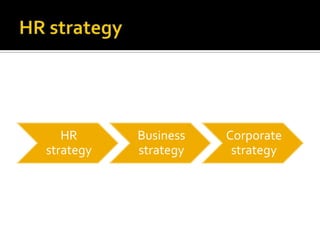
HR strategy
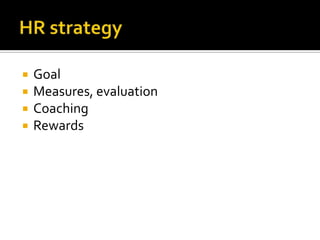
HR strategyGoalMeasures, evaluationCoachingRewards
WorkforceplanningIdentifying the numbers and types of employees the organization will require to meet its objectives.Steen et al. 2009, 13
WorkforceplanningFutureneeds of talentsorcutsHiring, training, reassigningLayoffhandlingHandlingreactions to changes (eg. Closingfacilities, new marketentry)Knowledge of humanbehaviour to handleanger, confusion
GlobalizationMarket entryOffshoring: settingupbusiness abroadCompetitionfromoverseasInternational employeesGlobalassignmentsExpatriates: employeessentabroadCorporate cultureVariablepolicies, rules, legislationLanguage and culturalbarriers
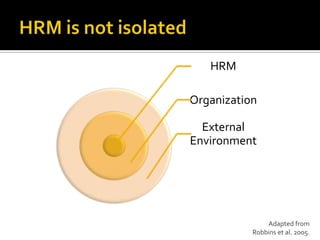
HRM is not isolatedAdapted from Robbins et al. 2005.
Trendsaffecting HRMUnemploymentrateGlobalfinancialconditionGovernmentalregulationsMigrationGenerationalshiftNumber of employeeseligible to retireincreasingSkill and talentshortage in tenyearsValues and attitudes
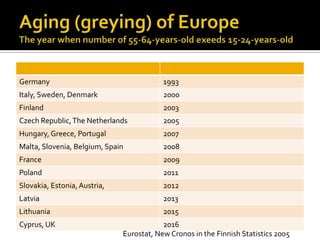
Aging (greying) of EuropeThe yearwhennumber of 55-64-years-old exeeds 15-24-years-oldEurostat, New Cronos in the FinnishStatistics 2005
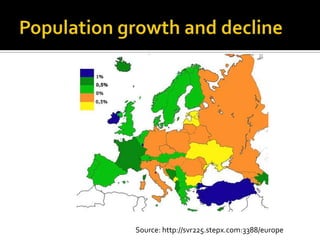
Population growth and declineSource: http://svr225.stepx.com:3388/europe
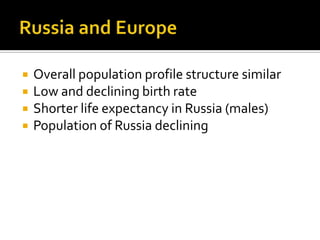
Russia and EuropeOverallpopulationprofilestructuresimilarLow and decliningbirthrateShorter life expectancy in Russia (males)Population of Russiadeclining
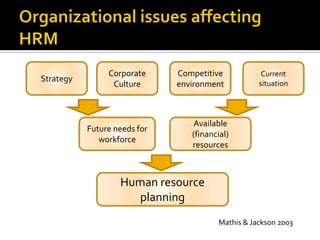
Organizationalissuesaffecting HRMStrategyCurrentsituationCompetitiveenvironmentCorporateCultureFutureneeds for workforceAvailable  (financial) resourcesHuman resourceplanningMathis & Jackson 2003
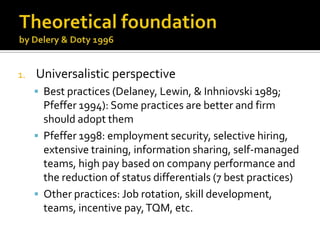
TheoreticalfoundationbyDelery & Doty 1996UniversalisticperspectiveBest practices (Delaney, Lewin, & Inhniovski 1989; Pfeffer 1994): Somepracticesarebetter and firmshouldadoptthemPfeffer 1998: employment security, selective hiring, extensive training, information sharing, self-managed teams, high pay based on company performance and the reduction of status differentials (7 best practices)Otherpractices: Job rotation, skilldevelopment, teams, incentivepay, TQM, etc.
TheoreticalfoundationbyDelery & Doty 19962.	ContingencyperspectiveBest fit (Dyer 1985; Butler, Ferris& Napier 1991): HR policiesmustbeconsistentwithotheraspects of the organization, i.e. strategySomepoliciesconsistentwithdifferentstrategicpositionsStrategicfit and itsrelationwithperformanceOrganizationallifecycle
Example: costleadershipstrategyHR Strategy:Long HR planninghorizonBuildskills in existingemployeeJob and employeespecilizationefficiencyHR ActivitiesPromotefromwithinExtensivetrainingHire and train for specificcapabilitiesMathis & Jackson 2003
Example: DifferentiationstrategyHR StrategyShorter HR planninghorizonHire the HR capabilitiesneededBroader and moreflexiblejobs and employeesHR ActivitiesExternalstaffingLesstrainingHire and train for broadcompetenciesMathis & Jackson 2003
TheoreticalfoundationbyDelery & Doty 1996ConfigurationalperspectiveBundling: (Doty & Glick 1994; Miller & Friesen 1984): planning and deployment of a pattern of HR practives to achieveorganizationalgoalsConfiguration: processes, relationships, boundaries, structure (Huczynski& Buchanan 2007)Coherence of practices and strategicalfactors(Armstrong 2009)
OutcomesInnovationsProductivityOutstandingserviceUniqueproductsUniqueknowledge
GroupworkTwostudentsfromdifferentcountries in a group10 minutespresentationMake sure thatyoudownloadthem to classroomcomputerbefore the lecture!2-pages-written essayabout the keyfindingsEmailattachmentorhand in on class
TopicsJob analysis and job designWorkforceplanning – process, challenges, etc.RecruitmentsourcesSelectingemployees –process, criteria, legalissuesSelectingemployees – tests, interviewsPerformanceappraisals and performancereviewmethodsMotivatingemployeesHealth and safetyissues in attractingemployeesEquality at workplace

Hrm2