Performance and Potential
•Performance is an assessment of an individual's past and present
results in their current role, while Potential is a forward-looking
assessment of their future capacity for growth, development, and
success in more complex roles or leadership positions.
• Organizations use both to manage talent, with performance focusing
on execution and potential on future promise, often visualized in
a performance-potential matrix to guide development and strategic
planning.
2
3.
Key Features ofPotential vs. Performance
• Assessment Metrics: Performance is typically assessed using objective
metrics and achievements, while potential is evaluated through traits,
behaviors, and competencies that indicate the ability to grow.
• Development Focus: Performance management focuses on improving
current job effectiveness, whereas potential management looks at
development activities that prepare an employee for future roles.
• Time Orientation: Performance assessment is retrospective, looking at
past and current achievements. Potential assessment is predictive,
considering future capabilities and contributions.
• Role of Feedback: Continuous feedback is essential for both, but the
focus shifts from improving current job performance to developing skills
and competencies for future roles.
•
3
4.
Performance Appraisal
• PerformanceAppraisal is a process of assessing and evaluating an
employee's job performance systematically and formally.
• The primary purpose of performance appraisal is to provide feedback to
employees about their work performance, identify strengths and weaknesses,
set goals for improvement, and provide a basis for making decisions about
promotions, raises, and other job-related matters.
• Performance appraisal typically involves a structured evaluation of an
employee's performance over a specified period with a focus on specific job-
related competencies, skills, and behaviours.
• The process may involve the use of standardized rating scales, self-
assessments, and feedback from supervisors, peers, and subordinates.
• The results of performance appraisals are used to make decisions about
career development, training, compensation, and other personnel actions.
•
4
5.
Why is HRDimportant?
• Facilitates learning: The very purpose of HRD is to enable employees to
acquire knowledge, learn new concepts and develop their skills. HRD
aims to enhance the quality of the workforce by creating an environment
that fosters constant learning.
• Helps employees with their career development: HRD helps in the
career development of individuals by matching employee characteristics
with job requirements. Organizations can achieve their goals by
facilitating the growth and development of individual employees.
• Improves the overall performance of a business operation: HRD
significantly improves employee performance. Training programmes
enhance the capabilities of employees and improve their productivity over
time and the overall productivity of an organization.
• Facilitates organizational development: HRD aims to facilitate the
development of an organization as a whole. Organizations can introduce
positive changes in work culture, work processes and organizational
structure to develop and grow their business.
5
HRD Functions
•Training andDevelopment The primary role of HRD is to offer
employees training and development opportunities to improve their skills
and knowledge. This aspect includes on-the-job training, workshops,
conferences, and e-learning programs.
•Performance Appraisal HRD is responsible for evaluating the
performance of employees, providing feedback, and identifying the training
needs of employees. This function is crucial in recognizing high performers
and developing strategies for improvement where necessary.
•Career Planning and Development HRD works on designing career
paths for employees, providing them with the necessary tools to improve
and succeed. This includes mentoring, coaching, succession planning, and
more.
•Organization Development One of the key functions of HRD is to
facilitate change and manage the growth and development of the
organization. HRD personnel work in collaboration with top management to
draft strategies that align with the company's goals.
7
8.
• Helps makelong-term changes: The results of HRD may start
manifesting only after it becomes a fully functional process in an
organization. It benefits the employee and the organization for an
extended period of time.
• Makes it easier to implement change: Introducing change in the
organization through HRD can ease apprehension about new policies or
procedures. Employees can better understand the purpose and benefits
of the change, which can help them grow accustomed to the innovations
more smoothly.
• Focuses on employee welfare: An organization attempts to provide
facilities that are vital for the physical and mental well-being of
employees. Companies provide benefits to their employees, like
subsidized meals, medical insurance policies and retirement plans as
part of employee welfare initiatives.
• Inculcates team spirit: HRD creates a conducive environment for
building team spirit and coordinating among various employee groups
and departments. Team spirit is necessary for fostering loyalty among
professionals.
8
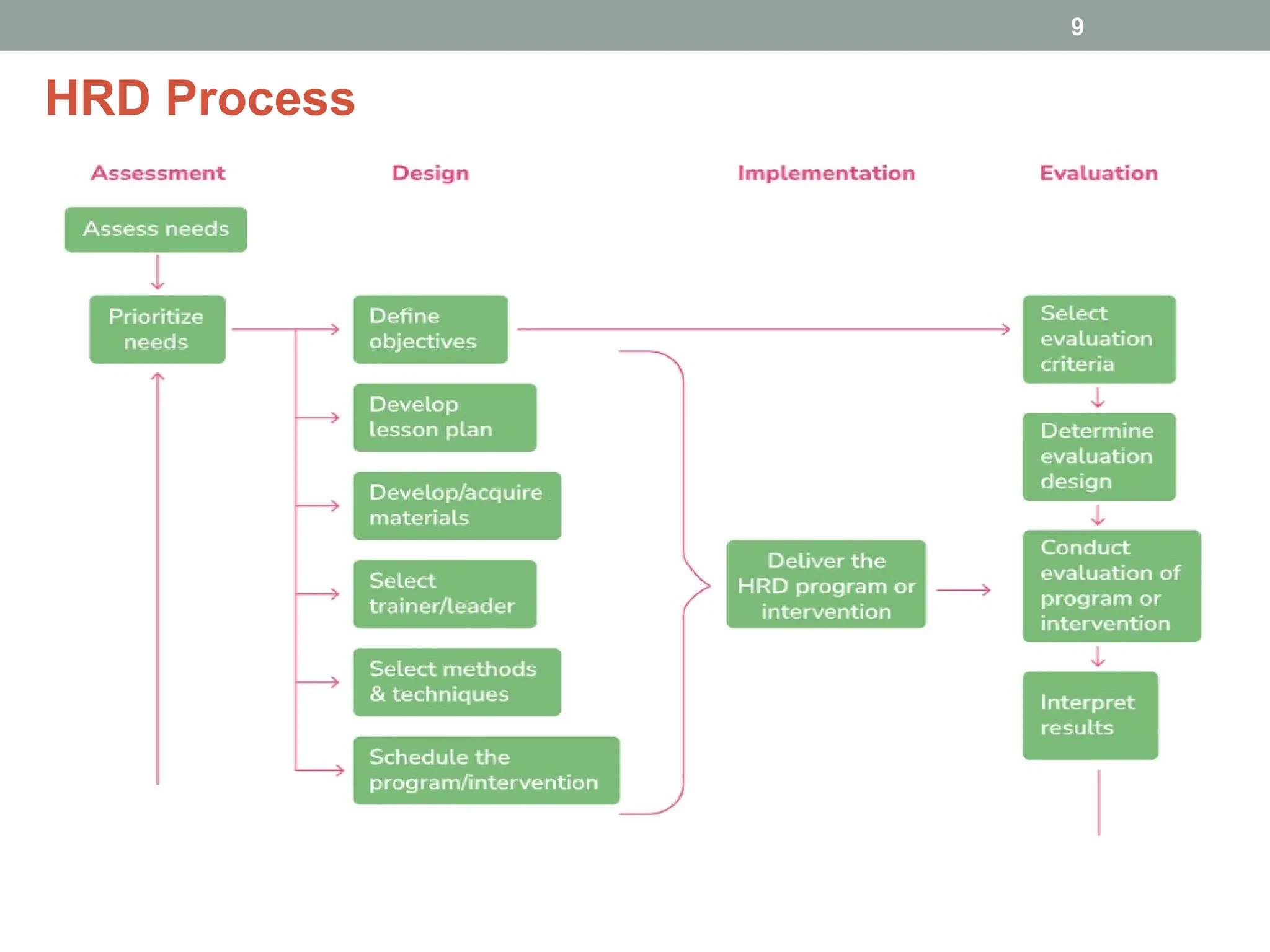
Human Resource Development(HRD) process involves assessing
organizational and employee needs, designing tailored development
programs, implementing these programs through training and other
methods, and then evaluating their effectiveness to drive continuous
improvement and align with organizational goals.
Key components of this cycle include training, career development, and
organizational development, all focused on enhancing employee skills,
knowledge, and overall organizational performance.
10
11.
HRD Process
1) NeedsAssessment
•Identify Needs: The process begins by identifying both current and
future skill and competency gaps within the organization and among its
employees.
•Define Objectives: Based on these needs, specific, measurable
objectives for development programs are established.
2) Design
•Program Development: Develop training materials, select trainers,
and choose appropriate learning methods (e.g., coaching, job rotation).
•Resource Planning: Secure necessary resources and schedule the
programs, considering factors like cost and organizational readiness.
11
12.
3) Implementation
•Delivery: Thedesigned training programs and development initiatives are
delivered to employees.
•Support Systems: This phase also involves putting support mechanisms
in place, such as performance appraisals, feedback, and career planning.
4) Evaluation
•Measure Effectiveness: Evaluate the impact and success of the HRD
programs against the established objectives.
•Feedback and Analysis: Collect feedback, analyze the results, and use
this information to refine future needs assessment and program design.
•This cycle is ongoing, with each phase informing the next to foster a culture
of continuous learning, growth, and improved organizational effectiveness.
12
13.
Planning and organizingan HRD system
Planning and organizing an HRD system involves a continuous
cycle of assessing needs, designing initiatives, implementing
programs, and evaluating effectiveness to ensure the workforce can
meet organizational goals.
•This process requires aligning HR activities with strategic objectives,
forecasting workforce requirements, developing employee skills
through training and development, managing performance, and
fostering engagement to achieve optimal human resource utilization
and organizational success.
13
14.
Key Steps inPlanning & Organizing the HRD System
1) Assessment & Planning
• Analyze Organizational Objectives: Understand the overall
business goals to align HR strategies with them.
• Audit Existing Workforce: Inventory the current skills, knowledge,
and competencies of the existing employees.
• Forecast Future Needs: Predict future workforce requirements by
forecasting labor demand and supply.
• Identify Gaps: Perform a gap analysis to identify skill and
knowledge deficiencies between current and required
competencies.
14
15.
2) Design &Implementation
• Set Clear Objectives: Define specific, measurable goals for HRD
initiatives that support organizational goals.
• Develop HRD Strategies: Create plans and programs for learning
and development, such as training workshops, seminars, and on-
the-job programs, to address identified gaps.
• Strategic Staffing: Develop strategies for recruiting, retaining, and
developing employees to fill key roles.
• Implement Programs: Execute the designed HRD programs,
ensuring appropriate delivery methods and a supportive learning
environment.
15
16.
3) Evaluation &Continuous Improvement
• Monitor Effectiveness: Continuously monitor and evaluate the
impact of HRD programs using feedback, performance
indicators, and other data.
• Provide Feedback & Analysis: Analyze the data collected to
understand what worked well and what can be improved.
• Integrate Performance Management: Link HRD efforts to
performance management systems to measure and improve
employee performance.
• Adapt & Evolve: Periodically review and modify HRD plans to
adapt to changing organizational demands and market
conditions.
16
17.
HRD Outcomes
HRD (HumanResource Development) Outcomes are the results
and impacts of HRD processes, leading to more competent, satisfied,
and committed employees who contribute to organizational
effectiveness, improved productivity, better work culture, and stronger
long-term sustainability through aligned individual and organizational
goals.
Key outcomes include enhanced skills, increased motivation and
morale, fostered teamwork, improved performance, better employee
retention, and stronger leadership pipelines.
17
18.
Outcomes for Individuals
•IncreasedCompetence and Skills: Employees acquire new skills
and knowledge, improving their ability to perform current and future job
requirements.
•Higher Job Satisfaction: A positive HRD climate leads to more
satisfied and motivated employees.
•Career Development: HRD helps employees develop their potential
and advance their careers.
•Greater Commitment: Employees become more committed to their
roles and the organization.
•Improved Attitude and Morale: HRD efforts boost individual attitudes
and overall morale.
18
19.
Outcomes for theOrganization
1) Enhanced Productivity and Performance:
•Improved employee capabilities translate directly to higher
organizational productivity.
2) Organizational Development:
•HRD processes drive positive changes in work culture, processes, and
structure, contributing to overall progress.
3) Better Resource Utilization:
•HRD ensures that human resources are effectively utilized and their
potential is harnessed.
4) Stronger Work Culture:
•Fostering teamwork, collaboration, and positive interpersonal
relationships creates a harmonious work environment.
19
20.
5) Succession Planning
Identifyingand nurturing future leaders ensures continuity and smooth
transitions within the organization.
6) Increased Effectiveness:
•Organizations with well-developed human resources are more effective in
achieving their goals.
7) Alignment of Goals:
•Individual employee goals are better aligned with the overarching performance
and objectives of the organization.
8) Improved Organizational Health:
•A focus on competence, satisfaction, and teamwork leads to better
organizational health and sustainability.
20
21.
Role of LineManagers in HRD
Line managers are crucial in Human Resource Development (HRD)
as they bridge the gap between the HR department and employees,
implementing HR policies and processes, overseeing daily tasks, and
focusing on employee development.
Their key HRD roles include identifying employee training needs,
providing coaching and feedback, managing performance, motivating
staff, ensuring compliance, and fostering a positive team environment
to achieve organizational goals.
21
22.
Key Responsibilities ofLine Managers in HRD
1) Identifying and Fulfilling Training Needs: Line managers assess
the skills and knowledge gaps within their teams and recommend
relevant training and development opportunities to the HR department.
2) Performance Management and Feedback: They set performance
objectives, conduct appraisals, offer regular feedback and coaching,
and identify areas for improvement to enhance employee performance.
3) Employee Development: Line managers act as coaches and
mentors, guiding their team members in developing their skills and
careers, which contributes to overall organizational development.
4) Implementing Policies and Processes: They are responsible for
translating HR policies and procedures into daily practice within their
teams, ensuring compliance and alignment with business objectives.
22
23.
5) Motivation andEngagement: Line managers play a significant role in
fostering employee engagement, motivation, and well-being, which are
essential for productivity and a positive work environment.
6) Goal Setting and Communication: They communicate organizational
goals to their teams, set departmental objectives, and ensure that tasks are
aligned with overall strategy.
7) Resource Management: Line managers manage the resources under
their control, including staff time and finances, to ensure the efficient
achievement of team and departmental goals.
8) Talent Acquisition Support: In some contexts, line managers are
involved in the recruitment process, providing input on hiring decisions and
ensuring the right talent is brought into the organization.
23