2013 Webinar Series

                                               HR Shock and Awe: What
                                              can we learn from some of
                                              HR’s most appalling cases?
                                                       Thursday: February 21, 2013
                                                         Presented By:
                                                    Carrie B. Cherveny, Esq.
                                            Vice President of Employment Practices
                                                           AlphaStaff


800 Corporate Drive, Ste 600 Ft. Lauderdale, FL 33334 | 888.335.9545 Toll-Free | alphastaff.com
This presentation contains explicit
                                              and vulgar language – we have
                                           sanitized the information as must as
                                              possible but in some cases the
                                           language is important to the court’s
                                            analysis and that language may be
                                              alluded to in this presentation.


800 Corporate Drive, Ste 600 Ft. Lauderdale, FL 33334 | 888.335.9545 Toll-Free | alphastaff.com
Title VII of the Civil Rights Act
of 1964
Employment Discrimination Basics
•   Sexual Harassment is a claim of Disparate Treatment (vs. Disparate
    Impact)
     •     Tangible employment action
     •     Hostile environment = disparate treatment
•   Discriminatory treatment - when members of one sex are exposed to
    disadvantageous terms or conditions of employment to which members
    of the other sex are not exposed
•   Plaintiff must show that the employer discriminated against him/her
    because of his/her membership in a protected group
•   Title VII is not a general civility code
•   The Vince Lombardi Rule: “Lombardi treats us all alike, like dogs!” –
•   The plaintiff must prove “that similarly situated persons not of the
    plaintiff’s sex were treated differently and better”


              Simplifying business. Benefiting people.                      4
What must the plaintiff prove in a Title VII
case?
• Employee belongs to a protected class
• Employee has been subject to unwelcome sexual harassment;
  (i.e. sexual advances, requests for sexual favors, other conduct of a sexual
  nature);

• Harassment is based on the sex of the employee;
• Harassment was sufficiently severe OR pervasive to alter the
  terms and conditions of employment (subjectively AND
  objectively) ; and
• There is a basis for holding the employer liable.


               Simplifying business. Benefiting people.
How to Determine a Hostile Working
Environment
• Co-worker harassment: must show that the employer “knew or should
  have known” of the harassing conduct
• Workplace conduct should be considered in context and cumulatively; not in
  isolation
• May prove sexual harassment even if the conduct is not directed at the
  plaintiff

Factors to consider:
• Severity of conduct;
• Frequency of conduct;
• Effect on employee’s work performance;
• Employee is subject to unwelcome conduct or advances; and
• The conduct affects a term or condition of employment.


               Simplifying business. Benefiting people.
The Faragher-Ellerth Affirmative Defense

• Not available when there is a “tangible employment action”
   – Pay decrease
   – Demotion
   – Termination
• Available for hostile working environment claims
• Elements:
   – Employer exercised reasonable care to prevent and promptly correct
     any sexually harassing behavior; and
   – The employee unreasonably failed to take advantage of any
     preventative or corrective opportunities it provided
• Employer’s burden to establish this defense


             Simplifying business. Benefiting people.
Baldwin vs. Blue Cross/Blue Shield of AL
11th Circuit 2007

• Marketing representative for BC/BS
• Workplace filled with profanity
   – General use of profanity vs. gender directed profanity
   – Regular use of profanity including F-word and B-word
   – Head called male employees offensive gender specific names
• Propositioned Baldwin more than once
• Asked Baldwin to spend the night, claimed he went to her
  house
• Asked her to perform sexual acts
• Would come up close behind Baldwin, breathe heavily and
  move the zipper to his pants up and down (at least 3x)


             Simplifying business. Benefiting people.
Baldwin vs. BC/BS cont.

• Upon being hired the following comment was made “Hey,
  Baldwin, look, the only reason you are here is because we
  needed a skirt in the office”
• Suggestion that Baldwin perform oral sex on him, on more than
  one occasion
• The reason he made one particular hiring decision: “I need to
  hire a guy for this job, a Susan Baldwin, somebody who has
  balls like you do”
• Referred to the female employee that he did not promote as a
  “slut” and a “tramp”
• Baldwin complained about a short commission check
   – Head threatened her for doing so


             Simplifying business. Benefiting people.
Baldwin vs. BC/BS cont.

• BC/BS had sexual harassment policy prohibiting Head’s conduct and
  behavior
• The policy contained a complaint procedure
• Baldwin worked for BC/BS reporting to Head for 13 months
   – Baldwin waiting 3 months and 2 weeks to complain from the first
      proposition
   – She complained to HR verbally and submitted a 5 page complaint
• The investigation team focused on Head, Baldwin, and 3 other team
  members including the office manager who was present in the office
  at all times


             Simplifying business. Benefiting people.
BC/BS - Lessons from the Investigation
• No evidence obtained to corroborate any of the allegations
• Baldwin Argues that the investigation was deficient
• Lessons of investigations:
   – The employer is not required to conduct full-blown, due process, trial-
     type proceeding
   – Investigation must be reasonable in all of the circumstances
   – The employer may consider methods that will not unnecessarily disrupt
     the company’s business
   – The court will not second guess investigations – the court is not in the
     business of supervising internal investigations
   – Do not have to credit uncorroborated statements made by the
     complainant
   – There is no special weight given to either side in a he said/she said case


               Simplifying business. Benefiting people.
BC/BS – The Proposed Remedies

Offered Baldwin the following at least 4 different occasions:
    1. Enlist the assistance of an expert to counsel Head and Baldwin and
       monitor their interactions to prevent future problems OR
    2. Transfer Baldwin to the Birmingham office from Huntsville
•   Baldwin (on several occasions) rejected the proposed
    remedies
•   Placed on administrative leave and then terminated
•   Finding: “firing an employee because she will not cooperate
    with the employer’s reasonable efforts to resolve her
    complaints is not discrimination based on sex”


               Simplifying business. Benefiting people.
Was Baldwin subjected to a hostile working
environment?
In a nutshell – No
• Reasoning
   – The profanity was not aimed specifically at females
   – Most of the profanity was were “relatively gender-neutral”
   – Baldwin testified that the language was used indiscriminately to (and
     in front of) both men and women
Is BC/BS Entitled to Faragher Ellerth Defense? - Yes
• Reasoning
   –   It promptly responded when it learned of the compliant
   –   It conducted a reasonable investigation
   –   A written warning was received by Head
   –   The Complainant does not get to choose the remedy
   –   Baldwin waited too long to complain – affirmative and express duty
       of employee to promptly/immediately follow complaint procedure

               Simplifying business. Benefiting people.
Compare Reeves vs. C.H. Robinson
11th Circuit 2010

• Female employee - Reeves worked as a transportation sales
  representative in Birmingham, AL (sales ops for freight shipping)
• Previously a member of the Merchant Marines (consider
  subjective prong of harassment)
• Subjected to daily profanity in the workplace
• Also subjected to a crude morning radio show that featured
  discussions of women’s anatomy
• Employee displayed on his computer a pornographic image of a
  fully naked woman with her legs spread open exposing herself
• Coworkers sang songs about gender derogatory topics


             Simplifying business. Benefiting people.
Reeves vs. C.H. Robinson, cont.

•   Gender derogatory language permeated the workplace:
     – Language to refer to women with whom they dealt inside and outside
       (customers) of the office
     – Gender specific expletives paired with the F-word
     – Used names and phrases that were specifically directed toward women
•   Behavior occurred from summer 2001 through spring 2004
•   Reeves objected frequently to the offenders
•   She also complained at least 5 times to her local manager (as required by
    the company policy) who was also a participant in the conduct
•   Asked the employee to remove the image of the naked woman from his
    computer (he did)
•   Reeves complained about her co-worker’s conduct in at least 2 separate
    work evaluations

                Simplifying business. Benefiting people.
Reeves vs. C.H. Robinson, cont.

• Although it was his responsibility to do so, the local manager
  never reported the complaints to corporate
• Reeves ultimately contacted 2 corporate executives: the
  Director of Branch Operations and the Vice President
• Reeves set up a meeting with these executives during their visit
  to her location
• During the Birmingham visit the executives never met with
  Reeves and never discussed or addressed her complaint
• Reeves resigned on March 24, 2004


             Simplifying business. Benefiting people.
The Lessons From Reeves

• General vulgarity or references to sex that are indiscriminate in
  nature will not generally be actionable
• Title VII does not prohibit profanity alone, however profane
• Title VII prohibits discrimination based on a protected category
• The court will consider the context of the profanity and
  whether it contains a reference to gender
• The court stated that certain vulgar terms are more degrading
  to women
• The F-word alone can be gender neutral vulgarity vs. the F-
  word followed by gender specific profanity such as the B-word
• Use of profanity can be discriminatory

             Simplifying business. Benefiting people.
Reeves Lost
What Went Wrong?
• The 11th Circuit reversed the district court and ordered a
  re-hearing of the entire matter
• Reasoning
   – Defendant failed to respond to Reeves’ complaint thus “adopting”
     the offending conduct just as if it had affirmatively authorized it
   – The offending language was directly specifically at women and
     constituted intentional discrimination
• What if the employer
   – Had responded promptly?
   – Conducted an investigation?
   – Different result?


              Simplifying business. Benefiting people.
The Americans With Disabilities Act
Americans With Disabilities Act
The Basics
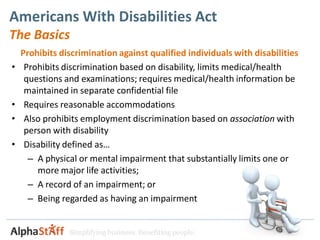
    Prohibits discrimination against qualified individuals with disabilities
•    Prohibits discrimination based on disability, limits medical/health
     questions and examinations; requires medical/health information be
     maintained in separate confidential file
•    Requires reasonable accommodations
•    Also prohibits employment discrimination based on association with
     person with disability
•    Disability defined as…
      – A physical or mental impairment that substantially limits one or
        more major life activities;
      – A record of an impairment; or
      – Being regarded as having an impairment


                Simplifying business. Benefiting people.
ADA - A Reasonable Accommodation
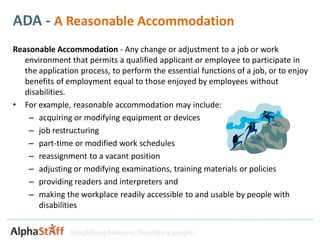
Reasonable Accommodation - Any change or adjustment to a job or work
   environment that permits a qualified applicant or employee to participate in
   the application process, to perform the essential functions of a job, or to enjoy
   benefits of employment equal to those enjoyed by employees without
   disabilities.
• For example, reasonable accommodation may include:
    – acquiring or modifying equipment or devices
    – job restructuring
    – part-time or modified work schedules
    – reassignment to a vacant position
    – adjusting or modifying examinations, training materials or policies
    – providing readers and interpreters and
    – making the workplace readily accessible to and usable by people with
       disabilities


                Simplifying business. Benefiting people.
Covington v. Walgreens,
Southern District Florida, 2012
•   Employees was morbidly obese and required various forms of medical care
    including dialysis
•   Walgreens accommodated and provided employee with 3 afternoons off
    each week to attend dialysis appointments
•   Covington attended more than 200 dialysis appointments and was never
    late
•   Walgreens hired additional personnel to fill in for Covington and sustained
    increased overtime expenses
•   Covington was also provided with weekends off to be with her children
•   For some time, Walgreens allowed significant latitude to Covington with
    respect to time and attendance
•   Covington’s poor attendance had negative impact on the business
•   After going through an audit Walgreens brought in a new District Manager
    to improve the store’s performance

                Simplifying business. Benefiting people.
Covington v. Walgreens, cont.

• As part of the effort to improve the store’s performance, the
  new District Manager informed Covington that she must work
  as scheduled
• After several additional time and attendance violations,
  Covington was disciplined
• On the same day of the discipline Covington went directly to
  the EEOC office and filed her charge of discrimination
• She eventually received a Right to Sue and filed suit in the
  Southern District Court of Florida
• After several years of litigation and significant expense,
  Walgreens won at Summary Judgment


             Simplifying business. Benefiting people.
What are the lessons from Covington?
• Employers should consistently and uniformly enforce their
  policies
• Allowing an employee latitude and variances over a prolonged
  period of time can create an expectation by an employee
• The decision to enforce the rules afterward may make an
  employee feel like something is being taken away
• Walgreens went above and beyond its legal requirements under
  the ADA and the judge agreed
• Always document all employee activities – especially requests
  for and responses to accommodations
• Obtain complete medical information to support requests for
  accommodation

            Simplifying business. Benefiting people.
The Family and Medical Leave Act
The Family & Medical Leave Act
The Basics
• To be eligible for FMLA benefits, an
  employee must:
   – work for a covered employer (BAMS is a
     covered employer)
• Have worked for their employer for a total
  of 12 months
• Have worked at least 1,250 hours over the
  previous 12 months


             Simplifying business. Benefiting people.
FMLA
Categories
  Employees may take FMLA for the following reasons:
• For a qualifying exigency;
• To provide care to a qualified family member or veteran
  injured in the line of duty (servicemember leave);
• For their own Serious Health Condition;
• To provide care to an immediate family member with a
  serious health condition; or
• For the birth, placement, or adoption of a child.


           Simplifying business. Benefiting people.
Serious Health Condition
Definitions
  A Serious Health Condition (SHC) is an illness, injury,
  impairment, or physical or mental condition that
  involves
  Either
  (1) Inpatient Care
  Or
  (2) Continuing Treatment
  (a) Incapacity & Treatment
  (b) Pregnancy/prenatal Care
  (c) Chronic Conditions


             Simplifying business. Benefiting people.
Iwanejko vs. Cohen & Grigsby
Third Circuit, 2007

• Iwanejko was an associate attorney at defendant law firm
• When arrived at work on the day in question he thought it was
  Sunday (it was Monday) meaning he had one less day to
  complete a project
• He had an acute psychotic episode and began shouting and
  using profanity
• Another attorney told Iwanejko to stop shouting
• Iwanejko pushed the attorney aside, and began shouting and
  ranting again
• Iwanejko left the office to go to the parking garage – the other
  attorney followed him

             Simplifying business. Benefiting people.
Iwanejko vs. Cohen & Grigsby
• Iwanejko took the elevator to the top floor of the garage
• When we got off the elevator he began shouting a women in
  the garage, threw a bottle of contact lens solution at her, and
  assaulted her.
• The attorney that followed Iwanejko pulled Iwanejko away
  from the woman and Iwanejko was screaming incoherently
• The attroney escorted Iwanejko to the a lower level of the
  garage
• Iwanejko continued to rant and laid down in front of oncoming
  vehicles
• Iwanejko was aprehended by the police and handcuffed
• He banged his head against the wall and then against the
  window in the police car


             Simplifying business. Benefiting people.
Iwanejko
The Medical Information
• Diagnosed with an acute psychotic episode
• The Firm provided Iwanejko time off under the FMLA
• Retained a licensed health care provider to advise the firm
  regarding Iwanejko’s ability to return to work
• Entered into an agreement to return to work with certain
  limitations including limited working hours
• Iwanejko violated the work hours limitation in the agreement
  87 times
• Terminated for failure to abide by the agreement
• Sued a number of parties including the firm for violation of the
  FMLA

             Simplifying business. Benefiting people.
Iwanejko’s Claims Under the FMLA

• Iwanejko claims that he honored the agreement
• Court disagreed given the nature and severity of the
  psychotic episode and the plan to gradually resume
  Iwanejko’s workload
• They reasoned that there were safety concerns for co-
  workers, tenants, and visitors
   – The law firm followed the guidance of the licensed health
     care provider
   – Found that the limitations were reasonable and rational


            Simplifying business. Benefiting people.
Iwanejko’s Claims Under the ADA

• Claims that the firm “regarded him” as disabled and refused to
  accommodate his disability
• The accommodation he sought was to remove the work-hours
  limitations
• The court had already stated that the limitations were
  reasonable and rational
• Found that he was terminated for a legitimate business reason
  – violating the work-hours limitation in the agreement


             Simplifying business. Benefiting people.
Questions?


             34
Contact Us !
• .


                            Copies of the presentation
                            hrsc@alphstaff.com
                            888-335-9545 (Option 8)


      Simplifying business. Benefiting people.
Upcoming AlphaStaff Webinar

     Please mark your calendars !!!

     Date: Thursday, March 7, 2013
   Topic: CA AB 1825 Discrimination &
   Harassment Training for Managers

      Date: Thursday, March 21, 2013
Topic: Recruiting and Hiring: Best Practices
in Finding Strong Candidates and Selecting
                Who to Hire


                                               36
Thank you for joining us !!!


                               37

Title VII: Stories of Shock and Awe

  • 1.
    2013 Webinar Series HR Shock and Awe: What can we learn from some of HR’s most appalling cases? Thursday: February 21, 2013 Presented By: Carrie B. Cherveny, Esq. Vice President of Employment Practices AlphaStaff 800 Corporate Drive, Ste 600 Ft. Lauderdale, FL 33334 | 888.335.9545 Toll-Free | alphastaff.com
  • 2.
    This presentation containsexplicit and vulgar language – we have sanitized the information as must as possible but in some cases the language is important to the court’s analysis and that language may be alluded to in this presentation. 800 Corporate Drive, Ste 600 Ft. Lauderdale, FL 33334 | 888.335.9545 Toll-Free | alphastaff.com
  • 3.
    Title VII ofthe Civil Rights Act of 1964
  • 4.
    Employment Discrimination Basics • Sexual Harassment is a claim of Disparate Treatment (vs. Disparate Impact) • Tangible employment action • Hostile environment = disparate treatment • Discriminatory treatment - when members of one sex are exposed to disadvantageous terms or conditions of employment to which members of the other sex are not exposed • Plaintiff must show that the employer discriminated against him/her because of his/her membership in a protected group • Title VII is not a general civility code • The Vince Lombardi Rule: “Lombardi treats us all alike, like dogs!” – • The plaintiff must prove “that similarly situated persons not of the plaintiff’s sex were treated differently and better” Simplifying business. Benefiting people. 4
  • 5.
    What must theplaintiff prove in a Title VII case? • Employee belongs to a protected class • Employee has been subject to unwelcome sexual harassment; (i.e. sexual advances, requests for sexual favors, other conduct of a sexual nature); • Harassment is based on the sex of the employee; • Harassment was sufficiently severe OR pervasive to alter the terms and conditions of employment (subjectively AND objectively) ; and • There is a basis for holding the employer liable. Simplifying business. Benefiting people.
  • 6.
    How to Determinea Hostile Working Environment • Co-worker harassment: must show that the employer “knew or should have known” of the harassing conduct • Workplace conduct should be considered in context and cumulatively; not in isolation • May prove sexual harassment even if the conduct is not directed at the plaintiff Factors to consider: • Severity of conduct; • Frequency of conduct; • Effect on employee’s work performance; • Employee is subject to unwelcome conduct or advances; and • The conduct affects a term or condition of employment. Simplifying business. Benefiting people.
  • 7.
    The Faragher-Ellerth AffirmativeDefense • Not available when there is a “tangible employment action” – Pay decrease – Demotion – Termination • Available for hostile working environment claims • Elements: – Employer exercised reasonable care to prevent and promptly correct any sexually harassing behavior; and – The employee unreasonably failed to take advantage of any preventative or corrective opportunities it provided • Employer’s burden to establish this defense Simplifying business. Benefiting people.
  • 8.
    Baldwin vs. BlueCross/Blue Shield of AL 11th Circuit 2007 • Marketing representative for BC/BS • Workplace filled with profanity – General use of profanity vs. gender directed profanity – Regular use of profanity including F-word and B-word – Head called male employees offensive gender specific names • Propositioned Baldwin more than once • Asked Baldwin to spend the night, claimed he went to her house • Asked her to perform sexual acts • Would come up close behind Baldwin, breathe heavily and move the zipper to his pants up and down (at least 3x) Simplifying business. Benefiting people.
  • 9.
    Baldwin vs. BC/BScont. • Upon being hired the following comment was made “Hey, Baldwin, look, the only reason you are here is because we needed a skirt in the office” • Suggestion that Baldwin perform oral sex on him, on more than one occasion • The reason he made one particular hiring decision: “I need to hire a guy for this job, a Susan Baldwin, somebody who has balls like you do” • Referred to the female employee that he did not promote as a “slut” and a “tramp” • Baldwin complained about a short commission check – Head threatened her for doing so Simplifying business. Benefiting people.
  • 10.
    Baldwin vs. BC/BScont. • BC/BS had sexual harassment policy prohibiting Head’s conduct and behavior • The policy contained a complaint procedure • Baldwin worked for BC/BS reporting to Head for 13 months – Baldwin waiting 3 months and 2 weeks to complain from the first proposition – She complained to HR verbally and submitted a 5 page complaint • The investigation team focused on Head, Baldwin, and 3 other team members including the office manager who was present in the office at all times Simplifying business. Benefiting people.
  • 11.
    BC/BS - Lessonsfrom the Investigation • No evidence obtained to corroborate any of the allegations • Baldwin Argues that the investigation was deficient • Lessons of investigations: – The employer is not required to conduct full-blown, due process, trial- type proceeding – Investigation must be reasonable in all of the circumstances – The employer may consider methods that will not unnecessarily disrupt the company’s business – The court will not second guess investigations – the court is not in the business of supervising internal investigations – Do not have to credit uncorroborated statements made by the complainant – There is no special weight given to either side in a he said/she said case Simplifying business. Benefiting people.
  • 12.
    BC/BS – TheProposed Remedies Offered Baldwin the following at least 4 different occasions: 1. Enlist the assistance of an expert to counsel Head and Baldwin and monitor their interactions to prevent future problems OR 2. Transfer Baldwin to the Birmingham office from Huntsville • Baldwin (on several occasions) rejected the proposed remedies • Placed on administrative leave and then terminated • Finding: “firing an employee because she will not cooperate with the employer’s reasonable efforts to resolve her complaints is not discrimination based on sex” Simplifying business. Benefiting people.
  • 13.
    Was Baldwin subjectedto a hostile working environment? In a nutshell – No • Reasoning – The profanity was not aimed specifically at females – Most of the profanity was were “relatively gender-neutral” – Baldwin testified that the language was used indiscriminately to (and in front of) both men and women Is BC/BS Entitled to Faragher Ellerth Defense? - Yes • Reasoning – It promptly responded when it learned of the compliant – It conducted a reasonable investigation – A written warning was received by Head – The Complainant does not get to choose the remedy – Baldwin waited too long to complain – affirmative and express duty of employee to promptly/immediately follow complaint procedure Simplifying business. Benefiting people.
  • 14.
    Compare Reeves vs.C.H. Robinson 11th Circuit 2010 • Female employee - Reeves worked as a transportation sales representative in Birmingham, AL (sales ops for freight shipping) • Previously a member of the Merchant Marines (consider subjective prong of harassment) • Subjected to daily profanity in the workplace • Also subjected to a crude morning radio show that featured discussions of women’s anatomy • Employee displayed on his computer a pornographic image of a fully naked woman with her legs spread open exposing herself • Coworkers sang songs about gender derogatory topics Simplifying business. Benefiting people.
  • 15.
    Reeves vs. C.H.Robinson, cont. • Gender derogatory language permeated the workplace: – Language to refer to women with whom they dealt inside and outside (customers) of the office – Gender specific expletives paired with the F-word – Used names and phrases that were specifically directed toward women • Behavior occurred from summer 2001 through spring 2004 • Reeves objected frequently to the offenders • She also complained at least 5 times to her local manager (as required by the company policy) who was also a participant in the conduct • Asked the employee to remove the image of the naked woman from his computer (he did) • Reeves complained about her co-worker’s conduct in at least 2 separate work evaluations Simplifying business. Benefiting people.
  • 16.
    Reeves vs. C.H.Robinson, cont. • Although it was his responsibility to do so, the local manager never reported the complaints to corporate • Reeves ultimately contacted 2 corporate executives: the Director of Branch Operations and the Vice President • Reeves set up a meeting with these executives during their visit to her location • During the Birmingham visit the executives never met with Reeves and never discussed or addressed her complaint • Reeves resigned on March 24, 2004 Simplifying business. Benefiting people.
  • 17.
    The Lessons FromReeves • General vulgarity or references to sex that are indiscriminate in nature will not generally be actionable • Title VII does not prohibit profanity alone, however profane • Title VII prohibits discrimination based on a protected category • The court will consider the context of the profanity and whether it contains a reference to gender • The court stated that certain vulgar terms are more degrading to women • The F-word alone can be gender neutral vulgarity vs. the F- word followed by gender specific profanity such as the B-word • Use of profanity can be discriminatory Simplifying business. Benefiting people.
  • 18.
    Reeves Lost What WentWrong? • The 11th Circuit reversed the district court and ordered a re-hearing of the entire matter • Reasoning – Defendant failed to respond to Reeves’ complaint thus “adopting” the offending conduct just as if it had affirmatively authorized it – The offending language was directly specifically at women and constituted intentional discrimination • What if the employer – Had responded promptly? – Conducted an investigation? – Different result? Simplifying business. Benefiting people.
  • 19.
    The Americans WithDisabilities Act
  • 20.
    Americans With DisabilitiesAct The Basics Prohibits discrimination against qualified individuals with disabilities • Prohibits discrimination based on disability, limits medical/health questions and examinations; requires medical/health information be maintained in separate confidential file • Requires reasonable accommodations • Also prohibits employment discrimination based on association with person with disability • Disability defined as… – A physical or mental impairment that substantially limits one or more major life activities; – A record of an impairment; or – Being regarded as having an impairment Simplifying business. Benefiting people.
  • 21.
    ADA - AReasonable Accommodation Reasonable Accommodation - Any change or adjustment to a job or work environment that permits a qualified applicant or employee to participate in the application process, to perform the essential functions of a job, or to enjoy benefits of employment equal to those enjoyed by employees without disabilities. • For example, reasonable accommodation may include: – acquiring or modifying equipment or devices – job restructuring – part-time or modified work schedules – reassignment to a vacant position – adjusting or modifying examinations, training materials or policies – providing readers and interpreters and – making the workplace readily accessible to and usable by people with disabilities Simplifying business. Benefiting people.
  • 22.
    Covington v. Walgreens, SouthernDistrict Florida, 2012 • Employees was morbidly obese and required various forms of medical care including dialysis • Walgreens accommodated and provided employee with 3 afternoons off each week to attend dialysis appointments • Covington attended more than 200 dialysis appointments and was never late • Walgreens hired additional personnel to fill in for Covington and sustained increased overtime expenses • Covington was also provided with weekends off to be with her children • For some time, Walgreens allowed significant latitude to Covington with respect to time and attendance • Covington’s poor attendance had negative impact on the business • After going through an audit Walgreens brought in a new District Manager to improve the store’s performance Simplifying business. Benefiting people.
  • 23.
    Covington v. Walgreens,cont. • As part of the effort to improve the store’s performance, the new District Manager informed Covington that she must work as scheduled • After several additional time and attendance violations, Covington was disciplined • On the same day of the discipline Covington went directly to the EEOC office and filed her charge of discrimination • She eventually received a Right to Sue and filed suit in the Southern District Court of Florida • After several years of litigation and significant expense, Walgreens won at Summary Judgment Simplifying business. Benefiting people.
  • 24.
    What are thelessons from Covington? • Employers should consistently and uniformly enforce their policies • Allowing an employee latitude and variances over a prolonged period of time can create an expectation by an employee • The decision to enforce the rules afterward may make an employee feel like something is being taken away • Walgreens went above and beyond its legal requirements under the ADA and the judge agreed • Always document all employee activities – especially requests for and responses to accommodations • Obtain complete medical information to support requests for accommodation Simplifying business. Benefiting people.
  • 25.
    The Family andMedical Leave Act
  • 26.
    The Family &Medical Leave Act The Basics • To be eligible for FMLA benefits, an employee must: – work for a covered employer (BAMS is a covered employer) • Have worked for their employer for a total of 12 months • Have worked at least 1,250 hours over the previous 12 months Simplifying business. Benefiting people.
  • 27.
    FMLA Categories Employeesmay take FMLA for the following reasons: • For a qualifying exigency; • To provide care to a qualified family member or veteran injured in the line of duty (servicemember leave); • For their own Serious Health Condition; • To provide care to an immediate family member with a serious health condition; or • For the birth, placement, or adoption of a child. Simplifying business. Benefiting people.
  • 28.
    Serious Health Condition Definitions A Serious Health Condition (SHC) is an illness, injury, impairment, or physical or mental condition that involves Either (1) Inpatient Care Or (2) Continuing Treatment (a) Incapacity & Treatment (b) Pregnancy/prenatal Care (c) Chronic Conditions Simplifying business. Benefiting people.
  • 29.
    Iwanejko vs. Cohen& Grigsby Third Circuit, 2007 • Iwanejko was an associate attorney at defendant law firm • When arrived at work on the day in question he thought it was Sunday (it was Monday) meaning he had one less day to complete a project • He had an acute psychotic episode and began shouting and using profanity • Another attorney told Iwanejko to stop shouting • Iwanejko pushed the attorney aside, and began shouting and ranting again • Iwanejko left the office to go to the parking garage – the other attorney followed him Simplifying business. Benefiting people.
  • 30.
    Iwanejko vs. Cohen& Grigsby • Iwanejko took the elevator to the top floor of the garage • When we got off the elevator he began shouting a women in the garage, threw a bottle of contact lens solution at her, and assaulted her. • The attorney that followed Iwanejko pulled Iwanejko away from the woman and Iwanejko was screaming incoherently • The attroney escorted Iwanejko to the a lower level of the garage • Iwanejko continued to rant and laid down in front of oncoming vehicles • Iwanejko was aprehended by the police and handcuffed • He banged his head against the wall and then against the window in the police car Simplifying business. Benefiting people.
  • 31.
    Iwanejko The Medical Information •Diagnosed with an acute psychotic episode • The Firm provided Iwanejko time off under the FMLA • Retained a licensed health care provider to advise the firm regarding Iwanejko’s ability to return to work • Entered into an agreement to return to work with certain limitations including limited working hours • Iwanejko violated the work hours limitation in the agreement 87 times • Terminated for failure to abide by the agreement • Sued a number of parties including the firm for violation of the FMLA Simplifying business. Benefiting people.
  • 32.
    Iwanejko’s Claims Underthe FMLA • Iwanejko claims that he honored the agreement • Court disagreed given the nature and severity of the psychotic episode and the plan to gradually resume Iwanejko’s workload • They reasoned that there were safety concerns for co- workers, tenants, and visitors – The law firm followed the guidance of the licensed health care provider – Found that the limitations were reasonable and rational Simplifying business. Benefiting people.
  • 33.
    Iwanejko’s Claims Underthe ADA • Claims that the firm “regarded him” as disabled and refused to accommodate his disability • The accommodation he sought was to remove the work-hours limitations • The court had already stated that the limitations were reasonable and rational • Found that he was terminated for a legitimate business reason – violating the work-hours limitation in the agreement Simplifying business. Benefiting people.
  • 34.
  • 35.
    Contact Us ! •. Copies of the presentation hrsc@alphstaff.com 888-335-9545 (Option 8) Simplifying business. Benefiting people.
  • 36.
    Upcoming AlphaStaff Webinar Please mark your calendars !!! Date: Thursday, March 7, 2013 Topic: CA AB 1825 Discrimination & Harassment Training for Managers Date: Thursday, March 21, 2013 Topic: Recruiting and Hiring: Best Practices in Finding Strong Candidates and Selecting Who to Hire 36
  • 37.
    Thank you forjoining us !!! 37