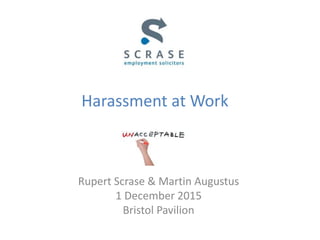
Harassment at Work
Rupert Scrase & Martin Augustus
1 December 2015
Bristol Pavilion
Seminar outline
• Introduction
– Rupert Scrase
• The Legal Definition of Harassment
– Rupert Scrase
• Practical Steps for Employers
– Martin Augustus
Scrase Employment Solicitors
Training from experience
– in house training programmes
Practical, straightforward advice
– Fixed rate for projects, e.g checking contracts or
updating handbooks
– Hourly rate, or
– Employment Law Advice Agreement (ELAA)
ELAA
A fixed annual fee covers you for:
• Employment law advice on the phone, email
or in person
• Preparation and representation in the
Employment Tribunal
• Drafting settlement agreements
• Checking of employment related
documentation
The Legal Definition
Rupert Scrase
Introduction
• Meeting the differing needs of employees is a
careful balancing act ... In dealing with
employment issues, you need to be fair to the
individual concerned, keep your other
employees happy and comply with the law –
while at the same time making sure your
business can prosper.
– Equality and Human Rights Commission
Legal definition
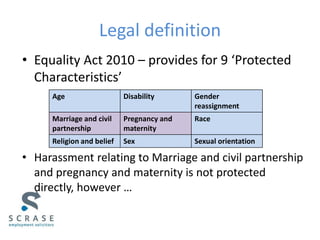
• Equality Act 2010 – provides for 9 ‘Protected
Characteristics’
• Harassment relating to Marriage and civil partnership
and pregnancy and maternity is not protected
directly, however …
Age Disability Gender
reassignment
Marriage and civil
partnership
Pregnancy and
maternity
Race
Religion and belief Sex Sexual orientation
Legal definition
• Harassment related to pregnancy and
maternity would be likely to amount to direct
discrimination related to sex
• Harassment related to civil partnership would
be likely to amount to direct discrimination
related to sexual orientation
Legal definitions
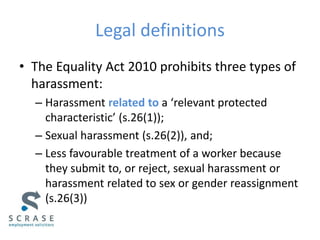
• The Equality Act 2010 prohibits three types of
harassment:
– Harassment related to a ‘relevant protected
characteristic’ (s.26(1));
– Sexual harassment (s.26(2)), and;
– Less favourable treatment of a worker because
they submit to, or reject, sexual harassment or
harassment related to sex or gender reassignment
(s.26(3))
Legal definition
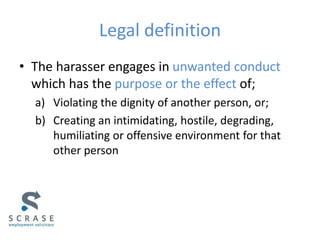
• The harasser engages in unwanted conduct
which has the purpose or the effect of;
a) Violating the dignity of another person, or;
b) Creating an intimidating, hostile, degrading,
humiliating or offensive environment for that
other person
Unwanted conduct
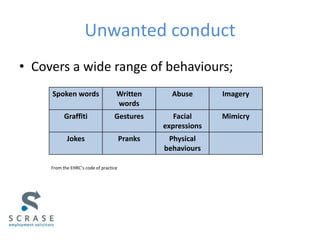
• Covers a wide range of behaviours;
From the EHRC’s code of practice
Spoken words Written
words
Abuse Imagery
Graffiti Gestures Facial
expressions
Mimicry
Jokes Pranks Physical
behaviours
Unwanted conduct
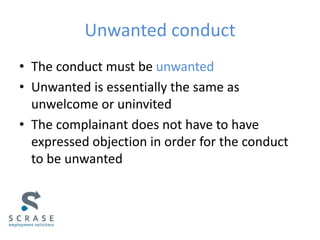
• The conduct must be unwanted
• Unwanted is essentially the same as
unwelcome or uninvited
• The complainant does not have to have
expressed objection in order for the conduct
to be unwanted
Unwanted conduct
• The conduct does not have to be directed at
the complainant
– Viewing pornography on workplace computers
even if not visible to the complainant could
amount to harassment
• The conduct does not have to be on-going, a
single event is enough to constitute
harassment
Purpose or effect
• The perpetrator's intentions or motives are
not relevant, even if entirely innocent
• The effect is considered from the
complainant’s point of view
• It does not normally matter whether the
complainant is particularly sensitive to the
treatment in question
Purpose or effect
• The employer need not know or approve of
the behaviour in order to be liable
• Only defence is the ‘reasonable steps’ defence
which is discussed later
Purpose or effect
• The following must be taken into account in
determining whether conduct had that effect
– The perception of the worker
– Other circumstances that may be relevant;
cultural norms, the environment, mental health,
mental capacity
– The conduct shall only be regarded as having that
effect if in all of the circumstances, including the
particular perception of the complainant, it should
reasonably be considered as having that effect
On or related to prohibited
grounds
• No requirement for the complainant to put
forward a comparator
• ‘related to’ has a broad meaning
– Related to the worker’s own protected
characteristic, or;
– Where the worker has a connection with someone
with that protected characteristic
Perception
• The definition is broad enough to allow a
worker to claim harassment where they are
harassed relating to a protected characteristic
which they do not possess
– Could be mistaken – A Sikh worker is exposed to
Islamophobic comments on the mistaken belief
that he is Muslim
– Or deliberate – a straight man is taunted for being
gay, even though the perpetrator knows that he is
heterosexual
Third party harassment
• The Equality Act originally contained specific
provisions dealing with harassment by a third
party (perhaps a customer, member of the
public or supplier)
• These provisions were seen as being
unworkable and were repealed in 2013.
Third party harassment
• However, even thought the specific provisions
in the Equality Act were repealed, an
employer’s reaction (or lack of reaction) to
harassment of an employee by a third party
may still amount to harassment or
discrimination
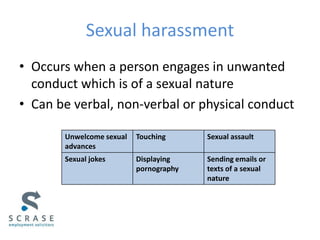
Sexual harassment
• Occurs when a person engages in unwanted
conduct which is of a sexual nature
• Can be verbal, non-verbal or physical conduct
Unwelcome sexual
advances
Touching Sexual assault
Sexual jokes Displaying
pornography
Sending emails or
texts of a sexual
nature
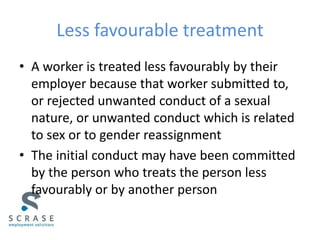
Less favourable treatment
• A worker is treated less favourably by their
employer because that worker submitted to,
or rejected unwanted conduct of a sexual
nature, or unwanted conduct which is related
to sex or to gender reassignment
• The initial conduct may have been committed
by the person who treats the person less
favourably or by another person
Practical Steps for Employers
Martin Augustus
Reasonable steps
• An employer can defend a claim that it is
liable for acts of harassment, committed by its
employees if it can show that;
– It took all reasonable steps to prevent the
employee from
• Doing that thing;
• Doing anything of that description
Reasonable steps
• What the employer did before the event is
relevant to the defence, not what it did
subsequently
• The employer cannot rely on the defence if it
did not take steps that are reasonable, even if
the steps in question would not have made a
difference to the case in hand
Practical steps
• Does your employer have in place a written
equality policy?
• The policy might be referred to by other titles
such as a diversity policy or dignity at work policy
• Does the employer have a policy and procedure
for dealing with harassment?
• The harassment policy should be separate from
the employer’s disciplinary and grievance
policies
Practical steps
• Employers can be liable for acts of harassment
carried out by their employees
– Even if the employer does not know about the act
or condone it
• Employees can themselves be held liable for
actions of harassment which they perpetrate
• Training is a key element of a reasonable steps
defence
Practical steps
• Equality Action Plan
– Policies and procedures are not enough
– Employers need to show that they have put
policies and procedures into action
– and, done all that they can to ensure that
employees are not subjected to harassment
Practical steps
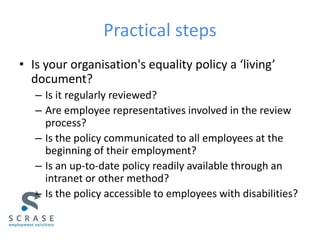
• Is your organisation's equality policy a ‘living’
document?
– Is it regularly reviewed?
– Are employee representatives involved in the review
process?
– Is the policy communicated to all employees at the
beginning of their employment?
– Is an up-to-date policy readily available through an
intranet or other method?
– Is the policy accessible to employees with disabilities?
Practical steps
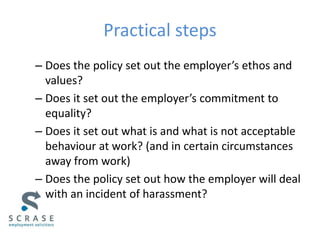
– Does the policy set out the employer’s ethos and
values?
– Does it set out the employer’s commitment to
equality?
– Does it set out what is and what is not acceptable
behaviour at work? (and in certain circumstances
away from work)
– Does the policy set out how the employer will deal
with an incident of harassment?
Practical steps
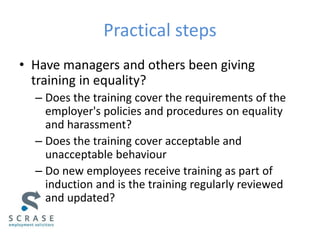
• Have managers and others been giving
training in equality?
– Does the training cover the requirements of the
employer's policies and procedures on equality
and harassment?
– Does the training cover acceptable and
unacceptable behaviour
– Do new employees receive training as part of
induction and is the training regularly reviewed
and updated?
Reasonable steps
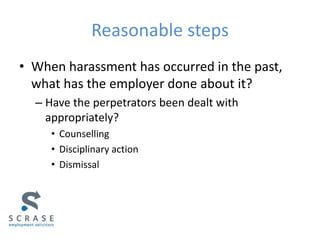
• When harassment has occurred in the past,
what has the employer done about it?
– Have the perpetrators been dealt with
appropriately?
• Counselling
• Disciplinary action
• Dismissal
Reasonable steps
• Does the employer carry out monitoring?
– Does the employer use monitoring results to see if
any practices need to be changed?
– Are you aware of background statistics for your
area?
• What percentage of the population of Bristol describe
themselves as Black or minority ethnic?
• What percentage of the population of the UK describe
themselves as gay, lesbian or bisexual?
Case Studies
Case Study 1
• Mr Heafield, a Catholic, was a sub-editor on
the Times newspaper
• A news stories in development relating to the
Pope in the context of allegations of
paedophilia in the Catholic Church was given
the working title “the Pope”
Case Study 1
• When a senior editor realised that the news
story was not yet ready he shouted across the
newsroom “Can anybody tell me what's
happening to the ******* Pope?”
• Mr Heafield objected stating that he found the
comment to be “offensive, unnecessary and
blasphemous”
– Heafield v Times newspaper [2012] ET
Case Study 2
• Miss Karmazyn and three others were
waitresses, they were all immigrants from
Eastern Europe with between two and five
years services
• They claim that they were subjected to
harassment by the Restaurant owner
throughout their employment
• Required to wear short skirts, references to
their sex lives etc
Case Study 2
• A female assistant manager, who had acted as
a “buffer” between the claimants and the
owner left work due to illness
• The claimants accepted that sometimes they
had engaged the owner in conversation about
his own sex life as this made him easier to
handle
• Each brought claims of harassment
– Munchkins Restaurant v Karmazyn & ors [2009] EAT
Case Study 3
• Mr English claimed that he had been
subjected to homophobic banter, in particular,
calling him “faggot”
• This was because;
– He had attended boarding school, and
– He had lived in Brighton
• His colleagues knew that he was not gay
– English v Thomas Sanderson Ltd [2008] EWCA
Case Study 4
• Miss Southern was a waitress in a hotel
• She claimed that she had been harassed by
her manager over a period of 8 months
• She was on a zero hours contract and had a
history of mental illness
• She claims that she was touched, kissed and
subjected to inappropriate remarks
Case Study 4
• She complained to another line manager and
was told to put the complaint into writing but
nothing further happened
• An investigation carried out later when further
harassment was alleged was cursory
– Southern v Britannia Hotels [2015] ET
Equality Awareness Training
• Equality awareness training is essential for
anyone in a supervisory or managerial role
• As well as reducing the legal risk, equality
awareness training can help employee feel
that they are treated with dignity and respect
at work
SES Equality Awareness Training
• We can provide in-house training for your
organisation which includes:
– The law on equality and discrimination
– Equality in practice
– Understanding harassment and bullying
– Employer’s and employee’s responsibilities
– Case studies
• This should assist you in running a ‘reasonable
steps’ defence
SES Equality Awareness Training
• Up to 30 delegates
• All delegates are issued with a certificate of
attendance
• Our usual fee for a half day training session is
£825 plus VAT (plus mileage)
• Until the end of February 2016, for today’s
attendees we will charge a fee of just £725
plus VAT (plus mileage)
Whilst every effort has been made to ensure the
accuracy of this presentation, the information
contained within it is not comprehensive and
does not constitute ‘advice’. You should not
take action without first seeking professional
advice.
Scrase Law Limited t/a Scrase Employment
Solicitors.
Our next event
Employment Law Update – 28 January 2016
Thank you
www.scraselaw.com
twitter.com/scraselaw

Harassment at work - 1 December 2015

  • 1.
    Harassment at Work RupertScrase & Martin Augustus 1 December 2015 Bristol Pavilion
  • 2.
    Seminar outline • Introduction –Rupert Scrase • The Legal Definition of Harassment – Rupert Scrase • Practical Steps for Employers – Martin Augustus
  • 3.
    Scrase Employment Solicitors Trainingfrom experience – in house training programmes Practical, straightforward advice – Fixed rate for projects, e.g checking contracts or updating handbooks – Hourly rate, or – Employment Law Advice Agreement (ELAA)
  • 4.
    ELAA A fixed annualfee covers you for: • Employment law advice on the phone, email or in person • Preparation and representation in the Employment Tribunal • Drafting settlement agreements • Checking of employment related documentation
  • 5.
  • 6.
    Introduction • Meeting thediffering needs of employees is a careful balancing act ... In dealing with employment issues, you need to be fair to the individual concerned, keep your other employees happy and comply with the law – while at the same time making sure your business can prosper. – Equality and Human Rights Commission
  • 7.
    Legal definition • EqualityAct 2010 – provides for 9 ‘Protected Characteristics’ • Harassment relating to Marriage and civil partnership and pregnancy and maternity is not protected directly, however … Age Disability Gender reassignment Marriage and civil partnership Pregnancy and maternity Race Religion and belief Sex Sexual orientation
  • 8.
    Legal definition • Harassmentrelated to pregnancy and maternity would be likely to amount to direct discrimination related to sex • Harassment related to civil partnership would be likely to amount to direct discrimination related to sexual orientation
  • 9.
    Legal definitions • TheEquality Act 2010 prohibits three types of harassment: – Harassment related to a ‘relevant protected characteristic’ (s.26(1)); – Sexual harassment (s.26(2)), and; – Less favourable treatment of a worker because they submit to, or reject, sexual harassment or harassment related to sex or gender reassignment (s.26(3))
  • 10.
    Legal definition • Theharasser engages in unwanted conduct which has the purpose or the effect of; a) Violating the dignity of another person, or; b) Creating an intimidating, hostile, degrading, humiliating or offensive environment for that other person
  • 11.
    Unwanted conduct • Coversa wide range of behaviours; From the EHRC’s code of practice Spoken words Written words Abuse Imagery Graffiti Gestures Facial expressions Mimicry Jokes Pranks Physical behaviours
  • 12.
    Unwanted conduct • Theconduct must be unwanted • Unwanted is essentially the same as unwelcome or uninvited • The complainant does not have to have expressed objection in order for the conduct to be unwanted
  • 13.
    Unwanted conduct • Theconduct does not have to be directed at the complainant – Viewing pornography on workplace computers even if not visible to the complainant could amount to harassment • The conduct does not have to be on-going, a single event is enough to constitute harassment
  • 14.
    Purpose or effect •The perpetrator's intentions or motives are not relevant, even if entirely innocent • The effect is considered from the complainant’s point of view • It does not normally matter whether the complainant is particularly sensitive to the treatment in question
  • 15.
    Purpose or effect •The employer need not know or approve of the behaviour in order to be liable • Only defence is the ‘reasonable steps’ defence which is discussed later
  • 16.
    Purpose or effect •The following must be taken into account in determining whether conduct had that effect – The perception of the worker – Other circumstances that may be relevant; cultural norms, the environment, mental health, mental capacity – The conduct shall only be regarded as having that effect if in all of the circumstances, including the particular perception of the complainant, it should reasonably be considered as having that effect
  • 17.
    On or relatedto prohibited grounds • No requirement for the complainant to put forward a comparator • ‘related to’ has a broad meaning – Related to the worker’s own protected characteristic, or; – Where the worker has a connection with someone with that protected characteristic
  • 18.
    Perception • The definitionis broad enough to allow a worker to claim harassment where they are harassed relating to a protected characteristic which they do not possess – Could be mistaken – A Sikh worker is exposed to Islamophobic comments on the mistaken belief that he is Muslim – Or deliberate – a straight man is taunted for being gay, even though the perpetrator knows that he is heterosexual
  • 19.
    Third party harassment •The Equality Act originally contained specific provisions dealing with harassment by a third party (perhaps a customer, member of the public or supplier) • These provisions were seen as being unworkable and were repealed in 2013.
  • 20.
    Third party harassment •However, even thought the specific provisions in the Equality Act were repealed, an employer’s reaction (or lack of reaction) to harassment of an employee by a third party may still amount to harassment or discrimination
  • 21.
    Sexual harassment • Occurswhen a person engages in unwanted conduct which is of a sexual nature • Can be verbal, non-verbal or physical conduct Unwelcome sexual advances Touching Sexual assault Sexual jokes Displaying pornography Sending emails or texts of a sexual nature
  • 22.
    Less favourable treatment •A worker is treated less favourably by their employer because that worker submitted to, or rejected unwanted conduct of a sexual nature, or unwanted conduct which is related to sex or to gender reassignment • The initial conduct may have been committed by the person who treats the person less favourably or by another person
  • 23.
    Practical Steps forEmployers Martin Augustus
  • 24.
    Reasonable steps • Anemployer can defend a claim that it is liable for acts of harassment, committed by its employees if it can show that; – It took all reasonable steps to prevent the employee from • Doing that thing; • Doing anything of that description
  • 25.
    Reasonable steps • Whatthe employer did before the event is relevant to the defence, not what it did subsequently • The employer cannot rely on the defence if it did not take steps that are reasonable, even if the steps in question would not have made a difference to the case in hand
  • 26.
    Practical steps • Doesyour employer have in place a written equality policy? • The policy might be referred to by other titles such as a diversity policy or dignity at work policy • Does the employer have a policy and procedure for dealing with harassment? • The harassment policy should be separate from the employer’s disciplinary and grievance policies
  • 27.
    Practical steps • Employerscan be liable for acts of harassment carried out by their employees – Even if the employer does not know about the act or condone it • Employees can themselves be held liable for actions of harassment which they perpetrate • Training is a key element of a reasonable steps defence
  • 28.
    Practical steps • EqualityAction Plan – Policies and procedures are not enough – Employers need to show that they have put policies and procedures into action – and, done all that they can to ensure that employees are not subjected to harassment
  • 29.
    Practical steps • Isyour organisation's equality policy a ‘living’ document? – Is it regularly reviewed? – Are employee representatives involved in the review process? – Is the policy communicated to all employees at the beginning of their employment? – Is an up-to-date policy readily available through an intranet or other method? – Is the policy accessible to employees with disabilities?
  • 30.
    Practical steps – Doesthe policy set out the employer’s ethos and values? – Does it set out the employer’s commitment to equality? – Does it set out what is and what is not acceptable behaviour at work? (and in certain circumstances away from work) – Does the policy set out how the employer will deal with an incident of harassment?
  • 31.
    Practical steps • Havemanagers and others been giving training in equality? – Does the training cover the requirements of the employer's policies and procedures on equality and harassment? – Does the training cover acceptable and unacceptable behaviour – Do new employees receive training as part of induction and is the training regularly reviewed and updated?
  • 32.
    Reasonable steps • Whenharassment has occurred in the past, what has the employer done about it? – Have the perpetrators been dealt with appropriately? • Counselling • Disciplinary action • Dismissal
  • 33.
    Reasonable steps • Doesthe employer carry out monitoring? – Does the employer use monitoring results to see if any practices need to be changed? – Are you aware of background statistics for your area? • What percentage of the population of Bristol describe themselves as Black or minority ethnic? • What percentage of the population of the UK describe themselves as gay, lesbian or bisexual?
  • 34.
  • 35.
    Case Study 1 •Mr Heafield, a Catholic, was a sub-editor on the Times newspaper • A news stories in development relating to the Pope in the context of allegations of paedophilia in the Catholic Church was given the working title “the Pope”
  • 36.
    Case Study 1 •When a senior editor realised that the news story was not yet ready he shouted across the newsroom “Can anybody tell me what's happening to the ******* Pope?” • Mr Heafield objected stating that he found the comment to be “offensive, unnecessary and blasphemous” – Heafield v Times newspaper [2012] ET
  • 37.
    Case Study 2 •Miss Karmazyn and three others were waitresses, they were all immigrants from Eastern Europe with between two and five years services • They claim that they were subjected to harassment by the Restaurant owner throughout their employment • Required to wear short skirts, references to their sex lives etc
  • 38.
    Case Study 2 •A female assistant manager, who had acted as a “buffer” between the claimants and the owner left work due to illness • The claimants accepted that sometimes they had engaged the owner in conversation about his own sex life as this made him easier to handle • Each brought claims of harassment – Munchkins Restaurant v Karmazyn & ors [2009] EAT
  • 39.
    Case Study 3 •Mr English claimed that he had been subjected to homophobic banter, in particular, calling him “faggot” • This was because; – He had attended boarding school, and – He had lived in Brighton • His colleagues knew that he was not gay – English v Thomas Sanderson Ltd [2008] EWCA
  • 40.
    Case Study 4 •Miss Southern was a waitress in a hotel • She claimed that she had been harassed by her manager over a period of 8 months • She was on a zero hours contract and had a history of mental illness • She claims that she was touched, kissed and subjected to inappropriate remarks
  • 41.
    Case Study 4 •She complained to another line manager and was told to put the complaint into writing but nothing further happened • An investigation carried out later when further harassment was alleged was cursory – Southern v Britannia Hotels [2015] ET
  • 42.
    Equality Awareness Training •Equality awareness training is essential for anyone in a supervisory or managerial role • As well as reducing the legal risk, equality awareness training can help employee feel that they are treated with dignity and respect at work
  • 43.
    SES Equality AwarenessTraining • We can provide in-house training for your organisation which includes: – The law on equality and discrimination – Equality in practice – Understanding harassment and bullying – Employer’s and employee’s responsibilities – Case studies • This should assist you in running a ‘reasonable steps’ defence
  • 44.
    SES Equality AwarenessTraining • Up to 30 delegates • All delegates are issued with a certificate of attendance • Our usual fee for a half day training session is £825 plus VAT (plus mileage) • Until the end of February 2016, for today’s attendees we will charge a fee of just £725 plus VAT (plus mileage)
  • 45.
    Whilst every efforthas been made to ensure the accuracy of this presentation, the information contained within it is not comprehensive and does not constitute ‘advice’. You should not take action without first seeking professional advice. Scrase Law Limited t/a Scrase Employment Solicitors.
  • 46.
    Our next event EmploymentLaw Update – 28 January 2016 Thank you www.scraselaw.com twitter.com/scraselaw