HR PROFILING
SYSTEM
TABLE CONTENTS
TECHNICAL
BACKGROUND
01.
METHODOLGY
02.
RESULT AND
DISCUSSION
03.
CONCLUSION
AND
RECOMMENDATI
ON
04.
PROJECT CONTEXT
-What is the Problem all about?
PURPOSE AND DESCRIPTION
-Describe the purpose and description of
the actual study
OBJECTIVE OF THE STUDY
-Identify its specific objectives of your
study
REVIEW RELATED LITERATURE
-RL must be recent
TECHNICAL
BACKGROUND
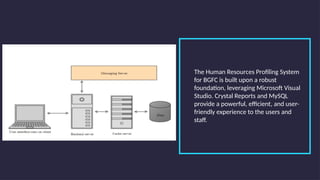
The Human Resources Profiling System
for BGFC is built upon a robust
foundation, leveraging Microsoft Visual
Studio. Crystal Reports and MySQL
provide a powerful, efficient, and user-
friendly experience to the users and
staff.
Microsoft Visual Studio: Microsoft
Visual Studio serves as a server for
developing this system. It facilitates the
dynamic content generation, and
management of user authentication
and authorization, and connects to the
MYSQL database to retrieve and
manipulate data. Microsoft Visual
Studio's versatility and extensive library
functions make it an ideal choice for
the back and of the system, enabling
seamless transaction processing and
data management.
.
Crystal Reports: This is used for the system to
create visually appealing reports that can include
tables, charts, and graphs to present HR profiling
data in a meaningful way. The tool also offers
advanced features such as sorting, filtering, and
grouping data, allowing users to analyse and drill
down into specific aspects of the HR profiling
results furthermore. Crystal Reports provides
options for exporting reports to various formats
such as PDF, Excel, or Word, making it easy to
share and distribute the generated reports to
stakeholders within the HR department or other
relevant parties.
.
MySQL: MySQL is the database management
system of choice for this HR Profiling System. It
stores and manages critical data, including
Employee Information. Services Records Salary
Adjustment, Leave Application, and DTR.
MySQL's reliability, scalability, and strong
support for complete queries make it suitable
for efficiently managing large volumes of
transaction data and supporting data-driven
decision-making through analytics.
The technical stack of Microsoft Visual Studio
Crystal Report and MySQL form a well-integrated
architecture that ensures the seamless
operation of the HR Profiling System. Microsoft
Visual Studio handles to development of the
system and data processing. Crystal Reports
ensures the reports of every table in the
database and MySQL provides a robust and
organized data management platform. This
combination of technologies is the backbone of
the HR Profiling System, enabling efficient
transactions, accurate data management, and a
user-friendly experience for the client and staff.
METHODOLODY
The RAD technique is a systematic approach to software development
that emphasizes fast prototypes and rapid feedback. The creation of
an HR Profiling System for BGFC is one project that would benefit
greatly from using this process because it calls for fast adaption to
changing needs and on-going employee input.
The following steps outline a RAD methodology for this project:
Figure 2. Rapid Application Development Diagram
Phase 1: System Analysis and Design
In this stage, the researchers have written formal letters and started having conversations with the
HR Office. These letters served as a request for authorization to create an HR Profiling System for
the BGFC. Following this, the investigators interviewed important staff members, including HRMO.
Upon collecting information on the HR office, the researcher found a problem there is no system
for the HR office to profile the employee and manage the data. The goal was to create a strong
basis and strategy for creating a better system.
The researchers then proceeded to design the recommended system architecture after
conducting a thorough system analysis. The purpose of this design was to solve the issues in the
HR office. The technical background documentation included a detailed description of the
proposed system design.
Phase 2: Development of the System.
The System design was tailored to align with the existing infrastructure and
accommodate the preferences of the HR office and staff. The researcher used a model-based
design methodology and recommended tools to guarantee an effective and user-friendly
interface. With a particular focus on the system's functioning, the user interface was created using
MySQL, Crystal Reports, and Microsoft Visual Studio.
Due to the design of the system, a computer system with a 256GB hard drive, a minimum of
8GB of RAM, and a minimum of core i3 CPU speed is required. This hardware setup makes sure
there are enough resources to carry out the development duties without any problems and makes
it easier to implement the system.
Phase 3: System Testing
The HRMO, IT, and end-user all took part in system testing at this phase. The participant's
astute suggestions and remarks were considered during the system’s update process. To improve
the system’s effectiveness and reliability. Open beta testing was made available so that anybody
could participate and provide unfettered feedback. Significant insights into the system’s operation
and performance in actual situation ware obtained during the beta testing phase, which made it
easier to identify any areas that need improvement or adjustment. The feedback from the beta
users significantly enhanced the functionality and overall usefulness of the system.
Throughout the development process, this Rapid Application Development (RAD)
methodology priority user interaction, fast interaction and teamwork. It guarantees that the HR
office and permits quick adjustment in response to evolving specifications and costumer input.
Phase 4: System Implementation
During the phase, the researcher composed a formal letter addressed to the HR office,
requesting their assistance in setting up the system titled “HR Profiling System BGFC Taruc,
Socorro, Surigao del Norte”. The system underwent thorough utilization and evaluation by IT to
assess its functionality, efficiency, user-friendliness, reliability maintainability, and portability.
A picture documentary was made to record the system’s use and efficacy to assess and
adapt it further. This graphic documentation was an invaluable tool for evaluating the
effectiveness of the system and determining how affected the educational setting. Appendices are
where you may view the photo documentation. Owners and end-users participated in the
necessary training sessions to guarantee an efficient implementation. The goal of this training
session was to give the end users the information and abilities they would need to operate the
system properly and efficiently.
The goal was to guarantee the effective implementation and usage of the study by carrying
out evaluations. Putting in place suitable documentation, and offering pertinent training.
Phase 5: System Evaluation
The instrument used to evaluate the system’s functionality, efficiency, usability, and portability was
based on the ISO 9126 and john Brooke (1986) methodology. This tool was divided into two sections: Part 1
was responsible for gathering the employees’ personal information, and Part ll covered the variables that
would describe the system qualities described earlier. The sponsor employed a validation procedure to
guarantee that the instrument adequately addressed the study’s goals. Expert advice and feedback to our IT
dean as well as to the researcher’s adviser are sought to verify and validate the instrument’s effectiveness.
The researchers computed descriptive statistics for the system evaluation. Such as the mean. For the
primary analysis. The table below provides an interpretation of the means. The 5-point likers-scale description
measurement was employed by the researchers.
Likert-Scale Description Scale Interval
Strongly Disagree 1 1.0 – 1.7
Disagree 2 1.8 – 2.5
Neutral / Uncertain 3 2.6 – 3.3
Agree 4 3.4 – 4.1
Strongly Agree 5 4.2 – 5.0
Table 1. Likert-Scale Description Utilized in System Evaluation
Development and Testing
In designing, developing and evaluating the proposed Human Resource Profiling System of BGFC shall be using the ISO
9126-1 Software Quality Model.
10 respondents, including HRMO, IT Expert, HR staff, and students, participated in the evaluation of the system. The
selection of respondents was conducted through random sampling, ensuring a diverse representation. The respondents
were given a validation survey instrument to evaluate and rank the system's performance according to the specified
attributes.
Respondents N Percentage
HR Staff 1 10%
HRMO 1 20%
IT Students 3 30%
IT Experts 5 50%
Total 10 100%
Table 2. Distribution of Respondents
The study sought to gather thorough input on the functionality, efficiency, usability, dependability, maintainability, and
portability of the system by using a validated assessment tool and a wide range of respondents. This information would
help identify areas for further growth or improvement and contribute to a thorough review of the system's performance.
Figure 5 below illustrates this.
RESULTS AND
DISCUSSION
Implementation Results
This section provides an overview of the outcomes and
achievements of the HR Profiling System of Bucas Grande
Foundation College implementation. The purpose of this
part is to evaluate the process of implementation in terms
of its overall success, effectiveness, and efficiency. It draws
attention to the main outcomes of the system's
deployment. Please go to Appendices for the system's user
interface and example input and output.
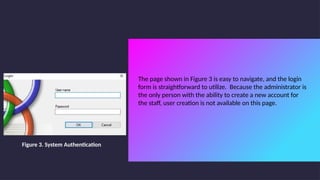
The page shown in Figure 3 is easy to navigate, and the login
form is straightforward to utilize. Because the administrator is
the only person with the ability to create a new account for
the staff, user creation is not available on this page.
Figure 3. System Authentication
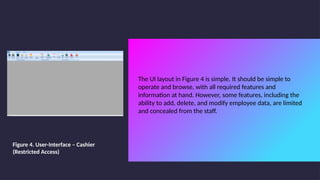
The UI layout in Figure 4 is simple. It should be simple to
operate and browse, with all required features and
information at hand. However, some features, including the
ability to add, delete, and modify employee data, are limited
and concealed from the staff.
Figure 4. User-Interface – Cashier
(Restricted Access)
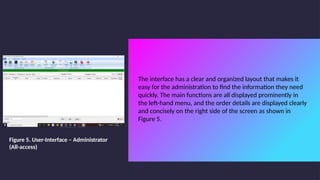
The interface has a clear and organized layout that makes it
easy for the administration to find the information they need
quickly. The main functions are all displayed prominently in
the left-hand menu, and the order details are displayed clearly
and concisely on the right side of the screen as shown in
Figure 5.
Figure 5. User-Interface – Administrator
(All-access)
This interface shown in Figure 6 allows administrators to easily
manage users, including creating new users, assigning
permissions, and resetting passwords. This can help to ensure
that only authorized personnel have access to sensitive
information.
Figure 6. User Profile Settings
Figure 7. Employee Information
Figure 8. List of Employee
Figure 9. Employee Service Record
Figure 10. Leave Application
Figure 11. Salary Adjustment by Schedule
Figure 12. Travel Order Pass Slip Holiday
Figure 13. Employee General Information
Figure 14. Output Data Sheet
CONCLUSION AND
RECOMMENDATION
Conclusion
Based on the result of the study, it was concluded that the system has a good
impact to the HR Office wherein they can effectively added and view the
information of the employee and the work of HR was faster because of the
system. And from the findings mentioned above, the following conclusion are
made:
1. The proposed system was applicable and useful in th HR Office of Bucas
Grande Foundation College.
2. The goal of the system is so satisfy the HRMO based on the performance of
the system evaluation in terms of functionality, efficiency, usability,
reliability, maintainability and portability.
Recommendations
Based on the system testing it was recommended that the application
must be able to:
1. A proper training for installing a system to the HR Office
2. The proposed system can be improved by any concerns expert to be more
convenient and can be enhanced for the future research.
THANKS

HR-Profiling-System HR PROFILING SYSTEM SYSTEM.pptx

  • 1.
  • 2.
  • 3.
    PROJECT CONTEXT -What isthe Problem all about? PURPOSE AND DESCRIPTION -Describe the purpose and description of the actual study OBJECTIVE OF THE STUDY -Identify its specific objectives of your study REVIEW RELATED LITERATURE -RL must be recent
  • 4.
  • 5.
    The Human ResourcesProfiling System for BGFC is built upon a robust foundation, leveraging Microsoft Visual Studio. Crystal Reports and MySQL provide a powerful, efficient, and user- friendly experience to the users and staff.
  • 6.
    Microsoft Visual Studio:Microsoft Visual Studio serves as a server for developing this system. It facilitates the dynamic content generation, and management of user authentication and authorization, and connects to the MYSQL database to retrieve and manipulate data. Microsoft Visual Studio's versatility and extensive library functions make it an ideal choice for the back and of the system, enabling seamless transaction processing and data management. .
  • 7.
    Crystal Reports: Thisis used for the system to create visually appealing reports that can include tables, charts, and graphs to present HR profiling data in a meaningful way. The tool also offers advanced features such as sorting, filtering, and grouping data, allowing users to analyse and drill down into specific aspects of the HR profiling results furthermore. Crystal Reports provides options for exporting reports to various formats such as PDF, Excel, or Word, making it easy to share and distribute the generated reports to stakeholders within the HR department or other relevant parties. .
  • 8.
    MySQL: MySQL isthe database management system of choice for this HR Profiling System. It stores and manages critical data, including Employee Information. Services Records Salary Adjustment, Leave Application, and DTR. MySQL's reliability, scalability, and strong support for complete queries make it suitable for efficiently managing large volumes of transaction data and supporting data-driven decision-making through analytics.
  • 9.
    The technical stackof Microsoft Visual Studio Crystal Report and MySQL form a well-integrated architecture that ensures the seamless operation of the HR Profiling System. Microsoft Visual Studio handles to development of the system and data processing. Crystal Reports ensures the reports of every table in the database and MySQL provides a robust and organized data management platform. This combination of technologies is the backbone of the HR Profiling System, enabling efficient transactions, accurate data management, and a user-friendly experience for the client and staff.
  • 10.
  • 11.
    The RAD techniqueis a systematic approach to software development that emphasizes fast prototypes and rapid feedback. The creation of an HR Profiling System for BGFC is one project that would benefit greatly from using this process because it calls for fast adaption to changing needs and on-going employee input. The following steps outline a RAD methodology for this project: Figure 2. Rapid Application Development Diagram
  • 12.
    Phase 1: SystemAnalysis and Design In this stage, the researchers have written formal letters and started having conversations with the HR Office. These letters served as a request for authorization to create an HR Profiling System for the BGFC. Following this, the investigators interviewed important staff members, including HRMO. Upon collecting information on the HR office, the researcher found a problem there is no system for the HR office to profile the employee and manage the data. The goal was to create a strong basis and strategy for creating a better system. The researchers then proceeded to design the recommended system architecture after conducting a thorough system analysis. The purpose of this design was to solve the issues in the HR office. The technical background documentation included a detailed description of the proposed system design.
  • 13.
    Phase 2: Developmentof the System. The System design was tailored to align with the existing infrastructure and accommodate the preferences of the HR office and staff. The researcher used a model-based design methodology and recommended tools to guarantee an effective and user-friendly interface. With a particular focus on the system's functioning, the user interface was created using MySQL, Crystal Reports, and Microsoft Visual Studio. Due to the design of the system, a computer system with a 256GB hard drive, a minimum of 8GB of RAM, and a minimum of core i3 CPU speed is required. This hardware setup makes sure there are enough resources to carry out the development duties without any problems and makes it easier to implement the system.
  • 14.
    Phase 3: SystemTesting The HRMO, IT, and end-user all took part in system testing at this phase. The participant's astute suggestions and remarks were considered during the system’s update process. To improve the system’s effectiveness and reliability. Open beta testing was made available so that anybody could participate and provide unfettered feedback. Significant insights into the system’s operation and performance in actual situation ware obtained during the beta testing phase, which made it easier to identify any areas that need improvement or adjustment. The feedback from the beta users significantly enhanced the functionality and overall usefulness of the system. Throughout the development process, this Rapid Application Development (RAD) methodology priority user interaction, fast interaction and teamwork. It guarantees that the HR office and permits quick adjustment in response to evolving specifications and costumer input.
  • 15.
    Phase 4: SystemImplementation During the phase, the researcher composed a formal letter addressed to the HR office, requesting their assistance in setting up the system titled “HR Profiling System BGFC Taruc, Socorro, Surigao del Norte”. The system underwent thorough utilization and evaluation by IT to assess its functionality, efficiency, user-friendliness, reliability maintainability, and portability. A picture documentary was made to record the system’s use and efficacy to assess and adapt it further. This graphic documentation was an invaluable tool for evaluating the effectiveness of the system and determining how affected the educational setting. Appendices are where you may view the photo documentation. Owners and end-users participated in the necessary training sessions to guarantee an efficient implementation. The goal of this training session was to give the end users the information and abilities they would need to operate the system properly and efficiently. The goal was to guarantee the effective implementation and usage of the study by carrying out evaluations. Putting in place suitable documentation, and offering pertinent training.
  • 16.
    Phase 5: SystemEvaluation The instrument used to evaluate the system’s functionality, efficiency, usability, and portability was based on the ISO 9126 and john Brooke (1986) methodology. This tool was divided into two sections: Part 1 was responsible for gathering the employees’ personal information, and Part ll covered the variables that would describe the system qualities described earlier. The sponsor employed a validation procedure to guarantee that the instrument adequately addressed the study’s goals. Expert advice and feedback to our IT dean as well as to the researcher’s adviser are sought to verify and validate the instrument’s effectiveness. The researchers computed descriptive statistics for the system evaluation. Such as the mean. For the primary analysis. The table below provides an interpretation of the means. The 5-point likers-scale description measurement was employed by the researchers. Likert-Scale Description Scale Interval Strongly Disagree 1 1.0 – 1.7 Disagree 2 1.8 – 2.5 Neutral / Uncertain 3 2.6 – 3.3 Agree 4 3.4 – 4.1 Strongly Agree 5 4.2 – 5.0 Table 1. Likert-Scale Description Utilized in System Evaluation
  • 17.
    Development and Testing Indesigning, developing and evaluating the proposed Human Resource Profiling System of BGFC shall be using the ISO 9126-1 Software Quality Model. 10 respondents, including HRMO, IT Expert, HR staff, and students, participated in the evaluation of the system. The selection of respondents was conducted through random sampling, ensuring a diverse representation. The respondents were given a validation survey instrument to evaluate and rank the system's performance according to the specified attributes. Respondents N Percentage HR Staff 1 10% HRMO 1 20% IT Students 3 30% IT Experts 5 50% Total 10 100% Table 2. Distribution of Respondents The study sought to gather thorough input on the functionality, efficiency, usability, dependability, maintainability, and portability of the system by using a validated assessment tool and a wide range of respondents. This information would help identify areas for further growth or improvement and contribute to a thorough review of the system's performance. Figure 5 below illustrates this.
  • 18.
  • 19.
    Implementation Results This sectionprovides an overview of the outcomes and achievements of the HR Profiling System of Bucas Grande Foundation College implementation. The purpose of this part is to evaluate the process of implementation in terms of its overall success, effectiveness, and efficiency. It draws attention to the main outcomes of the system's deployment. Please go to Appendices for the system's user interface and example input and output.
  • 20.
    The page shownin Figure 3 is easy to navigate, and the login form is straightforward to utilize. Because the administrator is the only person with the ability to create a new account for the staff, user creation is not available on this page. Figure 3. System Authentication
  • 21.
    The UI layoutin Figure 4 is simple. It should be simple to operate and browse, with all required features and information at hand. However, some features, including the ability to add, delete, and modify employee data, are limited and concealed from the staff. Figure 4. User-Interface – Cashier (Restricted Access)
  • 22.
    The interface hasa clear and organized layout that makes it easy for the administration to find the information they need quickly. The main functions are all displayed prominently in the left-hand menu, and the order details are displayed clearly and concisely on the right side of the screen as shown in Figure 5. Figure 5. User-Interface – Administrator (All-access)
  • 23.
    This interface shownin Figure 6 allows administrators to easily manage users, including creating new users, assigning permissions, and resetting passwords. This can help to ensure that only authorized personnel have access to sensitive information. Figure 6. User Profile Settings
  • 24.
    Figure 7. EmployeeInformation
  • 25.
    Figure 8. Listof Employee
  • 26.
    Figure 9. EmployeeService Record
  • 27.
    Figure 10. LeaveApplication
  • 28.
    Figure 11. SalaryAdjustment by Schedule
  • 29.
    Figure 12. TravelOrder Pass Slip Holiday
  • 30.
    Figure 13. EmployeeGeneral Information
  • 31.
    Figure 13. EmployeeGeneral Information
  • 32.
  • 33.
  • 34.
    Conclusion Based on theresult of the study, it was concluded that the system has a good impact to the HR Office wherein they can effectively added and view the information of the employee and the work of HR was faster because of the system. And from the findings mentioned above, the following conclusion are made: 1. The proposed system was applicable and useful in th HR Office of Bucas Grande Foundation College. 2. The goal of the system is so satisfy the HRMO based on the performance of the system evaluation in terms of functionality, efficiency, usability, reliability, maintainability and portability.
  • 35.
    Recommendations Based on thesystem testing it was recommended that the application must be able to: 1. A proper training for installing a system to the HR Office 2. The proposed system can be improved by any concerns expert to be more convenient and can be enhanced for the future research.
  • 36.