The   Five Temptations  of a CEO Jennifer Granger Carrie Hazen Edward Kennedy Sean Wint
Introduction Andrew O’Brian is the CEO of Trinity Systems for the past year Trinity Systems is a company that develops computer software Andrew is worried about having a meeting with the Board of Directors Poor numbers for the year Andrew decides to take the train home at midnight after a long day While on the train he meets Charlie, whose father was the CEO of a railroad
The Five Temptations Choosing Status Over Results Choosing Popularity over Accountability Choosing Certainty over Clarity Choosing Harmony over Productive Conflict Choosing Invulnerability over Trust
Temptation 1 – Choosing Status Over Results There is many CEO’s that are concerned about what the company’s image is rather than what the numbers say CEO’s who are more concerned about their own image and status over the company’s results CEO’s try to protect themselves over the company
Advice Make results the TOP PRIORITY over any other thing Results protect the customers, employees and the company as a whole
Temptation 2 – Choosing Popularity over Accountability “ Wanting to be popular with direct reports instead of holding them accountable” Accountability is the most overused buzz word in business today CEO’s need to understand the difference between holding people accountable and deciding to terminate them Andrew never told Terry (Marketing) that his job might be in jeopardy, instead without warning, terminated him Do you consider yourself a close friend of direct reports?
Temptation 2 – Continued Does it bother you to the point of distraction if your employees are unhappy with you? Do you often find yourself reluctant to give negative feedback to your direct reports? Do you water down negative feedback to make it more palatable? Do you often vent to them about issues in the organization? (For example do you refer to your staff as we and other employees as they?)
Temptation 3 – Choosing Certainty over Clarity Choosing certainty over clarity insures that your decisions are correct Some executives may fear being wrong so much that they wait until they’re absolutely certain about something before they make a decision You cannot hold people accountable for things that are not clear. If you are unwilling to make decisions with limited information, you cannot achieve clarity Do you pride yourself on being intellectually precise? Do you prefer to wait for more information rather than make a decision without all of the facts? Do you enjoy debating details with your direct reports during meetings
Temptation 4 – Choosing Harmony over Productive Conflict This temptation is directly state, most CEOs want their meetings to go smoothly and without any problems. According to the book CONFLICT is a positive thing. Without conflict in meetings, most problems will not be sorted out until its deeper in the organization by other employees. Also without productive ideological conflict and passions within meetings, the meetings themselves may become boring or less productive and that is when employees decide that “real work” is more important.
Example College classroom settings: Listening to a professor lecture for 3 hours is awfully boring. When the professor includes his/her students in a classroom debate over a topic where there could be conflict, this makes the classroom more enjoyable and gives the student the incentive to attend class.
Temptation 5 – Choosing Invulnerability over Trust In the book, temptation 5’s biggest weakness is that CEOs have a hard time trusting other employees and are afraid they are too soft and will lose their edge. This makes other employees too comfortable with the CEO and leads them to slack off.
Example Teachers that trust students to turn in homework on time is similar to a team leader that trusts everyone in the group to do their part. When someone does not get their work done on time, all of the responsibility falls on the team leader. This puts everything on the table and shows who you can trust and who can not.
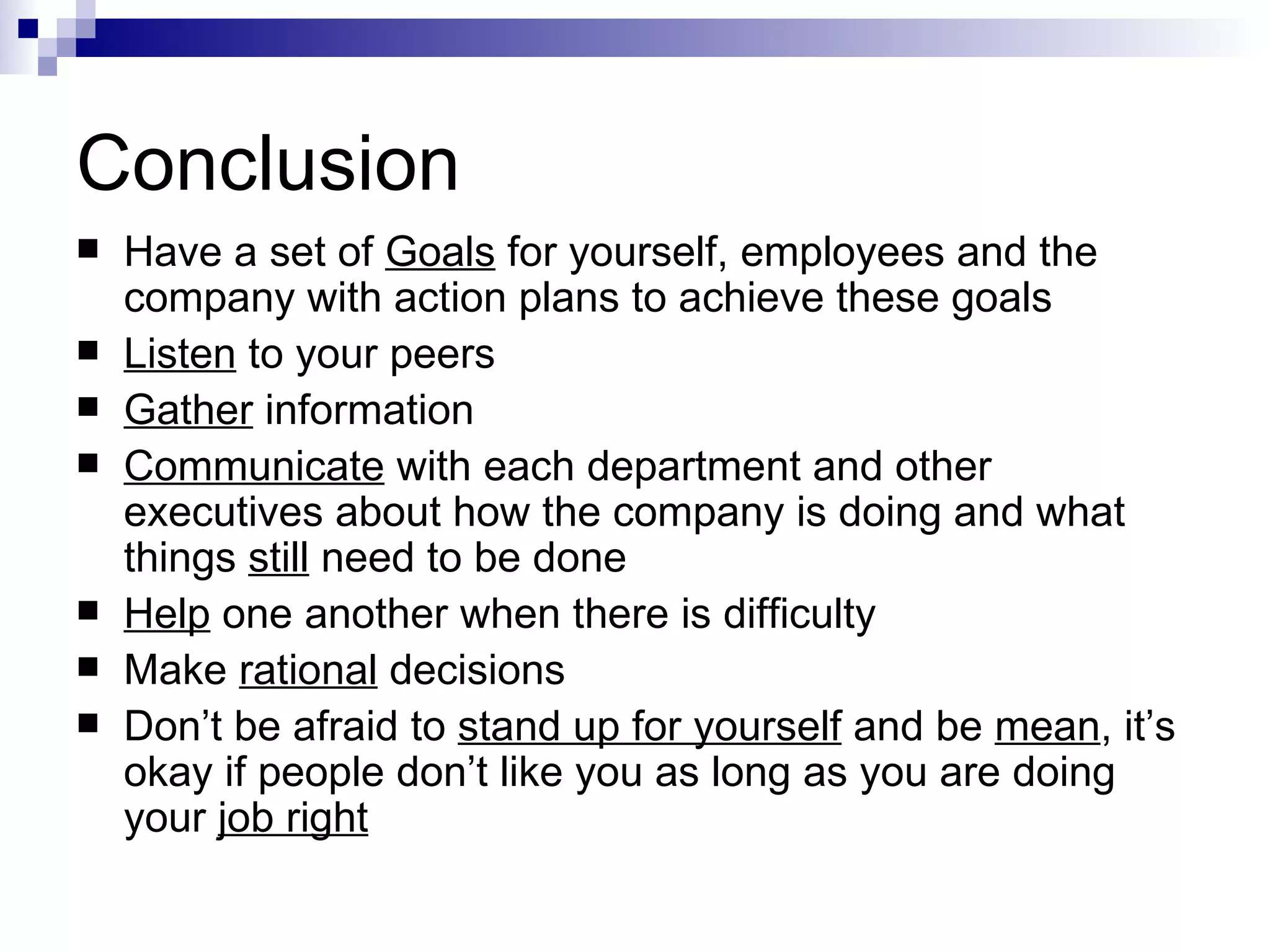
Conclusion Have a set of  Goals  for yourself, employees and the company with action plans to achieve these goals Listen  to your peers Gather  information Communicate  with each department and other executives about how the company is doing and what things  still  need to be done Help  one another when there is difficulty Make  rational  decisions Don’t be afraid to  stand up for yourself  and be  mean , it’s okay if people don’t like you as long as you are doing your  job right
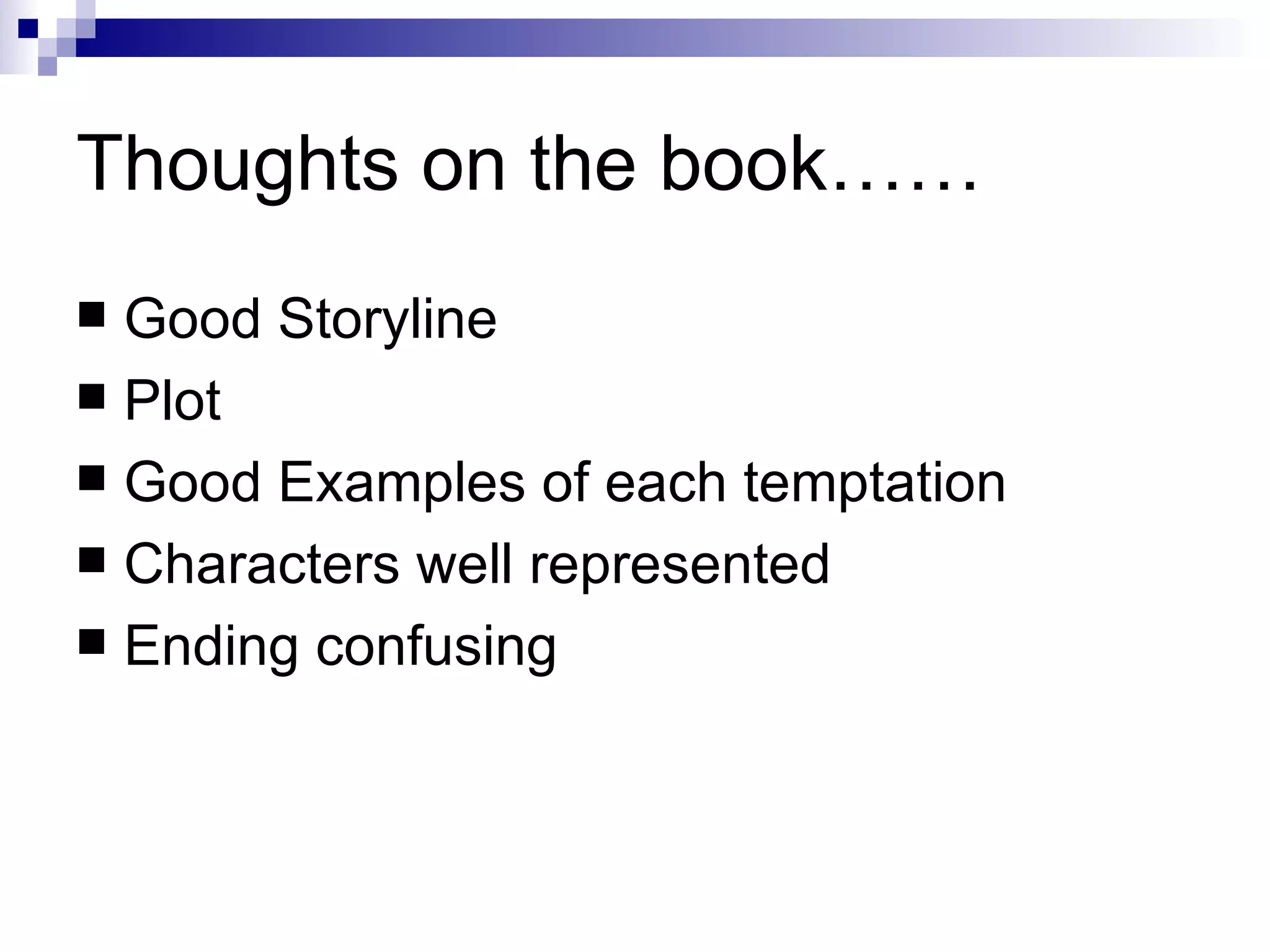
Thoughts on the book…… Good Storyline Plot Good Examples of each temptation Characters well represented Ending confusing

Hr Power Point

  • 1.
    The Five Temptations of a CEO Jennifer Granger Carrie Hazen Edward Kennedy Sean Wint
  • 2.
    Introduction Andrew O’Brianis the CEO of Trinity Systems for the past year Trinity Systems is a company that develops computer software Andrew is worried about having a meeting with the Board of Directors Poor numbers for the year Andrew decides to take the train home at midnight after a long day While on the train he meets Charlie, whose father was the CEO of a railroad
  • 3.
    The Five TemptationsChoosing Status Over Results Choosing Popularity over Accountability Choosing Certainty over Clarity Choosing Harmony over Productive Conflict Choosing Invulnerability over Trust
  • 4.
    Temptation 1 –Choosing Status Over Results There is many CEO’s that are concerned about what the company’s image is rather than what the numbers say CEO’s who are more concerned about their own image and status over the company’s results CEO’s try to protect themselves over the company
  • 5.
    Advice Make resultsthe TOP PRIORITY over any other thing Results protect the customers, employees and the company as a whole
  • 6.
    Temptation 2 –Choosing Popularity over Accountability “ Wanting to be popular with direct reports instead of holding them accountable” Accountability is the most overused buzz word in business today CEO’s need to understand the difference between holding people accountable and deciding to terminate them Andrew never told Terry (Marketing) that his job might be in jeopardy, instead without warning, terminated him Do you consider yourself a close friend of direct reports?
  • 7.
    Temptation 2 –Continued Does it bother you to the point of distraction if your employees are unhappy with you? Do you often find yourself reluctant to give negative feedback to your direct reports? Do you water down negative feedback to make it more palatable? Do you often vent to them about issues in the organization? (For example do you refer to your staff as we and other employees as they?)
  • 8.
    Temptation 3 –Choosing Certainty over Clarity Choosing certainty over clarity insures that your decisions are correct Some executives may fear being wrong so much that they wait until they’re absolutely certain about something before they make a decision You cannot hold people accountable for things that are not clear. If you are unwilling to make decisions with limited information, you cannot achieve clarity Do you pride yourself on being intellectually precise? Do you prefer to wait for more information rather than make a decision without all of the facts? Do you enjoy debating details with your direct reports during meetings
  • 9.
    Temptation 4 –Choosing Harmony over Productive Conflict This temptation is directly state, most CEOs want their meetings to go smoothly and without any problems. According to the book CONFLICT is a positive thing. Without conflict in meetings, most problems will not be sorted out until its deeper in the organization by other employees. Also without productive ideological conflict and passions within meetings, the meetings themselves may become boring or less productive and that is when employees decide that “real work” is more important.
  • 10.
    Example College classroomsettings: Listening to a professor lecture for 3 hours is awfully boring. When the professor includes his/her students in a classroom debate over a topic where there could be conflict, this makes the classroom more enjoyable and gives the student the incentive to attend class.
  • 11.
    Temptation 5 –Choosing Invulnerability over Trust In the book, temptation 5’s biggest weakness is that CEOs have a hard time trusting other employees and are afraid they are too soft and will lose their edge. This makes other employees too comfortable with the CEO and leads them to slack off.
  • 12.
    Example Teachers thattrust students to turn in homework on time is similar to a team leader that trusts everyone in the group to do their part. When someone does not get their work done on time, all of the responsibility falls on the team leader. This puts everything on the table and shows who you can trust and who can not.
  • 13.
    Conclusion Have aset of Goals for yourself, employees and the company with action plans to achieve these goals Listen to your peers Gather information Communicate with each department and other executives about how the company is doing and what things still need to be done Help one another when there is difficulty Make rational decisions Don’t be afraid to stand up for yourself and be mean , it’s okay if people don’t like you as long as you are doing your job right
  • 14.
    Thoughts on thebook…… Good Storyline Plot Good Examples of each temptation Characters well represented Ending confusing