Dr. Muhammad Shariat Ullah
Professor
Department of Organization Strategy & Leadership
University of Dhaka
Email: shariat@du.ac.bd
Learning objectives
1. To learn the development of HRM and
New HRM Model
2. Alternative approaches to the study
and practice of HRM
3. To explain how HR goes Agile
4. To illustrate Agile team experiment,
The case of One Bank
5. Illustrate the human resources
responsibilities of line and staff (HR)
managers.
6. To understand trends in HRM and
emerging aspects of HRM
HRM
Management of People in the
Workplace.
HRM refers to all those activities
associated with the management of work
and people in organizations
The Development of HRM
The roots of HRM can be found in the emergence of industrial
welfare work from the 1890s, as organisations began to provide
workplace amenities such as medical care, housing and libraries.
[Welfare approach]
When scientific management emerged, HRM function came to
life, responsible for establishing modern personnel methods.
[Personnel Administrative Approach]
In the mid-1980s in the UK, and earlier in the US, the term ‘HRM’
became fashionable and gradually started to replace others
such as ‘personnel management’, ‘industrial relations’ and
‘labour relations’.
The 1990s saw the launch of new journals and the flourishing
of university courses in HRM
Scientific Management
https://www.youtube.com/watch?v=vNfy
_AHG-MU
• Personnel management was seen as a low-level
recordkeeping and ‘people maintenance’ function.
• The HRM view is characterised as being much
more concerned with business strategy, taking the
view that HR is the most important organisational
resource. Thus there has been much talk of an
HRM ‘revolution’ with a transformation from
administrative efficiency to the role of HRM as a
fully-fledged strategic business partner.
HRM: Old wine in a New Bottle?
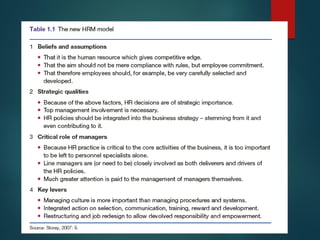
The new HRM?
Human resource management is a
distinctive approach to employment
management
which seeks to achieve competitive
advantage through the strategic
deployment of a
highly committed and capable
workforce, using an integrated array
of cultural, structural
and personnel techniques. (Storey,
1995: 5).
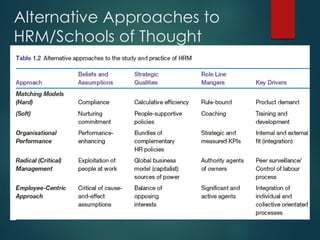
Alternative Approaches to
HRM/Schools of Thought
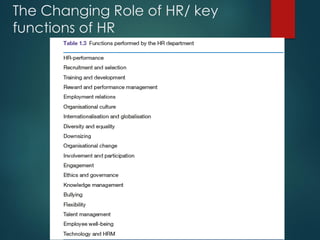
The Changing Role of HR/ key
functions of HR
HR Goes Agile
One Bank’s Agile
Team Experiment
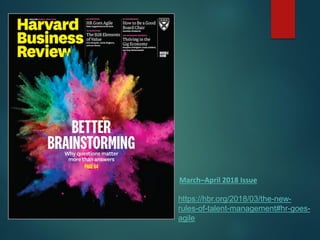
March–April 2018 Issue
https://hbr.org/2018/03/the-new-
rules-of-talent-management#hr-goes-
agile
Thank You

HR Class 1.pdf

  • 1.
    Dr. Muhammad ShariatUllah Professor Department of Organization Strategy & Leadership University of Dhaka Email: shariat@du.ac.bd
  • 2.
    Learning objectives 1. Tolearn the development of HRM and New HRM Model 2. Alternative approaches to the study and practice of HRM 3. To explain how HR goes Agile 4. To illustrate Agile team experiment, The case of One Bank 5. Illustrate the human resources responsibilities of line and staff (HR) managers. 6. To understand trends in HRM and emerging aspects of HRM
  • 3.
    HRM Management of Peoplein the Workplace. HRM refers to all those activities associated with the management of work and people in organizations
  • 4.
    The Development ofHRM The roots of HRM can be found in the emergence of industrial welfare work from the 1890s, as organisations began to provide workplace amenities such as medical care, housing and libraries. [Welfare approach] When scientific management emerged, HRM function came to life, responsible for establishing modern personnel methods. [Personnel Administrative Approach] In the mid-1980s in the UK, and earlier in the US, the term ‘HRM’ became fashionable and gradually started to replace others such as ‘personnel management’, ‘industrial relations’ and ‘labour relations’. The 1990s saw the launch of new journals and the flourishing of university courses in HRM
  • 5.
  • 6.
    • Personnel managementwas seen as a low-level recordkeeping and ‘people maintenance’ function. • The HRM view is characterised as being much more concerned with business strategy, taking the view that HR is the most important organisational resource. Thus there has been much talk of an HRM ‘revolution’ with a transformation from administrative efficiency to the role of HRM as a fully-fledged strategic business partner. HRM: Old wine in a New Bottle?
  • 7.
    The new HRM? Humanresource management is a distinctive approach to employment management which seeks to achieve competitive advantage through the strategic deployment of a highly committed and capable workforce, using an integrated array of cultural, structural and personnel techniques. (Storey, 1995: 5).
  • 9.
  • 10.
    The Changing Roleof HR/ key functions of HR
  • 11.
    HR Goes Agile OneBank’s Agile Team Experiment
  • 12.
  • 13.