Human Powered Vehicle Frame and
         Drive Train
                    Final Project Report


              Bicycle Technical Innovations
                    Advisor: Brian P. Self, Ph.D.
               Mechanical Engineering Department
              California Polytechnic State University
                    San Luis Obispo, California


       Aaron Williams                williams@calpoly.edu
         Caleb Bartels               caleb.bartels@gmail.com
        Sean McHugh                  seanmmchugh@yahoo.com
Statement of Disclaimer
Since this project is a result of a class assignment, it has been graded and accepted as fulfillment of the
course requirements. Acceptance does not imply technical accuracy or reliability. Any use of information
in this report is done at the risk of the user. These risks may include catastrophic failure of the device or
infringement of patent or copyright laws. California Polytechnic State University at San Luis Obispo and its
staff cannot be held liable for any use or misuse of the project.


Page | 1
Abstract
Cal Poly’s Human Powered Vehicle Club challenged our team to design, build, and test a working
recumbent frame and drive train to race in the annual ASME Human Powered Vehicle Challenge. By
talking to Human Powered Vehicle club leadership and previous riders, a full list of engineering
specifications was developed to focus the design process. Concepts were brainstormed, resulting in the
most realistic and innovative ideas being selected. Among our concepts selected, we focused our project
on creating a full carbon fiber-epoxy frame that could be removed from the vehicle fairing for test runs
and training. Final designs were drafted using Computer Aided Design software to create engineering
drawing schematics for manufacturing. Our team focused on composite manufacturing, outsourcing
machining to technicians and other Human Powered Vehicle members. Our final product weighs less than
4 pounds, representing a 50% weight reduction from the last design. Further testing is needed to verify
the performance of the bike once fully assembled.


Page | 2
Table of Contents
Statement of Disclaimer .......................................................................................................................... 1
Abstract .................................................................................................................................................. 2
Chapter 1: Introduction ........................................................................................................................ 8
  1.1 Nomenclature ................................................................................................................................ 8
  1.2 Background .................................................................................................................................... 8
  1.3 The HPV Spectrum ......................................................................................................................... 9
  1.4 Cal Poly HPV History ..................................................................................................................... 10
  1.5 Objectives ...................................................................................................................................... 12
Chapter 2: Engineering Specifications ................................................................................................. 14
Chapter 3: Design Concept Development ............................................................................................ 15
  3.1 Design Philosophy ........................................................................................................................ 15
  3.2 Drive Train Concepts .................................................................................................................... 15
  3.3 Frame Concepts ........................................................................................................................... 16
  3.4 Seat Mount Concepts ................................................................................................................... 18
  3.5 Final Concept ............................................................................................................................... 19
Chapter 4: Design Refinement ............................................................................................................ 21
  4.1 Frame........................................................................................................................................... 21
  4.2 Drive Train ................................................................................................................................... 24
  4.3 Seat Mount ..................................................................................................................................... 24
Chapter 5: Final Design ....................................................................................................................... 26
  5.1 Frame........................................................................................................................................... 26
  5.2 Drive Train ................................................................................................................................... 27
  5.3 Seat Mounts and Fairing Mounts .................................................................................................. 28
  5.4 Integration with the Cal Poly Human Powered Vehicle Club ........................................................... 28
Chapter 6: Analysis ............................................................................................................................. 29
  6.1 Frame........................................................................................................................................... 29
  6.2 Drive Train .................................................................................................................................... 32
  6.3 Seat Mount .................................................................................................................................. 34
Chapter 7: Manufacturing and Assembly .............................................................................................. 36
Chapter 8: Design Verification ............................................................................................................. 49
Chapter 9: Cost Analysis....................................................................................................................... 53
Chapter 10: Conclusions and Recommendations ................................................................................. 57
References ............................................................................................................................................ 59
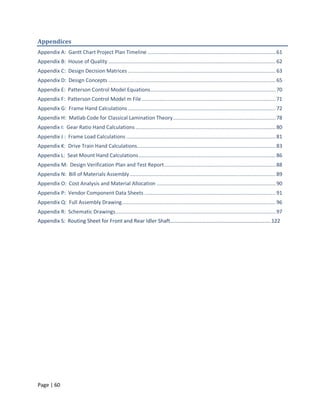
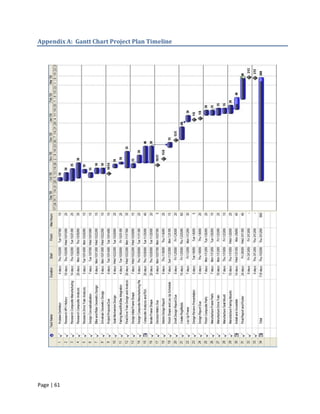
Appendix A: Gantt Chart Project Plan Timeline ..................................................................................... 61
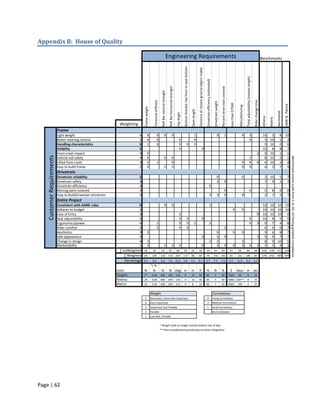
Appendix B: House of Quality ............................................................................................................... 62
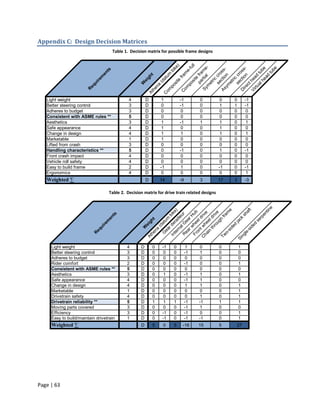
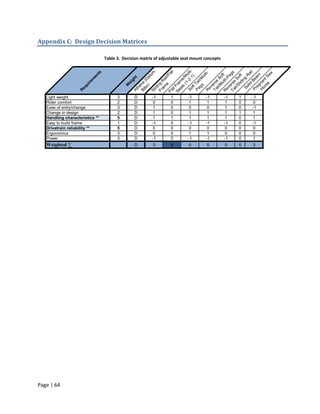
Appendix C: Design Decision Matrices .................................................................................................. 64
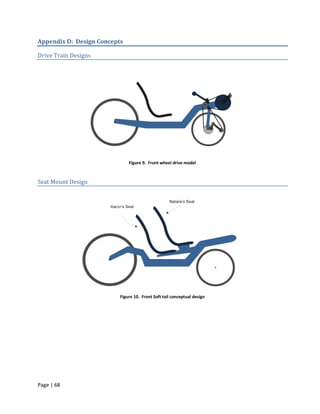
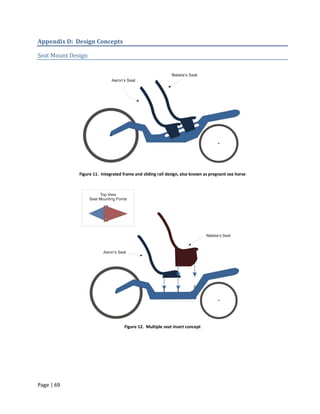
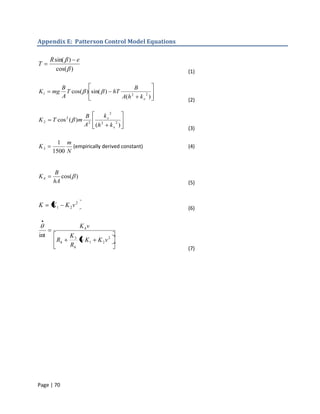
Appendix D: Design Concepts ............................................................................................................... 65
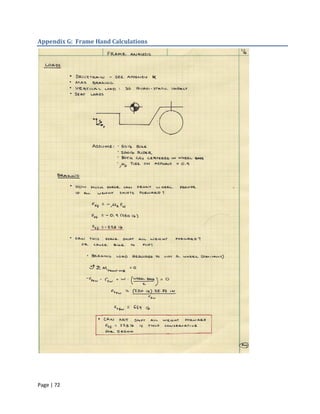
Appendix E: Patterson Control Model Equations ................................................................................... 70
Appendix F: Patterson Control Model m File ......................................................................................... 71

Page | 3
Appendix G: Frame Hand Calculations .................................................................................................. 72
Appendix H: Matlab Code for Classical Lamination Theory .................................................................... 78
Appendix I: Gear Ratio Hand Calculations ............................................................................................. 80
Appendix J : Frame Load Calculations ................................................................................................... 81
Appendix K: Drive Train Hand Calculations............................................................................................ 83
Appendix L: Seat Mount Hand Calculations ........................................................................................... 86
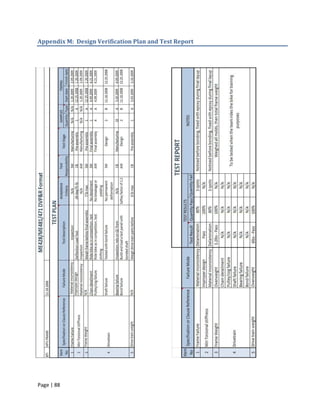
Appendix M: Design Verification Plan and Test Report .......................................................................... 88
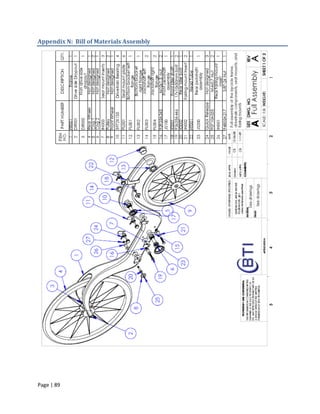
Appendix N: Bill of Materials Assembly ................................................................................................. 89
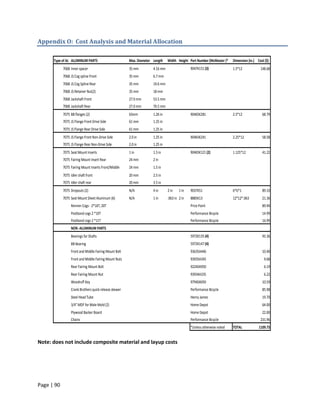
Appendix O: Cost Analysis and Material Allocation ............................................................................... 90
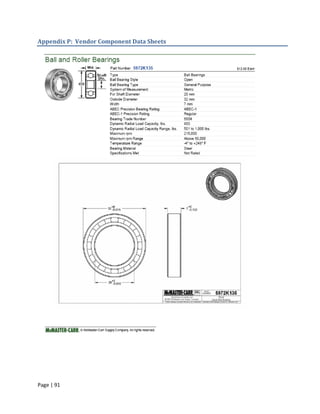
Appendix P: Vendor Component Data Sheets ....................................................................................... 91
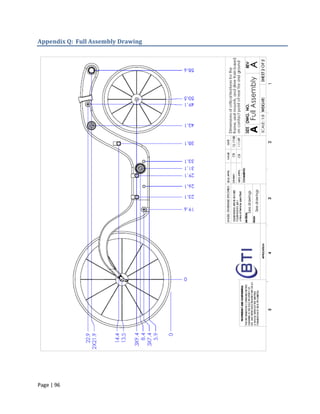
Appendix Q: Full Assembly Drawing ...................................................................................................... 96
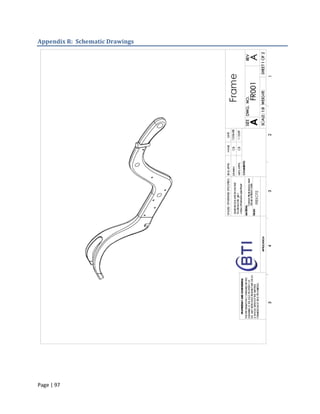
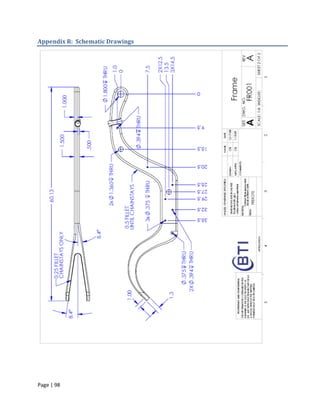
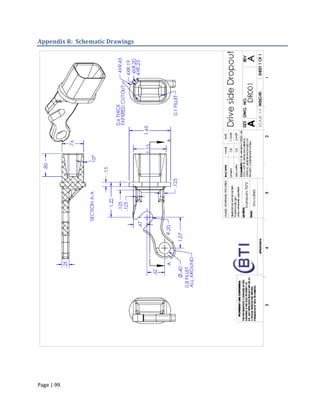
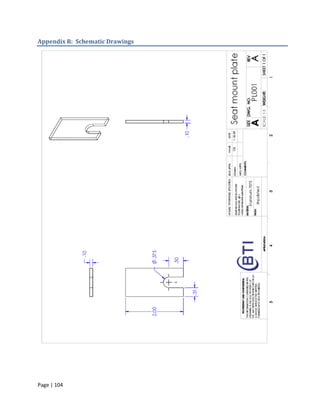
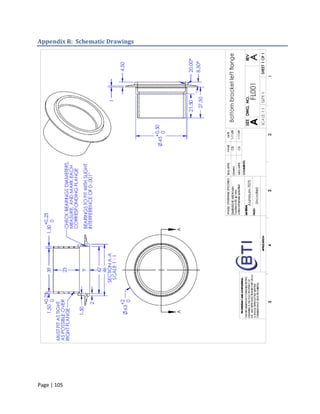
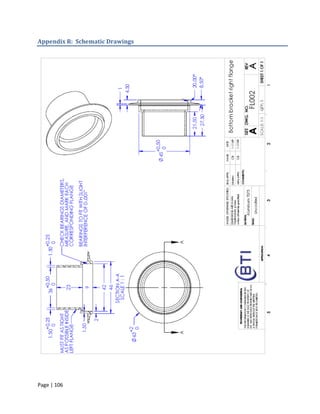
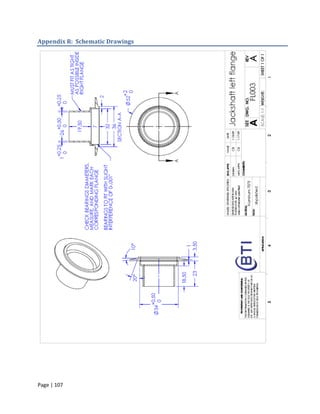
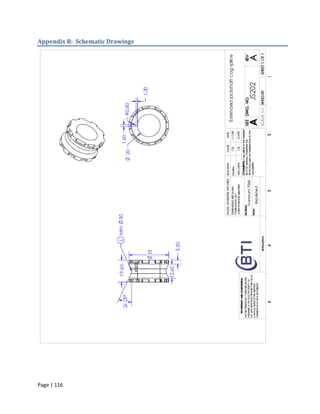
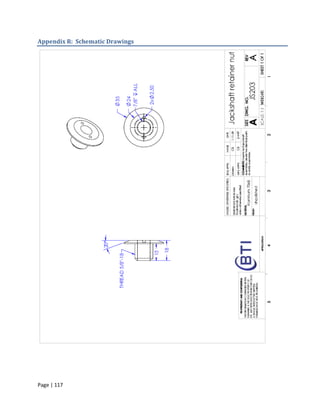
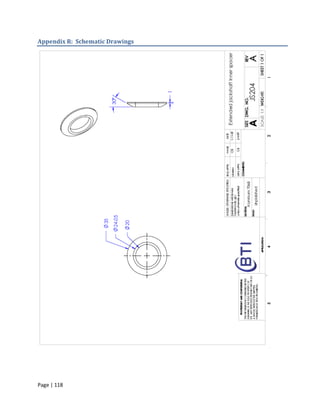
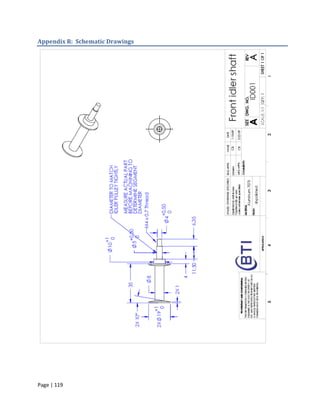
Appendix R: Schematic Drawings .......................................................................................................... 97
Appendix S: Routing Sheet For Front And Rear Idler Shafts ................................................................. 122


Page | 4
Table of Figures
Figure 1.1 Bicycle terminology                                                               8
Figure 1.2 Vehicles representing the two ends of the HPV spectrum                            9
Figure 1.3 Matrix’ drive train                                                              11
Figure 1.4 Athena drive train                                                               12
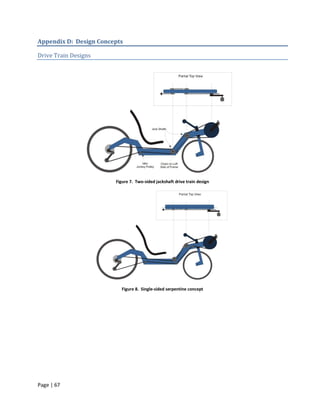
Figure 3.1 Two-sided jackshaft drive train design                                           16
Figure 3.2 Single-sided serpentine drive train concept                                      16
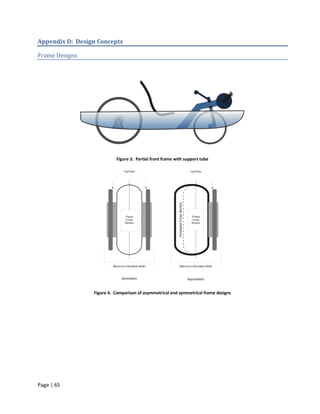
Figure 3.3 Front partial frame with support tub                                             17
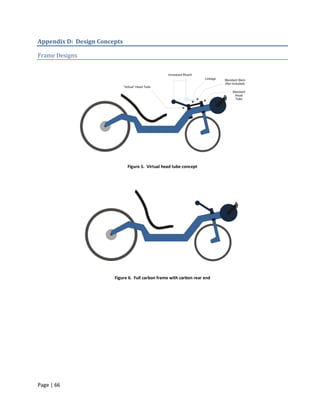
Figure 3.4 Virtual head tube steering design                                                17
Figure 3.5 Frame cross-sections for symmetric and asymmetric concepts                       17
Figure 3.6 Initial soft tail concept                                                        18
Figure 3.7 Adjustable sliding rails seat mount                                              18
Figure 3.8 Seat mount insert diagram.                                                       19
Figure 3.9 2009 BTI Human Powered Vehicle initial concept                                   19
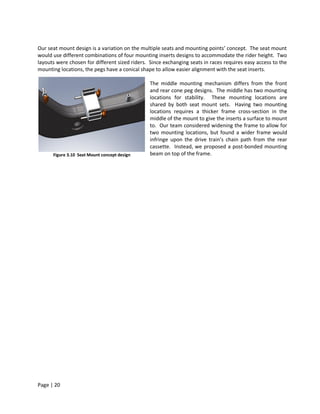
Figure 3.10 Seat Mount concept design                                                       20
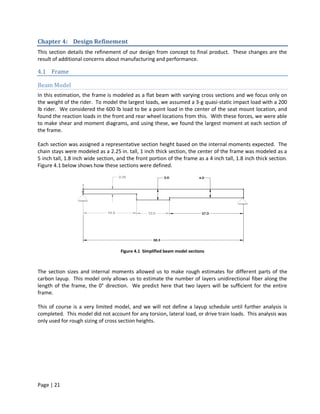
Figure 4.1 Simplified beam model sections                                                   21
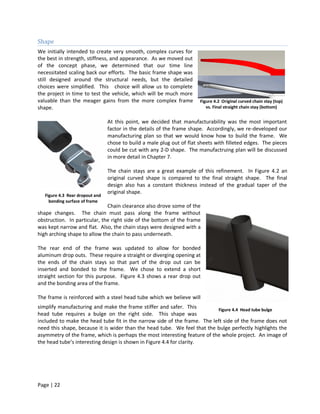
Figure 4.2 Original curved chain stay (top) vs. Final straight chain stay (bottom)          22
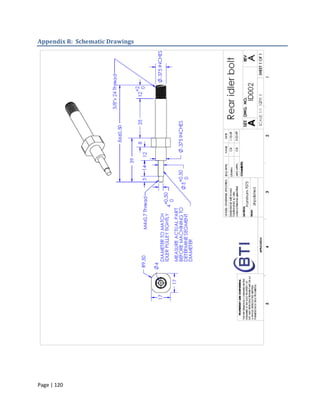
Figure 4.3 Rear dropout and bonding surface of frame                                        22
Figure 4.4 Head tube bulge                                                                  22
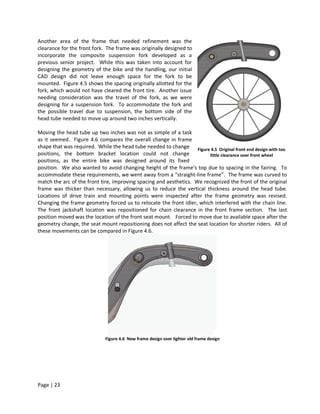
Figure 4.5 Original front end design with too little clearance over front wheel             23
Figure 4.6 New frame design over lighter old frame design                                   23
Figure 4.7 Dual cog lower shaft concept                                                     24
Figure 4.8 Bearing and frame interface                                                      24
Figure 4.9 Seat mount design prior to refinement                                            24
Figure 4.10 New seat mount design                                                           25
Figure 5.1 Full assembly of the final frame and drive train                                 26
Figure 5.2 Render of frame and dropout inserts                                              26
Figure 5.3 Drive train locations along the frame                                            27
Figure 5.4 Jackshaft assembly                                                               27
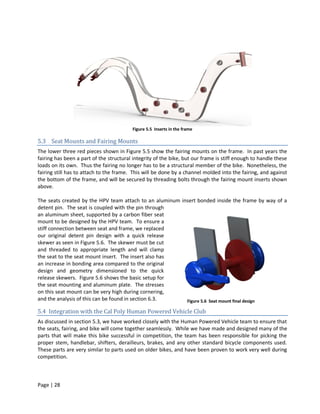
Figure 5.5 Inserts in the frame                                                             28
Figure 5.6 Seat mount final design                                                          28
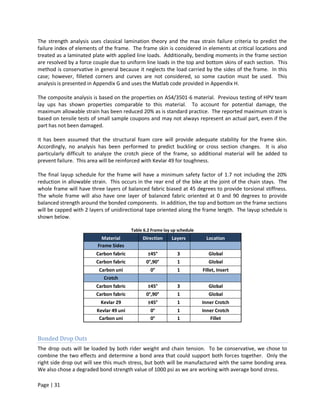
Figure 6.1 Patterson Control Model output: control spring and sensitivity comparison        30
Figure 6.2 Geometry diagram for drive train force analysis                                  33
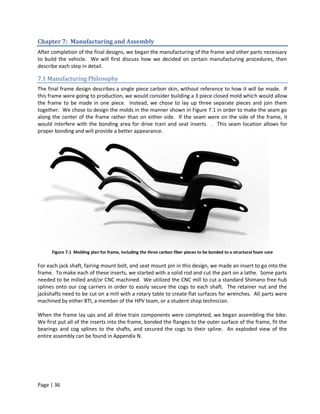
Figure 7.1 Molding plan for frame                                                           36
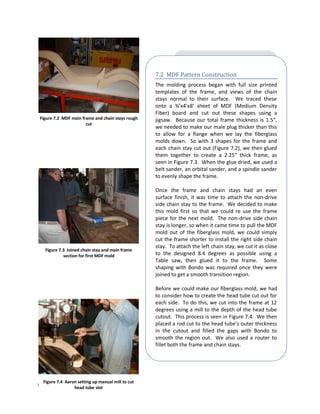
Figure 7.2 MDF main frame and chain stays rough cut                                         37
Figure 7.3 Joined chain stay and main frame section for first MDF mold                      37
Figure 7.4 Aaron setting up manual mill to cut head tube slot                               37
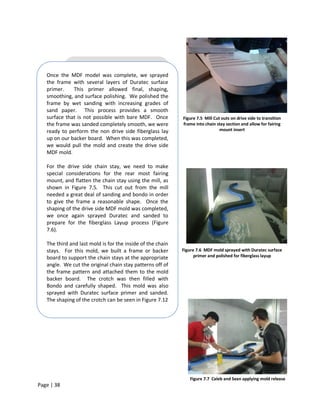
Figure 7.5 Mill Cut outs on drive side to transition frame into chain stay section          38
Figure 7.6 MDF mold sprayed with Duratec surface primer and polished for fiberglass layup   38
Figure 7.7 Caleb and Sean applying mold release                                             38
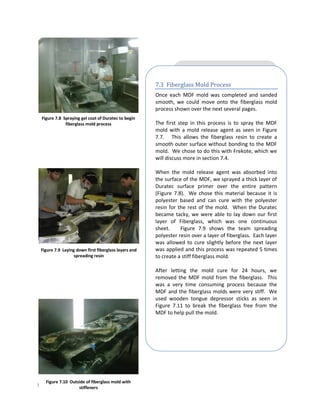
Figure 7.8 Spraying gel coat of Duratec to begin fiberglass mold process                    39
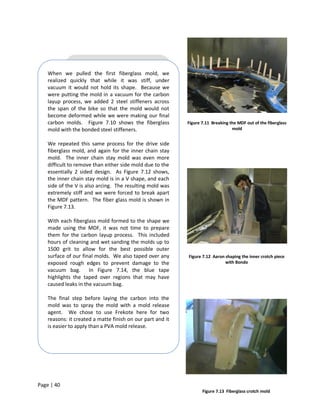
Figure 7.9 Laying down first fiberglass layers and spreading resin                          39


Page | 5
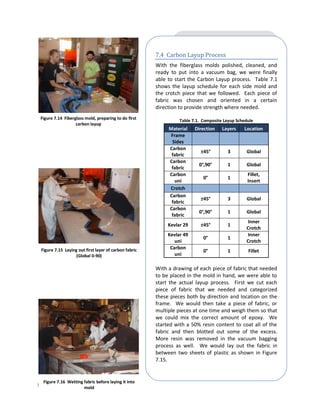
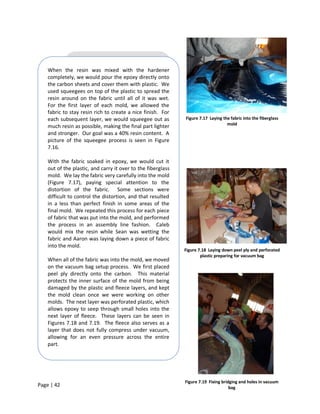
Figure 7.10 Outside of fiberglass mold with stiffeners                                 39
Figure 7.11 Breaking the MDF out of the fiberglass mold                                40
Figure 7.12 Aaron shaping the inner crotch piece with Bondo                            40
Figure 7.13 Fiberglass crotch mold                                                     40
Figure 7.14 Fiberglass mold, preparing to do first carbon layup                        41
Figure 7.15 Laying out first layer of carbon fabric (Global 0-90)                      41
Figure 7.16 Wetting fabric before laying it into mold                                  41
Figure 7.17 Laying the fabric into the fiberglass mold                                 42
Figure 7.18 Laying down peel ply and perforated plastic preparing for vacuum bag       42
Figure 7.19 Fixing bridging and holes in vacuum bag                                    42
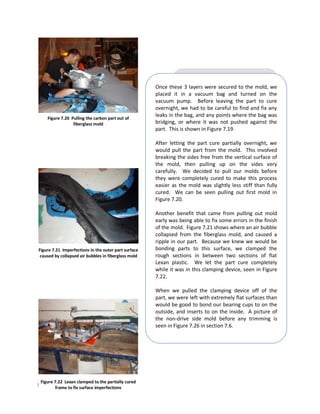
Figure 7.20 Pulling the carbon part out of fiberglass mold                             43
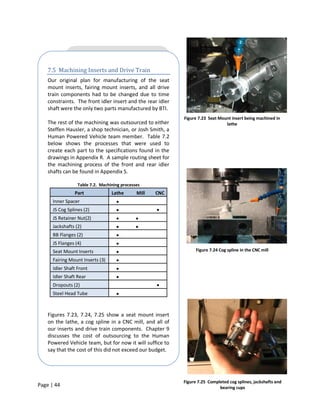
Figure 7.21 Imperfections in the outer part surface                                    43
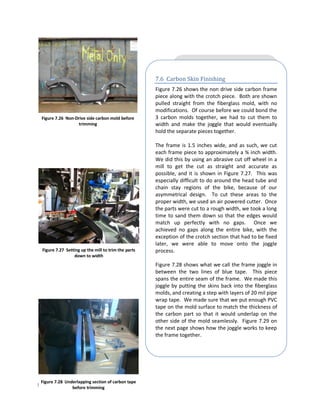
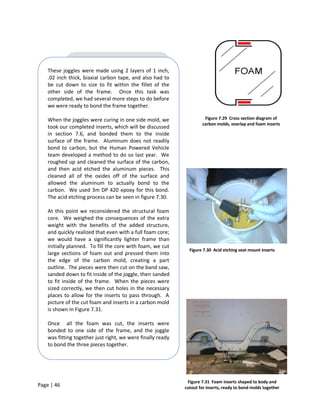
Figure 7.22 Lexan clamped to the partially cured frame to fix surface imperfections    43
Figure 7.23 Seat Mount insert being machined in lathe                                  44
Figure 7.24 Cog spline in the CNC mill                                                 44
Figure 7.25 Completed cog splines, jackshafts and bearing cups                         44
Figure 7.26 Non-Drive side carbon mold before trimming                                 45
Figure 7.27 Setting up the mill to trim the parts down to width                        45
Figure 7.28 Underlapping section of carbon tape before trimming                        45
Figure 7.29 Cross section diagram of carbon molds, overlap and foam inserts            46
Figure 7.30 Acid etching seat mount inserts                                            46
Figure 7.31 Foam shaped to body and cutout for inserts, ready to bond molds together   46
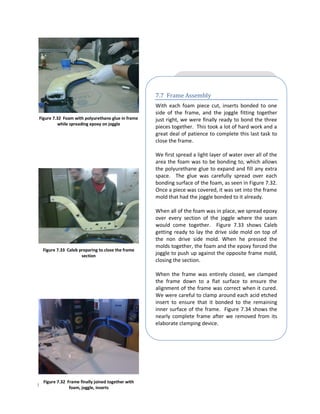
Figure 7.32 Foam with polyurethane glue in frame while spreading epoxy on joggle       47
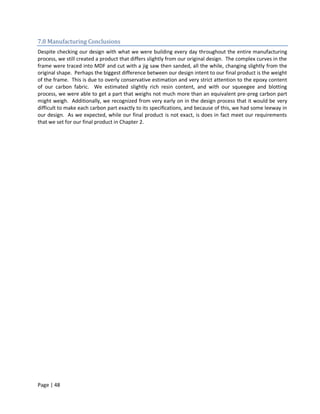
Figure 7.33 Caleb preparing to close the frame section                                 47
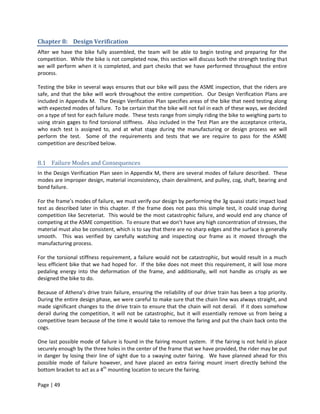
Figure 7.34 Frame finally joined together with foam, joggle, inserts                   47


Page | 6
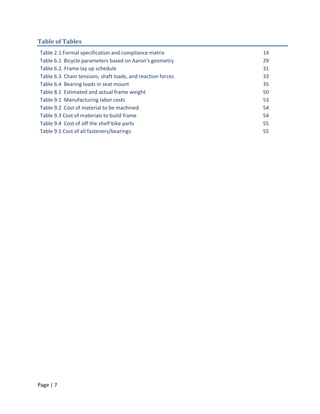
Table of Tables
Table 2.1 Formal specification and compliance matrix         14
Table 6.1 Bicycle parameters based on Aaron's geometry       29
Table 6.2. Frame lay up schedule                             31
Table 6.3 Chain tensions, shaft loads, and reaction forces   33
Table 6.4 Bearing loads in seat mount                        35
Table 8.1 Estimated and actual frame weight                  50
Table 9.1 Manufacturing labor costs                          53
Table 9.2 Cost of material to be machined                    54
Table 9.3 Cost of materials to build frame                   54
Table 9.4 Cost of off the shelf bike parts                   55
Table 9.5 Cost of all fasteners/bearings                     55


Page | 7
Chapter 1: Introduction
For our first project at Bicycle Technical Innovations, we have designed a new bike for Cal Poly’s 2009
Human Powered Vehicle team. Our bike will be used in the 2009 American Society of Mechanical
Engineers Human Powered Vehicle competition, in Portland, Oregon. We have worked closely with the
HPV club, their racers, and an Aerospace Engineering senior project group to determine the necessary
engineering specifications and concepts for our new vehicle. The final bike will be a working prototype
that is integrated with other components specified by the HPV team. Our goals, discussed in greater
depth later in this report, are to design and build a new, lighter frame, more reliable drive train, and an
easily adjustable seat mount. By completing these goals, we plan to deliver a high quality vehicle that
performs exceptionally well at the ASME competition.

1.1 Nomenclature
This document contains many terms that are very common in the cycling industry and the Human
Powered Vehicle world. Figure 1.1 shows many of these terms to help clarify any parts or terms that may
be discussed throughout this report.


                                         Figure 1.1 Bicycle terminology

1.2 Background

Competition Details
To begin our research, we considered the format of the competition and reviewed the body of rules
relating to vehicle design and construction. The ASME judges have provided a detailed description of the
competition formats and a list of rules [1]. The HPV Challenge involves three distinct areas of competition:
a design category and two different races. Success in the competition will require excellent performance in
all three areas.

The first category of the competition, design, begins with the submission of a report several weeks before
the actual event. Student teams must prepare and submit technical reports detailing the design and


Page | 8
construction of their vehicles, with a presentation to the judges during the competition. Scoring in this
event considers innovation, analysis, testing, safety, and utility. As our work is a significant portion of the
vehicle, we will constantly consider the way our design will be judged.

The two races take place over the weekend of the event. The second area of competition is called the
sprint race. In this event riders are given a run-up of between 400 meters and 1 kilometer before a timed,
flying 100m section. Points are awarded for both male and female categories. The female category also
determines the starting positions for the third competition, an endurance race. This third area of
competition is a relay race of 65 kilometers which includes sharp corners and some straight sections.

The majority of the restrictions are in place to provide for fair and consistent competition and scoring.
The rules also include some details to assure that all vehicles will be safe for both riders and spectators.
The most specific and challenging rules describe the roll over protection system (RPS) testing regulations.
These rules will have a significant impact on the design process; however, this portion of the design is the
responsibility of the entire HPV team.

1.3 The HPV Spectrum
The term human powered vehicle in general applies to any vehicle powered solely by human occupants;
however, in the context of this report, we consider a narrower connotation. The term is used to represent
the spectrum of wheeled ground vehicles powered largely by the legs and having at least a partial
aerodynamic fairing. On the fast side of the spectrum, there are streamliners used for top speed
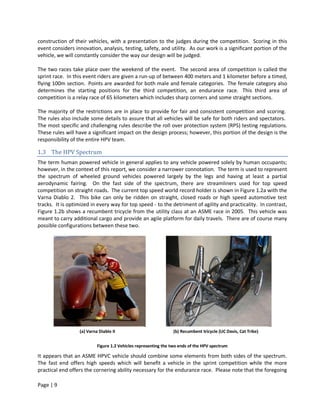
competition on straight roads. The current top speed world record holder is shown in Figure 1.2a with the
Varna Diablo 2. This bike can only be ridden on straight, closed roads or high speed automotive test
tracks. It is optimized in every way for top speed - to the detriment of agility and practicality. In contrast,
Figure 1.2b shows a recumbent tricycle from the utility class at an ASME race in 2005. This vehicle was
meant to carry additional cargo and provide an agile platform for daily travels. There are of course many
possible configurations between these two.


                  (a) Varna Diablo II                            (b) Recumbent tricycle (UC Davis, Cat Trike)


                           Figure 1.2 Vehicles representing the two ends of the HPV spectrum

It appears that an ASME HPVC vehicle should combine some elements from both sides of the spectrum.
The fast end offers high speeds which will benefit a vehicle in the sprint competition while the more
practical end offers the cornering ability necessary for the endurance race. Please note that the foregoing

Page | 9
project is not intended for competition in the utility class of the ASME HPVC and thus does not need to be
street ready or able to carry any additional cargo.

1.4 Cal Poly HPV History
In defining our design goals, we studied production vehicles, home built hobby vehicles, and other ASME
vehicles. In particular, the Cal Poly team has a history of strong performances in the ASME event and a
collection of various bicycle designs. We have presented only Cal Poly vehicles for consideration. There
are two reasons for this: vehicles built solely for the ASME HPVC are most relevant, and we only have
access to design details of Cal Poly vehicles. The Cal Poly HPV team is the oldest continually running HPV
team for any event in the entire world; however, much of the information regarding earlier designs has
been lost over the years.

Information regarding the previous four generations has been compiled by members of the HPV team to
follow the evolution through Princess, Secretariat, Matrix, and Athena. We have seen the vehicle frame
built successfully with a structural fairing and partial frame; a full, detachable aluminum frame; and a full
frame with redundant fairing structure. The drive trains of these vehicles have advanced from front wheel
drive with internally geared hubs to a newer, more efficient system with multiple shafts and chains to
allow rear wheel drive with a standard rear derailleur. A short description of these vehicles is provided
below.

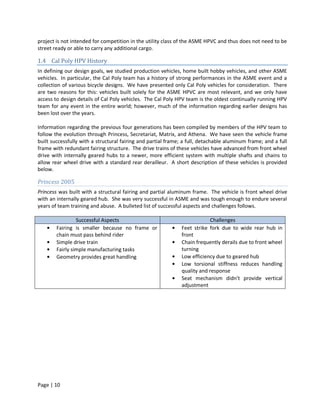
Princess 2005
Princess was built with a structural fairing and partial aluminum frame. The vehicle is front wheel drive
with an internally geared hub. She was very successful in ASME and was tough enough to endure several
years of team training and abuse. A bulleted list of successful aspects and challenges follows.

                 Successful Aspects                                        Challenges
        Fairing is smaller because no frame or                Feet strike fork due to wide rear hub in
        chain must pass behind rider                          front
        Simple drive train                                    Chain frequently derails due to front wheel
        Fairly simple manufacturing tasks                     turning
        Geometry provides great handling                      Low efficiency due to geared hub
                                                              Low torsional stiffness reduces handling
                                                              quality and response
                                                              Seat mechanism didn’t provide vertical
                                                              adjustment


Page | 10
Secretariat 2006
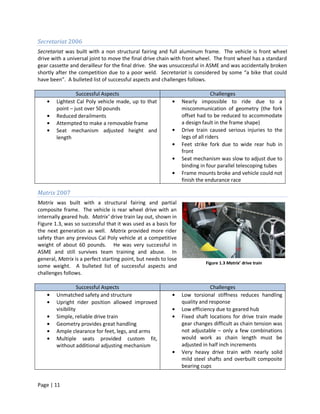
Secretariat was built with a non structural fairing and full aluminum frame. The vehicle is front wheel
drive with a universal joint to move the final drive chain with front wheel. The front wheel has a standard
gear cassette and derailleur for the final drive. She was unsuccessful in ASME and was accidentally broken
shortly after the competition due to a poor weld. Secretariat is considered by some “a bike that could
have been”. A bulleted list of successful aspects and challenges follows.

                 Successful Aspects                                             Challenges
        Lightest Cal Poly vehicle made, up to that               Nearly impossible to ride due to a
        point – just over 50 pounds                              miscommunication of geometry (the fork
        Reduced derailments                                      offset had to be reduced to accommodate
        Attempted to make a removable frame                      a design fault in the frame shape)
        Seat mechanism adjusted height and                       Drive train caused serious injuries to the
        length                                                   legs of all riders
                                                                 Feet strike fork due to wide rear hub in
                                                                 front
                                                                 Seat mechanism was slow to adjust due to
                                                                 binding in four parallel telescoping tubes
                                                                 Frame mounts broke and vehicle could not
                                                                 finish the endurance race

Matrix 2007
Matrix was built with a structural fairing and partial
composite frame. The vehicle is rear wheel drive with an
internally geared hub. Matrix’ drive train lay out, shown in
Figure 1.3, was so successful that it was used as a basis for
the next generation as well. Matrix provided more rider
safety than any previous Cal Poly vehicle at a competitive
weight of about 60 pounds. He was very successful in
ASME and still survives team training and abuse. In
general, Matrix is a perfect starting point, but needs to lose
                                                                           Figure 1.3 Matrix’ drive train
some weight. A bulleted list of successful aspects and
challenges follows.

                   Successful Aspects                                         Challenges
        Unmatched safety and structure                           Low torsional stiffness reduces handling
        Upright rider position allowed improved                  quality and response
        visibility                                               Low efficiency due to geared hub
        Simple, reliable drive train                             Fixed shaft locations for drive train made
        Geometry provides great handling                         gear changes difficult as chain tension was
        Ample clearance for feet, legs, and arms                 not adjustable – only a few combinations
        Multiple seats provided custom fit,                      would work as chain length must be
        without additional adjusting mechanism                   adjusted in half inch increments
                                                                 Very heavy drive train with nearly solid
                                                                 mild steel shafts and overbuilt composite
                                                                 bearing cups


Page | 11
Athena 2008
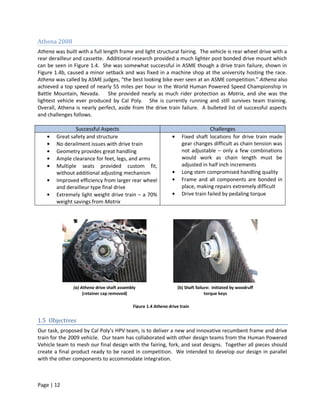
Athena was built with a full length frame and light structural fairing. The vehicle is rear wheel drive with a
rear derailleur and cassette. Additional research provided a much lighter post bonded drive mount which
can be seen in Figure 1.4. She was somewhat successful in ASME though a drive train failure, shown in
Figure 1.4b, caused a minor setback and was fixed in a machine shop at the university hosting the race.
Athena was called by ASME judges, “the best looking bike ever seen at an ASME competition.” Athena also
achieved a top speed of nearly 55 miles per hour in the World Human Powered Speed Championship in
Battle Mountain, Nevada. She provided nearly as much rider protection as Matrix, and she was the
lightest vehicle ever produced by Cal Poly. She is currently running and still survives team training.
Overall, Athena is nearly perfect, aside from the drive train failure. A bulleted list of successful aspects
and challenges follows.

                Successful Aspects                                                Challenges
        Great safety and structure                                   Fixed shaft locations for drive train made
        No derailment issues with drive train                        gear changes difficult as chain tension was
        Geometry provides great handling                             not adjustable – only a few combinations
        Ample clearance for feet, legs, and arms                     would work as chain length must be
        Multiple seats provided custom fit,                          adjusted in half inch increments
        without additional adjusting mechanism                       Long stem compromised handling quality
        Improved efficiency from larger rear wheel                   Frame and all components are bonded in
        and derailleur type final drive                              place, making repairs extremely difficult
        Extremely light weight drive train – a 70%                   Drive train failed by pedaling torque
        weight savings from Matrix


               (a) Athena drive shaft assembly                     (b) Shaft failure: Initiated by woodruff
                    (retainer cap removed)                                        torque keys

                                            Figure 1.4 Athena drive train


1.5 Objectives
Our task, proposed by Cal Poly’s HPV team, is to deliver a new and innovative recumbent frame and drive
train for the 2009 vehicle. Our team has collaborated with other design teams from the Human Powered
Vehicle team to mesh our final design with the fairing, fork, and seat designs. Together all pieces should
create a final product ready to be raced in competition. We intended to develop our design in parallel
with the other components to accommodate integration.


Page | 12
We sought to optimize the design while being somewhat conservative to create a high performance frame
and more reliable drive train. Our objectives led us to develop quantitative specifications and a design
philosophy described respectively in Chapter 2, Engineering Specifications and Chapter 3, Design Concept
Development.

Geometry and Handling
The bicycle needs to handle several riders varying from 5’1” to 6’4”. This necessitates a certain amount of
adjustability in the design. The layout is constrained primarily by the rider inside the vehicle, but must
provide good handling qualities for all riders. We set out to improve upon the handling of the 2008
vehicle Athena, which was described as good but ready for improvement. Specifically, our goal was to
increase the high speed stability of the vehicle while maintaining the current design’s low speed handling
characteristics. We desired also to shorten the stem based on rider requests. The steering mechanism
needs to fit inside the fairing and be located in a position so riders of varying heights can hold the
mechanism and not obstruct vision.

Drive Train Performance
The Human Powered Vehicle Team President stressed the need for reliability in the new design due to
drive train problems with the 2008 vehicle. We knew also that the weight of the overall drive train will
impact the performance of the vehicle as a whole, so we set out to find a suitable compromise.

Efficiency is also important, because power is very limited and efficiency losses are very significant. The
team desires drive train efficiency similar to that of the 2008 vehicle.

Safety
Our goal here was to provide a vehicle that will not injure the rider during racing and training. There are
two primary risks in this project, one is catastrophic frame failure and the other is bodily injury from the
moving parts of the drive train. To provide the best in safety, we intended to be thoughtful and
methodical in our design and analysis of all critical components. We also expected to create additional
design features to assure rider safety.

Manufacturing
Our primary goals for manufacturing are to stay on budget and complete the project in the two quarter
senior project schedule. We have allotted most of our budget toward materials as our labor is not
factored into the costs. We plan to spend $7500 at most. We are using Microsoft Project Planner to make
certain that we remain on track for our manufacturing time (See Appendix A for Gantt chart).

ASME Competition
The vehicle needs to adhere to the rules and categories judged in the ASME competition in order to win
the competition. The entire vehicle must have a safe and attractive appearance. We will inspect the final
design to ensure that it will be acceptable to the ASME judges. Additionally, the overall comfort and range
of adjustability will increase the rated utility and marketability.


Page | 13
Chapter 2: Engineering Specifications
Given the wide scope of our project, it was determined that BTI should be responsible for creating the
design specification documentation for much of the bike. We first contacted Robert Ehrmann, the current
HPV President, to determine what areas needed to be addressed. We also considered input from the
entire HPV team in group brainstorming sessions so that we would have a larger collection of ideas to
work with. From those conversations and our own research of the ASME competition rules, we developed
customer needs considering our main customers: the HPV President, the HPV team and riders, and the
ASME judges. To organize the resulting information, we employed a quality function development tool,
the house of quality. All pertinent needs are considered along with categories to quantify compliance with
each need. We also researched some existing designs as benchmarks for our own new design. The
combination of customer needs and benchmarks allowed us to turn a vague project definition into a
concise set of engineering specifications. The house of quality, shown in Appendix B, was indispensable in
the process of creating engineering specifications. We feel that communicating these goals in specific,
quantifiable terms will allow us to develop a product that meets or exceeds all expectations.

All current engineering specifications and tolerances are listed in Table 2.1. The requirements are
organized to show which needs apply to the entire project and which are specific to the frame and drive
train independently. Each specification is marked with an approximate level of risk associated with a lack
of compliance. In this table, risk is rated L for low, M for medium, and H for high risk. We have marked
each specification with the way in which it will be checked or considered. We will verify specifications by
analysis (A), physical testing (T), comparison based upon similarity to other designs (S), or physical
inspection (I).

                                Table 2.1 Formal specification and compliance matrix
        Engineering Specifications                Target Units             Tolerance Risk Compliance
        Frame
        Frame weight                                   7    lb               Max       M     A,T
        Torsional stiffness                         0.04    Deg / ft-lb      Max       M     A,T
        Hip angle                                   120     Degrees         ±5 Deg     L     A,I
        Bottom bracket rise                            8    in              ±0.50 in   M     A,I
        Stem Length                                   10 in                   ±4 in    L      A,I
        Drive Train
        Drive train weight                              6 lb                  Max      M     A,T
        Percent drive train covered                   50 %                    Min      M     A,S,I
        Entire Project
        Budget                                     7500 $                    Max       L      A
        Manufacturing                                40 days                ±5 days    H      S,I
        Total adjustability (seat to pedals)          8 in                  ±0.50 in   H     A,T,I
        Rider change time                             25 sec                  Max      L     T,S


Page | 14
Chapter 3: Design Concept Development
As part of BTI’s design process, the project was divided into different design areas: frame, drive train and
seat mounts. For each of these specific parts of the vehicle, we held a brainstorming session and came up
with many different concepts. After exhausting ourselves of all possible design ideas for our vehicle, we
formed a decision matrix for each area and analyzed our concepts based on our House of Quality chart,
seen in Appendix B. All of the decision matrices can be found in Appendix C, and drawings of all our
concepts are in Appendix D.

3.1 Design Philosophy
We committed ourselves to innovating where significant improvement is possible; however, we chose not
to stray too far from existing, successful technology. Throughout the design process we kept several
things in mind to ensure we delivered the best possible product. We wanted the bike to have a low
weight like Athena and a reliable drive train like Matrix.

3.2 Drive Train Concepts
The Cal Poly Human Powered Vehicle team has been around for 31 years and they have tried many drive
train configurations, which has provided a lot of valuable feedback. We examined many different ideas
that have been used before, and tried to come up with new concepts as well. Using information from HPV
team’s history, we were able to quickly identify areas of improvement for some of the more complex
ideas. After we completed our decision matrix, we ended up with a drive train design different than
anything the team has used in recent history.

We knew early on that the form of the drive train would drive much of the design. For example, with a
front wheel drive bike, there is no need for extra space under the rider and we would minimize the space
needed for the frame in order to minimize the size of the fairing. It was known also that every drive train
piece must be supported by a frame member, so the frame shape should be congruent with the drive train
lay out.


Front Wheel drive vs. Rear Wheel Drive
Some members of the Human Powered Vehicle Team were excited about the potential of a front wheel
drive design. This may end up making the bike slightly lighter, and would allow for a shorter wheelbase. A
front wheel drive design however, requires some way to accommodate the wheel turning with steering,
which will be inefficient when compared to a traditional chain driven system. One other major problem
on the front wheel drive system is that there are simply too many parts that would need to fit in between
the rider’s legs, compromising the ergonomics of the vehicle. Additionally, with so many parts connected
to the front wheel and fork, steering the bike can become a major problem. These problems make a front
wheel drive system much more difficult to produce, ride, and maintain than rear wheel drive.


Page | 15
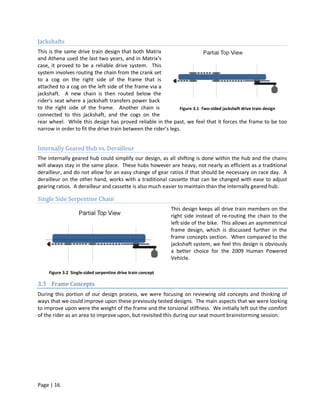
Jackshafts
This is the same drive train design that both Matrix
and Athena used the last two years, and in Matrix’s
case, it proved to be a reliable drive system. This
system involves routing the chain from the crank set
to a cog on the right side of the frame that is
attached to a cog on the left side of the frame via a
jackshaft. A new chain is then routed below the
rider’s seat where a jackshaft transfers power back
to the right side of the frame. Another chain is               Figure 3.1 Two-sided jackshaft drive train design
connected to this jackshaft, and the cogs on the
rear wheel. While this design has proved reliable in the past, we feel that it forces the frame to be too
narrow in order to fit the drive train between the rider’s legs.


Internally Geared Hub vs. Derailleur
The internally geared hub could simplify our design, as all shifting is done within the hub and the chains
will always stay in the same place. These hubs however are heavy, not nearly as efficient as a traditional
derailleur, and do not allow for an easy change of gear ratios if that should be necessary on race day. A
derailleur on the other hand, works with a traditional cassette that can be changed with ease to adjust
gearing ratios. A derailleur and cassette is also much easier to maintain than the internally geared hub.

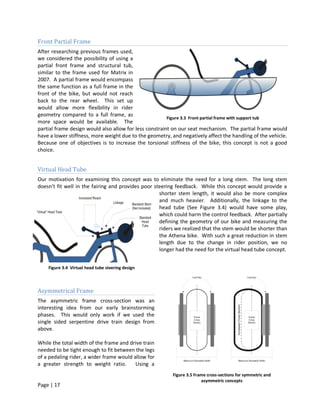
Single Side Serpentine Chain
                                                              This design keeps all drive train members on the
                                                              right side instead of re-routing the chain to the
                                                              left side of the bike. This allows an asymmetrical
                                                              frame design, which is discussed further in the
                                                              frame concepts section. When compared to the
                                                              jackshaft system, we feel this design is obviously
                                                              a better choice for the 2009 Human Powered
                                                              Vehicle.

     Figure 3.2 Single-sided serpentine drive train concept

3.3 Frame Concepts
During this portion of our design process, we were focusing on reviewing old concepts and thinking of
ways that we could improve upon these previously tested designs. The main aspects that we were looking
to improve upon were the weight of the frame and the torsional stiffness. We initially left out the comfort
of the rider as an area to improve upon, but revisited this during our seat mount brainstorming session.


Page | 16
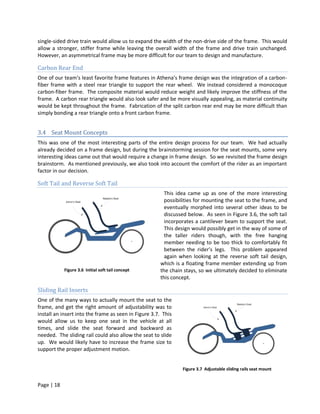
Front Partial Frame
After researching previous frames used,
we considered the possibility of using a
partial front frame and structural tub,
similar to the frame used for Matrix in
2007. A partial frame would encompass
the same function as a full frame in the
front of the bike, but would not reach
back to the rear wheel. This set up
would allow more flexibility in rider
geometry compared to a full frame, as
                                                        Figure 3.3 Front partial frame with support tub
more space would be available. The
partial frame design would also allow for less constraint on our seat mechanism. The partial frame would
have a lower stiffness, more weight due to the geometry, and negatively affect the handling of the vehicle.
Because one of objectives is to increase the torsional stiffness of the bike, this concept is not a good
choice.


Virtual Head Tube
Our motivation for examining this concept was to eliminate the need for a long stem. The long stem
doesn’t fit well in the fairing and provides poor steering feedback. While this concept would provide a
                                                    shorter stem length, it would also be more complex
                                                    and much heavier. Additionally, the linkage to the
                                                    head tube (See Figure 3.4) would have some play,
                                                    which could harm the control feedback. After partially
                                                    defining the geometry of our bike and measuring the
                                                    riders we realized that the stem would be shorter than
                                                    the Athena bike. With such a great reduction in stem
                                                    length due to the change in rider position, we no
                                                    longer had the need for the virtual head tube concept.


    Figure 3.4 Virtual head tube steering design


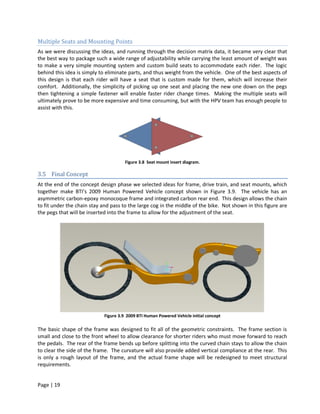
Asymmetrical Frame
The asymmetric frame cross-section was an
interesting idea from our early brainstorming
phases. This would only work if we used the
single sided serpentine drive train design from
above.

While the total width of the frame and drive train
needed to be tight enough to fit between the legs
of a pedaling rider, a wider frame would allow for
a greater strength to weight ratio.       Using a
                                                         Figure 3.5 Frame cross-sections for symmetric and
                                                                       asymmetric concepts
Page | 17
single-sided drive train would allow us to expand the width of the non-drive side of the frame. This would
allow a stronger, stiffer frame while leaving the overall width of the frame and drive train unchanged.
However, an asymmetrical frame may be more difficult for our team to design and manufacture.

Carbon Rear End
One of our team’s least favorite frame features in Athena’s frame design was the integration of a carbon-
fiber frame with a steel rear triangle to support the rear wheel. We instead considered a monocoque
carbon-fiber frame. The composite material would reduce weight and likely improve the stiffness of the
frame. A carbon rear triangle would also look safer and be more visually appealing, as material continuity
would be kept throughout the frame. Fabrication of the split carbon rear end may be more difficult than
simply bonding a rear triangle onto a front carbon frame.


3.4 Seat Mount Concepts
This was one of the most interesting parts of the entire design process for our team. We had actually
already decided on a frame design, but during the brainstorming session for the seat mounts, some very
interesting ideas came out that would require a change in frame design. So we revisited the frame design
brainstorm. As mentioned previously, we also took into account the comfort of the rider as an important
factor in our decision.

Soft Tail and Reverse Soft Tail
                                                        This idea came up as one of the more interesting
                                                        possibilities for mounting the seat to the frame, and
                                                        eventually morphed into several other ideas to be
                                                        discussed below. As seen in Figure 3.6, the soft tail
                                                        incorporates a cantilever beam to support the seat.
                                                        This design would possibly get in the way of some of
                                                        the taller riders though, with the free hanging
                                                        member needing to be too thick to comfortably fit
                                                        between the rider’s legs. This problem appeared
                                                        again when looking at the reverse soft tail design,
                                                      which is a floating frame member extending up from
            Figure 3.6 Initial soft tail concept      the chain stays, so we ultimately decided to eliminate
                                                      this concept.

Sliding Rail Inserts
One of the many ways to actually mount the seat to the
frame, and get the right amount of adjustability was to
install an insert into the frame as seen in Figure 3.7. This
would allow us to keep one seat in the vehicle at all
times, and slide the seat forward and backward as
needed. The sliding rail could also allow the seat to slide
up. We would likely have to increase the frame size to
support the proper adjustment motion.


                                                               Figure 3.7 Adjustable sliding rails seat mount


Page | 18
Multiple Seats and Mounting Points
As we were discussing the ideas, and running through the decision matrix data, it became very clear that
the best way to package such a wide range of adjustability while carrying the least amount of weight was
to make a very simple mounting system and custom build seats to accommodate each rider. The logic
behind this idea is simply to eliminate parts, and thus weight from the vehicle. One of the best aspects of
this design is that each rider will have a seat that is custom made for them, which will increase their
comfort. Additionally, the simplicity of picking up one seat and placing the new one down on the pegs
then tightening a simple fastener will enable faster rider change times. Making the multiple seats will
ultimately prove to be more expensive and time consuming, but with the HPV team has enough people to
assist with this.


                                       Figure 3.8 Seat mount insert diagram.

3.5 Final Concept
At the end of the concept design phase we selected ideas for frame, drive train, and seat mounts, which
together make BTI’s 2009 Human Powered Vehicle concept shown in Figure 3.9. The vehicle has an
asymmetric carbon-epoxy monocoque frame and integrated carbon rear end. This design allows the chain
to fit under the chain stay and pass to the large cog in the middle of the bike. Not shown in this figure are
the pegs that will be inserted into the frame to allow for the adjustment of the seat.


                             Figure 3.9 2009 BTI Human Powered Vehicle initial concept

The basic shape of the frame was designed to fit all of the geometric constraints. The frame section is
small and close to the front wheel to allow clearance for shorter riders who must move forward to reach
the pedals. The rear of the frame bends up before splitting into the curved chain stays to allow the chain
to clear the side of the frame. The curvature will also provide added vertical compliance at the rear. This
is only a rough layout of the frame, and the actual frame shape will be redesigned to meet structural
requirements.


Page | 19
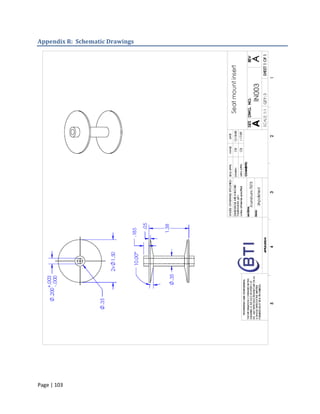
Our seat mount design is a variation on the multiple seats and mounting points’ concept. The seat mount
would use different combinations of four mounting inserts designs to accommodate the rider height. Two
layouts were chosen for different sized riders. Since exchanging seats in races requires easy access to the
mounting locations, the pegs have a conical shape to allow easier alignment with the seat inserts.

                                                The middle mounting mechanism differs from the front
                                                and rear cone peg designs. The middle has two mounting
                                                locations for stability. These mounting locations are
                                                shared by both seat mount sets. Having two mounting
                                                locations requires a thicker frame cross-section in the
                                                middle of the mount to give the inserts a surface to mount
                                                to. Our team considered widening the frame to allow for
                                                two mounting locations, but found a wider frame would
                                                infringe upon the drive train’s chain path from the rear
                                                cassette. Instead, we proposed a post-bonded mounting
      Figure 3.10 Seat Mount concept design     beam on top of the frame.


Page | 20
Chapter 4: Design Refinement
This section details the refinement of our design from concept to final product. These changes are the
result of additional concerns about manufacturing and performance.

4.1 Frame

Beam Model
In this estimation, the frame is modeled as a flat beam with varying cross sections and we focus only on
the weight of the rider. To model the largest loads, we assumed a 3-g quasi-static impact load with a 200
lb rider. We considered the 600 lb load to be a point load in the center of the seat mount location, and
found the reaction loads in the front and rear wheel locations from this. With these forces, we were able
to make shear and moment diagrams, and using these, we found the largest moment at each section of
the frame.

Each section was assigned a representative section height based on the internal moments expected. The
chain stays were modeled as a 2.25 in. tall, 1 inch thick section, the center of the frame was modeled as a
5 inch tall, 1.8 inch wide section, and the front portion of the frame as a 4 inch tall, 1.8 inch thick section.
Figure 4.1 below shows how these sections were defined.


                                     Figure 4.1 Simplified beam model sections


The section sizes and internal moments allowed us to make rough estimates for different parts of the
carbon layup. This model only allows us to estimate the number of layers unidirectional fiber along the
length of the frame, the 0° direction. We predict here that two layers will be sufficient for the entire
frame.

This of course is a very limited model, and we will not define a layup schedule until further analysis is
completed. This model did not account for any torsion, lateral load, or drive train loads. This analysis was
only used for rough sizing of cross section heights.


Page | 21
Shape
We initially intended to create very smooth, complex curves for
the best in strength, stiffness, and appearance. As we moved out
of the concept phase, we determined that our time line
necessitated scaling back our efforts. The basic frame shape was
still designed around the structural needs, but the detailed
choices were simplified. This choice will allow us to complete
the project in time to test the vehicle, which will be much more
valuable than the meager gains from the more complex frame              Figure 4.2 Original curved chain stay (top)
shape.                                                                     vs. Final straight chain stay (bottom)


                                 At this point, we decided that manufacturability was the most important
                                 factor in the details of the frame shape. Accordingly, we re-developed our
                                 manufacturing plan so that we would know how to build the frame. We
                                 chose to build a male plug out of flat sheets with filleted edges. The pieces
                                 could be cut with any 2-D shape. The manufactruing plan will be discussed
                                 in more detail in Chapter 7.

                                 The chain stays are a great example of this refinement. In Figure 4.2 an
                                 original curved shape is compared to the final straight shape. The final
                                 design also has a constant thickness instead of the gradual taper of the
                                 original shape.
   Figure 4.3 Rear dropout and
     bonding surface of frame
                              Chain clearance also drove some of the
shape changes. The chain must pass along the frame without
obstruction. In particular, the right side of the bottom of the frame
was kept narrow and flat. Also, the chain stays were designed with a
high arching shape to allow the chain to pass underneath.

The rear end of the frame was updated to allow for bonded
aluminum drop outs. These require a straight or diverging opening at
the ends of the chain stays so that part of the drop out can be
inserted and bonded to the frame. We chose to extend a short
straight section for this purpose. Figure 4.3 shows a rear drop out
and the bonding area of the frame.

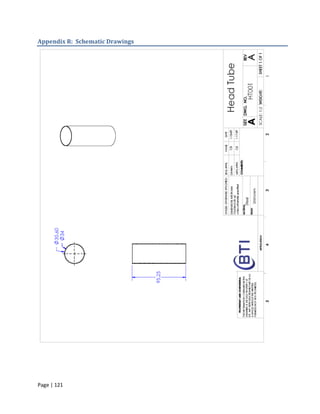
The frame is reinforced with a steel head tube which we believe will
simplify manufacturing and make the frame stiffer and safer. This          Figure 4.4 Head tube bulge
head tube requires a bulge on the right side. This shape was
included to make the head tube fit in the narrow side of the frame. The left side of the frame does not
need this shape, because it is wider than the head tube. We feel that the bulge perfectly highlights the
asymmetry of the frame, which is perhaps the most interesting feature of the whole project. An image of
the head tube’s interesting design is shown in Figure 4.4 for clarity.


Page | 22
Another area of the frame that needed refinement was the
clearance for the front fork. The frame was originally designed to
incorporate the composite suspension fork developed as a
previous senior project. While this was taken into account for
designing the geometry of the bike and the handling, our initial
CAD design did not leave enough space for the fork to be
mounted. Figure 4.5 shows the spacing originally allotted for the
fork, which would not have cleared the front tire. Another issue
needing consideration was the travel of the fork, as we were
designing for a suspension fork. To accommodate the fork and
the possible travel due to suspension, the bottom side of the
head tube needed to move up around two inches vertically.

Moving the head tube up two inches was not as simple of a task
as it seemed. Figure 4.6 compares the overall change in frame
shape that was required. While the head tube needed to change Figure 4.5 Original front end design with too
positions, the bottom bracket location could not change                  little clearance over front wheel
positions, as the entire bike was designed around its fixed
position. We also wanted to avoid changing height of the frame’s top due to spacing in the fairing. To
accommodate these requirements, we went away from a “straight-line frame”. The frame was curved to
match the arc of the front tire, improving spacing and aesthetics. We recognized the front of the original
frame was thicker than necessary, allowing us to reduce the vertical thickness around the head tube.
Locations of drive train and mounting points were inspected after the frame geometry was revised.
Changing the frame geometry forced us to relocate the front idler, which interfered with the chain line.
The front jackshaft location was repositioned for chain clearance in the front frame section. The last
position moved was the location of the front seat mount. Forced to move due to available space after the
geometry change, the seat mount repositioning does not affect the seat location for shorter riders. All of
these movements can be compared in Figure 4.6.


                             Figure 4.6 New frame design over lighter old frame design


Page | 23
4.2 Drive Train
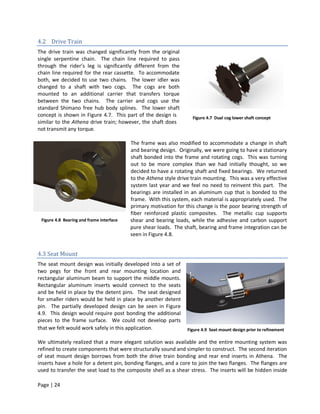
The drive train was changed significantly from the original
single serpentine chain. The chain line required to pass
through the rider’s leg is significantly different from the
chain line required for the rear cassette. To accommodate
both, we decided to use two chains. The lower idler was
changed to a shaft with two cogs. The cogs are both
mounted to an additional carrier that transfers torque
between the two chains. The carrier and cogs use the
standard Shimano free hub body splines. The lower shaft
concept is shown in Figure 4.7. This part of the design is          Figure 4.7 Dual cog lower shaft concept
similar to the Athena drive train; however, the shaft does
not transmit any torque.

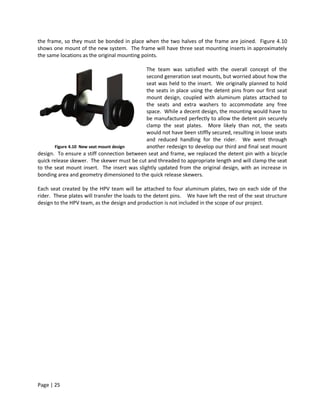
                                          The frame was also modified to accommodate a change in shaft
                                          and bearing design. Originally, we were going to have a stationary
                                          shaft bonded into the frame and rotating cogs. This was turning
                                          out to be more complex than we had initially thought, so we
                                          decided to have a rotating shaft and fixed bearings. We returned
                                          to the Athena style drive train mounting. This was a very effective
                                          system last year and we feel no need to reinvent this part. The
                                          bearings are installed in an aluminum cup that is bonded to the
                                          frame. With this system, each material is appropriately used. The
                                          primary motivation for this change is the poor bearing strength of
                                          fiber reinforced plastic composites. The metallic cup supports
 Figure 4.8 Bearing and frame interface   shear and bearing loads, while the adhesive and carbon support
                                          pure shear loads. The shaft, bearing and frame integration can be
                                          seen in Figure 4.8.


4.3 Seat Mount
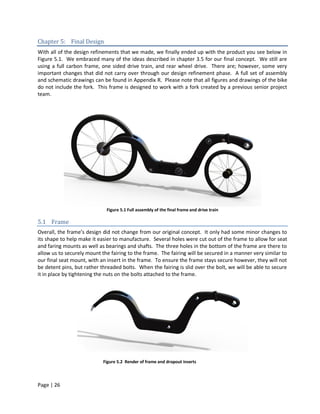
The seat mount design was initially developed into a set of
two pegs for the front and rear mounting location and
rectangular aluminum beam to support the middle mounts.
Rectangular aluminum inserts would connect to the seats
and be held in place by the detent pins. The seat designed
for smaller riders would be held in place by another detent
pin. The partially developed design can be seen in Figure
4.9. This design would require post bonding the additional
pieces to the frame surface. We could not develop parts
that we felt would work safely in this application.               Figure 4.9 Seat mount design prior to refinement

We ultimately realized that a more elegant solution was available and the entire mounting system was
refined to create components that were structurally sound and simpler to construct. The second iteration
of seat mount design borrows from both the drive train bonding and rear end inserts in Athena. The
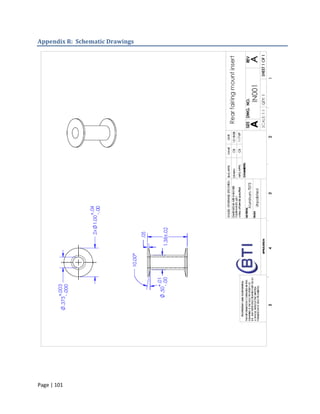
inserts have a hole for a detent pin, bonding flanges, and a core to join the two flanges. The flanges are
used to transfer the seat load to the composite shell as a shear stress. The inserts will be hidden inside

Page | 24
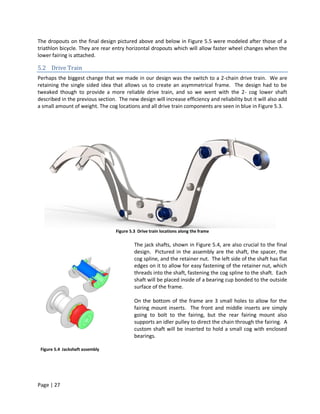
the frame, so they must be bonded in place when the two halves of the frame are joined. Figure 4.10
shows one mount of the new system. The frame will have three seat mounting inserts in approximately
the same locations as the original mounting points.

                                             The team was satisfied with the overall concept of the
                                             second generation seat mounts, but worried about how the
                                             seat was held to the insert. We originally planned to hold
                                             the seats in place using the detent pins from our first seat
                                             mount design, coupled with aluminum plates attached to
                                             the seats and extra washers to accommodate any free
                                             space. While a decent design, the mounting would have to
                                             be manufactured perfectly to allow the detent pin securely
                                             clamp the seat plates. More likely than not, the seats
                                             would not have been stiffly secured, resulting in loose seats
                                             and reduced handling for the rider. We went through
       Figure 4.10 New seat mount design     another redesign to develop our third and final seat mount
design. To ensure a stiff connection between seat and frame, we replaced the detent pin with a bicycle
quick release skewer. The skewer must be cut and threaded to appropriate length and will clamp the seat
to the seat mount insert. The insert was slightly updated from the original design, with an increase in
bonding area and geometry dimensioned to the quick release skewers.

Each seat created by the HPV team will be attached to four aluminum plates, two on each side of the
rider. These plates will transfer the loads to the detent pins. We have left the rest of the seat structure
design to the HPV team, as the design and production is not included in the scope of our project.


Page | 25
Chapter 5: Final Design
With all of the design refinements that we made, we finally ended up with the product you see below in
Figure 5.1. We embraced many of the ideas described in chapter 3.5 for our final concept. We still are
using a full carbon frame, one sided drive train, and rear wheel drive. There are; however, some very
important changes that did not carry over through our design refinement phase. A full set of assembly
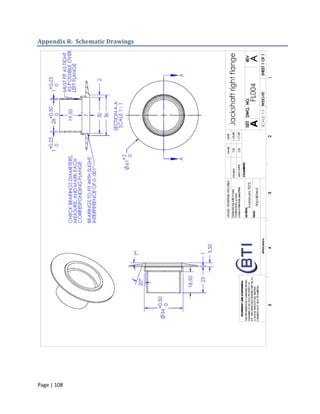
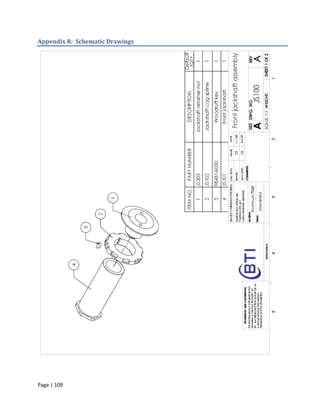
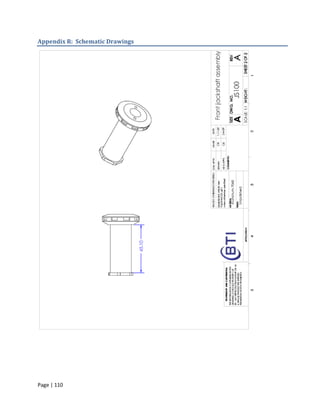
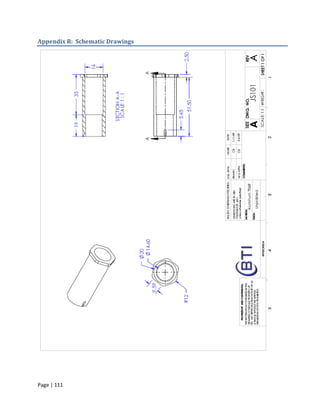
and schematic drawings can be found in Appendix R. Please note that all figures and drawings of the bike
do not include the fork. This frame is designed to work with a fork created by a previous senior project
team.


                             Figure 5.1 Full assembly of the final frame and drive train

5.1 Frame
Overall, the frame’s design did not change from our original concept. It only had some minor changes to
its shape to help make it easier to manufacture. Several holes were cut out of the frame to allow for seat
and faring mounts as well as bearings and shafts. The three holes in the bottom of the frame are there to
allow us to securely mount the fairing to the frame. The fairing will be secured in a manner very similar to
our final seat mount, with an insert in the frame. To ensure the frame stays secure however, they will not
be detent pins, but rather threaded bolts. When the fairing is slid over the bolt, we will be able to secure
it in place by tightening the nuts on the bolts attached to the frame.


                            Figure 5.2 Render of frame and dropout inserts


Page | 26
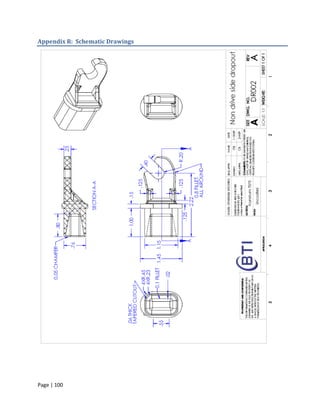
The dropouts on the final design pictured above and below in Figure 5.5 were modeled after those of a
triathlon bicycle. They are rear entry horizontal dropouts which will allow faster wheel changes when the
lower fairing is attached.

5.2 Drive Train
Perhaps the biggest change that we made in our design was the switch to a 2-chain drive train. We are
retaining the single sided idea that allows us to create an asymmetrical frame. The design had to be
tweaked though to provide a more reliable drive train, and so we went with the 2- cog lower shaft
described in the previous section. The new design will increase efficiency and reliability but it will also add
a small amount of weight. The cog locations and all drive train components are seen in blue in Figure 5.3.


                                  Figure 5.3 Drive train locations along the frame

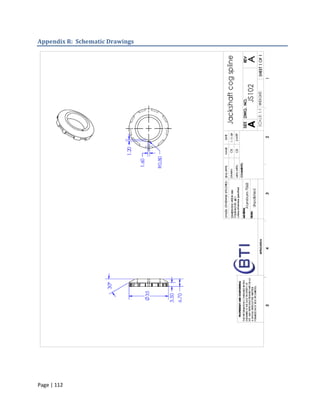
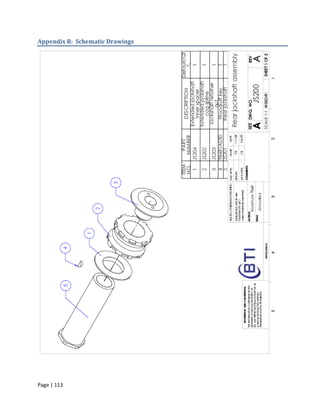
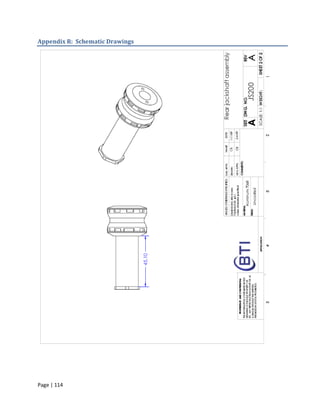
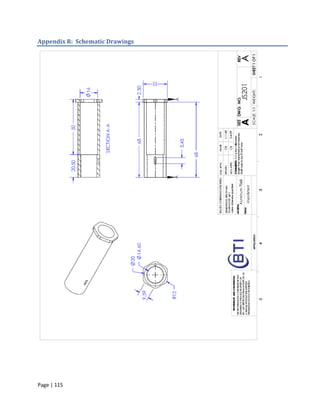
                                           The jack shafts, shown in Figure 5.4, are also crucial to the final
                                           design. Pictured in the assembly are the shaft, the spacer, the
                                           cog spline, and the retainer nut. The left side of the shaft has flat
                                           edges on it to allow for easy fastening of the retainer nut, which
                                           threads into the shaft, fastening the cog spline to the shaft. Each
                                           shaft will be placed inside of a bearing cup bonded to the outside
                                           surface of the frame.

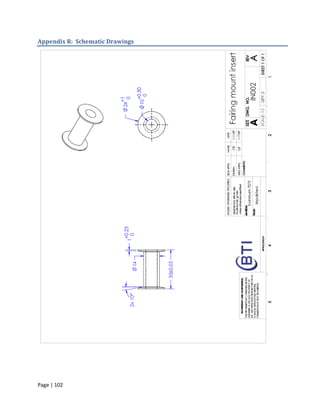
                                           On the bottom of the frame are 3 small holes to allow for the
                                           fairing mount inserts. The front and middle inserts are simply
                                           going to bolt to the fairing, but the rear fairing mount also
                                           supports an idler pulley to direct the chain through the fairing. A
                                           custom shaft will be inserted to hold a small cog with enclosed
                                           bearings.

 Figure 5.4 Jackshaft assembly


Page | 27
Figure 5.5 Inserts in the frame

5.3 Seat Mounts and Fairing Mounts
The lower three red pieces shown in Figure 5.5 show the fairing mounts on the frame. In past years the
fairing has been a part of the structural integrity of the bike, but our frame is stiff enough to handle these
loads on its own. Thus the fairing no longer has to be a structural member of the bike. Nonetheless, the
fairing still has to attach to the frame. This will be done by a channel molded into the fairing, and against
the bottom of the frame, and will be secured by threading bolts through the fairing mount inserts shown
above.

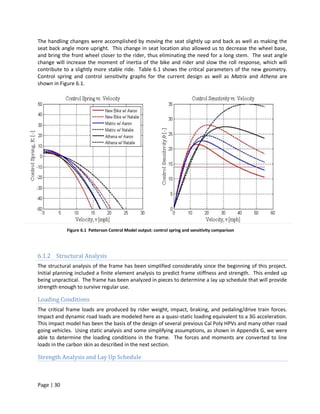
The seats created by the HPV team attach to an aluminum insert bonded inside the frame by way of a
detent pin. The seat is coupled with the pin through
an aluminum sheet, supported by a carbon fiber seat
mount to be designed by the HPV team. To ensure a
stiff connection between seat and frame, we replaced
our original detent pin design with a quick release
skewer as seen in Figure 5.6. The skewer must be cut
and threaded to appropriate length and will clamp
the seat to the seat mount insert. The insert also has
an increase in bonding area compared to the original
design and geometry dimensioned to the quick
release skewers. Figure 5.6 shows the basic setup for
the seat mounting and aluminum plate. The stresses
on this seat mount can be very high during cornering,
and the analysis of this can be found in section 6.3.     Figure 5.6 Seat mount final design

5.4 Integration with the Cal Poly Human Powered Vehicle Club
As discussed in section 5.3, we have worked closely with the Human Powered Vehicle team to ensure that
the seats, fairing, and bike will come together seamlessly. While we have made and designed many of the
parts that will make this bike successful in competition, the team has been responsible for picking the
proper stem, handlebar, shifters, derailleurs, brakes, and any other standard bicycle components used.
These parts are very similar to parts used on older bikes, and have been proven to work very well during
competition.


Page | 28
Chapter 6: Analysis

6.1 Frame
The frame has three basic requirements. It must provide: good handling, stiffness, and sufficient strength.
In order to meet these goals, we used an existing mathematical model of bicycle controllability and
classical lamination theory.

6.1.1 Handling and Controllability Analysis
In recent years, the Cal Poly HPV designs have provided exceptional handling characteristics. Many of the
team riders have provided feedback comparing some of these vehicles. We have also used the Patterson
Control Model (PCM) to quantify the response of the various bikes. The qualitative rider input was used to
interpret our results so that we could choose the best compromise of handling qualities. This model is
based on several critical parameters that are shown in Table 6.1.

The Patterson Control Model provides two very useful tools for analyzing the handling of a bicycle. The
first is the control spring as a function of velocity, which indicates the force feedback felt through the
handle bars. The positive values show a control reversal and tend to make a bike unstable and negative
values tend to make a bike stable. In this case, the maximum value must be low and the transition to a
negative control spring must happen at very low speeds so that the bike stabilizes itself quickly. The
second tool is a graph of the control sensitivity as a function of velocity. Control sensitivity describes the
roll response of the bike compared to the rider’s intention. The basic equations of this model are shown
in Appendix E and the Mat lab code used is included as Appendix F. A full description of these tools is
beyond the scope of this report, but more information is available from references 3 and 4.

                                 Table 6.1 Bicycle parameters based on Aaron's geometry

            Parameter                              Units       2009 BTI         Athena    Matrix
            Wheelbase                    A          [m]         1.321            1.397    1.051
            C.G. Position                B          [m]         0.838            0.874    0.531
            C.G. Height                  h          [m]         0.445            0.394    0.394
            Head Tube Angle              β           [°]          12               12       12
            Radius of Gyration           Kx         [m]         0.272            0.213    0.213
            Control Radius               Rh         [m]          0.2             0.203    0.127
            Front Wheel Radius           R          [m]         0.241            0.241    0.241
            Offset                       e          [m]         -0.076          -0.076    -0.051


In particular, we chose to compare to Athena because the general configuration is the same as our design.
We reduced the control sensitivity slightly while retaining a similar control spring response. Decreasing
the control sensitivity will provide a ride that feels more stable and predictable and should ultimately lead
to better performance. Testing by W.B. Patterson showed that a control sensitivity of about 14 made for a
stable, comfortable ride. This line is shown on the graph for comparison. We have been careful to retain
a fairly high amount of control sensitivity so that the bike will still feel responsive and quick. We believe
that the HPV riders are exceptional bike handlers and will prefer higher control sensitivity.


Page | 29
The handling changes were accomplished by moving the seat slightly up and back as well as making the
seat back angle more upright. This change in seat location also allowed us to decrease the wheel base,
and bring the front wheel closer to the rider, thus eliminating the need for a long stem. The seat angle
change will increase the moment of inertia of the bike and rider and slow the roll response, which will
contribute to a slightly more stable ride. Table 6.1 shows the critical parameters of the new geometry.
Control spring and control sensitivity graphs for the current design as well as Matrix and Athena are
shown in Figure 6.1.


            Figure 6.1 Patterson Control Model output: control spring and sensitivity comparison


6.1.2 Structural Analysis
The structural analysis of the frame has been simplified considerably since the beginning of this project.
Initial planning included a finite element analysis to predict frame stiffness and strength. This ended up
being unpractical. The frame has been analyzed in pieces to determine a lay up schedule that will provide
strength enough to survive regular use.

Loading Conditions
The critical frame loads are produced by rider weight, impact, braking, and pedaling/drive train forces.
Impact and dynamic road loads are modeled here as a quasi-static loading equivalent to a 3G acceleration.
This impact model has been the basis of the design of several previous Cal Poly HPVs and many other road
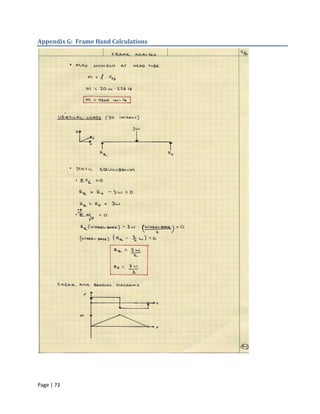
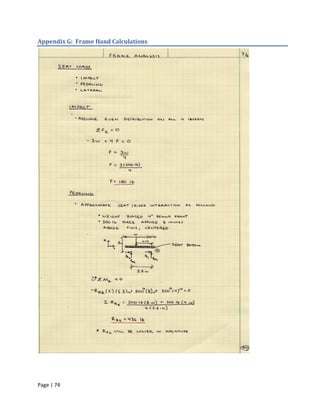
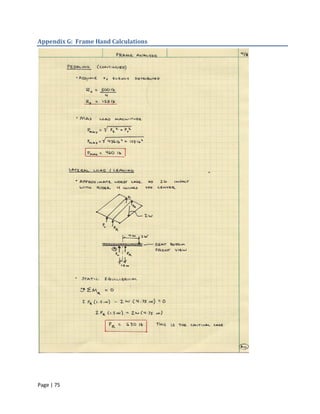
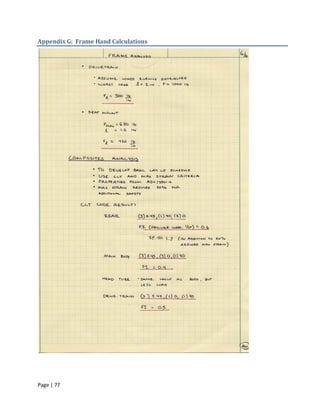
going vehicles. Using static analysis and some simplifying assumptions, as shown in Appendix G, we were
able to determine the loading conditions in the frame. The forces and moments are converted to line
loads in the carbon skin as described in the next section.

Strength Analysis and Lay Up Schedule


Page | 30
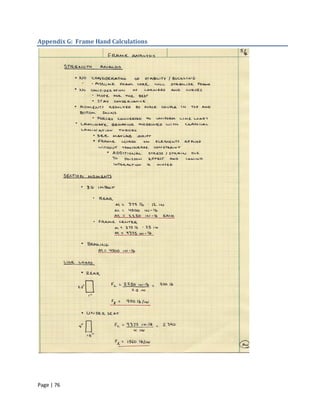
The strength analysis uses classical lamination theory and the max strain failure criteria to predict the
failure index of elements of the frame. The frame skin is considered in elements at critical locations and
treated as a laminated plate with applied line loads. Additionally, bending moments in the frame section
are resolved by a force couple due to uniform line loads in the top and bottom skins of each section. This
method is conservative in general because it neglects the load carried by the sides of the frame. In this
case; however, filleted corners and curves are not considered, so some caution must be used. This
analysis is presented in Appendix G and uses the Matlab code provided in Appendix H.

The composite analysis is based on the properties on AS4/3501-6 material. Previous testing of HPV team
lay ups has shown properties comparable to this material. To account for potential damage, the
maximum allowable strain has been reduced 20% as is standard practice. The reported maximum strain is
based on tensile tests of small sample coupons and may not always represent an actual part, even if the
part has not been damaged.

It has been assumed that the structural foam core will provide adequate stability for the frame skin.
Accordingly, no analysis has been performed to predict buckling or cross section changes. It is also
particularly difficult to analyze the crotch piece of the frame, so additional material will be added to
prevent failure. This area will be reinforced with Kevlar 49 for toughness.

The final layup schedule for the frame will have a minimum safety factor of 1.7 not including the 20%
reduction in allowable strain. This occurs in the rear end of the bike at the joint of the chain stays. The
whole frame will have three layers of balanced fabric biased at 45 degrees to provide torsional stiffness.
The whole frame will also have one layer of balanced fabric oriented at 0 and 90 degrees to provide
balanced strength around the bonded components. In addition, the top and bottom on the frame sections
will be capped with 2 layers of unidirectional tape oriented along the frame length. The layup schedule is
shown below.

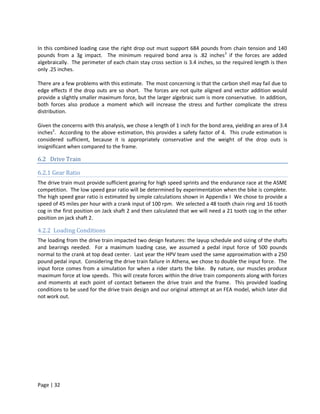
                                         Table 6.2 Frame lay up schedule
                           Material           Direction      Layers         Location
                         Frame Sides
                         Carbon fabric           ±45°          3              Global
                         Carbon fabric          0°,90°         1              Global
                          Carbon uni              0°           1           Fillet, Insert
                            Crotch
                         Carbon fabric           ±45°          3              Global
                         Carbon fabric          0°,90°         1              Global
                           Kevlar 29             ±45°          1           Inner Crotch
                         Kevlar 49 uni            0°           1           Inner Crotch
                          Carbon uni              0°           1              Fillet


Bonded Drop Outs
The drop outs will be loaded by both rider weight and chain tension. To be conservative, we chose to
combine the two effects and determine a bond area that could support both forces together. Only the
right side drop out will see this much stress, but both will be manufactured with the same bonding area.
We also chose a degraded bond strength value of 1000 psi as we are working with average bond stress.

Page | 31
In this combined loading case the right drop out must support 684 pounds from chain tension and 140
pounds from a 3g impact. The minimum required bond area is .82 inches 2 if the forces are added
algebraically. The perimeter of each chain stay cross section is 3.4 inches, so the required length is then
only .25 inches.

There are a few problems with this estimate. The most concerning is that the carbon shell may fail due to
edge effects if the drop outs are so short. The forces are not quite aligned and vector addition would
provide a slightly smaller maximum force, but the larger algebraic sum is more conservative. In addition,
both forces also produce a moment which will increase the stress and further complicate the stress
distribution.

Given the concerns with this analysis, we chose a length of 1 inch for the bond area, yielding an area of 3.4
inches2. According to the above estimation, this provides a safety factor of 4. This crude estimation is
considered sufficient, because it is appropriately conservative and the weight of the drop outs is
insignificant when compared to the frame.

6.2 Drive Train

6.2.1 Gear Ratio
The drive train must provide sufficient gearing for high speed sprints and the endurance race at the ASME
competition. The low speed gear ratio will be determined by experimentation when the bike is complete.
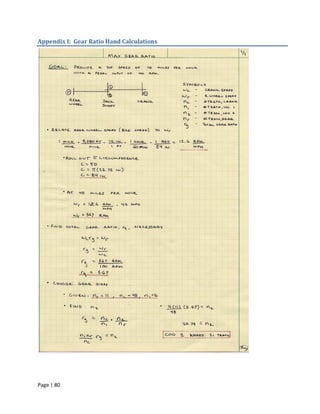
The high speed gear ratio is estimated by simple calculations shown in Appendix I We chose to provide a
speed of 45 miles per hour with a crank input of 100 rpm. We selected a 48 tooth chain ring and 16 tooth
cog in the first position on Jack shaft 2 and then calculated that we will need a 21 tooth cog in the other
position on jack shaft 2.

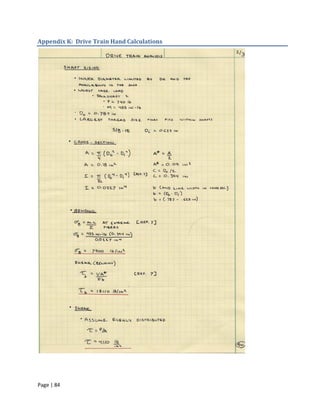
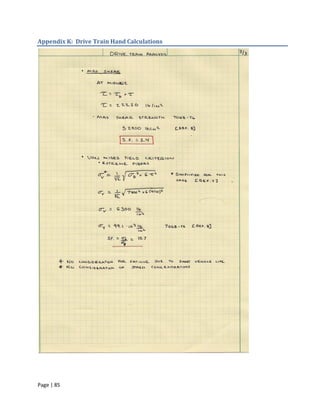
4.2.2 Loading Conditions
The loading from the drive train impacted two design features: the layup schedule and sizing of the shafts
and bearings needed. For a maximum loading case, we assumed a pedal input force of 500 pounds
normal to the crank at top dead center. Last year the HPV team used the same approximation with a 250
pound pedal input. Considering the drive train failure in Athena, we chose to double the input force. The
input force comes from a simulation for when a rider starts the bike. By nature, our muscles produce
maximum force at low speeds. This will create forces within the drive train components along with forces
and moments at each point of contact between the drive train and the frame. This provided loading
conditions to be used for the drive train design and our original attempt at an FEA model, which later did
not work out.


Page | 32
Figure 6.2 Geometry diagram for drive train force analysis

Using the geometry shown above in Figure 4.3, we were able to calculate the reaction forces for each
shaft in the drive train based on the chain tension. The reactions for points 1, 2, and 3 are shown below in
Table 6.3. These correspond to the bottom bracket, front jackshaft, and rear jackshaft respectively.
Details regarding the geometry of Figure 6.2 can be found in Appendix J.


                Table 6.3 Chain tensions, shaft loads, and reaction forces based on 500lbf Pedaling Force
                                   Tension             Vertical Shaft Loads          Horizontal Shaft
               Location              [lb]                       [lb]                   Loads [lb]
                  1                  855                       -219                       -827
                  2                  855                       -391                        227
                  3                  684                        735                        -73

The reactionary loads on the drive and non drive side of the frame were calculated from the vertical loads,
horizontal loads, and length of the shafts. This informed us where the critical sections were located and
what was the minimum force needed to design our bearing cup mounts. The critical load takes place at
location 3, on the drive side of the rear jackshaft. The skin of the frame experiences 1038 lb vertically and
411 lb horizontally. We designed around this loading case to ensure our drive train and frame would not
fail.

6.2.2 Bonding Area
The drive train shafts are bonded to the frame using round, tapered flanges. Adhesive bonding is a rapidly
developing field, and exact stress analysis of a particular bond is very difficult. To avoid excessive analysis,
we have used information from previous testing. The HPV performed careful testing of similar aluminum
bonds last year. The test data was reported as maximum average stress at joint failure. The drive train
cups will be similarly sized so an average shear stress approach is appropriate for design. Additionally, the
bonded flanges are tapered to reduce stress concentrations and smooth the shear stress distribution.

The analysis of a uniform stress distribution is used to determine the minimum outer diameter of the
bonded flanges. The right side cups will see significantly higher loads, estimated up to 740 pounds. The


Page | 33
right side cups must be at least 2.16 inches in diameter to provide a safety factor of three. The left side
requires very little area. If sized by area alone, the left side may fail, as much of the bonded area could be
affected by slight damage when cutting the hole in the frame. The minimum outer diameter is calculated
as 1.67 inches. A minimum diameter of 2 inches is preferred to avoid edge effects.

6.2.3 Bearing Selection
We chose to use the same bearing and shaft diameter in both shafts in order to simplify vehicle
manufacture and service. All analysis was performed for the lower shaft, number 3 in Figure 6.3, which
will be subjected to the highest loads.

The maximum radial load on a bearing will be about 900 pounds. We chose a 20 millimeter shaft diameter
as the largest that will fit within the spline of a standard cog. Additionally, our preferred supplier,
McMaster-Carr, offers a thin section bearing in this size with sufficient load capacity. The bearing is
specified in the bill of materials section, Appendix K.

Shaft Sizing
Shaft sizing is also quite simple in this project. The pedal input load of 500 pounds is significantly greater
than expected in normal service, so the analysis is simplified greatly. We have ignored stress
concentrations from threading and fatigue life. The bike is intended for a very short life cycle and thus it is
safe to ignore these as long as reasonable safety factors are provided for strength. The shafts are checked
for strength in two ways. The first check, which proved to be the most important, was maximum shear at
the center line. The second check used the Von Mises yield criterion to determine if the extreme fibers
would yield due to bending and shear stresses.

Shaft sizing was constrained by bearing selection and the available die and tap sets at the Cal Poly Senior
Project lab Machine Shop. We found all matched tap and die sets in sizes near the shaft diameter and
analyzed each to determine the best choice. The best choice is 5/8-18 thread, which provides a minimum
safety factor of 2.4 for shear failure. The calculations for shaft strength are shown in Appendix K. We
ended up using standard threading because no large metric tools were available. This is a non issue,
because we have made custom fasteners.

6.3 Seat Mount

6.3.1 Loads
The seat mounts must support the weight of the rider and pedaling loads. The rider is also able to shift
weight in the seat while adjusting position or leaning the bike in a turn. The seat mounting points were
analyzed for the following three cases: 3g vertical impact, static rider weight with pedaling loads, and
leaning rider weight. In the first case, the impact force was assumed to be distributed equally across all
four holes of the seat mount. In the second case, the pedaling force is resolved by a point load from the
rider’s back. The third case was modeled with the rider weight applied at the far right side of the seat.
These cases are considered in detail in Appendix L. A summary of the maximum forces and corresponding
locations is shown in Table 6.4. All seat mounts will be identical, so the critical case is used for design of all
inserts. The critical loading case for the seat mounts is leaning or cornering according to this model.


Page | 34
Table 6.4 Bearing loads in seat mount
                                                     Maximum Force
                             Loading Case                                    Location
                                                      Per Hole[lb]
                      3g Impact                           150                        all
                      Leaning or Cornering                630                 each side
                      Max Pedal Force                     460                      rear


6.3.2 Sizing
This section provides a description of the analyses made to size components and finalize the seat mount
design.

Bond Area
As mentioned above, all inserts will be identical and all design is based on the highest load predicted.
These inserts, like the drop outs will be bonded to the frame skin with round, tapered flanges. The bond is
modeled as a simple lap shear joint with an even stress distribution. With a safety factor of 3 and
maximum shear strength of 1500 psi, the outer diameter of the seat insert flange must be at least 1.3
inches, providing 1.26 in2 of bonding area.

Bearing Surface
The seat mount will have an aluminum plate as a bearing surface. This plate is intended only as a bearing
surface and must be reinforced by additional structure. Accordingly, we have analyzed only bearing stress
in the plates.

The worst case load is 630 pounds per insert. These plates will be made of 7075 T6 aluminum sheet which
has an approximate yield strength of 76 ksi [8]. The plate was sized by assuming uniform distribution of
bearing stress and neglecting the clamping mechanism. Clamping force provides a more complex stress
state and allows some load to be transmitted via friction and surface traction. According to this simplified
analysis, shown in Appendix L, the plates must be 0.083 inches thick to provide a safety factor of 3.


Page | 35
Chapter 7: Manufacturing and Assembly
After completion of the final designs, we began the manufacturing of the frame and other parts necessary
to build the vehicle. We will first discuss how we decided on certain manufacturing procedures, then
describe each step in detail.

7.1 Manufacturing Philosophy
The final frame design describes a single piece carbon skin, without reference to how it will be made. If
this frame were going to production, we would consider building a 3 piece closed mold which would allow
the frame to be made in one piece. Instead, we chose to lay up three separate pieces and join them
together. We chose to design the molds in the manner shown in Figure 7.1 in order to make the seam go
along the center of the frame rather than on either side. If the seam were on the side of the frame, it
would interfere with the bonding area for drive train and seat inserts. . This seam location allows for
proper bonding and will provide a better appearance.


      Figure 7.1 Molding plan for frame, including the three carbon fiber pieces to be bonded to a structural foam core

For each jack shaft, fairing mount bolt, and seat mount pin in this design, we made an insert to go into the
frame. To make each of these inserts, we started with a solid rod and cut the part on a lathe. Some parts
needed to be milled and/or CNC machined. We utilized the CNC mill to cut a standard Shimano free hub
splines onto our cog carriers in order to easily secure the cogs to each shaft. The retainer nut and the
jackshafts need to be cut on a mill with a rotary table to create flat surfaces for wrenches. All parts were
machined by either BTI, a member of the HPV team, or a student shop technician.

When the frame lay ups and all drive train components were completed, we began assembling the bike.
We first put all of the inserts into the frame, bonded the flanges to the outer surface of the frame, fit the
bearings and cog splines to the shafts, and secured the cogs to their spline. An exploded view of the
entire assembly can be found in Appendix N.


Page | 36
7.2 MDF Pattern Construction
                                                   The molding process began with full size printed
                                                   templates of the frame, and views of the chain
                                                   stays normal to their surface. We traced these
                                                   onto a ¾’x4’x8’ sheet of MDF (Medium Density
                                                   Fiber) board and cut out these shapes using a
Figure 7.2 MDF main frame and chain stays rough    jigsaw. Because our total frame thickness is 1.5”,
                      cut
                                                   we needed to make our male plug thicker than this
                                                   to allow for a flange when we lay the fiberglass
                                                   molds down. So with 3 shapes for the frame and
                                                   each chain stay cut out (Figure 7.2), we then glued
                                                   them together to create a 2.25” thick frame, as
                                                   seen in Figure 7.3. When the glue dried, we used a
                                                   belt sander, an orbital sander, and a spindle sander
                                                   to evenly shape the frame.

                                                   Once the frame and chain stays had an even
                                                   surface finish, it was time to attach the non-drive
                                                   side chain stay to the frame. We decided to make
                                                   this mold first so that we could re use the frame
                                                   piece for the next mold. The non-drive side chain
                                                   stay is longer, so when it came time to pull the MDF
                                                   mold out of the fiberglass mold, we could simply
                                                   cut the frame shorter to install the right side chain
                                                   stay. To attach the left chain stay, we cut it as close
   Figure 7.3 Joined chain stay and main frame
            section for first MDF mold             to the designed 8.4 degrees as possible using a
                                                   Table saw, then glued it to the frame. Some
                                                   shaping with Bondo was required once they were
                                                   joined to get a smooth transition region.

                                                   Before we could make our fiberglass mold, we had
                                                   to consider how to create the head tube cut out for
                                                   each side. To do this, we cut into the frame at 12
                                                   degrees using a mill to the depth of the head tube
                                                   cutout. This process is seen in Figure 7.4. We then
                                                   placed a rod cut to the head tube’s outer thickness
                                                   in the cutout and filled the gaps with Bondo to
                                                   smooth the region out. We also used a router to
                                                   fillet both the frame and chain stays.


  Figure 7.4 Aaron setting up manual mill to cut
Page | 37        head tube slot
Once the MDF model was complete, we sprayed
   the frame with several layers of Duratec surface
   primer.    This primer allowed final, shaping,
   smoothing, and surface polishing. We polished the
   frame by wet sanding with increasing grades of
   sand paper. This process provides a smooth
   surface that is not possible with bare MDF. Once         Figure 7.5 Mill Cut outs on drive side to transition
   the frame was sanded completely smooth, we were          frame into chain stay section and allow for fairing
   ready to perform the non drive side fiberglass lay                          mount insert
   up on our backer board. When this was completed,
   we would pull the mold and create the drive side
   MDF mold.

   For the drive side chain stay, we need to make
   special considerations for the rear most fairing
   mount, and flatten the chain stay using the mill, as
   shown in Figure 7.5. This cut out from the mill
   needed a great deal of sanding and bondo in order
   to give the frame a reasonable shape. Once the
   shaping of the drive side MDF mold was completed,
   we once again sprayed Duratec and sanded to
   prepare for the fiberglass Layup process (Figure
   7.6).

   The third and last mold is for the inside of the chain
   stays. For this mold, we built a frame or backer         Figure 7.6 MDF mold sprayed with Duratec surface
   board to support the chain stays at the appropriate            primer and polished for fiberglass layup
   angle. We cut the original chain stay patterns off of
   the frame pattern and attached them to the mold
   backer board. The crotch was then filled with
   Bondo and carefully shaped. This mold was also
   sprayed with Duratec surface primer and sanded.
   The shaping of the crotch can be seen in Figure 7.12


                                                               Figure 7.7 Caleb and Sean applying mold release
Page | 38
7.3 Fiberglass Mold Process
                                                      Once each MDF mold was completed and sanded
                                                      smooth, we could move onto the fiberglass mold
                                                      process shown over the next several pages.
 Figure 7.8 Spraying gel coat of Duratec to begin
             fiberglass mold process                  The first step in this process is to spray the MDF
                                                      mold with a mold release agent as seen in Figure
                                                      7.7. This allows the fiberglass resin to create a
                                                      smooth outer surface without bonding to the MDF
                                                      mold. We chose to do this with Frekote, which we
                                                      will discuss more in section 7.4.

                                                      When the mold release agent was absorbed into
                                                      the surface of the MDF, we sprayed a thick layer of
                                                      Duratec surface primer over the entire pattern
                                                      (Figure 7.8). We chose this material because it is
                                                      polyester based and can cure with the polyester
                                                      resin for the rest of the mold. When the Duratec
                                                      became tacky, we were able to lay down our first
                                                      layer of Fiberglass, which was one continuous
                                                      sheet.     Figure 7.9 shows the team spreading
                                                      polyester resin over a layer of fiberglass. Each layer
                                                      was allowed to cure slightly before the next layer
 Figure 7.9 Laying down first fiberglass layers and   was applied and this process was repeated 5 times
                  spreading resin                     to create a stiff fiberglass mold.

                                                      After letting the mold cure for 24 hours, we
                                                      removed the MDF mold from the fiberglass. This
                                                      was a very time consuming process because the
                                                      MDF and the fiberglass molds were very stiff. We
                                                      used wooden tongue depressor sticks as seen in
                                                      Figure 7.11 to break the fiberglass free from the
                                                      MDF to help pull the mold.


   Figure 7.10 Outside of fiberglass mold with
Page | 39          stiffeners
When we pulled the first fiberglass mold, we
    realized quickly that while it was stiff, under
    vacuum it would not hold its shape. Because we
    were putting the mold in a vacuum for the carbon
    layup process, we added 2 steel stiffeners across
    the span of the bike so that the mold would not
    become deformed while we were making our final
    carbon molds. Figure 7.10 shows the fiberglass          Figure 7.11 Breaking the MDF out of the fiberglass
    mold with the bonded steel stiffeners.                                        mold


    We repeated this same process for the drive side
    fiberglass mold, and again for the inner chain stay
    mold. The inner chain stay mold was even more
    difficult to remove than either side mold due to the
    essentially 2 sided design. As Figure 7.12 shows,
    the inner chain stay mold is in a V shape, and each
    side of the V is also arcing. The resulting mold was
    extremely stiff and we were forced to break apart
    the MDF pattern. The fiber glass mold is shown in
    Figure 7.13.

    With each fiberglass mold formed to the shape we
    made using the MDF, it was not time to prepare
    them for the carbon layup process. This included
    hours of cleaning and wet sanding the molds up to
    1500 grit to allow for the best possible outer
    surface of our final molds. We also taped over any      Figure 7.12 Aaron shaping the inner crotch piece
    exposed rough edges to prevent damage to the                              with Bondo
    vacuum bag. In Figure 7.14, the blue tape
    highlights the taped over regions that may have
    caused leaks in the vacuum bag.

    The final step before laying the carbon into the
    mold was to spray the mold with a mold release
    agent. We chose to use Frekote here for two
    reasons: it created a matte finish on our part and it
    is easier to apply than a PVA mold release.


Page | 40
                                                                   Figure 7.13 Fiberglass crotch mold
7.4 Carbon Layup Process
                                                       With the fiberglass molds polished, cleaned, and
                                                       ready to put into a vacuum bag, we were finally
                                                       able to start the Carbon Layup process. Table 7.1
                                                       shows the layup schedule for each side mold and
                                                       the crotch piece that we followed. Each piece of
                                                       fabric was chosen and oriented in a certain
                                                       direction to provide strength where needed.
 Figure 7.14 Fiberglass mold, preparing to do first
                                                                 Table 7.1. Composite Layup Schedule
                   carbon layup
                                                            Material    Direction    Layers    Location
                                                             Frame
                                                              Sides
                                                            Carbon
                                                                           ±45°        3        Global
                                                             fabric
                                                            Carbon
                                                                          0°,90°       1        Global
                                                             fabric
                                                            Carbon                               Fillet,
                                                                            0°         1
                                                               uni                               Insert
                                                            Crotch
                                                            Carbon
                                                                           ±45°        3        Global
                                                             fabric
                                                            Carbon
                                                                          0°,90°       1        Global
                                                             fabric
                                                                                                Inner
                                                            Kevlar 29      ±45°        1
                                                                                                Crotch
                                                            Kevlar 49                           Inner
                                                                            0°         1
                                                               uni                              Crotch
 Figure 7.15 Laying out first layer of carbon fabric         Carbon
                                                                            0°         1         Fillet
                   (Global 0-90)                               uni

                                                       With a drawing of each piece of fabric that needed
                                                       to be placed in the mold in hand, we were able to
                                                       start the actual layup process. First we cut each
                                                       piece of fabric that we needed and categorized
                                                       these pieces both by direction and location on the
                                                       frame. We would then take a piece of fabric, or
                                                       multiple pieces at one time and weigh them so that
                                                       we could mix the correct amount of epoxy. We
                                                       started with a 50% resin content to coat all of the
                                                       fabric and then blotted out some of the excess.
                                                       More resin was removed in the vacuum bagging
                                                       process as well. We would lay out the fabric in
                                                       between two sheets of plastic as shown in Figure
                                                       7.15.


  Figure 7.16 Wetting fabric before laying it into
Page | 41             mold
When the resin was mixed with the hardener
    completely, we would pour the epoxy directly onto
    the carbon sheets and cover them with plastic. We
    used squeegees on top of the plastic to spread the
    resin around on the fabric until all of it was wet.
    For the first layer of each mold, we allowed the
    fabric to stay resin rich to create a nice finish. For
    each subsequent layer, we would squeegee out as           Figure 7.17 Laying the fabric into the fiberglass
                                                                                   mold
    much resin as possible, making the final part lighter
    and stronger. Our goal was a 40% resin content. A
    picture of the squeegee process is seen in Figure
    7.16.

    With the fabric soaked in epoxy, we would cut it
    out of the plastic, and carry it over to the fiberglass
    mold. We lay the fabric very carefully into the mold
    (Figure 7.17), paying special attention to the
    distortion of the fabric. Some sections were
    difficult to control the distortion, and that resulted
    in a less than perfect finish in some areas of the
    final mold. We repeated this process for each piece
    of fabric that was put into the mold, and performed
    the process in an assembly line fashion. Caleb
    would mix the resin while Sean was wetting the
    fabric and Aaron was laying down a piece of fabric
    into the mold.
                                                              Figure 7.18 Laying down peel ply and perforated
                                                                      plastic preparing for vacuum bag
    When all of the fabric was into the mold, we moved
    on the vacuum bag setup process. We first placed
    peel ply directly onto the carbon. This material
    protects the inner surface of the mold from being
    damaged by the plastic and fleece layers, and kept
    the mold clean once we were working on other
    molds. The next layer was perforated plastic, which
    allows epoxy to seep through small holes into the
    next layer of fleece. These layers can be seen in
    Figures 7.18 and 7.19. The fleece also serves as a
    layer that does not fully compress under vacuum,
    allowing for an even pressure across the entire
    part.


                                                              Figure 7.19 Fixing bridging and holes in vacuum
Page | 42                                                                            bag
Once these 3 layers were secured to the mold, we
                                                      placed it in a vacuum bag and turned on the
                                                      vacuum pump. Before leaving the part to cure
                                                      overnight, we had to be careful to find and fix any
    Figure 7.20 Pulling the carbon part out of
                                                      leaks in the bag, and any points where the bag was
                 fiberglass mold                      bridging, or where it was not pushed against the
                                                      part. This is shown in Figure 7.19.

                                                      After letting the part cure partially overnight, we
                                                      would pull the part from the mold. This involved
                                                      breaking the sides free from the vertical surface of
                                                      the mold, then pulling up on the sides very
                                                      carefully. We decided to pull our molds before
                                                      they were completely cured to make this process
                                                      easier as the mold was slightly less stiff than fully
                                                      cured. We can be seen pulling out first mold in
                                                      Figure 7.20.

                                                      Another benefit that came from pulling out mold
                                                      early was being able to fix some errors in the finish
                                                      of the mold. Figure 7.21 shows where an air bubble
                                                      collapsed from the fiberglass mold, and caused a
                                                      ripple in our part. Because we knew we would be
Figure 7.21 Imperfections in the outer part surface   bonding parts to this surface, we clamped the
 caused by collapsed air bubbles in fiberglass mold   rough sections in between two sections of flat
                                                      Lexan plastic. We let the part cure completely
                                                      while it was in this clamping device, seen in Figure
                                                      7.22.

                                                      When we pulled the clamping device off of the
                                                      part, we were left with extremely flat surfaces than
                                                      would be good to bond our bearing cups to on the
                                                      outside, and inserts to on the inside. A picture of
                                                      the non-drive side mold before any trimming is
                                                      seen in Figure 7.26 in section 7.6.


 Figure 7.22 Lexan clamped to the partially cured
Page | 43 to fix surface imperfections
       frame
7.5 Machining Inserts and Drive Train
    Our original plan for manufacturing of the seat
    mount inserts, fairing mount inserts, and all drive
    train components had to be changed due to time
    constraints. The front idler insert and the rear idler
    shaft were the only two parts manufactured by BTI.
                                                             Figure 7.23 Seat Mount insert being machined in
    The rest of the machining was outsourced to either                           lathe
    Steffen Hausler, a shop technician, or Josh Smith, a
    Human Powered Vehicle team member. Table 7.2
    below shows the processes that were used to
    create each part to the specifications found in the
    drawings in Appendix R. A sample routing sheet for
    the machining process of the front and rear idler
    shafts can be found in Appendix S.

                  Table 7.2. Machining processes
                Part              Lathe       Mill   CNC
      Inner Spacer
      JS Cog Splines (2)
      JS Retainer Nut(2)
      Jackshafts (2)
      BB Flanges (2)
      JS Flanges (4)
      Seat Mount Inserts                                           Figure 7.24 Cog spline in the CNC mill

      Fairing Mount Inserts (3)
      Idler Shaft Front
      Idler Shaft Rear
      Dropouts (2)
      Steel Head Tube


    Figures 7.23, 7.24, 7.25 show a seat mount insert
    on the lathe, a cog spline in a CNC mill, and all of
    our inserts and drive train components. Chapter 9
    discusses the cost of outsourcing to the Human
    Powered Vehicle team, but for now it will suffice to
    say that the cost of this did not exceed our budget.


                                                             Figure 7.25 Completed cog splines, jackshafts and
Page | 44                                                                     bearing cups
7.6 Carbon Skin Finishing
                                                     Figure 7.26 shows the non drive side carbon frame
                                                     piece along with the crotch piece. Both are shown
                                                     pulled straight from the fiberglass mold, with no
                                                     modifications. Of course before we could bond the
 Figure 7.26 Non-Drive side carbon mold before       3 carbon molds together, we had to cut them to
                   trimming                          width and make the joggle that would eventually
                                                     hold the separate pieces together.

                                                     The frame is 1.5 inches wide, and as such, we cut
                                                     each frame piece to approximately a ¾ inch width.
                                                     We did this by using an abrasive cut off wheel in a
                                                     mill to get the cut as straight and accurate as
                                                     possible, and it is shown in Figure 7.27. This was
                                                     especially difficult to do around the head tube and
                                                     chain stay regions of the bike, because of our
                                                     asymmetrical design. To cut these areas to the
                                                     proper width, we used an air powered cutter. Once
                                                     the parts were cut to a rough width, we took a long
                                                     time to sand them down so that the edges would
                                                     match up perfectly with no gaps. Once we
                                                     achieved no gaps along the entire bike, with the
                                                     exception of the crotch section that had to be fixed
                                                     later, we were able to move onto the joggle
 Figure 7.27 Setting up the mill to trim the parts   process.
                 down to width
                                                     Figure 7.28 shows what we call the frame joggle in
                                                     between the two lines of blue tape. This piece
                                                     spans the entire seam of the frame. We made this
                                                     joggle by putting the skins back into the fiberglass
                                                     molds, and creating a step with layers of 20 mil pipe
                                                     wrap tape. We made sure that we put enough PVC
                                                     tape on the mold surface to match the thickness of
                                                     the carbon part so that it would underlap on the
                                                     other side of the mold seamlessly. Figure 7.29 on
                                                     the next page shows how the joggle works to keep
                                                     the frame together.


 Figure 7.28 Underlapping section of carbon tape
Page | 45       before trimming
These joggles were made using 2 layers of 1 inch,
    .02 inch thick, biaxial carbon tape, and also had to
    be cut down to size to fit within the fillet of the
    other side of the frame. Once this task was
    completed, we had several more steps to do before
    we were ready to bond the frame together.

    When the joggles were curing in one side mold, we                 Figure 7.29 Cross section diagram of
                                                                     carbon molds, overlap and foam inserts
    took our completed inserts, which will be discussed
    in section 7.6, and bonded them to the inside
    surface of the frame. Aluminum does not readily
    bond to carbon, but the Human Powered Vehicle
    team developed a method to do so last year. We
    roughed up and cleaned the surface of the carbon,
    and then acid etched the aluminum pieces. This
    cleaned all of the oxides off of the surface and
    allowed the aluminum to actually bond to the
    carbon. We used 3m DP 420 epoxy for this bond.
    The acid etching process can be seen in figure 7.30.

    At this point we reconsidered the structural foam
    core. We weighed the consequences of the extra
    weight with the benefits of the added structure,
    and quickly realized that even with a full foam core;
    we would have a significantly lighter frame than
    initially planned. To fill the core with foam, we cut
                                                               Figure 7.30 Acid etching seat mount inserts
    large sections of foam out and pressed them into
    the edge of the carbon mold, creating a part
    outline. The pieces were then cut on the band saw,
    sanded down to fit inside of the joggle, then sanded
    to fit inside of the frame. When the pieces were
    sized correctly, we then cut holes in the necessary
    places to allow for the inserts to pass through. A
    picture of the cut foam and inserts in a carbon mold
    is shown in Figure 7.31.

    Once all the foam was cut, the inserts were
    bonded to one side of the frame, and the joggle
    was fitting together just right, we were finally ready
    to bond the three pieces together.


                                                              Figure 7.31 Foam inserts shaped to body and
Page | 46                                                    cutout for inserts, ready to bond molds together
7.7 Frame Assembly
                                                   With each foam piece cut, inserts bonded to one
                                                   side of the frame, and the joggle fitting together
Figure 7.32 Foam with polyurethane glue in frame   just right, we were finally ready to bond the three
         while spreading epoxy on joggle
                                                   pieces together. This took a lot of hard work and a
                                                   great deal of patience to complete this last task to
                                                   close the frame.

                                                   We first spread a light layer of water over all of the
                                                   area the foam was to be bonding to, which allows
                                                   the polyurethane glue to expand and fill any extra
                                                   space. The glue was carefully spread over each
                                                   bonding surface of the foam, as seen in Figure 7.32.
                                                   Once a piece was covered, it was set into the frame
                                                   mold that had the joggle bonded to it already.

                                                   When all of the foam was in place, we spread epoxy
                                                   over every section of the joggle where the seam
                                                   would come together. Figure 7.33 shows Caleb
                                                   getting ready to lay the drive side mold on top of
                                                   the non drive side mold. When he pressed the
                                                   molds together, the foam and the epoxy forced the
  Figure 7.33 Caleb preparing to close the frame
                     section                       joggle to push up against the opposite frame mold,
                                                   closing the section.

                                                   When the frame was entirely closed, we clamped
                                                   the frame down to a flat surface to ensure the
                                                   alignment of the frame was correct when it cured.
                                                   We were careful to clamp around each acid etched
                                                   insert to ensure that it bonded to the remaining
                                                   inner surface of the frame. Figure 7.34 shows the
                                                   nearly complete frame after we removed from its
                                                   elaborate clamping device.


  Figure 7.32 Frame finally joined together with
Page | 47      foam, joggle, inserts
7.8 Manufacturing Conclusions
Despite checking our design with what we were building every day throughout the entire manufacturing
process, we still created a product that differs slightly from our original design. The complex curves in the
frame were traced into MDF and cut with a jig saw then sanded, all the while, changing slightly from the
original shape. Perhaps the biggest difference between our design intent to our final product is the weight
of the frame. This is due to overly conservative estimation and very strict attention to the epoxy content
of our carbon fabric. We estimated slightly rich resin content, and with our squeegee and blotting
process, we were able to get a part that weighs not much more than an equivalent pre-preg carbon part
might weigh. Additionally, we recognized from very early on in the design process that it would be very
difficult to make each carbon part exactly to its specifications, and because of this, we had some leeway in
our design. As we expected, while our final product is not exact, is does in fact meet our requirements
that we set for our final product in Chapter 2.


Page | 48
Chapter 8: Design Verification
After we have the bike fully assembled, the team will be able to begin testing and preparing for the
competition. While the bike is not completed now, this section will discuss both the strength testing that
we will perform when it is completed, and part checks that we have performed throughout the entire
process.

Testing the bike in several ways ensures that our bike will pass the ASME inspection, that the riders are
safe, and that the bike will work throughout the entire competition. Our Design Verification Plans are
included in Appendix M. The Design Verification Plan specifies areas of the bike that need testing along
with expected modes of failure. To be certain that the bike will not fail in each of these ways, we decided
on a type of test for each failure mode. These tests range from simply riding the bike to weighing parts to
using strain gages to find torsional stiffness. Also included in the Test Plan are the acceptance criteria,
who each test is assigned to, and at what stage during the manufacturing or design process we will
perform the test. Some of the requirements and tests that we are require to pass for the ASME
competition are described below.


8.1 Failure Modes and Consequences
In the Design Verification Plan seen in Appendix M, there are several modes of failure described. These
modes are improper design, material inconsistency, chain derailment, and pulley, cog, shaft, bearing and
bond failure.

For the frame’s modes of failure, we must verify our design by performing the 3g quassi static impact load
test as described later in this chapter. If the frame does not pass this simple test, it could snap during
competition like Secreteriat. This would be the most catastrophic failure, and would end any chance of
competing at the ASME competition. To ensure that we don’t have any high concentration of stresses, the
material must also be consistent, which is to say that there are no sharp edges and the surface is generally
smooth. This was verified by carefully watching and inspecting our frame as it moved through the
manufacturing process.

For the torsional stiffness requirement, a failure would not be catastrophic, but would result in a much
less efficient bike that we had hoped for. If the bike does not meet this requirement, it will lose more
pedaling energy into the deformation of the frame, and additionally, will not handle as crisply as we
designed the bike to do.

Because of Athena’s drive train failure, ensuring the reliability of our drive train has been a top priority.
During the entire design phase, we were careful to make sure that the chain line was always straight, and
made significant changes to the drive train to ensure that the chain will not derail. If it does somehow
derail during the competition, it will not be catastrophic, but it will essentially remove us from being a
competitive team because of the time it would take to remove the faring and put the chain back onto the
cogs.

One last possible mode of failure is found in the fairing mount system. If the fairing is not held in place
securely enough by the three holes in the center of the frame that we have provided, the rider may be put
in danger by losing their line of sight due to a swaying outer fairing. We have planned ahead for this
possible mode of failure however, and have placed an extra fairing mount insert directly behind the
bottom bracket to act as a 4th mounting location to secure the fairing.

Page | 49
8.2 Weight Analysis

As emphasized earlier, a major focus of our project is to continue weight reduction in the vehicle. One of
the main factors, yet not the only factor, that determines the potential performance of a vehicle is overall
weight. The lighter a vehicle weighs, the less force a rider will need to input to accelerate the bike and
reach higher speeds. After our final design was fully developed, our team calculated a weight estimate to
verify our design was on track to meeting our engineering specifications for weight.

Our weight estimate gave our team an initial verification of our design, allowing us to see if the design
accomplished the goal of reducing weight. We conservatively calculated the weight of the frame, drive
train, and seat mounts, always including extra material in calculations if there was a question. We first
estimated our drive train weight by calculating the volume of each component through Solidworks. Once
all the volumes were calculated, the mass was found using the density for the selected material. Overall,
the estimates are accurate for the drive train as the variation in volume for machined parts is negligible.
The weight of the frame was based on the surface area of our CAD model. Using the surface area, we
approximated the weight of the carbon skins using 5 layers. Epoxy content was assumed to be 40 percent,
a very reasonable estimate, and the foam mass was calculated using the volume of our CAD frame solid
model. The weight estimate also consists of other bicycle parts used in the drive train, such as the
cassette, derailleur, and crank set. The weight estimates along with actual weight can be viewed below in
Table 8.1.

                                  Table 8.1 Estimated and actual frame weight
            Category                               Estimated Weight (lb)        Actual Weight (lb)
            Frame
                                         Inserts            1.27                   1.28
                             Composite frame                3.58                   2.20
                     Measurable Frame weight                4.85                   3.8
            Drive Train
                        Machined components                 1.13                   1.13
               Measureable drive train weight               5.97                  5.97*
            Other
                                      Fasteners             0.23                   0.23
                            Total bike weight:               11                     10
                     *Weight still an estimate as racing bike parts not purchased yet

The weight of the frame is lighter due to our conservative estimation approach. Our layup schedule
reduced the weight by applying the last layer of carbon uni only to critical sections where reinforcement
would be needed. The surface area was slightly reduced due to differences in the prototype produced and
the solid CAD model developed. All the parts machined had accurate weight estimates, as predicting the
aluminum weights simply relies on volume and density. While we originally planned to only apply
structural foam to critical sections, our measured carbon frame weight allowed us to fill the entire frame
for structural purpose out of caution.

We are extremely satisfied with our weight results, as the overall weight is significantly lighter than our
original engineering specifications. Our goal for frame and drive train weight was originally 7 lb and 6 lb,


Page | 50
respectively. Our frame weight is a significant reduction from last year’s frame and will allow major
weight loss for the overall vehicle. Athena’s frame was heavier in comparison due to the steel rear while
also requiring a structural tub for stiffness considerations. Our frame has potentially reduced the
equivalent weight of Athena’s frame and structural tub, estimated at 20 lb, by 16 lb with a stand-alone
composite frame. While the net weight savings for the overall vehicle will be slightly reduced due to
reinforcement and safety precautions to be added before the competition, our weight reduction is a major
breakthrough and should be a major factor in producing the lightest vehicle Cal Poly has ever designed.

8.3 Testing

The frame underwent a visual inspection after the carbon layups were complete. We inspected outer and
inner composite shells for weave distortion, buckling, and areas of delamination. There were a few areas
of concern after inspection. The drive train side of the frame had several weave distortions and a section
that is slightly pre-buckled. A distortion in the weave can greatly reduce the composites strength, as the
path of the load is skewed. The pre-buckled section was reinforced with structural foam in hope to
transfer significant loads. A few sections of the post-bonded underlap seam experienced delamination
with the carbon frame. Extra epoxy was added to the sections before the parts were completely bonded
together. Exterior reinforcement will be needed to ensure a reliable bonding of all three carbon pieces.
Overall, we accept our carbon parts yet recognized that reinforcement is needed in several critical
sections.

We have been unable to complete a few tests that were originally scheduled to take place due to the
vehicle not being fully complete at this point. These tests will take place after the frame has been
reinforced, fully cured, and rear dropouts bonded in place. These tests will be critical to ensure the frame
is safe to be ridden in a competitive environment and will handle the loads seen at the ASME competition
in May.

Our primary test will be a torsion test, which will test the overall torsional stiffness of the frame. The
dropouts in the rear, once bonded in place, will be fixed and a lateral force will be applied to the head
tube in the front. Stiffness will be recorded in degree/ft-lb. A test fixture has been constructed to
properly constrain the dropouts and accurately measure the deflection. The test fixture will have linear
strain gauges soldered near the head tube. The strain on the fixture has been correlated to the amount of
force applied. At each specified strain, the angle of twist for the head tube will be measured. The data
taken will yield an overall linear torsional stiffness value for the bike and will be compared to our specified
goal of 0.04 deg/ft-lb. If the frame does not comply, the vehicle’s quality in handling will be greatly lower
than predicted.

The structural integrity of the frame will be measured by means of 3g static loading. The team will test the
integrity of our frame and seat mounts through static 3g loading after the frame is fully cured. This load
simulates crash conditions and pedaling start up. The head tube and dropouts will be simply supported,
and three team members will stand on appropriate locations of the frame, gradually transferring all their
weight onto the frame. The frame will be closely monitored to ensure the frame does not break during
testing or deflect too far.


Page | 51
Lastly, yet most importantly, the bike will experience several test runs after final assembly yet before the
competition in May. This will be crucial in tuning the drive train, a procedure that in the past took place
with little time for tuning due to reliance on other parts of the vehicle (i.e. fairing, roll bar, etc). Our
standalone frame will allow extensive test runs similar to competition conditions and should reveal any
problems in the drive train system, shafts, and bonding areas. This will also allow HPV riders to get
accustomed to the new bike, increasing performance at the competition.


Page | 52
Chapter 9: Cost Analysis
After the design and manufacturing plan were finalized, our team created a full cost report. The report
was based off of our Bill of Materials, seen in Appendix N. This chapter will explain the cost breakdown for
the various aspects of our project, both projected and actual. Initial costs will be combined in the
following groups: raw material, frame, fasteners, and bicycle part costs. A cost summary for each section
is tabulated where appropriate. Section 9.6 lists additional costs that were not considered originally, yet
played an important role in completing our project.

The final cost to the Cal Poly Human Powered Vehicle Team comes to a total of $2,560. This cost to the
team includes the raw material to be machined, frame material, fasteners, and some off the shelf bicycle
parts. The final cost is in general an estimate, as a portion of the material used for molding and layups
were from the HPV club’s supplies. Our team estimated as best as we could on material used and
assigned an appropriate cost value to include in our cost report. The only materials truly purchased by the
team are the aluminum stock, the stock bike components, and the fasteners. More details from the cost
analysis and material allocation is provided in Appendix O.

9.1 Labor Costs
We developed an estimate of our machining man hours that accounts for an hourly billing rate. Basing our
estimate on the current average machinist hourly billing rate of $65.00 per hour, our total machining
manufacturing cost sums to $40,950.00. While this price tag may initially seem extremely high, this is a
one of a kind custom bike. If we had developed a plan to mass produce this bike, the cost per bike would
come down greatly. Considering this, $40,950.00 is a reasonable estimate if the project was
manufactured in an outside machine shop. The breakdown of the hours and cost for this estimate is listed
in Table 9.1. For more information on the processes listed, see Chapter 7
.
                                      Table 9.1 Manufacturing labor costs
                            Process                 Hours      Hourly Rate      Cost
                  Create Plug/Molds                  450         $65.00       $29,250.00
                  Lay Up Frame                        45         $65.00        $2,925.00
                  Finish Composite Parts              60         $65.00        $3,900.00
                  Manufacture Frame Parts             15         $65.00          $975.00
                  Manufacture Drive Train             25         $65.00        $1,625.00
                  Manufacture Seat Mount              15         $65.00          $975.00
                  Manufacture Fairing Mounts          20         $65.00        $1,300.00
                  Total Manufacturing                185         $65.00       $40,950.00

9.2 Machining Material Costs
We had a large number of the drive train parts machined, with standardized parts such as cogs to be
purchased off the shelf. Due to the large amount of machining necessary, we decided to use only high
strength aluminum alloys with the exception of the head tube. Both 7075 and 7068 aluminum alloys were
selected, depending on the application of the material. 7068 was selected for smaller applications that
experience critical loads, such as the jackshafts. The parts were grouped according to diameters and
length, allowing us to order the needed material in bulk between common dimensioned parts from our
aluminum suppliers, McMaster-Carr online and Online Materials. The overall cost for the machining
material came to $370.99, seen in Table 9.2.


Page | 53
Table 9.2 Cost of material to be machined
       Supplier           Alloy         Dimension (in.)          Cost Per Part ($)     Parts       Cost ($)
      McMaster            7068             1.5x12 rod                 49.56              2          99.12
     Online Metals      7075-T651          2.5x12 rod                 57.81              1          57.81
      McMaster            7075            2.25x12 rod                 58.58              1          58.58
     Online Metals      7075-T651         1.25x24 rod                 32.43              1          32.43
      McMaster            7075            4x2x1 plate                 89.10              1          89.10
     Henry James         S3 Steel      38.6 mmx170mm                  19.70              1          19.70
     Online Metals      7075-T651       1x2x0.063 sheet               14.25              1          14.25
                                                                                     Total Cost    370.99


9.3 Frame Material Costs
The cost of the frame breaks down to the final composite frame, materials for constructing the plugs, and
materials for constructing the mold. As noted earlier, the frame consists of a structural foam core and a
three piece carbon-epoxy skin. Our manufacturing process shown in Chapter 7 results in a large cost due
to the amount of materials and multiple steps needed to create the molds. The HPV team has an existing
supply of composite lay-up materials that were available for the frame manufacturing, and thus an
estimate of material use yielded an approximate cost. The total cost for the complete frame and
manufacturing materials came to $1,241.00, seen in Table 9.3.

                                    Table 9.3 Cost of materials to build frame
         Supplier                   Description                 Cost Per Part ($)    Parts         Cost($)
       Home Depot            3/4" MDF for male mold                  32.00             2            64.00
       Home Depot             Plywood backer board                   22.00             1            22.00
            -                Carbon fabric, uni, Kevlar             Existing team supply           500.00
      Aaron Williams                Wood Glue                      Aaron’s Supply Cabinet           30.00
            -                        Fiberglass                     Existing team supply            50.00
            -                 Polyester resin/epoxy                 Existing team supply           150.00
            -                     Release agent                     Existing team supply            10.00
            -                Vacuum bagging material                Existing team supply            50.00
            -                    Painters Plastic                   Existing team supply           100.00
            -                         Duratec                       Existing team supply            75.00
            -                     Tongue Blades                     Existing team supply            15.00
            -                      Nitrile Gloves                   Existing team supply            25.00
            -                    Structural foam                    Existing team supply           150.00
                                                                                   Total Cost     1,241.00


Page | 54
9.4 Standard Bicycle Parts Costs
Certain bicycle parts would have been redundant and unnecessary to machine on our own, as there is a
vast array of standard parts readily available that can integrate with our design. This applies especially to
the drive train components. Parts such as the cogs, chain, and pulleys were available for order. The
appropriate parts were sized during the design phase and researched for availability online. Other parts,
such as the idler pulley, drove the design of our manually machined parts, as the idler pulleys are available
only in fixed sizes. Using standard bicycle parts saved time as well as increasing the reliability of the drive
train. We only bought a small portion of the bicycle needed for the complete vehicle. The parts are
expensive, coming in at nearly three hundred dollars for only a few pieces. This is due to their high
performance nature and precision in manufacturing. The costs are listed in Table 9.4. This list is only
partially complete due to the abundance of spare parts the HPV team has ready to install on the bike.

                                        Table 9.4 Cost of off the shelf bike parts
      Supplier                         Description                        Cost Per Part ($)     Parts      Cost ($)
     Price Point                     Rennen 16T cog                              29.98            2         59.96
     Price Point                     Rennen 20T cog                              29.98            1         29.98
 Performance Bike                  Forte 11T pulley pair                         16.99            1         16.99
 Performance Bike                  Forte 10T pulley pair                         14.99            1         14.99
 Performance Bike        Crank Brothers quick release skewers                    42.99            2         85.98
 Performance Bike                   Sram PC-991 chain                            57.99            3        173.97
                                                                                              Total Cost   381.87


9.5 Fastener Costs
Fasteners were needed to retain the seat mounts, fairing mounts, and jackshafts. Fasteners such as bolts
and pins are extremely convenient to purchase through McMaster-Carr online, as various sizes,
applications, and material are available to comply with our design. The bearings needed for the jackshafts
were also selected from McMaster-Carr online, complying with the available space and maximum loads
seen at the respective locations. We have an excess of fasteners since bolts and nuts are sold in minimum
quantity packs. The excess gives the HPV team part backups incase a fastener is lost or broken. The
fasteners selected are relatively inexpensive compared to the overall cost of the project, totaling $89.76.
A summary of the fasteners is listed in Table 9.5.

                                        Table 9.5 Cost of all fasteners/bearings
 Supplier             Description                Dimension (in.)           Cost Per Part($)      Parts      Cost ($)
McMaster                Bearings                   32x20x7mm                         11.67         4         46.68
McMaster      Front/middle fairing bolt           17x10x50mm                         10.4          1          10.4
McMaster      Front/middle fairing nut               17x10mm                         9.68          1          9.68
McMaster         Rear fairing mount bolt       9/16 x 3/8 x 3.25 in                  6.19          1          6.19
McMaster         Rear fairing mount nut            9/16 x 3/8 in                     6.22          1          6.22
McMaster             Woodruff keys                  1/16 x ¼ in                      10.59         1         10.59
                                                                                              Total Cost     89.76


Page | 55
9.6 Additional Costs
Due to time constraints on our project, the manufacturing for our drive train was outsourced to a student
machine shop technician. Outsourcing the machining was costly for the HPV club but saved time and
increased the quality of finish for the parts. The drive train parts required several interference or as close
as possible fits to connect the bearings, bearing cups, shafts, and cog adapters without bonding in place.
The total machining cost came to $800.00 and was worth every penny.


Page | 56
Chapter 10: Conclusions and Recommendations

Recommendations
Our team recommends a few items for future design teams. While we believe this to be one of the
lightest frame designs thus far, there exists ample room for weight reduction. Further optimizing frame
thickness, drive train components, and material selection could significantly reduce weight in the future.
The vehicle would benefit from a team optimizing the drive train efficiency, a large task that did not fall
into the scope of our project. This will continue the reduction of wasted energy in the vehicle and would
be helpful for future Cal Poly teams to come.

Also, future confusion could be avoided with an early and decisive decision on working unit systems. Our
team initially started designing in English units, yet experienced problems when learning that the HPV
team carried only metric fastener tools at competition. The design and manufacturing will be simplified
with consistent units throughout the project and avoiding multiple unit systems.

Throughout the process of building this bike, we have come up with several suggestions that might have
made our product even better. The first and foremost of these would be to work on a finite element
analysis model of the frame as soon as possible. We tried to follow the schedule that was created by the
senior project class, but that did not allow us enough time to complete out model. With it completed, we
would have been able to make an even lighter frame and optimized the strength of our bike.

This project is an extremely manufacturing intensive project, thus being difficult to finish in only two
quarters. While design iterations are always need to create a superb design, it may help for future teams
to shorten the designing stage in order to allow enough time for manufacturing and testing. This problem
should be addressed for teams to follow, as all future senior projects will span three quarters. To simplify
early stages of designing, teams should stick to CAD software they are most familiar with. While a project
of this scale can be useful in exploring possible software available, the short timeline given does not allow
for experimentation. Our team wasted several hours transferring files between Pro/e and Solidworks in
order to start over with a program more familiar to the team.

During the final assembly process described in section 7.7, we spent hours trying to make the molds fit
just right. We suspect that this error between the two side molds came from joining the two sides of the
rear end separately and using unnecessarily thick parts. At 2.25 inches, each mold was almost an inch
wider than the entire frame needed to be. This allowed the mold to form some small errors away from
the side surface of the frame. To remedy this, we recommend creating an exact replica of the bike you
want to build out of MDF or high density foam, then creating a fiberglass mold plan from there. Part of
the struggle described above was also due to our joggle running into the fillet on the other side of the
bike. If we had not allowed it to come so far out of the mold during our layup process, we would not have
had to cut it, which further distorted the joggle, making it harder to join the 2 sides.

Some errors that we made in our fiberglass molds caused irregularities in our final carbon molds. Rather
than laying down many layers of fiberglass onto the MDF part, we recommend that only 2 layers of
fiberglass be allowed to cure for the first layer. This will allow the MDF to be broken away from a more
flexible mold. Once removed from the mold, put the frame back into the flexible mold, and add on several
more thick layers of fiberglass, then put it into a vacuum bag. The extra thick layers will eliminate the
need for stiffeners that we used, and the vacuum bag will further eliminate air bubble that would collapse
in the carbon layup process.


Page | 57
There are several parts of our project that are left incomplete and will require the HPV team to take over
responsibility for. Our team has yet to finish manufacturing dropouts to be bonded into the rear of the
frame. Once dropouts are bonded into the frame, the torsion test can be conducted to determine
torsional stiffness. The frame will also need to cure at around 120°F for 15 hours to obtain the best
composite characteristics. Lastly, the seam of the frame pieces in the rear needs external composite
reinforcement to ensure a failure will not occur. A post-bonding layup must be done using one inch
carbon tape to cover the seam.

For the most part, we felt that the project scope was too large for a senior project. In the future the frame
and drive train should either be done separately or with a group of 5 or more. The most time consuming
part of this project was manufacturing the composite frame. Though we must recommend using a
composite frame for a variety of reasons, a team should not do so unless they have at least one member
with composites experience.

Conclusions
We have learned a great deal while working through the project. The project has given us an opportunity
to learn more about bicycle design and composite structures. We have learned how to work in a team as
both individuals and a group. With daily tasks and deadlines, the project has given us a taste of the
working environment in an academic setting. Finally, we have learned how to interact with a customer
and design to fit the customer’s needs and specifications.

Our team is confident in our design and excited to create the working prototype. We have pushed the
envelope of innovation further with features such as asymmetric geometry, integrated seat mounts, and
single-sided serpentine drive train that will integrate with the HPV team’s designs to produce a vehicle
ready to compete at this year’s ASME competition.

Our overall design meets the customer requirements set forth by the Cal Poly’s HPV team. Our design has
kept safety of the rider paramount in the design, with special attention given to any moving parts located
near the rider. Our team has managed to minimize weight while still improving the overall handling and
stiffness of the vehicle. The design was refined for reliability, ensuring the HPV team will have a drive train
they can trust. We accounted for the rider height discrepancy, optimizing the frame geometry around
multiple rider positions. The frame will appeal to the ASME judges at the competition with an
aesthetically attractive frame and drive train components. Lastly, the total cost of our final design is well
within budget and will not exceed the money allocated to the project. From here, we plan to allow the
Human Powered Vehicle team to test our bike for any potential problems that would show up during the
competition. A BTI team member will be on hand to assist with any of the teams needs up until the race
in May.


Page | 58
References

[1]    Rules for the 2009 Human Powered Vehicle Challenge, ASME.org, 2008
[2]    Dynamic Model of a Bicycle from Kinematic and Kinetic Considerations, Andrew Davol and Frank
       Owen, California Polytechnic State University, San Luis Obispo
[3]    Model of a Bicycle from Handling Qualities Considerations, Andrew Davol and Frank Owen,
       California Polytechnic State University, San Luis Obispo
[4]    The Chronicles of the Lords of the Chain Ring, W.B. Patterson
[5]    Bicycling Science, 3rd ed, David G. Wilson, MIT Press, 2004
[6]    High Tech Cycling, Edmond R. Burke, Human Kinetics, 2003
[7]    Shigley’s Mechanical Engineering Design, Richard Budynas and J. Keith Nisbett, McGraw-Hill,
       October 25, 2006
[8]    Matweb. 2009. Automation Creations, Inc.. <htt[://www.matweb.com/>


Page | 59
Appendices
Appendix A: Gantt Chart Project Plan Timeline ..................................................................................... 61
Appendix B: House of Quality ............................................................................................................... 62
Appendix C: Design Decision Matrices .................................................................................................. 63
Appendix D: Design Concepts ............................................................................................................... 65
Appendix E: Patterson Control Model Equations ................................................................................... 70
Appendix F: Patterson Control Model m File ......................................................................................... 71
Appendix G: Frame Hand Calculations .................................................................................................. 72
Appendix H: Matlab Code for Classical Lamination Theory .................................................................... 78
Appendix I: Gear Ratio Hand Calculations ............................................................................................. 80
Appendix J : Frame Load Calculations ................................................................................................... 81
Appendix K: Drive Train Hand Calculations............................................................................................ 83
Appendix L: Seat Mount Hand Calculations ........................................................................................... 86
Appendix M: Design Verification Plan and Test Report .......................................................................... 88
Appendix N: Bill of Materials Assembly ................................................................................................. 89
Appendix O: Cost Analysis and Material Allocation ............................................................................... 90
Appendix P: Vendor Component Data Sheets ....................................................................................... 91
Appendix Q: Full Assembly Drawing ...................................................................................................... 96
Appendix R: Schematic Drawings .......................................................................................................... 97
Appendix S: Routing Sheet for Front and Rear Idler Shaft………………………………………………………..………..122


Page | 60
Appendix A: Gantt Chart Project Plan Timeline


Page | 61
Appendix B: House of Quality

                                                                                                                                                   Engineering Requirements                                                                                                                                                                                                                                                                                                                  Benchmarks


                                                                                                                                                                                                    Bottom bracket rise from to seat bottom


                                                                                                                                                                                                                                                            Distance of closest ground object visible


                                                                                                                                                                                                                                                                                                                                                                                                                                   Total adjustability (inseam length)
                                                                                                                                                                                                                                                                                                        Drivetrain efficiency (estimated)
                                                                                                                                                        Roll Bar horizontal strength


                                                                                                                                                                                                                                                                                                                                                                 Percent drive train covered
                                                                                                                           Roll Bar vertical strength


                                                                                                                                                                                                                                                                                                                                                                                                                                                                         Rider change time
                                                                                                    Torsional stiffness


                                                                                                                                                                                                                                                                                                                                             Drivetrain weight


                                                                                                                                                                                                                                                                                                                                                                                                Less than $7500


                                                                                                                                                                                                                                                                                                                                                                                                                                                                                                                              UMR St. Patrick
                                                                                                                                                                                                                                                                                                                                                                                                                   Manufacturing
                                                                                  Frame weight


                                                                                                                                                                                                                                              Stem length


                                                                                                                                                                                                                                                                                                                                                                                                                                                                                                                Secretariat
                                                                                                                                                                                        Hip Angle


                                                                                                                                                                                                                                                                                                                                                                                                                                                                                              Athena

                                                                                                                                                                                                                                                                                                                                                                                                                                                                                                       Matrix
                                                                  Weighting
                            Frame
                            Light weight                                      4         9                      9                          9                             9                                                                           1                                                                                                 9                         1                                         9                            3                                      10        3             8        10
                            Better steering control                           3         9                      9                                                                             9                                                      9                                                                                                                                                                                                  9                                       3       10             1         3
                            Handling characteristics                          5         1                      9                                                                             9                            9                         9                                                                                                                                                                                                                                          9       10             0         6
                            Visibility                                        5                                                                                                              9                                                                                     9                                                                                                                                                                                                          10        8             8         7
                            Front crash impact                                4         9                                                                                                                                                                                                                                                                                                                                                                                         3            9       10             1         1
    Customer Requirements


                                                                                                                                                                                                                                                                                                                                                                                                                                                                                                                                                Benchmark scores scale from 1 to 10, 10 having greatest compliance
                            Vehicle roll safety                               4         9                                                 9                             9                                                                                                                                                                                                                                                                              3                                       8       10             5         1
                            Lifted from crash                                 3         3                      1                                                        9                                                                                                                                                                                                                                                 9                            9                          9            6       10             2         4
                            Easy to build frame                               2         9                                                 3                             3                                                                                                                                                                                                                                                 9                            9                                       6        5             7         9
                            Drivetrain
                            Drivetrain reliability                            5                                                                                                                                                                                                                                                                       9                                                                   9                                                                      2     10             5               7
                            Drivetrain safety                                 4                                                                                                                                                                                                                                                                       3                         9                                                                                                                7      9             1               7
                            Drivetrain efficiency                             4                                                                                                                                                                                                                                            9
                            Moving parts covered                              3                                                                                                                                                                                                                                                                                                 9                                                                      9                                         5        8           0               0
                            Easy to Build/maintain drivetrain                 3                                                                                                                                                                                                                                            3                          3                         9                                         9                                                                      2        7           5               7
                            Entire Project
                            Consistent with ASME rules                         5                                                          9                             9                                                                                                                                                  1                                                                                                                                                                  10       10       10             10
                            Adheres to budget                                  3                                                                                                                                                                                                                                                                                                                        9                 9                                                                   10       10       10             10
                            Ease of Entry                                      3                                                                                                             3                                                                                                                                                                                                                                                                                    9           10       10       10              0
                            Seat adjustability                                 2                                                                                                             9                            9                                                        9                                                                                                                                                                   9                                      10        8        5              5
                            Ergonomics/power                                   4          3                                                                                                  9                            9                         3                                                                      3                                                                                                                           9                          3            9        7        4              8
                            Rider comfort                                      2          3                                                                                                  9                            9                                                                                                                                                     3                                                                                                              6        6        0              7
                            Aesthetics                                         3   3                                                                                                                                                                                                                                                                  9                                                 9                 9                                                                    9        6        8              7
                            Safe appearance                                    4                                                                                                                                                                                                   3                                                                  3                         9                                                                                                 1            9        9        7              7
                            Change in design                                   4   3                                                                                                                                                                                                                                       3                          3                                                                   3                                                                    8        9       10              5
                            Marketability                                      1   3                                                      3                             3                    9                                                                                     9                                                                  3                         9                       9                 3                            9                          3            5        3        4              3
                                                                  ∑ UnWeighted 58      34                                  33                           42                             66           36                                        22            30                                          19                                   42                  49                             27                 69              69                                    28                  163       178      111           124
                                                                     ∑ Weighted 191 129                                   126                           153                            207          117                                       88            84                                          74                                  156                  145                            63                222              186                                   85                  579       642      395           444
                                                                      Percentage 9.4 6.4                                   6.2                          7.6                            10.2         5.8                                       4.3           4.1                                         3.7                                  7.7                 7.2                           3.1                11.0             9.2                                   4.2
                                                                                     °/ ft-
                                                                Units            lb    lb                                  lb                           lb Deg in                                                                             in            ft                                          %                                    lb                  %                              $                 days in                                                sec
                                                                Targets          7*   0.04                                600                           200                            120            8                                       10            30                                          85                                    5                  50                            7500                60                8                                   25
                                                                Athena           20   0.06                                600                           200                            130            9                                       16            30                                          85                                    4                  50                            4000 100**                            8                                   25
                                                                Matrix           25   0.03                                600                           200                            122            9                                       8             35                                          80                                    7                  50                            4000               100                4                                   25


                                                                                                 Weight                                                                                                                                                                                                                                     Correlations
                                                                                  5              Necessary, Extremely Important                                                                                                                                                                           9                                 Srong Correlation
                                                                                  4              Very Important                                                                                                                                                                                           3                                 Medium Correlation
                                                                                  3              Important, but Flexible                                                                                                                                                                                  1                                 Small Correlation
                                                                                  2              Flexible                                                                                                                                                                                                                                   No Correlation
                                                                                  1              Low Risk, Flexible


                                                                                                                          * Weight shall no longer include bottom tub of bike
                                                                                                                          ** Time included fairing build due to frame integration


Page | 62
Appendix C: Design Decision Matrices
                                      Table 1. Decision matrix for possible frame designs


                                                                                                         ll
                                                                              )
                                                                            ke


                                                                                                      fu


                                                                                                       -


                                                                                                    be
                                                                                   ire tion s-


                                                                                                    be
                                                                                  Sy rtia me


                                                                                 As ctio ss-
                                  s


                                                                                                   e-
                                                                          bi


                                                                                          c os
                                  t


                                                                                                 tu
                                                                                                 tu
                               en


                                                                                                 m


                                                                                       pa fra


                                                                                       se cro
                                                                     um


                                                                                       se cr
                                                            t


                                                                                               n
                                                                                             fra


                                                                                              ad
                                                                                   rtu ad
                                                                                               l
                                                         gh
                             m


                                                                                            te


                                                                                           ric
                                                                   at


                                                                                         he
                                                                                          ric
                           re


                                                                                         he
                                                      ei


                                                                            te


                                                                                         si
                                                                 (d


                                                                                        et
                          ui


                                                                                       et
                                                     W


                                                                            si


                                                                                      po


                                                                                      al
                                                                                      ct
                                                                                     ym
                                                               na
                        eq


                                                                          po


                                                                                     m
                                                                                  om
                                                             he


                                                                      om
                       R


                                                                                 Vi
                                                                                 D
                                                                                 C
                                                         At


                                                                     C
   Light weight                                4         D           1            -1        0    0    0       -1
   Better steering control                     3         D           0            -1        0    1    1       -1
   Adheres to budget                           3         D           0             0        0    0    0       0
   Consistent with ASME rules **               5         D           0             0        0    0    0       0
   Aesthetics                                  3         D           1            -1        1    1    0       1
   Safe appearance                             4         D           1             0        0    1    0       0
   Change in design                            4         D           1             1        0    1    0       1
   Marketable                                  1         D           1             0        0    0    0       0
   Lifted from crash                           3         D           0             0        0    0    0       0
   Handling characteristics **                 5         D           0            -1        0    1    0       -1
   Front crash impact                          4         D           0             0        0    0    0       0
   Vehicle roll safety                         4         D           0             0        0    0    0       0
   Easy to build frame                         2         D          -1             1        0    -1   0       -1
   Ergonomics                                  4         D           0             0        0    0    0       1
   Weighted ∑                                            D       14               -9        3    17   3       -3

                                     Table 2. Decision matrix for drive train related designs


                                                                                                                   e
                                                                                    tin
                                                                                      t
                                                                                     e
                                                           te era ke)


                                                                                    af
                                                                                   m
                                                                                  ub


                                                                       ug ve
                                                                                   e


                                                                                en
                                                                               sh
                                      s


                                                                                  r


                                                       C t wh riv


                                                                              fra
                                                                               bi

                                                                  al lleu

                                                               r w ar H
                                     t


                                                                                i
                                                                             dr


                                                                             rp
                                  en


                                                                          ck
                                                                             d
                                                              ea tum


                                                                           h
                                                                            t


                                                                         se
                                                                           i


                                                             in eel
                                                                       gh
                                 m


                                                            on eel


                                                                        ja
                                                                        e
                                                                     G
                               re


                                                                      a


                                                                    ed
                                                                    ei


                                                                     d
                                                                    ro
                                                                     h
                                                                   (d

                                                                  rd


                                                                 de
                             ui


                                                                W


                                                                 id
                                                                th
                                                              na
                           eq


                                                              rn


                                                              -s
                                                              si
                                                            ea


                                                           o-


                                                           le
                                                          he

                                                           G
                          R


                                                         ha
                                                         Fr
                                                          R
                                                         In


                                                        ng
                                                       Tw
                                                       At


                                                      Si
     Light weight                             4      D       0       -1     0          1     0   0        1
     Better steering control                  3      D       0        0     0          -1    1   0        0
     Adheres to budget                        3      D       0        0     0          0     0   0        0
     Rider comfort                            2      D       0        0     0          -1    0   0        1
     Consistent with ASME rules **            5      D       0        0     0          0     0   0        0
     Aesthetics                               3      D       0        1     0          -1    1   0        1
     Safe appearance                          4      D       0        0     0          -1    1   0        0
     Change in design                         4      D       0        0     0          1     1   0        1
     Marketable                               1      D       0        0     0          0     0   0        1
     Drivetrain safety                        4      D       0        0     0          0     1   0        1
     Drivetrain reliability **                5      D       1        1     1          -1   -1   1        1
     Moving parts covered                     3      D       0        0     0          -1    1   0        0
     Efficiency                               3      D       0       -1     0          -1    0   0        1
     Easy to build/maintain drivetrain        1      D       0       -1     0          -1   -1   0        1
     Weighted ∑                                      D       5       0      5      -16      15   5    27


Page | 63
Appendix C: Design Decision Matrices

                                  Table 3. Decision matrix of adjustable seat mount concepts


                                                   So -2- lti-
                                                                          t


                                                                         il
                                                                     um
                             s


                                                   Ta rse gs
                                                                       la


                                                                      ti-


                                                                     ea
                                                           lid Ra
                              t


                                                             (1 /Mu


                                                       eg am
                           en


                                                              ul ft
                                                            e il/F


                                                                    ul


                                                              id ft
                                                                    e
                                                                   1)
                                                                   at


                                                           se S
                                                           M o


                                                          Sl o
                                                     ev ti-P
                                                   t


                                                        gs il/M


                                                                  g
                                                       il/ S
                                                gh
                         m


                                                      il/ S
                                                      ke (D


                                                    Pr Be
                                                     am Ra


                                                     at me


                                                      or nt
                                                                in
                                                   Ta se
                       re


                                                    H na
                                             ei


                                                   Pe T a
                                                   Bi n a


                                                  Se Fra
                                                  Fr g
                      ui


                                                          er
                                            W


                                                           )

                                                         in


                                                          e
                                                         s
                                                      he


                                                     So
                    eq


                                                        ft


                                                     ev
                                                     id


                                                    at
                                                At
                   R


                                                   R
                                                  Sl


                                                   R
                                                  Fl
   Light weight                         3        D       -1        1       -1       -1         -1   1   -1
   Rider comfort                        2        D       0         0       1         1          1   0    0
   Ease of entry/change                 3        D       1         0       0         0          1   0   -1
   Change in design                     2        D       1         0       1         1          1   1    1
   Handling characteristics **          5        D       1         1       1         1          1   0    1
   Easy to build frame                  1        D       -1        0       -1       -1         -1   0   -1
   Drivetrain reliability **            5        D       0         0       0         0          0   0    0
   Ergonomics                           3        D       0         0       1         1          0   0    0
   Power                                3        D       -1        0       -1       -1         -1   0    1
   Weighted ∑                                    D        3        8        5        5         5    5   3


Page | 64
Appendix D: Design Concepts

Frame Designs


                           Figure 3. Partial front frame with support tube


                 Figure 4. Comparison of asymmetrical and symmetrical frame designs


Page | 65
Appendix D: Design Concepts

Frame Designs


                              Figure 5. Virtual head tube concept


                        Figure 6. Full carbon frame with carbon rear end


Page | 66
Appendix D: Design Concepts

Drive Train Designs


                        Figure 7. Two-sided jackshaft drive train design


                           Figure 8. Single-sided serpentine concept


Page | 67
Appendix D: Design Concepts

Drive Train Designs


                              Figure 9. Front wheel drive model


Seat Mount Design


                          Figure 10. Front Soft tail conceptual design


Page | 68
Appendix D: Design Concepts

Seat Mount Design


              Figure 11. Integrated frame and sliding rail design, also known as pregnant sea horse


                                     Figure 12. Multiple seat insert concept


Page | 69
Appendix E: Patterson Control Model Equations

      R sin( ) e
T
         cos( )                                 (1)

            B                          B
K1    mg      T cos( ) sin( ) hT     2     2
            A                    A(h     kx )
                                                (2)

                                  2
             2   B     kx
K2    T cos ( )m 2   2      2
                A (h      kx )
                                                (3)

        1 m
K3           (empirically derived constant)     (4)
      1500 N


       B
K4        cos( )
       hA                                       (5)


K     K1     K 2v 2                             (6)


                      K 4v
int              K3
        Rh              K1   K 2v 2
                 Rh
                                                (7)


Page | 70
Appendix F: Patterson Control Model m File
% Patterson Control Model
% By Darryll Fletcher
clc; close all; clear all

%    Parameters     %
%    New Bike || Matrix w/ Aaron || Athena w/Aaron ||
A =[ 1.321, 1.054,           1.397]; %Wheelbase Length [m]
B =[ 0.838, 0.531,           0.874]; %C.M. to Rear Hub [m]
h =[ 0.445, 0.394,           0.394]; %C.M. Height [m]
Beta =[ 13,     12,        12];      %Compliment of Head Tube Angle [∞]
k_x =[ 0.272,    0.213,        0.213]; %Radius of Gyration [m]
R_h =[ 0.2, 0.2032,          0.35]; %Handlebar Radius [m]
R =[ 0.241, 0.241,           0.241]; %Front Wheel Radius [m]
e =[ -.076, -0.051,        -0.076]; %Offset [m]
m =[ 119.7, 119.7,            119.7]; %Combined Mass [kg]
g = 9.81; %Gravity [m/s^2]
Max_V = 55*0.44704; %Maximum Velocity [m/s]

ConstantMtx = [A,B,h,Beta,k_x,R_h,R,e,m];
ConstantNames = {'Wheelbase','C.M. to Rear','C.M. Height','Head Tube Angle'...
         ,'Radius of Gyration','Handlebar Radius','Front Wheel Radius','Offset','Combined Mass'};
Velocity = [0:Max_V/1000:Max_V];

for alpha = 1:length(A)

        T(alpha) = (R(alpha)).*sind(Beta(alpha)) - e(alpha)./cosd(Beta(alpha)); % Track [m]

K_1(alpha)=(m(alpha).*g.*(B(alpha)./A(alpha)).*T(alpha).*cosd(Beta(alpha))).*(sind(Beta(alpha))             -
h(alpha).*T(alpha).*B(alpha)./(A(alpha).*(h(alpha).^2 + k_x(alpha).^2)));

K_2(alpha)=T(alpha).*(cos(Beta(alpha)).^2).*m(alpha).*(B(alpha)./A(alpha).^2).*(k_x(alpha).^2./(h(alpha).
^2 + k_x(alpha).^2));

K_3(alpha) = 1/1500; %[m/N]

K_4(alpha) = B(alpha)./(h(alpha).*A(alpha)).*cos(Beta(alpha));

K(:,alpha) = (K_1(alpha) - K_2(alpha).*Velocity.^2); %Control Spring

Con_Sens(:,alpha) = (K_4(alpha).*Velocity)./(R_h(alpha) + (K_3(alpha)/R_h(alpha)).*(-K_1(alpha) +
K_2(alpha).*Velocity.^2)); %Control Sensitivity [-]

End


Page | 71
Appendix G: Frame Hand Calculations


Page | 72
Appendix G: Frame Hand Calculations


Page | 73
Appendix G: Frame Hand Calculations


Page | 74
Appendix G: Frame Hand Calculations


Page | 75
Appendix G: Frame Hand Calculations


Page | 76
Appendix G: Frame Hand Calculations


Page | 77
Appendix H: Matlab Code for Classical Lamination Theory
% Simple CLT File                                                           for i = 2 : imax
% Written by Mello, J.D., Ph.D.                                               h(i) = h(i-1) + l(i-1,2);
clear all                                                                   end
close all
clc                                                                         %loop over each ply to integrate the ABD matrices
                                                                            for i = 1:n
%set up a diary file
diary CLTng.dat                                                              %ply material ID
%units are US customary (lb, in, E in psi)                                   mi=l(i,3);
% total laminate definition in matrix below                                  v21 = E(mi,2)*E(mi,3)/E(mi,1);
% [ply angles, thicknesses, matl. #]                                         d = 1 - E(mi,3)*v21;
%Set up for two materials
                                                                             %Q12 matrix
% Data in there now is                                                       Q = [E(mi,1)/d    v21*E(mi,1)/d      0;
%1-carbon                                                                      E(mi,3)*E(mi,2)/d E(mi,2)/d        0;
%2-Eglass                                                                      0           0      E(mi,4)];

% Laminate is defined in this matrix little "L" or l (sorry it looks like    %ply angle in radians
a one in default font)                                                       a1=l(i,1)*pi/180;
disp('Laminate:')
disp('angle thick matl #')                                                             %Form transformation matrices T1 for ply
%to change format of l output to default                                               T1 = [(cos(a1))^2                            (sin(a1))^2
format                                                                      2*sin(a1)*cos(a1);
l=[ 0 .0052 1;                                                                  (sin(a1))^2    (cos(a1))^2       -2*sin(a1)*cos(a1);
   45 .0052 1;                                                                  -sin(a1)*cos(a1) sin(a1)*cos(a1) (cos(a1))^2-(sin(a1))^2 ];
  -45 .0052 1;
   0 .0052 1];
 disp(l)                                                                     %Form Qxy
% this is the total laminate                                                 Qxy = inv(T1)*Q*R*T1*inv(R);
% cut, paste, edit above to study your laminate of choice
                                                                                      % build up the laminate stiffness matrices
% find the total thickness                                                   A = A + Qxy*(h(i+1)-h(i));
total = sum(l,1);                                                            B = B + Qxy*(h(i+1)^2 - h(i)^2);
thick = total(1,2);                                                          D = D + Qxy*(h(i+1)^3 - h(i)^3);
disp('thickness      ply count')
disp (total(2:3))                                                            %load alphs into and array
                                                                             a=[E(mi,5); E(mi,6); 0.0];
% size command to get number of plies
n = size(l,1) ;                                                             %end of stiffness loop
                                                                            end
% Lamina Properties                                                         %change the display format for compliance matrix
% matrix for engineering constants                                          format short e
 disp(' E1               E2          v12         G12                 a11    A = 1.0*A
a22')                                                                       B = .5*B
 E = [20.0e6 1.4e6 .30 .93e6 -.5e-6 15e-6; %AS4/3501-6                      D = (1/3)*D
    5.84e6 .9e6 .2 .3e6 0.0e-6 0.0e-6]; %E-Glass/Epoxy                      %
 % a's are CTE's not used yet!                                              K = [A, B;
 format short e                                                                B, D]
 disp (E)                                                                   %put in mechanical loads here
 %intiialize the ply distance and ABD matrices                              %mech loads
h = zeros(n+1,1);                                                            Nx=500
A = zeros(3);                                                                Ny=0
B = zeros(3);                                                                Ns=0.0
D = zeros(3);                                                                Mx=0.0
% Form R matrix which relates engineering to tensor strain                   My=0.0
R = [1 0 0;                                                                  Ms=0.0
   0 1 0;                                                                   %
   0      0 2];                                                             % builds array of loads
   1                                                                        load = [ Nx;
% locate the bottom of the first ply                                              Ny;
h(1) = -thick/2.;                                                                 Ns;
imax = n + 1;                                                                     Mx;
%loop for rest of the ply distances from midsurf                                  My;


Page | 78
Ms]                                                              % uses MAX Strain criteria
                                                                      %failure index now looks at two different materials
% Plate compliance
%                                                                     % check fiber direction
C = [inv(K)]                                                           if ep(1) > 0.0;
%                                                                         FI = ep(1)/ea(mi,1);
%solve for strains and curvatures                                         FIF=FI;
e = C*load                                                               elseif ep(1) < 0.0;
%                                                                          FI = abs( ep(1) )/ea(mi,2);
                                                                           FIF=FI;
% reduction factor for ultimate (pseudo A-basis use .80)               end
RF=.80
%                                                                       %chck transverse direction
%                                                                       if ep(2) > 0.0;
% allowable strains reduced to account for ultimate strength after        F1 = ep(2)/ea(mi,3);
impact                                                                  elseif ep(2) < 0.0;
% row1 is carbon                                                          F1 = abs( ep(2) )/ea(mi,4);
% row2 is E-glass                                                       end
% transverse prperties assumed same                                   %
% load allowable strains into array                                    if F1 > FI;
% ELU        ELUP     ETU ETUP ELTU                                     FI = F1;
ea = [RF*.014 RF*.012 RF*.007 RF*.031 RF*.0296;                        end
   RF*.02 RF*.018 RF*.0067 RF*.031 RF*.0296]                          %
%                                                                     %
%zero out results array                                               % check shear
ERES = zeros(2*n,6); %strain results                                    F1 = abs( ep(3) )/ea(mi,5);
SRES = zeros(2*n,6); %stress results                                   if F1 > FI ;
                                                                        FIe = F1;
% loop over each ply and calculate strain                              elseif F1 < FI;
for i=1 : n;                                                            FIe = FI;
  %loop over top and bottom of each ply                                end
  for j=1 : 2;
  % one is bottom two is top for loc                                   % FIF is failure index on fiber failure
  ply = i;                                                             % FIe is the lowest failure index which could be fiber, transverse or
  loc = j;                                                             % shear

 z = h(i-1+j);                                                         %load the results array
 % need angles and transform back to principal directions               % strain
 el= [ e(1)+z*e(4); e(2)+z*e(5); e(3)+z*e(6)];                          ERES(2*i+j-2,1)=l(i); %ply angle
                                                                        ERES(2*i+j-2,2)=ep(1); % strain in ply 1 direction
 %ply material ID                                                       ERES(2*i+j-2,3)=ep(2); % strain in ply 2 direction
 mi=l(i,3);                                                             ERES(2*i+j-2,4)=ep(3); % strain in ply 12 or shear strain
 v21 = E(mi,2)*E(mi,3)/E(mi,1);                                         ERES(2*i+j-2,5)=FIe; % lowest failure index
 d = 1 - E(mi,3)*v21;                                                   ERES(2*i+j-2,6)=FIF; % failure indice on fiber

 %Q12 matrix                                                            %stress now, note failure index is based on max strain and just
 Q = [E(mi,1)/d      v21*E(mi,1)/d     0;                             repeated
   E(mi,3)*E(mi,2)/d E(mi,2)/d        0;                                %here now with the stresses
   0           0       E(mi,4)];                                        SRES(2*i+j-2,1)=l(i);
 %                                                                      SRES(2*i+j-2,2)=sp(1);
 %ply angle in radians                                                  SRES(2*i+j-2,3)=sp(2);
 a1=l(i,1)*pi/180;                                                      SRES(2*i+j-2,4)=sp(3);
                                                                        SRES(2*i+j-2,5)=FIe;
           %Form transformation matrices T1 for ply                     SRES(2*i+j-2,6)=FIF;
           T1 = [(cos(a1))^2                            (sin(a1))^2   end
2*sin(a1)*cos(a1);                                                    %
    (sin(a1))^2    (cos(a1))^2       -2*sin(a1)*cos(a1);              end
    -sin(a1)*cos(a1) sin(a1)*cos(a1) (cos(a1))^2-(sin(a1))^2 ];       ERES=ERES*1
                                                                      SRES=SRES*1
 % ply srain in principal coords                                      diary off
 ep = R*T1*inv(R)*el;

 % ply stress in principal material coords
 sp = Q*ep;


Page | 79
Appendix I: Gear Ratio Hand Calculations


Page | 80
Appendix J : Frame Load Calculations


                                             Load Locations:
                                             1. Bottom bracket loads
                                             2. Front jackshaft loads
                                             3. Rear jackshaft loads

                    Variables      Units      Variables      Units         Variables       Units
                 F         500    lbf        θ1     14.8    deg      L2             0.5   in
                 lc         6.5   in         θ2     14.8    deg      L3a              1   in
                 dg         7.6   in         θ3    45.47    deg      L3b          1.20    in
                 dp           -   in         θ4    45.47    deg      D1           1.75    in
                 dc1       2.55   in         θ5    10.56    deg      D2               1   in
                 dc2       3.18   in         L1         1   in       D3               1   in

                                   Tension             Vertical Shaft         Horizontal Shaft
                 Location            [lb]               Loads [lb]              Loads [lb]
                    1                855                   -219                    -827
                    2                855                   -391                     227
                    3                684                    735                     -73

After the forces from the chain were calculated, each loading location was analyzed to find the reactionary
forces on the frame. The loading was analyzed in the z-x coordinates, or vertical force, and the y-x
coordinates, or horizontal force. A sample free body diagram is shown below with reaction forces acting
on the right (drive) and left (non-drive) sides.


Page | 81
The following equations are a sample calculation for finding the reaction vertical forces at the front
jackshaft. Calculations for the other cases were of similar fashion:


Where V2 is the applied load on the shaft, L is the length from the applied force to the frame’s surface, and
tframe is the inner thickness of the frame.

Our final results for the three locations are as follows:

       Reactionary Forces      Units     Reactionary Forces      Units   Reactionary Forces     Units
       Bottom Bracket (1)                Front Jackshaft (2)             Rear Jackshaft (3)
       RLV           -72.8     lbf       RLV           -130.4    lbf     RLV            178.2   lbf
       RRV           291.3     lbf       RRV            521.6    lbf     RRV         -1038.6    lbf
       RLH          -109.0     lbf       RLH              75.7   lbf     RLH            483.9   lbf
       RRH           435.9     lbf       RRH           -302.8    lbf     RRH           -411.0   lbf


Page | 82
Appendix K: Drive Train Hand Calculations


Page | 83
Appendix K: Drive Train Hand Calculations


Page | 84
Appendix K: Drive Train Hand Calculations


Page | 85
Appendix L: Seat Mount Hand Calculations


Page | 86
Appendix L: Seat Mount Hand Calculations


Page | 87
Appendix M: Design Verification Plan and Test Report


Page | 88
Appendix N: Bill of Materials Assembly


Page | 89
Appendix O: Cost Analysis and Material Allocation

      Type of AL ALUMINUM PARTS                        Max. Diameter Length    Width Height Part Number (McMaster )*    Dimension (in.) Cost ($)
            7068 Inner spacer                          35 mm         4.16 mm                  9047K151 (3)              1.5*12            148.68
            7068 JS Cog spline Front                   35 mm         6.7 mm
            7068 JS Cog Spline Rear                    35 mm         19.6 mm
            7068 JS Retainer Nut(2)                    35 mm         18 mm
            7068 Jackshaft Front                       27.0 mm       53.5 mm
            7068 Jackshaft Rear                        27.0 mm       70.5 mm
            7075 BB flanges (2)                        63mm          1.26 in                  90465K281                 2.5*12             68.79
            7075 JS Flange Front Drive Side            61 mm         1.25 in
            7075 JS Flange Rear Drive Side             61 mm         1.25 in
            7075 JS Flange Front Non-Drive Side        2.0 in        1.25 in                  90465K241                 2.25*12            58.58
            7075 JS Flange Rear Non-Drive Side         2.0 in        1.25 in
            7075 Seat Mount Inserts                    1 in          1.5 in                   90465K121 (2)             1.125*12           41.22
            7075 Fairing Mount Insert Rear             24 mm         2 in
            7075 Fairing Mount Inserts Front/Middle    24 mm         1.5 in
            7075 Idler shaft front                     20 mm         2.5 in
            7075 Idler shaft rear                      20 mm         3.5 in
            7075 Dropouts (2)                          N/A           4 in      2 in    1 in   9037K51                   6*6*1              89.10
            7075 Seat Mount Sheet Aluminum (6)         N/A           1 in      .063 in 2 in   8885K13                   12*12*.063         21.36
                 Rennen Cogs - 2*16T, 20T                                                     Price Point                                  89.94
                 Postbond cogs 2 *10T                                                         Performance Bicycle                          14.99
                 Postbond cogs 2 *11T                                                         Performance Bicycle                          16.99
                 NON -ALUMINUM PARTS
                 Bearings for Shafts                                                          5972K135 (4)                                 93.36
                 BB Bearing                                                                   5972K147 (4)
                 Front and Middle Fairing Mount Bolt                                          93635A446                                    10.40
                 Front and Middle Fairing Mount Nuts                                          93935A345                                     9.68
                 Rear Fairing Mount Bolt                                                      92240A950                                     6.19
                 Rear Fairing Mount Nut                                                       93934A335                                     6.22
                 Woodruff Key                                                                 97940A050                                    10.59
                 Crank Brothers quick release skewer                                          Performance Bicycle                          85.98
                 Steel Head Tube                                                              Henry James                                  19.70
                 3/4" MDF for Male Mold (2)                                                   Home Depot                                   64.00
                 Plywood Backer Board                                                         Home Depot                                   22.00
                 Chains                                                                       Performance Bicycle                         231.96
                                                                                              *Unless otherwise noted   TOTAL            1109.73


Note: does not include composite material and layup costs


Page | 90
Appendix P: Vendor Component Data Sheets


Page | 91
Appendix P: Vendor Component Data Sheets


Page | 92
Appendix P: Vendor Component Data Sheets


Page | 93
Appendix P: Vendor Component Data Sheets


Page | 94
Appendix P: Vendor Component Data Sheets


Page | 95
Appendix Q: Full Assembly Drawing


Page | 96
Appendix R: Schematic Drawings


Page | 97
Appendix R: Schematic Drawings


Page | 98
Appendix R: Schematic Drawings


Page | 99
Appendix R: Schematic Drawings


Page | 100
Appendix R: Schematic Drawings


Page | 101
Appendix R: Schematic Drawings


Page | 102
Appendix R: Schematic Drawings


Page | 103
Appendix R: Schematic Drawings


Page | 104
Appendix R: Schematic Drawings


Page | 105
Appendix R: Schematic Drawings


Page | 106
Appendix R: Schematic Drawings


Page | 107
Appendix R: Schematic Drawings


Page | 108
Appendix R: Schematic Drawings


Page | 109
Appendix R: Schematic Drawings


Page | 110
Appendix R: Schematic Drawings


Page | 111
Appendix R: Schematic Drawings


Page | 112
Appendix R: Schematic Drawings


Page | 113
Appendix R: Schematic Drawings


Page | 114
Appendix R: Schematic Drawings


Page | 115
Appendix R: Schematic Drawings


Page | 116
Appendix R: Schematic Drawings


Page | 117
Appendix R: Schematic Drawings


Page | 118
Appendix R: Schematic Drawings


Page | 119
Appendix R: Schematic Drawings


Page | 120
Appendix R: Schematic Drawings


Page | 121
Appendix S: Routing Sheet for Front and Rear Idler Shafts

Routing Sheet                   Front Idler Shaft, ID001                      1 ⅛" 7075 Al Rod
Op.
       Feature or Operation             Dimension                 Tooling                        Notes
 #
 1     Face 1st side            Entire face                    Facing Tool

 2     Turn Outer Diameter      0.750"φ x 3.25"                Turning tool   Very accurate gauge on lathe 5

 3     Turn Threaded End        0.158"φ x 0.250"               Turning tool

 4     Turn Pulley Fit          0.210"φ x 0.453"               Turning tool   Press fit pulley

 5     Turn Thru Skin Part      0.394"φ x 0.157"               Turning tool

 6     Turn Inner Diameter      0.314"φ x 1.223"               Parting tool   Use center drill to keep on center

 7     Angle on Flanges         10o x .08" final Thickness     Parting tool   Center Drill

 8     Break Part off stock                                    Parting tool   no center drill, let part drop


Routing Sheet                    Rear Idler Bolt, ID002                       1 ⅛" 7075 Al Rod
Op.
        Feature or Operation            Dimension                Tooling                         Notes
 #
                                                                              Working from         left   on drawing
 1     Face 1st side             Entire face                  Facing Tool
                                                                              (reverse)
 2     Turn Outer Diameter       0.750"φ x 4.50"              Turning tool    Overshoot part length here

 3     Turn Threaded End         0.158"φ x 0.250"             Turning tool

 4     Turn Pulley Fit           0.210"φ x 0.551"             Turning tool    Press fit pulley

 5     Turn Thru Skin Part       0.394"φ x 0.472"             Turning tool

 6     Turn Bolt Diameter (1)    0.394"φ x 0.50"              Parting tool    Use center drill to keep on center

 7     Turn Bolt Diameter (2)    0.394"φ x 1.811"             Turning tool    Total length" (0.5 already done)

 8     Angle on Flanges          10o x .08" final Thickness   Parting tool    Center Drill

 9     Break Part off stock                                   Parting tool    no center drill, let part drop


     Page | 122

HPV Senior Project Report 2009

  • 1.
    Human Powered VehicleFrame and Drive Train Final Project Report Bicycle Technical Innovations Advisor: Brian P. Self, Ph.D. Mechanical Engineering Department California Polytechnic State University San Luis Obispo, California Aaron Williams williams@calpoly.edu Caleb Bartels caleb.bartels@gmail.com Sean McHugh seanmmchugh@yahoo.com
  • 2.
    Statement of Disclaimer Sincethis project is a result of a class assignment, it has been graded and accepted as fulfillment of the course requirements. Acceptance does not imply technical accuracy or reliability. Any use of information in this report is done at the risk of the user. These risks may include catastrophic failure of the device or infringement of patent or copyright laws. California Polytechnic State University at San Luis Obispo and its staff cannot be held liable for any use or misuse of the project. Page | 1
  • 3.
    Abstract Cal Poly’s HumanPowered Vehicle Club challenged our team to design, build, and test a working recumbent frame and drive train to race in the annual ASME Human Powered Vehicle Challenge. By talking to Human Powered Vehicle club leadership and previous riders, a full list of engineering specifications was developed to focus the design process. Concepts were brainstormed, resulting in the most realistic and innovative ideas being selected. Among our concepts selected, we focused our project on creating a full carbon fiber-epoxy frame that could be removed from the vehicle fairing for test runs and training. Final designs were drafted using Computer Aided Design software to create engineering drawing schematics for manufacturing. Our team focused on composite manufacturing, outsourcing machining to technicians and other Human Powered Vehicle members. Our final product weighs less than 4 pounds, representing a 50% weight reduction from the last design. Further testing is needed to verify the performance of the bike once fully assembled. Page | 2
  • 4.
    Table of Contents Statementof Disclaimer .......................................................................................................................... 1 Abstract .................................................................................................................................................. 2 Chapter 1: Introduction ........................................................................................................................ 8 1.1 Nomenclature ................................................................................................................................ 8 1.2 Background .................................................................................................................................... 8 1.3 The HPV Spectrum ......................................................................................................................... 9 1.4 Cal Poly HPV History ..................................................................................................................... 10 1.5 Objectives ...................................................................................................................................... 12 Chapter 2: Engineering Specifications ................................................................................................. 14 Chapter 3: Design Concept Development ............................................................................................ 15 3.1 Design Philosophy ........................................................................................................................ 15 3.2 Drive Train Concepts .................................................................................................................... 15 3.3 Frame Concepts ........................................................................................................................... 16 3.4 Seat Mount Concepts ................................................................................................................... 18 3.5 Final Concept ............................................................................................................................... 19 Chapter 4: Design Refinement ............................................................................................................ 21 4.1 Frame........................................................................................................................................... 21 4.2 Drive Train ................................................................................................................................... 24 4.3 Seat Mount ..................................................................................................................................... 24 Chapter 5: Final Design ....................................................................................................................... 26 5.1 Frame........................................................................................................................................... 26 5.2 Drive Train ................................................................................................................................... 27 5.3 Seat Mounts and Fairing Mounts .................................................................................................. 28 5.4 Integration with the Cal Poly Human Powered Vehicle Club ........................................................... 28 Chapter 6: Analysis ............................................................................................................................. 29 6.1 Frame........................................................................................................................................... 29 6.2 Drive Train .................................................................................................................................... 32 6.3 Seat Mount .................................................................................................................................. 34 Chapter 7: Manufacturing and Assembly .............................................................................................. 36 Chapter 8: Design Verification ............................................................................................................. 49 Chapter 9: Cost Analysis....................................................................................................................... 53 Chapter 10: Conclusions and Recommendations ................................................................................. 57 References ............................................................................................................................................ 59 Appendix A: Gantt Chart Project Plan Timeline ..................................................................................... 61 Appendix B: House of Quality ............................................................................................................... 62 Appendix C: Design Decision Matrices .................................................................................................. 64 Appendix D: Design Concepts ............................................................................................................... 65 Appendix E: Patterson Control Model Equations ................................................................................... 70 Appendix F: Patterson Control Model m File ......................................................................................... 71 Page | 3
  • 5.
    Appendix G: FrameHand Calculations .................................................................................................. 72 Appendix H: Matlab Code for Classical Lamination Theory .................................................................... 78 Appendix I: Gear Ratio Hand Calculations ............................................................................................. 80 Appendix J : Frame Load Calculations ................................................................................................... 81 Appendix K: Drive Train Hand Calculations............................................................................................ 83 Appendix L: Seat Mount Hand Calculations ........................................................................................... 86 Appendix M: Design Verification Plan and Test Report .......................................................................... 88 Appendix N: Bill of Materials Assembly ................................................................................................. 89 Appendix O: Cost Analysis and Material Allocation ............................................................................... 90 Appendix P: Vendor Component Data Sheets ....................................................................................... 91 Appendix Q: Full Assembly Drawing ...................................................................................................... 96 Appendix R: Schematic Drawings .......................................................................................................... 97 Appendix S: Routing Sheet For Front And Rear Idler Shafts ................................................................. 122 Page | 4
  • 6.
    Table of Figures Figure1.1 Bicycle terminology 8 Figure 1.2 Vehicles representing the two ends of the HPV spectrum 9 Figure 1.3 Matrix’ drive train 11 Figure 1.4 Athena drive train 12 Figure 3.1 Two-sided jackshaft drive train design 16 Figure 3.2 Single-sided serpentine drive train concept 16 Figure 3.3 Front partial frame with support tub 17 Figure 3.4 Virtual head tube steering design 17 Figure 3.5 Frame cross-sections for symmetric and asymmetric concepts 17 Figure 3.6 Initial soft tail concept 18 Figure 3.7 Adjustable sliding rails seat mount 18 Figure 3.8 Seat mount insert diagram. 19 Figure 3.9 2009 BTI Human Powered Vehicle initial concept 19 Figure 3.10 Seat Mount concept design 20 Figure 4.1 Simplified beam model sections 21 Figure 4.2 Original curved chain stay (top) vs. Final straight chain stay (bottom) 22 Figure 4.3 Rear dropout and bonding surface of frame 22 Figure 4.4 Head tube bulge 22 Figure 4.5 Original front end design with too little clearance over front wheel 23 Figure 4.6 New frame design over lighter old frame design 23 Figure 4.7 Dual cog lower shaft concept 24 Figure 4.8 Bearing and frame interface 24 Figure 4.9 Seat mount design prior to refinement 24 Figure 4.10 New seat mount design 25 Figure 5.1 Full assembly of the final frame and drive train 26 Figure 5.2 Render of frame and dropout inserts 26 Figure 5.3 Drive train locations along the frame 27 Figure 5.4 Jackshaft assembly 27 Figure 5.5 Inserts in the frame 28 Figure 5.6 Seat mount final design 28 Figure 6.1 Patterson Control Model output: control spring and sensitivity comparison 30 Figure 6.2 Geometry diagram for drive train force analysis 33 Figure 7.1 Molding plan for frame 36 Figure 7.2 MDF main frame and chain stays rough cut 37 Figure 7.3 Joined chain stay and main frame section for first MDF mold 37 Figure 7.4 Aaron setting up manual mill to cut head tube slot 37 Figure 7.5 Mill Cut outs on drive side to transition frame into chain stay section 38 Figure 7.6 MDF mold sprayed with Duratec surface primer and polished for fiberglass layup 38 Figure 7.7 Caleb and Sean applying mold release 38 Figure 7.8 Spraying gel coat of Duratec to begin fiberglass mold process 39 Figure 7.9 Laying down first fiberglass layers and spreading resin 39 Page | 5
  • 7.
    Figure 7.10 Outsideof fiberglass mold with stiffeners 39 Figure 7.11 Breaking the MDF out of the fiberglass mold 40 Figure 7.12 Aaron shaping the inner crotch piece with Bondo 40 Figure 7.13 Fiberglass crotch mold 40 Figure 7.14 Fiberglass mold, preparing to do first carbon layup 41 Figure 7.15 Laying out first layer of carbon fabric (Global 0-90) 41 Figure 7.16 Wetting fabric before laying it into mold 41 Figure 7.17 Laying the fabric into the fiberglass mold 42 Figure 7.18 Laying down peel ply and perforated plastic preparing for vacuum bag 42 Figure 7.19 Fixing bridging and holes in vacuum bag 42 Figure 7.20 Pulling the carbon part out of fiberglass mold 43 Figure 7.21 Imperfections in the outer part surface 43 Figure 7.22 Lexan clamped to the partially cured frame to fix surface imperfections 43 Figure 7.23 Seat Mount insert being machined in lathe 44 Figure 7.24 Cog spline in the CNC mill 44 Figure 7.25 Completed cog splines, jackshafts and bearing cups 44 Figure 7.26 Non-Drive side carbon mold before trimming 45 Figure 7.27 Setting up the mill to trim the parts down to width 45 Figure 7.28 Underlapping section of carbon tape before trimming 45 Figure 7.29 Cross section diagram of carbon molds, overlap and foam inserts 46 Figure 7.30 Acid etching seat mount inserts 46 Figure 7.31 Foam shaped to body and cutout for inserts, ready to bond molds together 46 Figure 7.32 Foam with polyurethane glue in frame while spreading epoxy on joggle 47 Figure 7.33 Caleb preparing to close the frame section 47 Figure 7.34 Frame finally joined together with foam, joggle, inserts 47 Page | 6
  • 8.
    Table of Tables Table2.1 Formal specification and compliance matrix 14 Table 6.1 Bicycle parameters based on Aaron's geometry 29 Table 6.2. Frame lay up schedule 31 Table 6.3 Chain tensions, shaft loads, and reaction forces 33 Table 6.4 Bearing loads in seat mount 35 Table 8.1 Estimated and actual frame weight 50 Table 9.1 Manufacturing labor costs 53 Table 9.2 Cost of material to be machined 54 Table 9.3 Cost of materials to build frame 54 Table 9.4 Cost of off the shelf bike parts 55 Table 9.5 Cost of all fasteners/bearings 55 Page | 7
  • 9.
    Chapter 1: Introduction Forour first project at Bicycle Technical Innovations, we have designed a new bike for Cal Poly’s 2009 Human Powered Vehicle team. Our bike will be used in the 2009 American Society of Mechanical Engineers Human Powered Vehicle competition, in Portland, Oregon. We have worked closely with the HPV club, their racers, and an Aerospace Engineering senior project group to determine the necessary engineering specifications and concepts for our new vehicle. The final bike will be a working prototype that is integrated with other components specified by the HPV team. Our goals, discussed in greater depth later in this report, are to design and build a new, lighter frame, more reliable drive train, and an easily adjustable seat mount. By completing these goals, we plan to deliver a high quality vehicle that performs exceptionally well at the ASME competition. 1.1 Nomenclature This document contains many terms that are very common in the cycling industry and the Human Powered Vehicle world. Figure 1.1 shows many of these terms to help clarify any parts or terms that may be discussed throughout this report. Figure 1.1 Bicycle terminology 1.2 Background Competition Details To begin our research, we considered the format of the competition and reviewed the body of rules relating to vehicle design and construction. The ASME judges have provided a detailed description of the competition formats and a list of rules [1]. The HPV Challenge involves three distinct areas of competition: a design category and two different races. Success in the competition will require excellent performance in all three areas. The first category of the competition, design, begins with the submission of a report several weeks before the actual event. Student teams must prepare and submit technical reports detailing the design and Page | 8
  • 10.
    construction of theirvehicles, with a presentation to the judges during the competition. Scoring in this event considers innovation, analysis, testing, safety, and utility. As our work is a significant portion of the vehicle, we will constantly consider the way our design will be judged. The two races take place over the weekend of the event. The second area of competition is called the sprint race. In this event riders are given a run-up of between 400 meters and 1 kilometer before a timed, flying 100m section. Points are awarded for both male and female categories. The female category also determines the starting positions for the third competition, an endurance race. This third area of competition is a relay race of 65 kilometers which includes sharp corners and some straight sections. The majority of the restrictions are in place to provide for fair and consistent competition and scoring. The rules also include some details to assure that all vehicles will be safe for both riders and spectators. The most specific and challenging rules describe the roll over protection system (RPS) testing regulations. These rules will have a significant impact on the design process; however, this portion of the design is the responsibility of the entire HPV team. 1.3 The HPV Spectrum The term human powered vehicle in general applies to any vehicle powered solely by human occupants; however, in the context of this report, we consider a narrower connotation. The term is used to represent the spectrum of wheeled ground vehicles powered largely by the legs and having at least a partial aerodynamic fairing. On the fast side of the spectrum, there are streamliners used for top speed competition on straight roads. The current top speed world record holder is shown in Figure 1.2a with the Varna Diablo 2. This bike can only be ridden on straight, closed roads or high speed automotive test tracks. It is optimized in every way for top speed - to the detriment of agility and practicality. In contrast, Figure 1.2b shows a recumbent tricycle from the utility class at an ASME race in 2005. This vehicle was meant to carry additional cargo and provide an agile platform for daily travels. There are of course many possible configurations between these two. (a) Varna Diablo II (b) Recumbent tricycle (UC Davis, Cat Trike) Figure 1.2 Vehicles representing the two ends of the HPV spectrum It appears that an ASME HPVC vehicle should combine some elements from both sides of the spectrum. The fast end offers high speeds which will benefit a vehicle in the sprint competition while the more practical end offers the cornering ability necessary for the endurance race. Please note that the foregoing Page | 9
  • 11.
    project is notintended for competition in the utility class of the ASME HPVC and thus does not need to be street ready or able to carry any additional cargo. 1.4 Cal Poly HPV History In defining our design goals, we studied production vehicles, home built hobby vehicles, and other ASME vehicles. In particular, the Cal Poly team has a history of strong performances in the ASME event and a collection of various bicycle designs. We have presented only Cal Poly vehicles for consideration. There are two reasons for this: vehicles built solely for the ASME HPVC are most relevant, and we only have access to design details of Cal Poly vehicles. The Cal Poly HPV team is the oldest continually running HPV team for any event in the entire world; however, much of the information regarding earlier designs has been lost over the years. Information regarding the previous four generations has been compiled by members of the HPV team to follow the evolution through Princess, Secretariat, Matrix, and Athena. We have seen the vehicle frame built successfully with a structural fairing and partial frame; a full, detachable aluminum frame; and a full frame with redundant fairing structure. The drive trains of these vehicles have advanced from front wheel drive with internally geared hubs to a newer, more efficient system with multiple shafts and chains to allow rear wheel drive with a standard rear derailleur. A short description of these vehicles is provided below. Princess 2005 Princess was built with a structural fairing and partial aluminum frame. The vehicle is front wheel drive with an internally geared hub. She was very successful in ASME and was tough enough to endure several years of team training and abuse. A bulleted list of successful aspects and challenges follows. Successful Aspects Challenges Fairing is smaller because no frame or Feet strike fork due to wide rear hub in chain must pass behind rider front Simple drive train Chain frequently derails due to front wheel Fairly simple manufacturing tasks turning Geometry provides great handling Low efficiency due to geared hub Low torsional stiffness reduces handling quality and response Seat mechanism didn’t provide vertical adjustment Page | 10
  • 12.
    Secretariat 2006 Secretariat wasbuilt with a non structural fairing and full aluminum frame. The vehicle is front wheel drive with a universal joint to move the final drive chain with front wheel. The front wheel has a standard gear cassette and derailleur for the final drive. She was unsuccessful in ASME and was accidentally broken shortly after the competition due to a poor weld. Secretariat is considered by some “a bike that could have been”. A bulleted list of successful aspects and challenges follows. Successful Aspects Challenges Lightest Cal Poly vehicle made, up to that Nearly impossible to ride due to a point – just over 50 pounds miscommunication of geometry (the fork Reduced derailments offset had to be reduced to accommodate Attempted to make a removable frame a design fault in the frame shape) Seat mechanism adjusted height and Drive train caused serious injuries to the length legs of all riders Feet strike fork due to wide rear hub in front Seat mechanism was slow to adjust due to binding in four parallel telescoping tubes Frame mounts broke and vehicle could not finish the endurance race Matrix 2007 Matrix was built with a structural fairing and partial composite frame. The vehicle is rear wheel drive with an internally geared hub. Matrix’ drive train lay out, shown in Figure 1.3, was so successful that it was used as a basis for the next generation as well. Matrix provided more rider safety than any previous Cal Poly vehicle at a competitive weight of about 60 pounds. He was very successful in ASME and still survives team training and abuse. In general, Matrix is a perfect starting point, but needs to lose Figure 1.3 Matrix’ drive train some weight. A bulleted list of successful aspects and challenges follows. Successful Aspects Challenges Unmatched safety and structure Low torsional stiffness reduces handling Upright rider position allowed improved quality and response visibility Low efficiency due to geared hub Simple, reliable drive train Fixed shaft locations for drive train made Geometry provides great handling gear changes difficult as chain tension was Ample clearance for feet, legs, and arms not adjustable – only a few combinations Multiple seats provided custom fit, would work as chain length must be without additional adjusting mechanism adjusted in half inch increments Very heavy drive train with nearly solid mild steel shafts and overbuilt composite bearing cups Page | 11
  • 13.
    Athena 2008 Athena wasbuilt with a full length frame and light structural fairing. The vehicle is rear wheel drive with a rear derailleur and cassette. Additional research provided a much lighter post bonded drive mount which can be seen in Figure 1.4. She was somewhat successful in ASME though a drive train failure, shown in Figure 1.4b, caused a minor setback and was fixed in a machine shop at the university hosting the race. Athena was called by ASME judges, “the best looking bike ever seen at an ASME competition.” Athena also achieved a top speed of nearly 55 miles per hour in the World Human Powered Speed Championship in Battle Mountain, Nevada. She provided nearly as much rider protection as Matrix, and she was the lightest vehicle ever produced by Cal Poly. She is currently running and still survives team training. Overall, Athena is nearly perfect, aside from the drive train failure. A bulleted list of successful aspects and challenges follows. Successful Aspects Challenges Great safety and structure Fixed shaft locations for drive train made No derailment issues with drive train gear changes difficult as chain tension was Geometry provides great handling not adjustable – only a few combinations Ample clearance for feet, legs, and arms would work as chain length must be Multiple seats provided custom fit, adjusted in half inch increments without additional adjusting mechanism Long stem compromised handling quality Improved efficiency from larger rear wheel Frame and all components are bonded in and derailleur type final drive place, making repairs extremely difficult Extremely light weight drive train – a 70% Drive train failed by pedaling torque weight savings from Matrix (a) Athena drive shaft assembly (b) Shaft failure: Initiated by woodruff (retainer cap removed) torque keys Figure 1.4 Athena drive train 1.5 Objectives Our task, proposed by Cal Poly’s HPV team, is to deliver a new and innovative recumbent frame and drive train for the 2009 vehicle. Our team has collaborated with other design teams from the Human Powered Vehicle team to mesh our final design with the fairing, fork, and seat designs. Together all pieces should create a final product ready to be raced in competition. We intended to develop our design in parallel with the other components to accommodate integration. Page | 12
  • 14.
    We sought tooptimize the design while being somewhat conservative to create a high performance frame and more reliable drive train. Our objectives led us to develop quantitative specifications and a design philosophy described respectively in Chapter 2, Engineering Specifications and Chapter 3, Design Concept Development. Geometry and Handling The bicycle needs to handle several riders varying from 5’1” to 6’4”. This necessitates a certain amount of adjustability in the design. The layout is constrained primarily by the rider inside the vehicle, but must provide good handling qualities for all riders. We set out to improve upon the handling of the 2008 vehicle Athena, which was described as good but ready for improvement. Specifically, our goal was to increase the high speed stability of the vehicle while maintaining the current design’s low speed handling characteristics. We desired also to shorten the stem based on rider requests. The steering mechanism needs to fit inside the fairing and be located in a position so riders of varying heights can hold the mechanism and not obstruct vision. Drive Train Performance The Human Powered Vehicle Team President stressed the need for reliability in the new design due to drive train problems with the 2008 vehicle. We knew also that the weight of the overall drive train will impact the performance of the vehicle as a whole, so we set out to find a suitable compromise. Efficiency is also important, because power is very limited and efficiency losses are very significant. The team desires drive train efficiency similar to that of the 2008 vehicle. Safety Our goal here was to provide a vehicle that will not injure the rider during racing and training. There are two primary risks in this project, one is catastrophic frame failure and the other is bodily injury from the moving parts of the drive train. To provide the best in safety, we intended to be thoughtful and methodical in our design and analysis of all critical components. We also expected to create additional design features to assure rider safety. Manufacturing Our primary goals for manufacturing are to stay on budget and complete the project in the two quarter senior project schedule. We have allotted most of our budget toward materials as our labor is not factored into the costs. We plan to spend $7500 at most. We are using Microsoft Project Planner to make certain that we remain on track for our manufacturing time (See Appendix A for Gantt chart). ASME Competition The vehicle needs to adhere to the rules and categories judged in the ASME competition in order to win the competition. The entire vehicle must have a safe and attractive appearance. We will inspect the final design to ensure that it will be acceptable to the ASME judges. Additionally, the overall comfort and range of adjustability will increase the rated utility and marketability. Page | 13
  • 15.
    Chapter 2: EngineeringSpecifications Given the wide scope of our project, it was determined that BTI should be responsible for creating the design specification documentation for much of the bike. We first contacted Robert Ehrmann, the current HPV President, to determine what areas needed to be addressed. We also considered input from the entire HPV team in group brainstorming sessions so that we would have a larger collection of ideas to work with. From those conversations and our own research of the ASME competition rules, we developed customer needs considering our main customers: the HPV President, the HPV team and riders, and the ASME judges. To organize the resulting information, we employed a quality function development tool, the house of quality. All pertinent needs are considered along with categories to quantify compliance with each need. We also researched some existing designs as benchmarks for our own new design. The combination of customer needs and benchmarks allowed us to turn a vague project definition into a concise set of engineering specifications. The house of quality, shown in Appendix B, was indispensable in the process of creating engineering specifications. We feel that communicating these goals in specific, quantifiable terms will allow us to develop a product that meets or exceeds all expectations. All current engineering specifications and tolerances are listed in Table 2.1. The requirements are organized to show which needs apply to the entire project and which are specific to the frame and drive train independently. Each specification is marked with an approximate level of risk associated with a lack of compliance. In this table, risk is rated L for low, M for medium, and H for high risk. We have marked each specification with the way in which it will be checked or considered. We will verify specifications by analysis (A), physical testing (T), comparison based upon similarity to other designs (S), or physical inspection (I). Table 2.1 Formal specification and compliance matrix Engineering Specifications Target Units Tolerance Risk Compliance Frame Frame weight 7 lb Max M A,T Torsional stiffness 0.04 Deg / ft-lb Max M A,T Hip angle 120 Degrees ±5 Deg L A,I Bottom bracket rise 8 in ±0.50 in M A,I Stem Length 10 in ±4 in L A,I Drive Train Drive train weight 6 lb Max M A,T Percent drive train covered 50 % Min M A,S,I Entire Project Budget 7500 $ Max L A Manufacturing 40 days ±5 days H S,I Total adjustability (seat to pedals) 8 in ±0.50 in H A,T,I Rider change time 25 sec Max L T,S Page | 14
  • 16.
    Chapter 3: DesignConcept Development As part of BTI’s design process, the project was divided into different design areas: frame, drive train and seat mounts. For each of these specific parts of the vehicle, we held a brainstorming session and came up with many different concepts. After exhausting ourselves of all possible design ideas for our vehicle, we formed a decision matrix for each area and analyzed our concepts based on our House of Quality chart, seen in Appendix B. All of the decision matrices can be found in Appendix C, and drawings of all our concepts are in Appendix D. 3.1 Design Philosophy We committed ourselves to innovating where significant improvement is possible; however, we chose not to stray too far from existing, successful technology. Throughout the design process we kept several things in mind to ensure we delivered the best possible product. We wanted the bike to have a low weight like Athena and a reliable drive train like Matrix. 3.2 Drive Train Concepts The Cal Poly Human Powered Vehicle team has been around for 31 years and they have tried many drive train configurations, which has provided a lot of valuable feedback. We examined many different ideas that have been used before, and tried to come up with new concepts as well. Using information from HPV team’s history, we were able to quickly identify areas of improvement for some of the more complex ideas. After we completed our decision matrix, we ended up with a drive train design different than anything the team has used in recent history. We knew early on that the form of the drive train would drive much of the design. For example, with a front wheel drive bike, there is no need for extra space under the rider and we would minimize the space needed for the frame in order to minimize the size of the fairing. It was known also that every drive train piece must be supported by a frame member, so the frame shape should be congruent with the drive train lay out. Front Wheel drive vs. Rear Wheel Drive Some members of the Human Powered Vehicle Team were excited about the potential of a front wheel drive design. This may end up making the bike slightly lighter, and would allow for a shorter wheelbase. A front wheel drive design however, requires some way to accommodate the wheel turning with steering, which will be inefficient when compared to a traditional chain driven system. One other major problem on the front wheel drive system is that there are simply too many parts that would need to fit in between the rider’s legs, compromising the ergonomics of the vehicle. Additionally, with so many parts connected to the front wheel and fork, steering the bike can become a major problem. These problems make a front wheel drive system much more difficult to produce, ride, and maintain than rear wheel drive. Page | 15
  • 17.
    Jackshafts This is thesame drive train design that both Matrix and Athena used the last two years, and in Matrix’s case, it proved to be a reliable drive system. This system involves routing the chain from the crank set to a cog on the right side of the frame that is attached to a cog on the left side of the frame via a jackshaft. A new chain is then routed below the rider’s seat where a jackshaft transfers power back to the right side of the frame. Another chain is Figure 3.1 Two-sided jackshaft drive train design connected to this jackshaft, and the cogs on the rear wheel. While this design has proved reliable in the past, we feel that it forces the frame to be too narrow in order to fit the drive train between the rider’s legs. Internally Geared Hub vs. Derailleur The internally geared hub could simplify our design, as all shifting is done within the hub and the chains will always stay in the same place. These hubs however are heavy, not nearly as efficient as a traditional derailleur, and do not allow for an easy change of gear ratios if that should be necessary on race day. A derailleur on the other hand, works with a traditional cassette that can be changed with ease to adjust gearing ratios. A derailleur and cassette is also much easier to maintain than the internally geared hub. Single Side Serpentine Chain This design keeps all drive train members on the right side instead of re-routing the chain to the left side of the bike. This allows an asymmetrical frame design, which is discussed further in the frame concepts section. When compared to the jackshaft system, we feel this design is obviously a better choice for the 2009 Human Powered Vehicle. Figure 3.2 Single-sided serpentine drive train concept 3.3 Frame Concepts During this portion of our design process, we were focusing on reviewing old concepts and thinking of ways that we could improve upon these previously tested designs. The main aspects that we were looking to improve upon were the weight of the frame and the torsional stiffness. We initially left out the comfort of the rider as an area to improve upon, but revisited this during our seat mount brainstorming session. Page | 16
  • 18.
    Front Partial Frame Afterresearching previous frames used, we considered the possibility of using a partial front frame and structural tub, similar to the frame used for Matrix in 2007. A partial frame would encompass the same function as a full frame in the front of the bike, but would not reach back to the rear wheel. This set up would allow more flexibility in rider geometry compared to a full frame, as Figure 3.3 Front partial frame with support tub more space would be available. The partial frame design would also allow for less constraint on our seat mechanism. The partial frame would have a lower stiffness, more weight due to the geometry, and negatively affect the handling of the vehicle. Because one of objectives is to increase the torsional stiffness of the bike, this concept is not a good choice. Virtual Head Tube Our motivation for examining this concept was to eliminate the need for a long stem. The long stem doesn’t fit well in the fairing and provides poor steering feedback. While this concept would provide a shorter stem length, it would also be more complex and much heavier. Additionally, the linkage to the head tube (See Figure 3.4) would have some play, which could harm the control feedback. After partially defining the geometry of our bike and measuring the riders we realized that the stem would be shorter than the Athena bike. With such a great reduction in stem length due to the change in rider position, we no longer had the need for the virtual head tube concept. Figure 3.4 Virtual head tube steering design Asymmetrical Frame The asymmetric frame cross-section was an interesting idea from our early brainstorming phases. This would only work if we used the single sided serpentine drive train design from above. While the total width of the frame and drive train needed to be tight enough to fit between the legs of a pedaling rider, a wider frame would allow for a greater strength to weight ratio. Using a Figure 3.5 Frame cross-sections for symmetric and asymmetric concepts Page | 17
  • 19.
    single-sided drive trainwould allow us to expand the width of the non-drive side of the frame. This would allow a stronger, stiffer frame while leaving the overall width of the frame and drive train unchanged. However, an asymmetrical frame may be more difficult for our team to design and manufacture. Carbon Rear End One of our team’s least favorite frame features in Athena’s frame design was the integration of a carbon- fiber frame with a steel rear triangle to support the rear wheel. We instead considered a monocoque carbon-fiber frame. The composite material would reduce weight and likely improve the stiffness of the frame. A carbon rear triangle would also look safer and be more visually appealing, as material continuity would be kept throughout the frame. Fabrication of the split carbon rear end may be more difficult than simply bonding a rear triangle onto a front carbon frame. 3.4 Seat Mount Concepts This was one of the most interesting parts of the entire design process for our team. We had actually already decided on a frame design, but during the brainstorming session for the seat mounts, some very interesting ideas came out that would require a change in frame design. So we revisited the frame design brainstorm. As mentioned previously, we also took into account the comfort of the rider as an important factor in our decision. Soft Tail and Reverse Soft Tail This idea came up as one of the more interesting possibilities for mounting the seat to the frame, and eventually morphed into several other ideas to be discussed below. As seen in Figure 3.6, the soft tail incorporates a cantilever beam to support the seat. This design would possibly get in the way of some of the taller riders though, with the free hanging member needing to be too thick to comfortably fit between the rider’s legs. This problem appeared again when looking at the reverse soft tail design, which is a floating frame member extending up from Figure 3.6 Initial soft tail concept the chain stays, so we ultimately decided to eliminate this concept. Sliding Rail Inserts One of the many ways to actually mount the seat to the frame, and get the right amount of adjustability was to install an insert into the frame as seen in Figure 3.7. This would allow us to keep one seat in the vehicle at all times, and slide the seat forward and backward as needed. The sliding rail could also allow the seat to slide up. We would likely have to increase the frame size to support the proper adjustment motion. Figure 3.7 Adjustable sliding rails seat mount Page | 18
  • 20.
    Multiple Seats andMounting Points As we were discussing the ideas, and running through the decision matrix data, it became very clear that the best way to package such a wide range of adjustability while carrying the least amount of weight was to make a very simple mounting system and custom build seats to accommodate each rider. The logic behind this idea is simply to eliminate parts, and thus weight from the vehicle. One of the best aspects of this design is that each rider will have a seat that is custom made for them, which will increase their comfort. Additionally, the simplicity of picking up one seat and placing the new one down on the pegs then tightening a simple fastener will enable faster rider change times. Making the multiple seats will ultimately prove to be more expensive and time consuming, but with the HPV team has enough people to assist with this. Figure 3.8 Seat mount insert diagram. 3.5 Final Concept At the end of the concept design phase we selected ideas for frame, drive train, and seat mounts, which together make BTI’s 2009 Human Powered Vehicle concept shown in Figure 3.9. The vehicle has an asymmetric carbon-epoxy monocoque frame and integrated carbon rear end. This design allows the chain to fit under the chain stay and pass to the large cog in the middle of the bike. Not shown in this figure are the pegs that will be inserted into the frame to allow for the adjustment of the seat. Figure 3.9 2009 BTI Human Powered Vehicle initial concept The basic shape of the frame was designed to fit all of the geometric constraints. The frame section is small and close to the front wheel to allow clearance for shorter riders who must move forward to reach the pedals. The rear of the frame bends up before splitting into the curved chain stays to allow the chain to clear the side of the frame. The curvature will also provide added vertical compliance at the rear. This is only a rough layout of the frame, and the actual frame shape will be redesigned to meet structural requirements. Page | 19
  • 21.
    Our seat mountdesign is a variation on the multiple seats and mounting points’ concept. The seat mount would use different combinations of four mounting inserts designs to accommodate the rider height. Two layouts were chosen for different sized riders. Since exchanging seats in races requires easy access to the mounting locations, the pegs have a conical shape to allow easier alignment with the seat inserts. The middle mounting mechanism differs from the front and rear cone peg designs. The middle has two mounting locations for stability. These mounting locations are shared by both seat mount sets. Having two mounting locations requires a thicker frame cross-section in the middle of the mount to give the inserts a surface to mount to. Our team considered widening the frame to allow for two mounting locations, but found a wider frame would infringe upon the drive train’s chain path from the rear cassette. Instead, we proposed a post-bonded mounting Figure 3.10 Seat Mount concept design beam on top of the frame. Page | 20
  • 22.
    Chapter 4: DesignRefinement This section details the refinement of our design from concept to final product. These changes are the result of additional concerns about manufacturing and performance. 4.1 Frame Beam Model In this estimation, the frame is modeled as a flat beam with varying cross sections and we focus only on the weight of the rider. To model the largest loads, we assumed a 3-g quasi-static impact load with a 200 lb rider. We considered the 600 lb load to be a point load in the center of the seat mount location, and found the reaction loads in the front and rear wheel locations from this. With these forces, we were able to make shear and moment diagrams, and using these, we found the largest moment at each section of the frame. Each section was assigned a representative section height based on the internal moments expected. The chain stays were modeled as a 2.25 in. tall, 1 inch thick section, the center of the frame was modeled as a 5 inch tall, 1.8 inch wide section, and the front portion of the frame as a 4 inch tall, 1.8 inch thick section. Figure 4.1 below shows how these sections were defined. Figure 4.1 Simplified beam model sections The section sizes and internal moments allowed us to make rough estimates for different parts of the carbon layup. This model only allows us to estimate the number of layers unidirectional fiber along the length of the frame, the 0° direction. We predict here that two layers will be sufficient for the entire frame. This of course is a very limited model, and we will not define a layup schedule until further analysis is completed. This model did not account for any torsion, lateral load, or drive train loads. This analysis was only used for rough sizing of cross section heights. Page | 21
  • 23.
    Shape We initially intendedto create very smooth, complex curves for the best in strength, stiffness, and appearance. As we moved out of the concept phase, we determined that our time line necessitated scaling back our efforts. The basic frame shape was still designed around the structural needs, but the detailed choices were simplified. This choice will allow us to complete the project in time to test the vehicle, which will be much more valuable than the meager gains from the more complex frame Figure 4.2 Original curved chain stay (top) shape. vs. Final straight chain stay (bottom) At this point, we decided that manufacturability was the most important factor in the details of the frame shape. Accordingly, we re-developed our manufacturing plan so that we would know how to build the frame. We chose to build a male plug out of flat sheets with filleted edges. The pieces could be cut with any 2-D shape. The manufactruing plan will be discussed in more detail in Chapter 7. The chain stays are a great example of this refinement. In Figure 4.2 an original curved shape is compared to the final straight shape. The final design also has a constant thickness instead of the gradual taper of the original shape. Figure 4.3 Rear dropout and bonding surface of frame Chain clearance also drove some of the shape changes. The chain must pass along the frame without obstruction. In particular, the right side of the bottom of the frame was kept narrow and flat. Also, the chain stays were designed with a high arching shape to allow the chain to pass underneath. The rear end of the frame was updated to allow for bonded aluminum drop outs. These require a straight or diverging opening at the ends of the chain stays so that part of the drop out can be inserted and bonded to the frame. We chose to extend a short straight section for this purpose. Figure 4.3 shows a rear drop out and the bonding area of the frame. The frame is reinforced with a steel head tube which we believe will simplify manufacturing and make the frame stiffer and safer. This Figure 4.4 Head tube bulge head tube requires a bulge on the right side. This shape was included to make the head tube fit in the narrow side of the frame. The left side of the frame does not need this shape, because it is wider than the head tube. We feel that the bulge perfectly highlights the asymmetry of the frame, which is perhaps the most interesting feature of the whole project. An image of the head tube’s interesting design is shown in Figure 4.4 for clarity. Page | 22
  • 24.
    Another area ofthe frame that needed refinement was the clearance for the front fork. The frame was originally designed to incorporate the composite suspension fork developed as a previous senior project. While this was taken into account for designing the geometry of the bike and the handling, our initial CAD design did not leave enough space for the fork to be mounted. Figure 4.5 shows the spacing originally allotted for the fork, which would not have cleared the front tire. Another issue needing consideration was the travel of the fork, as we were designing for a suspension fork. To accommodate the fork and the possible travel due to suspension, the bottom side of the head tube needed to move up around two inches vertically. Moving the head tube up two inches was not as simple of a task as it seemed. Figure 4.6 compares the overall change in frame shape that was required. While the head tube needed to change Figure 4.5 Original front end design with too positions, the bottom bracket location could not change little clearance over front wheel positions, as the entire bike was designed around its fixed position. We also wanted to avoid changing height of the frame’s top due to spacing in the fairing. To accommodate these requirements, we went away from a “straight-line frame”. The frame was curved to match the arc of the front tire, improving spacing and aesthetics. We recognized the front of the original frame was thicker than necessary, allowing us to reduce the vertical thickness around the head tube. Locations of drive train and mounting points were inspected after the frame geometry was revised. Changing the frame geometry forced us to relocate the front idler, which interfered with the chain line. The front jackshaft location was repositioned for chain clearance in the front frame section. The last position moved was the location of the front seat mount. Forced to move due to available space after the geometry change, the seat mount repositioning does not affect the seat location for shorter riders. All of these movements can be compared in Figure 4.6. Figure 4.6 New frame design over lighter old frame design Page | 23
  • 25.
    4.2 Drive Train Thedrive train was changed significantly from the original single serpentine chain. The chain line required to pass through the rider’s leg is significantly different from the chain line required for the rear cassette. To accommodate both, we decided to use two chains. The lower idler was changed to a shaft with two cogs. The cogs are both mounted to an additional carrier that transfers torque between the two chains. The carrier and cogs use the standard Shimano free hub body splines. The lower shaft concept is shown in Figure 4.7. This part of the design is Figure 4.7 Dual cog lower shaft concept similar to the Athena drive train; however, the shaft does not transmit any torque. The frame was also modified to accommodate a change in shaft and bearing design. Originally, we were going to have a stationary shaft bonded into the frame and rotating cogs. This was turning out to be more complex than we had initially thought, so we decided to have a rotating shaft and fixed bearings. We returned to the Athena style drive train mounting. This was a very effective system last year and we feel no need to reinvent this part. The bearings are installed in an aluminum cup that is bonded to the frame. With this system, each material is appropriately used. The primary motivation for this change is the poor bearing strength of fiber reinforced plastic composites. The metallic cup supports Figure 4.8 Bearing and frame interface shear and bearing loads, while the adhesive and carbon support pure shear loads. The shaft, bearing and frame integration can be seen in Figure 4.8. 4.3 Seat Mount The seat mount design was initially developed into a set of two pegs for the front and rear mounting location and rectangular aluminum beam to support the middle mounts. Rectangular aluminum inserts would connect to the seats and be held in place by the detent pins. The seat designed for smaller riders would be held in place by another detent pin. The partially developed design can be seen in Figure 4.9. This design would require post bonding the additional pieces to the frame surface. We could not develop parts that we felt would work safely in this application. Figure 4.9 Seat mount design prior to refinement We ultimately realized that a more elegant solution was available and the entire mounting system was refined to create components that were structurally sound and simpler to construct. The second iteration of seat mount design borrows from both the drive train bonding and rear end inserts in Athena. The inserts have a hole for a detent pin, bonding flanges, and a core to join the two flanges. The flanges are used to transfer the seat load to the composite shell as a shear stress. The inserts will be hidden inside Page | 24
  • 26.
    the frame, sothey must be bonded in place when the two halves of the frame are joined. Figure 4.10 shows one mount of the new system. The frame will have three seat mounting inserts in approximately the same locations as the original mounting points. The team was satisfied with the overall concept of the second generation seat mounts, but worried about how the seat was held to the insert. We originally planned to hold the seats in place using the detent pins from our first seat mount design, coupled with aluminum plates attached to the seats and extra washers to accommodate any free space. While a decent design, the mounting would have to be manufactured perfectly to allow the detent pin securely clamp the seat plates. More likely than not, the seats would not have been stiffly secured, resulting in loose seats and reduced handling for the rider. We went through Figure 4.10 New seat mount design another redesign to develop our third and final seat mount design. To ensure a stiff connection between seat and frame, we replaced the detent pin with a bicycle quick release skewer. The skewer must be cut and threaded to appropriate length and will clamp the seat to the seat mount insert. The insert was slightly updated from the original design, with an increase in bonding area and geometry dimensioned to the quick release skewers. Each seat created by the HPV team will be attached to four aluminum plates, two on each side of the rider. These plates will transfer the loads to the detent pins. We have left the rest of the seat structure design to the HPV team, as the design and production is not included in the scope of our project. Page | 25
  • 27.
    Chapter 5: FinalDesign With all of the design refinements that we made, we finally ended up with the product you see below in Figure 5.1. We embraced many of the ideas described in chapter 3.5 for our final concept. We still are using a full carbon frame, one sided drive train, and rear wheel drive. There are; however, some very important changes that did not carry over through our design refinement phase. A full set of assembly and schematic drawings can be found in Appendix R. Please note that all figures and drawings of the bike do not include the fork. This frame is designed to work with a fork created by a previous senior project team. Figure 5.1 Full assembly of the final frame and drive train 5.1 Frame Overall, the frame’s design did not change from our original concept. It only had some minor changes to its shape to help make it easier to manufacture. Several holes were cut out of the frame to allow for seat and faring mounts as well as bearings and shafts. The three holes in the bottom of the frame are there to allow us to securely mount the fairing to the frame. The fairing will be secured in a manner very similar to our final seat mount, with an insert in the frame. To ensure the frame stays secure however, they will not be detent pins, but rather threaded bolts. When the fairing is slid over the bolt, we will be able to secure it in place by tightening the nuts on the bolts attached to the frame. Figure 5.2 Render of frame and dropout inserts Page | 26
  • 28.
    The dropouts onthe final design pictured above and below in Figure 5.5 were modeled after those of a triathlon bicycle. They are rear entry horizontal dropouts which will allow faster wheel changes when the lower fairing is attached. 5.2 Drive Train Perhaps the biggest change that we made in our design was the switch to a 2-chain drive train. We are retaining the single sided idea that allows us to create an asymmetrical frame. The design had to be tweaked though to provide a more reliable drive train, and so we went with the 2- cog lower shaft described in the previous section. The new design will increase efficiency and reliability but it will also add a small amount of weight. The cog locations and all drive train components are seen in blue in Figure 5.3. Figure 5.3 Drive train locations along the frame The jack shafts, shown in Figure 5.4, are also crucial to the final design. Pictured in the assembly are the shaft, the spacer, the cog spline, and the retainer nut. The left side of the shaft has flat edges on it to allow for easy fastening of the retainer nut, which threads into the shaft, fastening the cog spline to the shaft. Each shaft will be placed inside of a bearing cup bonded to the outside surface of the frame. On the bottom of the frame are 3 small holes to allow for the fairing mount inserts. The front and middle inserts are simply going to bolt to the fairing, but the rear fairing mount also supports an idler pulley to direct the chain through the fairing. A custom shaft will be inserted to hold a small cog with enclosed bearings. Figure 5.4 Jackshaft assembly Page | 27
  • 29.
    Figure 5.5 Insertsin the frame 5.3 Seat Mounts and Fairing Mounts The lower three red pieces shown in Figure 5.5 show the fairing mounts on the frame. In past years the fairing has been a part of the structural integrity of the bike, but our frame is stiff enough to handle these loads on its own. Thus the fairing no longer has to be a structural member of the bike. Nonetheless, the fairing still has to attach to the frame. This will be done by a channel molded into the fairing, and against the bottom of the frame, and will be secured by threading bolts through the fairing mount inserts shown above. The seats created by the HPV team attach to an aluminum insert bonded inside the frame by way of a detent pin. The seat is coupled with the pin through an aluminum sheet, supported by a carbon fiber seat mount to be designed by the HPV team. To ensure a stiff connection between seat and frame, we replaced our original detent pin design with a quick release skewer as seen in Figure 5.6. The skewer must be cut and threaded to appropriate length and will clamp the seat to the seat mount insert. The insert also has an increase in bonding area compared to the original design and geometry dimensioned to the quick release skewers. Figure 5.6 shows the basic setup for the seat mounting and aluminum plate. The stresses on this seat mount can be very high during cornering, and the analysis of this can be found in section 6.3. Figure 5.6 Seat mount final design 5.4 Integration with the Cal Poly Human Powered Vehicle Club As discussed in section 5.3, we have worked closely with the Human Powered Vehicle team to ensure that the seats, fairing, and bike will come together seamlessly. While we have made and designed many of the parts that will make this bike successful in competition, the team has been responsible for picking the proper stem, handlebar, shifters, derailleurs, brakes, and any other standard bicycle components used. These parts are very similar to parts used on older bikes, and have been proven to work very well during competition. Page | 28
  • 30.
    Chapter 6: Analysis 6.1Frame The frame has three basic requirements. It must provide: good handling, stiffness, and sufficient strength. In order to meet these goals, we used an existing mathematical model of bicycle controllability and classical lamination theory. 6.1.1 Handling and Controllability Analysis In recent years, the Cal Poly HPV designs have provided exceptional handling characteristics. Many of the team riders have provided feedback comparing some of these vehicles. We have also used the Patterson Control Model (PCM) to quantify the response of the various bikes. The qualitative rider input was used to interpret our results so that we could choose the best compromise of handling qualities. This model is based on several critical parameters that are shown in Table 6.1. The Patterson Control Model provides two very useful tools for analyzing the handling of a bicycle. The first is the control spring as a function of velocity, which indicates the force feedback felt through the handle bars. The positive values show a control reversal and tend to make a bike unstable and negative values tend to make a bike stable. In this case, the maximum value must be low and the transition to a negative control spring must happen at very low speeds so that the bike stabilizes itself quickly. The second tool is a graph of the control sensitivity as a function of velocity. Control sensitivity describes the roll response of the bike compared to the rider’s intention. The basic equations of this model are shown in Appendix E and the Mat lab code used is included as Appendix F. A full description of these tools is beyond the scope of this report, but more information is available from references 3 and 4. Table 6.1 Bicycle parameters based on Aaron's geometry Parameter Units 2009 BTI Athena Matrix Wheelbase A [m] 1.321 1.397 1.051 C.G. Position B [m] 0.838 0.874 0.531 C.G. Height h [m] 0.445 0.394 0.394 Head Tube Angle β [°] 12 12 12 Radius of Gyration Kx [m] 0.272 0.213 0.213 Control Radius Rh [m] 0.2 0.203 0.127 Front Wheel Radius R [m] 0.241 0.241 0.241 Offset e [m] -0.076 -0.076 -0.051 In particular, we chose to compare to Athena because the general configuration is the same as our design. We reduced the control sensitivity slightly while retaining a similar control spring response. Decreasing the control sensitivity will provide a ride that feels more stable and predictable and should ultimately lead to better performance. Testing by W.B. Patterson showed that a control sensitivity of about 14 made for a stable, comfortable ride. This line is shown on the graph for comparison. We have been careful to retain a fairly high amount of control sensitivity so that the bike will still feel responsive and quick. We believe that the HPV riders are exceptional bike handlers and will prefer higher control sensitivity. Page | 29
  • 31.
    The handling changeswere accomplished by moving the seat slightly up and back as well as making the seat back angle more upright. This change in seat location also allowed us to decrease the wheel base, and bring the front wheel closer to the rider, thus eliminating the need for a long stem. The seat angle change will increase the moment of inertia of the bike and rider and slow the roll response, which will contribute to a slightly more stable ride. Table 6.1 shows the critical parameters of the new geometry. Control spring and control sensitivity graphs for the current design as well as Matrix and Athena are shown in Figure 6.1. Figure 6.1 Patterson Control Model output: control spring and sensitivity comparison 6.1.2 Structural Analysis The structural analysis of the frame has been simplified considerably since the beginning of this project. Initial planning included a finite element analysis to predict frame stiffness and strength. This ended up being unpractical. The frame has been analyzed in pieces to determine a lay up schedule that will provide strength enough to survive regular use. Loading Conditions The critical frame loads are produced by rider weight, impact, braking, and pedaling/drive train forces. Impact and dynamic road loads are modeled here as a quasi-static loading equivalent to a 3G acceleration. This impact model has been the basis of the design of several previous Cal Poly HPVs and many other road going vehicles. Using static analysis and some simplifying assumptions, as shown in Appendix G, we were able to determine the loading conditions in the frame. The forces and moments are converted to line loads in the carbon skin as described in the next section. Strength Analysis and Lay Up Schedule Page | 30
  • 32.
    The strength analysisuses classical lamination theory and the max strain failure criteria to predict the failure index of elements of the frame. The frame skin is considered in elements at critical locations and treated as a laminated plate with applied line loads. Additionally, bending moments in the frame section are resolved by a force couple due to uniform line loads in the top and bottom skins of each section. This method is conservative in general because it neglects the load carried by the sides of the frame. In this case; however, filleted corners and curves are not considered, so some caution must be used. This analysis is presented in Appendix G and uses the Matlab code provided in Appendix H. The composite analysis is based on the properties on AS4/3501-6 material. Previous testing of HPV team lay ups has shown properties comparable to this material. To account for potential damage, the maximum allowable strain has been reduced 20% as is standard practice. The reported maximum strain is based on tensile tests of small sample coupons and may not always represent an actual part, even if the part has not been damaged. It has been assumed that the structural foam core will provide adequate stability for the frame skin. Accordingly, no analysis has been performed to predict buckling or cross section changes. It is also particularly difficult to analyze the crotch piece of the frame, so additional material will be added to prevent failure. This area will be reinforced with Kevlar 49 for toughness. The final layup schedule for the frame will have a minimum safety factor of 1.7 not including the 20% reduction in allowable strain. This occurs in the rear end of the bike at the joint of the chain stays. The whole frame will have three layers of balanced fabric biased at 45 degrees to provide torsional stiffness. The whole frame will also have one layer of balanced fabric oriented at 0 and 90 degrees to provide balanced strength around the bonded components. In addition, the top and bottom on the frame sections will be capped with 2 layers of unidirectional tape oriented along the frame length. The layup schedule is shown below. Table 6.2 Frame lay up schedule Material Direction Layers Location Frame Sides Carbon fabric ±45° 3 Global Carbon fabric 0°,90° 1 Global Carbon uni 0° 1 Fillet, Insert Crotch Carbon fabric ±45° 3 Global Carbon fabric 0°,90° 1 Global Kevlar 29 ±45° 1 Inner Crotch Kevlar 49 uni 0° 1 Inner Crotch Carbon uni 0° 1 Fillet Bonded Drop Outs The drop outs will be loaded by both rider weight and chain tension. To be conservative, we chose to combine the two effects and determine a bond area that could support both forces together. Only the right side drop out will see this much stress, but both will be manufactured with the same bonding area. We also chose a degraded bond strength value of 1000 psi as we are working with average bond stress. Page | 31
  • 33.
    In this combinedloading case the right drop out must support 684 pounds from chain tension and 140 pounds from a 3g impact. The minimum required bond area is .82 inches 2 if the forces are added algebraically. The perimeter of each chain stay cross section is 3.4 inches, so the required length is then only .25 inches. There are a few problems with this estimate. The most concerning is that the carbon shell may fail due to edge effects if the drop outs are so short. The forces are not quite aligned and vector addition would provide a slightly smaller maximum force, but the larger algebraic sum is more conservative. In addition, both forces also produce a moment which will increase the stress and further complicate the stress distribution. Given the concerns with this analysis, we chose a length of 1 inch for the bond area, yielding an area of 3.4 inches2. According to the above estimation, this provides a safety factor of 4. This crude estimation is considered sufficient, because it is appropriately conservative and the weight of the drop outs is insignificant when compared to the frame. 6.2 Drive Train 6.2.1 Gear Ratio The drive train must provide sufficient gearing for high speed sprints and the endurance race at the ASME competition. The low speed gear ratio will be determined by experimentation when the bike is complete. The high speed gear ratio is estimated by simple calculations shown in Appendix I We chose to provide a speed of 45 miles per hour with a crank input of 100 rpm. We selected a 48 tooth chain ring and 16 tooth cog in the first position on Jack shaft 2 and then calculated that we will need a 21 tooth cog in the other position on jack shaft 2. 4.2.2 Loading Conditions The loading from the drive train impacted two design features: the layup schedule and sizing of the shafts and bearings needed. For a maximum loading case, we assumed a pedal input force of 500 pounds normal to the crank at top dead center. Last year the HPV team used the same approximation with a 250 pound pedal input. Considering the drive train failure in Athena, we chose to double the input force. The input force comes from a simulation for when a rider starts the bike. By nature, our muscles produce maximum force at low speeds. This will create forces within the drive train components along with forces and moments at each point of contact between the drive train and the frame. This provided loading conditions to be used for the drive train design and our original attempt at an FEA model, which later did not work out. Page | 32
  • 34.
    Figure 6.2 Geometrydiagram for drive train force analysis Using the geometry shown above in Figure 4.3, we were able to calculate the reaction forces for each shaft in the drive train based on the chain tension. The reactions for points 1, 2, and 3 are shown below in Table 6.3. These correspond to the bottom bracket, front jackshaft, and rear jackshaft respectively. Details regarding the geometry of Figure 6.2 can be found in Appendix J. Table 6.3 Chain tensions, shaft loads, and reaction forces based on 500lbf Pedaling Force Tension Vertical Shaft Loads Horizontal Shaft Location [lb] [lb] Loads [lb] 1 855 -219 -827 2 855 -391 227 3 684 735 -73 The reactionary loads on the drive and non drive side of the frame were calculated from the vertical loads, horizontal loads, and length of the shafts. This informed us where the critical sections were located and what was the minimum force needed to design our bearing cup mounts. The critical load takes place at location 3, on the drive side of the rear jackshaft. The skin of the frame experiences 1038 lb vertically and 411 lb horizontally. We designed around this loading case to ensure our drive train and frame would not fail. 6.2.2 Bonding Area The drive train shafts are bonded to the frame using round, tapered flanges. Adhesive bonding is a rapidly developing field, and exact stress analysis of a particular bond is very difficult. To avoid excessive analysis, we have used information from previous testing. The HPV performed careful testing of similar aluminum bonds last year. The test data was reported as maximum average stress at joint failure. The drive train cups will be similarly sized so an average shear stress approach is appropriate for design. Additionally, the bonded flanges are tapered to reduce stress concentrations and smooth the shear stress distribution. The analysis of a uniform stress distribution is used to determine the minimum outer diameter of the bonded flanges. The right side cups will see significantly higher loads, estimated up to 740 pounds. The Page | 33
  • 35.
    right side cupsmust be at least 2.16 inches in diameter to provide a safety factor of three. The left side requires very little area. If sized by area alone, the left side may fail, as much of the bonded area could be affected by slight damage when cutting the hole in the frame. The minimum outer diameter is calculated as 1.67 inches. A minimum diameter of 2 inches is preferred to avoid edge effects. 6.2.3 Bearing Selection We chose to use the same bearing and shaft diameter in both shafts in order to simplify vehicle manufacture and service. All analysis was performed for the lower shaft, number 3 in Figure 6.3, which will be subjected to the highest loads. The maximum radial load on a bearing will be about 900 pounds. We chose a 20 millimeter shaft diameter as the largest that will fit within the spline of a standard cog. Additionally, our preferred supplier, McMaster-Carr, offers a thin section bearing in this size with sufficient load capacity. The bearing is specified in the bill of materials section, Appendix K. Shaft Sizing Shaft sizing is also quite simple in this project. The pedal input load of 500 pounds is significantly greater than expected in normal service, so the analysis is simplified greatly. We have ignored stress concentrations from threading and fatigue life. The bike is intended for a very short life cycle and thus it is safe to ignore these as long as reasonable safety factors are provided for strength. The shafts are checked for strength in two ways. The first check, which proved to be the most important, was maximum shear at the center line. The second check used the Von Mises yield criterion to determine if the extreme fibers would yield due to bending and shear stresses. Shaft sizing was constrained by bearing selection and the available die and tap sets at the Cal Poly Senior Project lab Machine Shop. We found all matched tap and die sets in sizes near the shaft diameter and analyzed each to determine the best choice. The best choice is 5/8-18 thread, which provides a minimum safety factor of 2.4 for shear failure. The calculations for shaft strength are shown in Appendix K. We ended up using standard threading because no large metric tools were available. This is a non issue, because we have made custom fasteners. 6.3 Seat Mount 6.3.1 Loads The seat mounts must support the weight of the rider and pedaling loads. The rider is also able to shift weight in the seat while adjusting position or leaning the bike in a turn. The seat mounting points were analyzed for the following three cases: 3g vertical impact, static rider weight with pedaling loads, and leaning rider weight. In the first case, the impact force was assumed to be distributed equally across all four holes of the seat mount. In the second case, the pedaling force is resolved by a point load from the rider’s back. The third case was modeled with the rider weight applied at the far right side of the seat. These cases are considered in detail in Appendix L. A summary of the maximum forces and corresponding locations is shown in Table 6.4. All seat mounts will be identical, so the critical case is used for design of all inserts. The critical loading case for the seat mounts is leaning or cornering according to this model. Page | 34
  • 36.
    Table 6.4 Bearingloads in seat mount Maximum Force Loading Case Location Per Hole[lb] 3g Impact 150 all Leaning or Cornering 630 each side Max Pedal Force 460 rear 6.3.2 Sizing This section provides a description of the analyses made to size components and finalize the seat mount design. Bond Area As mentioned above, all inserts will be identical and all design is based on the highest load predicted. These inserts, like the drop outs will be bonded to the frame skin with round, tapered flanges. The bond is modeled as a simple lap shear joint with an even stress distribution. With a safety factor of 3 and maximum shear strength of 1500 psi, the outer diameter of the seat insert flange must be at least 1.3 inches, providing 1.26 in2 of bonding area. Bearing Surface The seat mount will have an aluminum plate as a bearing surface. This plate is intended only as a bearing surface and must be reinforced by additional structure. Accordingly, we have analyzed only bearing stress in the plates. The worst case load is 630 pounds per insert. These plates will be made of 7075 T6 aluminum sheet which has an approximate yield strength of 76 ksi [8]. The plate was sized by assuming uniform distribution of bearing stress and neglecting the clamping mechanism. Clamping force provides a more complex stress state and allows some load to be transmitted via friction and surface traction. According to this simplified analysis, shown in Appendix L, the plates must be 0.083 inches thick to provide a safety factor of 3. Page | 35
  • 37.
    Chapter 7: Manufacturingand Assembly After completion of the final designs, we began the manufacturing of the frame and other parts necessary to build the vehicle. We will first discuss how we decided on certain manufacturing procedures, then describe each step in detail. 7.1 Manufacturing Philosophy The final frame design describes a single piece carbon skin, without reference to how it will be made. If this frame were going to production, we would consider building a 3 piece closed mold which would allow the frame to be made in one piece. Instead, we chose to lay up three separate pieces and join them together. We chose to design the molds in the manner shown in Figure 7.1 in order to make the seam go along the center of the frame rather than on either side. If the seam were on the side of the frame, it would interfere with the bonding area for drive train and seat inserts. . This seam location allows for proper bonding and will provide a better appearance. Figure 7.1 Molding plan for frame, including the three carbon fiber pieces to be bonded to a structural foam core For each jack shaft, fairing mount bolt, and seat mount pin in this design, we made an insert to go into the frame. To make each of these inserts, we started with a solid rod and cut the part on a lathe. Some parts needed to be milled and/or CNC machined. We utilized the CNC mill to cut a standard Shimano free hub splines onto our cog carriers in order to easily secure the cogs to each shaft. The retainer nut and the jackshafts need to be cut on a mill with a rotary table to create flat surfaces for wrenches. All parts were machined by either BTI, a member of the HPV team, or a student shop technician. When the frame lay ups and all drive train components were completed, we began assembling the bike. We first put all of the inserts into the frame, bonded the flanges to the outer surface of the frame, fit the bearings and cog splines to the shafts, and secured the cogs to their spline. An exploded view of the entire assembly can be found in Appendix N. Page | 36
  • 38.
    7.2 MDF PatternConstruction The molding process began with full size printed templates of the frame, and views of the chain stays normal to their surface. We traced these onto a ¾’x4’x8’ sheet of MDF (Medium Density Fiber) board and cut out these shapes using a Figure 7.2 MDF main frame and chain stays rough jigsaw. Because our total frame thickness is 1.5”, cut we needed to make our male plug thicker than this to allow for a flange when we lay the fiberglass molds down. So with 3 shapes for the frame and each chain stay cut out (Figure 7.2), we then glued them together to create a 2.25” thick frame, as seen in Figure 7.3. When the glue dried, we used a belt sander, an orbital sander, and a spindle sander to evenly shape the frame. Once the frame and chain stays had an even surface finish, it was time to attach the non-drive side chain stay to the frame. We decided to make this mold first so that we could re use the frame piece for the next mold. The non-drive side chain stay is longer, so when it came time to pull the MDF mold out of the fiberglass mold, we could simply cut the frame shorter to install the right side chain stay. To attach the left chain stay, we cut it as close Figure 7.3 Joined chain stay and main frame section for first MDF mold to the designed 8.4 degrees as possible using a Table saw, then glued it to the frame. Some shaping with Bondo was required once they were joined to get a smooth transition region. Before we could make our fiberglass mold, we had to consider how to create the head tube cut out for each side. To do this, we cut into the frame at 12 degrees using a mill to the depth of the head tube cutout. This process is seen in Figure 7.4. We then placed a rod cut to the head tube’s outer thickness in the cutout and filled the gaps with Bondo to smooth the region out. We also used a router to fillet both the frame and chain stays. Figure 7.4 Aaron setting up manual mill to cut Page | 37 head tube slot
  • 39.
    Once the MDFmodel was complete, we sprayed the frame with several layers of Duratec surface primer. This primer allowed final, shaping, smoothing, and surface polishing. We polished the frame by wet sanding with increasing grades of sand paper. This process provides a smooth surface that is not possible with bare MDF. Once Figure 7.5 Mill Cut outs on drive side to transition the frame was sanded completely smooth, we were frame into chain stay section and allow for fairing ready to perform the non drive side fiberglass lay mount insert up on our backer board. When this was completed, we would pull the mold and create the drive side MDF mold. For the drive side chain stay, we need to make special considerations for the rear most fairing mount, and flatten the chain stay using the mill, as shown in Figure 7.5. This cut out from the mill needed a great deal of sanding and bondo in order to give the frame a reasonable shape. Once the shaping of the drive side MDF mold was completed, we once again sprayed Duratec and sanded to prepare for the fiberglass Layup process (Figure 7.6). The third and last mold is for the inside of the chain stays. For this mold, we built a frame or backer Figure 7.6 MDF mold sprayed with Duratec surface board to support the chain stays at the appropriate primer and polished for fiberglass layup angle. We cut the original chain stay patterns off of the frame pattern and attached them to the mold backer board. The crotch was then filled with Bondo and carefully shaped. This mold was also sprayed with Duratec surface primer and sanded. The shaping of the crotch can be seen in Figure 7.12 Figure 7.7 Caleb and Sean applying mold release Page | 38
  • 40.
    7.3 Fiberglass MoldProcess Once each MDF mold was completed and sanded smooth, we could move onto the fiberglass mold process shown over the next several pages. Figure 7.8 Spraying gel coat of Duratec to begin fiberglass mold process The first step in this process is to spray the MDF mold with a mold release agent as seen in Figure 7.7. This allows the fiberglass resin to create a smooth outer surface without bonding to the MDF mold. We chose to do this with Frekote, which we will discuss more in section 7.4. When the mold release agent was absorbed into the surface of the MDF, we sprayed a thick layer of Duratec surface primer over the entire pattern (Figure 7.8). We chose this material because it is polyester based and can cure with the polyester resin for the rest of the mold. When the Duratec became tacky, we were able to lay down our first layer of Fiberglass, which was one continuous sheet. Figure 7.9 shows the team spreading polyester resin over a layer of fiberglass. Each layer was allowed to cure slightly before the next layer Figure 7.9 Laying down first fiberglass layers and was applied and this process was repeated 5 times spreading resin to create a stiff fiberglass mold. After letting the mold cure for 24 hours, we removed the MDF mold from the fiberglass. This was a very time consuming process because the MDF and the fiberglass molds were very stiff. We used wooden tongue depressor sticks as seen in Figure 7.11 to break the fiberglass free from the MDF to help pull the mold. Figure 7.10 Outside of fiberglass mold with Page | 39 stiffeners
  • 41.
    When we pulledthe first fiberglass mold, we realized quickly that while it was stiff, under vacuum it would not hold its shape. Because we were putting the mold in a vacuum for the carbon layup process, we added 2 steel stiffeners across the span of the bike so that the mold would not become deformed while we were making our final carbon molds. Figure 7.10 shows the fiberglass Figure 7.11 Breaking the MDF out of the fiberglass mold with the bonded steel stiffeners. mold We repeated this same process for the drive side fiberglass mold, and again for the inner chain stay mold. The inner chain stay mold was even more difficult to remove than either side mold due to the essentially 2 sided design. As Figure 7.12 shows, the inner chain stay mold is in a V shape, and each side of the V is also arcing. The resulting mold was extremely stiff and we were forced to break apart the MDF pattern. The fiber glass mold is shown in Figure 7.13. With each fiberglass mold formed to the shape we made using the MDF, it was not time to prepare them for the carbon layup process. This included hours of cleaning and wet sanding the molds up to 1500 grit to allow for the best possible outer surface of our final molds. We also taped over any Figure 7.12 Aaron shaping the inner crotch piece exposed rough edges to prevent damage to the with Bondo vacuum bag. In Figure 7.14, the blue tape highlights the taped over regions that may have caused leaks in the vacuum bag. The final step before laying the carbon into the mold was to spray the mold with a mold release agent. We chose to use Frekote here for two reasons: it created a matte finish on our part and it is easier to apply than a PVA mold release. Page | 40 Figure 7.13 Fiberglass crotch mold
  • 42.
    7.4 Carbon LayupProcess With the fiberglass molds polished, cleaned, and ready to put into a vacuum bag, we were finally able to start the Carbon Layup process. Table 7.1 shows the layup schedule for each side mold and the crotch piece that we followed. Each piece of fabric was chosen and oriented in a certain direction to provide strength where needed. Figure 7.14 Fiberglass mold, preparing to do first Table 7.1. Composite Layup Schedule carbon layup Material Direction Layers Location Frame Sides Carbon ±45° 3 Global fabric Carbon 0°,90° 1 Global fabric Carbon Fillet, 0° 1 uni Insert Crotch Carbon ±45° 3 Global fabric Carbon 0°,90° 1 Global fabric Inner Kevlar 29 ±45° 1 Crotch Kevlar 49 Inner 0° 1 uni Crotch Figure 7.15 Laying out first layer of carbon fabric Carbon 0° 1 Fillet (Global 0-90) uni With a drawing of each piece of fabric that needed to be placed in the mold in hand, we were able to start the actual layup process. First we cut each piece of fabric that we needed and categorized these pieces both by direction and location on the frame. We would then take a piece of fabric, or multiple pieces at one time and weigh them so that we could mix the correct amount of epoxy. We started with a 50% resin content to coat all of the fabric and then blotted out some of the excess. More resin was removed in the vacuum bagging process as well. We would lay out the fabric in between two sheets of plastic as shown in Figure 7.15. Figure 7.16 Wetting fabric before laying it into Page | 41 mold
  • 43.
    When the resinwas mixed with the hardener completely, we would pour the epoxy directly onto the carbon sheets and cover them with plastic. We used squeegees on top of the plastic to spread the resin around on the fabric until all of it was wet. For the first layer of each mold, we allowed the fabric to stay resin rich to create a nice finish. For each subsequent layer, we would squeegee out as Figure 7.17 Laying the fabric into the fiberglass mold much resin as possible, making the final part lighter and stronger. Our goal was a 40% resin content. A picture of the squeegee process is seen in Figure 7.16. With the fabric soaked in epoxy, we would cut it out of the plastic, and carry it over to the fiberglass mold. We lay the fabric very carefully into the mold (Figure 7.17), paying special attention to the distortion of the fabric. Some sections were difficult to control the distortion, and that resulted in a less than perfect finish in some areas of the final mold. We repeated this process for each piece of fabric that was put into the mold, and performed the process in an assembly line fashion. Caleb would mix the resin while Sean was wetting the fabric and Aaron was laying down a piece of fabric into the mold. Figure 7.18 Laying down peel ply and perforated plastic preparing for vacuum bag When all of the fabric was into the mold, we moved on the vacuum bag setup process. We first placed peel ply directly onto the carbon. This material protects the inner surface of the mold from being damaged by the plastic and fleece layers, and kept the mold clean once we were working on other molds. The next layer was perforated plastic, which allows epoxy to seep through small holes into the next layer of fleece. These layers can be seen in Figures 7.18 and 7.19. The fleece also serves as a layer that does not fully compress under vacuum, allowing for an even pressure across the entire part. Figure 7.19 Fixing bridging and holes in vacuum Page | 42 bag
  • 44.
    Once these 3layers were secured to the mold, we placed it in a vacuum bag and turned on the vacuum pump. Before leaving the part to cure overnight, we had to be careful to find and fix any Figure 7.20 Pulling the carbon part out of leaks in the bag, and any points where the bag was fiberglass mold bridging, or where it was not pushed against the part. This is shown in Figure 7.19. After letting the part cure partially overnight, we would pull the part from the mold. This involved breaking the sides free from the vertical surface of the mold, then pulling up on the sides very carefully. We decided to pull our molds before they were completely cured to make this process easier as the mold was slightly less stiff than fully cured. We can be seen pulling out first mold in Figure 7.20. Another benefit that came from pulling out mold early was being able to fix some errors in the finish of the mold. Figure 7.21 shows where an air bubble collapsed from the fiberglass mold, and caused a ripple in our part. Because we knew we would be Figure 7.21 Imperfections in the outer part surface bonding parts to this surface, we clamped the caused by collapsed air bubbles in fiberglass mold rough sections in between two sections of flat Lexan plastic. We let the part cure completely while it was in this clamping device, seen in Figure 7.22. When we pulled the clamping device off of the part, we were left with extremely flat surfaces than would be good to bond our bearing cups to on the outside, and inserts to on the inside. A picture of the non-drive side mold before any trimming is seen in Figure 7.26 in section 7.6. Figure 7.22 Lexan clamped to the partially cured Page | 43 to fix surface imperfections frame
  • 45.
    7.5 Machining Insertsand Drive Train Our original plan for manufacturing of the seat mount inserts, fairing mount inserts, and all drive train components had to be changed due to time constraints. The front idler insert and the rear idler shaft were the only two parts manufactured by BTI. Figure 7.23 Seat Mount insert being machined in The rest of the machining was outsourced to either lathe Steffen Hausler, a shop technician, or Josh Smith, a Human Powered Vehicle team member. Table 7.2 below shows the processes that were used to create each part to the specifications found in the drawings in Appendix R. A sample routing sheet for the machining process of the front and rear idler shafts can be found in Appendix S. Table 7.2. Machining processes Part Lathe Mill CNC Inner Spacer JS Cog Splines (2) JS Retainer Nut(2) Jackshafts (2) BB Flanges (2) JS Flanges (4) Seat Mount Inserts Figure 7.24 Cog spline in the CNC mill Fairing Mount Inserts (3) Idler Shaft Front Idler Shaft Rear Dropouts (2) Steel Head Tube Figures 7.23, 7.24, 7.25 show a seat mount insert on the lathe, a cog spline in a CNC mill, and all of our inserts and drive train components. Chapter 9 discusses the cost of outsourcing to the Human Powered Vehicle team, but for now it will suffice to say that the cost of this did not exceed our budget. Figure 7.25 Completed cog splines, jackshafts and Page | 44 bearing cups
  • 46.
    7.6 Carbon SkinFinishing Figure 7.26 shows the non drive side carbon frame piece along with the crotch piece. Both are shown pulled straight from the fiberglass mold, with no modifications. Of course before we could bond the Figure 7.26 Non-Drive side carbon mold before 3 carbon molds together, we had to cut them to trimming width and make the joggle that would eventually hold the separate pieces together. The frame is 1.5 inches wide, and as such, we cut each frame piece to approximately a ¾ inch width. We did this by using an abrasive cut off wheel in a mill to get the cut as straight and accurate as possible, and it is shown in Figure 7.27. This was especially difficult to do around the head tube and chain stay regions of the bike, because of our asymmetrical design. To cut these areas to the proper width, we used an air powered cutter. Once the parts were cut to a rough width, we took a long time to sand them down so that the edges would match up perfectly with no gaps. Once we achieved no gaps along the entire bike, with the exception of the crotch section that had to be fixed later, we were able to move onto the joggle Figure 7.27 Setting up the mill to trim the parts process. down to width Figure 7.28 shows what we call the frame joggle in between the two lines of blue tape. This piece spans the entire seam of the frame. We made this joggle by putting the skins back into the fiberglass molds, and creating a step with layers of 20 mil pipe wrap tape. We made sure that we put enough PVC tape on the mold surface to match the thickness of the carbon part so that it would underlap on the other side of the mold seamlessly. Figure 7.29 on the next page shows how the joggle works to keep the frame together. Figure 7.28 Underlapping section of carbon tape Page | 45 before trimming
  • 47.
    These joggles weremade using 2 layers of 1 inch, .02 inch thick, biaxial carbon tape, and also had to be cut down to size to fit within the fillet of the other side of the frame. Once this task was completed, we had several more steps to do before we were ready to bond the frame together. When the joggles were curing in one side mold, we Figure 7.29 Cross section diagram of carbon molds, overlap and foam inserts took our completed inserts, which will be discussed in section 7.6, and bonded them to the inside surface of the frame. Aluminum does not readily bond to carbon, but the Human Powered Vehicle team developed a method to do so last year. We roughed up and cleaned the surface of the carbon, and then acid etched the aluminum pieces. This cleaned all of the oxides off of the surface and allowed the aluminum to actually bond to the carbon. We used 3m DP 420 epoxy for this bond. The acid etching process can be seen in figure 7.30. At this point we reconsidered the structural foam core. We weighed the consequences of the extra weight with the benefits of the added structure, and quickly realized that even with a full foam core; we would have a significantly lighter frame than initially planned. To fill the core with foam, we cut Figure 7.30 Acid etching seat mount inserts large sections of foam out and pressed them into the edge of the carbon mold, creating a part outline. The pieces were then cut on the band saw, sanded down to fit inside of the joggle, then sanded to fit inside of the frame. When the pieces were sized correctly, we then cut holes in the necessary places to allow for the inserts to pass through. A picture of the cut foam and inserts in a carbon mold is shown in Figure 7.31. Once all the foam was cut, the inserts were bonded to one side of the frame, and the joggle was fitting together just right, we were finally ready to bond the three pieces together. Figure 7.31 Foam inserts shaped to body and Page | 46 cutout for inserts, ready to bond molds together
  • 48.
    7.7 Frame Assembly With each foam piece cut, inserts bonded to one side of the frame, and the joggle fitting together Figure 7.32 Foam with polyurethane glue in frame just right, we were finally ready to bond the three while spreading epoxy on joggle pieces together. This took a lot of hard work and a great deal of patience to complete this last task to close the frame. We first spread a light layer of water over all of the area the foam was to be bonding to, which allows the polyurethane glue to expand and fill any extra space. The glue was carefully spread over each bonding surface of the foam, as seen in Figure 7.32. Once a piece was covered, it was set into the frame mold that had the joggle bonded to it already. When all of the foam was in place, we spread epoxy over every section of the joggle where the seam would come together. Figure 7.33 shows Caleb getting ready to lay the drive side mold on top of the non drive side mold. When he pressed the molds together, the foam and the epoxy forced the Figure 7.33 Caleb preparing to close the frame section joggle to push up against the opposite frame mold, closing the section. When the frame was entirely closed, we clamped the frame down to a flat surface to ensure the alignment of the frame was correct when it cured. We were careful to clamp around each acid etched insert to ensure that it bonded to the remaining inner surface of the frame. Figure 7.34 shows the nearly complete frame after we removed from its elaborate clamping device. Figure 7.32 Frame finally joined together with Page | 47 foam, joggle, inserts
  • 49.
    7.8 Manufacturing Conclusions Despitechecking our design with what we were building every day throughout the entire manufacturing process, we still created a product that differs slightly from our original design. The complex curves in the frame were traced into MDF and cut with a jig saw then sanded, all the while, changing slightly from the original shape. Perhaps the biggest difference between our design intent to our final product is the weight of the frame. This is due to overly conservative estimation and very strict attention to the epoxy content of our carbon fabric. We estimated slightly rich resin content, and with our squeegee and blotting process, we were able to get a part that weighs not much more than an equivalent pre-preg carbon part might weigh. Additionally, we recognized from very early on in the design process that it would be very difficult to make each carbon part exactly to its specifications, and because of this, we had some leeway in our design. As we expected, while our final product is not exact, is does in fact meet our requirements that we set for our final product in Chapter 2. Page | 48
  • 50.
    Chapter 8: DesignVerification After we have the bike fully assembled, the team will be able to begin testing and preparing for the competition. While the bike is not completed now, this section will discuss both the strength testing that we will perform when it is completed, and part checks that we have performed throughout the entire process. Testing the bike in several ways ensures that our bike will pass the ASME inspection, that the riders are safe, and that the bike will work throughout the entire competition. Our Design Verification Plans are included in Appendix M. The Design Verification Plan specifies areas of the bike that need testing along with expected modes of failure. To be certain that the bike will not fail in each of these ways, we decided on a type of test for each failure mode. These tests range from simply riding the bike to weighing parts to using strain gages to find torsional stiffness. Also included in the Test Plan are the acceptance criteria, who each test is assigned to, and at what stage during the manufacturing or design process we will perform the test. Some of the requirements and tests that we are require to pass for the ASME competition are described below. 8.1 Failure Modes and Consequences In the Design Verification Plan seen in Appendix M, there are several modes of failure described. These modes are improper design, material inconsistency, chain derailment, and pulley, cog, shaft, bearing and bond failure. For the frame’s modes of failure, we must verify our design by performing the 3g quassi static impact load test as described later in this chapter. If the frame does not pass this simple test, it could snap during competition like Secreteriat. This would be the most catastrophic failure, and would end any chance of competing at the ASME competition. To ensure that we don’t have any high concentration of stresses, the material must also be consistent, which is to say that there are no sharp edges and the surface is generally smooth. This was verified by carefully watching and inspecting our frame as it moved through the manufacturing process. For the torsional stiffness requirement, a failure would not be catastrophic, but would result in a much less efficient bike that we had hoped for. If the bike does not meet this requirement, it will lose more pedaling energy into the deformation of the frame, and additionally, will not handle as crisply as we designed the bike to do. Because of Athena’s drive train failure, ensuring the reliability of our drive train has been a top priority. During the entire design phase, we were careful to make sure that the chain line was always straight, and made significant changes to the drive train to ensure that the chain will not derail. If it does somehow derail during the competition, it will not be catastrophic, but it will essentially remove us from being a competitive team because of the time it would take to remove the faring and put the chain back onto the cogs. One last possible mode of failure is found in the fairing mount system. If the fairing is not held in place securely enough by the three holes in the center of the frame that we have provided, the rider may be put in danger by losing their line of sight due to a swaying outer fairing. We have planned ahead for this possible mode of failure however, and have placed an extra fairing mount insert directly behind the bottom bracket to act as a 4th mounting location to secure the fairing. Page | 49
  • 51.
    8.2 Weight Analysis Asemphasized earlier, a major focus of our project is to continue weight reduction in the vehicle. One of the main factors, yet not the only factor, that determines the potential performance of a vehicle is overall weight. The lighter a vehicle weighs, the less force a rider will need to input to accelerate the bike and reach higher speeds. After our final design was fully developed, our team calculated a weight estimate to verify our design was on track to meeting our engineering specifications for weight. Our weight estimate gave our team an initial verification of our design, allowing us to see if the design accomplished the goal of reducing weight. We conservatively calculated the weight of the frame, drive train, and seat mounts, always including extra material in calculations if there was a question. We first estimated our drive train weight by calculating the volume of each component through Solidworks. Once all the volumes were calculated, the mass was found using the density for the selected material. Overall, the estimates are accurate for the drive train as the variation in volume for machined parts is negligible. The weight of the frame was based on the surface area of our CAD model. Using the surface area, we approximated the weight of the carbon skins using 5 layers. Epoxy content was assumed to be 40 percent, a very reasonable estimate, and the foam mass was calculated using the volume of our CAD frame solid model. The weight estimate also consists of other bicycle parts used in the drive train, such as the cassette, derailleur, and crank set. The weight estimates along with actual weight can be viewed below in Table 8.1. Table 8.1 Estimated and actual frame weight Category Estimated Weight (lb) Actual Weight (lb) Frame Inserts 1.27 1.28 Composite frame 3.58 2.20 Measurable Frame weight 4.85 3.8 Drive Train Machined components 1.13 1.13 Measureable drive train weight 5.97 5.97* Other Fasteners 0.23 0.23 Total bike weight: 11 10 *Weight still an estimate as racing bike parts not purchased yet The weight of the frame is lighter due to our conservative estimation approach. Our layup schedule reduced the weight by applying the last layer of carbon uni only to critical sections where reinforcement would be needed. The surface area was slightly reduced due to differences in the prototype produced and the solid CAD model developed. All the parts machined had accurate weight estimates, as predicting the aluminum weights simply relies on volume and density. While we originally planned to only apply structural foam to critical sections, our measured carbon frame weight allowed us to fill the entire frame for structural purpose out of caution. We are extremely satisfied with our weight results, as the overall weight is significantly lighter than our original engineering specifications. Our goal for frame and drive train weight was originally 7 lb and 6 lb, Page | 50
  • 52.
    respectively. Our frameweight is a significant reduction from last year’s frame and will allow major weight loss for the overall vehicle. Athena’s frame was heavier in comparison due to the steel rear while also requiring a structural tub for stiffness considerations. Our frame has potentially reduced the equivalent weight of Athena’s frame and structural tub, estimated at 20 lb, by 16 lb with a stand-alone composite frame. While the net weight savings for the overall vehicle will be slightly reduced due to reinforcement and safety precautions to be added before the competition, our weight reduction is a major breakthrough and should be a major factor in producing the lightest vehicle Cal Poly has ever designed. 8.3 Testing The frame underwent a visual inspection after the carbon layups were complete. We inspected outer and inner composite shells for weave distortion, buckling, and areas of delamination. There were a few areas of concern after inspection. The drive train side of the frame had several weave distortions and a section that is slightly pre-buckled. A distortion in the weave can greatly reduce the composites strength, as the path of the load is skewed. The pre-buckled section was reinforced with structural foam in hope to transfer significant loads. A few sections of the post-bonded underlap seam experienced delamination with the carbon frame. Extra epoxy was added to the sections before the parts were completely bonded together. Exterior reinforcement will be needed to ensure a reliable bonding of all three carbon pieces. Overall, we accept our carbon parts yet recognized that reinforcement is needed in several critical sections. We have been unable to complete a few tests that were originally scheduled to take place due to the vehicle not being fully complete at this point. These tests will take place after the frame has been reinforced, fully cured, and rear dropouts bonded in place. These tests will be critical to ensure the frame is safe to be ridden in a competitive environment and will handle the loads seen at the ASME competition in May. Our primary test will be a torsion test, which will test the overall torsional stiffness of the frame. The dropouts in the rear, once bonded in place, will be fixed and a lateral force will be applied to the head tube in the front. Stiffness will be recorded in degree/ft-lb. A test fixture has been constructed to properly constrain the dropouts and accurately measure the deflection. The test fixture will have linear strain gauges soldered near the head tube. The strain on the fixture has been correlated to the amount of force applied. At each specified strain, the angle of twist for the head tube will be measured. The data taken will yield an overall linear torsional stiffness value for the bike and will be compared to our specified goal of 0.04 deg/ft-lb. If the frame does not comply, the vehicle’s quality in handling will be greatly lower than predicted. The structural integrity of the frame will be measured by means of 3g static loading. The team will test the integrity of our frame and seat mounts through static 3g loading after the frame is fully cured. This load simulates crash conditions and pedaling start up. The head tube and dropouts will be simply supported, and three team members will stand on appropriate locations of the frame, gradually transferring all their weight onto the frame. The frame will be closely monitored to ensure the frame does not break during testing or deflect too far. Page | 51
  • 53.
    Lastly, yet mostimportantly, the bike will experience several test runs after final assembly yet before the competition in May. This will be crucial in tuning the drive train, a procedure that in the past took place with little time for tuning due to reliance on other parts of the vehicle (i.e. fairing, roll bar, etc). Our standalone frame will allow extensive test runs similar to competition conditions and should reveal any problems in the drive train system, shafts, and bonding areas. This will also allow HPV riders to get accustomed to the new bike, increasing performance at the competition. Page | 52
  • 54.
    Chapter 9: CostAnalysis After the design and manufacturing plan were finalized, our team created a full cost report. The report was based off of our Bill of Materials, seen in Appendix N. This chapter will explain the cost breakdown for the various aspects of our project, both projected and actual. Initial costs will be combined in the following groups: raw material, frame, fasteners, and bicycle part costs. A cost summary for each section is tabulated where appropriate. Section 9.6 lists additional costs that were not considered originally, yet played an important role in completing our project. The final cost to the Cal Poly Human Powered Vehicle Team comes to a total of $2,560. This cost to the team includes the raw material to be machined, frame material, fasteners, and some off the shelf bicycle parts. The final cost is in general an estimate, as a portion of the material used for molding and layups were from the HPV club’s supplies. Our team estimated as best as we could on material used and assigned an appropriate cost value to include in our cost report. The only materials truly purchased by the team are the aluminum stock, the stock bike components, and the fasteners. More details from the cost analysis and material allocation is provided in Appendix O. 9.1 Labor Costs We developed an estimate of our machining man hours that accounts for an hourly billing rate. Basing our estimate on the current average machinist hourly billing rate of $65.00 per hour, our total machining manufacturing cost sums to $40,950.00. While this price tag may initially seem extremely high, this is a one of a kind custom bike. If we had developed a plan to mass produce this bike, the cost per bike would come down greatly. Considering this, $40,950.00 is a reasonable estimate if the project was manufactured in an outside machine shop. The breakdown of the hours and cost for this estimate is listed in Table 9.1. For more information on the processes listed, see Chapter 7 . Table 9.1 Manufacturing labor costs Process Hours Hourly Rate Cost Create Plug/Molds 450 $65.00 $29,250.00 Lay Up Frame 45 $65.00 $2,925.00 Finish Composite Parts 60 $65.00 $3,900.00 Manufacture Frame Parts 15 $65.00 $975.00 Manufacture Drive Train 25 $65.00 $1,625.00 Manufacture Seat Mount 15 $65.00 $975.00 Manufacture Fairing Mounts 20 $65.00 $1,300.00 Total Manufacturing 185 $65.00 $40,950.00 9.2 Machining Material Costs We had a large number of the drive train parts machined, with standardized parts such as cogs to be purchased off the shelf. Due to the large amount of machining necessary, we decided to use only high strength aluminum alloys with the exception of the head tube. Both 7075 and 7068 aluminum alloys were selected, depending on the application of the material. 7068 was selected for smaller applications that experience critical loads, such as the jackshafts. The parts were grouped according to diameters and length, allowing us to order the needed material in bulk between common dimensioned parts from our aluminum suppliers, McMaster-Carr online and Online Materials. The overall cost for the machining material came to $370.99, seen in Table 9.2. Page | 53
  • 55.
    Table 9.2 Costof material to be machined Supplier Alloy Dimension (in.) Cost Per Part ($) Parts Cost ($) McMaster 7068 1.5x12 rod 49.56 2 99.12 Online Metals 7075-T651 2.5x12 rod 57.81 1 57.81 McMaster 7075 2.25x12 rod 58.58 1 58.58 Online Metals 7075-T651 1.25x24 rod 32.43 1 32.43 McMaster 7075 4x2x1 plate 89.10 1 89.10 Henry James S3 Steel 38.6 mmx170mm 19.70 1 19.70 Online Metals 7075-T651 1x2x0.063 sheet 14.25 1 14.25 Total Cost 370.99 9.3 Frame Material Costs The cost of the frame breaks down to the final composite frame, materials for constructing the plugs, and materials for constructing the mold. As noted earlier, the frame consists of a structural foam core and a three piece carbon-epoxy skin. Our manufacturing process shown in Chapter 7 results in a large cost due to the amount of materials and multiple steps needed to create the molds. The HPV team has an existing supply of composite lay-up materials that were available for the frame manufacturing, and thus an estimate of material use yielded an approximate cost. The total cost for the complete frame and manufacturing materials came to $1,241.00, seen in Table 9.3. Table 9.3 Cost of materials to build frame Supplier Description Cost Per Part ($) Parts Cost($) Home Depot 3/4" MDF for male mold 32.00 2 64.00 Home Depot Plywood backer board 22.00 1 22.00 - Carbon fabric, uni, Kevlar Existing team supply 500.00 Aaron Williams Wood Glue Aaron’s Supply Cabinet 30.00 - Fiberglass Existing team supply 50.00 - Polyester resin/epoxy Existing team supply 150.00 - Release agent Existing team supply 10.00 - Vacuum bagging material Existing team supply 50.00 - Painters Plastic Existing team supply 100.00 - Duratec Existing team supply 75.00 - Tongue Blades Existing team supply 15.00 - Nitrile Gloves Existing team supply 25.00 - Structural foam Existing team supply 150.00 Total Cost 1,241.00 Page | 54
  • 56.
    9.4 Standard BicycleParts Costs Certain bicycle parts would have been redundant and unnecessary to machine on our own, as there is a vast array of standard parts readily available that can integrate with our design. This applies especially to the drive train components. Parts such as the cogs, chain, and pulleys were available for order. The appropriate parts were sized during the design phase and researched for availability online. Other parts, such as the idler pulley, drove the design of our manually machined parts, as the idler pulleys are available only in fixed sizes. Using standard bicycle parts saved time as well as increasing the reliability of the drive train. We only bought a small portion of the bicycle needed for the complete vehicle. The parts are expensive, coming in at nearly three hundred dollars for only a few pieces. This is due to their high performance nature and precision in manufacturing. The costs are listed in Table 9.4. This list is only partially complete due to the abundance of spare parts the HPV team has ready to install on the bike. Table 9.4 Cost of off the shelf bike parts Supplier Description Cost Per Part ($) Parts Cost ($) Price Point Rennen 16T cog 29.98 2 59.96 Price Point Rennen 20T cog 29.98 1 29.98 Performance Bike Forte 11T pulley pair 16.99 1 16.99 Performance Bike Forte 10T pulley pair 14.99 1 14.99 Performance Bike Crank Brothers quick release skewers 42.99 2 85.98 Performance Bike Sram PC-991 chain 57.99 3 173.97 Total Cost 381.87 9.5 Fastener Costs Fasteners were needed to retain the seat mounts, fairing mounts, and jackshafts. Fasteners such as bolts and pins are extremely convenient to purchase through McMaster-Carr online, as various sizes, applications, and material are available to comply with our design. The bearings needed for the jackshafts were also selected from McMaster-Carr online, complying with the available space and maximum loads seen at the respective locations. We have an excess of fasteners since bolts and nuts are sold in minimum quantity packs. The excess gives the HPV team part backups incase a fastener is lost or broken. The fasteners selected are relatively inexpensive compared to the overall cost of the project, totaling $89.76. A summary of the fasteners is listed in Table 9.5. Table 9.5 Cost of all fasteners/bearings Supplier Description Dimension (in.) Cost Per Part($) Parts Cost ($) McMaster Bearings 32x20x7mm 11.67 4 46.68 McMaster Front/middle fairing bolt 17x10x50mm 10.4 1 10.4 McMaster Front/middle fairing nut 17x10mm 9.68 1 9.68 McMaster Rear fairing mount bolt 9/16 x 3/8 x 3.25 in 6.19 1 6.19 McMaster Rear fairing mount nut 9/16 x 3/8 in 6.22 1 6.22 McMaster Woodruff keys 1/16 x ¼ in 10.59 1 10.59 Total Cost 89.76 Page | 55
  • 57.
    9.6 Additional Costs Dueto time constraints on our project, the manufacturing for our drive train was outsourced to a student machine shop technician. Outsourcing the machining was costly for the HPV club but saved time and increased the quality of finish for the parts. The drive train parts required several interference or as close as possible fits to connect the bearings, bearing cups, shafts, and cog adapters without bonding in place. The total machining cost came to $800.00 and was worth every penny. Page | 56
  • 58.
    Chapter 10: Conclusionsand Recommendations Recommendations Our team recommends a few items for future design teams. While we believe this to be one of the lightest frame designs thus far, there exists ample room for weight reduction. Further optimizing frame thickness, drive train components, and material selection could significantly reduce weight in the future. The vehicle would benefit from a team optimizing the drive train efficiency, a large task that did not fall into the scope of our project. This will continue the reduction of wasted energy in the vehicle and would be helpful for future Cal Poly teams to come. Also, future confusion could be avoided with an early and decisive decision on working unit systems. Our team initially started designing in English units, yet experienced problems when learning that the HPV team carried only metric fastener tools at competition. The design and manufacturing will be simplified with consistent units throughout the project and avoiding multiple unit systems. Throughout the process of building this bike, we have come up with several suggestions that might have made our product even better. The first and foremost of these would be to work on a finite element analysis model of the frame as soon as possible. We tried to follow the schedule that was created by the senior project class, but that did not allow us enough time to complete out model. With it completed, we would have been able to make an even lighter frame and optimized the strength of our bike. This project is an extremely manufacturing intensive project, thus being difficult to finish in only two quarters. While design iterations are always need to create a superb design, it may help for future teams to shorten the designing stage in order to allow enough time for manufacturing and testing. This problem should be addressed for teams to follow, as all future senior projects will span three quarters. To simplify early stages of designing, teams should stick to CAD software they are most familiar with. While a project of this scale can be useful in exploring possible software available, the short timeline given does not allow for experimentation. Our team wasted several hours transferring files between Pro/e and Solidworks in order to start over with a program more familiar to the team. During the final assembly process described in section 7.7, we spent hours trying to make the molds fit just right. We suspect that this error between the two side molds came from joining the two sides of the rear end separately and using unnecessarily thick parts. At 2.25 inches, each mold was almost an inch wider than the entire frame needed to be. This allowed the mold to form some small errors away from the side surface of the frame. To remedy this, we recommend creating an exact replica of the bike you want to build out of MDF or high density foam, then creating a fiberglass mold plan from there. Part of the struggle described above was also due to our joggle running into the fillet on the other side of the bike. If we had not allowed it to come so far out of the mold during our layup process, we would not have had to cut it, which further distorted the joggle, making it harder to join the 2 sides. Some errors that we made in our fiberglass molds caused irregularities in our final carbon molds. Rather than laying down many layers of fiberglass onto the MDF part, we recommend that only 2 layers of fiberglass be allowed to cure for the first layer. This will allow the MDF to be broken away from a more flexible mold. Once removed from the mold, put the frame back into the flexible mold, and add on several more thick layers of fiberglass, then put it into a vacuum bag. The extra thick layers will eliminate the need for stiffeners that we used, and the vacuum bag will further eliminate air bubble that would collapse in the carbon layup process. Page | 57
  • 59.
    There are severalparts of our project that are left incomplete and will require the HPV team to take over responsibility for. Our team has yet to finish manufacturing dropouts to be bonded into the rear of the frame. Once dropouts are bonded into the frame, the torsion test can be conducted to determine torsional stiffness. The frame will also need to cure at around 120°F for 15 hours to obtain the best composite characteristics. Lastly, the seam of the frame pieces in the rear needs external composite reinforcement to ensure a failure will not occur. A post-bonding layup must be done using one inch carbon tape to cover the seam. For the most part, we felt that the project scope was too large for a senior project. In the future the frame and drive train should either be done separately or with a group of 5 or more. The most time consuming part of this project was manufacturing the composite frame. Though we must recommend using a composite frame for a variety of reasons, a team should not do so unless they have at least one member with composites experience. Conclusions We have learned a great deal while working through the project. The project has given us an opportunity to learn more about bicycle design and composite structures. We have learned how to work in a team as both individuals and a group. With daily tasks and deadlines, the project has given us a taste of the working environment in an academic setting. Finally, we have learned how to interact with a customer and design to fit the customer’s needs and specifications. Our team is confident in our design and excited to create the working prototype. We have pushed the envelope of innovation further with features such as asymmetric geometry, integrated seat mounts, and single-sided serpentine drive train that will integrate with the HPV team’s designs to produce a vehicle ready to compete at this year’s ASME competition. Our overall design meets the customer requirements set forth by the Cal Poly’s HPV team. Our design has kept safety of the rider paramount in the design, with special attention given to any moving parts located near the rider. Our team has managed to minimize weight while still improving the overall handling and stiffness of the vehicle. The design was refined for reliability, ensuring the HPV team will have a drive train they can trust. We accounted for the rider height discrepancy, optimizing the frame geometry around multiple rider positions. The frame will appeal to the ASME judges at the competition with an aesthetically attractive frame and drive train components. Lastly, the total cost of our final design is well within budget and will not exceed the money allocated to the project. From here, we plan to allow the Human Powered Vehicle team to test our bike for any potential problems that would show up during the competition. A BTI team member will be on hand to assist with any of the teams needs up until the race in May. Page | 58
  • 60.
    References [1] Rules for the 2009 Human Powered Vehicle Challenge, ASME.org, 2008 [2] Dynamic Model of a Bicycle from Kinematic and Kinetic Considerations, Andrew Davol and Frank Owen, California Polytechnic State University, San Luis Obispo [3] Model of a Bicycle from Handling Qualities Considerations, Andrew Davol and Frank Owen, California Polytechnic State University, San Luis Obispo [4] The Chronicles of the Lords of the Chain Ring, W.B. Patterson [5] Bicycling Science, 3rd ed, David G. Wilson, MIT Press, 2004 [6] High Tech Cycling, Edmond R. Burke, Human Kinetics, 2003 [7] Shigley’s Mechanical Engineering Design, Richard Budynas and J. Keith Nisbett, McGraw-Hill, October 25, 2006 [8] Matweb. 2009. Automation Creations, Inc.. <htt[://www.matweb.com/> Page | 59
  • 61.
    Appendices Appendix A: GanttChart Project Plan Timeline ..................................................................................... 61 Appendix B: House of Quality ............................................................................................................... 62 Appendix C: Design Decision Matrices .................................................................................................. 63 Appendix D: Design Concepts ............................................................................................................... 65 Appendix E: Patterson Control Model Equations ................................................................................... 70 Appendix F: Patterson Control Model m File ......................................................................................... 71 Appendix G: Frame Hand Calculations .................................................................................................. 72 Appendix H: Matlab Code for Classical Lamination Theory .................................................................... 78 Appendix I: Gear Ratio Hand Calculations ............................................................................................. 80 Appendix J : Frame Load Calculations ................................................................................................... 81 Appendix K: Drive Train Hand Calculations............................................................................................ 83 Appendix L: Seat Mount Hand Calculations ........................................................................................... 86 Appendix M: Design Verification Plan and Test Report .......................................................................... 88 Appendix N: Bill of Materials Assembly ................................................................................................. 89 Appendix O: Cost Analysis and Material Allocation ............................................................................... 90 Appendix P: Vendor Component Data Sheets ....................................................................................... 91 Appendix Q: Full Assembly Drawing ...................................................................................................... 96 Appendix R: Schematic Drawings .......................................................................................................... 97 Appendix S: Routing Sheet for Front and Rear Idler Shaft………………………………………………………..………..122 Page | 60
  • 62.
    Appendix A: GanttChart Project Plan Timeline Page | 61
  • 63.
    Appendix B: Houseof Quality Engineering Requirements Benchmarks Bottom bracket rise from to seat bottom Distance of closest ground object visible Total adjustability (inseam length) Drivetrain efficiency (estimated) Roll Bar horizontal strength Percent drive train covered Roll Bar vertical strength Rider change time Torsional stiffness Drivetrain weight Less than $7500 UMR St. Patrick Manufacturing Frame weight Stem length Secretariat Hip Angle Athena Matrix Weighting Frame Light weight 4 9 9 9 9 1 9 1 9 3 10 3 8 10 Better steering control 3 9 9 9 9 9 3 10 1 3 Handling characteristics 5 1 9 9 9 9 9 10 0 6 Visibility 5 9 9 10 8 8 7 Front crash impact 4 9 3 9 10 1 1 Customer Requirements Benchmark scores scale from 1 to 10, 10 having greatest compliance Vehicle roll safety 4 9 9 9 3 8 10 5 1 Lifted from crash 3 3 1 9 9 9 9 6 10 2 4 Easy to build frame 2 9 3 3 9 9 6 5 7 9 Drivetrain Drivetrain reliability 5 9 9 2 10 5 7 Drivetrain safety 4 3 9 7 9 1 7 Drivetrain efficiency 4 9 Moving parts covered 3 9 9 5 8 0 0 Easy to Build/maintain drivetrain 3 3 3 9 9 2 7 5 7 Entire Project Consistent with ASME rules 5 9 9 1 10 10 10 10 Adheres to budget 3 9 9 10 10 10 10 Ease of Entry 3 3 9 10 10 10 0 Seat adjustability 2 9 9 9 9 10 8 5 5 Ergonomics/power 4 3 9 9 3 3 9 3 9 7 4 8 Rider comfort 2 3 9 9 3 6 6 0 7 Aesthetics 3 3 9 9 9 9 6 8 7 Safe appearance 4 3 3 9 1 9 9 7 7 Change in design 4 3 3 3 3 8 9 10 5 Marketability 1 3 3 3 9 9 3 9 9 3 9 3 5 3 4 3 ∑ UnWeighted 58 34 33 42 66 36 22 30 19 42 49 27 69 69 28 163 178 111 124 ∑ Weighted 191 129 126 153 207 117 88 84 74 156 145 63 222 186 85 579 642 395 444 Percentage 9.4 6.4 6.2 7.6 10.2 5.8 4.3 4.1 3.7 7.7 7.2 3.1 11.0 9.2 4.2 °/ ft- Units lb lb lb lb Deg in in ft % lb % $ days in sec Targets 7* 0.04 600 200 120 8 10 30 85 5 50 7500 60 8 25 Athena 20 0.06 600 200 130 9 16 30 85 4 50 4000 100** 8 25 Matrix 25 0.03 600 200 122 9 8 35 80 7 50 4000 100 4 25 Weight Correlations 5 Necessary, Extremely Important 9 Srong Correlation 4 Very Important 3 Medium Correlation 3 Important, but Flexible 1 Small Correlation 2 Flexible No Correlation 1 Low Risk, Flexible * Weight shall no longer include bottom tub of bike ** Time included fairing build due to frame integration Page | 62
  • 64.
    Appendix C: DesignDecision Matrices Table 1. Decision matrix for possible frame designs ll ) ke fu - be ire tion s- be Sy rtia me As ctio ss- s e- bi c os t tu tu en m pa fra se cro um se cr t n fra ad rtu ad l gh m te ric at he ric re he ei te si (d et ui et W si po al ct ym na eq po m om he om R Vi D C At C Light weight 4 D 1 -1 0 0 0 -1 Better steering control 3 D 0 -1 0 1 1 -1 Adheres to budget 3 D 0 0 0 0 0 0 Consistent with ASME rules ** 5 D 0 0 0 0 0 0 Aesthetics 3 D 1 -1 1 1 0 1 Safe appearance 4 D 1 0 0 1 0 0 Change in design 4 D 1 1 0 1 0 1 Marketable 1 D 1 0 0 0 0 0 Lifted from crash 3 D 0 0 0 0 0 0 Handling characteristics ** 5 D 0 -1 0 1 0 -1 Front crash impact 4 D 0 0 0 0 0 0 Vehicle roll safety 4 D 0 0 0 0 0 0 Easy to build frame 2 D -1 1 0 -1 0 -1 Ergonomics 4 D 0 0 0 0 0 1 Weighted ∑ D 14 -9 3 17 3 -3 Table 2. Decision matrix for drive train related designs e tin t e te era ke) af m ub ug ve e en sh s r C t wh riv fra bi al lleu r w ar H t i dr rp en ck d ea tum h t se i in eel gh m on eel ja e G re a ed ei d ro h (d rd de ui W id th na eq rn -s si ea o- le he G R ha Fr R In ng Tw At Si Light weight 4 D 0 -1 0 1 0 0 1 Better steering control 3 D 0 0 0 -1 1 0 0 Adheres to budget 3 D 0 0 0 0 0 0 0 Rider comfort 2 D 0 0 0 -1 0 0 1 Consistent with ASME rules ** 5 D 0 0 0 0 0 0 0 Aesthetics 3 D 0 1 0 -1 1 0 1 Safe appearance 4 D 0 0 0 -1 1 0 0 Change in design 4 D 0 0 0 1 1 0 1 Marketable 1 D 0 0 0 0 0 0 1 Drivetrain safety 4 D 0 0 0 0 1 0 1 Drivetrain reliability ** 5 D 1 1 1 -1 -1 1 1 Moving parts covered 3 D 0 0 0 -1 1 0 0 Efficiency 3 D 0 -1 0 -1 0 0 1 Easy to build/maintain drivetrain 1 D 0 -1 0 -1 -1 0 1 Weighted ∑ D 5 0 5 -16 15 5 27 Page | 63
  • 65.
    Appendix C: DesignDecision Matrices Table 3. Decision matrix of adjustable seat mount concepts So -2- lti- t il um s Ta rse gs la ti- ea lid Ra t (1 /Mu eg am en ul ft e il/F ul id ft e 1) at se S M o Sl o ev ti-P t gs il/M g il/ S gh m il/ S ke (D Pr Be am Ra at me or nt in Ta se re H na ei Pe T a Bi n a Se Fra Fr g ui er W ) in e s he So eq ft ev id at At R R Sl R Fl Light weight 3 D -1 1 -1 -1 -1 1 -1 Rider comfort 2 D 0 0 1 1 1 0 0 Ease of entry/change 3 D 1 0 0 0 1 0 -1 Change in design 2 D 1 0 1 1 1 1 1 Handling characteristics ** 5 D 1 1 1 1 1 0 1 Easy to build frame 1 D -1 0 -1 -1 -1 0 -1 Drivetrain reliability ** 5 D 0 0 0 0 0 0 0 Ergonomics 3 D 0 0 1 1 0 0 0 Power 3 D -1 0 -1 -1 -1 0 1 Weighted ∑ D 3 8 5 5 5 5 3 Page | 64
  • 66.
    Appendix D: DesignConcepts Frame Designs Figure 3. Partial front frame with support tube Figure 4. Comparison of asymmetrical and symmetrical frame designs Page | 65
  • 67.
    Appendix D: DesignConcepts Frame Designs Figure 5. Virtual head tube concept Figure 6. Full carbon frame with carbon rear end Page | 66
  • 68.
    Appendix D: DesignConcepts Drive Train Designs Figure 7. Two-sided jackshaft drive train design Figure 8. Single-sided serpentine concept Page | 67
  • 69.
    Appendix D: DesignConcepts Drive Train Designs Figure 9. Front wheel drive model Seat Mount Design Figure 10. Front Soft tail conceptual design Page | 68
  • 70.
    Appendix D: DesignConcepts Seat Mount Design Figure 11. Integrated frame and sliding rail design, also known as pregnant sea horse Figure 12. Multiple seat insert concept Page | 69
  • 71.
    Appendix E: PattersonControl Model Equations R sin( ) e T cos( ) (1) B B K1 mg T cos( ) sin( ) hT 2 2 A A(h kx ) (2) 2 2 B kx K2 T cos ( )m 2 2 2 A (h kx ) (3) 1 m K3 (empirically derived constant) (4) 1500 N B K4 cos( ) hA (5) K K1 K 2v 2 (6) K 4v int K3 Rh K1 K 2v 2 Rh (7) Page | 70
  • 72.
    Appendix F: PattersonControl Model m File % Patterson Control Model % By Darryll Fletcher clc; close all; clear all % Parameters % % New Bike || Matrix w/ Aaron || Athena w/Aaron || A =[ 1.321, 1.054, 1.397]; %Wheelbase Length [m] B =[ 0.838, 0.531, 0.874]; %C.M. to Rear Hub [m] h =[ 0.445, 0.394, 0.394]; %C.M. Height [m] Beta =[ 13, 12, 12]; %Compliment of Head Tube Angle [∞] k_x =[ 0.272, 0.213, 0.213]; %Radius of Gyration [m] R_h =[ 0.2, 0.2032, 0.35]; %Handlebar Radius [m] R =[ 0.241, 0.241, 0.241]; %Front Wheel Radius [m] e =[ -.076, -0.051, -0.076]; %Offset [m] m =[ 119.7, 119.7, 119.7]; %Combined Mass [kg] g = 9.81; %Gravity [m/s^2] Max_V = 55*0.44704; %Maximum Velocity [m/s] ConstantMtx = [A,B,h,Beta,k_x,R_h,R,e,m]; ConstantNames = {'Wheelbase','C.M. to Rear','C.M. Height','Head Tube Angle'... ,'Radius of Gyration','Handlebar Radius','Front Wheel Radius','Offset','Combined Mass'}; Velocity = [0:Max_V/1000:Max_V]; for alpha = 1:length(A) T(alpha) = (R(alpha)).*sind(Beta(alpha)) - e(alpha)./cosd(Beta(alpha)); % Track [m] K_1(alpha)=(m(alpha).*g.*(B(alpha)./A(alpha)).*T(alpha).*cosd(Beta(alpha))).*(sind(Beta(alpha)) - h(alpha).*T(alpha).*B(alpha)./(A(alpha).*(h(alpha).^2 + k_x(alpha).^2))); K_2(alpha)=T(alpha).*(cos(Beta(alpha)).^2).*m(alpha).*(B(alpha)./A(alpha).^2).*(k_x(alpha).^2./(h(alpha). ^2 + k_x(alpha).^2)); K_3(alpha) = 1/1500; %[m/N] K_4(alpha) = B(alpha)./(h(alpha).*A(alpha)).*cos(Beta(alpha)); K(:,alpha) = (K_1(alpha) - K_2(alpha).*Velocity.^2); %Control Spring Con_Sens(:,alpha) = (K_4(alpha).*Velocity)./(R_h(alpha) + (K_3(alpha)/R_h(alpha)).*(-K_1(alpha) + K_2(alpha).*Velocity.^2)); %Control Sensitivity [-] End Page | 71
  • 73.
    Appendix G: FrameHand Calculations Page | 72
  • 74.
    Appendix G: FrameHand Calculations Page | 73
  • 75.
    Appendix G: FrameHand Calculations Page | 74
  • 76.
    Appendix G: FrameHand Calculations Page | 75
  • 77.
    Appendix G: FrameHand Calculations Page | 76
  • 78.
    Appendix G: FrameHand Calculations Page | 77
  • 79.
    Appendix H: MatlabCode for Classical Lamination Theory % Simple CLT File for i = 2 : imax % Written by Mello, J.D., Ph.D. h(i) = h(i-1) + l(i-1,2); clear all end close all clc %loop over each ply to integrate the ABD matrices for i = 1:n %set up a diary file diary CLTng.dat %ply material ID %units are US customary (lb, in, E in psi) mi=l(i,3); % total laminate definition in matrix below v21 = E(mi,2)*E(mi,3)/E(mi,1); % [ply angles, thicknesses, matl. #] d = 1 - E(mi,3)*v21; %Set up for two materials %Q12 matrix % Data in there now is Q = [E(mi,1)/d v21*E(mi,1)/d 0; %1-carbon E(mi,3)*E(mi,2)/d E(mi,2)/d 0; %2-Eglass 0 0 E(mi,4)]; % Laminate is defined in this matrix little "L" or l (sorry it looks like %ply angle in radians a one in default font) a1=l(i,1)*pi/180; disp('Laminate:') disp('angle thick matl #') %Form transformation matrices T1 for ply %to change format of l output to default T1 = [(cos(a1))^2 (sin(a1))^2 format 2*sin(a1)*cos(a1); l=[ 0 .0052 1; (sin(a1))^2 (cos(a1))^2 -2*sin(a1)*cos(a1); 45 .0052 1; -sin(a1)*cos(a1) sin(a1)*cos(a1) (cos(a1))^2-(sin(a1))^2 ]; -45 .0052 1; 0 .0052 1]; disp(l) %Form Qxy % this is the total laminate Qxy = inv(T1)*Q*R*T1*inv(R); % cut, paste, edit above to study your laminate of choice % build up the laminate stiffness matrices % find the total thickness A = A + Qxy*(h(i+1)-h(i)); total = sum(l,1); B = B + Qxy*(h(i+1)^2 - h(i)^2); thick = total(1,2); D = D + Qxy*(h(i+1)^3 - h(i)^3); disp('thickness ply count') disp (total(2:3)) %load alphs into and array a=[E(mi,5); E(mi,6); 0.0]; % size command to get number of plies n = size(l,1) ; %end of stiffness loop end % Lamina Properties %change the display format for compliance matrix % matrix for engineering constants format short e disp(' E1 E2 v12 G12 a11 A = 1.0*A a22') B = .5*B E = [20.0e6 1.4e6 .30 .93e6 -.5e-6 15e-6; %AS4/3501-6 D = (1/3)*D 5.84e6 .9e6 .2 .3e6 0.0e-6 0.0e-6]; %E-Glass/Epoxy % % a's are CTE's not used yet! K = [A, B; format short e B, D] disp (E) %put in mechanical loads here %intiialize the ply distance and ABD matrices %mech loads h = zeros(n+1,1); Nx=500 A = zeros(3); Ny=0 B = zeros(3); Ns=0.0 D = zeros(3); Mx=0.0 % Form R matrix which relates engineering to tensor strain My=0.0 R = [1 0 0; Ms=0.0 0 1 0; % 0 0 2]; % builds array of loads 1 load = [ Nx; % locate the bottom of the first ply Ny; h(1) = -thick/2.; Ns; imax = n + 1; Mx; %loop for rest of the ply distances from midsurf My; Page | 78
  • 80.
    Ms] % uses MAX Strain criteria %failure index now looks at two different materials % Plate compliance % % check fiber direction C = [inv(K)] if ep(1) > 0.0; % FI = ep(1)/ea(mi,1); %solve for strains and curvatures FIF=FI; e = C*load elseif ep(1) < 0.0; % FI = abs( ep(1) )/ea(mi,2); FIF=FI; % reduction factor for ultimate (pseudo A-basis use .80) end RF=.80 % %chck transverse direction % if ep(2) > 0.0; % allowable strains reduced to account for ultimate strength after F1 = ep(2)/ea(mi,3); impact elseif ep(2) < 0.0; % row1 is carbon F1 = abs( ep(2) )/ea(mi,4); % row2 is E-glass end % transverse prperties assumed same % % load allowable strains into array if F1 > FI; % ELU ELUP ETU ETUP ELTU FI = F1; ea = [RF*.014 RF*.012 RF*.007 RF*.031 RF*.0296; end RF*.02 RF*.018 RF*.0067 RF*.031 RF*.0296] % % % %zero out results array % check shear ERES = zeros(2*n,6); %strain results F1 = abs( ep(3) )/ea(mi,5); SRES = zeros(2*n,6); %stress results if F1 > FI ; FIe = F1; % loop over each ply and calculate strain elseif F1 < FI; for i=1 : n; FIe = FI; %loop over top and bottom of each ply end for j=1 : 2; % one is bottom two is top for loc % FIF is failure index on fiber failure ply = i; % FIe is the lowest failure index which could be fiber, transverse or loc = j; % shear z = h(i-1+j); %load the results array % need angles and transform back to principal directions % strain el= [ e(1)+z*e(4); e(2)+z*e(5); e(3)+z*e(6)]; ERES(2*i+j-2,1)=l(i); %ply angle ERES(2*i+j-2,2)=ep(1); % strain in ply 1 direction %ply material ID ERES(2*i+j-2,3)=ep(2); % strain in ply 2 direction mi=l(i,3); ERES(2*i+j-2,4)=ep(3); % strain in ply 12 or shear strain v21 = E(mi,2)*E(mi,3)/E(mi,1); ERES(2*i+j-2,5)=FIe; % lowest failure index d = 1 - E(mi,3)*v21; ERES(2*i+j-2,6)=FIF; % failure indice on fiber %Q12 matrix %stress now, note failure index is based on max strain and just Q = [E(mi,1)/d v21*E(mi,1)/d 0; repeated E(mi,3)*E(mi,2)/d E(mi,2)/d 0; %here now with the stresses 0 0 E(mi,4)]; SRES(2*i+j-2,1)=l(i); % SRES(2*i+j-2,2)=sp(1); %ply angle in radians SRES(2*i+j-2,3)=sp(2); a1=l(i,1)*pi/180; SRES(2*i+j-2,4)=sp(3); SRES(2*i+j-2,5)=FIe; %Form transformation matrices T1 for ply SRES(2*i+j-2,6)=FIF; T1 = [(cos(a1))^2 (sin(a1))^2 end 2*sin(a1)*cos(a1); % (sin(a1))^2 (cos(a1))^2 -2*sin(a1)*cos(a1); end -sin(a1)*cos(a1) sin(a1)*cos(a1) (cos(a1))^2-(sin(a1))^2 ]; ERES=ERES*1 SRES=SRES*1 % ply srain in principal coords diary off ep = R*T1*inv(R)*el; % ply stress in principal material coords sp = Q*ep; Page | 79
  • 81.
    Appendix I: GearRatio Hand Calculations Page | 80
  • 82.
    Appendix J :Frame Load Calculations Load Locations: 1. Bottom bracket loads 2. Front jackshaft loads 3. Rear jackshaft loads Variables Units Variables Units Variables Units F 500 lbf θ1 14.8 deg L2 0.5 in lc 6.5 in θ2 14.8 deg L3a 1 in dg 7.6 in θ3 45.47 deg L3b 1.20 in dp - in θ4 45.47 deg D1 1.75 in dc1 2.55 in θ5 10.56 deg D2 1 in dc2 3.18 in L1 1 in D3 1 in Tension Vertical Shaft Horizontal Shaft Location [lb] Loads [lb] Loads [lb] 1 855 -219 -827 2 855 -391 227 3 684 735 -73 After the forces from the chain were calculated, each loading location was analyzed to find the reactionary forces on the frame. The loading was analyzed in the z-x coordinates, or vertical force, and the y-x coordinates, or horizontal force. A sample free body diagram is shown below with reaction forces acting on the right (drive) and left (non-drive) sides. Page | 81
  • 83.
    The following equationsare a sample calculation for finding the reaction vertical forces at the front jackshaft. Calculations for the other cases were of similar fashion: Where V2 is the applied load on the shaft, L is the length from the applied force to the frame’s surface, and tframe is the inner thickness of the frame. Our final results for the three locations are as follows: Reactionary Forces Units Reactionary Forces Units Reactionary Forces Units Bottom Bracket (1) Front Jackshaft (2) Rear Jackshaft (3) RLV -72.8 lbf RLV -130.4 lbf RLV 178.2 lbf RRV 291.3 lbf RRV 521.6 lbf RRV -1038.6 lbf RLH -109.0 lbf RLH 75.7 lbf RLH 483.9 lbf RRH 435.9 lbf RRH -302.8 lbf RRH -411.0 lbf Page | 82
  • 84.
    Appendix K: DriveTrain Hand Calculations Page | 83
  • 85.
    Appendix K: DriveTrain Hand Calculations Page | 84
  • 86.
    Appendix K: DriveTrain Hand Calculations Page | 85
  • 87.
    Appendix L: SeatMount Hand Calculations Page | 86
  • 88.
    Appendix L: SeatMount Hand Calculations Page | 87
  • 89.
    Appendix M: DesignVerification Plan and Test Report Page | 88
  • 90.
    Appendix N: Billof Materials Assembly Page | 89
  • 91.
    Appendix O: CostAnalysis and Material Allocation Type of AL ALUMINUM PARTS Max. Diameter Length Width Height Part Number (McMaster )* Dimension (in.) Cost ($) 7068 Inner spacer 35 mm 4.16 mm 9047K151 (3) 1.5*12 148.68 7068 JS Cog spline Front 35 mm 6.7 mm 7068 JS Cog Spline Rear 35 mm 19.6 mm 7068 JS Retainer Nut(2) 35 mm 18 mm 7068 Jackshaft Front 27.0 mm 53.5 mm 7068 Jackshaft Rear 27.0 mm 70.5 mm 7075 BB flanges (2) 63mm 1.26 in 90465K281 2.5*12 68.79 7075 JS Flange Front Drive Side 61 mm 1.25 in 7075 JS Flange Rear Drive Side 61 mm 1.25 in 7075 JS Flange Front Non-Drive Side 2.0 in 1.25 in 90465K241 2.25*12 58.58 7075 JS Flange Rear Non-Drive Side 2.0 in 1.25 in 7075 Seat Mount Inserts 1 in 1.5 in 90465K121 (2) 1.125*12 41.22 7075 Fairing Mount Insert Rear 24 mm 2 in 7075 Fairing Mount Inserts Front/Middle 24 mm 1.5 in 7075 Idler shaft front 20 mm 2.5 in 7075 Idler shaft rear 20 mm 3.5 in 7075 Dropouts (2) N/A 4 in 2 in 1 in 9037K51 6*6*1 89.10 7075 Seat Mount Sheet Aluminum (6) N/A 1 in .063 in 2 in 8885K13 12*12*.063 21.36 Rennen Cogs - 2*16T, 20T Price Point 89.94 Postbond cogs 2 *10T Performance Bicycle 14.99 Postbond cogs 2 *11T Performance Bicycle 16.99 NON -ALUMINUM PARTS Bearings for Shafts 5972K135 (4) 93.36 BB Bearing 5972K147 (4) Front and Middle Fairing Mount Bolt 93635A446 10.40 Front and Middle Fairing Mount Nuts 93935A345 9.68 Rear Fairing Mount Bolt 92240A950 6.19 Rear Fairing Mount Nut 93934A335 6.22 Woodruff Key 97940A050 10.59 Crank Brothers quick release skewer Performance Bicycle 85.98 Steel Head Tube Henry James 19.70 3/4" MDF for Male Mold (2) Home Depot 64.00 Plywood Backer Board Home Depot 22.00 Chains Performance Bicycle 231.96 *Unless otherwise noted TOTAL 1109.73 Note: does not include composite material and layup costs Page | 90
  • 92.
    Appendix P: VendorComponent Data Sheets Page | 91
  • 93.
    Appendix P: VendorComponent Data Sheets Page | 92
  • 94.
    Appendix P: VendorComponent Data Sheets Page | 93
  • 95.
    Appendix P: VendorComponent Data Sheets Page | 94
  • 96.
    Appendix P: VendorComponent Data Sheets Page | 95
  • 97.
    Appendix Q: FullAssembly Drawing Page | 96
  • 98.
    Appendix R: SchematicDrawings Page | 97
  • 99.
    Appendix R: SchematicDrawings Page | 98
  • 100.
    Appendix R: SchematicDrawings Page | 99
  • 101.
    Appendix R: SchematicDrawings Page | 100
  • 102.
    Appendix R: SchematicDrawings Page | 101
  • 103.
    Appendix R: SchematicDrawings Page | 102
  • 104.
    Appendix R: SchematicDrawings Page | 103
  • 105.
    Appendix R: SchematicDrawings Page | 104
  • 106.
    Appendix R: SchematicDrawings Page | 105
  • 107.
    Appendix R: SchematicDrawings Page | 106
  • 108.
    Appendix R: SchematicDrawings Page | 107
  • 109.
    Appendix R: SchematicDrawings Page | 108
  • 110.
    Appendix R: SchematicDrawings Page | 109
  • 111.
    Appendix R: SchematicDrawings Page | 110
  • 112.
    Appendix R: SchematicDrawings Page | 111
  • 113.
    Appendix R: SchematicDrawings Page | 112
  • 114.
    Appendix R: SchematicDrawings Page | 113
  • 115.
    Appendix R: SchematicDrawings Page | 114
  • 116.
    Appendix R: SchematicDrawings Page | 115
  • 117.
    Appendix R: SchematicDrawings Page | 116
  • 118.
    Appendix R: SchematicDrawings Page | 117
  • 119.
    Appendix R: SchematicDrawings Page | 118
  • 120.
    Appendix R: SchematicDrawings Page | 119
  • 121.
    Appendix R: SchematicDrawings Page | 120
  • 122.
    Appendix R: SchematicDrawings Page | 121
  • 123.
    Appendix S: RoutingSheet for Front and Rear Idler Shafts Routing Sheet Front Idler Shaft, ID001 1 ⅛" 7075 Al Rod Op. Feature or Operation Dimension Tooling Notes # 1 Face 1st side Entire face Facing Tool 2 Turn Outer Diameter 0.750"φ x 3.25" Turning tool Very accurate gauge on lathe 5 3 Turn Threaded End 0.158"φ x 0.250" Turning tool 4 Turn Pulley Fit 0.210"φ x 0.453" Turning tool Press fit pulley 5 Turn Thru Skin Part 0.394"φ x 0.157" Turning tool 6 Turn Inner Diameter 0.314"φ x 1.223" Parting tool Use center drill to keep on center 7 Angle on Flanges 10o x .08" final Thickness Parting tool Center Drill 8 Break Part off stock Parting tool no center drill, let part drop Routing Sheet Rear Idler Bolt, ID002 1 ⅛" 7075 Al Rod Op. Feature or Operation Dimension Tooling Notes # Working from left on drawing 1 Face 1st side Entire face Facing Tool (reverse) 2 Turn Outer Diameter 0.750"φ x 4.50" Turning tool Overshoot part length here 3 Turn Threaded End 0.158"φ x 0.250" Turning tool 4 Turn Pulley Fit 0.210"φ x 0.551" Turning tool Press fit pulley 5 Turn Thru Skin Part 0.394"φ x 0.472" Turning tool 6 Turn Bolt Diameter (1) 0.394"φ x 0.50" Parting tool Use center drill to keep on center 7 Turn Bolt Diameter (2) 0.394"φ x 1.811" Turning tool Total length" (0.5 already done) 8 Angle on Flanges 10o x .08" final Thickness Parting tool Center Drill 9 Break Part off stock Parting tool no center drill, let part drop Page | 122