EWRT 211
Day 20
Next up… Paper 6!
Let’s finish this!
IF YOU SIGNED UP for the Winter EWRT 1A class, but
you have not registered for one of the sections yet…
We will need to reserve your space by the end of this
week. In order to do so, we need you to tell me which
section you intend to register for.
We will then save you a space only in that section.
These are your options:
EWRT1A.23 CRN #00770 TTh 10:00-12:15PM Malone
EWRT1A.12 CRN #32486 TTh 7:30-9:45AM Palmore
EWRT1A.17 CRN #00756 MW 10:00-12:15PM Palmore
If you need READ 211, this is the one you must register for:
READ 80.01 CRN #35372 TTh 1:30-3:20PM Skager
Business / Agenda
 House Points– Check them in House
Points Page
 Portfolio explanation
 Paper 6 overview
 Paper 6 sample essay
 Paper 6: brainstorm, outline,
writing.
EWRT 211 Portfolio
 Remember: in order to pass this
class, you must submit a portfolio
to the English Department and they
will determine whether you can
move on to EWRT 1A.
 Your portfolio is due IN CLASS on
Thursday, December 7.
 There is no extension for this
deadline.
 Everything in your portfolio must
be submitted as a HARD COPY.
There is no submission via email or
Canvas.
 THREE COMPONENTS of your
portfolio:
1. Essay 6: The Reflective Essay
2. A clean, revised version of
EITHER Essay 2 or Paper 3. (One
take-home essay.)
3. The original Blue Book versions
of Essay 4 or Paper 5. No revision
allowed. (in-class essays)
 You should make your choices to
best illustrate your skills.
So let’s talk about Paper 6: The Reflective Essay.
Content:
Write an essay of at least two full pages, explaining both your progress in writing this
quarter and why you are ready to go to EWRT1A. This essay goes in the front of your
portfolio to serve as an introduction to your work for the instructors evaluating the
portfolio.
How to Proceed:
Review all the work you have done for the class. Consider why you chose the essays
in your portfolio and how they show your readiness for EWRT1A. Give specific
examples from these essays to show your improvements.
--Discuss what you have learned in EWRT 211. This might include, for
example, practice in organization, analysis, development, vivid examples,
construction of better sentences, or proofreading.
--Include how your writing has changed as a result of what you have learned in class.
Remember to provide specific evidence for your claims. Use examples from your
writing to support your points.
--What still needs improvement? Write about what you'd still like to work on
concerning your writing. Remember that all of us are still trying to be better writers,
so what are you going to focus on in 1A and beyond?
Paper 6, continued:
Audience:
De Anza English Instructors
Format: MLA style
What we're looking for in the reflective essay:
Clear organization
Well-developed, focused paragraphs
Specific examples, details
Well-constructed sentences
Correct grammar and punctuation
Paper 6: The Reflective Essay
 Even though it might not be
obvious, this is a thesis-driven
essay.
 What is your thesis? A more specific
version of this claim:
“I learned some things in EWRT 211
and I know I still have some things
to work on, but now I’m ready to
move on to EWRT 1A.”
 I recommend that you discuss
 THREE things you learned, and
 ONE thing that you still need to
improve (and that you will work on
in 1A).
 Things NOT to write about:
 The CONTENT of the course. The
English Department is not interested in
what you learned about Harry Potter or
Hogwarts. They just want to hear about
your writing skills.
 The instructor. Whether you want to
praise me (or criticize me), the
portfolio readers do not care. They are
interested in what you learned, not
how I taught it.
 So what might you talk about?
Let’s brainstorm.
Paper 5: Structure
 At least five paragraphs.
 Introduction: what might you put in
your intro? How might you start this
essay?
 Could talk about previous experience
with writing.
 Could talk about your feelings about
writing.
 Could talk about high school and your
experience with writing.
 Could talk about learning English.
 Could talk about your future plans
and how writing fits with them.
 Three body paragraphs about what
you learned.
 Additional body paragraph about
what you still need to work on
(though this could be combined with
the…)
 Conclusion
 The body paragraphs should be PIE
paragraphs.
 What is the POINT of each paragraph?
 But what is the INFORMATION?
 Examples from your own work.
 Seriously: give specific examples
from your papers—especially the
portfolio essays.
 Seriously: QUOTE YOUR OWN WORK.
 Brainstorming activity:
 How might you start your intro?
 What are three things have you
learned?
 What one thing will you work on in
1A?
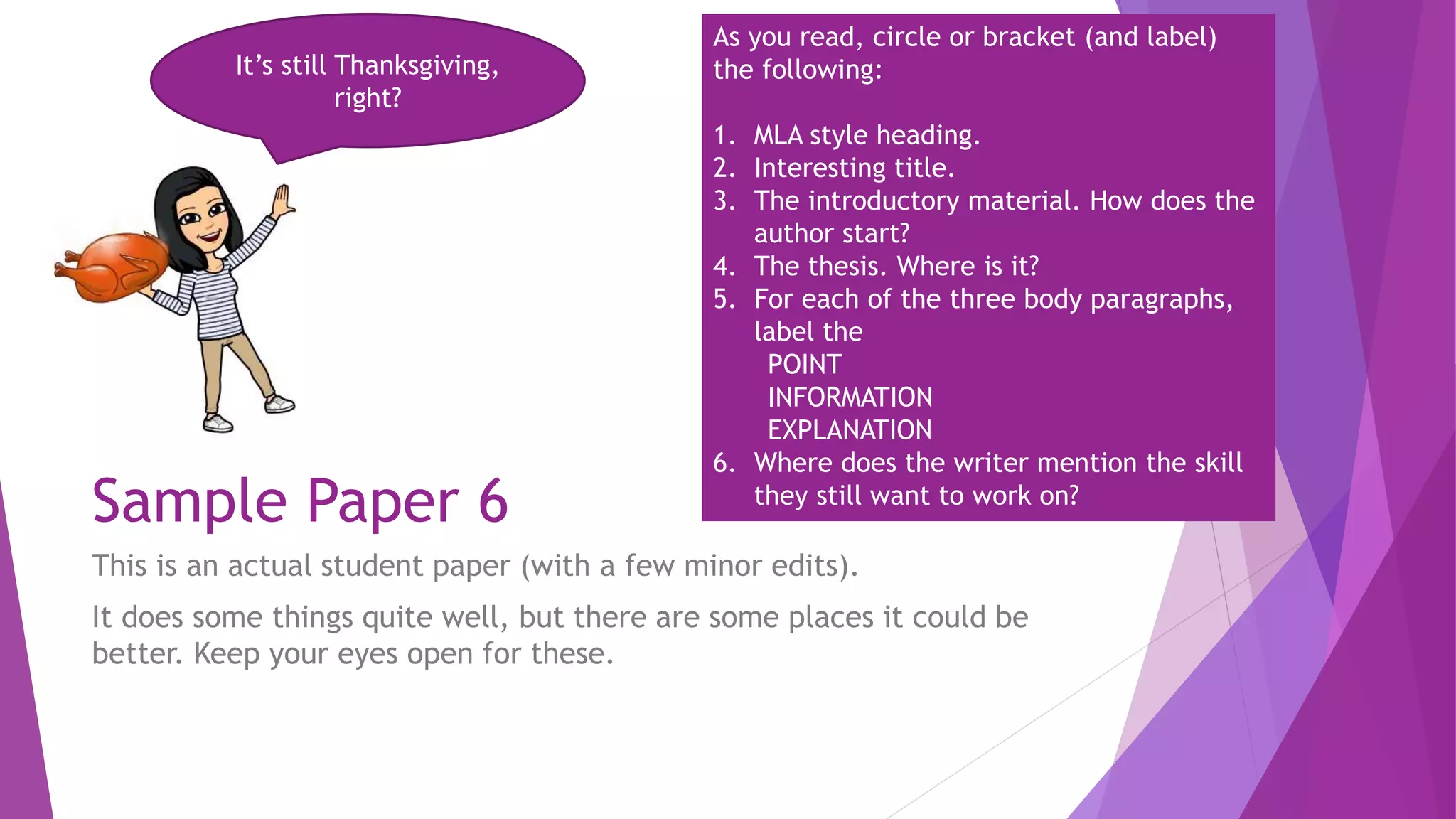
Sample Paper 6
This is an actual student paper (with a few minor edits).
It does some things quite well, but there are some places it could be
better. Keep your eyes open for these.
It’s still Thanksgiving,
right?
As you read, circle or bracket (and label)
the following:
1. MLA style heading.
2. Interesting title.
3. The introductory material. How does the
author start?
4. The thesis. Where is it?
5. For each of the three body paragraphs,
label the
POINT
INFORMATION
EXPLANATION
6. Where does the writer mention the skill
they still want to work on?
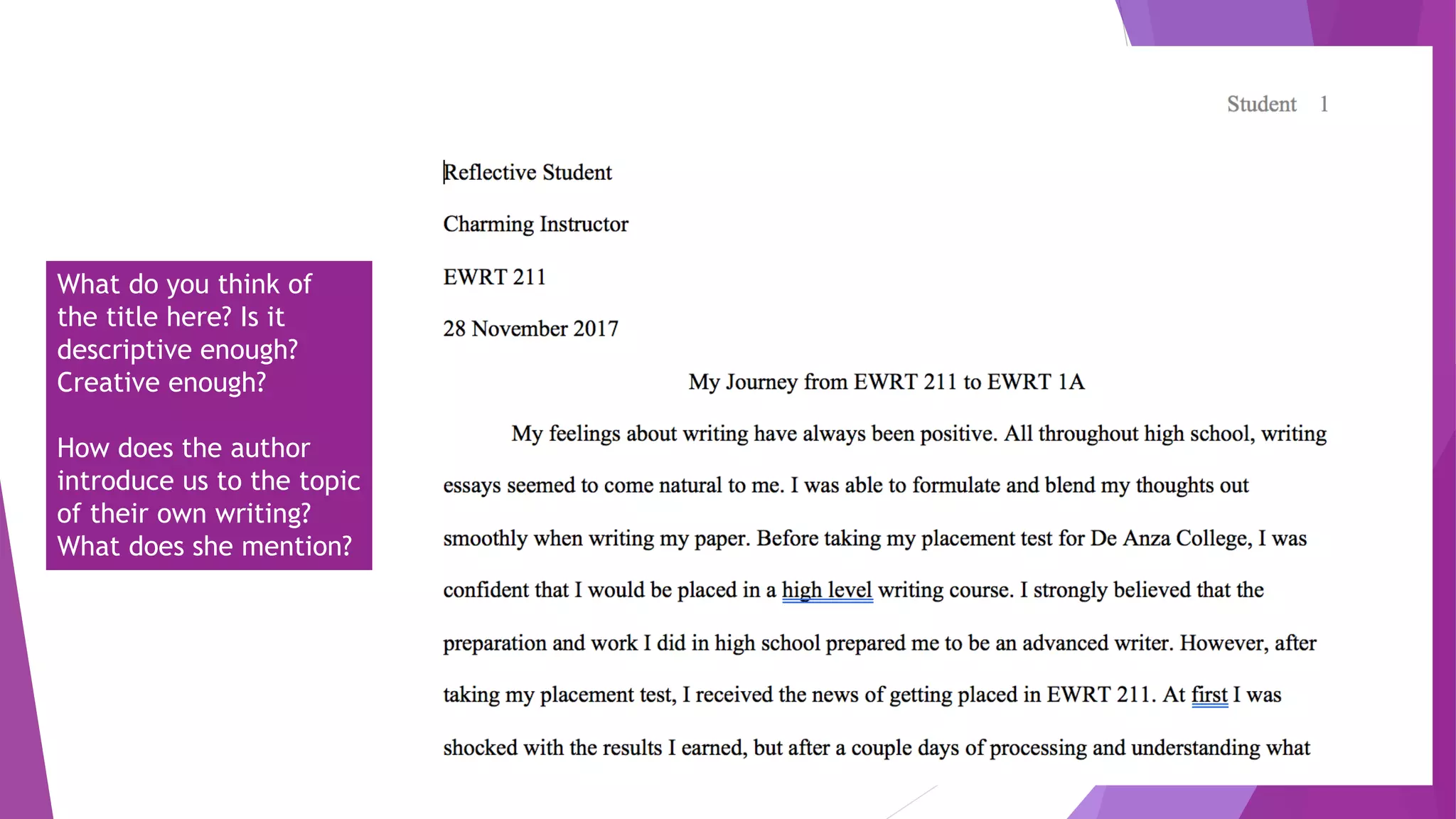
What do you think of
the title here? Is it
descriptive enough?
Creative enough?
How does the author
introduce us to the topic
of their own writing?
What does she mention?
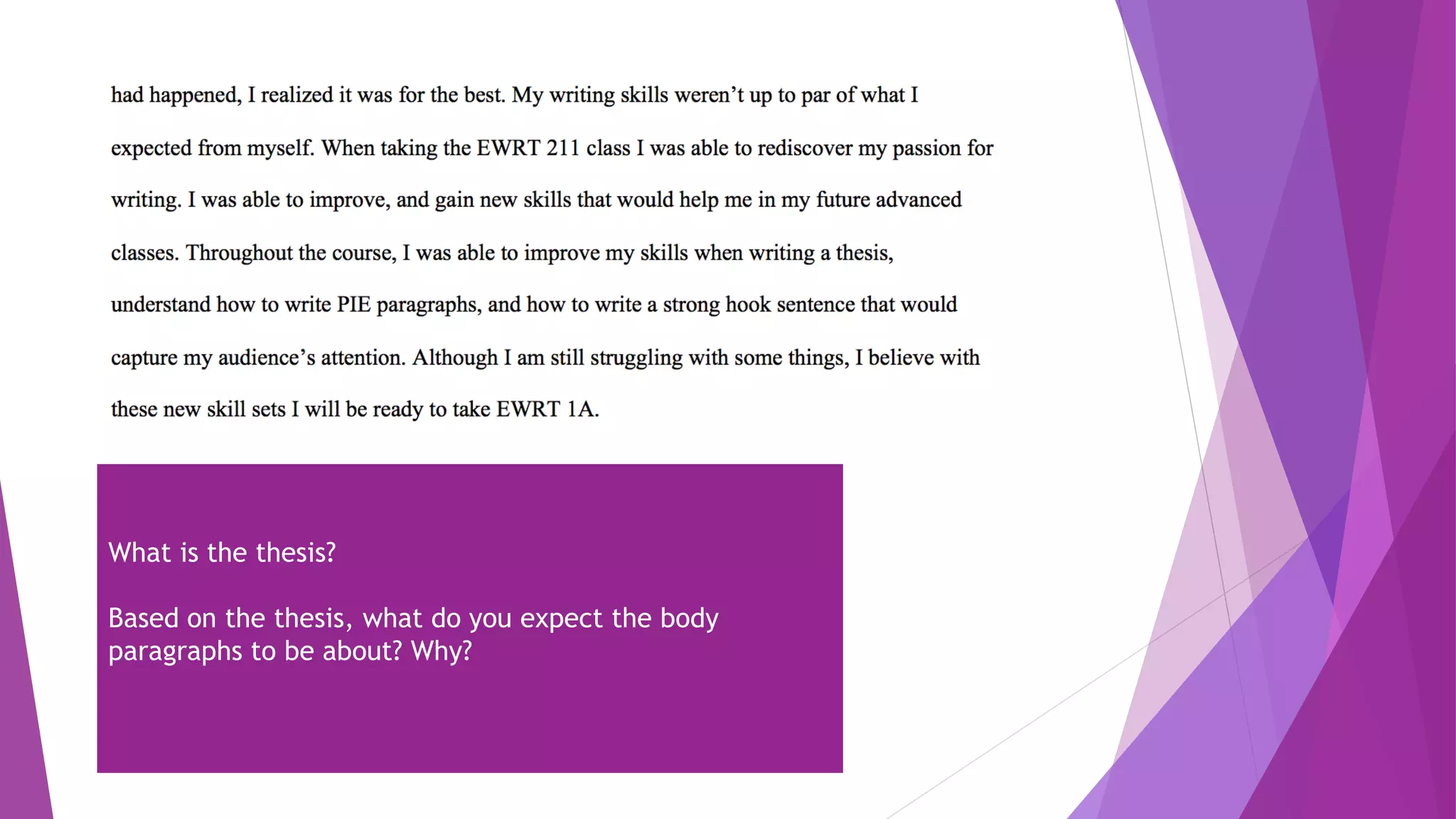
What is the thesis?
Based on the thesis, what do you expect the body
paragraphs to be about? Why?
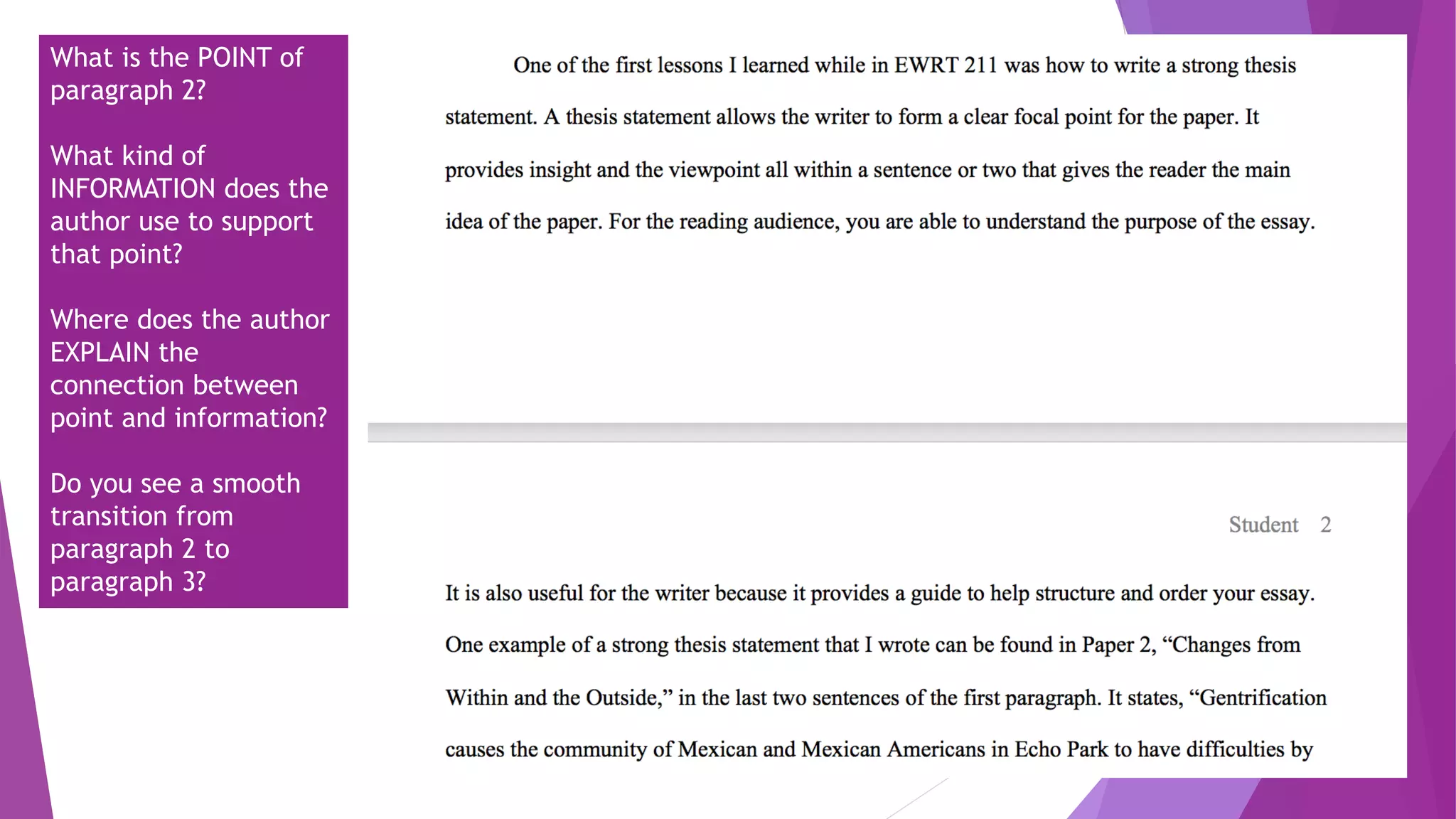
What is the POINT of
paragraph 2?
What kind of
INFORMATION does the
author use to support
that point?
Where does the author
EXPLAIN the
connection between
point and information?
Do you see a smooth
transition from
paragraph 2 to
paragraph 3?
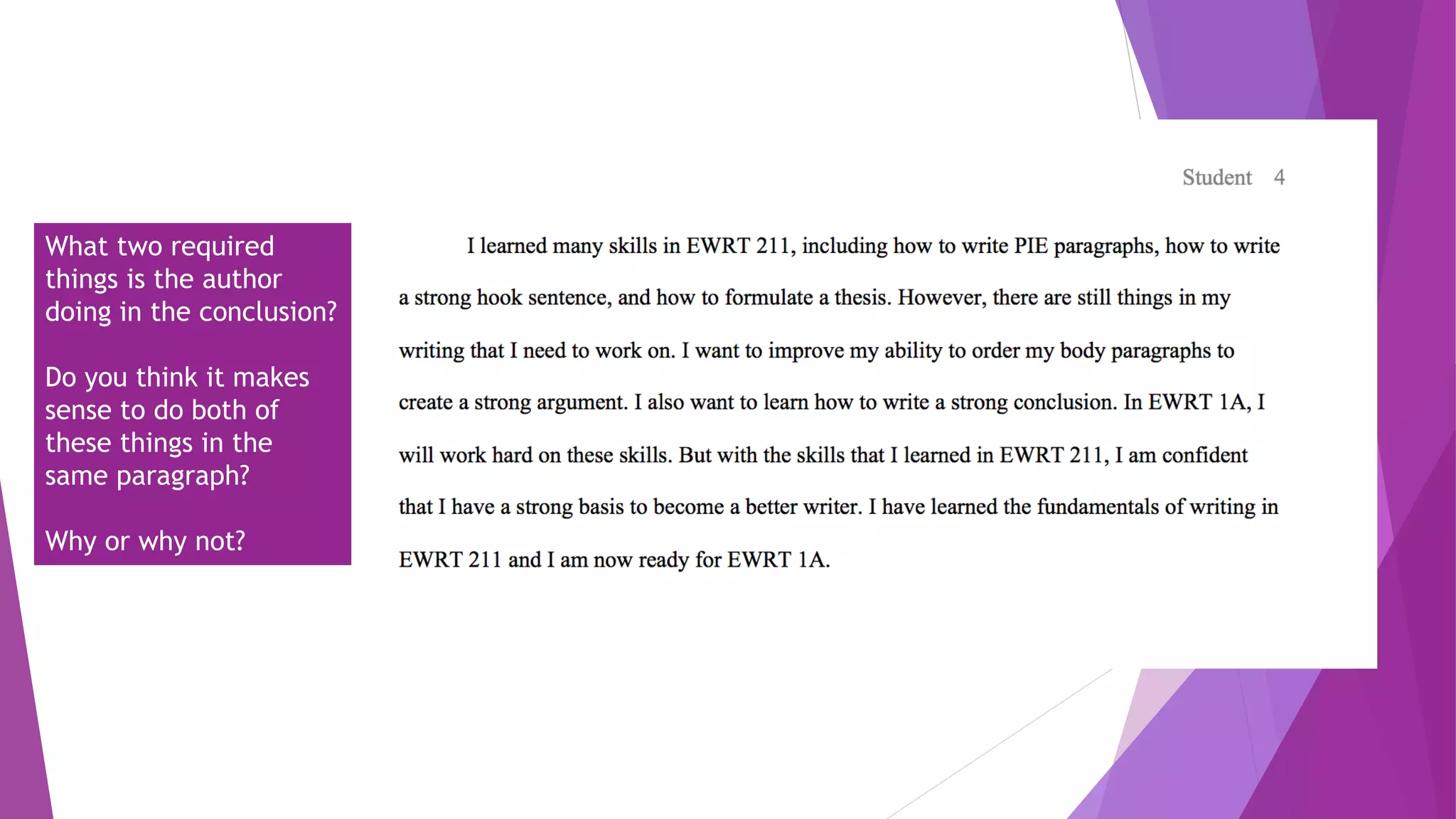
What two required
things is the author
doing in the conclusion?
Do you think it makes
sense to do both of
these things in the
same paragraph?
Why or why not?
Comparing Paragraph 2 to Paragraph 4
 What is the example that the author
uses to support their point in
paragraph 2?
 What example do they use in
paragraph 4?
 What is a key difference between
these examples?
 Why do you think paragraph 2 uses a
quote and paragraph 4 doesn’t?
 When it doesn’t make sense to use a
quote, what can you do instead to
provide the necessary example?
Brainstorm and in-class writing
 Think about your introduction.
What do you want to say about
your relationship to
writing/English? What stories do
you want to tell? You can freewrite
a bit to help you figure it out.
 Come up with a list of things that
you learned in this course. Now
come up with a list of things you
still want to work on in EWRT 1A.
 Write a basic outline of your essay.
 What will you say in your
introduction?
 What is your thesis?
 What three skills will you discuss?
 What do you want to work on?
Homework
 Do Essay 2 and 3 revisions.
 Bring your 1-page Outline and Blue
Book to write Essay #5 on Tuesday,
Dec. 5.
 Bring Reflective Essay #6 to class
on Thursday, Dec. 7.
 YOU ARE SO CLOSE TO DONE! One
last burst of effort and you got it!

Hp211 f17d20 ewrt 211kc

  • 1.
    EWRT 211 Day 20 Nextup… Paper 6! Let’s finish this!
  • 2.
    IF YOU SIGNEDUP for the Winter EWRT 1A class, but you have not registered for one of the sections yet… We will need to reserve your space by the end of this week. In order to do so, we need you to tell me which section you intend to register for. We will then save you a space only in that section. These are your options: EWRT1A.23 CRN #00770 TTh 10:00-12:15PM Malone EWRT1A.12 CRN #32486 TTh 7:30-9:45AM Palmore EWRT1A.17 CRN #00756 MW 10:00-12:15PM Palmore If you need READ 211, this is the one you must register for: READ 80.01 CRN #35372 TTh 1:30-3:20PM Skager
  • 3.
    Business / Agenda House Points– Check them in House Points Page  Portfolio explanation  Paper 6 overview  Paper 6 sample essay  Paper 6: brainstorm, outline, writing.
  • 4.
    EWRT 211 Portfolio Remember: in order to pass this class, you must submit a portfolio to the English Department and they will determine whether you can move on to EWRT 1A.  Your portfolio is due IN CLASS on Thursday, December 7.  There is no extension for this deadline.  Everything in your portfolio must be submitted as a HARD COPY. There is no submission via email or Canvas.  THREE COMPONENTS of your portfolio: 1. Essay 6: The Reflective Essay 2. A clean, revised version of EITHER Essay 2 or Paper 3. (One take-home essay.) 3. The original Blue Book versions of Essay 4 or Paper 5. No revision allowed. (in-class essays)  You should make your choices to best illustrate your skills.
  • 5.
    So let’s talkabout Paper 6: The Reflective Essay. Content: Write an essay of at least two full pages, explaining both your progress in writing this quarter and why you are ready to go to EWRT1A. This essay goes in the front of your portfolio to serve as an introduction to your work for the instructors evaluating the portfolio. How to Proceed: Review all the work you have done for the class. Consider why you chose the essays in your portfolio and how they show your readiness for EWRT1A. Give specific examples from these essays to show your improvements. --Discuss what you have learned in EWRT 211. This might include, for example, practice in organization, analysis, development, vivid examples, construction of better sentences, or proofreading. --Include how your writing has changed as a result of what you have learned in class. Remember to provide specific evidence for your claims. Use examples from your writing to support your points. --What still needs improvement? Write about what you'd still like to work on concerning your writing. Remember that all of us are still trying to be better writers, so what are you going to focus on in 1A and beyond?
  • 6.
    Paper 6, continued: Audience: DeAnza English Instructors Format: MLA style What we're looking for in the reflective essay: Clear organization Well-developed, focused paragraphs Specific examples, details Well-constructed sentences Correct grammar and punctuation
  • 7.
    Paper 6: TheReflective Essay  Even though it might not be obvious, this is a thesis-driven essay.  What is your thesis? A more specific version of this claim: “I learned some things in EWRT 211 and I know I still have some things to work on, but now I’m ready to move on to EWRT 1A.”  I recommend that you discuss  THREE things you learned, and  ONE thing that you still need to improve (and that you will work on in 1A).  Things NOT to write about:  The CONTENT of the course. The English Department is not interested in what you learned about Harry Potter or Hogwarts. They just want to hear about your writing skills.  The instructor. Whether you want to praise me (or criticize me), the portfolio readers do not care. They are interested in what you learned, not how I taught it.  So what might you talk about? Let’s brainstorm.
  • 8.
    Paper 5: Structure At least five paragraphs.  Introduction: what might you put in your intro? How might you start this essay?  Could talk about previous experience with writing.  Could talk about your feelings about writing.  Could talk about high school and your experience with writing.  Could talk about learning English.  Could talk about your future plans and how writing fits with them.  Three body paragraphs about what you learned.  Additional body paragraph about what you still need to work on (though this could be combined with the…)  Conclusion  The body paragraphs should be PIE paragraphs.  What is the POINT of each paragraph?  But what is the INFORMATION?  Examples from your own work.  Seriously: give specific examples from your papers—especially the portfolio essays.  Seriously: QUOTE YOUR OWN WORK.  Brainstorming activity:  How might you start your intro?  What are three things have you learned?  What one thing will you work on in 1A?
  • 9.
    Sample Paper 6 Thisis an actual student paper (with a few minor edits). It does some things quite well, but there are some places it could be better. Keep your eyes open for these. It’s still Thanksgiving, right? As you read, circle or bracket (and label) the following: 1. MLA style heading. 2. Interesting title. 3. The introductory material. How does the author start? 4. The thesis. Where is it? 5. For each of the three body paragraphs, label the POINT INFORMATION EXPLANATION 6. Where does the writer mention the skill they still want to work on?
  • 10.
    What do youthink of the title here? Is it descriptive enough? Creative enough? How does the author introduce us to the topic of their own writing? What does she mention?
  • 11.
    What is thethesis? Based on the thesis, what do you expect the body paragraphs to be about? Why?
  • 12.
    What is thePOINT of paragraph 2? What kind of INFORMATION does the author use to support that point? Where does the author EXPLAIN the connection between point and information? Do you see a smooth transition from paragraph 2 to paragraph 3?
  • 13.
    What two required thingsis the author doing in the conclusion? Do you think it makes sense to do both of these things in the same paragraph? Why or why not?
  • 14.
    Comparing Paragraph 2to Paragraph 4  What is the example that the author uses to support their point in paragraph 2?  What example do they use in paragraph 4?  What is a key difference between these examples?  Why do you think paragraph 2 uses a quote and paragraph 4 doesn’t?  When it doesn’t make sense to use a quote, what can you do instead to provide the necessary example?
  • 15.
    Brainstorm and in-classwriting  Think about your introduction. What do you want to say about your relationship to writing/English? What stories do you want to tell? You can freewrite a bit to help you figure it out.  Come up with a list of things that you learned in this course. Now come up with a list of things you still want to work on in EWRT 1A.  Write a basic outline of your essay.  What will you say in your introduction?  What is your thesis?  What three skills will you discuss?  What do you want to work on?
  • 16.
    Homework  Do Essay2 and 3 revisions.  Bring your 1-page Outline and Blue Book to write Essay #5 on Tuesday, Dec. 5.  Bring Reflective Essay #6 to class on Thursday, Dec. 7.  YOU ARE SO CLOSE TO DONE! One last burst of effort and you got it!