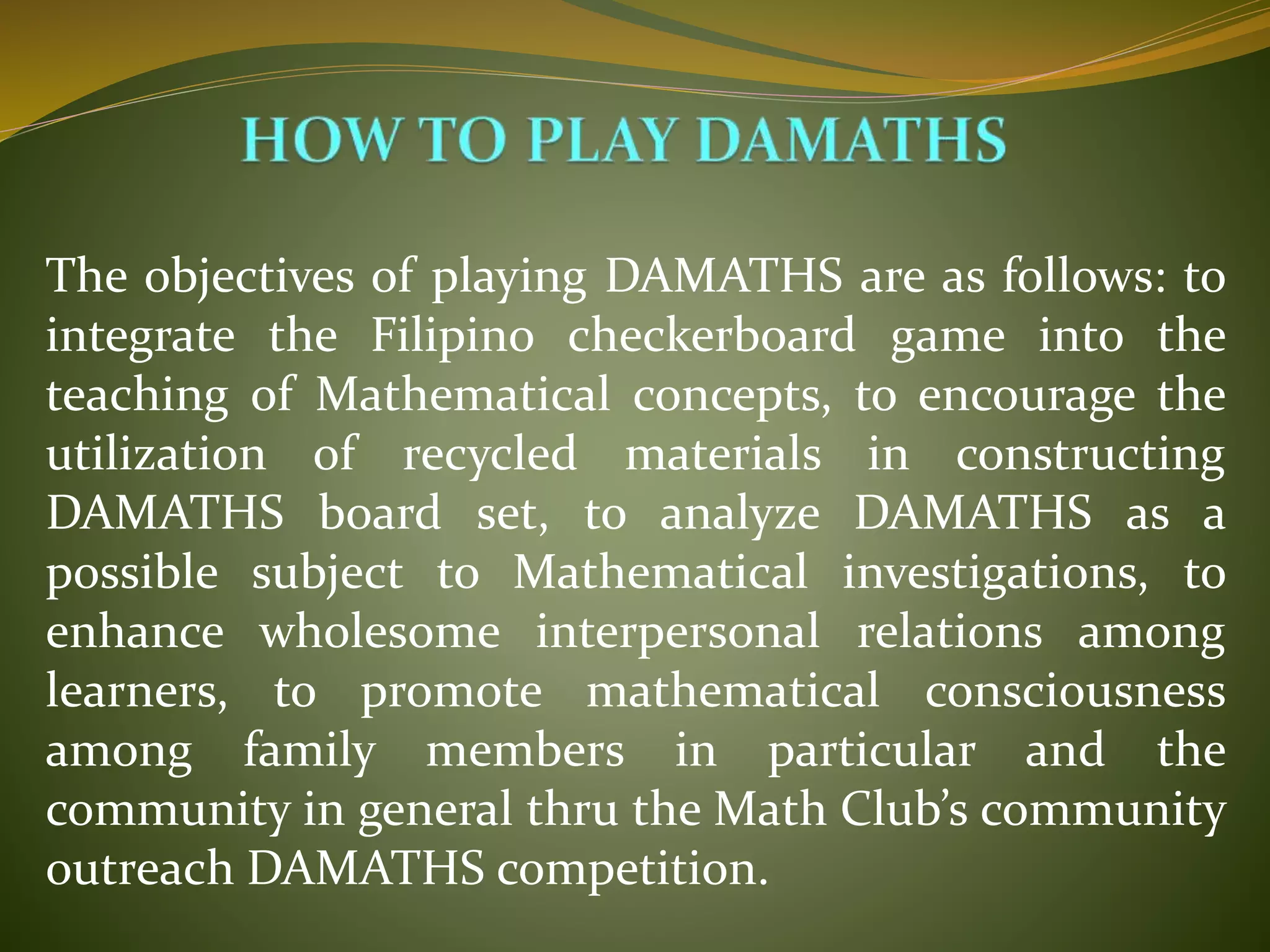
The objectives of playing DAMATHS are as follows: to
integrate the Filipino checkerboard game into the
teaching of Mathematical concepts, to encourage the
utilization of recycled materials in constructing
DAMATHS board set, to analyze DAMATHS as a
possible subject to Mathematical investigations, to
enhance wholesome interpersonal relations among
learners, to promote mathematical consciousness
among family members in particular and the
community in general thru the Math Club’s community
outreach DAMATHS competition.
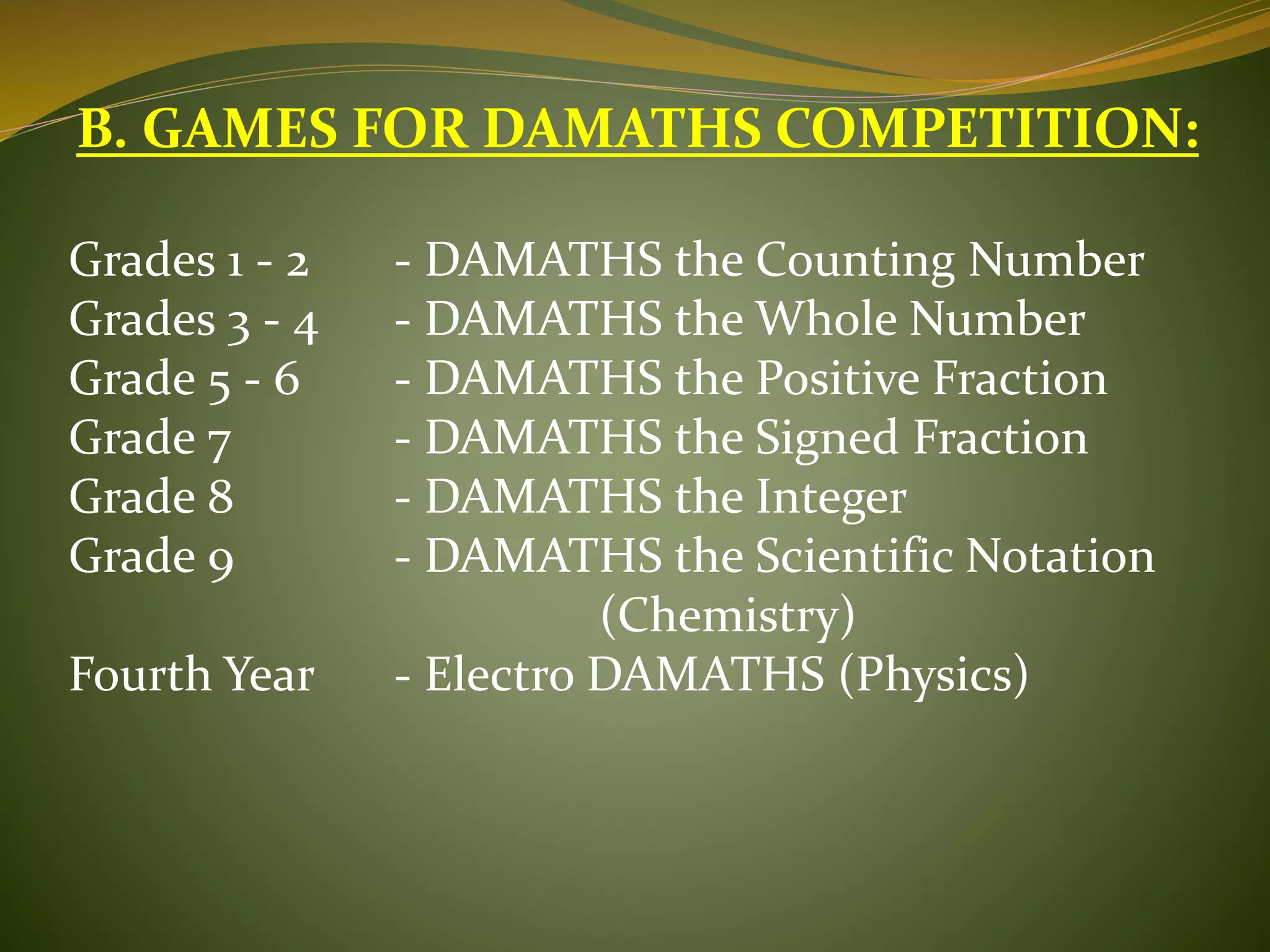
B. GAMES FOR DAMATHS COMPETITION:
Grades 1 - 2 - DAMATHS the Counting Number
Grades 3 - 4 - DAMATHS the Whole Number
Grade 5 - 6 - DAMATHS the Positive Fraction
Grade 7 - DAMATHS the Signed Fraction
Grade 8 - DAMATHS the Integer
Grade 9 - DAMATHS the Scientific Notation
(Chemistry)
Fourth Year - Electro DAMATHS (Physics)
C. POSITIONS OF CHIPS
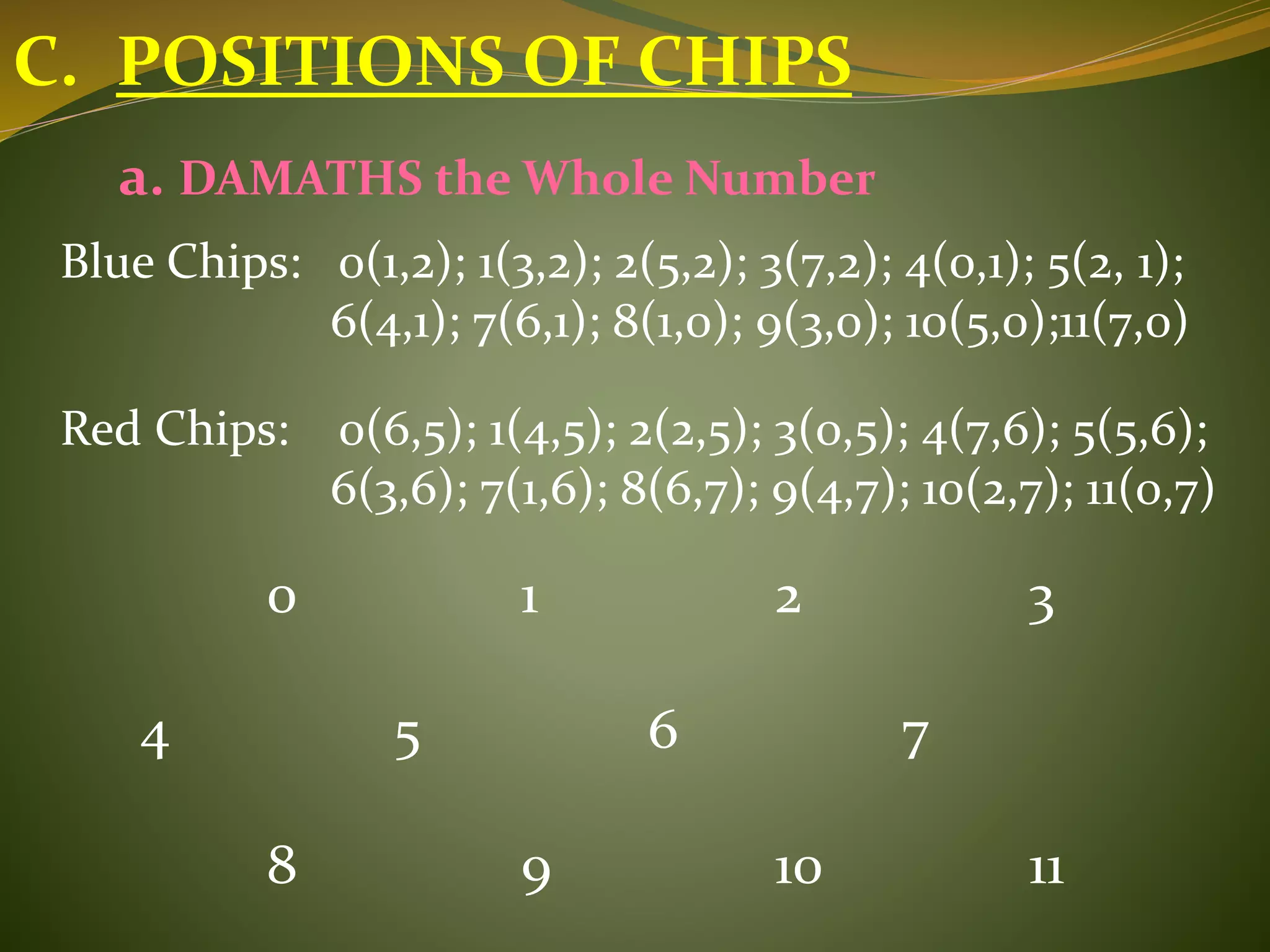
a. DAMATHS the Whole Number
Blue Chips: 0(1,2); 1(3,2); 2(5,2); 3(7,2); 4(0,1); 5(2, 1);
6(4,1); 7(6,1); 8(1,0); 9(3,0); 10(5,0);11(7,0)
Red Chips: 0(6,5); 1(4,5); 2(2,5); 3(0,5); 4(7,6); 5(5,6);
6(3,6); 7(1,6); 8(6,7); 9(4,7); 10(2,7); 11(0,7)
0 1 2 3
4 5 6 7
8 9 10 11
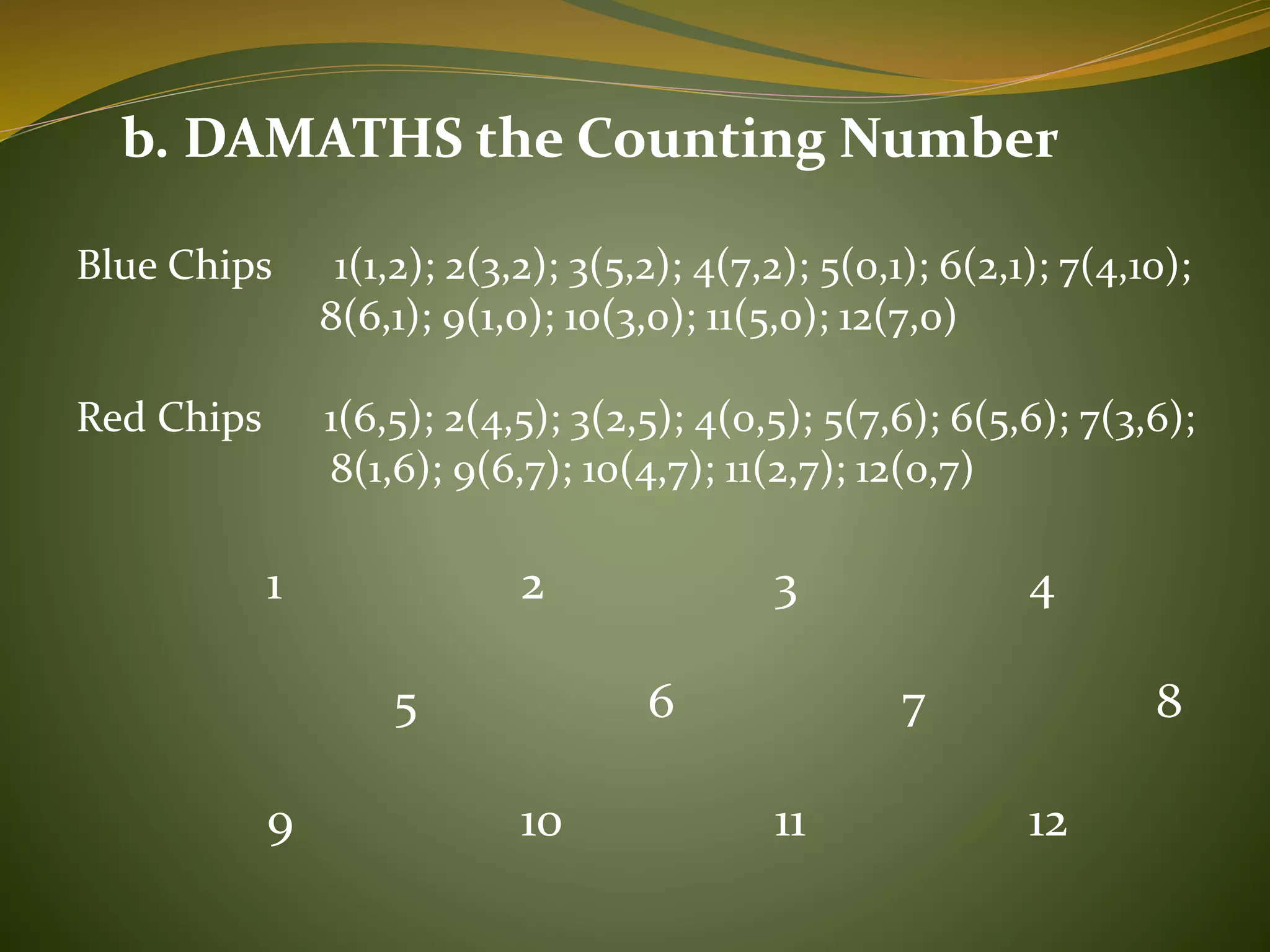
b. DAMATHS the Counting Number
Blue Chips 1(1,2); 2(3,2); 3(5,2); 4(7,2); 5(0,1); 6(2,1); 7(4,10);
8(6,1); 9(1,0); 10(3,0); 11(5,0); 12(7,0)
Red Chips 1(6,5); 2(4,5); 3(2,5); 4(0,5); 5(7,6); 6(5,6); 7(3,6);
8(1,6); 9(6,7); 10(4,7); 11(2,7); 12(0,7)
1 2 3 4
5 6 7 8
9 10 11 12
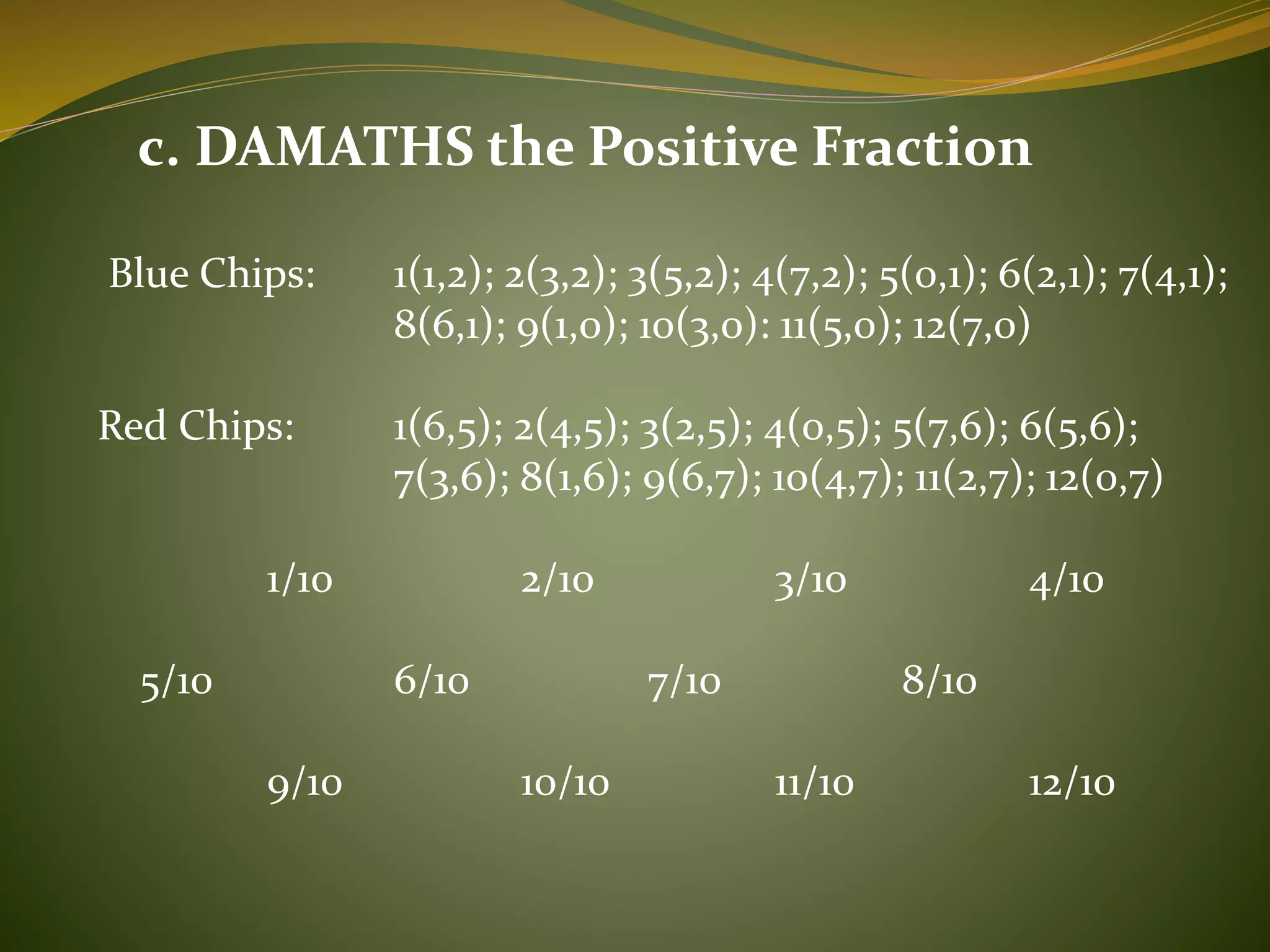
c. DAMATHS the Positive Fraction
Blue Chips: 1(1,2); 2(3,2); 3(5,2); 4(7,2); 5(0,1); 6(2,1); 7(4,1);
8(6,1); 9(1,0); 10(3,0): 11(5,0); 12(7,0)
Red Chips: 1(6,5); 2(4,5); 3(2,5); 4(0,5); 5(7,6); 6(5,6);
7(3,6); 8(1,6); 9(6,7); 10(4,7); 11(2,7); 12(0,7)
1/10 2/10 3/10 4/10
5/10 6/10 7/10 8/10
9/10 10/10 11/10 12/10
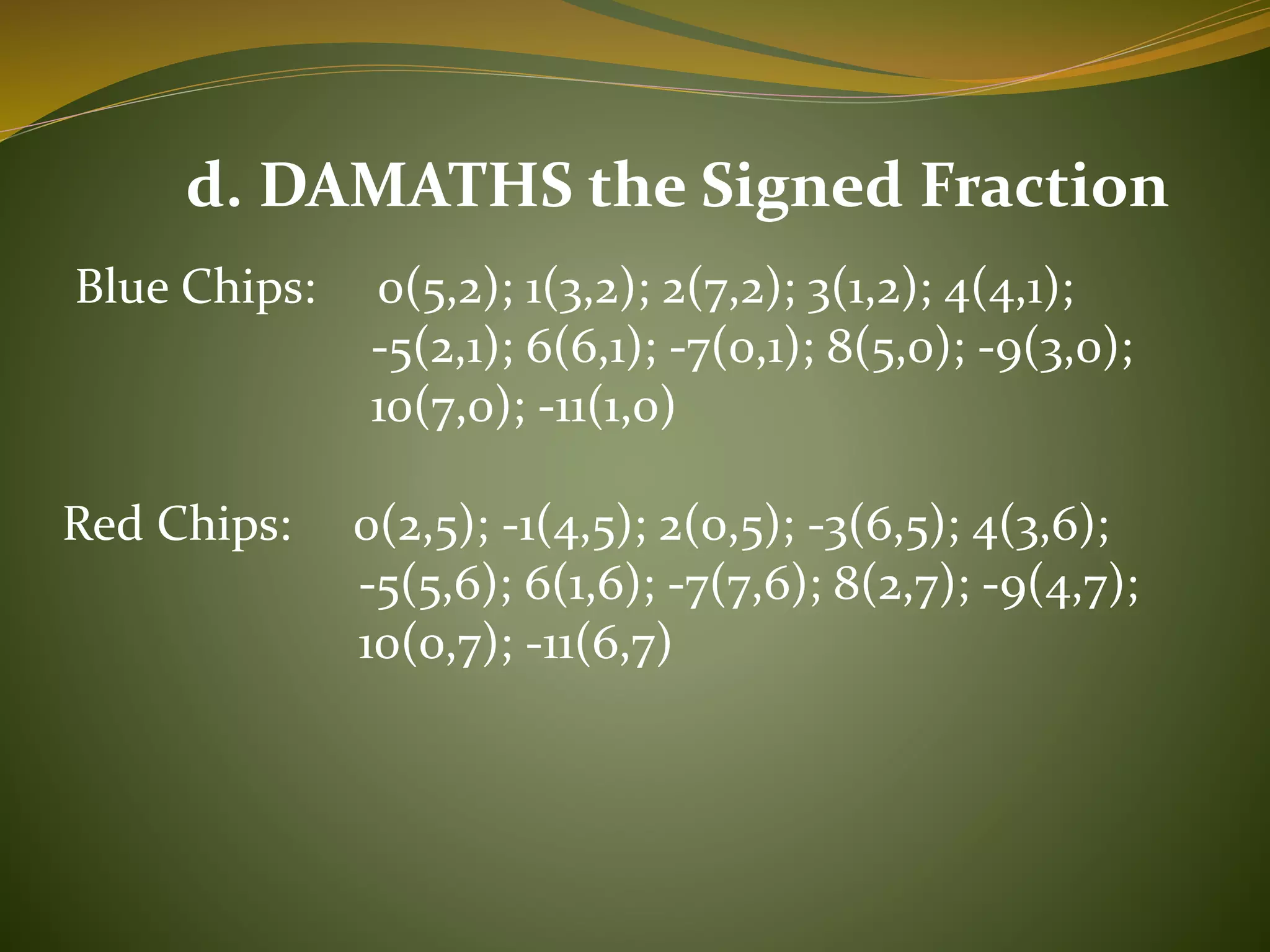
d. DAMATHS the Signed Fraction
Blue Chips: 0(5,2); 1(3,2); 2(7,2); 3(1,2); 4(4,1);
-5(2,1); 6(6,1); -7(0,1); 8(5,0); -9(3,0);
10(7,0); -11(1,0)
Red Chips: 0(2,5); -1(4,5); 2(0,5); -3(6,5); 4(3,6);
-5(5,6); 6(1,6); -7(7,6); 8(2,7); -9(4,7);
10(0,7); -11(6,7)
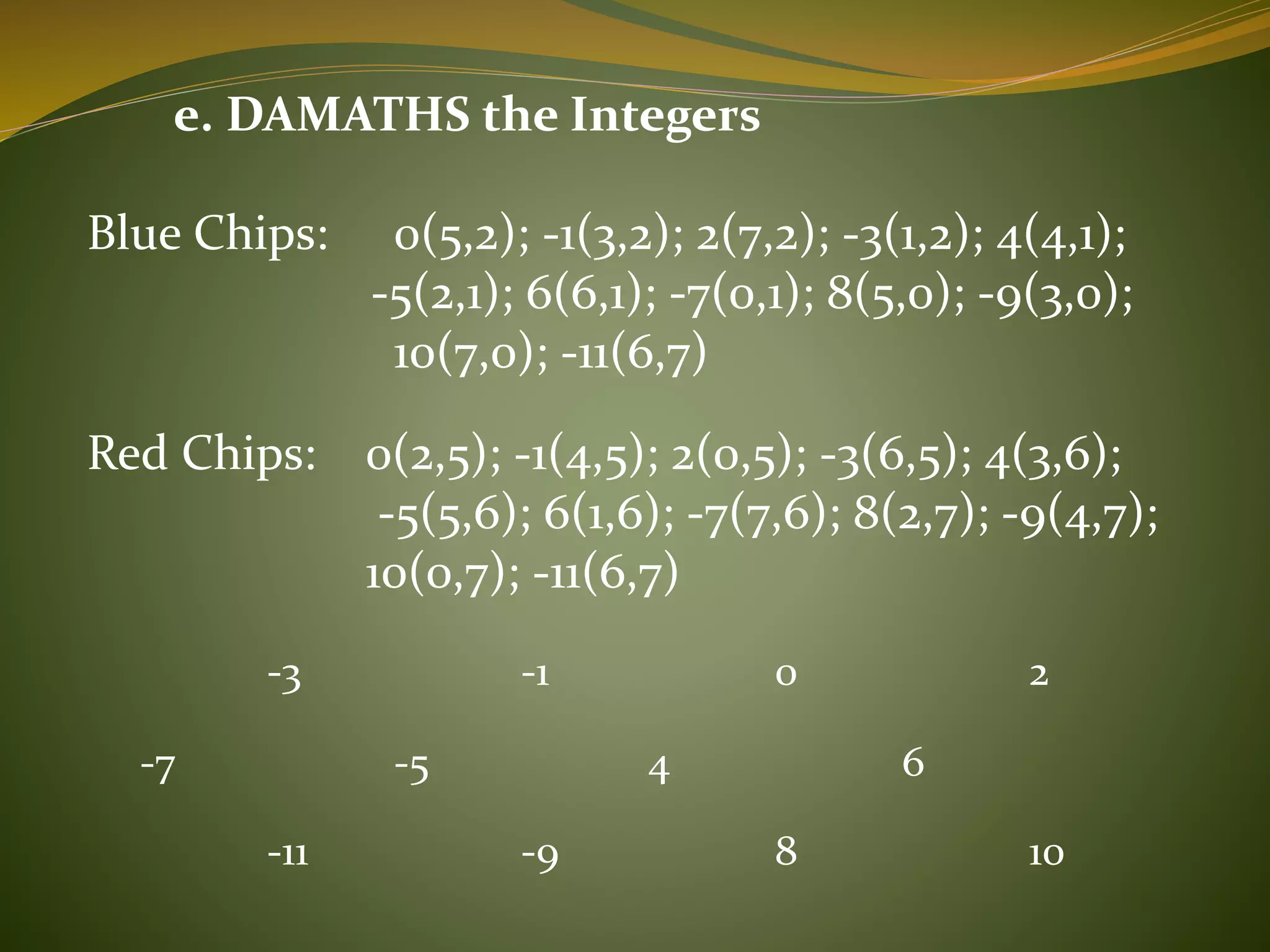
e. DAMATHS the Integers
Blue Chips: 0(5,2); -1(3,2); 2(7,2); -3(1,2); 4(4,1);
-5(2,1); 6(6,1); -7(0,1); 8(5,0); -9(3,0);
10(7,0); -11(6,7)
Red Chips: 0(2,5); -1(4,5); 2(0,5); -3(6,5); 4(3,6);
-5(5,6); 6(1,6); -7(7,6); 8(2,7); -9(4,7);
10(0,7); -11(6,7)
-3 -1 0 2
-7 -5 4 6
-11 -9 8 10
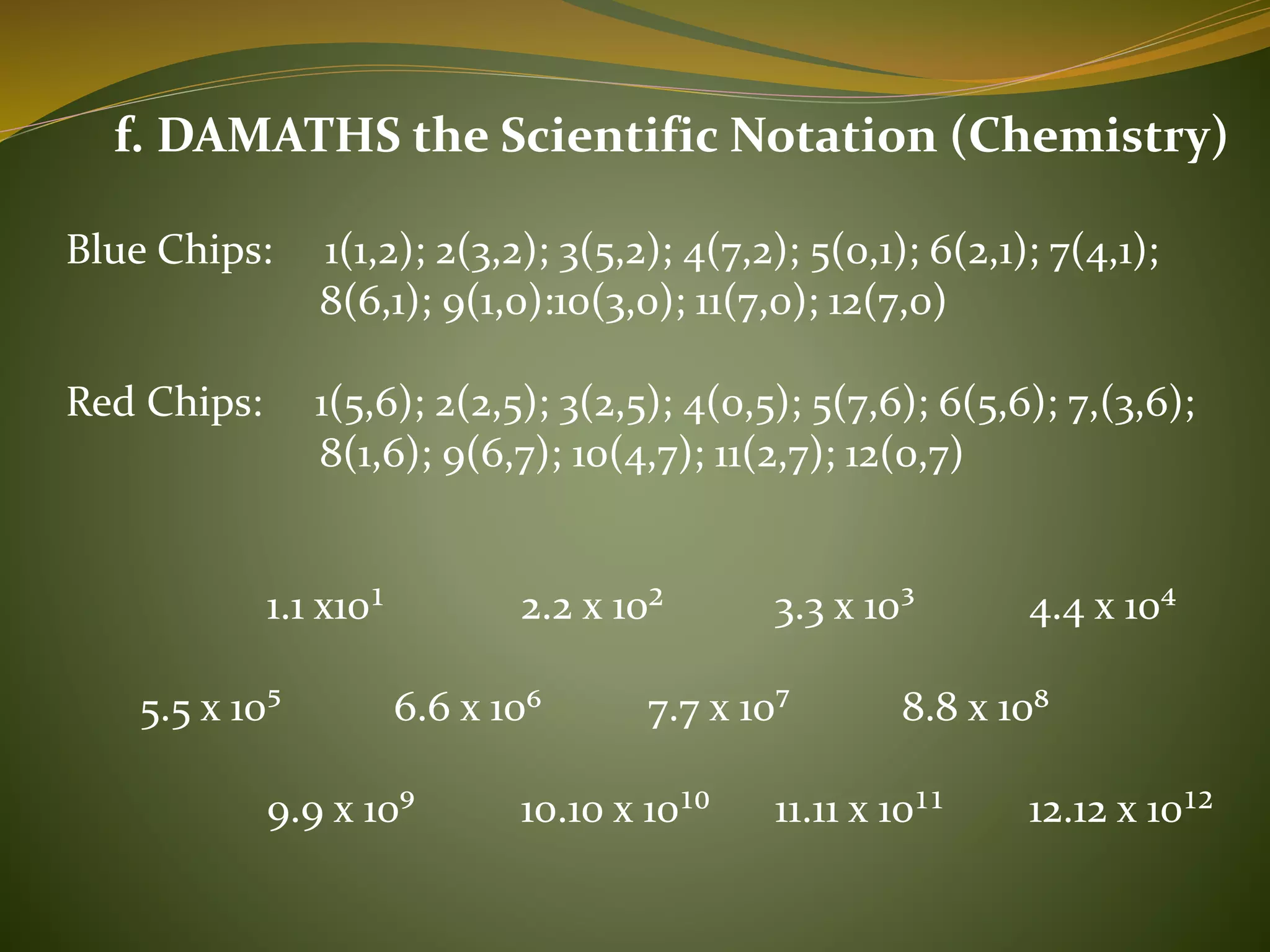
f. DAMATHS the Scientific Notation (Chemistry)
Blue Chips: 1(1,2); 2(3,2); 3(5,2); 4(7,2); 5(0,1); 6(2,1); 7(4,1);
8(6,1); 9(1,0):10(3,0); 11(7,0); 12(7,0)
Red Chips: 1(5,6); 2(2,5); 3(2,5); 4(0,5); 5(7,6); 6(5,6); 7,(3,6);
8(1,6); 9(6,7); 10(4,7); 11(2,7); 12(0,7)
1.1 x10¹ 2.2 x 10² 3.3 x 10³ 4.4 x 10⁴
5.5 x 10⁵ 6.6 x 10⁶ 7.7 x 10⁷ 8.8 x 10⁸
9.9 x 10⁹ 10.10 x 10¹⁰ 11.11 x 10¹¹ 12.12 x 10¹²
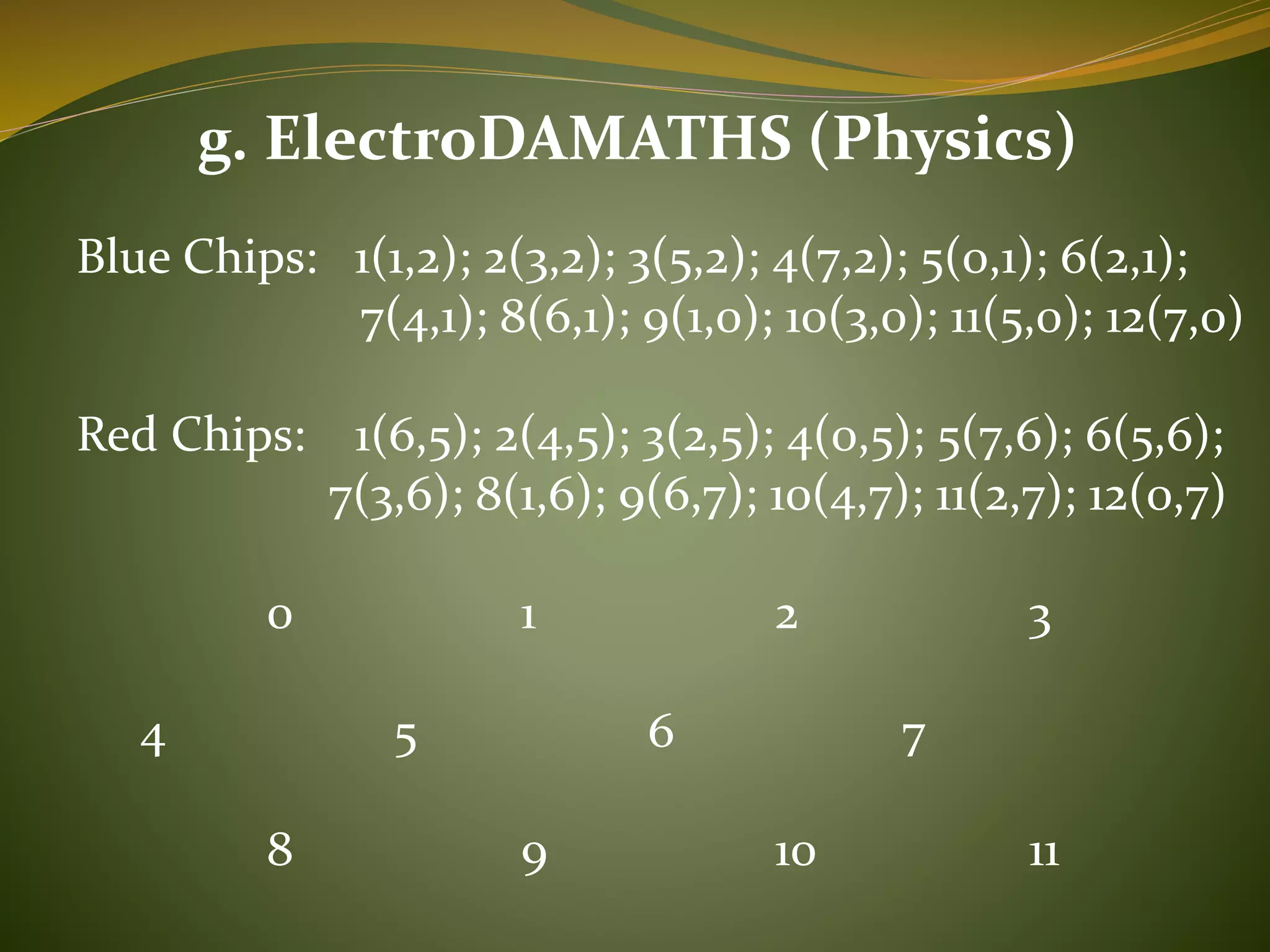
g. ElectroDAMATHS (Physics)
Blue Chips: 1(1,2); 2(3,2); 3(5,2); 4(7,2); 5(0,1); 6(2,1);
7(4,1); 8(6,1); 9(1,0); 10(3,0); 11(5,0); 12(7,0)
Red Chips: 1(6,5); 2(4,5); 3(2,5); 4(0,5); 5(7,6); 6(5,6);
7(3,6); 8(1,6); 9(6,7); 10(4,7); 11(2,7); 12(0,7)
0 1 2 3
4 5 6 7
8 9 10 11
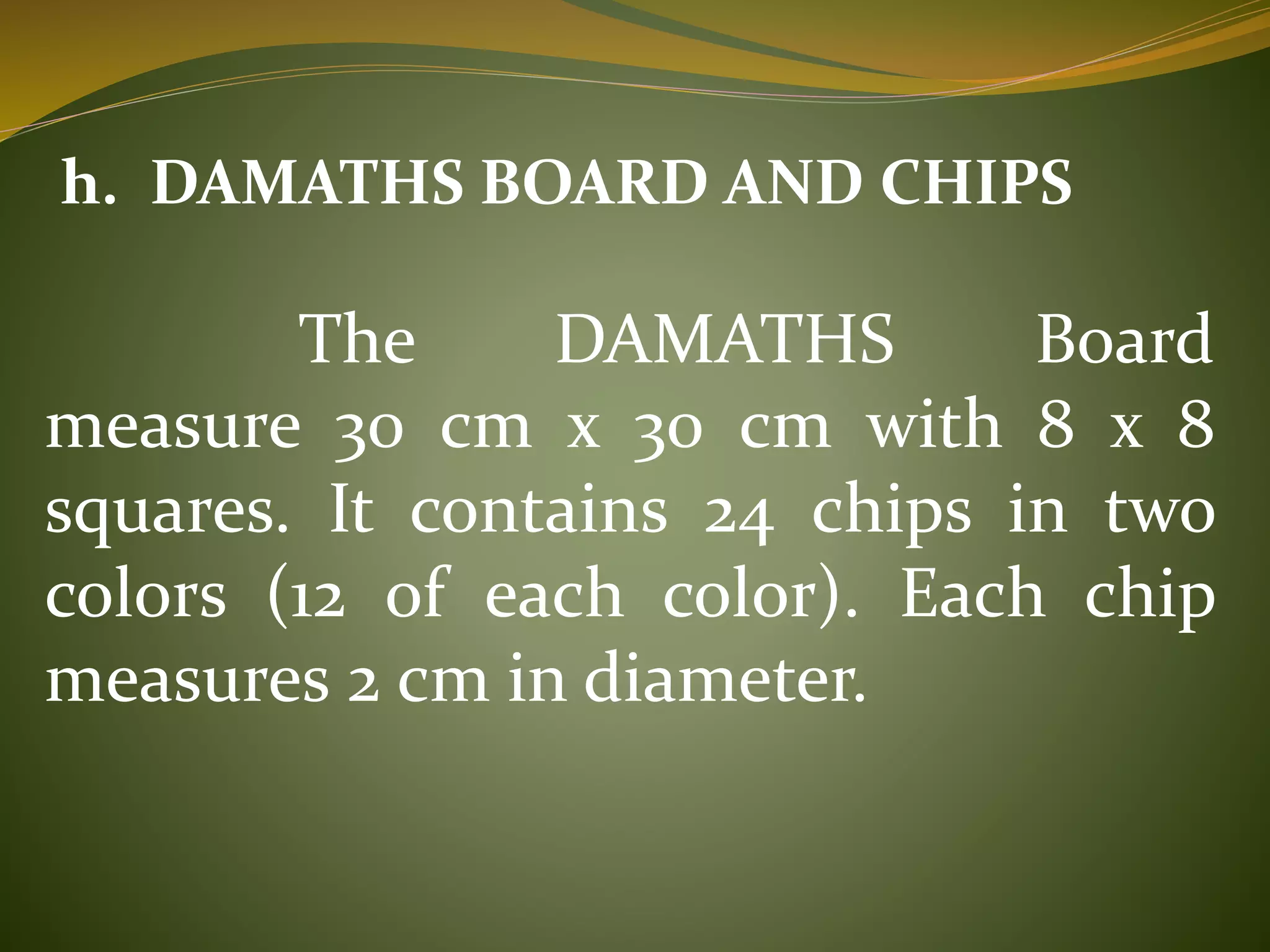
h. DAMATHS BOARD AND CHIPS
The DAMATHS Board
measure 30 cm x 30 cm with 8 x 8
squares. It contains 24 chips in two
colors (12 of each color). Each chip
measures 2 cm in diameter.
D. GENERAL GUIDELINES ON DAMATHS CENTURY MATCH
(Enclosure 1 to DECS Memo No. 348, s 1996)
1. First player is determined by drawing lots.
2. Basically, the rule in playing dama shall be used as follows:
a. A “chip with numeral” moves diagonally forward to an adjoining vacant
square.
b. A chip takes an opponent’s chip or chips diagonally forward or backward.
Mathematical operation such as addition, subtraction, multiplication, or
division of numerals shall be used depending on the vacant square’s
operation symbol where the “taker” chip lands by jumping over the
“taken” chip. “Pass” is not allowed.
c. On taking a chip or chips the following policy shall prevail.
•“mayor dalawa” [ ] takes Ovs. [ ] takes O and O
•“mayor tatlo” [ ] takes Ovs. [ ] takes O and O
•“mayor dama” [ ] takes Ovs. [ ] dama takes O
•“mayor dalawa” [ ] dama takes Ovs. [ ] takes O and O and over
“mayor dama”
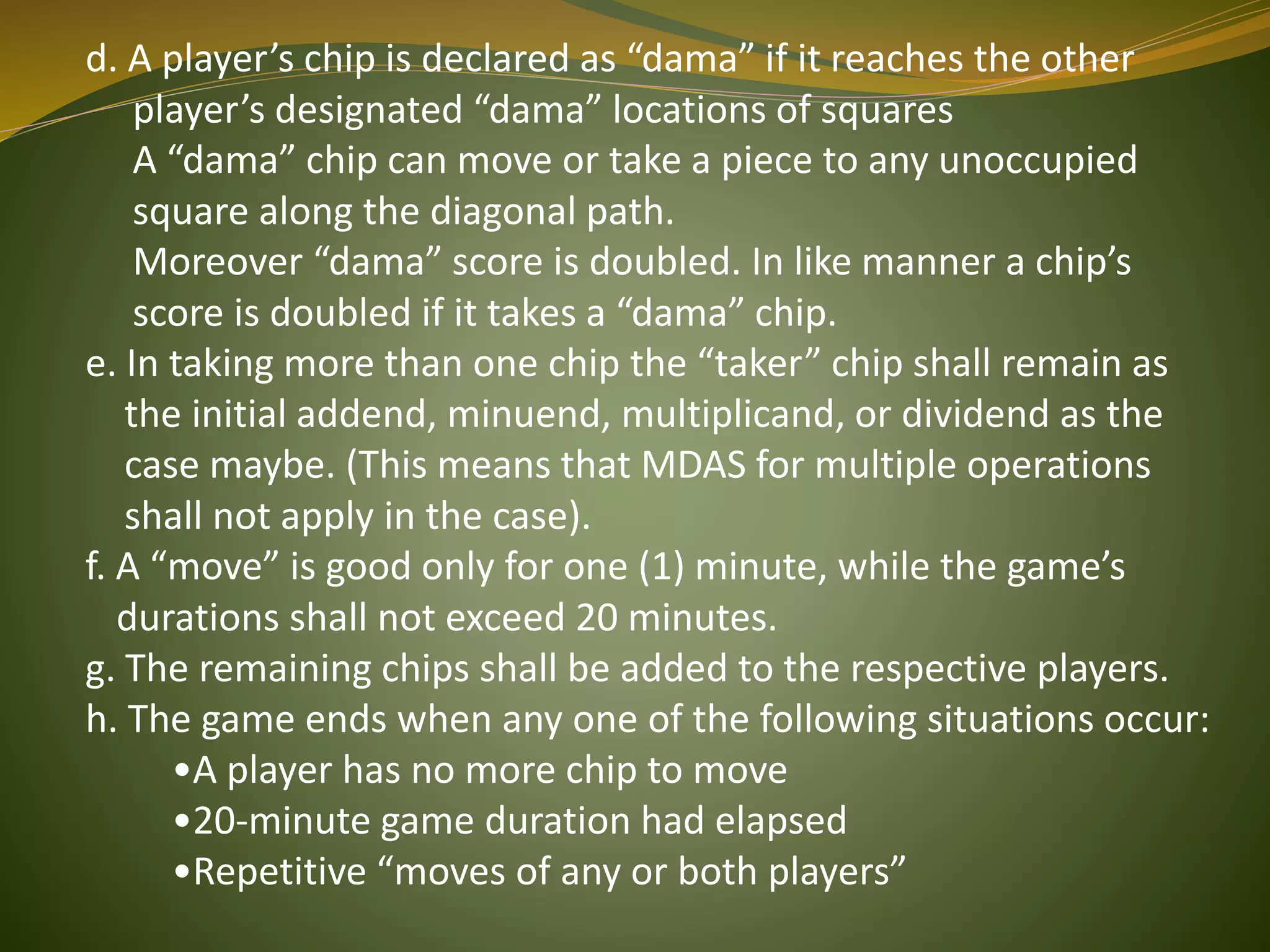
d. A player’s chip is declared as “dama” if it reaches the other
player’s designated “dama” locations of squares
A “dama” chip can move or take a piece to any unoccupied
square along the diagonal path.
Moreover “dama” score is doubled. In like manner a chip’s
score is doubled if it takes a “dama” chip.
e. In taking more than one chip the “taker” chip shall remain as
the initial addend, minuend, multiplicand, or dividend as the
case maybe. (This means that MDAS for multiple operations
shall not apply in the case).
f. A “move” is good only for one (1) minute, while the game’s
durations shall not exceed 20 minutes.
g. The remaining chips shall be added to the respective players.
h. The game ends when any one of the following situations occur:
•A player has no more chip to move
•20-minute game duration had elapsed
•Repetitive “moves of any or both players”
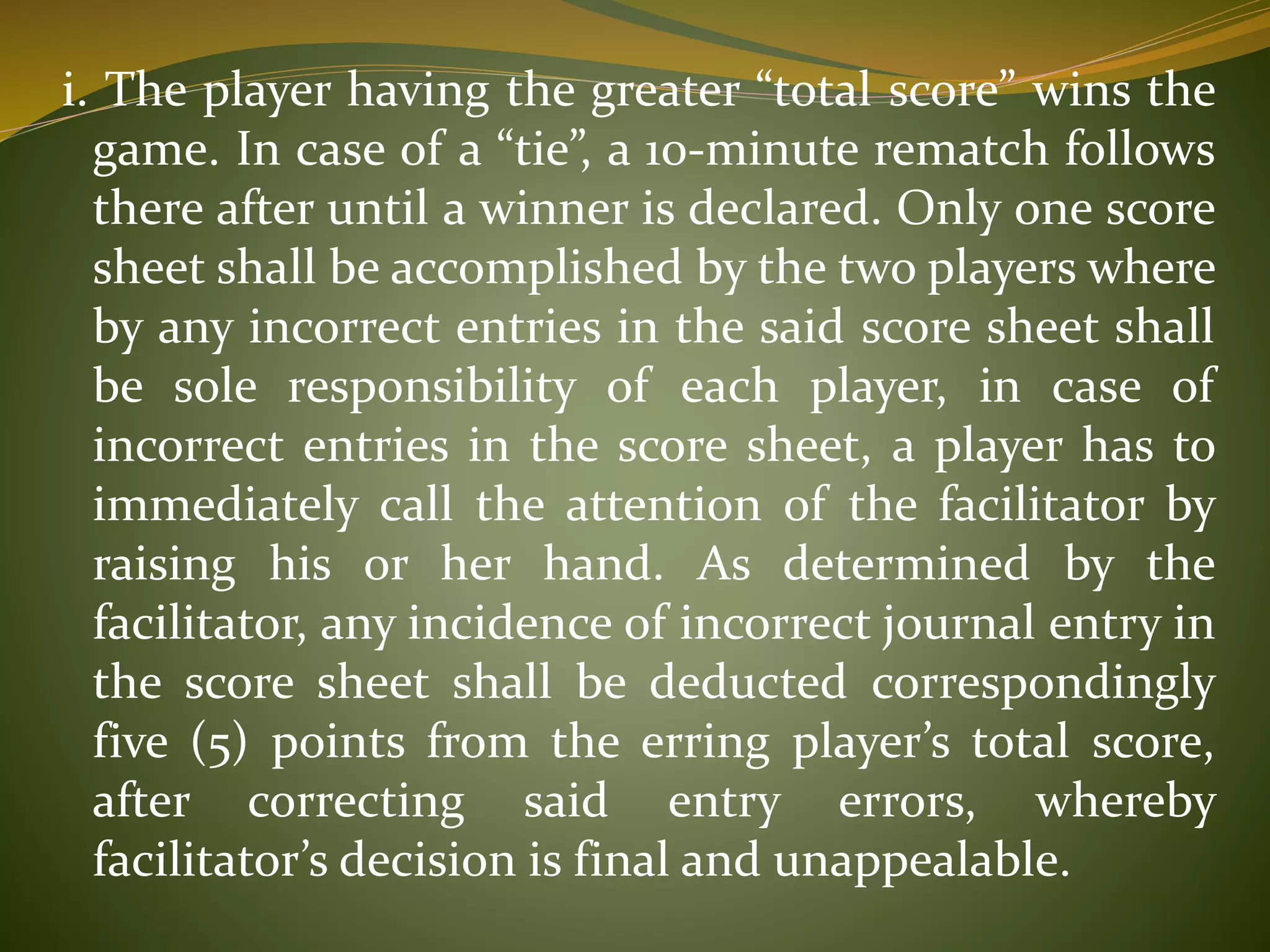
i. The player having the greater “total score” wins the
game. In case of a “tie”, a 10-minute rematch follows
there after until a winner is declared. Only one score
sheet shall be accomplished by the two players where
by any incorrect entries in the said score sheet shall
be sole responsibility of each player, in case of
incorrect entries in the score sheet, a player has to
immediately call the attention of the facilitator by
raising his or her hand. As determined by the
facilitator, any incidence of incorrect journal entry in
the score sheet shall be deducted correspondingly
five (5) points from the erring player’s total score,
after correcting said entry errors, whereby
facilitator’s decision is final and unappealable.
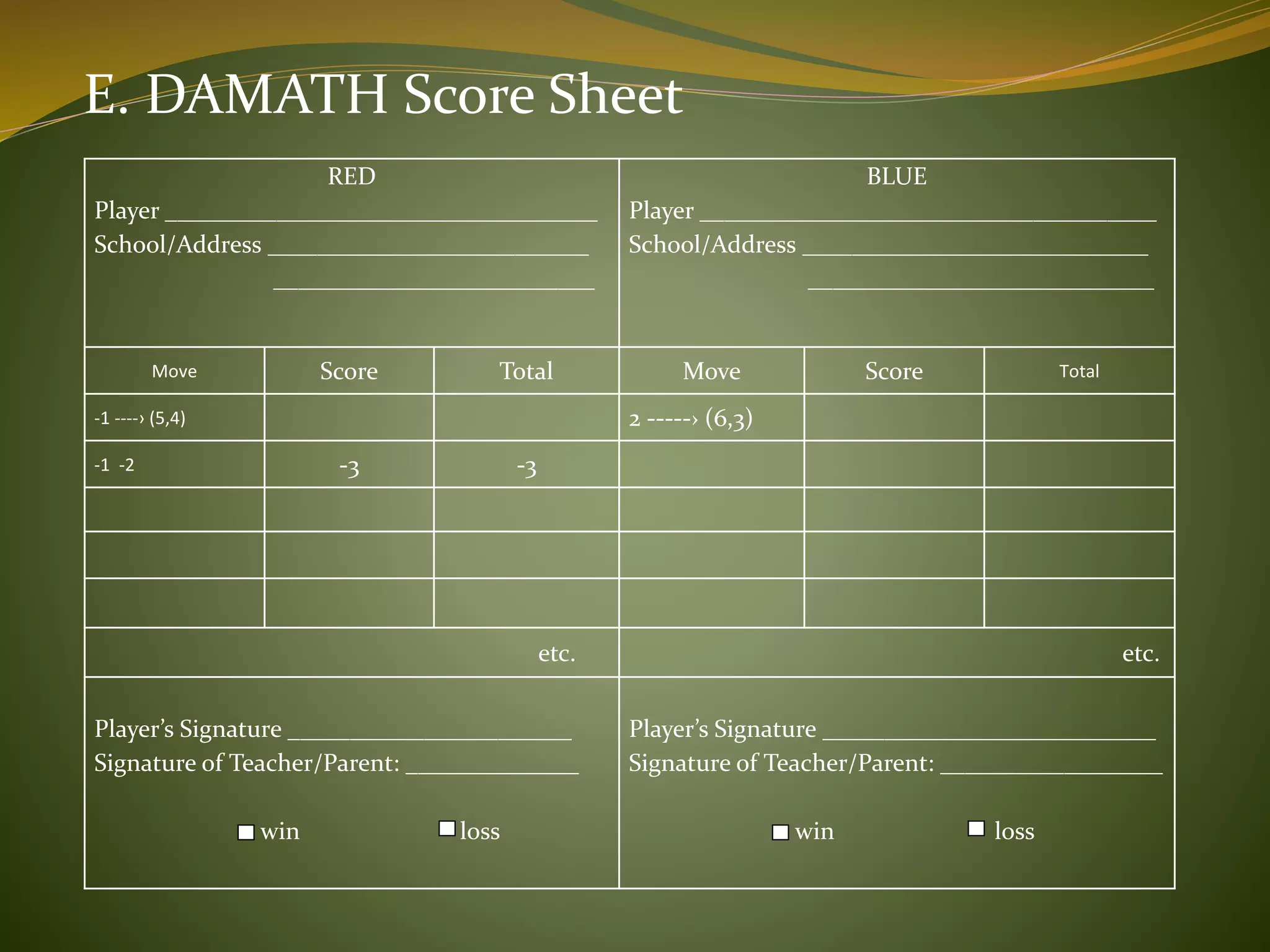
RED
Player ___________________________________
School/Address __________________________
__________________________
BLUE
Player _____________________________________
School/Address ____________________________
____________________________
Move Score Total Move Score Total
-1 ----› (5,4) 2 -----› (6,3)
-1 -2 -3 -3
etc. etc.
Player’s Signature _______________________
Signature of Teacher/Parent: ______________
win loss
Player’s Signature ___________________________
Signature of Teacher/Parent: __________________
win loss
E. DAMATH Score Sheet
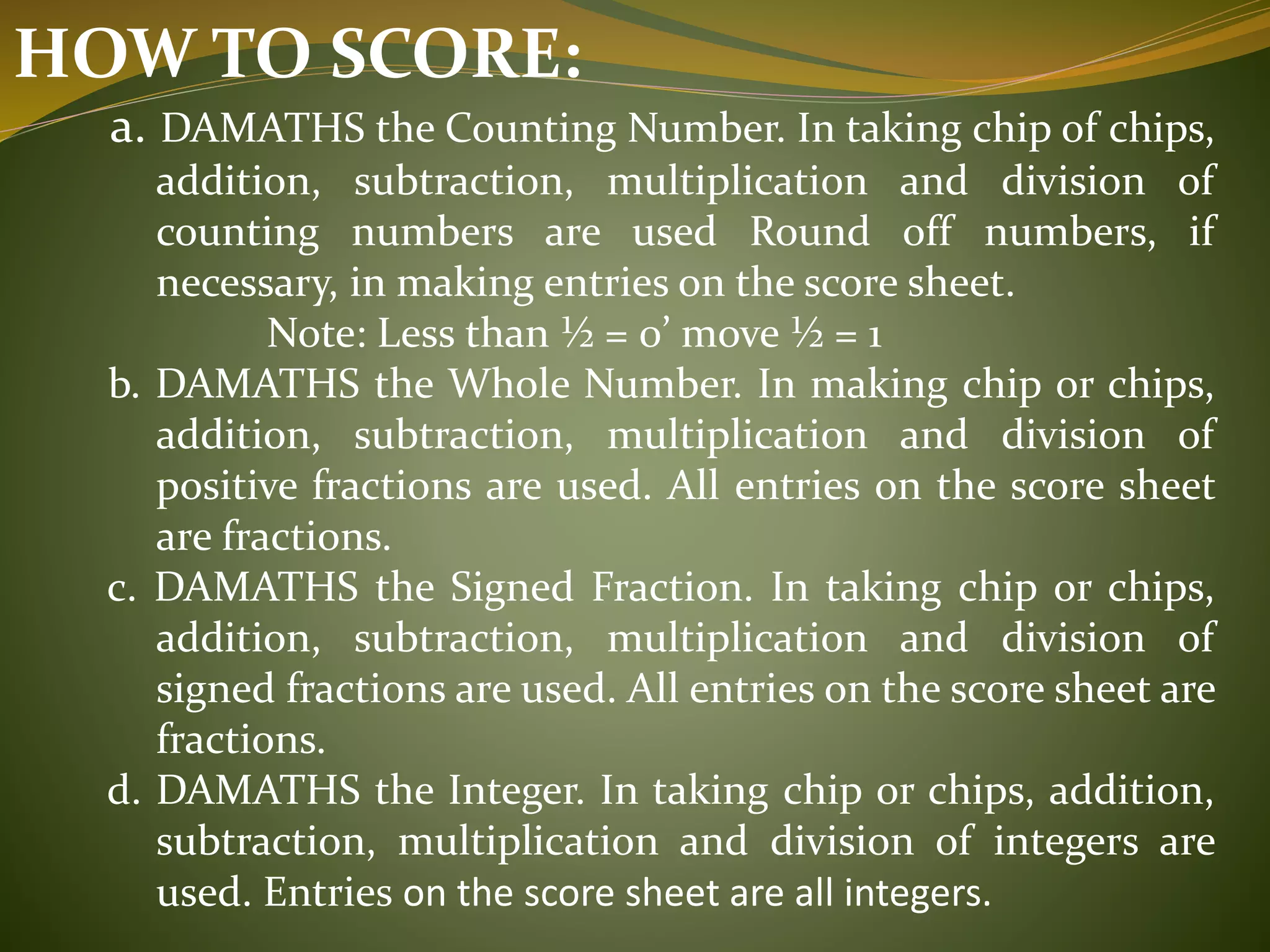
HOW TO SCORE:
a. DAMATHS the Counting Number. In taking chip of chips,
addition, subtraction, multiplication and division of
counting numbers are used Round off numbers, if
necessary, in making entries on the score sheet.
Note: Less than ½ = 0’ move ½ = 1
b. DAMATHS the Whole Number. In making chip or chips,
addition, subtraction, multiplication and division of
positive fractions are used. All entries on the score sheet
are fractions.
c. DAMATHS the Signed Fraction. In taking chip or chips,
addition, subtraction, multiplication and division of
signed fractions are used. All entries on the score sheet are
fractions.
d. DAMATHS the Integer. In taking chip or chips, addition,
subtraction, multiplication and division of integers are
used. Entries on the score sheet are all integers.

HOW-TO-PLAY-DAMATHS-presentation.pptx

  • 3.
    The objectives ofplaying DAMATHS are as follows: to integrate the Filipino checkerboard game into the teaching of Mathematical concepts, to encourage the utilization of recycled materials in constructing DAMATHS board set, to analyze DAMATHS as a possible subject to Mathematical investigations, to enhance wholesome interpersonal relations among learners, to promote mathematical consciousness among family members in particular and the community in general thru the Math Club’s community outreach DAMATHS competition.
  • 4.
    B. GAMES FORDAMATHS COMPETITION: Grades 1 - 2 - DAMATHS the Counting Number Grades 3 - 4 - DAMATHS the Whole Number Grade 5 - 6 - DAMATHS the Positive Fraction Grade 7 - DAMATHS the Signed Fraction Grade 8 - DAMATHS the Integer Grade 9 - DAMATHS the Scientific Notation (Chemistry) Fourth Year - Electro DAMATHS (Physics)
  • 5.
    C. POSITIONS OFCHIPS a. DAMATHS the Whole Number Blue Chips: 0(1,2); 1(3,2); 2(5,2); 3(7,2); 4(0,1); 5(2, 1); 6(4,1); 7(6,1); 8(1,0); 9(3,0); 10(5,0);11(7,0) Red Chips: 0(6,5); 1(4,5); 2(2,5); 3(0,5); 4(7,6); 5(5,6); 6(3,6); 7(1,6); 8(6,7); 9(4,7); 10(2,7); 11(0,7) 0 1 2 3 4 5 6 7 8 9 10 11
  • 6.
    b. DAMATHS theCounting Number Blue Chips 1(1,2); 2(3,2); 3(5,2); 4(7,2); 5(0,1); 6(2,1); 7(4,10); 8(6,1); 9(1,0); 10(3,0); 11(5,0); 12(7,0) Red Chips 1(6,5); 2(4,5); 3(2,5); 4(0,5); 5(7,6); 6(5,6); 7(3,6); 8(1,6); 9(6,7); 10(4,7); 11(2,7); 12(0,7) 1 2 3 4 5 6 7 8 9 10 11 12
  • 7.
    c. DAMATHS thePositive Fraction Blue Chips: 1(1,2); 2(3,2); 3(5,2); 4(7,2); 5(0,1); 6(2,1); 7(4,1); 8(6,1); 9(1,0); 10(3,0): 11(5,0); 12(7,0) Red Chips: 1(6,5); 2(4,5); 3(2,5); 4(0,5); 5(7,6); 6(5,6); 7(3,6); 8(1,6); 9(6,7); 10(4,7); 11(2,7); 12(0,7) 1/10 2/10 3/10 4/10 5/10 6/10 7/10 8/10 9/10 10/10 11/10 12/10
  • 8.
    d. DAMATHS theSigned Fraction Blue Chips: 0(5,2); 1(3,2); 2(7,2); 3(1,2); 4(4,1); -5(2,1); 6(6,1); -7(0,1); 8(5,0); -9(3,0); 10(7,0); -11(1,0) Red Chips: 0(2,5); -1(4,5); 2(0,5); -3(6,5); 4(3,6); -5(5,6); 6(1,6); -7(7,6); 8(2,7); -9(4,7); 10(0,7); -11(6,7)
  • 9.
    e. DAMATHS theIntegers Blue Chips: 0(5,2); -1(3,2); 2(7,2); -3(1,2); 4(4,1); -5(2,1); 6(6,1); -7(0,1); 8(5,0); -9(3,0); 10(7,0); -11(6,7) Red Chips: 0(2,5); -1(4,5); 2(0,5); -3(6,5); 4(3,6); -5(5,6); 6(1,6); -7(7,6); 8(2,7); -9(4,7); 10(0,7); -11(6,7) -3 -1 0 2 -7 -5 4 6 -11 -9 8 10
  • 10.
    f. DAMATHS theScientific Notation (Chemistry) Blue Chips: 1(1,2); 2(3,2); 3(5,2); 4(7,2); 5(0,1); 6(2,1); 7(4,1); 8(6,1); 9(1,0):10(3,0); 11(7,0); 12(7,0) Red Chips: 1(5,6); 2(2,5); 3(2,5); 4(0,5); 5(7,6); 6(5,6); 7,(3,6); 8(1,6); 9(6,7); 10(4,7); 11(2,7); 12(0,7) 1.1 x10¹ 2.2 x 10² 3.3 x 10³ 4.4 x 10⁴ 5.5 x 10⁵ 6.6 x 10⁶ 7.7 x 10⁷ 8.8 x 10⁸ 9.9 x 10⁹ 10.10 x 10¹⁰ 11.11 x 10¹¹ 12.12 x 10¹²
  • 11.
    g. ElectroDAMATHS (Physics) BlueChips: 1(1,2); 2(3,2); 3(5,2); 4(7,2); 5(0,1); 6(2,1); 7(4,1); 8(6,1); 9(1,0); 10(3,0); 11(5,0); 12(7,0) Red Chips: 1(6,5); 2(4,5); 3(2,5); 4(0,5); 5(7,6); 6(5,6); 7(3,6); 8(1,6); 9(6,7); 10(4,7); 11(2,7); 12(0,7) 0 1 2 3 4 5 6 7 8 9 10 11
  • 12.
    h. DAMATHS BOARDAND CHIPS The DAMATHS Board measure 30 cm x 30 cm with 8 x 8 squares. It contains 24 chips in two colors (12 of each color). Each chip measures 2 cm in diameter.
  • 13.
    D. GENERAL GUIDELINESON DAMATHS CENTURY MATCH (Enclosure 1 to DECS Memo No. 348, s 1996) 1. First player is determined by drawing lots. 2. Basically, the rule in playing dama shall be used as follows: a. A “chip with numeral” moves diagonally forward to an adjoining vacant square. b. A chip takes an opponent’s chip or chips diagonally forward or backward. Mathematical operation such as addition, subtraction, multiplication, or division of numerals shall be used depending on the vacant square’s operation symbol where the “taker” chip lands by jumping over the “taken” chip. “Pass” is not allowed. c. On taking a chip or chips the following policy shall prevail. •“mayor dalawa” [ ] takes Ovs. [ ] takes O and O •“mayor tatlo” [ ] takes Ovs. [ ] takes O and O •“mayor dama” [ ] takes Ovs. [ ] dama takes O •“mayor dalawa” [ ] dama takes Ovs. [ ] takes O and O and over “mayor dama”
  • 14.
    d. A player’schip is declared as “dama” if it reaches the other player’s designated “dama” locations of squares A “dama” chip can move or take a piece to any unoccupied square along the diagonal path. Moreover “dama” score is doubled. In like manner a chip’s score is doubled if it takes a “dama” chip. e. In taking more than one chip the “taker” chip shall remain as the initial addend, minuend, multiplicand, or dividend as the case maybe. (This means that MDAS for multiple operations shall not apply in the case). f. A “move” is good only for one (1) minute, while the game’s durations shall not exceed 20 minutes. g. The remaining chips shall be added to the respective players. h. The game ends when any one of the following situations occur: •A player has no more chip to move •20-minute game duration had elapsed •Repetitive “moves of any or both players”
  • 15.
    i. The playerhaving the greater “total score” wins the game. In case of a “tie”, a 10-minute rematch follows there after until a winner is declared. Only one score sheet shall be accomplished by the two players where by any incorrect entries in the said score sheet shall be sole responsibility of each player, in case of incorrect entries in the score sheet, a player has to immediately call the attention of the facilitator by raising his or her hand. As determined by the facilitator, any incidence of incorrect journal entry in the score sheet shall be deducted correspondingly five (5) points from the erring player’s total score, after correcting said entry errors, whereby facilitator’s decision is final and unappealable.
  • 16.
    RED Player ___________________________________ School/Address __________________________ __________________________ BLUE Player_____________________________________ School/Address ____________________________ ____________________________ Move Score Total Move Score Total -1 ----› (5,4) 2 -----› (6,3) -1 -2 -3 -3 etc. etc. Player’s Signature _______________________ Signature of Teacher/Parent: ______________ win loss Player’s Signature ___________________________ Signature of Teacher/Parent: __________________ win loss E. DAMATH Score Sheet
  • 17.
    HOW TO SCORE: a.DAMATHS the Counting Number. In taking chip of chips, addition, subtraction, multiplication and division of counting numbers are used Round off numbers, if necessary, in making entries on the score sheet. Note: Less than ½ = 0’ move ½ = 1 b. DAMATHS the Whole Number. In making chip or chips, addition, subtraction, multiplication and division of positive fractions are used. All entries on the score sheet are fractions. c. DAMATHS the Signed Fraction. In taking chip or chips, addition, subtraction, multiplication and division of signed fractions are used. All entries on the score sheet are fractions. d. DAMATHS the Integer. In taking chip or chips, addition, subtraction, multiplication and division of integers are used. Entries on the score sheet are all integers.