How to make a Research
Question?
Jorge A. Restrepo M.
2016
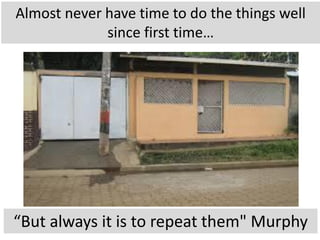
Almost never have time to do the things well
since first time…
“But always it is to repeat them" Murphy
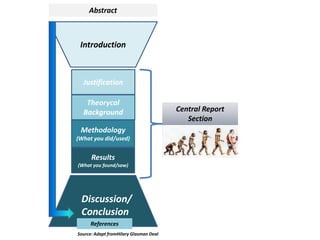
Introduction
Discussion/
Conclusion
Methodology
(What you did/used)
Results
(What you found/saw)
Abstract
Central Report
Section
Source: Adapt fromHilary Glasman Deal
Justification
References
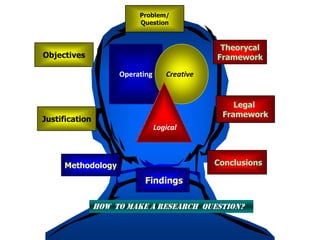
Theorycal
Background
Operating Creative
Logical
Theorycal
FrameworkObjectives
Justification
Legal
Framework
ConclusionsMethodology
Problem/
Question
Findings
How to make a research question?
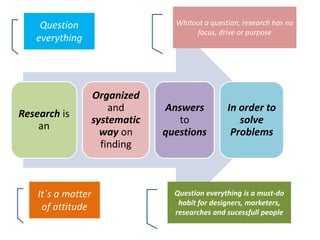
Research is
an
Organized
and
systematic
way on
finding
Answers
to
questions
In order to
solve
Problems
Question
everything
Question everything is a must-do
habit for designers, marketers,
researches and sucessfull people
Whitout a question, research has no
focus, drive or purpose
It´s a matter
of attitude
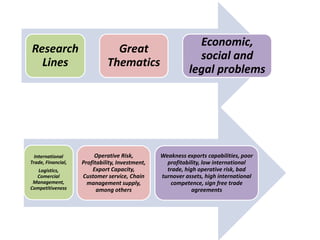
Research
Lines
Great
Thematics
Economic,
social and
legal problems
International
Trade, Financial,
Logistics,
Comercial
Management,
Competitiveness
Operative Risk,
Profitability, Investment,
Export Capacity,
Customer service, Chain
management supply,
among others
Weakness exports capabilities, poor
profitability, low international
trade, high operative risk, bad
turnover assets, high international
competence, sign free trade
agreements
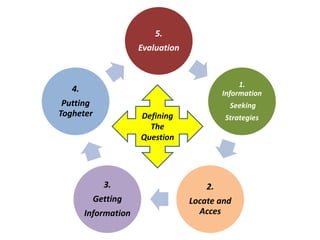
5.
Evaluation
1.
Information
Seeking
Strategies
2.
Locate and
Acces
3.
Getting
Information
4.
Putting
Togheter Defining
The
Question
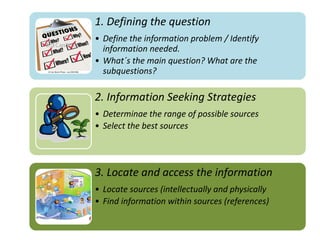
1. Defining the question
• Define the information problem / Identify
information needed.
• What´s the main question? What are the
subquestions?
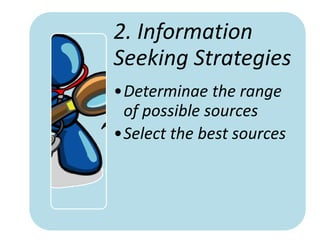
2. Information Seeking Strategies
• Determinae the range of possible sources
• Select the best sources
3. Locate and access the information
• Locate sources (intellectually and physically
• Find information within sources (references)
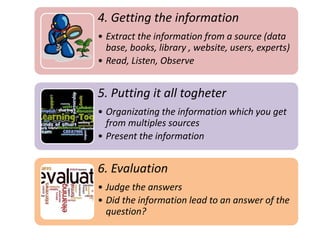
4. Getting the information
• Extract the information from a source (data
base, books, library , website, users, experts)
• Read, Listen, Observe
5. Putting it all togheter
• Organizating the information which you get
from multiples sources
• Present the information
6. Evaluation
• Judge the answers
• Did the information lead to an answer of the
question?
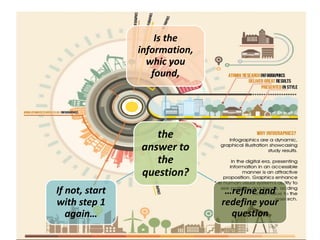
Did the information lead to an answer of the question?
If not…
1. Defining the
question
•Define the information
problem / Identify
information needed.
•What´s the main
question? What are the
subquestions?
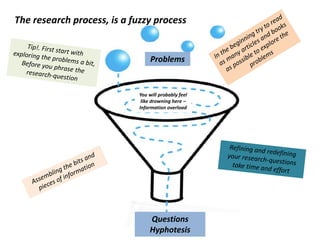
The research process, is a fuzzy process
You will probably feel
like drowning here –
Information overload
Problems
Questions
Hyphotesis
Something About Export Capability
problem…
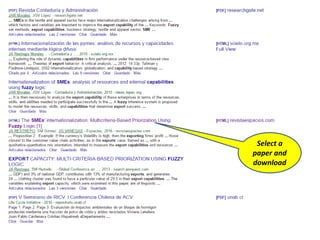
Step 1. Searching
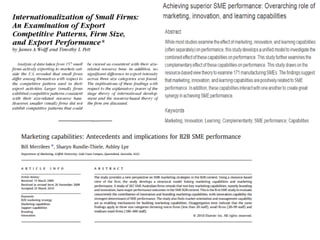
Literature.
Most Simple: Google
Scholar
Select a
paper and
download
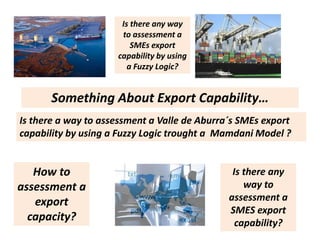
Something About Export Capability…
How to
assessment a
export
capacity?
Is there any
way to
assessment a
SMES export
capability?
Is there any way
to assessment a
SMEs export
capability by using
a Fuzzy Logic?
Is there a way to assessment a Valle de Aburra´s SMEs export
capability by using a Fuzzy Logic trought a Mamdani Model ?
Let´s see
the most
Important
elements
(keywords)
Of the
question
are…
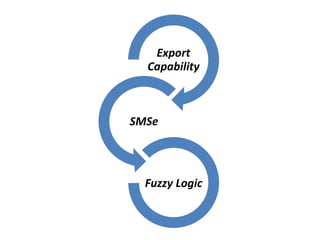
Export
Capability
SMSe
Fuzzy Logic
Export
Capacity SMEs
Fuzzy Logic
System
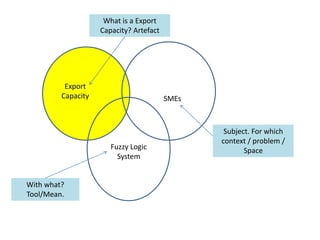
Subject. For which
context / problem /
Space
What is a Export
Capacity? Artefact
With what?
Tool/Mean.
Export
Capacity SMEs
Fuzzy Logic
System
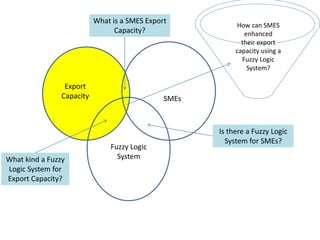
Is there a Fuzzy Logic
System for SMEs?
What is a SMES Export
Capacity?
What kind a Fuzzy
Logic System for
Export Capacity?
How can SMES
enhanced
their export
capacity using a
Fuzzy Logic
System?
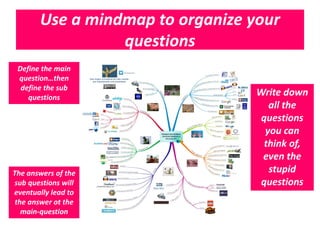
Use a mindmap to organize your
questions
Define the main
question…then
define the sub
questions
Write down
all the
questions
you can
think of,
even the
stupid
questions
The answers of the
sub questions will
eventually lead to
the answer ot the
main-question
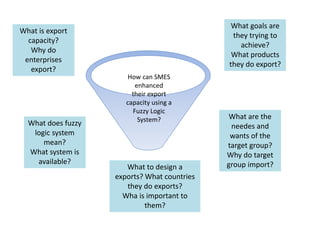
How can SMES
enhanced
their export
capacity using a
Fuzzy Logic
System?
What goals are
they trying to
achieve?
What products
they do export?
What is export
capacity?
Why do
enterprises
export?
What are the
needes and
wants of the
target group?
Why do target
group import?
What does fuzzy
logic system
mean?
What system is
available?
What to design a
exports? What countries
they do exports?
Wha is important to
them?
Estructura del párrafo
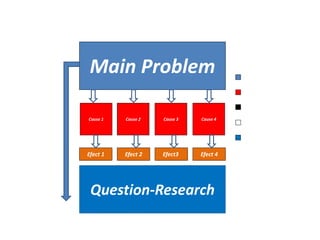
Main Problem
Cause 1 Cause 2 Cause 3 Cause 4
Idea principal
Ideas secundarias
Conectores
Efect 1 Efect 2 Efect3 Efect 4
Question-Research
Detalles
Conclusión
Estructura del párrafo
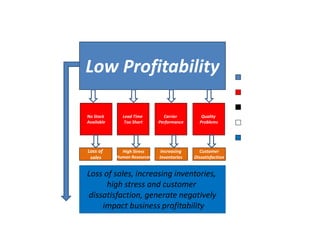
Low Profitability
No Stock
Available
Lead Time
Too Short
Carrier
Performance
Quality
Problems
Idea principal
Ideas secundarias
Conectores
Loss of
sales
High Stress
Human Resources
Increasing
Inventories
Customer
Dissatisfaction
Loss of sales, increasing inventories,
high stress and customer
dissatisfaction, generate negatively
impact business profitability
Detalles
Conclusión
Estructura del párrafo
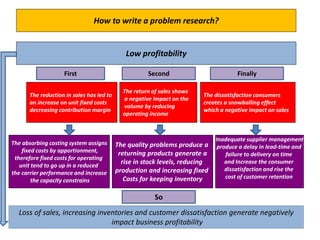
Low profitability
The reduction in sales has led to
an increase on unit fixed costs
decreasing contribution margin
The absorbing costing system assigns
fixed costs by apportionment,
therefore fixed costs for operating
unit tend to go up in a reduced
the carrier performance and increase
the capacity constrains
Loss of sales, increasing inventories and customer dissatisfaction generate negatively
impact business profitability
The return of sales shows
a negative impact on the
volume by reducing
operating income
The dissatisfaction consumers
creates a snowballing effect
which a negative impact on sales
The quality problems produce a
returning products generate a
rise in stock levels, reducing
production and increasing fixed
Costs for keeping inventory
Inadequate supplier management
produce a delay in lead-time and
failure to delivery on time
and Increase the consumer
dissatisfaction and rise the
cost of customer retention
First Second Finally
So
How to write a problem research?
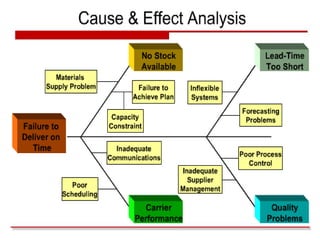
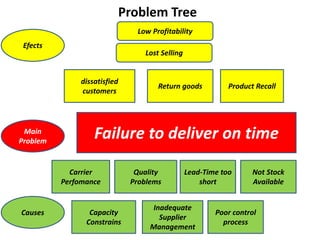
Failure to deliver on time
dissatisfied
customers
Product Recall
Lost Selling
Carrier
Perfomance
Quality
Problems
Lead-Time too
short
Capacity
Constrains
Inadequate
Supplier
Management
Main
Problem
Causes
Efects
Problem Tree
Return goods
Low Profitability
Not Stock
Available
Poor control
process
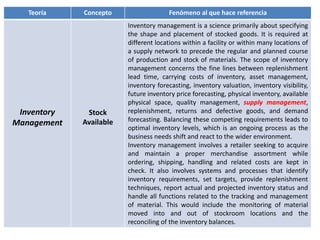
Teoría Concepto Fenómeno al que hace referencia
Inventory
Management
Stock
Available
Inventory management is a science primarily about specifying
the shape and placement of stocked goods. It is required at
different locations within a facility or within many locations of
a supply network to precede the regular and planned course
of production and stock of materials. The scope of inventory
management concerns the fine lines between replenishment
lead time, carrying costs of inventory, asset management,
inventory forecasting, inventory valuation, inventory visibility,
future inventory price forecasting, physical inventory, available
physical space, quality management, supply management,
replenishment, returns and defective goods, and demand
forecasting. Balancing these competing requirements leads to
optimal inventory levels, which is an ongoing process as the
business needs shift and react to the wider environment.
Inventory management involves a retailer seeking to acquire
and maintain a proper merchandise assortment while
ordering, shipping, handling and related costs are kept in
check. It also involves systems and processes that identify
inventory requirements, set targets, provide replenishment
techniques, report actual and projected inventory status and
handle all functions related to the tracking and management
of material. This would include the monitoring of material
moved into and out of stockroom locations and the
reconciling of the inventory balances.
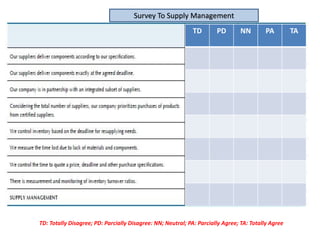
TD: Totally Disagree; PD: Parcially Disagree: NN; Neutral; PA: Parcially Agree; TA: Totally Agree
Survey To Supply Management
TD PD NN PA TA
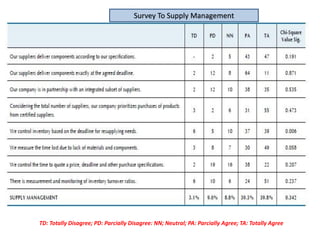
TD: Totally Disagree; PD: Parcially Disagree: NN; Neutral; PA: Parcially Agree; TA: Totally Agree
Survey To Supply Management
Estructura del párrafo
Low profitability
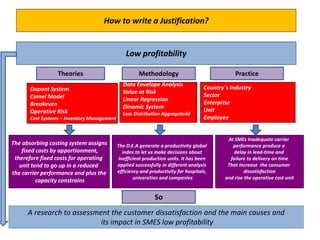
Dupont System
Camel Model
Breakeven
Operative Risk
Cost Systems – Inventory Management
The absorbing costing system assigns
fixed costs by apportionment,
therefore fixed costs for operating
unit tend to go up in a reduced
the carrier performance and plus the
capacity constrains
A research to assessment the customer dissatisfaction and the main causes and
its impact in SMES low profitability
Data Envelope Analysis
Value at Risk
Linear Regression
Dinamic System
Loss Distribution Aggregatedd
Country´s Industry
Sector
Enterprise
Unit
Employee
The D.E.A generate a productivity global
index to let us make decisions about
Inefficient production units. It has been
applied successfully in different analysis
efficiency and productivity for hospitals,
universities and companies
At SMEs Inadequate carrier
performance produce a
delay in lead-time and
failure to delivery on time
That Increase the consumer
dissatisfaction
and rise the operative cost unit
Theories Methodology Practice
So
How to write a Justification?
2. Information
Seeking Strategies
•Determinae the range
of possible sources
•Select the best sources
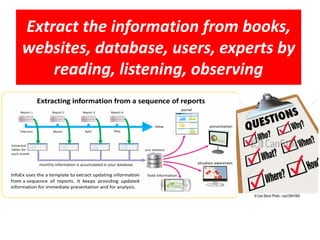
Extract the information from books,
websites, database, users, experts by
reading, listening, observing
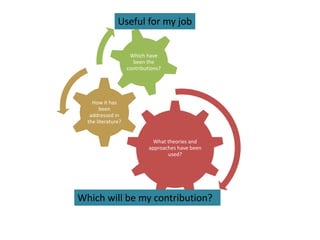
What theories and
approaches have been
used?
How it has
been
addressed in
the literature?
Which have
been the
contributions?
Which will be my contribution?
Useful for my job
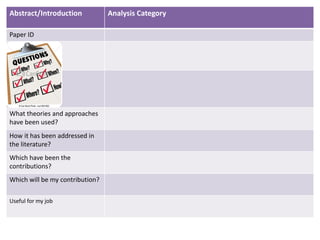
Abstract/Introduction Analysis Category
Paper ID
What ?
Why?
For what?
How?
Whom?
When?
Where?
What theories and approaches
have been used?
How it has been addressed in
the literature?
Which have been the
contributions?
Which will be my contribution?
Useful for my job
If you are not an experienced reader,
reading can be tedius…
But should you read a
paper/book from page one
to the very last one
So if you read the first
chapters/abstract/conclusions…you get an
idea what they are trying to explain
If you are having problems with
English literature?
Don´t try to translate every
word by looking it up in a
dictionary
Keep reading, and try to grasp the essence of
the text, only translate words which are
crucial…and use a english-english dictionary
How to organize all the material
which you get from several sources?
Make notes, write
summaries of interesting
things you see
Use del.icio.us or OneNote,
Skydrive, Dropbox or a Notebook
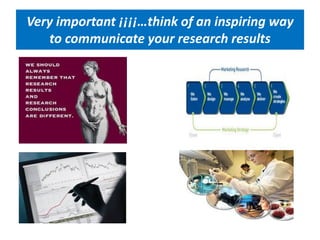
Very important ¡¡¡¡…think of an inspiring way
to communicate your research results
the
answer to
the
question?
Is the
information,
whic you
found,
…refine and
redefine your
question
If not, start
with step 1
again…
Thanks

How tomakeresearchquestion

  • 1.
    How to makea Research Question? Jorge A. Restrepo M. 2016
  • 2.
    Almost never havetime to do the things well since first time… “But always it is to repeat them" Murphy
  • 4.
    Introduction Discussion/ Conclusion Methodology (What you did/used) Results (Whatyou found/saw) Abstract Central Report Section Source: Adapt fromHilary Glasman Deal Justification References Theorycal Background
  • 5.
  • 6.
    Research is an Organized and systematic way on finding Answers to questions Inorder to solve Problems Question everything Question everything is a must-do habit for designers, marketers, researches and sucessfull people Whitout a question, research has no focus, drive or purpose It´s a matter of attitude
  • 7.
    Research Lines Great Thematics Economic, social and legal problems International Trade,Financial, Logistics, Comercial Management, Competitiveness Operative Risk, Profitability, Investment, Export Capacity, Customer service, Chain management supply, among others Weakness exports capabilities, poor profitability, low international trade, high operative risk, bad turnover assets, high international competence, sign free trade agreements
  • 8.
  • 9.
    1. Defining thequestion • Define the information problem / Identify information needed. • What´s the main question? What are the subquestions? 2. Information Seeking Strategies • Determinae the range of possible sources • Select the best sources 3. Locate and access the information • Locate sources (intellectually and physically • Find information within sources (references)
  • 10.
    4. Getting theinformation • Extract the information from a source (data base, books, library , website, users, experts) • Read, Listen, Observe 5. Putting it all togheter • Organizating the information which you get from multiples sources • Present the information 6. Evaluation • Judge the answers • Did the information lead to an answer of the question?
  • 11.
    Did the informationlead to an answer of the question? If not…
  • 12.
    1. Defining the question •Definethe information problem / Identify information needed. •What´s the main question? What are the subquestions?
  • 13.
    The research process,is a fuzzy process You will probably feel like drowning here – Information overload Problems Questions Hyphotesis
  • 14.
    Something About ExportCapability problem…
  • 15.
    Step 1. Searching Literature. MostSimple: Google Scholar
  • 16.
  • 19.
    Something About ExportCapability… How to assessment a export capacity? Is there any way to assessment a SMES export capability? Is there any way to assessment a SMEs export capability by using a Fuzzy Logic? Is there a way to assessment a Valle de Aburra´s SMEs export capability by using a Fuzzy Logic trought a Mamdani Model ?
  • 20.
  • 21.
  • 22.
    Export Capacity SMEs Fuzzy Logic System Subject.For which context / problem / Space What is a Export Capacity? Artefact With what? Tool/Mean.
  • 23.
    Export Capacity SMEs Fuzzy Logic System Isthere a Fuzzy Logic System for SMEs? What is a SMES Export Capacity? What kind a Fuzzy Logic System for Export Capacity? How can SMES enhanced their export capacity using a Fuzzy Logic System?
  • 24.
    Use a mindmapto organize your questions Define the main question…then define the sub questions Write down all the questions you can think of, even the stupid questions The answers of the sub questions will eventually lead to the answer ot the main-question
  • 25.
    How can SMES enhanced theirexport capacity using a Fuzzy Logic System? What goals are they trying to achieve? What products they do export? What is export capacity? Why do enterprises export? What are the needes and wants of the target group? Why do target group import? What does fuzzy logic system mean? What system is available? What to design a exports? What countries they do exports? Wha is important to them?
  • 26.
    Estructura del párrafo MainProblem Cause 1 Cause 2 Cause 3 Cause 4 Idea principal Ideas secundarias Conectores Efect 1 Efect 2 Efect3 Efect 4 Question-Research Detalles Conclusión
  • 27.
    Estructura del párrafo LowProfitability No Stock Available Lead Time Too Short Carrier Performance Quality Problems Idea principal Ideas secundarias Conectores Loss of sales High Stress Human Resources Increasing Inventories Customer Dissatisfaction Loss of sales, increasing inventories, high stress and customer dissatisfaction, generate negatively impact business profitability Detalles Conclusión
  • 28.
    Estructura del párrafo Lowprofitability The reduction in sales has led to an increase on unit fixed costs decreasing contribution margin The absorbing costing system assigns fixed costs by apportionment, therefore fixed costs for operating unit tend to go up in a reduced the carrier performance and increase the capacity constrains Loss of sales, increasing inventories and customer dissatisfaction generate negatively impact business profitability The return of sales shows a negative impact on the volume by reducing operating income The dissatisfaction consumers creates a snowballing effect which a negative impact on sales The quality problems produce a returning products generate a rise in stock levels, reducing production and increasing fixed Costs for keeping inventory Inadequate supplier management produce a delay in lead-time and failure to delivery on time and Increase the consumer dissatisfaction and rise the cost of customer retention First Second Finally So How to write a problem research?
  • 30.
    Failure to deliveron time dissatisfied customers Product Recall Lost Selling Carrier Perfomance Quality Problems Lead-Time too short Capacity Constrains Inadequate Supplier Management Main Problem Causes Efects Problem Tree Return goods Low Profitability Not Stock Available Poor control process
  • 31.
    Teoría Concepto Fenómenoal que hace referencia Inventory Management Stock Available Inventory management is a science primarily about specifying the shape and placement of stocked goods. It is required at different locations within a facility or within many locations of a supply network to precede the regular and planned course of production and stock of materials. The scope of inventory management concerns the fine lines between replenishment lead time, carrying costs of inventory, asset management, inventory forecasting, inventory valuation, inventory visibility, future inventory price forecasting, physical inventory, available physical space, quality management, supply management, replenishment, returns and defective goods, and demand forecasting. Balancing these competing requirements leads to optimal inventory levels, which is an ongoing process as the business needs shift and react to the wider environment. Inventory management involves a retailer seeking to acquire and maintain a proper merchandise assortment while ordering, shipping, handling and related costs are kept in check. It also involves systems and processes that identify inventory requirements, set targets, provide replenishment techniques, report actual and projected inventory status and handle all functions related to the tracking and management of material. This would include the monitoring of material moved into and out of stockroom locations and the reconciling of the inventory balances.
  • 32.
    TD: Totally Disagree;PD: Parcially Disagree: NN; Neutral; PA: Parcially Agree; TA: Totally Agree Survey To Supply Management TD PD NN PA TA
  • 33.
    TD: Totally Disagree;PD: Parcially Disagree: NN; Neutral; PA: Parcially Agree; TA: Totally Agree Survey To Supply Management
  • 34.
    Estructura del párrafo Lowprofitability Dupont System Camel Model Breakeven Operative Risk Cost Systems – Inventory Management The absorbing costing system assigns fixed costs by apportionment, therefore fixed costs for operating unit tend to go up in a reduced the carrier performance and plus the capacity constrains A research to assessment the customer dissatisfaction and the main causes and its impact in SMES low profitability Data Envelope Analysis Value at Risk Linear Regression Dinamic System Loss Distribution Aggregatedd Country´s Industry Sector Enterprise Unit Employee The D.E.A generate a productivity global index to let us make decisions about Inefficient production units. It has been applied successfully in different analysis efficiency and productivity for hospitals, universities and companies At SMEs Inadequate carrier performance produce a delay in lead-time and failure to delivery on time That Increase the consumer dissatisfaction and rise the operative cost unit Theories Methodology Practice So How to write a Justification?
  • 35.
    2. Information Seeking Strategies •Determinaethe range of possible sources •Select the best sources
  • 36.
    Extract the informationfrom books, websites, database, users, experts by reading, listening, observing
  • 37.
    What theories and approacheshave been used? How it has been addressed in the literature? Which have been the contributions? Which will be my contribution? Useful for my job
  • 38.
    Abstract/Introduction Analysis Category PaperID What ? Why? For what? How? Whom? When? Where? What theories and approaches have been used? How it has been addressed in the literature? Which have been the contributions? Which will be my contribution? Useful for my job
  • 39.
    If you arenot an experienced reader, reading can be tedius… But should you read a paper/book from page one to the very last one So if you read the first chapters/abstract/conclusions…you get an idea what they are trying to explain
  • 40.
    If you arehaving problems with English literature? Don´t try to translate every word by looking it up in a dictionary Keep reading, and try to grasp the essence of the text, only translate words which are crucial…and use a english-english dictionary
  • 41.
    How to organizeall the material which you get from several sources? Make notes, write summaries of interesting things you see Use del.icio.us or OneNote, Skydrive, Dropbox or a Notebook
  • 42.
    Very important ¡¡¡¡…thinkof an inspiring way to communicate your research results
  • 43.
    the answer to the question? Is the information, whicyou found, …refine and redefine your question If not, start with step 1 again…
  • 44.