The Complexity Crisis Why too Many Products, Markets and Customers are Crippling Your CompanyJohn L. MariottiFormer President of Rubbermaid Office Products and Huffy Bicycles
Table of ContentsThe Complexity ProblemTruths About ComplexityCalculating the Complexity Factor – A New Measure to Correlate Complexity With ProfitabilityRecognizing Excess Complexity – Motorola Case StudyReducing Complexity – One Step at a TimeSources of Complexity – What to Measure - Where to Assign costsControlling Complexity – Know Your CompetitionTopics You Must Understand in Order to CompeteThe Shape of Value – Creating the Shared VisionMemorable Quotes
The Complexity ProblemQuest for top-line growth in low/no growth marketsWhat gets measured gets done – but none of today’s accounting or measurement systems identify the costs of excess complexity until it is too latePeople feel the need to create new products, processes, facilities and systems, but no one is designated to kill of the old and unproductive onesThis results in proliferation in products, customers, markets, suppliers, facilities, locationsThe rate and scope of complexity in the world around us is exceeding our ability to deal with itJust because you can make/sell a product or service doesn’t mean you shouldComplexity fragments management focus, wastes time and money and ultimately reduces shareholder value
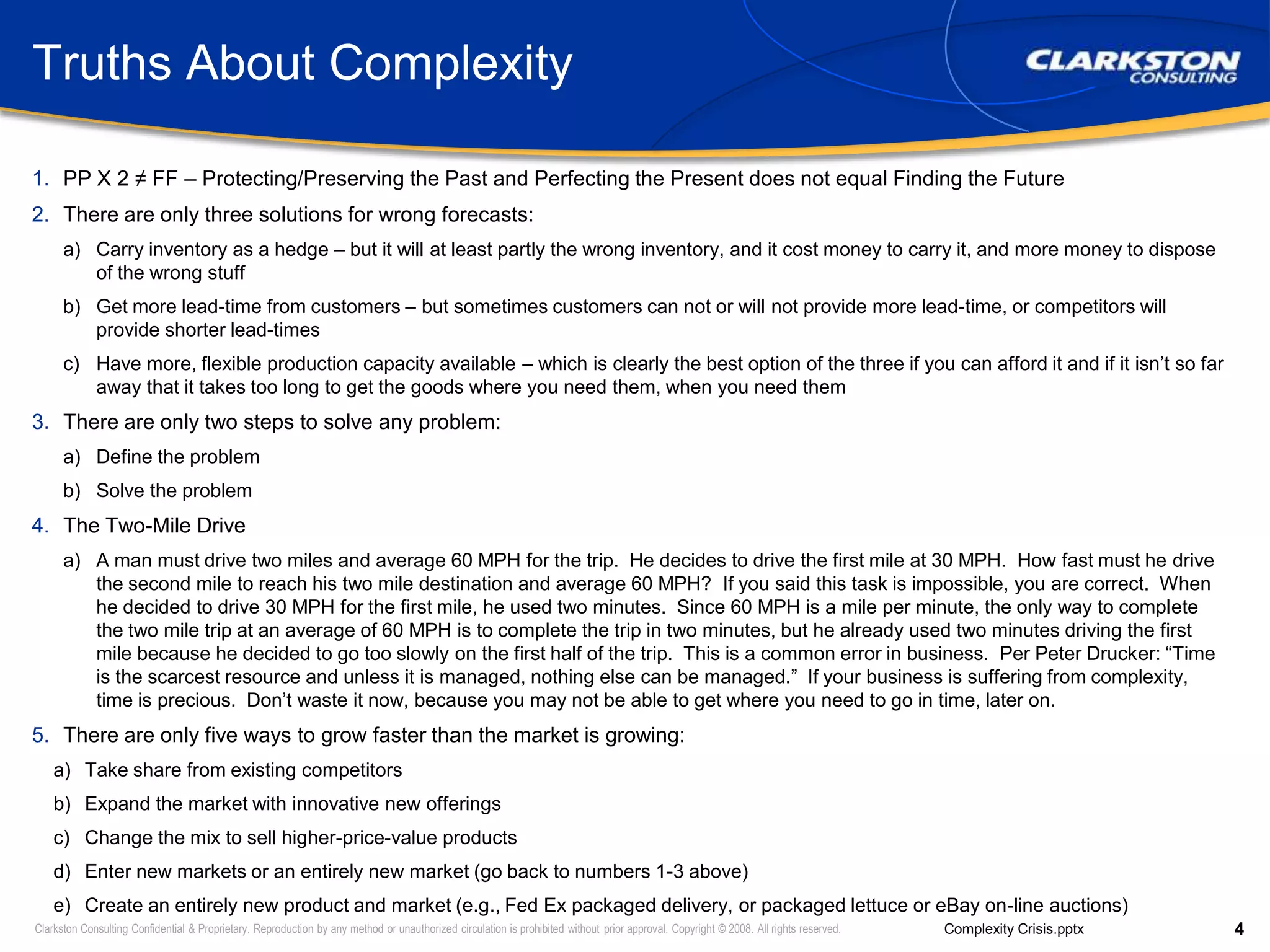
Truths About ComplexityPP X 2 ≠ FF – Protecting/Preserving the Past and Perfecting the Present does not equal Finding the FutureThere are only three solutions for wrong forecasts:Carry inventory as a hedge – but it will at least partly the wrong inventory, and it cost money to carry it, and more money to dispose of the wrong stuffGet more lead-time from customers – but sometimes customers can not or will not provide more lead-time, or competitors will provide shorter lead-timesHave more, flexible production capacity available – which is clearly the best option of the three if you can afford it and if it isn’t so far away that it takes too long to get the goods where you need them, when you need themThere are only two steps to solve any problem:Define the problemSolve the problemThe Two-Mile DriveA man must drive two miles and average 60 MPH for the trip.  He decides to drive the first mile at 30 MPH.  How fast must he drive the second mile to reach his two mile destination and average 60 MPH?  If you said this task is impossible, you are correct.  When he decided to drive 30 MPH for the first mile, he used two minutes.  Since 60 MPH is a mile per minute, the only way to complete the two mile trip at an average of 60 MPH is to complete the trip in two minutes, but he already used two minutes driving the first mile because he decided to go too slowly on the first half of the trip.  This is a common error in business.  Per Peter Drucker: “Time is the scarcest resource and unless it is managed, nothing else can be managed.”  If your business is suffering from complexity, time is precious.  Don’t waste it now, because you may not be able to get where you need to go in time, later on.There are only five ways to grow faster than the market is growing:Take share from existing competitorsExpand the market with innovative new offeringsChange the mix to sell higher-price-value productsEnter new markets or an entirely new market (go back to numbers 1-3 above)Create an entirely new product and market (e.g., Fed Ex packaged delivery, or packaged lettuce or eBay on-line auctions)
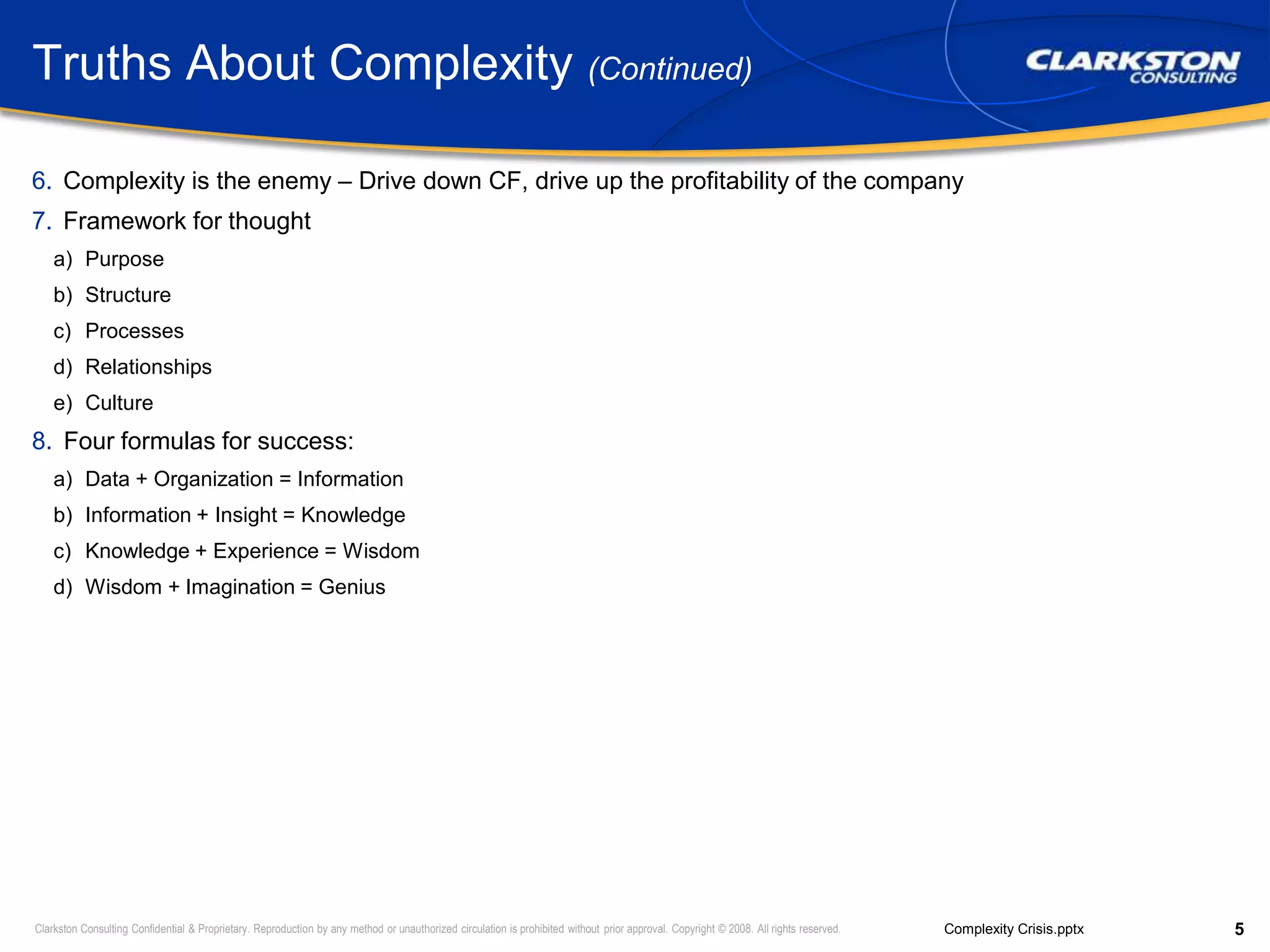
Truths About Complexity (Continued)Complexity is the enemy – Drive down CF, drive up the profitability of the companyFramework for thoughtPurposeStructureProcessesRelationshipsCultureFour formulas for success:Data + Organization = InformationInformation + Insight = KnowledgeKnowledge + Experience = WisdomWisdom + Imagination = Genius
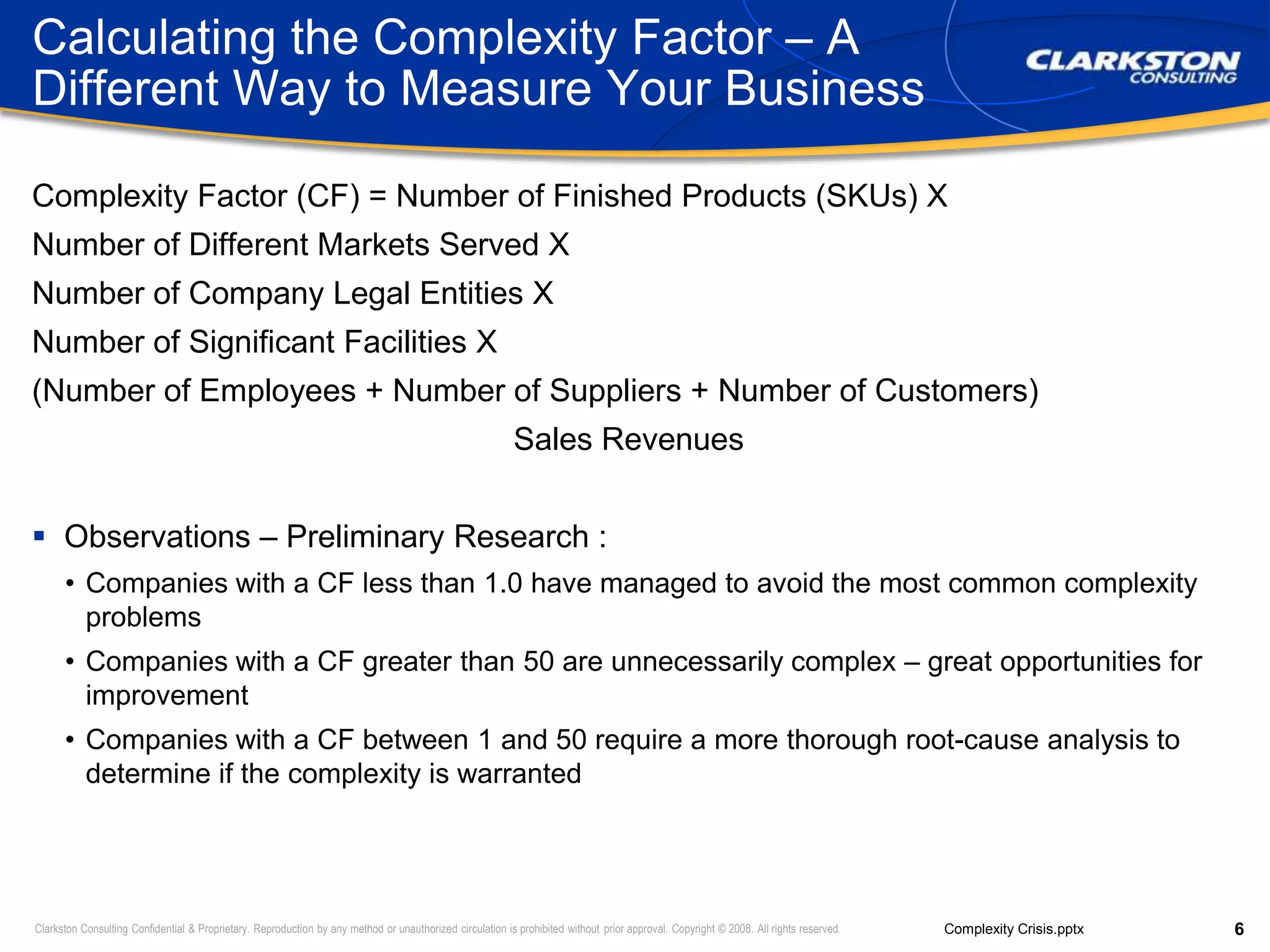
Calculating the Complexity Factor – A Different Way to Measure Your BusinessComplexity Factor (CF) = Number of Finished Products (SKUs) XNumber of Different Markets Served XNumber of Company Legal Entities X Number of Significant Facilities X(Number of Employees + Number of Suppliers + Number of Customers) ÷Sales RevenuesObservations – Preliminary Research :Companies with a CF less than 1.0 have managed to avoid the most common complexity problemsCompanies with a CF greater than 50 are unnecessarily complex – great opportunities for improvementCompanies with a CF between 1 and 50 require a more thorough root-cause analysis to determine if the complexity is warranted
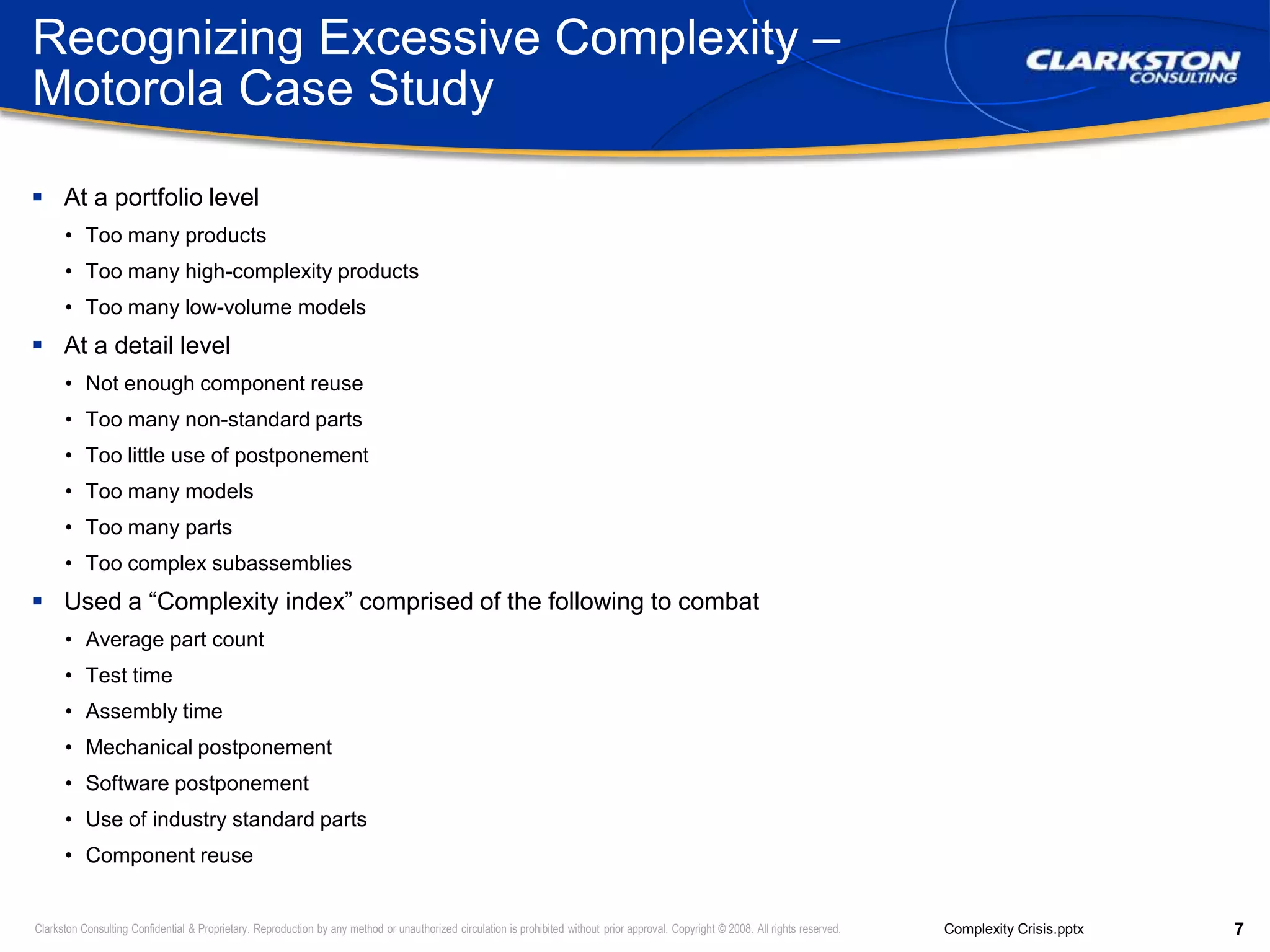
Recognizing Excessive Complexity – Motorola Case StudyAt a portfolio levelToo many productsToo many high-complexity productsToo many low-volume modelsAt a detail levelNot enough component reuseToo many non-standard partsToo little use of postponementToo many modelsToo many partsToo complex subassembliesUsed a “Complexity index” comprised of the following to combatAverage part countTest timeAssembly timeMechanical postponementSoftware postponementUse of industry standard partsComponent reuse
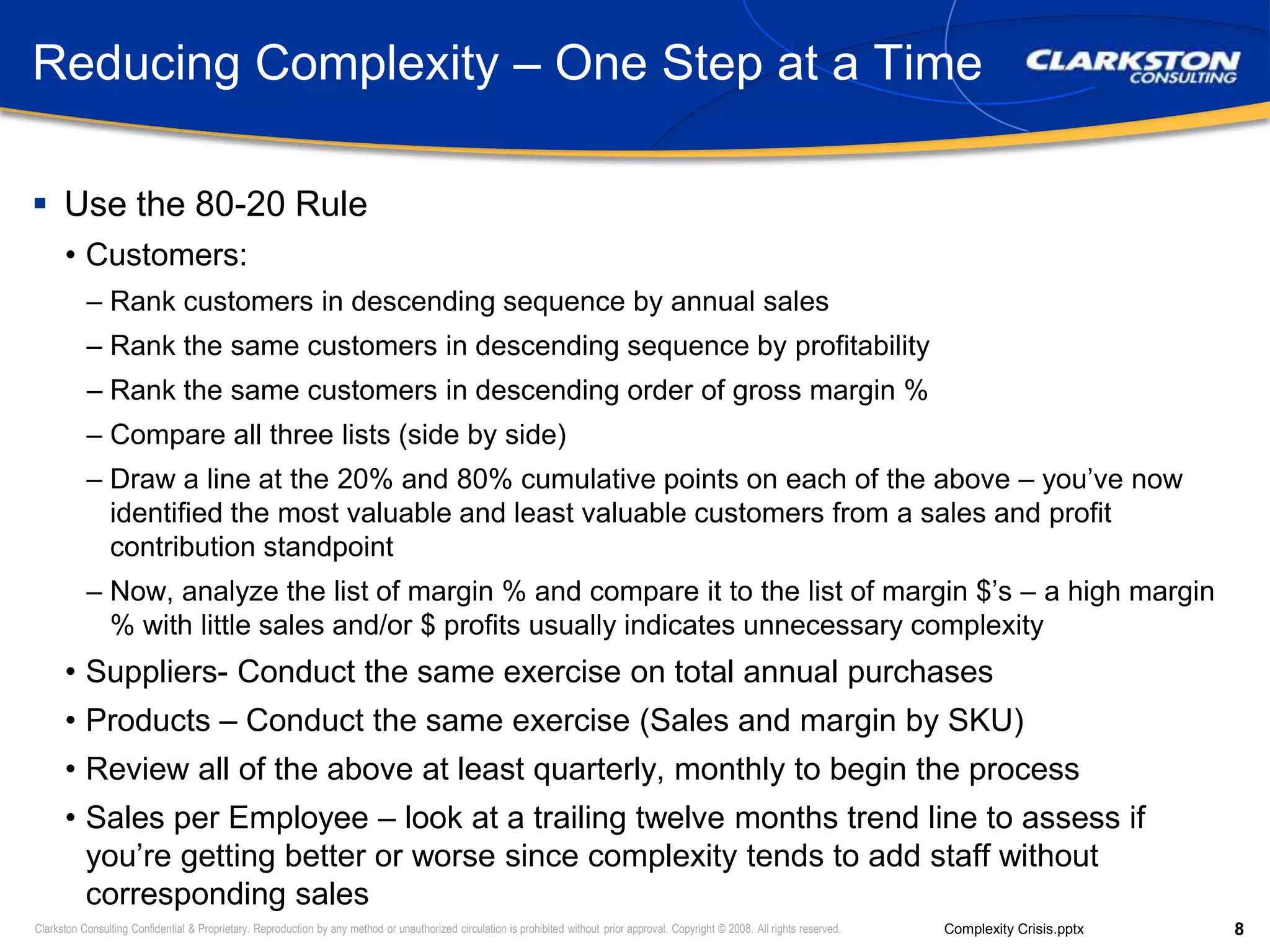
Reducing Complexity – One Step at a TimeUse the 80-20 RuleCustomers:Rank customers in descending sequence by annual salesRank the same customers in descending sequence by profitabilityRank the same customers in descending order of gross margin % Compare all three lists (side by side)Draw a line at the 20% and 80% cumulative points on each of the above – you’ve now identified the most valuable and least valuable customers from a sales and profit contribution standpointNow, analyze the list of margin % and compare it to the list of margin $’s – a high margin % with little sales and/or $ profits usually indicates unnecessary complexitySuppliers- Conduct the same exercise on total annual purchasesProducts – Conduct the same exercise (Sales and margin by SKU)Review all of the above at least quarterly, monthly to begin the processSales per Employee – look at a trailing twelve months trend line to assess if you’re getting better or worse since complexity tends to add staff without corresponding sales
Complexity Sources – What to Measure – Where to Assign CostsTransactions – orders, invoices, payments, voucher entries, adjustmentsCustomers – sales calls, unique products, programs, promotions, record keeping/reportingSuppliers – Sales calls, unique components, materials, deals, record keeping/reporting, variability and six sigmaCompetition – market segments, products, regions, countries and distribution typesObsolescence -  raw material, components, finished products, marketing/merchandising materials, closeouts, markdowns, scrap, administration (Which customers, products, dist channels)Forecasting – Variety, similarity/shifting, seasonality, geography, Bill of Materials, planning changes, schedule changesShipments -  destinations, routings, shipping instructions, manifests/paperwork, confusing, similar numbers/models/packages, DC locationsStaffing costs, learning curve and training costsInformation systems – EDI protocols, size of database, number of programs, memory, processing, documentation, network management, securityCurrency risks – number of countries buying, selling, doing business, employeesTax returns – number of different states and countries, different tax codes, regulationsIncorporation and officer designations – Number of states and countries, governing lawRegulations – number of states and countries, local codes, industry relatedIntellectual property – number of states and countries, patents, trademarks, copyrights
Solutions to the Complexity ProblemCommon platforms – around which product variation can be producedStandard component listsApproved supplier listsLong term agreementsPostponementMass customizationPlan global, make localStudy how industry leaders have managed complexityOther tools at emcien.com
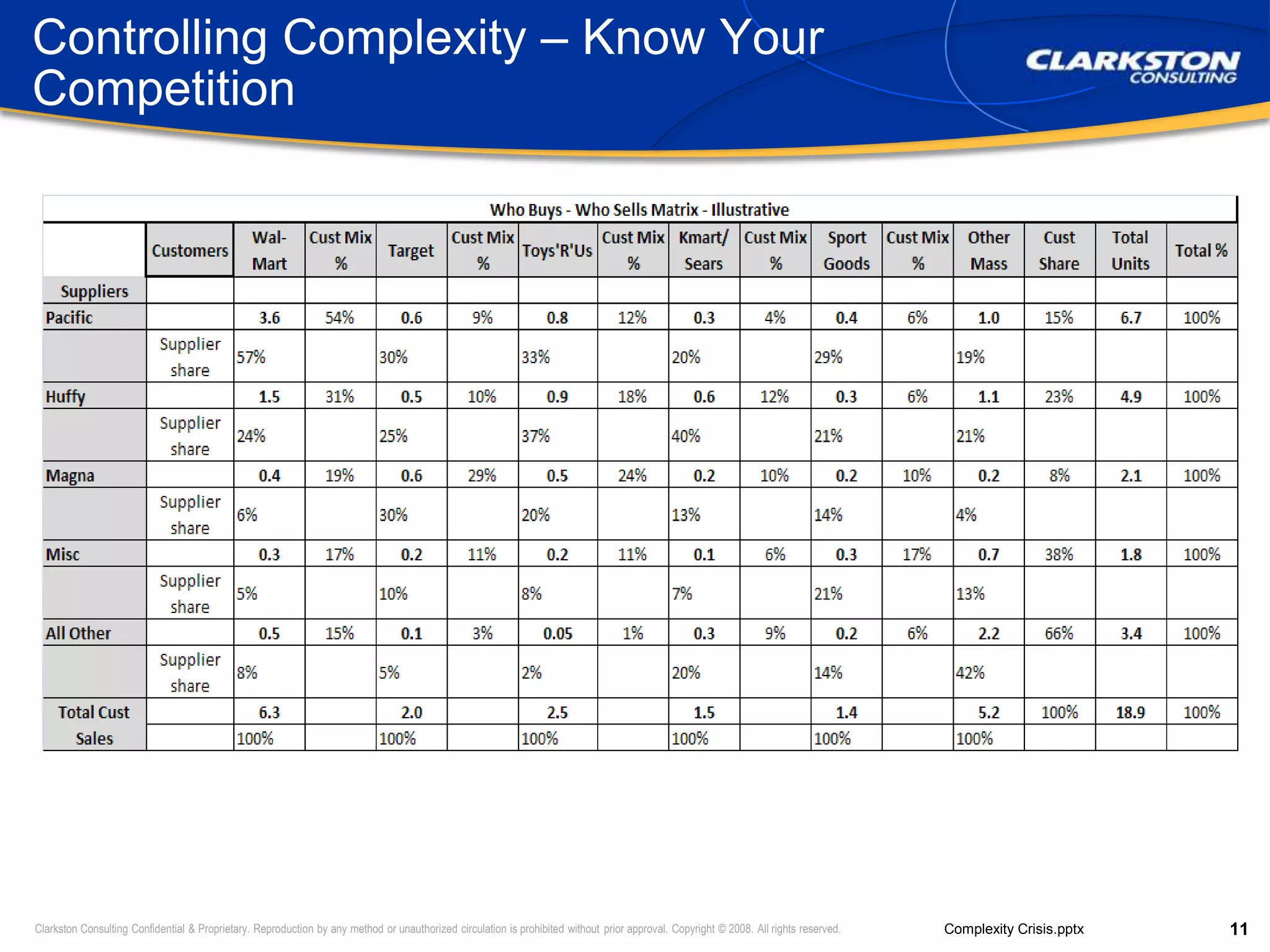
Controlling Complexity – Know Your Competition
Topics You Must Understand in Order to CompeteThe Current EnvironmentLatent over-capacityGlobal parityThe Curse of ComplexityCapacity is elastic, demand only exists where there is wealth, needs and wantsThere is no measurement systemStrategic Outsourcing – Boon or Bane?You (and your competitors) can get it in China, subcontract it to India, import it from South AmericaBe careful what you give away – Your supplier could become your biggest competitorThe Value NetworkSupply Chain is a misnomer – it’s about what network creates the most valuePartnerships in an Era of Growing ComplexityPeople and partners are key competitive differentiatorsThe best partners, working collaboratively enable winnersLeadership – Creating a Path to the FutureCreates a clear understanding of and a healthy dissatisfaction with the current realityBuilds a shared vision of a new, better realityCreates an environment in which people are motivated to move from the former to the later
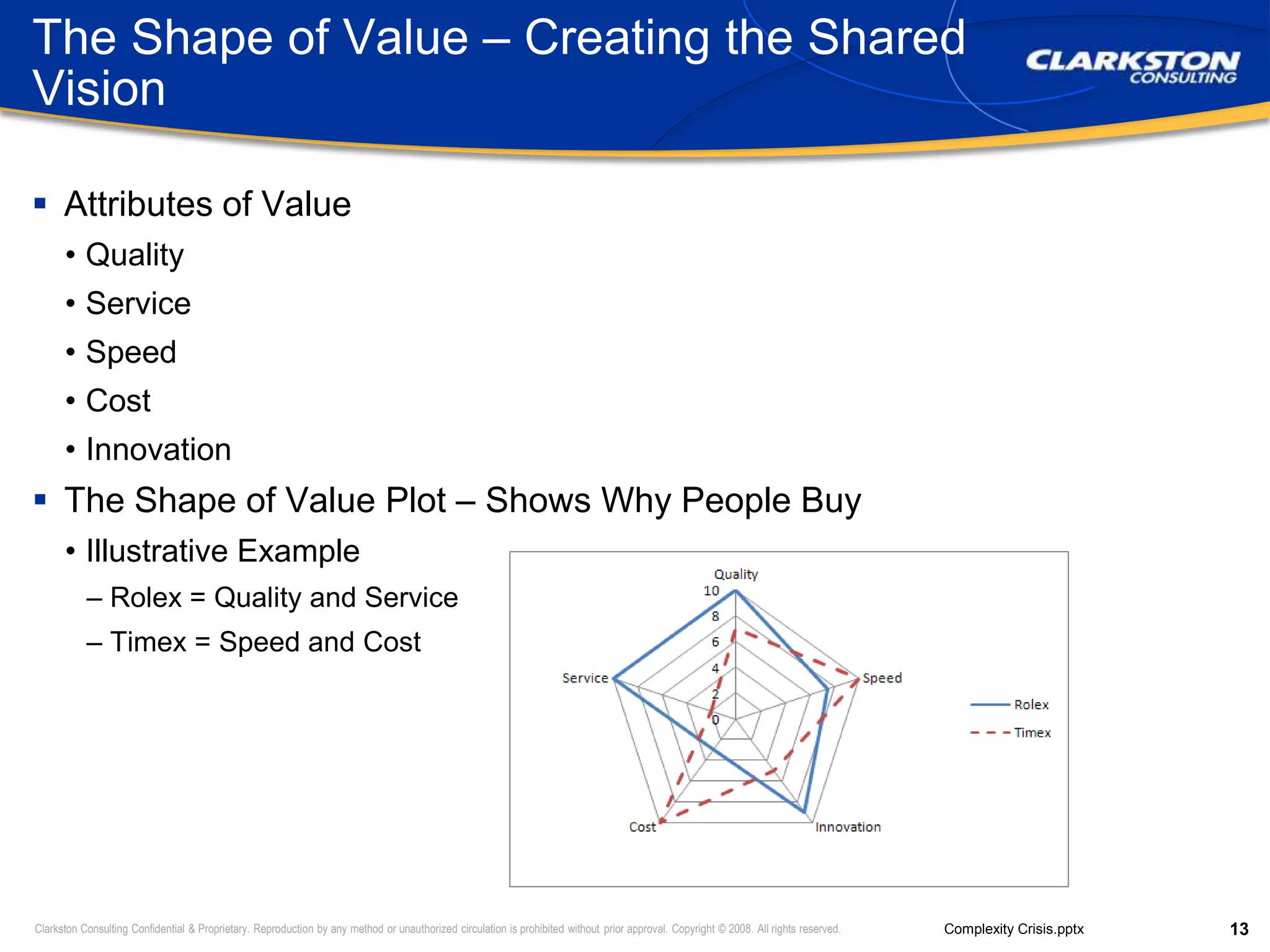
The Shape of Value – Creating the Shared VisionAttributes of ValueQualityServiceSpeedCost InnovationThe Shape of Value Plot – Shows Why People BuyIllustrative ExampleRolex = Quality and ServiceTimex = Speed and Cost
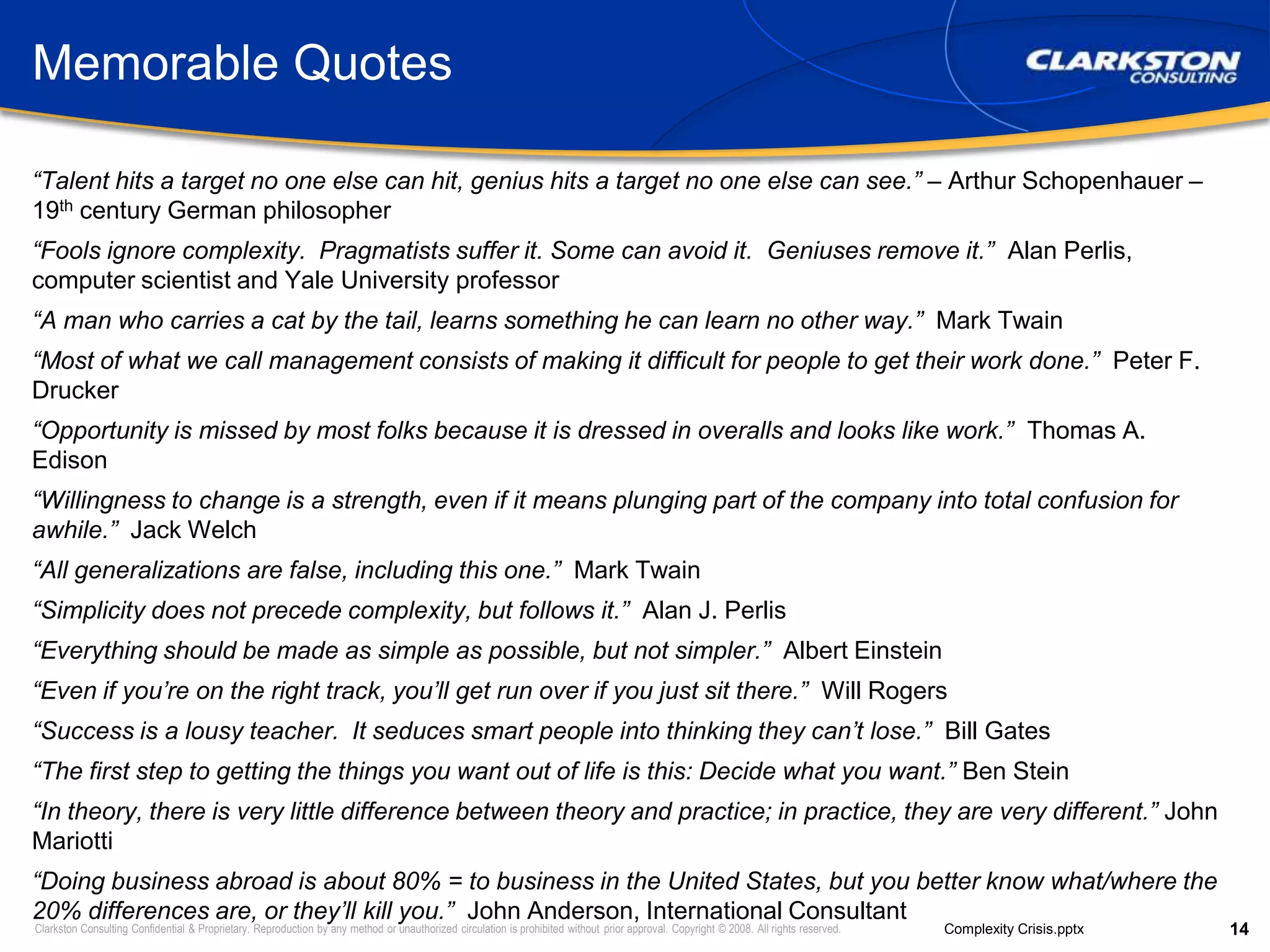
Memorable Quotes“Talent hits a target no one else can hit, genius hits a target no one else can see.” – Arthur Schopenhauer – 19th century German philosopher“Fools ignore complexity.  Pragmatists suffer it. Some can avoid it.  Geniuses remove it.”  Alan Perlis, computer scientist and Yale University professor“A man who carries a cat by the tail, learns something he can learn no other way.”  Mark Twain“Most of what we call management consists of making it difficult for people to get their work done.”  Peter F. Drucker“Opportunity is missed by most folks because it is dressed in overalls and looks like work.”  Thomas A. Edison“Willingness to change is a strength, even if it means plunging part of the company into total confusion for awhile.”  Jack Welch“All generalizations are false, including this one.”  Mark Twain“Simplicity does not precede complexity, but follows it.”  Alan J. Perlis“Everything should be made as simple as possible, but not simpler.”  Albert Einstein“Even if you’re on the right track, you’ll get run over if you just sit there.”  Will Rogers“Success is a lousy teacher.  It seduces smart people into thinking they can’t lose.”  Bill Gates“The first step to getting the things you want out of life is this: Decide what you want.” Ben Stein“In theory, there is very little difference between theory and practice; in practice, they are very different.” John Mariotti“Doing business abroad is about 80% = to business in the United States, but you better know what/where the 20% differences are, or they’ll kill you.”  John Anderson, International Consultant
Appendix
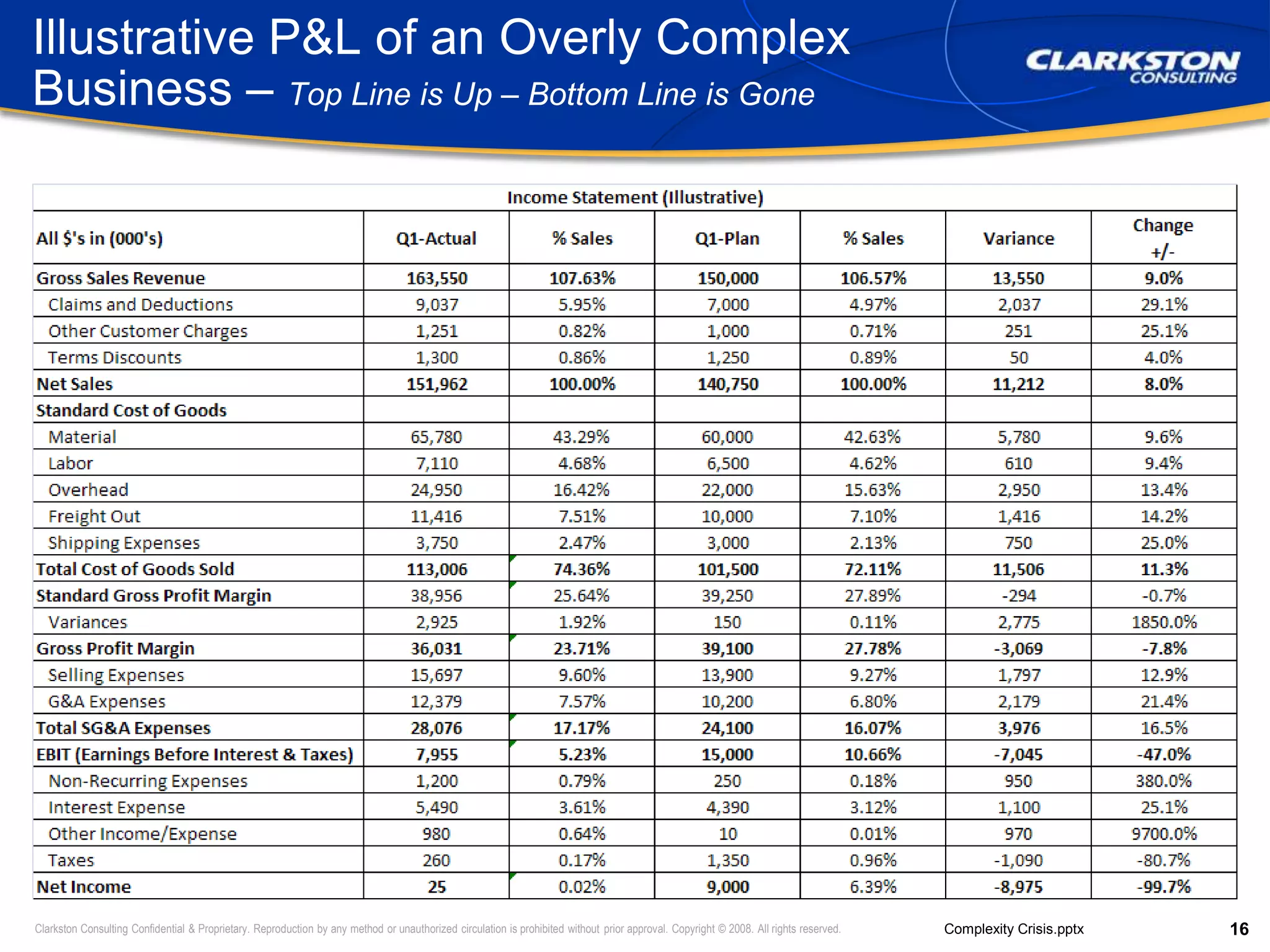
Illustrative P&L of an Overly Complex Business – Top Line is Up – Bottom Line is Gone
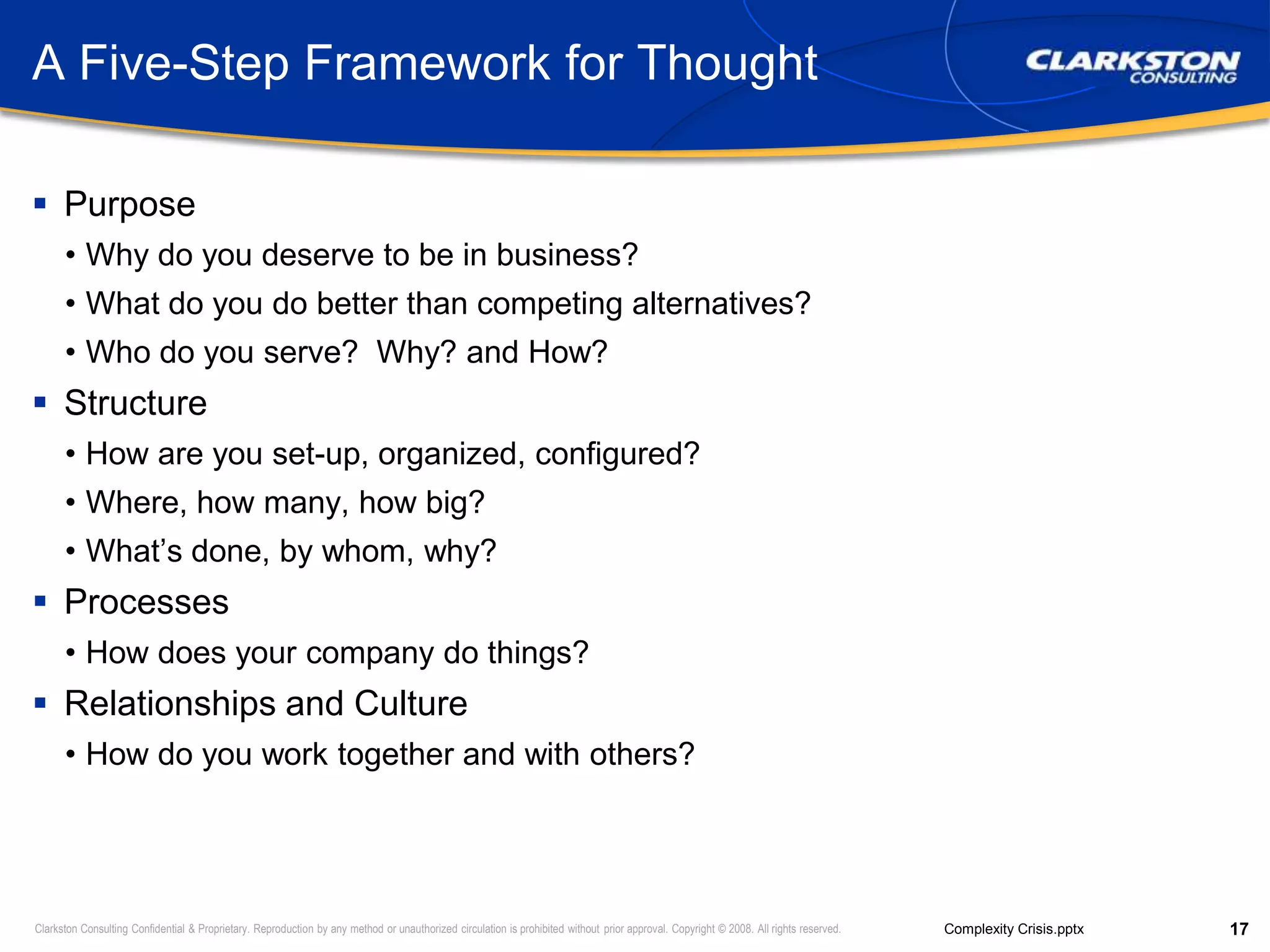
A Five-Step Framework for ThoughtPurposeWhy do you deserve to be in business?What do you do better than competing alternatives?Who do you serve?  Why? and How?StructureHow are you set-up, organized, configured?Where, how many, how big?What’s done, by whom, why?ProcessesHow does your company do things?Relationships and CultureHow do you work together and with others?
Thank YouClarkston Consulting is a different kind of management and technology consulting firm. We deliver a unique experience for market leaders within the Consumer Products and Life Sciences  industries. Considering professionalism, expertise, and value as prerequisites, we take service a step further through our unyielding commitment to the success of people as individuals, both our clients and our employees. By combining integrity, adaptability, and a whatever-it-takes attitude, we have achieved an extremely high rate of referral and repeat business and a 7-year average client satisfaction rate of 96%.Ron Clauderclaude@clarkstonconsulting.com1234 Some RoadSuite 123Any Town, NC 12345office: 	123-123-1234 mobile: 	123-123-1234www.clarkstonconsulting.com

Complexity Crisis

  • 1.
    The Complexity CrisisWhy too Many Products, Markets and Customers are Crippling Your CompanyJohn L. MariottiFormer President of Rubbermaid Office Products and Huffy Bicycles
  • 2.
    Table of ContentsTheComplexity ProblemTruths About ComplexityCalculating the Complexity Factor – A New Measure to Correlate Complexity With ProfitabilityRecognizing Excess Complexity – Motorola Case StudyReducing Complexity – One Step at a TimeSources of Complexity – What to Measure - Where to Assign costsControlling Complexity – Know Your CompetitionTopics You Must Understand in Order to CompeteThe Shape of Value – Creating the Shared VisionMemorable Quotes
  • 3.
    The Complexity ProblemQuestfor top-line growth in low/no growth marketsWhat gets measured gets done – but none of today’s accounting or measurement systems identify the costs of excess complexity until it is too latePeople feel the need to create new products, processes, facilities and systems, but no one is designated to kill of the old and unproductive onesThis results in proliferation in products, customers, markets, suppliers, facilities, locationsThe rate and scope of complexity in the world around us is exceeding our ability to deal with itJust because you can make/sell a product or service doesn’t mean you shouldComplexity fragments management focus, wastes time and money and ultimately reduces shareholder value
  • 4.
    Truths About ComplexityPPX 2 ≠ FF – Protecting/Preserving the Past and Perfecting the Present does not equal Finding the FutureThere are only three solutions for wrong forecasts:Carry inventory as a hedge – but it will at least partly the wrong inventory, and it cost money to carry it, and more money to dispose of the wrong stuffGet more lead-time from customers – but sometimes customers can not or will not provide more lead-time, or competitors will provide shorter lead-timesHave more, flexible production capacity available – which is clearly the best option of the three if you can afford it and if it isn’t so far away that it takes too long to get the goods where you need them, when you need themThere are only two steps to solve any problem:Define the problemSolve the problemThe Two-Mile DriveA man must drive two miles and average 60 MPH for the trip. He decides to drive the first mile at 30 MPH. How fast must he drive the second mile to reach his two mile destination and average 60 MPH? If you said this task is impossible, you are correct. When he decided to drive 30 MPH for the first mile, he used two minutes. Since 60 MPH is a mile per minute, the only way to complete the two mile trip at an average of 60 MPH is to complete the trip in two minutes, but he already used two minutes driving the first mile because he decided to go too slowly on the first half of the trip. This is a common error in business. Per Peter Drucker: “Time is the scarcest resource and unless it is managed, nothing else can be managed.” If your business is suffering from complexity, time is precious. Don’t waste it now, because you may not be able to get where you need to go in time, later on.There are only five ways to grow faster than the market is growing:Take share from existing competitorsExpand the market with innovative new offeringsChange the mix to sell higher-price-value productsEnter new markets or an entirely new market (go back to numbers 1-3 above)Create an entirely new product and market (e.g., Fed Ex packaged delivery, or packaged lettuce or eBay on-line auctions)
  • 5.
    Truths About Complexity(Continued)Complexity is the enemy – Drive down CF, drive up the profitability of the companyFramework for thoughtPurposeStructureProcessesRelationshipsCultureFour formulas for success:Data + Organization = InformationInformation + Insight = KnowledgeKnowledge + Experience = WisdomWisdom + Imagination = Genius
  • 6.
    Calculating the ComplexityFactor – A Different Way to Measure Your BusinessComplexity Factor (CF) = Number of Finished Products (SKUs) XNumber of Different Markets Served XNumber of Company Legal Entities X Number of Significant Facilities X(Number of Employees + Number of Suppliers + Number of Customers) ÷Sales RevenuesObservations – Preliminary Research :Companies with a CF less than 1.0 have managed to avoid the most common complexity problemsCompanies with a CF greater than 50 are unnecessarily complex – great opportunities for improvementCompanies with a CF between 1 and 50 require a more thorough root-cause analysis to determine if the complexity is warranted
  • 7.
    Recognizing Excessive Complexity– Motorola Case StudyAt a portfolio levelToo many productsToo many high-complexity productsToo many low-volume modelsAt a detail levelNot enough component reuseToo many non-standard partsToo little use of postponementToo many modelsToo many partsToo complex subassembliesUsed a “Complexity index” comprised of the following to combatAverage part countTest timeAssembly timeMechanical postponementSoftware postponementUse of industry standard partsComponent reuse
  • 8.
    Reducing Complexity –One Step at a TimeUse the 80-20 RuleCustomers:Rank customers in descending sequence by annual salesRank the same customers in descending sequence by profitabilityRank the same customers in descending order of gross margin % Compare all three lists (side by side)Draw a line at the 20% and 80% cumulative points on each of the above – you’ve now identified the most valuable and least valuable customers from a sales and profit contribution standpointNow, analyze the list of margin % and compare it to the list of margin $’s – a high margin % with little sales and/or $ profits usually indicates unnecessary complexitySuppliers- Conduct the same exercise on total annual purchasesProducts – Conduct the same exercise (Sales and margin by SKU)Review all of the above at least quarterly, monthly to begin the processSales per Employee – look at a trailing twelve months trend line to assess if you’re getting better or worse since complexity tends to add staff without corresponding sales
  • 9.
    Complexity Sources –What to Measure – Where to Assign CostsTransactions – orders, invoices, payments, voucher entries, adjustmentsCustomers – sales calls, unique products, programs, promotions, record keeping/reportingSuppliers – Sales calls, unique components, materials, deals, record keeping/reporting, variability and six sigmaCompetition – market segments, products, regions, countries and distribution typesObsolescence - raw material, components, finished products, marketing/merchandising materials, closeouts, markdowns, scrap, administration (Which customers, products, dist channels)Forecasting – Variety, similarity/shifting, seasonality, geography, Bill of Materials, planning changes, schedule changesShipments - destinations, routings, shipping instructions, manifests/paperwork, confusing, similar numbers/models/packages, DC locationsStaffing costs, learning curve and training costsInformation systems – EDI protocols, size of database, number of programs, memory, processing, documentation, network management, securityCurrency risks – number of countries buying, selling, doing business, employeesTax returns – number of different states and countries, different tax codes, regulationsIncorporation and officer designations – Number of states and countries, governing lawRegulations – number of states and countries, local codes, industry relatedIntellectual property – number of states and countries, patents, trademarks, copyrights
  • 10.
    Solutions to theComplexity ProblemCommon platforms – around which product variation can be producedStandard component listsApproved supplier listsLong term agreementsPostponementMass customizationPlan global, make localStudy how industry leaders have managed complexityOther tools at emcien.com
  • 11.
    Controlling Complexity –Know Your Competition
  • 12.
    Topics You MustUnderstand in Order to CompeteThe Current EnvironmentLatent over-capacityGlobal parityThe Curse of ComplexityCapacity is elastic, demand only exists where there is wealth, needs and wantsThere is no measurement systemStrategic Outsourcing – Boon or Bane?You (and your competitors) can get it in China, subcontract it to India, import it from South AmericaBe careful what you give away – Your supplier could become your biggest competitorThe Value NetworkSupply Chain is a misnomer – it’s about what network creates the most valuePartnerships in an Era of Growing ComplexityPeople and partners are key competitive differentiatorsThe best partners, working collaboratively enable winnersLeadership – Creating a Path to the FutureCreates a clear understanding of and a healthy dissatisfaction with the current realityBuilds a shared vision of a new, better realityCreates an environment in which people are motivated to move from the former to the later
  • 13.
    The Shape ofValue – Creating the Shared VisionAttributes of ValueQualityServiceSpeedCost InnovationThe Shape of Value Plot – Shows Why People BuyIllustrative ExampleRolex = Quality and ServiceTimex = Speed and Cost
  • 14.
    Memorable Quotes“Talent hitsa target no one else can hit, genius hits a target no one else can see.” – Arthur Schopenhauer – 19th century German philosopher“Fools ignore complexity. Pragmatists suffer it. Some can avoid it. Geniuses remove it.” Alan Perlis, computer scientist and Yale University professor“A man who carries a cat by the tail, learns something he can learn no other way.” Mark Twain“Most of what we call management consists of making it difficult for people to get their work done.” Peter F. Drucker“Opportunity is missed by most folks because it is dressed in overalls and looks like work.” Thomas A. Edison“Willingness to change is a strength, even if it means plunging part of the company into total confusion for awhile.” Jack Welch“All generalizations are false, including this one.” Mark Twain“Simplicity does not precede complexity, but follows it.” Alan J. Perlis“Everything should be made as simple as possible, but not simpler.” Albert Einstein“Even if you’re on the right track, you’ll get run over if you just sit there.” Will Rogers“Success is a lousy teacher. It seduces smart people into thinking they can’t lose.” Bill Gates“The first step to getting the things you want out of life is this: Decide what you want.” Ben Stein“In theory, there is very little difference between theory and practice; in practice, they are very different.” John Mariotti“Doing business abroad is about 80% = to business in the United States, but you better know what/where the 20% differences are, or they’ll kill you.” John Anderson, International Consultant
  • 15.
  • 16.
    Illustrative P&L ofan Overly Complex Business – Top Line is Up – Bottom Line is Gone
  • 17.
    A Five-Step Frameworkfor ThoughtPurposeWhy do you deserve to be in business?What do you do better than competing alternatives?Who do you serve? Why? and How?StructureHow are you set-up, organized, configured?Where, how many, how big?What’s done, by whom, why?ProcessesHow does your company do things?Relationships and CultureHow do you work together and with others?
  • 18.
    Thank YouClarkston Consultingis a different kind of management and technology consulting firm. We deliver a unique experience for market leaders within the Consumer Products and Life Sciences  industries. Considering professionalism, expertise, and value as prerequisites, we take service a step further through our unyielding commitment to the success of people as individuals, both our clients and our employees. By combining integrity, adaptability, and a whatever-it-takes attitude, we have achieved an extremely high rate of referral and repeat business and a 7-year average client satisfaction rate of 96%.Ron Clauderclaude@clarkstonconsulting.com1234 Some RoadSuite 123Any Town, NC 12345office: 123-123-1234 mobile: 123-123-1234www.clarkstonconsulting.com