




Designing Effective
“PowerPoint Presentations”
By: Satyajeet Singh
satyajeet.singh@yahoo.com
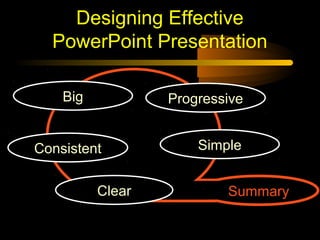
Designing Effective
PowerPoint Presentation
Big

Progressive

Consistent
Clear

Simple
Summary
Make It

Big
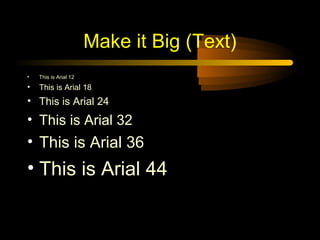
Make it Big (Text)
•

This is Arial 12

•

This is Arial 18

• This is Arial 24

• This is Arial 32

• This is Arial 36

• This is Arial 44
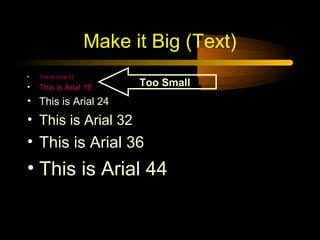
Make it Big (Text)
•

This is Arial 12

•

This is Arial 18

Too Small

• This is Arial 24

• This is Arial 32

• This is Arial 36

• This is Arial 44
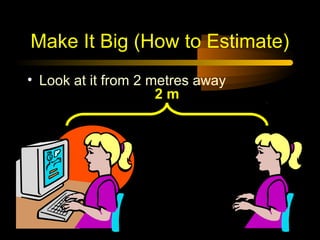
Make It Big (How to Estimate)
• Look at it from 2 metres away
2m
Keep It Simple
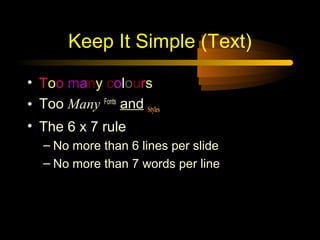
Keep It Simple (Text)
• Too many colours
• Too Many Fonts and Styles
• The 6 x 7 rule
– No more than 6 lines per slide
– No more than 7 words per line
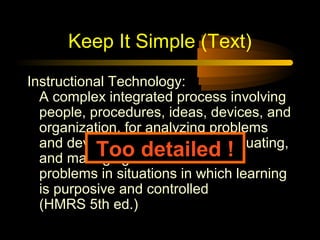
Keep It Simple (Text)
Instructional Technology:
A complex integrated process involving
people, procedures, ideas, devices, and
organization, for analyzing problems
and devising, implementing, evaluating,
Toosolutions to those
detailed !
and managing
problems in situations in which learning
is purposive and controlled
(HMRS 5th ed.)
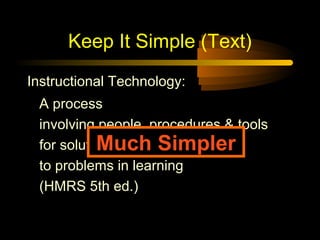
Keep It Simple (Text)
Instructional Technology:
A process
involving people, procedures & tools
for solutions
Much Simpler
to problems in learning
(HMRS 5th ed.)
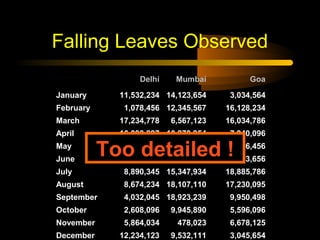
Falling Leaves Observed
Delhi

Mumbai

Goa

January

11,532,234 14,123,654

3,034,564

February

1,078,456 12,345,567

16,128,234

March

17,234,778

6,567,123

16,034,786

April

16,098,897 10,870,954

7,940,096

8,036,897 10,345,394

14,856,456

June

Too detailed !
678,095

4,123,656

July

8,890,345 15,347,934

18,885,786

August

8,674,234 18,107,110

17,230,095

September

4,032,045 18,923,239

9,950,498

October

2,608,096

9,945,890

5,596,096

November

5,864,034

478,023

6,678,125

December

12,234,123

9,532,111

3,045,654

May

16,184,345
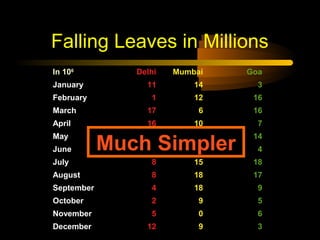
Falling Leaves in Millions
In 106

Delhi

Mumbai

Goa

January

11

14

3

February

1

12

16

March

17

6

16

April

16

10

7

May

Much Simpler
8

10

14

16

0

4

July

8

15

18

August

8

18

17

September

4

18

9

October

2

9

5

November

5

0

6

December

12

9

3

June
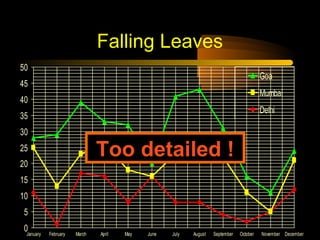
Falling Leaves
50

Goa

45

Mumbai

40

Delhi

35
30

Too detailed !

25
20
15
10
5
0January

February

March

April

May

June

July

August

September

October

November December
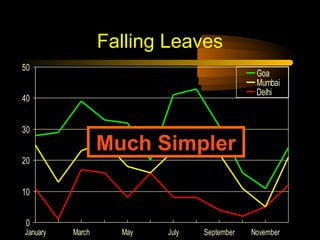
Falling Leaves
50

Goa
Mumbai
Delhi

40
30

Much Simpler

20
10
0

January

March

May

July

September

November
Keep It Simple (Picture)
• Art work may distract your audience
• Artistry does not substitute for content
Keep It Simple (Sound)
• Sound effects may distract too
• Use sound only when necessary
Keep It Simple (Transition)
• This transition is annoying, not
enhancing
• "Appear" and "Disappear" are better
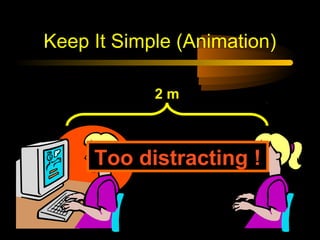
Keep It Simple (Animation)
2m

Too distracting !
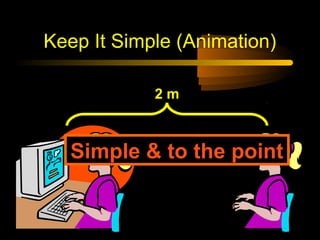
Keep It Simple (Animation)
2m

Simple & to the point
Make It Clear
Make It Clear (Capitalisation)
• ALL CAPITAL LETTERS ARE
DIFFICULT TO READ
• Upper and lower case letters are easier
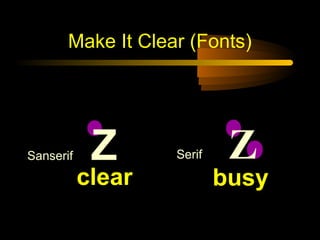
Make It Clear (Fonts)

Sanserif

Z

clear

Serif

Z

busy
Make It Clear (Fonts)
•
•
•
•
•
•

Serif fonts are difficult to read on screen
Sanserif fonts are clearer
Italics are difficult to read on screen
Normal or bold fonts are clearer
Underlines may signify hyperlinks
Instead, use colours to emphasise
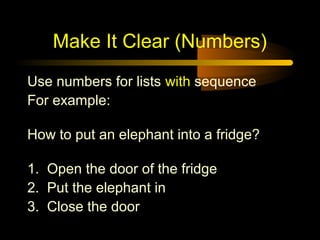
Make It Clear (Numbers)
Use numbers for lists with sequence
For example:
How to put an elephant into a fridge?
1. Open the door of the fridge
2. Put the elephant in
3. Close the door
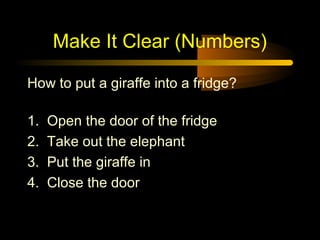
Make It Clear (Numbers)
How to put a giraffe into a fridge?
1.
2.
3.
4.

Open the door of the fridge
Take out the elephant
Put the giraffe in
Close the door
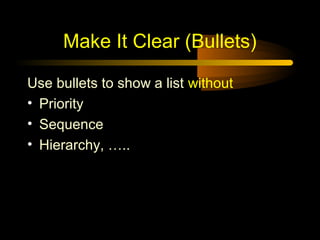
Make It Clear (Bullets)
Use bullets to show a list without
• Priority
• Sequence
• Hierarchy, …..
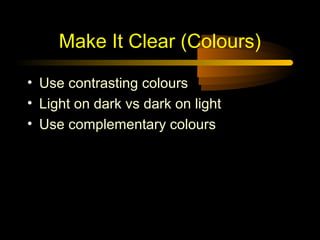
Make It Clear (Colours)
• Use contrasting colours
• Light on dark vs dark on light
• Use complementary colours
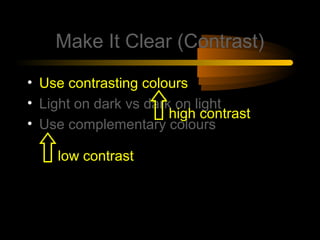
Make It Clear (Contrast)
• Use contrasting colours
• Light on dark vs dark on light
high contrast
• Use complementary colours
low contrast
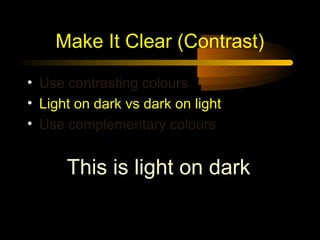
Make It Clear (Contrast)
• Use contrasting colours
• Light on dark vs dark on light
• Use complementary colours

This is light on dark
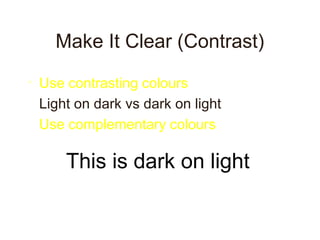
Make It Clear (Contrast)
• Use contrasting colours
• Light on dark vs dark on light
• Use complementary colours

This is dark on light
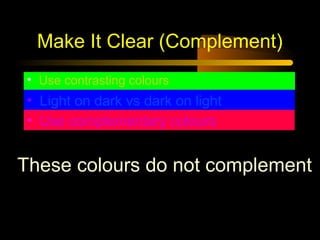
Make It Clear (Complement)
• Use contrasting colours

• Light on dark vs dark on light
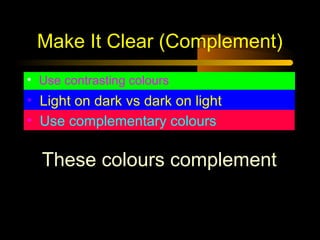
• Use complementary colours

These colours do not complement
Make It Clear (Complement)
• Use contrasting colours

• Light on dark vs dark on light
• Use complementary colours

These colours complement
Make It Clear (Size)
• Size implies importance
Make It Clear (Size)

• Size implies importance
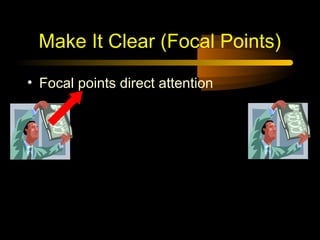
Make It Clear (Focal Points)
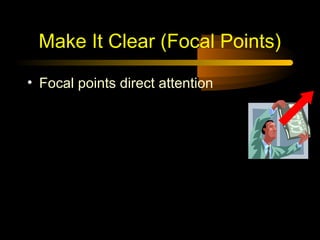
• Focal points direct attention
Make It Clear (Focal Points)
• Focal points direct attention
Be Progressive
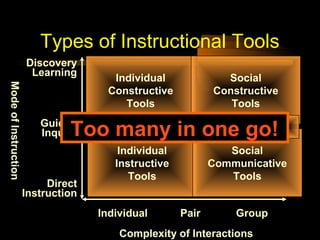
Types of Instructional Tools
Discovery
Learning
Mode of Instruction

Individual
Constructive
Tools

Social
Constructive
Tools

Informational Tools
Too many in one go!

Guided
Inquiry

Direct
Instruction

Individual
Instructive
Tools
Individual

Social
Communicative
Tools
Pair

Group

Complexity of Interactions
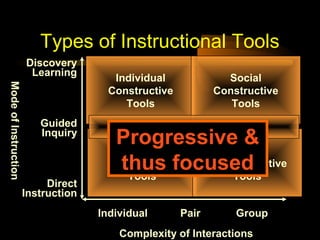
Types of Instructional Tools
Discovery
Learning
Mode of Instruction

Guided
Inquiry

Direct
Instruction

Individual
Constructive
Tools

Social
Constructive
Tools

Informational Tools

Progressive &
Individual
Social
Instructive focused
Communicative
thus
Tools
Tools
Individual

Pair

Group

Complexity of Interactions
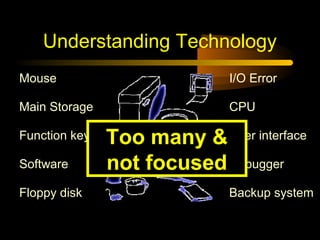
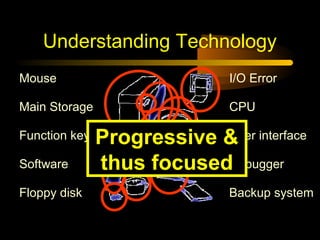
Understanding Technology
Mouse

I/O Error

Main Storage

CPU

Function key
Software
Floppy disk

Too many & User interface
not focused Debugger
Backup system
Understanding Technology
Mouse

I/O Error

Main Storage

CPU

Function key
Software
Floppy disk

User
Progressive & interface
thus focusedDebugger
Backup system
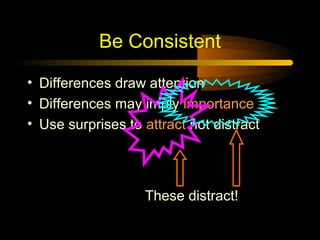
Be Consistent
Be Consistent
• Differences draw attention
• Differences may imply importance
• Use surprises to attract not distract
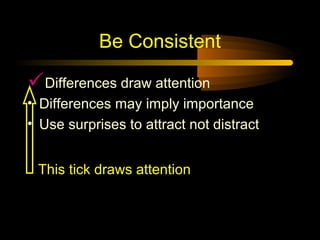
Be Consistent

Differences draw attention
• Differences may imply importance
• Use surprises to attract not distract
This tick draws attention
Be Consistent

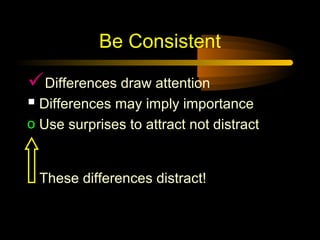
Differences draw attention
 Differences may imply importance
o Use surprises to attract not distract

These differences distract!
Be Consistent
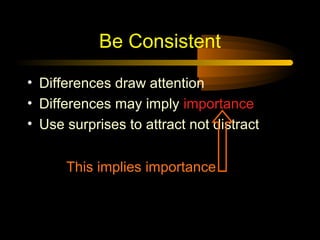
• Differences draw attention
• Differences may imply importance
• Use surprises to attract not distract
This implies importance
Be Consistent
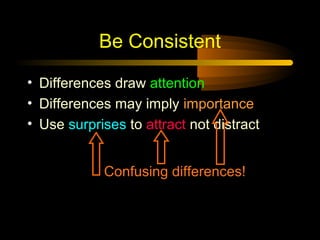
• Differences draw attention
• Differences may imply importance
• Use surprises to attract not distract
Confusing differences!
Be Consistent
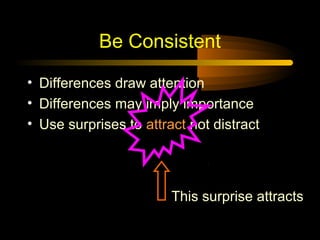
• Differences draw attention
• Differences may imply importance
• Use surprises to attract not distract

This surprise attracts
Be Consistent
• Differences draw attention
• Differences may imply importance
• Use surprises to attract not distract

These distract!
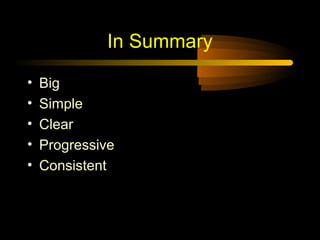
In Summary
•
•
•
•
•

Big
Simple
Clear
Progressive
Consistent
Some Final Words
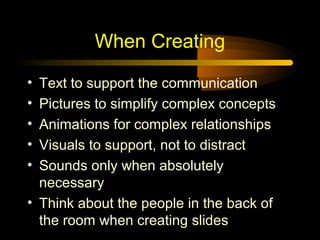
When Creating
•
•
•
•
•

Text to support the communication
Pictures to simplify complex concepts
Animations for complex relationships
Visuals to support, not to distract
Sounds only when absolutely
necessary
• Think about the people in the back of
the room when creating slides
When Presenting
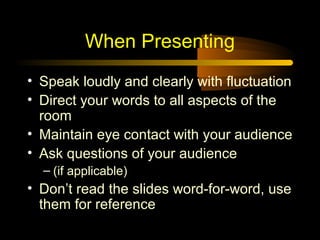
• Speak loudly and clearly with fluctuation
• Direct your words to all aspects of the
room
• Maintain eye contact with your audience
• Ask questions of your audience
– (if applicable)

• Don’t read the slides word-for-word, use
them for reference
Closing Remarks
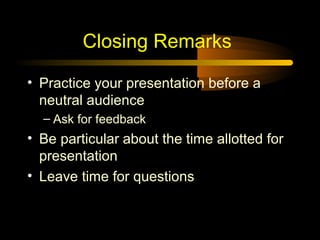
• Practice your presentation before a
neutral audience
– Ask for feedback

• Be particular about the time allotted for
presentation
• Leave time for questions
Thank You !

how to-make-effective-power-point-presentation

  • 1.
    Designing Effective “PowerPoint Presentations” By:Satyajeet Singh satyajeet.singh@yahoo.com
  • 2.
  • 3.
  • 4.
    Make it Big(Text) • This is Arial 12 • This is Arial 18 • This is Arial 24 • This is Arial 32 • This is Arial 36 • This is Arial 44
  • 5.
    Make it Big(Text) • This is Arial 12 • This is Arial 18 Too Small • This is Arial 24 • This is Arial 32 • This is Arial 36 • This is Arial 44
  • 6.
    Make It Big(How to Estimate) • Look at it from 2 metres away 2m
  • 7.
  • 8.
    Keep It Simple(Text) • Too many colours • Too Many Fonts and Styles • The 6 x 7 rule – No more than 6 lines per slide – No more than 7 words per line
  • 9.
    Keep It Simple(Text) Instructional Technology: A complex integrated process involving people, procedures, ideas, devices, and organization, for analyzing problems and devising, implementing, evaluating, Toosolutions to those detailed ! and managing problems in situations in which learning is purposive and controlled (HMRS 5th ed.)
  • 10.
    Keep It Simple(Text) Instructional Technology: A process involving people, procedures & tools for solutions Much Simpler to problems in learning (HMRS 5th ed.)
  • 11.
    Falling Leaves Observed Delhi Mumbai Goa January 11,532,23414,123,654 3,034,564 February 1,078,456 12,345,567 16,128,234 March 17,234,778 6,567,123 16,034,786 April 16,098,897 10,870,954 7,940,096 8,036,897 10,345,394 14,856,456 June Too detailed ! 678,095 4,123,656 July 8,890,345 15,347,934 18,885,786 August 8,674,234 18,107,110 17,230,095 September 4,032,045 18,923,239 9,950,498 October 2,608,096 9,945,890 5,596,096 November 5,864,034 478,023 6,678,125 December 12,234,123 9,532,111 3,045,654 May 16,184,345
  • 12.
    Falling Leaves inMillions In 106 Delhi Mumbai Goa January 11 14 3 February 1 12 16 March 17 6 16 April 16 10 7 May Much Simpler 8 10 14 16 0 4 July 8 15 18 August 8 18 17 September 4 18 9 October 2 9 5 November 5 0 6 December 12 9 3 June
  • 13.
    Falling Leaves 50 Goa 45 Mumbai 40 Delhi 35 30 Too detailed! 25 20 15 10 5 0January February March April May June July August September October November December
  • 14.
  • 15.
    Keep It Simple(Picture) • Art work may distract your audience • Artistry does not substitute for content
  • 16.
    Keep It Simple(Sound) • Sound effects may distract too • Use sound only when necessary
  • 17.
    Keep It Simple(Transition) • This transition is annoying, not enhancing • "Appear" and "Disappear" are better
  • 18.
    Keep It Simple(Animation) 2m Too distracting !
  • 19.
    Keep It Simple(Animation) 2m Simple & to the point
  • 20.
  • 21.
    Make It Clear(Capitalisation) • ALL CAPITAL LETTERS ARE DIFFICULT TO READ • Upper and lower case letters are easier
  • 22.
    Make It Clear(Fonts) Sanserif Z clear Serif Z busy
  • 23.
    Make It Clear(Fonts) • • • • • • Serif fonts are difficult to read on screen Sanserif fonts are clearer Italics are difficult to read on screen Normal or bold fonts are clearer Underlines may signify hyperlinks Instead, use colours to emphasise
  • 24.
    Make It Clear(Numbers) Use numbers for lists with sequence For example: How to put an elephant into a fridge? 1. Open the door of the fridge 2. Put the elephant in 3. Close the door
  • 25.
    Make It Clear(Numbers) How to put a giraffe into a fridge? 1. 2. 3. 4. Open the door of the fridge Take out the elephant Put the giraffe in Close the door
  • 26.
    Make It Clear(Bullets) Use bullets to show a list without • Priority • Sequence • Hierarchy, …..
  • 27.
    Make It Clear(Colours) • Use contrasting colours • Light on dark vs dark on light • Use complementary colours
  • 28.
    Make It Clear(Contrast) • Use contrasting colours • Light on dark vs dark on light high contrast • Use complementary colours low contrast
  • 29.
    Make It Clear(Contrast) • Use contrasting colours • Light on dark vs dark on light • Use complementary colours This is light on dark
  • 30.
    Make It Clear(Contrast) • Use contrasting colours • Light on dark vs dark on light • Use complementary colours This is dark on light
  • 31.
    Make It Clear(Complement) • Use contrasting colours • Light on dark vs dark on light • Use complementary colours These colours do not complement
  • 32.
    Make It Clear(Complement) • Use contrasting colours • Light on dark vs dark on light • Use complementary colours These colours complement
  • 33.
    Make It Clear(Size) • Size implies importance
  • 34.
    Make It Clear(Size) • Size implies importance
  • 35.
    Make It Clear(Focal Points) • Focal points direct attention
  • 36.
    Make It Clear(Focal Points) • Focal points direct attention
  • 37.
  • 38.
    Types of InstructionalTools Discovery Learning Mode of Instruction Individual Constructive Tools Social Constructive Tools Informational Tools Too many in one go! Guided Inquiry Direct Instruction Individual Instructive Tools Individual Social Communicative Tools Pair Group Complexity of Interactions
  • 39.
    Types of InstructionalTools Discovery Learning Mode of Instruction Guided Inquiry Direct Instruction Individual Constructive Tools Social Constructive Tools Informational Tools Progressive & Individual Social Instructive focused Communicative thus Tools Tools Individual Pair Group Complexity of Interactions
  • 40.
    Understanding Technology Mouse I/O Error MainStorage CPU Function key Software Floppy disk Too many & User interface not focused Debugger Backup system
  • 41.
    Understanding Technology Mouse I/O Error MainStorage CPU Function key Software Floppy disk User Progressive & interface thus focusedDebugger Backup system
  • 42.
  • 43.
    Be Consistent • Differencesdraw attention • Differences may imply importance • Use surprises to attract not distract
  • 44.
    Be Consistent Differences drawattention • Differences may imply importance • Use surprises to attract not distract This tick draws attention
  • 45.
    Be Consistent Differences drawattention  Differences may imply importance o Use surprises to attract not distract These differences distract!
  • 46.
    Be Consistent • Differencesdraw attention • Differences may imply importance • Use surprises to attract not distract This implies importance
  • 47.
    Be Consistent • Differencesdraw attention • Differences may imply importance • Use surprises to attract not distract Confusing differences!
  • 48.
    Be Consistent • Differencesdraw attention • Differences may imply importance • Use surprises to attract not distract This surprise attracts
  • 49.
    Be Consistent • Differencesdraw attention • Differences may imply importance • Use surprises to attract not distract These distract!
  • 50.
  • 51.
  • 52.
    When Creating • • • • • Text tosupport the communication Pictures to simplify complex concepts Animations for complex relationships Visuals to support, not to distract Sounds only when absolutely necessary • Think about the people in the back of the room when creating slides
  • 53.
    When Presenting • Speakloudly and clearly with fluctuation • Direct your words to all aspects of the room • Maintain eye contact with your audience • Ask questions of your audience – (if applicable) • Don’t read the slides word-for-word, use them for reference
  • 54.
    Closing Remarks • Practiceyour presentation before a neutral audience – Ask for feedback • Be particular about the time allotted for presentation • Leave time for questions
  • 55.