1
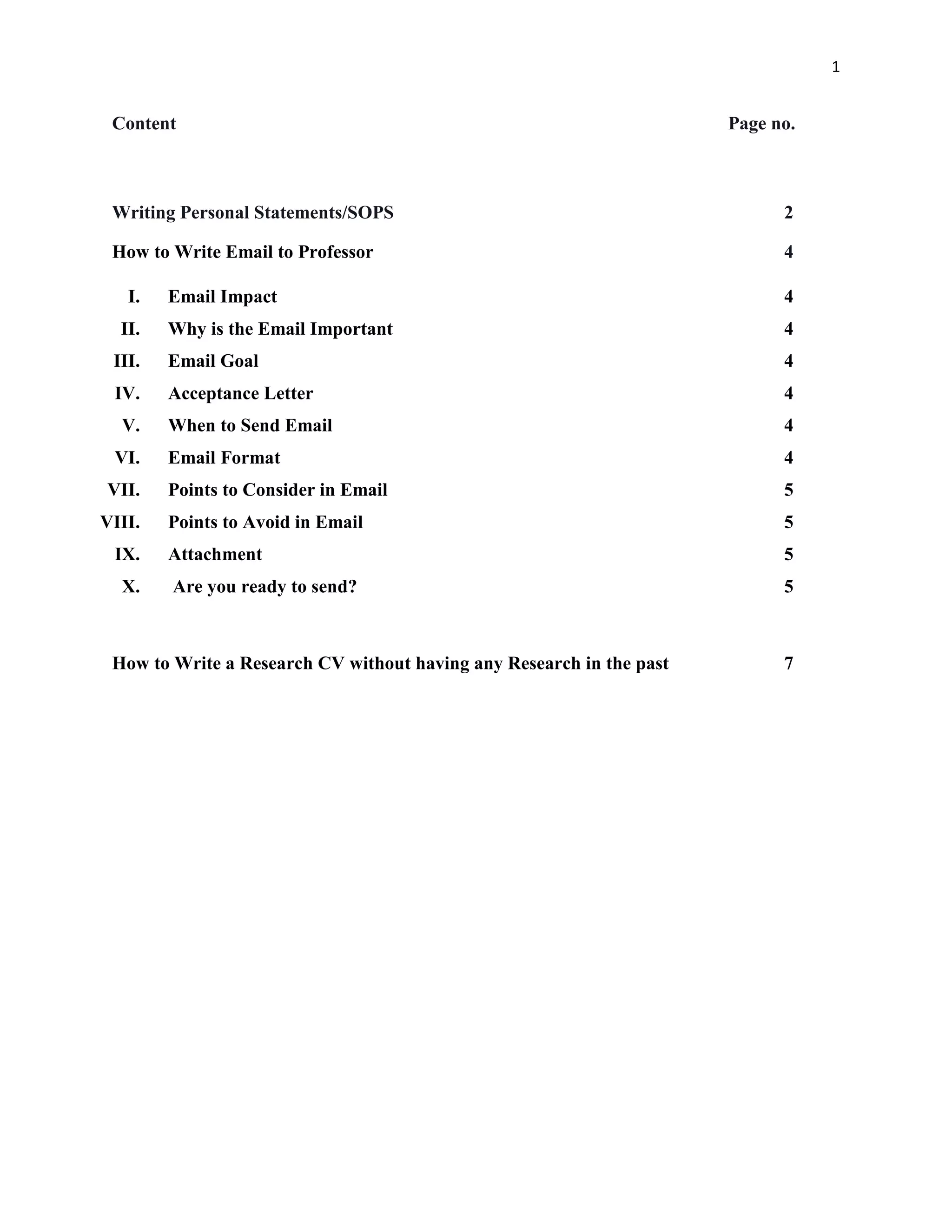
Content Page no.
Writing Personal Statements/SOPS 2
How to Write Email to Professor 4
I. Email Impact 4
II. Why is the Email Important 4
III. Email Goal 4
IV. Acceptance Letter 4
V. When to Send Email 4
VI. Email Format 4
VII. Points to Consider in Email 5
VIII. Points to Avoid in Email 5
IX. Attachment 5
X. Are you ready to send? 5
How to Write a Research CV without having any Research in the past 7
2
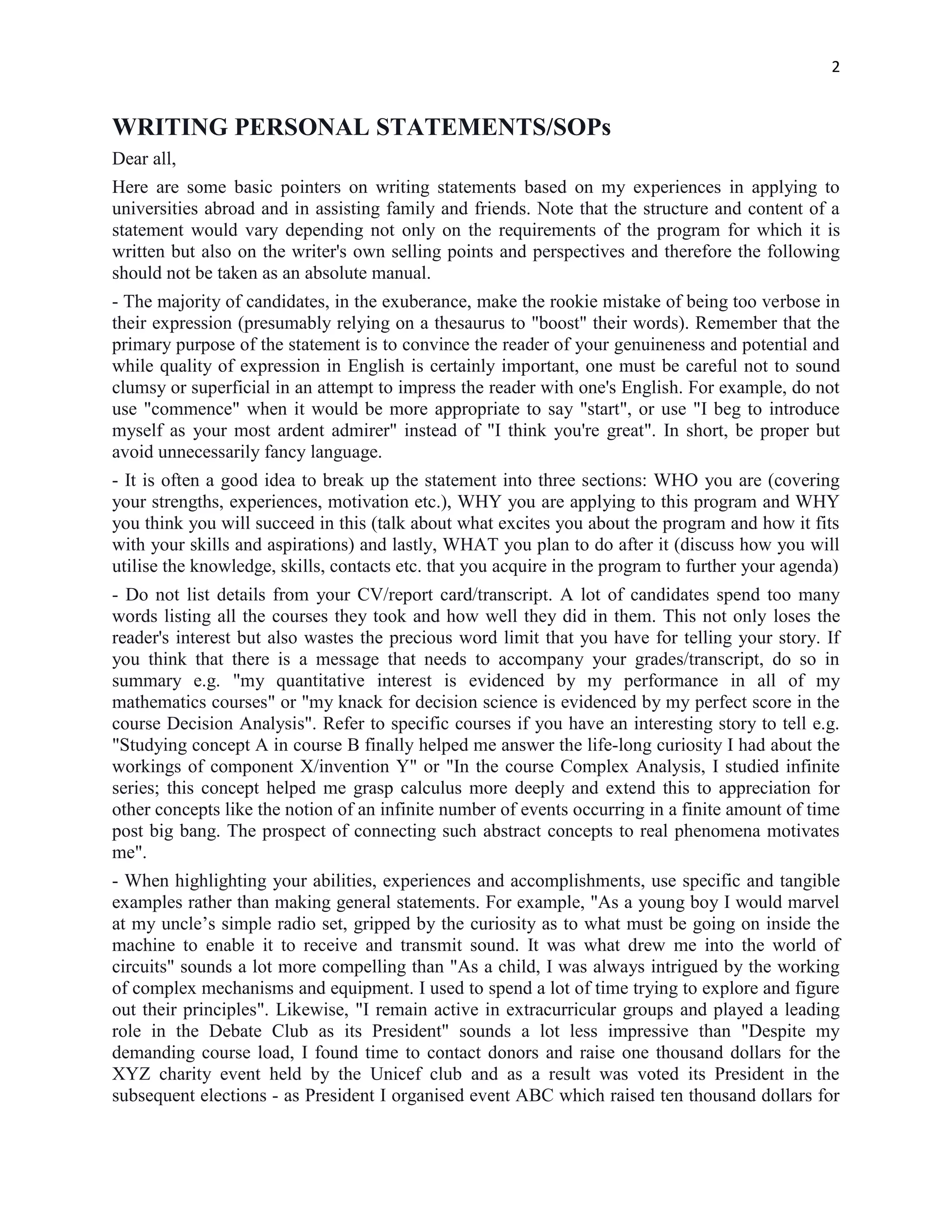
WRITING PERSONAL STATEMENTS/SOPs
Dear all,
Here are some basic pointers on writing statements based on my experiences in applying to
universities abroad and in assisting family and friends. Note that the structure and content of a
statement would vary depending not only on the requirements of the program for which it is
written but also on the writer's own selling points and perspectives and therefore the following
should not be taken as an absolute manual.
- The majority of candidates, in the exuberance, make the rookie mistake of being too verbose in
their expression (presumably relying on a thesaurus to "boost" their words). Remember that the
primary purpose of the statement is to convince the reader of your genuineness and potential and
while quality of expression in English is certainly important, one must be careful not to sound
clumsy or superficial in an attempt to impress the reader with one's English. For example, do not
use "commence" when it would be more appropriate to say "start", or use "I beg to introduce
myself as your most ardent admirer" instead of "I think you're great". In short, be proper but
avoid unnecessarily fancy language.
- It is often a good idea to break up the statement into three sections: WHO you are (covering
your strengths, experiences, motivation etc.), WHY you are applying to this program and WHY
you think you will succeed in this (talk about what excites you about the program and how it fits
with your skills and aspirations) and lastly, WHAT you plan to do after it (discuss how you will
utilise the knowledge, skills, contacts etc. that you acquire in the program to further your agenda)
- Do not list details from your CV/report card/transcript. A lot of candidates spend too many
words listing all the courses they took and how well they did in them. This not only loses the
reader's interest but also wastes the precious word limit that you have for telling your story. If
you think that there is a message that needs to accompany your grades/transcript, do so in
summary e.g. "my quantitative interest is evidenced by my performance in all of my
mathematics courses" or "my knack for decision science is evidenced by my perfect score in the
course Decision Analysis". Refer to specific courses if you have an interesting story to tell e.g.
"Studying concept A in course B finally helped me answer the life-long curiosity I had about the
workings of component X/invention Y" or "In the course Complex Analysis, I studied infinite
series; this concept helped me grasp calculus more deeply and extend this to appreciation for
other concepts like the notion of an infinite number of events occurring in a finite amount of time
post big bang. The prospect of connecting such abstract concepts to real phenomena motivates
me".
- When highlighting your abilities, experiences and accomplishments, use specific and tangible
examples rather than making general statements. For example, "As a young boy I would marvel
at my uncle’s simple radio set, gripped by the curiosity as to what must be going on inside the
machine to enable it to receive and transmit sound. It was what drew me into the world of
circuits" sounds a lot more compelling than "As a child, I was always intrigued by the working
of complex mechanisms and equipment. I used to spend a lot of time trying to explore and figure
out their principles". Likewise, "I remain active in extracurricular groups and played a leading
role in the Debate Club as its President" sounds a lot less impressive than "Despite my
demanding course load, I found time to contact donors and raise one thousand dollars for the
XYZ charity event held by the Unicef club and as a result was voted its President in the
subsequent elections - as President I organised event ABC which raised ten thousand dollars for
3
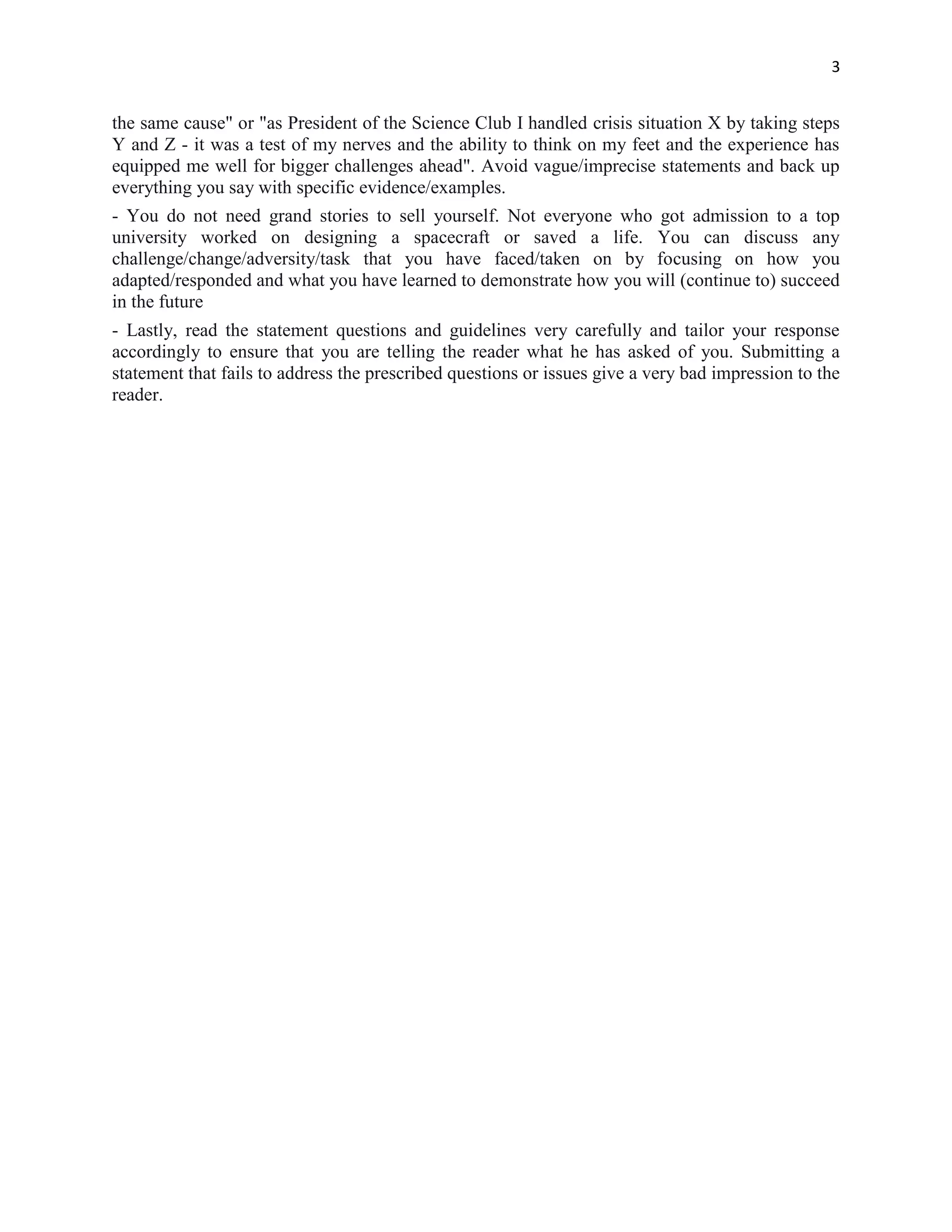
the same cause" or "as President of the Science Club I handled crisis situation X by taking steps
Y and Z - it was a test of my nerves and the ability to think on my feet and the experience has
equipped me well for bigger challenges ahead". Avoid vague/imprecise statements and back up
everything you say with specific evidence/examples.
- You do not need grand stories to sell yourself. Not everyone who got admission to a top
university worked on designing a spacecraft or saved a life. You can discuss any
challenge/change/adversity/task that you have faced/taken on by focusing on how you
adapted/responded and what you have learned to demonstrate how you will (continue to) succeed
in the future
- Lastly, read the statement questions and guidelines very carefully and tailor your response
accordingly to ensure that you are telling the reader what he has asked of you. Submitting a
statement that fails to address the prescribed questions or issues give a very bad impression to the
reader.
4
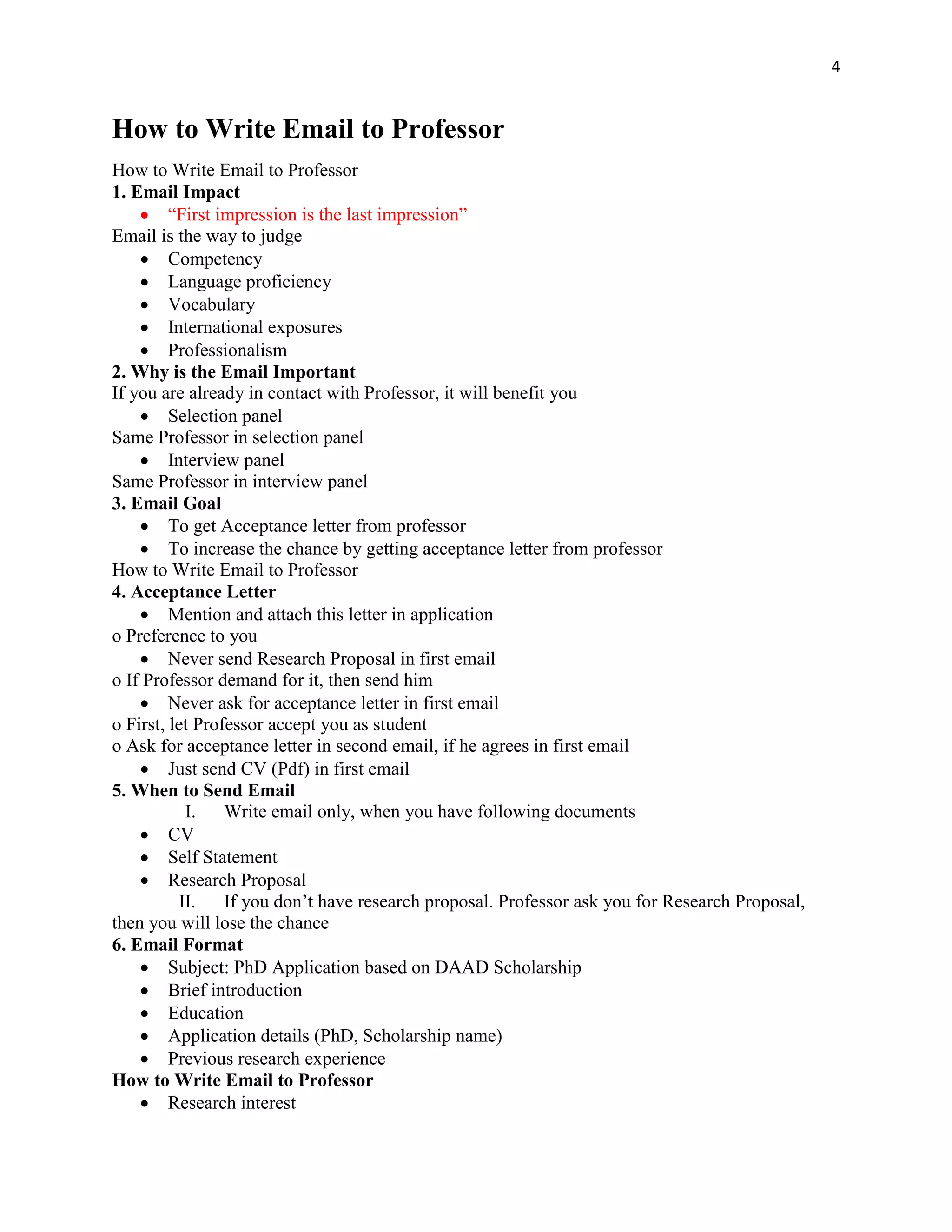
How to Write Email to Professor
1. Email Impact
 “First impression is the last impression”
Email is the way to judge
 Competency
 Language proficiency
 Vocabulary
 International exposures
 Professionalism
2. Why is the Email Important
If you are already in contact with Professor, it will benefit you
 Selection panel
Same Professor in selection panel
 Interview panel
Same Professor in interview panel
3. Email Goal
 To get Acceptance letter from professor
 To increase the chance by getting acceptance letter from professor
How to Write Email to Professor
4. Acceptance Letter
 Mention and attach this letter in application
o Preference to you
 Never send Research Proposal in first email
o If Professor demand for it, then send him
 Never ask for acceptance letter in first email
o First, let Professor accept you as student
o Ask for acceptance letter in second email, if he agrees in first email
 Just send CV (Pdf) in first email
5. When to Send Email
I. Write email only, when you have following documents
 CV
 Self Statement
 Research Proposal
II. If you don’t have research proposal. Professor ask you for Research Proposal,
then you will lose the chance
6. Email Format
 Subject: PhD Application based on DAAD Scholarship
 Brief introduction
 Education
 Application details (PhD, Scholarship name)
 Previous research experience
How to Write Email to Professor
 Research interest
5
 Motivation for PhD
 Motivation for this Lab / University
 Request for application acceptance
 Best Regards
 CV in attachment (Pdf)
7. Points to Consider in Email
 Formal language
o Thank you
 Positive language
o I would appreciate, if you could consider my application
 Polite language
 Short email
 2 - 3 paragraphs
 2 – 3 sentences in each paragraph
8. Points to Avoid in Email
 Don't write words Sir, Madam
o They love to be called by name
o Write, Dear Professor Ahmad,
 Don't ask about health, weather or life
 Informal language
o Thanx.
How to Write Email to Professor
 Dictate words
 Very long email
 Just one paragraph
 Many colors or fonts in email
 All CAPITAL Letters
 Don't mention about your previous contact, if he rejected you last time
9. Attachment
 Attach file at the beginning of email
o Otherwise you will forget to attach it
 Attachment proper name
o CV_Ahmad
o Avoid the name, CV1, Doc 1 etc.
 Multiple attachments
o Use numbers to describe all attachments
 1. CV_Ahmad
 2. Personal Statement
 3. Research Proposal
 Please find the attached file of my CV for consideration.
How to Write Email to Professor
https://www.facebook.com/groups/InternationalScholarshipsUniverse/
10. Are you ready to send?
WAIT!
 Is recipient email and name same?
6
 Attachments?
 Spell check?
 Proof reading?
 Email language?
 Is degree and scholarship name clearly mentioned?
 Is there any thing missing in it?
Done
Press Send
7
How to Write a Research CV without
having any Research in the past
My Experience:
Assalamualaikum:
General Discussion.
I hope you all are doing well. I just want to share my experience regarding writing a Research
CV without any Research in the past. If you have not read my post How to Get Acceptance
letter, please first read that post and then read this.
No need to Fear about anything even if your GPA is as low as 2.9/4. If your CV reflects a good
personality of yours, Professor/Supervisor will not be having any problem to welcome you to
his laboratory.
With this approach, chances are very high (depends on your efforts) to get the acceptance letter.
Description.
Before you start to write your CV, please gather all of your semester projects which you have
done in your BSc and make a rough note.
Basic parts:
 Contact address such as email address and phone no. should be written in your CV.
 Picture is necessary.
 Main points:
 You should write the CV in the order of points mentioned below.
 Write your objective like To become a good researcher in my field etc.
 Write your Education background from Secondary School up to Bachelors
8
 Please note to write the web link of your University/College/ School like in the image
below:
 Write your Final Year Project with its abstract of about 6-8 lines.
 For example:
 Next Step is to write your Semester projects (A-Z) with abstract of bout 2-3 lines.
 For example:
 It is better to first write the project which most suits yours intended professor interests.
Even if professor does not have any link with the project, please write it in your CV. In
this way he will think you have done some work in your past.
 Write about your internship/ seminar explaining it in 2-3 lines.
 For example:
9
 Write your Technical skills like software you have used. No need to mention any
explanation because if you have done any project related to it, it will be covered in your
semester project part.
 Finally write your awards etc.
Note: Most students thinks CV of freshly graduates should not be more than 1 page. This is
totally wrong. If your CV ends at 4th page it is OK and perfect!

How to write cv, sop and email to professor

  • 1.
    1 Content Page no. WritingPersonal Statements/SOPS 2 How to Write Email to Professor 4 I. Email Impact 4 II. Why is the Email Important 4 III. Email Goal 4 IV. Acceptance Letter 4 V. When to Send Email 4 VI. Email Format 4 VII. Points to Consider in Email 5 VIII. Points to Avoid in Email 5 IX. Attachment 5 X. Are you ready to send? 5 How to Write a Research CV without having any Research in the past 7
  • 2.
    2 WRITING PERSONAL STATEMENTS/SOPs Dearall, Here are some basic pointers on writing statements based on my experiences in applying to universities abroad and in assisting family and friends. Note that the structure and content of a statement would vary depending not only on the requirements of the program for which it is written but also on the writer's own selling points and perspectives and therefore the following should not be taken as an absolute manual. - The majority of candidates, in the exuberance, make the rookie mistake of being too verbose in their expression (presumably relying on a thesaurus to "boost" their words). Remember that the primary purpose of the statement is to convince the reader of your genuineness and potential and while quality of expression in English is certainly important, one must be careful not to sound clumsy or superficial in an attempt to impress the reader with one's English. For example, do not use "commence" when it would be more appropriate to say "start", or use "I beg to introduce myself as your most ardent admirer" instead of "I think you're great". In short, be proper but avoid unnecessarily fancy language. - It is often a good idea to break up the statement into three sections: WHO you are (covering your strengths, experiences, motivation etc.), WHY you are applying to this program and WHY you think you will succeed in this (talk about what excites you about the program and how it fits with your skills and aspirations) and lastly, WHAT you plan to do after it (discuss how you will utilise the knowledge, skills, contacts etc. that you acquire in the program to further your agenda) - Do not list details from your CV/report card/transcript. A lot of candidates spend too many words listing all the courses they took and how well they did in them. This not only loses the reader's interest but also wastes the precious word limit that you have for telling your story. If you think that there is a message that needs to accompany your grades/transcript, do so in summary e.g. "my quantitative interest is evidenced by my performance in all of my mathematics courses" or "my knack for decision science is evidenced by my perfect score in the course Decision Analysis". Refer to specific courses if you have an interesting story to tell e.g. "Studying concept A in course B finally helped me answer the life-long curiosity I had about the workings of component X/invention Y" or "In the course Complex Analysis, I studied infinite series; this concept helped me grasp calculus more deeply and extend this to appreciation for other concepts like the notion of an infinite number of events occurring in a finite amount of time post big bang. The prospect of connecting such abstract concepts to real phenomena motivates me". - When highlighting your abilities, experiences and accomplishments, use specific and tangible examples rather than making general statements. For example, "As a young boy I would marvel at my uncle’s simple radio set, gripped by the curiosity as to what must be going on inside the machine to enable it to receive and transmit sound. It was what drew me into the world of circuits" sounds a lot more compelling than "As a child, I was always intrigued by the working of complex mechanisms and equipment. I used to spend a lot of time trying to explore and figure out their principles". Likewise, "I remain active in extracurricular groups and played a leading role in the Debate Club as its President" sounds a lot less impressive than "Despite my demanding course load, I found time to contact donors and raise one thousand dollars for the XYZ charity event held by the Unicef club and as a result was voted its President in the subsequent elections - as President I organised event ABC which raised ten thousand dollars for
  • 3.
    3 the same cause"or "as President of the Science Club I handled crisis situation X by taking steps Y and Z - it was a test of my nerves and the ability to think on my feet and the experience has equipped me well for bigger challenges ahead". Avoid vague/imprecise statements and back up everything you say with specific evidence/examples. - You do not need grand stories to sell yourself. Not everyone who got admission to a top university worked on designing a spacecraft or saved a life. You can discuss any challenge/change/adversity/task that you have faced/taken on by focusing on how you adapted/responded and what you have learned to demonstrate how you will (continue to) succeed in the future - Lastly, read the statement questions and guidelines very carefully and tailor your response accordingly to ensure that you are telling the reader what he has asked of you. Submitting a statement that fails to address the prescribed questions or issues give a very bad impression to the reader.
  • 4.
    4 How to WriteEmail to Professor How to Write Email to Professor 1. Email Impact  “First impression is the last impression” Email is the way to judge  Competency  Language proficiency  Vocabulary  International exposures  Professionalism 2. Why is the Email Important If you are already in contact with Professor, it will benefit you  Selection panel Same Professor in selection panel  Interview panel Same Professor in interview panel 3. Email Goal  To get Acceptance letter from professor  To increase the chance by getting acceptance letter from professor How to Write Email to Professor 4. Acceptance Letter  Mention and attach this letter in application o Preference to you  Never send Research Proposal in first email o If Professor demand for it, then send him  Never ask for acceptance letter in first email o First, let Professor accept you as student o Ask for acceptance letter in second email, if he agrees in first email  Just send CV (Pdf) in first email 5. When to Send Email I. Write email only, when you have following documents  CV  Self Statement  Research Proposal II. If you don’t have research proposal. Professor ask you for Research Proposal, then you will lose the chance 6. Email Format  Subject: PhD Application based on DAAD Scholarship  Brief introduction  Education  Application details (PhD, Scholarship name)  Previous research experience How to Write Email to Professor  Research interest
  • 5.
    5  Motivation forPhD  Motivation for this Lab / University  Request for application acceptance  Best Regards  CV in attachment (Pdf) 7. Points to Consider in Email  Formal language o Thank you  Positive language o I would appreciate, if you could consider my application  Polite language  Short email  2 - 3 paragraphs  2 – 3 sentences in each paragraph 8. Points to Avoid in Email  Don't write words Sir, Madam o They love to be called by name o Write, Dear Professor Ahmad,  Don't ask about health, weather or life  Informal language o Thanx. How to Write Email to Professor  Dictate words  Very long email  Just one paragraph  Many colors or fonts in email  All CAPITAL Letters  Don't mention about your previous contact, if he rejected you last time 9. Attachment  Attach file at the beginning of email o Otherwise you will forget to attach it  Attachment proper name o CV_Ahmad o Avoid the name, CV1, Doc 1 etc.  Multiple attachments o Use numbers to describe all attachments  1. CV_Ahmad  2. Personal Statement  3. Research Proposal  Please find the attached file of my CV for consideration. How to Write Email to Professor https://www.facebook.com/groups/InternationalScholarshipsUniverse/ 10. Are you ready to send? WAIT!  Is recipient email and name same?
  • 6.
    6  Attachments?  Spellcheck?  Proof reading?  Email language?  Is degree and scholarship name clearly mentioned?  Is there any thing missing in it? Done Press Send
  • 7.
    7 How to Writea Research CV without having any Research in the past My Experience: Assalamualaikum: General Discussion. I hope you all are doing well. I just want to share my experience regarding writing a Research CV without any Research in the past. If you have not read my post How to Get Acceptance letter, please first read that post and then read this. No need to Fear about anything even if your GPA is as low as 2.9/4. If your CV reflects a good personality of yours, Professor/Supervisor will not be having any problem to welcome you to his laboratory. With this approach, chances are very high (depends on your efforts) to get the acceptance letter. Description. Before you start to write your CV, please gather all of your semester projects which you have done in your BSc and make a rough note. Basic parts:  Contact address such as email address and phone no. should be written in your CV.  Picture is necessary.  Main points:  You should write the CV in the order of points mentioned below.  Write your objective like To become a good researcher in my field etc.  Write your Education background from Secondary School up to Bachelors
  • 8.
    8  Please noteto write the web link of your University/College/ School like in the image below:  Write your Final Year Project with its abstract of about 6-8 lines.  For example:  Next Step is to write your Semester projects (A-Z) with abstract of bout 2-3 lines.  For example:  It is better to first write the project which most suits yours intended professor interests. Even if professor does not have any link with the project, please write it in your CV. In this way he will think you have done some work in your past.  Write about your internship/ seminar explaining it in 2-3 lines.  For example:
  • 9.
    9  Write yourTechnical skills like software you have used. No need to mention any explanation because if you have done any project related to it, it will be covered in your semester project part.  Finally write your awards etc. Note: Most students thinks CV of freshly graduates should not be more than 1 page. This is totally wrong. If your CV ends at 4th page it is OK and perfect!