REFINING THE PATH TO
EXEMPLARY PUBLISHING
1
S.R. VIDHYAMBIKA
Vidhyambika
WHAT IS PAPER/JOURNAL PUBLICATION?
2
• A paper publication is a written document that has been
printed on paper and is available for distribution or sale.
Vidhyambika
BENEFITS
• Knowledge Expansion
• Establishing expertise
• Professional recognition
• Opportunities for collaboration
• Impact on society
• Policy Formulation
• Credibility and trust
• Inspiration for future research
• Contribution to the relevant field
TYPES OF PAPERS
3
Review Paper
– Basics to Latest along with future scope and
outcomes
Research Paper (Outcome of a Project)
– Stages adopted (methodology) in completing project
Vidhyambika
TYPES OF RESEARCH PRESENTATION /
PUBLICATION
4
– Symposium
– International Conference
– International Journal published from India/
outside India/virtual (Scopus, SCI, Web of
Science indexed)
– Books
– Patents
Vidhyambika
STRUCTURE OF ANY PRESENTATION /
PUBLICATION
5
• Introduction
• Literature review / study / survey.
• Methodology
• Results and discussions //not in review
• Conclusions
• References
• Acknowledgement (Optional)
• Abstract
Vidhyambika
HOW TO CHOOSE A RESEARCH TOPIC
• Interests you the most
• Novelty
• Manageable
• Availability of data/resources
• Dig deeper into the topic
• Problems in current scenario
• Gaps in existing research
• Arrive at research problem
6
Vidhyambika
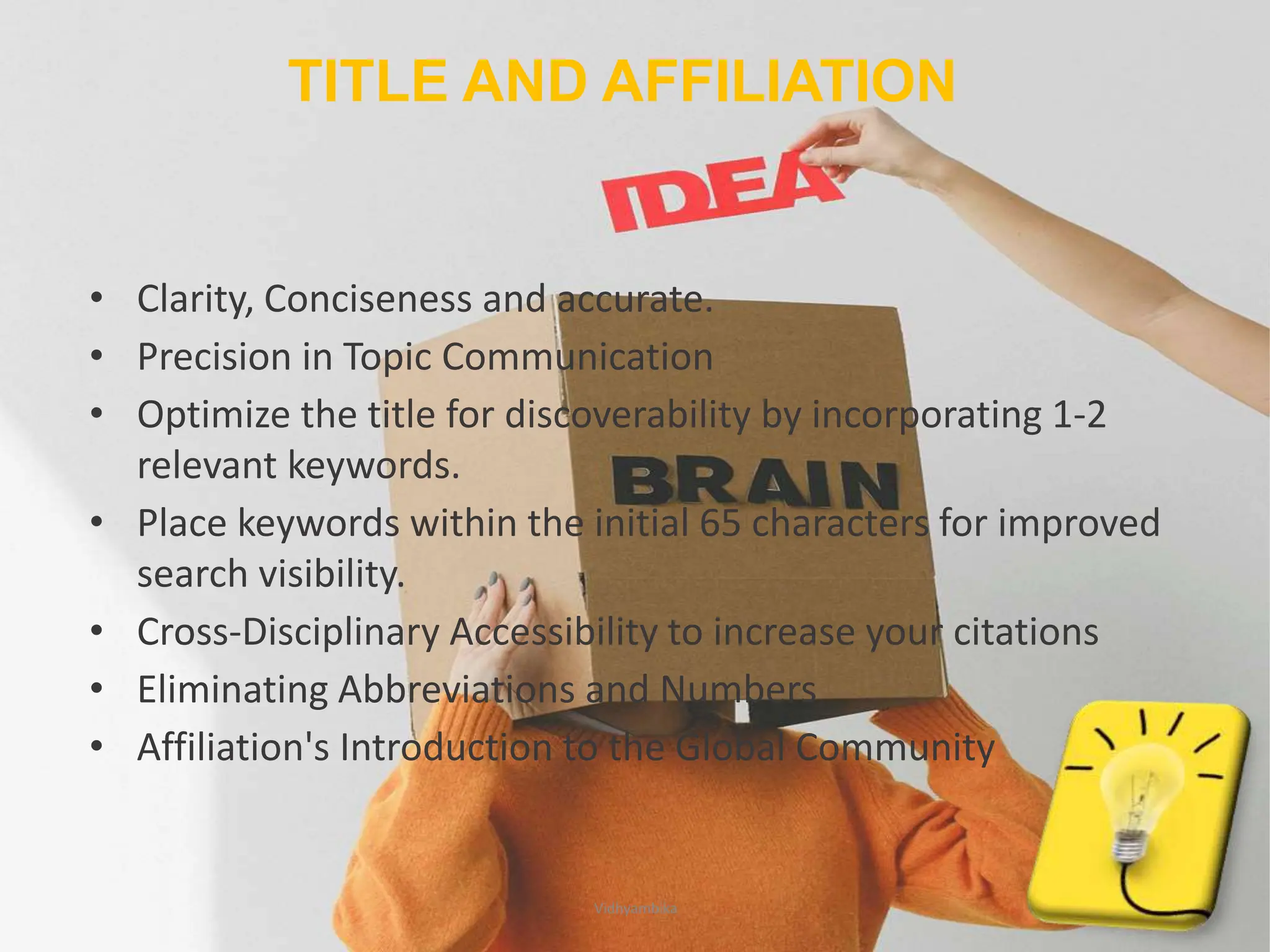
TITLE AND AFFILIATION
• Clarity, Conciseness and accurate.
• Precision in Topic Communication
• Optimize the title for discoverability by incorporating 1-2
relevant keywords.
• Place keywords within the initial 65 characters for improved
search visibility.
• Cross-Disciplinary Accessibility to increase your citations
• Eliminating Abbreviations and Numbers
• Affiliation's Introduction to the Global Community
7
Vidhyambika
LITERATURE REVIEW
It should not just a descriptive summary of the
topic.
Good review tells a story.
Should have logical structure with a beginning,
middle, and end.
Appropriate headings and sequencing of ideas to
make the content flow and guide readers
seamlessly from start to finish.
Divide the review into sections of a suitable length
to allow key points to be identified more easily.
If required, create charts, graphs, or other visuals
that synthesize information effectively
8
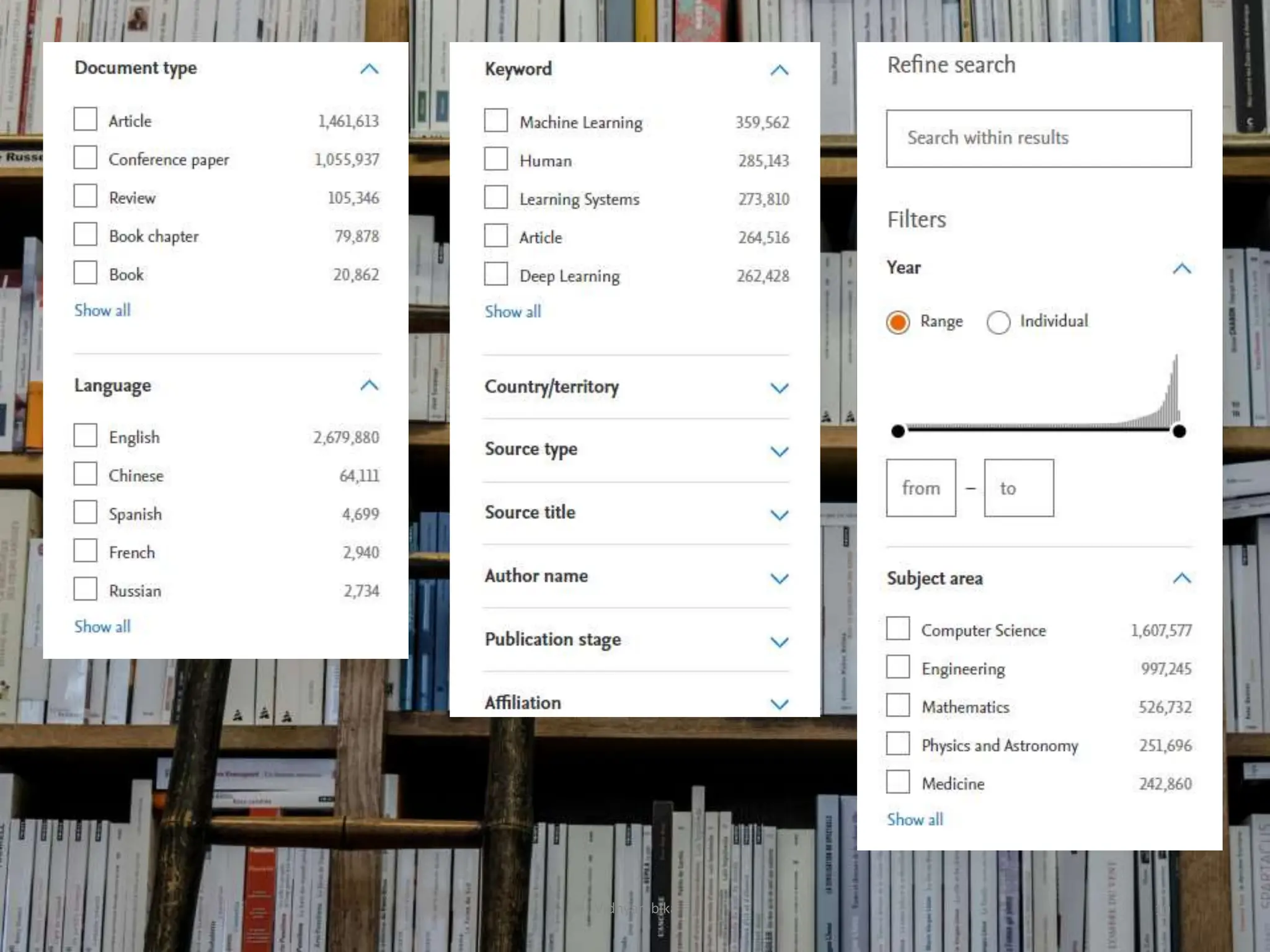
• Conduct a
Preliminary Search
• Use Keywords and
Boolean Operators
• Review Search
Results
• Filter by Date and
Relevance
Vidhyambika
Vidhyambika 9
Vidhyambika 10
Vidhyambika 11
USES OF LITERATURE REVIEW
12
• Establishthefoundationaboutaparticulardomain
• Toavoid duplication of work
• To provide credit to other researchers
• Identification of research gap
• Aligning with latest techniques
• Methodology to be adopted
• Specific procedure to be implemented
• Validation
Vidhyambika
• Appropriatekeywords
• IEEE
• Springer
• Elsevier
• Wiley
• Google Scholar (Year can be given)
• Research Gate
• Microsoft Academic
• Web of Science
• ACM
• Scopus, etc
Vidhyambika 13
WHERE TO FIND LITERATURE PAPERS?
USING KEYWORDS APPROPRIATELY
TO FIND LITERATURES
Vidhyambika 14
Dr. B. N. Sreeharan, sree4student@gmail.com
– Exact Phrase
: Exclude words
- Similar words
- Either word. E.g. unsupervised OR clustering
- gives definition
- results from specific domain
- results with only pdf
• Use of appropriate keyword
• “ ”
• -
• ~
• OR
• Define
• Site
• Filetype
• Title
• Google Lens
• Use key words used in literatures you referred
INTRODUCTION
15
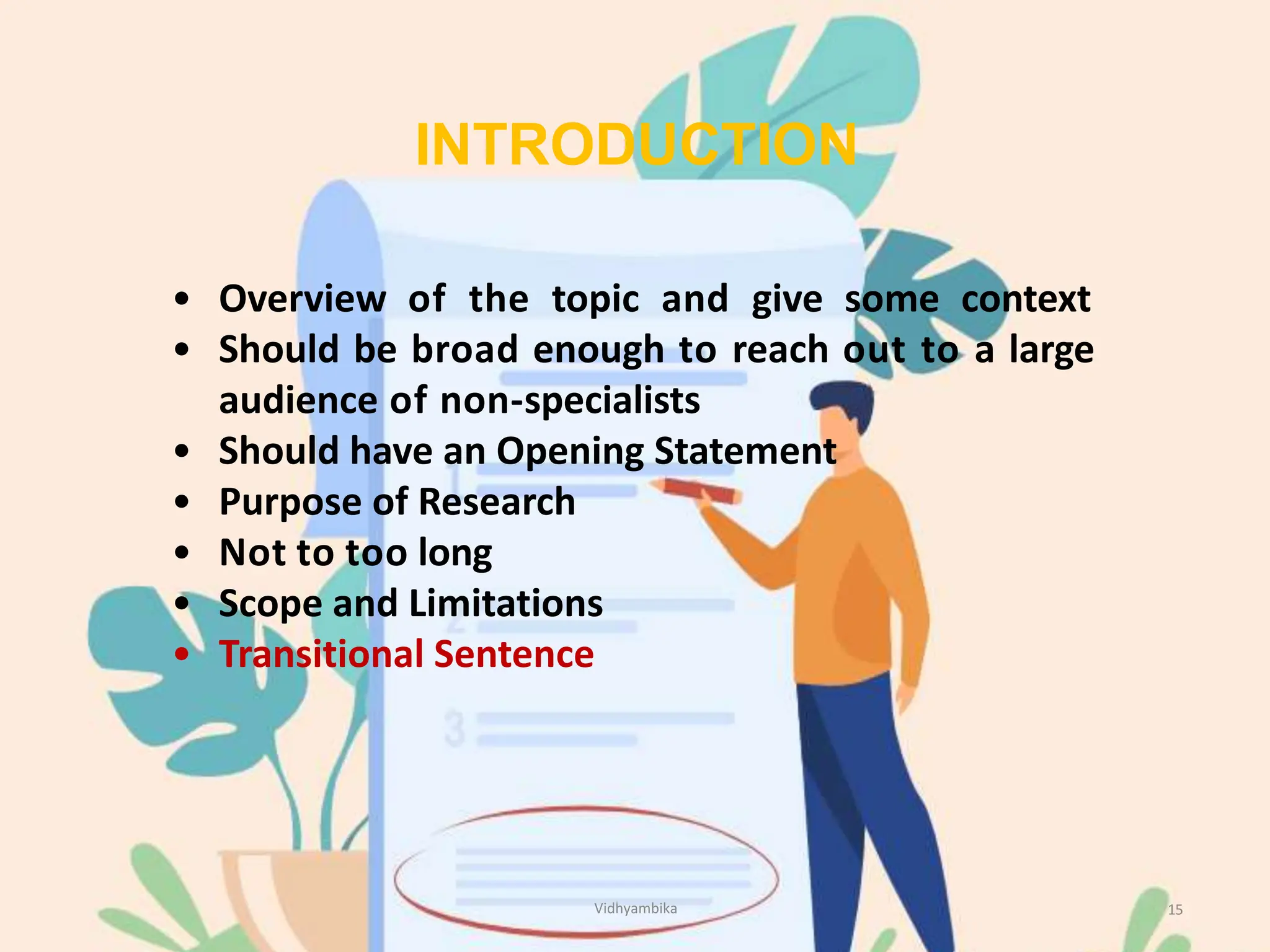
• Overview of the topic and give some context
• Should be broad enough to reach out to a large
audience of non-specialists
• Should have an Opening Statement
• Purpose of Research
• Not to too long
• Scope and Limitations
• Transitional Sentence
Vidhyambika
Transitional Sentence
• A transition is a change from one idea to another idea in writing or
speaking and can be achieved using transition terms or phrases.
• These transitions are usually placed at the beginning of sentences,
independent clauses, and paragraphs and thus establish a specific
relationship between ideas or groups of ideas.
• Transitions are used to enhance cohesion in your paper and make
its logical development clearer to readers.
• When you start a new paragraph, the first sentence should clearly
express:
• What this paragraph will discuss
• How it relates to the previous paragraph
Vidhyambika 16
METHODOLOGY
• Clearly outline the chosen research design
• Specify participant criteria succinctly.
• Provide concise details on sample size and sampling techniques
• Data collection methods
• Explain method alignment with research goals and contribution to data validity
• If applicable, describe the tools, instruments, or equipment used to collect data.
• Highlight the reliability and validity of the instruments employed
• Summarize procedures in a step-by-step format
• Specify consent and ensure participant confidentiality and privacy (if applicable)
• Data Presentation
• Triangulation (if applicable)
• Potential Limitations
• Summarize key methodology aspects, reinforcing alignment with research
objectives
Vidhyambika 17
Triangulation
Vidhyambika 18
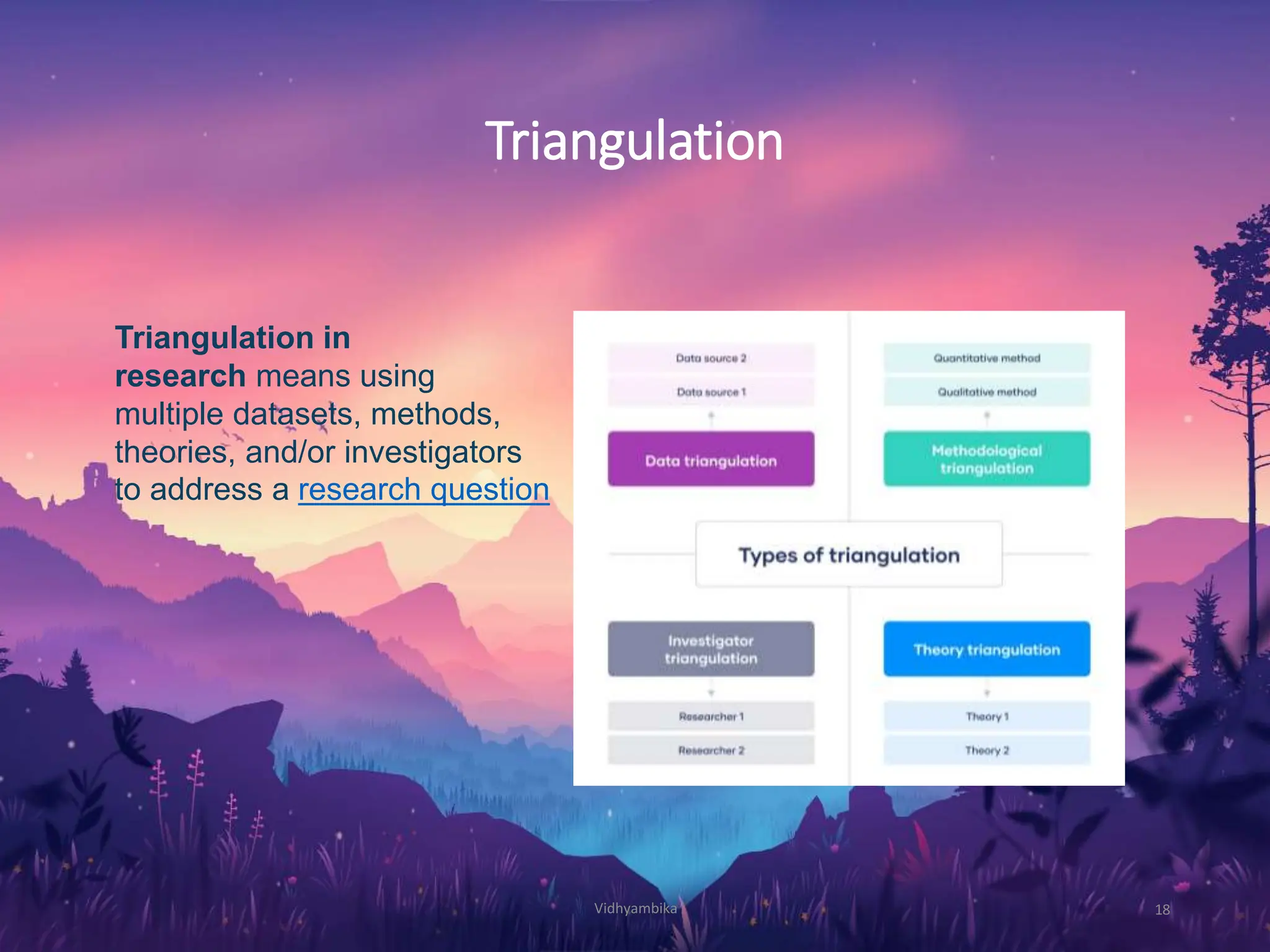
Triangulation in
research means using
multiple datasets, methods,
theories, and/or investigators
to address a research question
Types of Triangulation
• Data triangulation:
Data triangulation is the process of checking data by comparing results
obtained from multiple sources.
Eg:To understand sleep patterns in college students, you compile data
from 15 universities in California. Using data triangulation, you also
obtain data from 15 universities in Texas, and 15 universities in New
York. By gathering data from three locations, you gain a deeper
understanding of how sleep patterns vary among college students
across the country.
• Theory Triangulation
Theory triangulation involves using multiple theoretical models to
study a particular phenomenon or issue.
Vidhyambika 19
Types of Triangulation (Contd)
Eg: A researcher uses two different psychological theories to explain
the same phenomenon, such as competitive and cooperative behavior
in dogs. While one theory predicts that dogs may compete against
their owners for desirable food, the other theory predicts that dogs
may cooperate with their owners when they’re competing for
desirable food. By comparing these two theories, the researcher
strengthens both theories and removes any gaps between them that
may prevent a complete explanation of the phenomenon.
• Methodological triangulation:
Researcher combines qualitative and quantitative methods when using
methodological triangulation.
Vidhyambika 20
RESULTS AND DISCUSSION
• Summary of the key findings
• Comparison to Hypotheses/Expectations
• Interpretation of Results
• Relation to Previous Research
• Limitations of the Study
Vidhyambika 21
CONCLUSION
22
• Summarize the important aspects of your work
• Interpretation of Findings
• Outline areas for future study
• This can include making suggestions for future
research on the topic
Vidhyambika
REFERENCES
23
• Report all the papers cited in the paper
• The format for references section differs w. r. to
each journal (APA, IEEE, Harvard, etc)
• Double-check references for accuracy, including
verifying author names, publication dates, titles,
and other details
• Consequences of improper referencing: Academic
penalties and Damage to reputation
• Use softwares like Mendeley
Vidhyambika
ABSTRACT AND KEY WORDS
• Should be clear, concise and to the point.
• Give a clear picture/idea of your work
• Interest them to read the complete paper
• This will help maximize the visibility of your paper online.
• Should have the primary objective of the review, the reason
behind the choice of selecting the topic, the main outcomes
and results of the review, and the conclusions that might be
drawn, including their implications for further research,
application, or practice
• Key words helps to make your paper to reach others.
24
Vidhyambika
Where to publish papers?
25
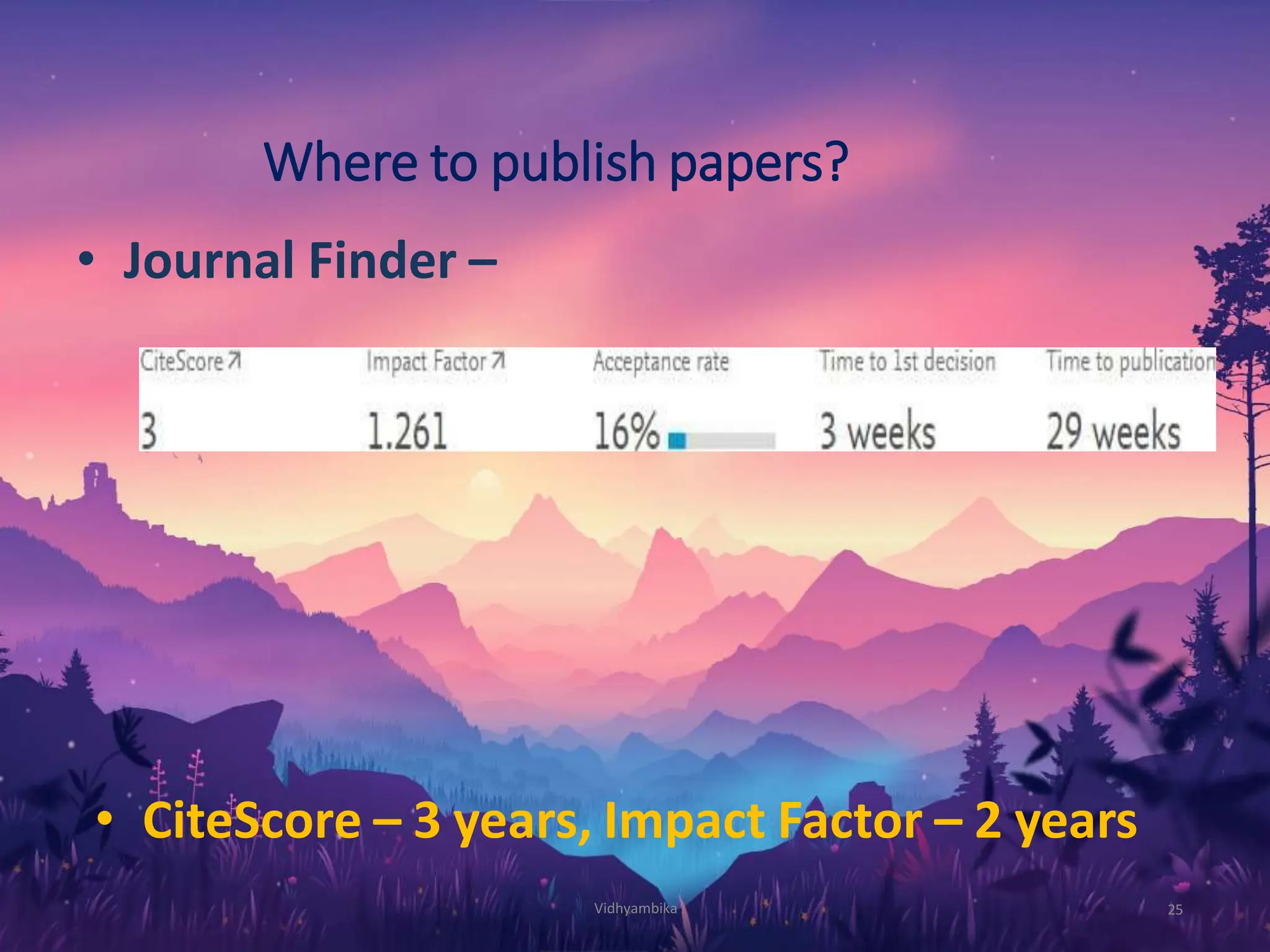
• Journal Finder –
• CiteScore – 3 years, Impact Factor – 2 years
Vidhyambika
REVEALING THE SECRETS
26
• More number of relevant papers to be cited
• Tables and figures
• Plagiarism (3-word, 5-word) – Paraphrase, Rephrase, Article spinning.
Write in own words (max avoided)
• Novel idea (Originality, Uniqueness); Application specific; suitable for
industry; immediately implemented
• Length of paper (Min – 6 pages, Optimum – 8 pages – Max – 12
pages not to exceed 16 pages)
• No. of References – Min. 15 – Max…. 30 paper;
• For review paper Min: 50 papers – Max 100 papers.
• Min 15 days to prepare (2 hours / day)
• Rejection with comments are welcomed
• Secondary data from reputed journals can be used to start with
• Sci-hub
• Mendeley
• Keyword search in google
Vidhyambika
27
Vidhyambika

How to write an effective research paper

  • 1.
    REFINING THE PATHTO EXEMPLARY PUBLISHING 1 S.R. VIDHYAMBIKA Vidhyambika
  • 2.
    WHAT IS PAPER/JOURNALPUBLICATION? 2 • A paper publication is a written document that has been printed on paper and is available for distribution or sale. Vidhyambika BENEFITS • Knowledge Expansion • Establishing expertise • Professional recognition • Opportunities for collaboration • Impact on society • Policy Formulation • Credibility and trust • Inspiration for future research • Contribution to the relevant field
  • 3.
    TYPES OF PAPERS 3 ReviewPaper – Basics to Latest along with future scope and outcomes Research Paper (Outcome of a Project) – Stages adopted (methodology) in completing project Vidhyambika
  • 4.
    TYPES OF RESEARCHPRESENTATION / PUBLICATION 4 – Symposium – International Conference – International Journal published from India/ outside India/virtual (Scopus, SCI, Web of Science indexed) – Books – Patents Vidhyambika
  • 5.
    STRUCTURE OF ANYPRESENTATION / PUBLICATION 5 • Introduction • Literature review / study / survey. • Methodology • Results and discussions //not in review • Conclusions • References • Acknowledgement (Optional) • Abstract Vidhyambika
  • 6.
    HOW TO CHOOSEA RESEARCH TOPIC • Interests you the most • Novelty • Manageable • Availability of data/resources • Dig deeper into the topic • Problems in current scenario • Gaps in existing research • Arrive at research problem 6 Vidhyambika
  • 7.
    TITLE AND AFFILIATION •Clarity, Conciseness and accurate. • Precision in Topic Communication • Optimize the title for discoverability by incorporating 1-2 relevant keywords. • Place keywords within the initial 65 characters for improved search visibility. • Cross-Disciplinary Accessibility to increase your citations • Eliminating Abbreviations and Numbers • Affiliation's Introduction to the Global Community 7 Vidhyambika
  • 8.
    LITERATURE REVIEW It shouldnot just a descriptive summary of the topic. Good review tells a story. Should have logical structure with a beginning, middle, and end. Appropriate headings and sequencing of ideas to make the content flow and guide readers seamlessly from start to finish. Divide the review into sections of a suitable length to allow key points to be identified more easily. If required, create charts, graphs, or other visuals that synthesize information effectively 8 • Conduct a Preliminary Search • Use Keywords and Boolean Operators • Review Search Results • Filter by Date and Relevance Vidhyambika
  • 9.
  • 10.
  • 11.
  • 12.
    USES OF LITERATUREREVIEW 12 • Establishthefoundationaboutaparticulardomain • Toavoid duplication of work • To provide credit to other researchers • Identification of research gap • Aligning with latest techniques • Methodology to be adopted • Specific procedure to be implemented • Validation Vidhyambika
  • 13.
    • Appropriatekeywords • IEEE •Springer • Elsevier • Wiley • Google Scholar (Year can be given) • Research Gate • Microsoft Academic • Web of Science • ACM • Scopus, etc Vidhyambika 13 WHERE TO FIND LITERATURE PAPERS?
  • 14.
    USING KEYWORDS APPROPRIATELY TOFIND LITERATURES Vidhyambika 14 Dr. B. N. Sreeharan, sree4student@gmail.com – Exact Phrase : Exclude words - Similar words - Either word. E.g. unsupervised OR clustering - gives definition - results from specific domain - results with only pdf • Use of appropriate keyword • “ ” • - • ~ • OR • Define • Site • Filetype • Title • Google Lens • Use key words used in literatures you referred
  • 15.
    INTRODUCTION 15 • Overview ofthe topic and give some context • Should be broad enough to reach out to a large audience of non-specialists • Should have an Opening Statement • Purpose of Research • Not to too long • Scope and Limitations • Transitional Sentence Vidhyambika
  • 16.
    Transitional Sentence • Atransition is a change from one idea to another idea in writing or speaking and can be achieved using transition terms or phrases. • These transitions are usually placed at the beginning of sentences, independent clauses, and paragraphs and thus establish a specific relationship between ideas or groups of ideas. • Transitions are used to enhance cohesion in your paper and make its logical development clearer to readers. • When you start a new paragraph, the first sentence should clearly express: • What this paragraph will discuss • How it relates to the previous paragraph Vidhyambika 16
  • 17.
    METHODOLOGY • Clearly outlinethe chosen research design • Specify participant criteria succinctly. • Provide concise details on sample size and sampling techniques • Data collection methods • Explain method alignment with research goals and contribution to data validity • If applicable, describe the tools, instruments, or equipment used to collect data. • Highlight the reliability and validity of the instruments employed • Summarize procedures in a step-by-step format • Specify consent and ensure participant confidentiality and privacy (if applicable) • Data Presentation • Triangulation (if applicable) • Potential Limitations • Summarize key methodology aspects, reinforcing alignment with research objectives Vidhyambika 17
  • 18.
    Triangulation Vidhyambika 18 Triangulation in researchmeans using multiple datasets, methods, theories, and/or investigators to address a research question
  • 19.
    Types of Triangulation •Data triangulation: Data triangulation is the process of checking data by comparing results obtained from multiple sources. Eg:To understand sleep patterns in college students, you compile data from 15 universities in California. Using data triangulation, you also obtain data from 15 universities in Texas, and 15 universities in New York. By gathering data from three locations, you gain a deeper understanding of how sleep patterns vary among college students across the country. • Theory Triangulation Theory triangulation involves using multiple theoretical models to study a particular phenomenon or issue. Vidhyambika 19
  • 20.
    Types of Triangulation(Contd) Eg: A researcher uses two different psychological theories to explain the same phenomenon, such as competitive and cooperative behavior in dogs. While one theory predicts that dogs may compete against their owners for desirable food, the other theory predicts that dogs may cooperate with their owners when they’re competing for desirable food. By comparing these two theories, the researcher strengthens both theories and removes any gaps between them that may prevent a complete explanation of the phenomenon. • Methodological triangulation: Researcher combines qualitative and quantitative methods when using methodological triangulation. Vidhyambika 20
  • 21.
    RESULTS AND DISCUSSION •Summary of the key findings • Comparison to Hypotheses/Expectations • Interpretation of Results • Relation to Previous Research • Limitations of the Study Vidhyambika 21
  • 22.
    CONCLUSION 22 • Summarize theimportant aspects of your work • Interpretation of Findings • Outline areas for future study • This can include making suggestions for future research on the topic Vidhyambika
  • 23.
    REFERENCES 23 • Report allthe papers cited in the paper • The format for references section differs w. r. to each journal (APA, IEEE, Harvard, etc) • Double-check references for accuracy, including verifying author names, publication dates, titles, and other details • Consequences of improper referencing: Academic penalties and Damage to reputation • Use softwares like Mendeley Vidhyambika
  • 24.
    ABSTRACT AND KEYWORDS • Should be clear, concise and to the point. • Give a clear picture/idea of your work • Interest them to read the complete paper • This will help maximize the visibility of your paper online. • Should have the primary objective of the review, the reason behind the choice of selecting the topic, the main outcomes and results of the review, and the conclusions that might be drawn, including their implications for further research, application, or practice • Key words helps to make your paper to reach others. 24 Vidhyambika
  • 25.
    Where to publishpapers? 25 • Journal Finder – • CiteScore – 3 years, Impact Factor – 2 years Vidhyambika
  • 26.
    REVEALING THE SECRETS 26 •More number of relevant papers to be cited • Tables and figures • Plagiarism (3-word, 5-word) – Paraphrase, Rephrase, Article spinning. Write in own words (max avoided) • Novel idea (Originality, Uniqueness); Application specific; suitable for industry; immediately implemented • Length of paper (Min – 6 pages, Optimum – 8 pages – Max – 12 pages not to exceed 16 pages) • No. of References – Min. 15 – Max…. 30 paper; • For review paper Min: 50 papers – Max 100 papers. • Min 15 days to prepare (2 hours / day) • Rejection with comments are welcomed • Secondary data from reputed journals can be used to start with • Sci-hub • Mendeley • Keyword search in google Vidhyambika
  • 27.