How to Write an
Effective Law Essay?
Law essay writing requires more than just knowledge of legal concepts. It
involves research, analysis, and organizing your thoughts effectively.
Follow these steps to write an excellent law essay.
HB by Harry Brook
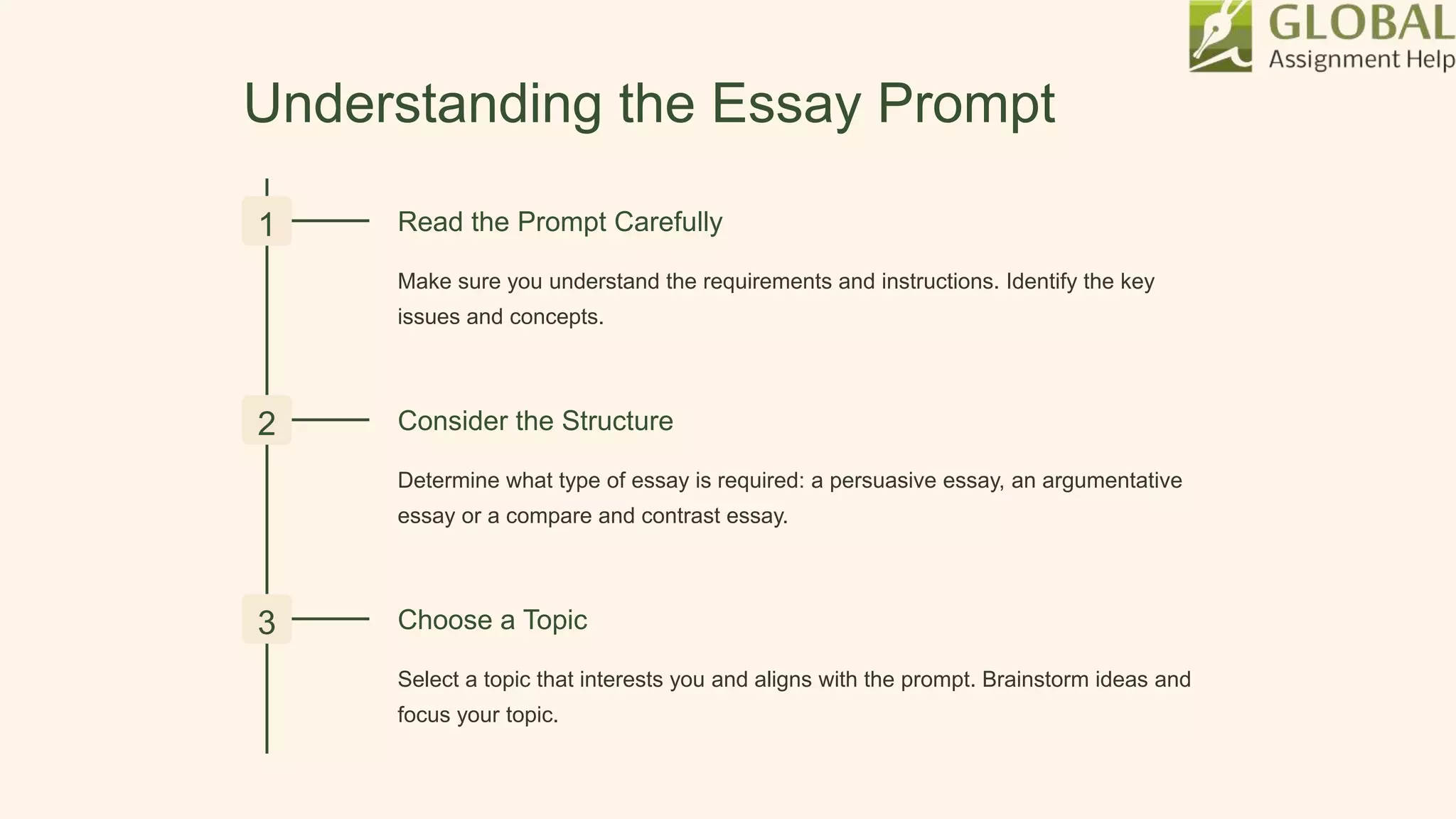
Understanding the Essay Prompt
1 Read the Prompt Carefully
Make sure you understand the requirements and instructions. Identify the key
issues and concepts.
2 Consider the Structure
Determine what type of essay is required: a persuasive essay, an argumentative
essay or a compare and contrast essay.
3 Choose a Topic
Select a topic that interests you and aligns with the prompt. Brainstorm ideas and
focus your topic.
Research and Analysis
Use Reliable Sources
Find credible sources
such as academic
articles, case law, and
primary sources. Take
detailed notes while
researching.
Identify Arguments
and
Counterarguments
Look for arguments and
evidence to support your
thesis statement while
anticipating
counterarguments. Think
critically about the evidence
you find.
Organize Your
Findings
Sort your research in a
coherent order,
categorize and prioritize
your findings, and take
note of any gaps in your
research that need to be
filled.
Structuring the Essay
Create an Outline
Organize your research into
an outline and create a
structure for your essay. Use
the outline to guide your
writing and ensure that all
requirements are met.
Flowchart Your Essay
Create a visual representation
of your arguments, evidence,
and research. This will help you
to see the connections between
different elements of your essay
and ensure its logical flow.
Mind Map Your Ideas
Draw a mind map to organize
your ideas and help you to
identify the connections
between different parts of your
essay.
Writing the Essay
1 Introduction
Begin with a strong
opening sentence that
hooks the reader. Provide
background information
and context, and present
your thesis statement.
2 Main Body
Write clear and concise
paragraphs with good
transitions. Present your
arguments and evidence,
citing your sources
appropriately. Use topic
sentences to keep the
focus on your thesis.
3 Conclusion
Sum up your arguments and provide a clear conclusion based on
your research. Restate your thesis and the main points of your
essay.
Editing and Proofreading
Edit for Structure
Reread your essay for
logic, coherence, and
structure. Check that each
sentence serves a purpose
and that paragraphs flow
smoothly.
Eliminate Spelling and
Grammatical Errors
Proofread your essay for
errors in spelling, grammar,
and punctuation. Use
editing tools to help you
spot mistakes.
Check Your Citations
Ensure that all your sources
are cited correctly and that
you have included a
reference section at the end
of your essay.
Conclusion
Revel in Your Success
Congratulations, you've
written an effective law
essay! Make sure to
celebrate your
achievements. Share your
knowledge and inspire others
to succeed.
Upgrade Your Skills
The more you write, the better
you become. Invest in your
writing skills and get feedback
from your professors or peers.
Attend writing workshops or
seminars, or take online courses
to take your writing to the next
level.
Read and Learn
Stay up-to-date with
developments in the legal field.
Read legal journals, news
articles, case summaries, and
other scholarly work to stay
informed. Cultivate a thirst for
knowledge and learning.

How to Write an Effective Law Essay?

  • 1.
    How to Writean Effective Law Essay? Law essay writing requires more than just knowledge of legal concepts. It involves research, analysis, and organizing your thoughts effectively. Follow these steps to write an excellent law essay. HB by Harry Brook
  • 2.
    Understanding the EssayPrompt 1 Read the Prompt Carefully Make sure you understand the requirements and instructions. Identify the key issues and concepts. 2 Consider the Structure Determine what type of essay is required: a persuasive essay, an argumentative essay or a compare and contrast essay. 3 Choose a Topic Select a topic that interests you and aligns with the prompt. Brainstorm ideas and focus your topic.
  • 3.
    Research and Analysis UseReliable Sources Find credible sources such as academic articles, case law, and primary sources. Take detailed notes while researching. Identify Arguments and Counterarguments Look for arguments and evidence to support your thesis statement while anticipating counterarguments. Think critically about the evidence you find. Organize Your Findings Sort your research in a coherent order, categorize and prioritize your findings, and take note of any gaps in your research that need to be filled.
  • 4.
    Structuring the Essay Createan Outline Organize your research into an outline and create a structure for your essay. Use the outline to guide your writing and ensure that all requirements are met. Flowchart Your Essay Create a visual representation of your arguments, evidence, and research. This will help you to see the connections between different elements of your essay and ensure its logical flow. Mind Map Your Ideas Draw a mind map to organize your ideas and help you to identify the connections between different parts of your essay.
  • 5.
    Writing the Essay 1Introduction Begin with a strong opening sentence that hooks the reader. Provide background information and context, and present your thesis statement. 2 Main Body Write clear and concise paragraphs with good transitions. Present your arguments and evidence, citing your sources appropriately. Use topic sentences to keep the focus on your thesis. 3 Conclusion Sum up your arguments and provide a clear conclusion based on your research. Restate your thesis and the main points of your essay.
  • 6.
    Editing and Proofreading Editfor Structure Reread your essay for logic, coherence, and structure. Check that each sentence serves a purpose and that paragraphs flow smoothly. Eliminate Spelling and Grammatical Errors Proofread your essay for errors in spelling, grammar, and punctuation. Use editing tools to help you spot mistakes. Check Your Citations Ensure that all your sources are cited correctly and that you have included a reference section at the end of your essay.
  • 7.
    Conclusion Revel in YourSuccess Congratulations, you've written an effective law essay! Make sure to celebrate your achievements. Share your knowledge and inspire others to succeed. Upgrade Your Skills The more you write, the better you become. Invest in your writing skills and get feedback from your professors or peers. Attend writing workshops or seminars, or take online courses to take your writing to the next level. Read and Learn Stay up-to-date with developments in the legal field. Read legal journals, news articles, case summaries, and other scholarly work to stay informed. Cultivate a thirst for knowledge and learning.