12 Practical
Guidelines For
Effective MBA
Assignment Writing
Whether you are a seasoned professional or a student just
starting on your MBA journey, effective MBA assignment help
writing skills are essential. Here are some practical guidelines to
help you improve your writing skills and achieve success.
HB
by Harry Brook
Understanding The Requirements of The
Assignment
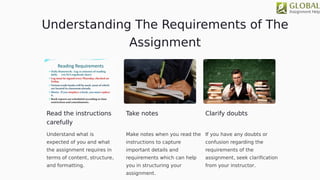
Read the instructions
carefully
Understand what is
expected of you and what
the assignment requires in
terms of content, structure,
and formatting.
Take notes
Make notes when you read the
instructions to capture
important details and
requirements which can help
you in structuring your
assignment.
Clarify doubts
If you have any doubts or
confusion regarding the
requirements of the
assignment, seek clarification
from your instructor.
Choosing The Topic and Researching
Topic Selection
Choose a topic that interests you and is
relevant to the course requirements.
Brainstorm with classmates and consult
the instructor for suitable topics if needed.
Research
Perform in-depth research on the
chosen topic. Use academic sources
such as databases, journals, and books
and be sure to use credible sources only.
Note-Taking
Take detailed notes on the research
matter. Ensure that you reference all the
sources and keep a note of the important
information.
Plagiarism Check
Check for plagiarism by running your
work through online software and make
sure that the assignment is original.
Structuring and Organizing the Assignment
1 Introduction
Provide an introduction to the topic and clearly state the objective and
structure of the assignment.
2 Main Body
Develop the main argument in the body of the assignment. Organize the
content by using subheadings and bullet points for clarity.
3 Conclusion
Summarize the findings, draw clear conclusions, and make recommendations
for future studies if required.
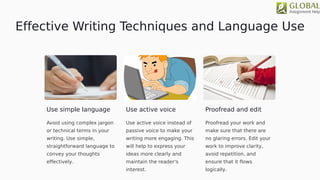
Effective Writing Techniques and Language Use
Use simple language
Avoid using complex jargon
or technical terms in your
writing. Use simple,
straightforward language to
convey your thoughts
effectively.
Use active voice
Use active voice instead of
passive voice to make your
writing more engaging. This
will help to express your
ideas more clearly and
maintain the reader's
interest.
Proofread and edit
Proofread your work and
make sure that there are
no glaring errors. Edit your
work to improve clarity,
avoid repetition, and
ensure that it flows
logically.
Citation and Referencing
1 APA format
Cite all the sources
using APA format and
follow the
bibliographic citation
guidelines provided
by your institution.
2 Paraphrasing
Use paraphrasing
instead of copying
someone else’s work
word for word.
Paraphrasing requires
that you put the text
in your own words
while retaining the
intent of the original
text and providing a
reference to the work.
3 Reference list
Create a reference
list at the end of your
assignment to list all
the sources used in
your work. Make sure
to double-check the
accuracy of the
citations.
Proofreading and Editing
Proofreading Tips
• Take a break before proofreading
• Print out your work and read it aloud
• Proofread your work several times
Editing Tips
• Edit your work for clarity and coherence
• Check that all your ideas flow
logically and that the narrative is
cohesive
• Think about the structure and any
gaps in information or logic
Conclusion
Effective assignment writing is essential for success in MBA courses. By following these
practical guidelines, you can improve your writing skills and increase your chances of
achieving academic success. Remember, good writing skills can take you far in your
professional and personal life.

12 Practical Guidelines For Effective MBA Assignment Writing

  • 1.
    12 Practical Guidelines For EffectiveMBA Assignment Writing Whether you are a seasoned professional or a student just starting on your MBA journey, effective MBA assignment help writing skills are essential. Here are some practical guidelines to help you improve your writing skills and achieve success. HB by Harry Brook
  • 2.
    Understanding The Requirementsof The Assignment Read the instructions carefully Understand what is expected of you and what the assignment requires in terms of content, structure, and formatting. Take notes Make notes when you read the instructions to capture important details and requirements which can help you in structuring your assignment. Clarify doubts If you have any doubts or confusion regarding the requirements of the assignment, seek clarification from your instructor.
  • 3.
    Choosing The Topicand Researching Topic Selection Choose a topic that interests you and is relevant to the course requirements. Brainstorm with classmates and consult the instructor for suitable topics if needed. Research Perform in-depth research on the chosen topic. Use academic sources such as databases, journals, and books and be sure to use credible sources only. Note-Taking Take detailed notes on the research matter. Ensure that you reference all the sources and keep a note of the important information. Plagiarism Check Check for plagiarism by running your work through online software and make sure that the assignment is original.
  • 4.
    Structuring and Organizingthe Assignment 1 Introduction Provide an introduction to the topic and clearly state the objective and structure of the assignment. 2 Main Body Develop the main argument in the body of the assignment. Organize the content by using subheadings and bullet points for clarity. 3 Conclusion Summarize the findings, draw clear conclusions, and make recommendations for future studies if required.
  • 5.
    Effective Writing Techniquesand Language Use Use simple language Avoid using complex jargon or technical terms in your writing. Use simple, straightforward language to convey your thoughts effectively. Use active voice Use active voice instead of passive voice to make your writing more engaging. This will help to express your ideas more clearly and maintain the reader's interest. Proofread and edit Proofread your work and make sure that there are no glaring errors. Edit your work to improve clarity, avoid repetition, and ensure that it flows logically.
  • 6.
    Citation and Referencing 1APA format Cite all the sources using APA format and follow the bibliographic citation guidelines provided by your institution. 2 Paraphrasing Use paraphrasing instead of copying someone else’s work word for word. Paraphrasing requires that you put the text in your own words while retaining the intent of the original text and providing a reference to the work. 3 Reference list Create a reference list at the end of your assignment to list all the sources used in your work. Make sure to double-check the accuracy of the citations.
  • 7.
    Proofreading and Editing ProofreadingTips • Take a break before proofreading • Print out your work and read it aloud • Proofread your work several times Editing Tips • Edit your work for clarity and coherence • Check that all your ideas flow logically and that the narrative is cohesive • Think about the structure and any gaps in information or logic
  • 8.
    Conclusion Effective assignment writingis essential for success in MBA courses. By following these practical guidelines, you can improve your writing skills and increase your chances of achieving academic success. Remember, good writing skills can take you far in your professional and personal life.