How to Write a Legal
Research Paper and Legal
Research Article
Master the art of scholarly legal writing with comprehensive
strategies for research, structure, and publication success.
Why Write a Legal Research Paper?
Develop Expertise
Sharpen critical thinking skills and deep dive into specialized legal fields to build professional authority.
Original Analysis
Contribute fresh insights or propose innovative solutions to pressing legal problems facing our society.
Career Advancement
Create compelling writing samples that demonstrate your analytical abilities to employers and academic institutions.
Professional Impact
Engage meaningfully with scholars, practitioners, and policymakers through thoughtful legal discourse.
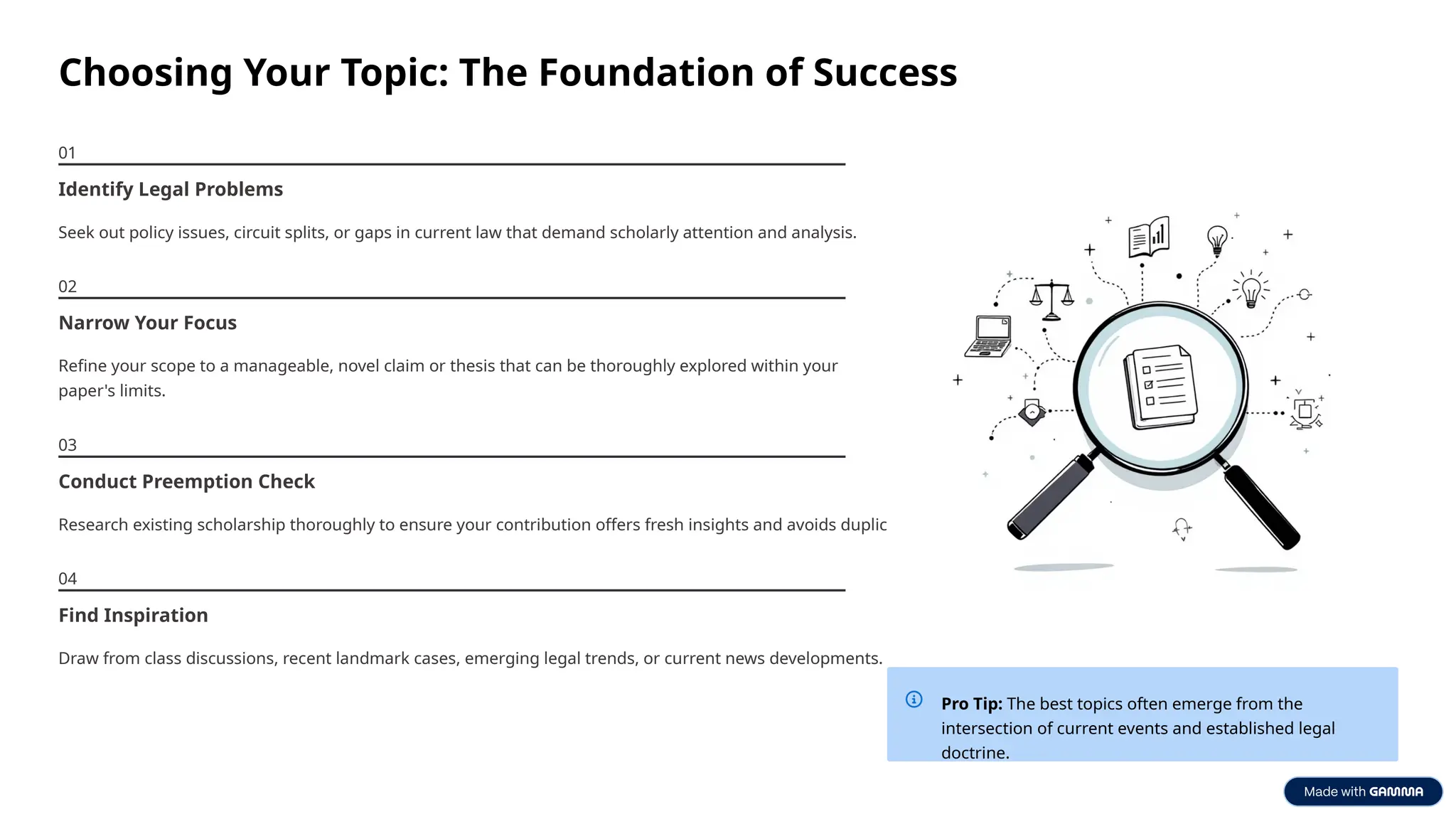
Choosing Your Topic: The Foundation of Success
01
Identify Legal Problems
Seek out policy issues, circuit splits, or gaps in current law that demand scholarly attention and analysis.
02
Narrow Your Focus
Refine your scope to a manageable, novel claim or thesis that can be thoroughly explored within your
paper's limits.
03
Conduct Preemption Check
Research existing scholarship thoroughly to ensure your contribution offers fresh insights and avoids duplication.
04
Find Inspiration
Draw from class discussions, recent landmark cases, emerging legal trends, or current news developments.
Pro Tip: The best topics often emerge from the
intersection of current events and established legal
doctrine.
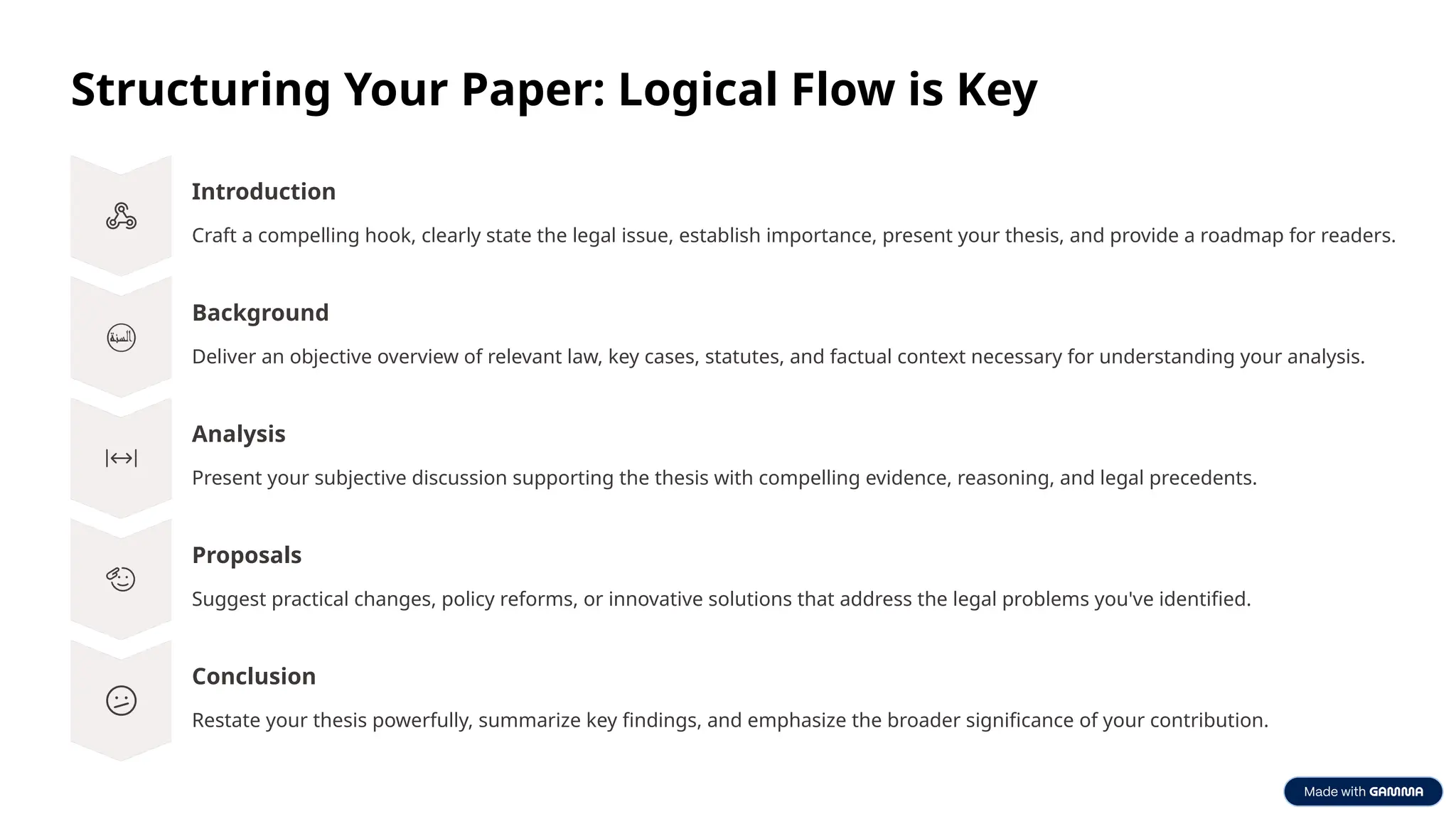
Structuring Your Paper: Logical Flow is Key
Introduction
Craft a compelling hook, clearly state the legal issue, establish importance, present your thesis, and provide a roadmap for readers.
Background
Deliver an objective overview of relevant law, key cases, statutes, and factual context necessary for understanding your analysis.
Analysis
Present your subjective discussion supporting the thesis with compelling evidence, reasoning, and legal precedents.
Proposals
Suggest practical changes, policy reforms, or innovative solutions that address the legal problems you've identified.
Conclusion
Restate your thesis powerfully, summarize key findings, and emphasize the broader significance of your contribution.
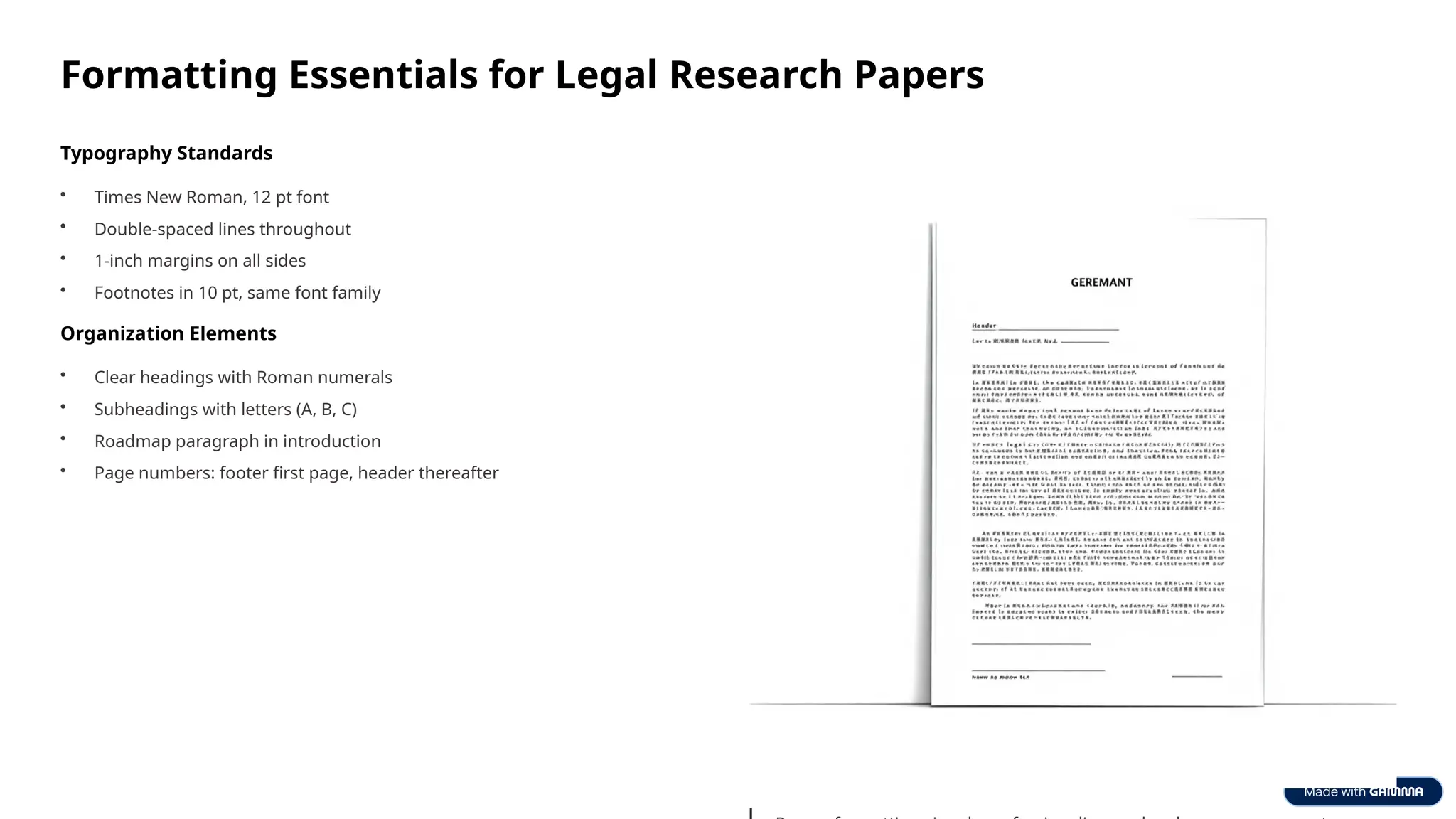
Formatting Essentials for Legal Research Papers
Typography Standards
• Times New Roman, 12 pt font
• Double-spaced lines throughout
• 1-inch margins on all sides
• Footnotes in 10 pt, same font family
Organization Elements
• Clear headings with Roman numerals
• Subheadings with letters (A, B, C)
• Roadmap paragraph in introduction
• Page numbers: footer first page, header thereafter
Conducting Effective Legal Research
Start with Secondary
Sources
Begin with legal
encyclopedias, treatises,
and law review articles to
build foundational
knowledge and identify key
authorities.
Leverage Premium
Databases
Utilize Westlaw, LexisNexis,
SSRN, and Google Scholar
for comprehensive access
to cases, statutes, and
scholarly articles.
Track Research
Meticulously
Document search terms,
sources consulted, dates
accessed, and key findings
using digital tools or
detailed spreadsheets.
Verify Jurisdiction
Confirm applicable
jurisdiction and check for
conflicting authorities or
preemptive cases that
could impact your
argument.
Writing Tips: Crafting a Persuasive Legal Argument
Clarity First
Write clearly and concisely,
avoiding unnecessary legalese. Aim
for plain English that makes
complex legal concepts accessible
to your intended audience.
Support Every Claim
Back up each assertion with
authoritative citations and sound
legal reasoning. Your credibility
depends on thorough
documentation of sources.
Address Counterarguments
Anticipate opposing viewpoints and
address them respectfully but
firmly. This demonstrates
intellectual honesty and
strengthens your position.
Maintain Consistent Tone
Keep an appropriate stance
throughout—whether firm,
objective, or persuasive—that
matches your paper's purpose and
audience expectations.
Revise Thoroughly
Edit for clarity, logical flow,
grammar accuracy, and precise
Bluebook citations. Multiple
revision rounds are essential for
professional quality.
Footnotes and Citation: The Backbone of Credibility
Avoid "Tail Wagging Dog": Footnotes should
support, not overshadow, your main argument.
Citation Best Practices
• Use footnotes for sources, not new arguments
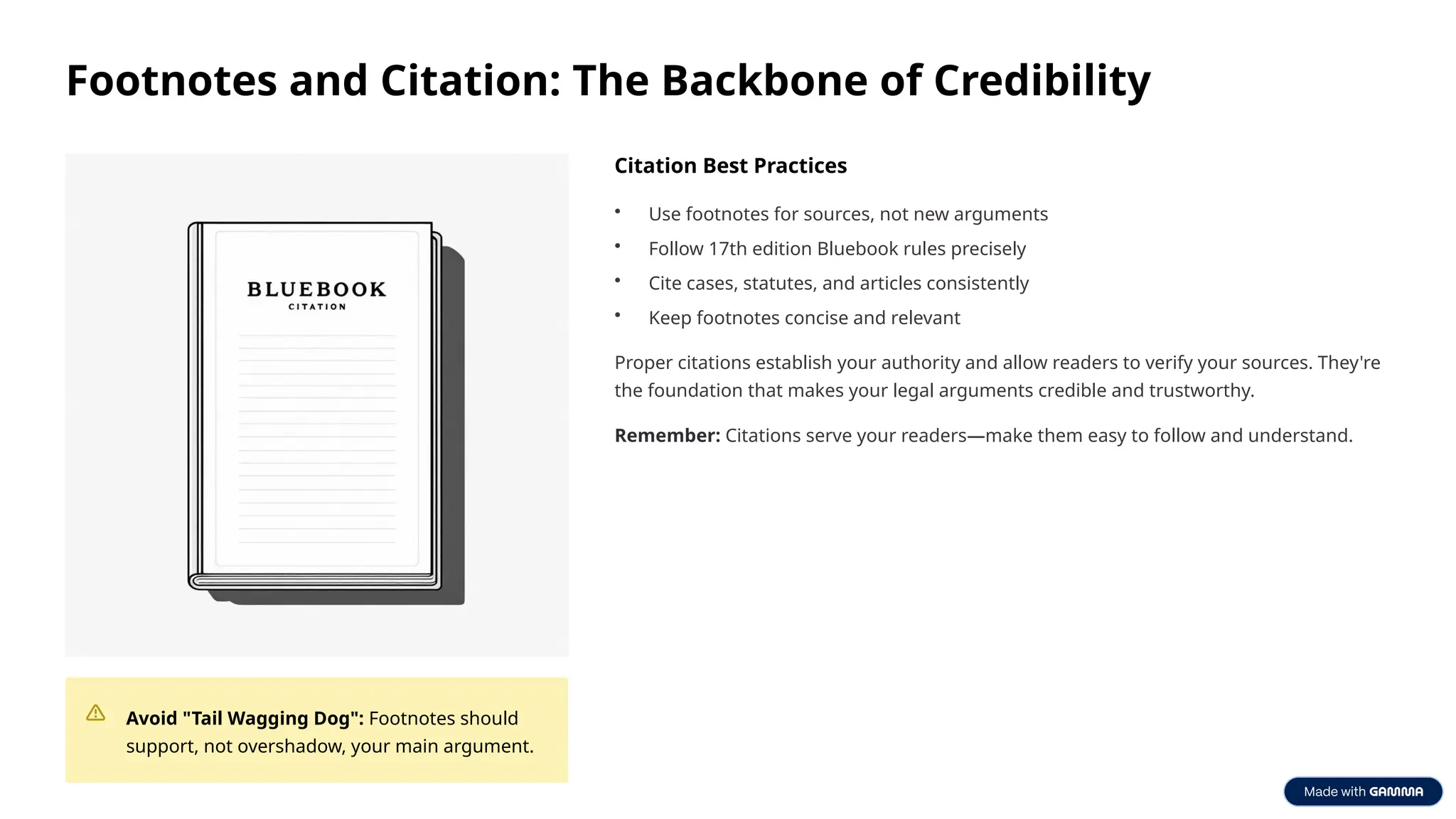
• Follow 17th edition Bluebook rules precisely
• Cite cases, statutes, and articles consistently
• Keep footnotes concise and relevant
Proper citations establish your authority and allow readers to verify your sources. They're
the foundation that makes your legal arguments credible and trustworthy.
Remember: Citations serve your readers—make them easy to follow and understand.
From Paper to Publication: Sharing Your Work
1
Identify Venues
Research suitable law reviews, specialty journals, or online
platforms that align with your topic and target audience.
2 Follow Guidelines
Adhere precisely to submission requirements including
format specifications, length limits, and cover letter
expectations.
3
Present for Feedback
Share your work at academic seminars, professional
conferences, or peer review groups to refine your
arguments. 4 Prepare for Revision
Expect multiple drafts and constructive peer review. The
publication process strengthens your final product
significantly.
5
Build Your Profile
Use successful publication to establish your expertise and
expand your professional network within the legal
community.
Your Voice Matters
Writing with Purpose and
Impact
Legal research writing is a journey of
discovery and persuasion that can influence
legal thought, policy, and practice. Your
unique perspective and rigorous analysis
contribute to the ongoing evolution of law.
Stay organized, focused, and open to
revision. Embrace the challenge—every
expert was once a beginner who refused to
give up.
Start Today
Pick your compelling topic and begin
your research journey.
Plan Strategically
Organize your approach and set
realistic milestones.
Write Confidently
Trust your voice and contribute
meaningfully to legal discourse.
Legal Research Explain in Easy way For Law Students

Legal Research Explain in Easy way For Law Students

  • 1.
    How to Writea Legal Research Paper and Legal Research Article Master the art of scholarly legal writing with comprehensive strategies for research, structure, and publication success.
  • 2.
    Why Write aLegal Research Paper? Develop Expertise Sharpen critical thinking skills and deep dive into specialized legal fields to build professional authority. Original Analysis Contribute fresh insights or propose innovative solutions to pressing legal problems facing our society. Career Advancement Create compelling writing samples that demonstrate your analytical abilities to employers and academic institutions. Professional Impact Engage meaningfully with scholars, practitioners, and policymakers through thoughtful legal discourse.
  • 3.
    Choosing Your Topic:The Foundation of Success 01 Identify Legal Problems Seek out policy issues, circuit splits, or gaps in current law that demand scholarly attention and analysis. 02 Narrow Your Focus Refine your scope to a manageable, novel claim or thesis that can be thoroughly explored within your paper's limits. 03 Conduct Preemption Check Research existing scholarship thoroughly to ensure your contribution offers fresh insights and avoids duplication. 04 Find Inspiration Draw from class discussions, recent landmark cases, emerging legal trends, or current news developments. Pro Tip: The best topics often emerge from the intersection of current events and established legal doctrine.
  • 4.
    Structuring Your Paper:Logical Flow is Key Introduction Craft a compelling hook, clearly state the legal issue, establish importance, present your thesis, and provide a roadmap for readers. Background Deliver an objective overview of relevant law, key cases, statutes, and factual context necessary for understanding your analysis. Analysis Present your subjective discussion supporting the thesis with compelling evidence, reasoning, and legal precedents. Proposals Suggest practical changes, policy reforms, or innovative solutions that address the legal problems you've identified. Conclusion Restate your thesis powerfully, summarize key findings, and emphasize the broader significance of your contribution.
  • 5.
    Formatting Essentials forLegal Research Papers Typography Standards • Times New Roman, 12 pt font • Double-spaced lines throughout • 1-inch margins on all sides • Footnotes in 10 pt, same font family Organization Elements • Clear headings with Roman numerals • Subheadings with letters (A, B, C) • Roadmap paragraph in introduction • Page numbers: footer first page, header thereafter
  • 6.
    Conducting Effective LegalResearch Start with Secondary Sources Begin with legal encyclopedias, treatises, and law review articles to build foundational knowledge and identify key authorities. Leverage Premium Databases Utilize Westlaw, LexisNexis, SSRN, and Google Scholar for comprehensive access to cases, statutes, and scholarly articles. Track Research Meticulously Document search terms, sources consulted, dates accessed, and key findings using digital tools or detailed spreadsheets. Verify Jurisdiction Confirm applicable jurisdiction and check for conflicting authorities or preemptive cases that could impact your argument.
  • 7.
    Writing Tips: Craftinga Persuasive Legal Argument Clarity First Write clearly and concisely, avoiding unnecessary legalese. Aim for plain English that makes complex legal concepts accessible to your intended audience. Support Every Claim Back up each assertion with authoritative citations and sound legal reasoning. Your credibility depends on thorough documentation of sources. Address Counterarguments Anticipate opposing viewpoints and address them respectfully but firmly. This demonstrates intellectual honesty and strengthens your position. Maintain Consistent Tone Keep an appropriate stance throughout—whether firm, objective, or persuasive—that matches your paper's purpose and audience expectations. Revise Thoroughly Edit for clarity, logical flow, grammar accuracy, and precise Bluebook citations. Multiple revision rounds are essential for professional quality.
  • 8.
    Footnotes and Citation:The Backbone of Credibility Avoid "Tail Wagging Dog": Footnotes should support, not overshadow, your main argument. Citation Best Practices • Use footnotes for sources, not new arguments • Follow 17th edition Bluebook rules precisely • Cite cases, statutes, and articles consistently • Keep footnotes concise and relevant Proper citations establish your authority and allow readers to verify your sources. They're the foundation that makes your legal arguments credible and trustworthy. Remember: Citations serve your readers—make them easy to follow and understand.
  • 9.
    From Paper toPublication: Sharing Your Work 1 Identify Venues Research suitable law reviews, specialty journals, or online platforms that align with your topic and target audience. 2 Follow Guidelines Adhere precisely to submission requirements including format specifications, length limits, and cover letter expectations. 3 Present for Feedback Share your work at academic seminars, professional conferences, or peer review groups to refine your arguments. 4 Prepare for Revision Expect multiple drafts and constructive peer review. The publication process strengthens your final product significantly. 5 Build Your Profile Use successful publication to establish your expertise and expand your professional network within the legal community.
  • 10.
    Your Voice Matters Writingwith Purpose and Impact Legal research writing is a journey of discovery and persuasion that can influence legal thought, policy, and practice. Your unique perspective and rigorous analysis contribute to the ongoing evolution of law. Stay organized, focused, and open to revision. Embrace the challenge—every expert was once a beginner who refused to give up. Start Today Pick your compelling topic and begin your research journey. Plan Strategically Organize your approach and set realistic milestones. Write Confidently Trust your voice and contribute meaningfully to legal discourse.