How to Start a
Non-Profit…
That Matters!
Week One
Defining Non-Profits
Researching Your Vision
Conducting a Needs Assessment
Writing a Mission Statement
Branding
About Me
   I have been involved in the non-profit world
    for over 20 years; starting three successful
    organizations in the aging and health care
    fields.
   I’ve raised over $10,000,000 and served
    thousands of people.
   I currently serve on the Board of Directors of
    three non-profit organizations.
   I love the non-profit world and you will too!
Our Classroom
Please turn off other technology and try to minimize distractions.
This course moves quickly and we cover a lot of ground!

Feel free to type in questions as we go through the material.

View the material in full-screen mode.

While each course is 90 minutes long, there will be time each
week to answer questions and talk.

Feel free to email me throughout the week if you get stuck or
need some encouragement.
AskMeg@likefinewine.net
What Is a Non-Profit?
 NPO: An organization in which no owner,
 stockholder or trustee shares in profits and
 losses and which exists not to earn
 revenue but to promote a mission that
 enhances the public welfare. These
 organizations are usually eligible for tax-
 exempt status and can receive tax-
 deductible contributions.
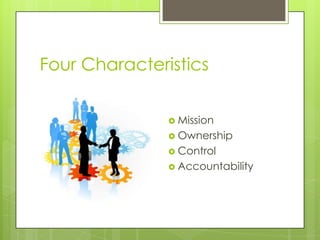
Four Characteristics


                Mission
                Ownership
                Control
                Accountability
Your Vision, Your Abilities
   What need are you             Do you have the
    meeting?                       business skills to run a
   Is your mission vital to       non-profit?
    YOUR community?               Are you creative,
   Does your vision lend          passionate and
    itself to high quality,        persistent?
    responsive and                 Collaborative? Driven?
    unduplicated                  Can you inspire others?
    programs?                     Can you communicate
   Will you have                  your vision quickly and
    adequate facilities?           effectively?
Conducting a Needs
Assessment
    Discover                             Quantify
   Is there another non-profit in      Talk to a sample group of
    your program space?                  your intended audience.
   Who is your audience?               Talk to other non-profits that
    Where do they live? How do           are providing similar services.
    they get around? How many           Guidestar
    people will need your               211 Call Centers
    service?
                                        Interview leaders in your
   What services do they                community.
    currently use?
                                        Search the web.
   What are this group’s stated
    needs and desires?                  Use a SWOT analysis.
Writing Your Mission Statement
1. What is a mission statement?

2. Why is a mission statement
important?

3. Constructing a mission
statement.

4. Using your mission statement.
 Witha written
          mission statement
BRAND!    and a completed
          needs assessment,
          your name and
          brand should be
          coming into focus.
          Brainstorm.
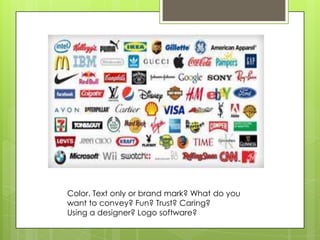
Color. Text only or brand mark? What do you
want to convey? Fun? Trust? Caring?
Using a designer? Logo software?
 Conduct   your needs assessment
 Begin to refine your mission statement
 Brainstorm about your name and brand
 Howto write a mission statement
 Sample needs assessment
 SWOT analysis
How to Start a
Non-Profit…
That Matters!
Week Two
The Business Plan
By-Laws
Policies and Procedures
Overview of Legal Filings
Our Classroom
Please turn off other technology and try to minimize distractions.
This course moves quickly and we cover a lot of ground!

Feel free to type in questions as we go through the material.

View the material in full-screen mode.

While each course is 90 minutes long, there will be time each
week to answer questions and talk.

Feel free to email me throughout the week if you get stuck or
need some encouragement.

AskMeg@likefinewine.net
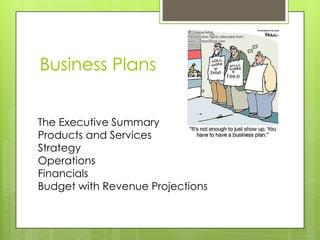
Business Plans


The Executive Summary
Products and Services
Strategy
Operations
Financials
Budget with Revenue Projections
The Executive Summary
 Thisexplains very concisely and clearly
  what the business does or will do.
 Include your mission statement, a
  description of the Board of Directors,
  types and numbers of employees
  needed, location of where services will be
  provided, a description of those services,
  your funding sources and a summary of
  the market research you have
  conducted.
Products and services
 What   products or services will be
  provided?
 Who is the market?
 What differentiates your services from
  existing services?
 What problems do your services address?
 What are your objectives?
Strategy
   Include the results of your needs analysis.
   Explain the documented need for your
    service and/or a new need you will address.
   Who else provides this service or a similar
    one?
   Who are your clients? Where are they? How
    many are there?
   How will you market your services to this
    population?
Organization and
Management
 How will you organize?
 Create an organizational chart.
 Develop and include staff profiles for the
  major players.
Marketing Strategies
 How  do you plan to communicate with
  your target audience?
 Include an advertising or PR plan.
 Include a social networking plan.
Financials
 Where   will you get your start-up funding?
 Will you be a membership organization?
 Include research you have done on
  grants and special events. Include
  fundraising goals.
 Prepare an annual budget showing
  revenues and expenses.
Why?
 You  will need your business plan to show
  to donors and foundations that may fund
  you, to potential board members, and to
  key volunteers and employees.
 The business plan is your compass.
 Your business plan is a living document
  that will grow and change with the
  organization.
Policies and Procedures
 Bylaws                Policies
 Seesample by-       Conflict
                              of Interest
 laws in the          Compensation
 handouts section.    Board Roles and
                       Responsibilities
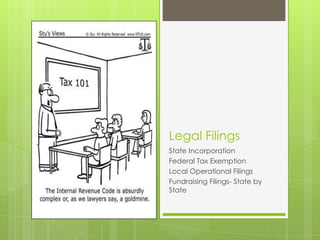
Legal Filings
State Incorporation
Federal Tax Exemption
Local Operational Filings
Fundraising Filings- State by
State
Begin policies and procedures notebook
Do your legal filings
 Sample policies and procedures forms
 Sample by-laws
How to Start a
Non-Profit…
That Matters!
Week Three
Developing a Fundraising
Plan
Sources of Funding
Special Events
The Fundraising Plan
 Develop   your goals!
    How much money do you need to raise?
    What will you use the money for?
     Overhead, salaries, programs, capital
     projects, emergency fund?

    Develop a plan for EACH goal!
Fundraising Plan - Costs
 Estimate   your cost of fundraising.
    Your total cost of fundraising should not
     exceed 23% of your overall operating
     budget.
    Consider postage, website, special event
     costs, cost of staff and cost of facilities
     used.
Fundraising Plan - Timelines
 Develop   a timeline for your fundraising
 plan.
    Fill in a one year calendar with specific
     activities.
    Then develop timelines for each activity.
Fundraising Plan – Funding
Sources
 Can  you leverage current sources of
  income?
 Who are the audiences you aren’t
  tapping?
 Should you return to the “well” or try for
  mass appeal?
 Grants?
 Can you develop a product or service
  that will bring in earned income?
Fundraising - Evaluation
 Evaluate your plan every three months.
 How will you evaluate your efforts?
    Money raised?
    New donors?
    Publicity?

    What were your success? Where did you
     miss? What should you change, drop or
     add?
Sources of Funding
   Grants –                   Service recipients
    Foundationcenter.org       Family and friends
   Local                      Special Events
    businesses/corporate       Non-profit coalitions
    presences
                               Community Marketing
   Community
    Foundations
   Cooperative ventures
    with established non-
    profits
Be:
A heartfelt connector
A beneficiary builder
A member motivator
Special Events
 Galas
 Runs  and Walks
 Golf Events
 Product Sales
 Individual House Events
 Fashion Shows
 Restaurant Nights/Happy Hours
Week Four
In the Community
Board Development
Social Media
Connecting with other
organization
Board Development
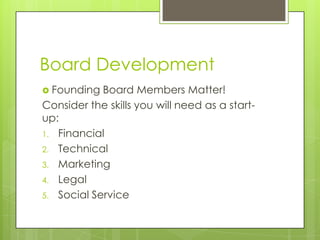
 Founding  Board Members Matter!
Consider the skills you will need as a start-
up:
1. Financial
2. Technical
3. Marketing
4. Legal
5. Social Service
Board Development
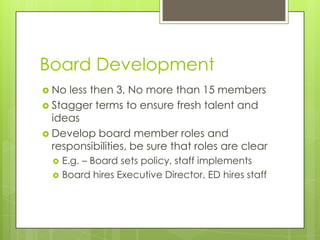
 No less then 3, No more than 15 members
 Stagger terms to ensure fresh talent and
  ideas
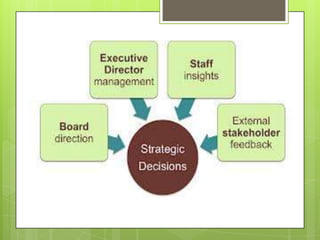
 Develop board member roles and
  responsibilities, be sure that roles are clear
     E.g. – Board sets policy, staff implements
     Board hires Executive Director, ED hires staff
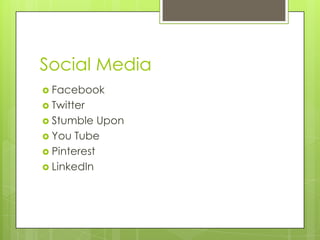
Social Media
 Facebook
 Twitter
 Stumble   Upon
 You Tube
 Pinterest
 LinkedIn
Sign-up for at least one social media site
Develop your daily social media plan
Begin Board Matrix
 Sample   board matrix
The Take-Away
Our course has given you the tools you
need to begin your journey. With a refined
vision, policies and procedures in place, a
fundraising strategy and board in place,
you are ready to serve.

Next steps: Developing programs and
additional revenue streams and next level
strategies.
Call or Email!
 Call   me or email me if you get stuck.

You won’t find this to be an easy road, but I
promise you it will be a fulfilling one!

AskMeg@likefinewine.net

How to start a non profit

  • 1.
    How to Starta Non-Profit… That Matters!
  • 2.
    Week One Defining Non-Profits ResearchingYour Vision Conducting a Needs Assessment Writing a Mission Statement Branding
  • 3.
    About Me  I have been involved in the non-profit world for over 20 years; starting three successful organizations in the aging and health care fields.  I’ve raised over $10,000,000 and served thousands of people.  I currently serve on the Board of Directors of three non-profit organizations.  I love the non-profit world and you will too!
  • 4.
    Our Classroom Please turnoff other technology and try to minimize distractions. This course moves quickly and we cover a lot of ground! Feel free to type in questions as we go through the material. View the material in full-screen mode. While each course is 90 minutes long, there will be time each week to answer questions and talk. Feel free to email me throughout the week if you get stuck or need some encouragement. AskMeg@likefinewine.net
  • 5.
    What Is aNon-Profit?  NPO: An organization in which no owner, stockholder or trustee shares in profits and losses and which exists not to earn revenue but to promote a mission that enhances the public welfare. These organizations are usually eligible for tax- exempt status and can receive tax- deductible contributions.
  • 7.
    Four Characteristics  Mission  Ownership  Control  Accountability
  • 8.
    Your Vision, YourAbilities  What need are you  Do you have the meeting? business skills to run a  Is your mission vital to non-profit? YOUR community?  Are you creative,  Does your vision lend passionate and itself to high quality, persistent? responsive and Collaborative? Driven? unduplicated  Can you inspire others? programs?  Can you communicate  Will you have your vision quickly and adequate facilities? effectively?
  • 9.
    Conducting a Needs Assessment Discover Quantify  Is there another non-profit in  Talk to a sample group of your program space? your intended audience.  Who is your audience?  Talk to other non-profits that Where do they live? How do are providing similar services. they get around? How many  Guidestar people will need your  211 Call Centers service?  Interview leaders in your  What services do they community. currently use?  Search the web.  What are this group’s stated needs and desires?  Use a SWOT analysis.
  • 10.
  • 11.
    1. What isa mission statement? 2. Why is a mission statement important? 3. Constructing a mission statement. 4. Using your mission statement.
  • 12.
     Witha written mission statement BRAND! and a completed needs assessment, your name and brand should be coming into focus. Brainstorm.
  • 13.
    Color. Text onlyor brand mark? What do you want to convey? Fun? Trust? Caring? Using a designer? Logo software?
  • 14.
     Conduct your needs assessment  Begin to refine your mission statement  Brainstorm about your name and brand
  • 15.
     Howto writea mission statement  Sample needs assessment  SWOT analysis
  • 16.
    How to Starta Non-Profit… That Matters!
  • 17.
    Week Two The BusinessPlan By-Laws Policies and Procedures Overview of Legal Filings
  • 18.
    Our Classroom Please turnoff other technology and try to minimize distractions. This course moves quickly and we cover a lot of ground! Feel free to type in questions as we go through the material. View the material in full-screen mode. While each course is 90 minutes long, there will be time each week to answer questions and talk. Feel free to email me throughout the week if you get stuck or need some encouragement. AskMeg@likefinewine.net
  • 19.
    Business Plans The ExecutiveSummary Products and Services Strategy Operations Financials Budget with Revenue Projections
  • 20.
    The Executive Summary Thisexplains very concisely and clearly what the business does or will do.  Include your mission statement, a description of the Board of Directors, types and numbers of employees needed, location of where services will be provided, a description of those services, your funding sources and a summary of the market research you have conducted.
  • 21.
    Products and services What products or services will be provided?  Who is the market?  What differentiates your services from existing services?  What problems do your services address?  What are your objectives?
  • 22.
    Strategy  Include the results of your needs analysis.  Explain the documented need for your service and/or a new need you will address.  Who else provides this service or a similar one?  Who are your clients? Where are they? How many are there?  How will you market your services to this population?
  • 23.
    Organization and Management  Howwill you organize?  Create an organizational chart.  Develop and include staff profiles for the major players.
  • 24.
    Marketing Strategies  How do you plan to communicate with your target audience?  Include an advertising or PR plan.  Include a social networking plan.
  • 25.
    Financials  Where will you get your start-up funding?  Will you be a membership organization?  Include research you have done on grants and special events. Include fundraising goals.  Prepare an annual budget showing revenues and expenses.
  • 26.
    Why?  You will need your business plan to show to donors and foundations that may fund you, to potential board members, and to key volunteers and employees.  The business plan is your compass.  Your business plan is a living document that will grow and change with the organization.
  • 27.
    Policies and Procedures Bylaws Policies  Seesample by-  Conflict of Interest laws in the  Compensation handouts section.  Board Roles and Responsibilities
  • 28.
    Legal Filings State Incorporation FederalTax Exemption Local Operational Filings Fundraising Filings- State by State
  • 29.
    Begin policies andprocedures notebook Do your legal filings
  • 30.
     Sample policiesand procedures forms  Sample by-laws
  • 31.
    How to Starta Non-Profit… That Matters!
  • 32.
    Week Three Developing aFundraising Plan Sources of Funding Special Events
  • 34.
    The Fundraising Plan Develop your goals!  How much money do you need to raise?  What will you use the money for? Overhead, salaries, programs, capital projects, emergency fund?  Develop a plan for EACH goal!
  • 35.
    Fundraising Plan -Costs  Estimate your cost of fundraising.  Your total cost of fundraising should not exceed 23% of your overall operating budget.  Consider postage, website, special event costs, cost of staff and cost of facilities used.
  • 36.
    Fundraising Plan -Timelines  Develop a timeline for your fundraising plan.  Fill in a one year calendar with specific activities.  Then develop timelines for each activity.
  • 37.
    Fundraising Plan –Funding Sources  Can you leverage current sources of income?  Who are the audiences you aren’t tapping?  Should you return to the “well” or try for mass appeal?  Grants?  Can you develop a product or service that will bring in earned income?
  • 38.
    Fundraising - Evaluation Evaluate your plan every three months. How will you evaluate your efforts?  Money raised?  New donors?  Publicity?  What were your success? Where did you miss? What should you change, drop or add?
  • 40.
    Sources of Funding  Grants –  Service recipients Foundationcenter.org  Family and friends  Local  Special Events businesses/corporate  Non-profit coalitions presences  Community Marketing  Community Foundations  Cooperative ventures with established non- profits
  • 41.
    Be: A heartfelt connector Abeneficiary builder A member motivator
  • 43.
    Special Events  Galas Runs and Walks  Golf Events  Product Sales  Individual House Events  Fashion Shows  Restaurant Nights/Happy Hours
  • 44.
    Week Four In theCommunity Board Development Social Media Connecting with other organization
  • 45.
    Board Development  Founding Board Members Matter! Consider the skills you will need as a start- up: 1. Financial 2. Technical 3. Marketing 4. Legal 5. Social Service
  • 46.
    Board Development  Noless then 3, No more than 15 members  Stagger terms to ensure fresh talent and ideas  Develop board member roles and responsibilities, be sure that roles are clear  E.g. – Board sets policy, staff implements  Board hires Executive Director, ED hires staff
  • 48.
    Social Media  Facebook Twitter  Stumble Upon  You Tube  Pinterest  LinkedIn
  • 49.
    Sign-up for atleast one social media site Develop your daily social media plan Begin Board Matrix
  • 50.
     Sample board matrix
  • 51.
    The Take-Away Our coursehas given you the tools you need to begin your journey. With a refined vision, policies and procedures in place, a fundraising strategy and board in place, you are ready to serve. Next steps: Developing programs and additional revenue streams and next level strategies.
  • 52.
    Call or Email! Call me or email me if you get stuck. You won’t find this to be an easy road, but I promise you it will be a fulfilling one! AskMeg@likefinewine.net