How to Present Your Project Topic Proposal Effectively
Outline
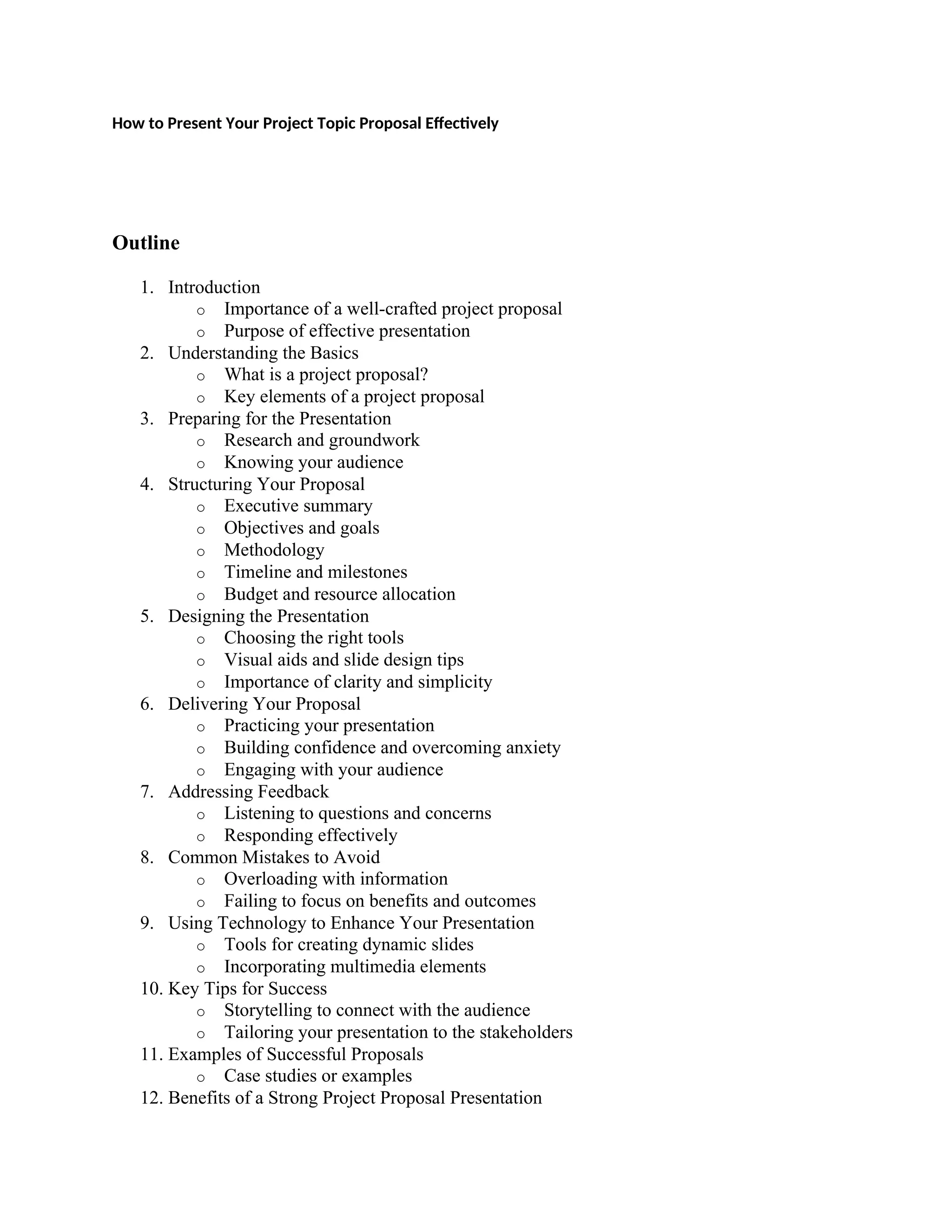
1. Introduction
o Importance of a well-crafted project proposal
o Purpose of effective presentation
2. Understanding the Basics
o What is a project proposal?
o Key elements of a project proposal
3. Preparing for the Presentation
o Research and groundwork
o Knowing your audience
4. Structuring Your Proposal
o Executive summary
o Objectives and goals
o Methodology
o Timeline and milestones
o Budget and resource allocation
5. Designing the Presentation
o Choosing the right tools
o Visual aids and slide design tips
o Importance of clarity and simplicity
6. Delivering Your Proposal
o Practicing your presentation
o Building confidence and overcoming anxiety
o Engaging with your audience
7. Addressing Feedback
o Listening to questions and concerns
o Responding effectively
8. Common Mistakes to Avoid
o Overloading with information
o Failing to focus on benefits and outcomes
9. Using Technology to Enhance Your Presentation
o Tools for creating dynamic slides
o Incorporating multimedia elements
10. Key Tips for Success
o Storytelling to connect with the audience
o Tailoring your presentation to the stakeholders
11. Examples of Successful Proposals
o Case studies or examples
12. Benefits of a Strong Project Proposal Presentation
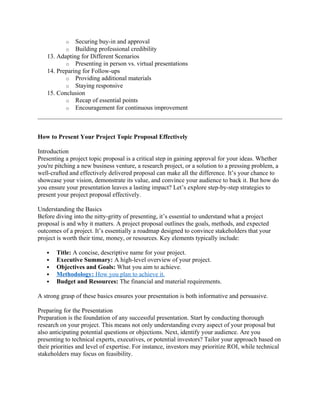
o Securing buy-in and approval
o Building professional credibility
13. Adapting for Different Scenarios
o Presenting in person vs. virtual presentations
14. Preparing for Follow-ups
o Providing additional materials
o Staying responsive
15. Conclusion
o Recap of essential points
o Encouragement for continuous improvement
How to Present Your Project Topic Proposal Effectively
Introduction
Presenting a project topic proposal is a critical step in gaining approval for your ideas. Whether
you're pitching a new business venture, a research project, or a solution to a pressing problem, a
well-crafted and effectively delivered proposal can make all the difference. It’s your chance to
showcase your vision, demonstrate its value, and convince your audience to back it. But how do
you ensure your presentation leaves a lasting impact? Let’s explore step-by-step strategies to
present your project proposal effectively.
Understanding the Basics
Before diving into the nitty-gritty of presenting, it’s essential to understand what a project
proposal is and why it matters. A project proposal outlines the goals, methods, and expected
outcomes of a project. It’s essentially a roadmap designed to convince stakeholders that your
project is worth their time, money, or resources. Key elements typically include:
 Title: A concise, descriptive name for your project.
 Executive Summary: A high-level overview of your project.
 Objectives and Goals: What you aim to achieve.
 Methodology: How you plan to achieve it.
 Budget and Resources: The financial and material requirements.
A strong grasp of these basics ensures your presentation is both informative and persuasive.
Preparing for the Presentation
Preparation is the foundation of any successful presentation. Start by conducting thorough
research on your project. This means not only understanding every aspect of your proposal but
also anticipating potential questions or objections. Next, identify your audience. Are you
presenting to technical experts, executives, or potential investors? Tailor your approach based on
their priorities and level of expertise. For instance, investors may prioritize ROI, while technical
stakeholders may focus on feasibility.
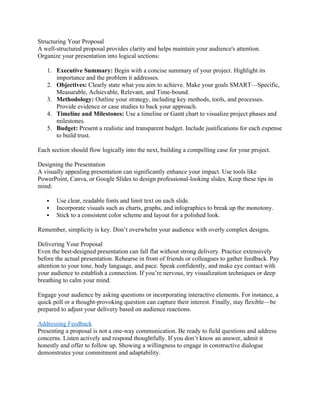
Structuring Your Proposal
A well-structured proposal provides clarity and helps maintain your audience's attention.
Organize your presentation into logical sections:
1. Executive Summary: Begin with a concise summary of your project. Highlight its
importance and the problem it addresses.
2. Objectives: Clearly state what you aim to achieve. Make your goals SMART—Specific,
Measurable, Achievable, Relevant, and Time-bound.
3. Methodology: Outline your strategy, including key methods, tools, and processes.
Provide evidence or case studies to back your approach.
4. Timeline and Milestones: Use a timeline or Gantt chart to visualize project phases and
milestones.
5. Budget: Present a realistic and transparent budget. Include justifications for each expense
to build trust.
Each section should flow logically into the next, building a compelling case for your project.
Designing the Presentation
A visually appealing presentation can significantly enhance your impact. Use tools like
PowerPoint, Canva, or Google Slides to design professional-looking slides. Keep these tips in
mind:
 Use clear, readable fonts and limit text on each slide.
 Incorporate visuals such as charts, graphs, and infographics to break up the monotony.
 Stick to a consistent color scheme and layout for a polished look.
Remember, simplicity is key. Don’t overwhelm your audience with overly complex designs.
Delivering Your Proposal
Even the best-designed presentation can fall flat without strong delivery. Practice extensively
before the actual presentation. Rehearse in front of friends or colleagues to gather feedback. Pay
attention to your tone, body language, and pace. Speak confidently, and make eye contact with
your audience to establish a connection. If you’re nervous, try visualization techniques or deep
breathing to calm your mind.
Engage your audience by asking questions or incorporating interactive elements. For instance, a
quick poll or a thought-provoking question can capture their interest. Finally, stay flexible—be
prepared to adjust your delivery based on audience reactions.
Addressing Feedback
Presenting a proposal is not a one-way communication. Be ready to field questions and address
concerns. Listen actively and respond thoughtfully. If you don’t know an answer, admit it
honestly and offer to follow up. Showing a willingness to engage in constructive dialogue
demonstrates your commitment and adaptability.
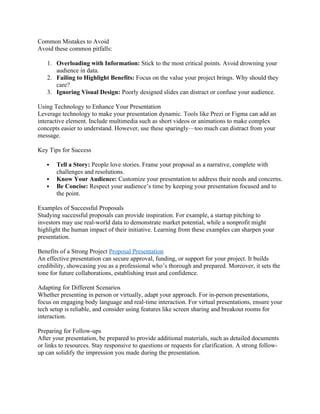
Common Mistakes to Avoid
Avoid these common pitfalls:
1. Overloading with Information: Stick to the most critical points. Avoid drowning your
audience in data.
2. Failing to Highlight Benefits: Focus on the value your project brings. Why should they
care?
3. Ignoring Visual Design: Poorly designed slides can distract or confuse your audience.
Using Technology to Enhance Your Presentation
Leverage technology to make your presentation dynamic. Tools like Prezi or Figma can add an
interactive element. Include multimedia such as short videos or animations to make complex
concepts easier to understand. However, use these sparingly—too much can distract from your
message.
Key Tips for Success
 Tell a Story: People love stories. Frame your proposal as a narrative, complete with
challenges and resolutions.
 Know Your Audience: Customize your presentation to address their needs and concerns.
 Be Concise: Respect your audience’s time by keeping your presentation focused and to
the point.
Examples of Successful Proposals
Studying successful proposals can provide inspiration. For example, a startup pitching to
investors may use real-world data to demonstrate market potential, while a nonprofit might
highlight the human impact of their initiative. Learning from these examples can sharpen your
presentation.
Benefits of a Strong Project Proposal Presentation
An effective presentation can secure approval, funding, or support for your project. It builds
credibility, showcasing you as a professional who’s thorough and prepared. Moreover, it sets the
tone for future collaborations, establishing trust and confidence.
Adapting for Different Scenarios
Whether presenting in person or virtually, adapt your approach. For in-person presentations,
focus on engaging body language and real-time interaction. For virtual presentations, ensure your
tech setup is reliable, and consider using features like screen sharing and breakout rooms for
interaction.
Preparing for Follow-ups
After your presentation, be prepared to provide additional materials, such as detailed documents
or links to resources. Stay responsive to questions or requests for clarification. A strong follow-
up can solidify the impression you made during the presentation.
Conclusion
Presenting a project proposal effectively is both an art and a science. It requires careful planning,
clear communication, and a focus on your audience’s needs. By structuring your presentation
well, designing it thoughtfully, and delivering it confidently, you can make a powerful case for
your project. Remember, every presentation is an opportunity to refine your skills and leave a
lasting impression. So go ahead—craft that proposal, step onto the stage, and own the moment!

How to Present Your Project Topic Proposal Effectively.docx

  • 1.
    How to PresentYour Project Topic Proposal Effectively Outline 1. Introduction o Importance of a well-crafted project proposal o Purpose of effective presentation 2. Understanding the Basics o What is a project proposal? o Key elements of a project proposal 3. Preparing for the Presentation o Research and groundwork o Knowing your audience 4. Structuring Your Proposal o Executive summary o Objectives and goals o Methodology o Timeline and milestones o Budget and resource allocation 5. Designing the Presentation o Choosing the right tools o Visual aids and slide design tips o Importance of clarity and simplicity 6. Delivering Your Proposal o Practicing your presentation o Building confidence and overcoming anxiety o Engaging with your audience 7. Addressing Feedback o Listening to questions and concerns o Responding effectively 8. Common Mistakes to Avoid o Overloading with information o Failing to focus on benefits and outcomes 9. Using Technology to Enhance Your Presentation o Tools for creating dynamic slides o Incorporating multimedia elements 10. Key Tips for Success o Storytelling to connect with the audience o Tailoring your presentation to the stakeholders 11. Examples of Successful Proposals o Case studies or examples 12. Benefits of a Strong Project Proposal Presentation
  • 2.
    o Securing buy-inand approval o Building professional credibility 13. Adapting for Different Scenarios o Presenting in person vs. virtual presentations 14. Preparing for Follow-ups o Providing additional materials o Staying responsive 15. Conclusion o Recap of essential points o Encouragement for continuous improvement How to Present Your Project Topic Proposal Effectively Introduction Presenting a project topic proposal is a critical step in gaining approval for your ideas. Whether you're pitching a new business venture, a research project, or a solution to a pressing problem, a well-crafted and effectively delivered proposal can make all the difference. It’s your chance to showcase your vision, demonstrate its value, and convince your audience to back it. But how do you ensure your presentation leaves a lasting impact? Let’s explore step-by-step strategies to present your project proposal effectively. Understanding the Basics Before diving into the nitty-gritty of presenting, it’s essential to understand what a project proposal is and why it matters. A project proposal outlines the goals, methods, and expected outcomes of a project. It’s essentially a roadmap designed to convince stakeholders that your project is worth their time, money, or resources. Key elements typically include:  Title: A concise, descriptive name for your project.  Executive Summary: A high-level overview of your project.  Objectives and Goals: What you aim to achieve.  Methodology: How you plan to achieve it.  Budget and Resources: The financial and material requirements. A strong grasp of these basics ensures your presentation is both informative and persuasive. Preparing for the Presentation Preparation is the foundation of any successful presentation. Start by conducting thorough research on your project. This means not only understanding every aspect of your proposal but also anticipating potential questions or objections. Next, identify your audience. Are you presenting to technical experts, executives, or potential investors? Tailor your approach based on their priorities and level of expertise. For instance, investors may prioritize ROI, while technical stakeholders may focus on feasibility.
  • 3.
    Structuring Your Proposal Awell-structured proposal provides clarity and helps maintain your audience's attention. Organize your presentation into logical sections: 1. Executive Summary: Begin with a concise summary of your project. Highlight its importance and the problem it addresses. 2. Objectives: Clearly state what you aim to achieve. Make your goals SMART—Specific, Measurable, Achievable, Relevant, and Time-bound. 3. Methodology: Outline your strategy, including key methods, tools, and processes. Provide evidence or case studies to back your approach. 4. Timeline and Milestones: Use a timeline or Gantt chart to visualize project phases and milestones. 5. Budget: Present a realistic and transparent budget. Include justifications for each expense to build trust. Each section should flow logically into the next, building a compelling case for your project. Designing the Presentation A visually appealing presentation can significantly enhance your impact. Use tools like PowerPoint, Canva, or Google Slides to design professional-looking slides. Keep these tips in mind:  Use clear, readable fonts and limit text on each slide.  Incorporate visuals such as charts, graphs, and infographics to break up the monotony.  Stick to a consistent color scheme and layout for a polished look. Remember, simplicity is key. Don’t overwhelm your audience with overly complex designs. Delivering Your Proposal Even the best-designed presentation can fall flat without strong delivery. Practice extensively before the actual presentation. Rehearse in front of friends or colleagues to gather feedback. Pay attention to your tone, body language, and pace. Speak confidently, and make eye contact with your audience to establish a connection. If you’re nervous, try visualization techniques or deep breathing to calm your mind. Engage your audience by asking questions or incorporating interactive elements. For instance, a quick poll or a thought-provoking question can capture their interest. Finally, stay flexible—be prepared to adjust your delivery based on audience reactions. Addressing Feedback Presenting a proposal is not a one-way communication. Be ready to field questions and address concerns. Listen actively and respond thoughtfully. If you don’t know an answer, admit it honestly and offer to follow up. Showing a willingness to engage in constructive dialogue demonstrates your commitment and adaptability.
  • 4.
    Common Mistakes toAvoid Avoid these common pitfalls: 1. Overloading with Information: Stick to the most critical points. Avoid drowning your audience in data. 2. Failing to Highlight Benefits: Focus on the value your project brings. Why should they care? 3. Ignoring Visual Design: Poorly designed slides can distract or confuse your audience. Using Technology to Enhance Your Presentation Leverage technology to make your presentation dynamic. Tools like Prezi or Figma can add an interactive element. Include multimedia such as short videos or animations to make complex concepts easier to understand. However, use these sparingly—too much can distract from your message. Key Tips for Success  Tell a Story: People love stories. Frame your proposal as a narrative, complete with challenges and resolutions.  Know Your Audience: Customize your presentation to address their needs and concerns.  Be Concise: Respect your audience’s time by keeping your presentation focused and to the point. Examples of Successful Proposals Studying successful proposals can provide inspiration. For example, a startup pitching to investors may use real-world data to demonstrate market potential, while a nonprofit might highlight the human impact of their initiative. Learning from these examples can sharpen your presentation. Benefits of a Strong Project Proposal Presentation An effective presentation can secure approval, funding, or support for your project. It builds credibility, showcasing you as a professional who’s thorough and prepared. Moreover, it sets the tone for future collaborations, establishing trust and confidence. Adapting for Different Scenarios Whether presenting in person or virtually, adapt your approach. For in-person presentations, focus on engaging body language and real-time interaction. For virtual presentations, ensure your tech setup is reliable, and consider using features like screen sharing and breakout rooms for interaction. Preparing for Follow-ups After your presentation, be prepared to provide additional materials, such as detailed documents or links to resources. Stay responsive to questions or requests for clarification. A strong follow- up can solidify the impression you made during the presentation.
  • 5.
    Conclusion Presenting a projectproposal effectively is both an art and a science. It requires careful planning, clear communication, and a focus on your audience’s needs. By structuring your presentation well, designing it thoughtfully, and delivering it confidently, you can make a powerful case for your project. Remember, every presentation is an opportunity to refine your skills and leave a lasting impression. So go ahead—craft that proposal, step onto the stage, and own the moment!