Insights into Proposal writing
Based on the Book Persuasive Business Proposals
-By Tom Sant
Presented By: Pankaj wadhwa
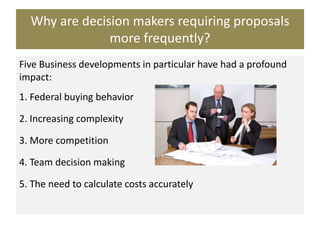
Why are decision makers requiring proposals
more frequently?
Five Business developments in particular have had a profound
impact:
1. Federal buying behavior
2. Increasing complexity
3. More competition
4. Team decision making
5. The need to calculate costs accurately
Food for Thought
.
Challenges we face while writing proposals
• How to begin?
• How to organize information and ideas?
• Which format to use?
• The pattern to follow?
• The details to include?
Proposal Cloning/Data Dump/graveyard
The deadly sins of proposal writing
1. Failure to focus on client’s business problems and payoffs-
the content sounds generic
2. No persuasive structure – the proposal is an “information
dump”
3. No clear differentiation of this vendor compared to others.
4. Failure to offer a compelling value proposition
5. Key points are buried – no impact, no highlighting.
6. Difficult to read because they are full of jargon, too long, or
too technical.
7. Credibility Killers – misspellings, grammar and punctuation
errors, use of wrong client’s name, inconsistent formats, and
similar mistakes.
So……what is a good proposal?
Before we define what a proposal is, let’s make sure we know
what it’s not:
1. It’s not a price quote
2. It’s not a bill of materials, project plan or scope of work.
3. It’s not the company history, either.
What is a good proposal?
Here’s the bottom line –
Q: What is a proposal?
A: It’s a Sales document
Q: What is it’s job?
A: To move the sales process towards closure.
• To do the proposal job writing well we need to ensure that
the proposal we write is:
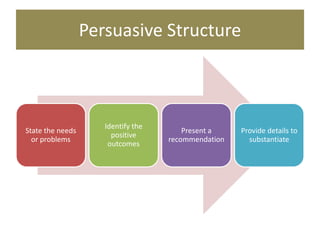
Persuasive Structure
State the needs
or problems
Identify the
positive
outcomes
Present a
recommendation
Provide details to
substantiate
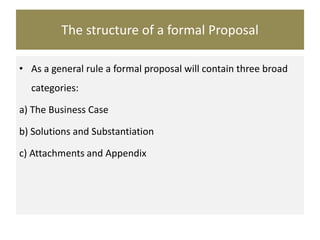
The structure of a formal Proposal
• As a general rule a formal proposal will contain three broad
categories:
a) The Business Case
b) Solutions and Substantiation
c) Attachments and Appendix
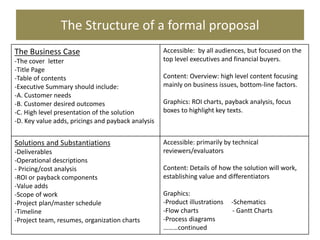
The Structure of a formal proposal
The Business Case
-The cover letter
-Title Page
-Table of contents
-Executive Summary should include:
-A. Customer needs
-B. Customer desired outcomes
-C. High level presentation of the solution
-D. Key value adds, pricings and payback analysis
Accessible: by all audiences, but focused on the
top level executives and financial buyers.
Content: Overview: high level content focusing
mainly on business issues, bottom-line factors.
Graphics: ROI charts, payback analysis, focus
boxes to highlight key texts.
Solutions and Substantiations
-Deliverables
-Operational descriptions
- Pricing/cost analysis
-ROI or payback components
-Value adds
-Scope of work
-Project plan/master schedule
-Timeline
-Project team, resumes, organization charts
Accessible: primarily by technical
reviewers/evaluators
Content: Details of how the solution will work,
establishing value and differentiators
Graphics:
-Product illustrations -Schematics
-Flow charts - Gantt Charts
-Process diagrams
………continued
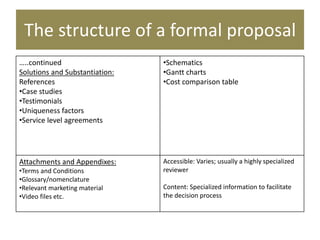
The structure of a formal proposal
…..continued
Solutions and Substantiation:
References
•Case studies
•Testimonials
•Uniqueness factors
•Service level agreements
•Schematics
•Gantt charts
•Cost comparison table
Attachments and Appendixes:
•Terms and Conditions
•Glossary/nomenclature
•Relevant marketing material
•Video files etc.
Accessible: Varies; usually a highly specialized
reviewer
Content: Specialized information to facilitate
the decision process
The Structure of formal proposal
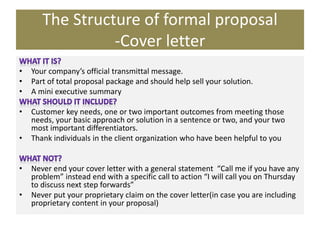
-Cover letter
• Your company’s official transmittal message.
• Part of total proposal package and should help sell your solution.
• A mini executive summary
• Customer key needs, one or two important outcomes from meeting those
needs, your basic approach or solution in a sentence or two, and your two
most important differentiators.
• Thank individuals in the client organization who have been helpful to you
• Never end your cover letter with a general statement “Call me if you have any
problem” instead end with a specific call to action “I will call you on Thursday
to discuss next step forwards”
• Never put your proprietary claim on the cover letter(in case you are including
proprietary content in your proposal)
The Structure of formal proposal
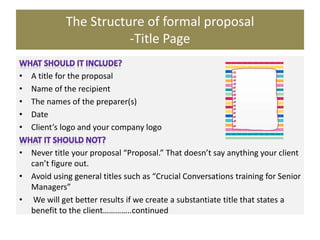
-Title Page
• A title for the proposal
• Name of the recipient
• The names of the preparer(s)
• Date
• Client’s logo and your company logo
• Never title your proposal “Proposal.” That doesn’t say anything your client
can’t figure out.
• Avoid using general titles such as “Crucial Conversations training for Senior
Managers”
• We will get better results if we create a substantiate title that states a
benefit to the client…………..continued
The Structure of formal proposal
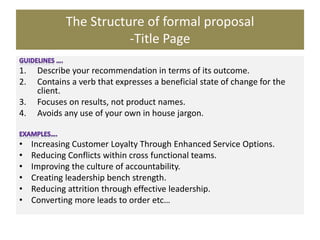
-Title Page
1. Describe your recommendation in terms of its outcome.
2. Contains a verb that expresses a beneficial state of change for the
client.
3. Focuses on results, not product names.
4. Avoids any use of your own in house jargon.
• Increasing Customer Loyalty Through Enhanced Service Options.
• Reducing Conflicts within cross functional teams.
• Improving the culture of accountability.
• Creating leadership bench strength.
• Reducing attrition through effective leadership.
• Converting more leads to order etc…
The structure of the formal proposal
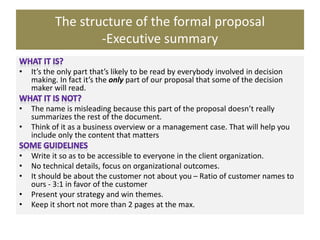
-Executive summary
• It’s the only part that’s likely to be read by everybody involved in decision
making. In fact it’s the only part of our proposal that some of the decision
maker will read.
• The name is misleading because this part of the proposal doesn’t really
summarizes the rest of the document.
• Think of it as a business overview or a management case. That will help you
include only the content that matters
• Write it so as to be accessible to everyone in the client organization.
• No technical details, focus on organizational outcomes.
• It should be about the customer not about you – Ratio of customer names to
ours - 3:1 in favor of the customer
• Present your strategy and win themes.
• Keep it short not more than 2 pages at the max.
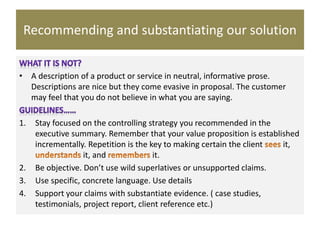
Recommending and substantiating our solution
• A description of a product or service in neutral, informative prose.
Descriptions are nice but they come evasive in proposal. The customer
may feel that you do not believe in what you are saying.
1. Stay focused on the controlling strategy you recommended in the
executive summary. Remember that your value proposition is established
incrementally. Repetition is the key to making certain the client it,
it, and it.
2. Be objective. Don’t use wild superlatives or unsupported claims.
3. Use specific, concrete language. Use details
4. Support your claims with substantiate evidence. ( case studies,
testimonials, project report, client reference etc.)
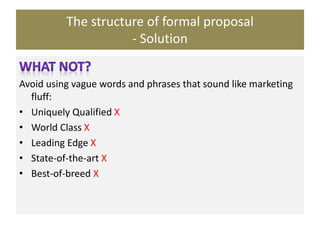
The structure of formal proposal
- Solution
Avoid using vague words and phrases that sound like marketing
fluff:
• Uniquely Qualified X
• World Class X
• Leading Edge X
• State-of-the-art X
• Best-of-breed X
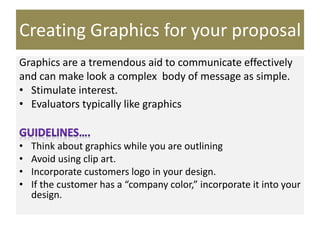
Creating Graphics for your proposal
Graphics are a tremendous aid to communicate effectively
and can make look a complex body of message as simple.
• Stimulate interest.
• Evaluators typically like graphics
• Think about graphics while you are outlining
• Avoid using clip art.
• Incorporate customers logo in your design.
• If the customer has a “company color,” incorporate it into your
design.
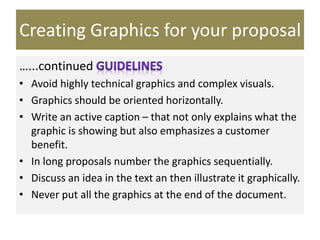
Creating Graphics for your proposal
…...continued
• Avoid highly technical graphics and complex visuals.
• Graphics should be oriented horizontally.
• Write an active caption – that not only explains what the
graphic is showing but also emphasizes a customer
benefit.
• In long proposals number the graphics sequentially.
• Discuss an idea in the text an then illustrate it graphically.
• Never put all the graphics at the end of the document.
Presenting your price
• Introduce price only after the solution and it’s potential
impact.
• Don’t talk about price in the first and the last paragraph of
the cover letter.
• State the price in smallest logical unit - $ 3000 per month
instead of $ 36000 per year.
• If you have the facts, quantify the impact of your solutions.
• Avoid presenting detailed pricing on an item-by-item basis.
It can encourage the customer to shop your proposal to
your customer.
Follow up
Follow up – isn’t only a confirmation call
• Do check following:
A. Ask about the evaluation process
B. Decision time frame
C. People involved in making a decision.
D. Do win-loss analysis
Few Important Tips
• Link the customer needs to your solution.
• Use short and simple sentences.
• GYST( Get your stuff together – take time to gather data, need
identification and suggestive solutions)
• Avoid passive voice - It is generally used to express bad news
and a language of non responsibility
• Watch your words…use everyday language, which is easy to
understand.
Continued……
……..Continued
• Avoid using technical language
• Preferably use Table of contents
• Use strong close - In mails, cover letter, executive summary
• Follow 3: 1 rule
• Make sure you review at the end before sending( spelling and
punctuation, No errors of fact, data or content, structure,
KISS)
• Address the needs of evaluators, users, decision makers
Few Important Tips
• Give a

Proposal writing

  • 1.
    Insights into Proposalwriting Based on the Book Persuasive Business Proposals -By Tom Sant Presented By: Pankaj wadhwa
  • 2.
    Why are decisionmakers requiring proposals more frequently? Five Business developments in particular have had a profound impact: 1. Federal buying behavior 2. Increasing complexity 3. More competition 4. Team decision making 5. The need to calculate costs accurately
  • 3.
  • 4.
  • 5.
    Challenges we facewhile writing proposals • How to begin? • How to organize information and ideas? • Which format to use? • The pattern to follow? • The details to include? Proposal Cloning/Data Dump/graveyard
  • 6.
    The deadly sinsof proposal writing 1. Failure to focus on client’s business problems and payoffs- the content sounds generic 2. No persuasive structure – the proposal is an “information dump” 3. No clear differentiation of this vendor compared to others. 4. Failure to offer a compelling value proposition 5. Key points are buried – no impact, no highlighting. 6. Difficult to read because they are full of jargon, too long, or too technical. 7. Credibility Killers – misspellings, grammar and punctuation errors, use of wrong client’s name, inconsistent formats, and similar mistakes.
  • 7.
    So……what is agood proposal? Before we define what a proposal is, let’s make sure we know what it’s not: 1. It’s not a price quote 2. It’s not a bill of materials, project plan or scope of work. 3. It’s not the company history, either.
  • 8.
    What is agood proposal? Here’s the bottom line – Q: What is a proposal? A: It’s a Sales document Q: What is it’s job? A: To move the sales process towards closure. • To do the proposal job writing well we need to ensure that the proposal we write is:
  • 9.
    Persuasive Structure State theneeds or problems Identify the positive outcomes Present a recommendation Provide details to substantiate
  • 10.
    The structure ofa formal Proposal • As a general rule a formal proposal will contain three broad categories: a) The Business Case b) Solutions and Substantiation c) Attachments and Appendix
  • 11.
    The Structure ofa formal proposal The Business Case -The cover letter -Title Page -Table of contents -Executive Summary should include: -A. Customer needs -B. Customer desired outcomes -C. High level presentation of the solution -D. Key value adds, pricings and payback analysis Accessible: by all audiences, but focused on the top level executives and financial buyers. Content: Overview: high level content focusing mainly on business issues, bottom-line factors. Graphics: ROI charts, payback analysis, focus boxes to highlight key texts. Solutions and Substantiations -Deliverables -Operational descriptions - Pricing/cost analysis -ROI or payback components -Value adds -Scope of work -Project plan/master schedule -Timeline -Project team, resumes, organization charts Accessible: primarily by technical reviewers/evaluators Content: Details of how the solution will work, establishing value and differentiators Graphics: -Product illustrations -Schematics -Flow charts - Gantt Charts -Process diagrams ………continued
  • 12.
    The structure ofa formal proposal …..continued Solutions and Substantiation: References •Case studies •Testimonials •Uniqueness factors •Service level agreements •Schematics •Gantt charts •Cost comparison table Attachments and Appendixes: •Terms and Conditions •Glossary/nomenclature •Relevant marketing material •Video files etc. Accessible: Varies; usually a highly specialized reviewer Content: Specialized information to facilitate the decision process
  • 13.
    The Structure offormal proposal -Cover letter • Your company’s official transmittal message. • Part of total proposal package and should help sell your solution. • A mini executive summary • Customer key needs, one or two important outcomes from meeting those needs, your basic approach or solution in a sentence or two, and your two most important differentiators. • Thank individuals in the client organization who have been helpful to you • Never end your cover letter with a general statement “Call me if you have any problem” instead end with a specific call to action “I will call you on Thursday to discuss next step forwards” • Never put your proprietary claim on the cover letter(in case you are including proprietary content in your proposal)
  • 14.
    The Structure offormal proposal -Title Page • A title for the proposal • Name of the recipient • The names of the preparer(s) • Date • Client’s logo and your company logo • Never title your proposal “Proposal.” That doesn’t say anything your client can’t figure out. • Avoid using general titles such as “Crucial Conversations training for Senior Managers” • We will get better results if we create a substantiate title that states a benefit to the client…………..continued
  • 15.
    The Structure offormal proposal -Title Page 1. Describe your recommendation in terms of its outcome. 2. Contains a verb that expresses a beneficial state of change for the client. 3. Focuses on results, not product names. 4. Avoids any use of your own in house jargon. • Increasing Customer Loyalty Through Enhanced Service Options. • Reducing Conflicts within cross functional teams. • Improving the culture of accountability. • Creating leadership bench strength. • Reducing attrition through effective leadership. • Converting more leads to order etc…
  • 16.
    The structure ofthe formal proposal -Executive summary • It’s the only part that’s likely to be read by everybody involved in decision making. In fact it’s the only part of our proposal that some of the decision maker will read. • The name is misleading because this part of the proposal doesn’t really summarizes the rest of the document. • Think of it as a business overview or a management case. That will help you include only the content that matters • Write it so as to be accessible to everyone in the client organization. • No technical details, focus on organizational outcomes. • It should be about the customer not about you – Ratio of customer names to ours - 3:1 in favor of the customer • Present your strategy and win themes. • Keep it short not more than 2 pages at the max.
  • 17.
    Recommending and substantiatingour solution • A description of a product or service in neutral, informative prose. Descriptions are nice but they come evasive in proposal. The customer may feel that you do not believe in what you are saying. 1. Stay focused on the controlling strategy you recommended in the executive summary. Remember that your value proposition is established incrementally. Repetition is the key to making certain the client it, it, and it. 2. Be objective. Don’t use wild superlatives or unsupported claims. 3. Use specific, concrete language. Use details 4. Support your claims with substantiate evidence. ( case studies, testimonials, project report, client reference etc.)
  • 18.
    The structure offormal proposal - Solution Avoid using vague words and phrases that sound like marketing fluff: • Uniquely Qualified X • World Class X • Leading Edge X • State-of-the-art X • Best-of-breed X
  • 19.
    Creating Graphics foryour proposal Graphics are a tremendous aid to communicate effectively and can make look a complex body of message as simple. • Stimulate interest. • Evaluators typically like graphics • Think about graphics while you are outlining • Avoid using clip art. • Incorporate customers logo in your design. • If the customer has a “company color,” incorporate it into your design.
  • 20.
    Creating Graphics foryour proposal …...continued • Avoid highly technical graphics and complex visuals. • Graphics should be oriented horizontally. • Write an active caption – that not only explains what the graphic is showing but also emphasizes a customer benefit. • In long proposals number the graphics sequentially. • Discuss an idea in the text an then illustrate it graphically. • Never put all the graphics at the end of the document.
  • 21.
    Presenting your price •Introduce price only after the solution and it’s potential impact. • Don’t talk about price in the first and the last paragraph of the cover letter. • State the price in smallest logical unit - $ 3000 per month instead of $ 36000 per year. • If you have the facts, quantify the impact of your solutions. • Avoid presenting detailed pricing on an item-by-item basis. It can encourage the customer to shop your proposal to your customer.
  • 22.
    Follow up Follow up– isn’t only a confirmation call • Do check following: A. Ask about the evaluation process B. Decision time frame C. People involved in making a decision. D. Do win-loss analysis
  • 23.
    Few Important Tips •Link the customer needs to your solution. • Use short and simple sentences. • GYST( Get your stuff together – take time to gather data, need identification and suggestive solutions) • Avoid passive voice - It is generally used to express bad news and a language of non responsibility • Watch your words…use everyday language, which is easy to understand. Continued……
  • 24.
    ……..Continued • Avoid usingtechnical language • Preferably use Table of contents • Use strong close - In mails, cover letter, executive summary • Follow 3: 1 rule • Make sure you review at the end before sending( spelling and punctuation, No errors of fact, data or content, structure, KISS) • Address the needs of evaluators, users, decision makers Few Important Tips
  • 25.