How To Improve
Your Memory For Students
Study Less But Still Ace Your Classes
By Johnny Briones
Grandmaster of Memory
Copyright © 2015-2016 John Briones: Master Your Memory, LLC with all rights
reserved. It is illegal to copy, distribute, or create derivative works from this book in
whole or in part or to contribute to the copying, distribution, or creating of derivative
works of this book.
Dedication
For my mom who has always showed
me how to get anything done even if I didn’t
want to.
Love you.
Table of Contents
Preface
Introduction: The Days Of School Being A Pain Are Over
Mastering The Basics
3 Keys To Memory
Imagination
Location
Concentration
Story Method
Simple Number Systems
Number Rhyme System
Number Shape System
The Alphabet Systems
Alphabet Rhyme System
Alphabet Letter System
Journey Method
Briones Double Digit System
Conclusion On The Basics
Applications Of The Basics
How To Remember Vocabulary
How To Learn Spanish
(And Other Letter Based Languages)
How To Learn Chinese (And Other Symbol Based Languages)
How To Give Speeches And Presentations Form Memory
How To Remember Historical Dates
How To Remember Equations
How To Remember Passwords
How To Remember Names
How To Remember Your Schedule
Conclusion On Applications
Conclusion
Memory Program
Preface
Quickly! Memorize the following digits in 20 seconds:
003982430831917043644013 Could you do it? Well if you are like most people, you
would think I am crazy for asking and think it’s impossible for you, if not everyone, to
do it. The truth is that you are capable of learning those 24 digits in 20 seconds: Believe
it or not!
My name is Johnny Briones and I am a Grandmaster of Memory. I teach
students how to improve their memory so they can study less and still ace their classes.
Many students think they are doomed to get poor grades and the student who do get good
grades are just smart. This is far from true. But also most students don’t believe they can
improve their memory. This is also not true! You are going to learn that getting good
grades and improving your memory is actually easy!
The 24 digit I gave you above is a piece of cake for me. My personal best for a
certain event is memorizing 80 digits in 40 seconds! But I am not a memory genius or a
memory savant. I am just a normal person with a normal memory that figured out how to
improve my memory to amazing extents. I have broken US memory records, been on a
game show in China, and I am the youngest American to achieve the title of Grandmaster
of Memory at the age of 19 years old. I was also the valedictorian and student of the
year in my high school. And believe me, I didn’t like school or find it easy at all until I
improved my memory.
But the best thing about having a good memory is you have the ability to learn
anything you want quickly, remember it for years, and recall it at a moment’s notice. I
was able to breeze through school easily! While all of my friends where studying, being
stressed, and worried, do you know what I was doing? Playing games, watching shows,
doing my hobbies, and pretty much anything I wanted!
Improving your memory is the most important thing you can do as a student
because you will be learning information all through school and you don’t want to spend
all of your time studying, right? You don’t want to spend all your time doing school
related work! This book is going to change your life and help make school a piece of
cake. You will be able to improve your memory to superhuman levels and learn things
so quickly people will think you are superhuman!
For me I always had the mind set of: If I could memorize a deck of cards under
a minute, then learning 20 vocabulary words pretty easily. Don’t worry this book is all
about how to use my different methods, techniques, and systems to remember all sorts of
school material. You will be wondering why you never learned this stuff in school!
I also create a video program on how to improve your memory called Acing
College Memory Program. You NEED to have this program if you are a student! This
memory program keeps getting updated with new systems and methods that I figure out.
Plus you get to ask me questions and get explanations directly from me. If you are
interested you can see it by clicking here. And since you got this ebook, I am going to
give you a discount on the program. How does that sound! But it is limited for only a
certain amount of time so make sure you act now!
Also if you want to stay connected, see videos, and see what I am up to, you
can go to my YouTube channel and subscribe to stay in touch by clicking here! Also,
you can follow me on Twitter: Johnny Briones
Go through this book as fast as you can because you will be eager to start using
what you learn so you can show school who’s the boss! I want you to have success in
school like I did. I studied less then everyone one else in college and high school, but I
still manage to get better grades than all of them. You can get the same results! What are
you waiting for? Start reading!
Introduction: The Days Of School Being
A Pain Are Over
“You will have a test on the American Revolution next Wednesday so make sure
you study.” Then in your next class, “You will have a test on the periodic table of
elements next Thursday and this test will be a hard one so study.” Don’t you hate this!
By the time you go through all of your classes, your next week is full of tests. So what
does your weekend look like? Studying. Studying. Studying.
You swear all the teachers got together and planned to ruin your weekend with
all of these tests! You now have no other choice but to study all weekend while you
wish you could be doing anything else than studying. How much time do you end up
study for? 8 hours? 12 hours? 20+ hours? I had a friend that studied for 8+ hours for
only one test! That is a lot of studying for one test wouldn’t you say?
Don’t think that your weekend is just ruined because you always have to be
studying for school if it’s for quizzes, presentations, projects, or homework on a daily
basis. Just think about how much time you actually spend studying. What could you be
doing instead of studying all that time? Well you could hang out with friends/family, go
to concerts, parties, do sports, clubs, volunteer, or sleep (just to name a few)! There are
more important things to be doing than spending all your time study for school because
most of it is a complete waste of time and energy!
But let me ask you: Did you ever learn in school how to improve your memory
so you could learn information more quickly, remember it for longer, and recall the
information perfectly any time you want? You NEVER learned how to do this! How
messed up is that! Has this ever happened to you: You spend hours upon hours study for
a test and you feel all pumped up for it. Then you take the test like a champ believing
you aced it. But you get it back and you got a C or worse. I have been there!
You wasted all of that time studied just for a C! You think you should at least get
a B if not an A. Doesn’t that just stink? So you pretty much had two choices up until this
point: 1) Not really study much for your classes and hopefully you pass or 2) Study your
butt off and spend hours of your life studying not even sure if you will do well. If you
want to go to college or are in college, getting good grades will help you get
scholarships which will help save thousands and thousands of dollars.
Now a lot of scholarships want more than just academics. They want you to be
doing a whole bunch of different activities and get good grades at the same time. But
how are you supposed to do all of these different activities if you are spending most of
your time doing school work? The key to solving this problem is improving your
memory! In this book you will learn the way I remember information and all my
methods, techniques, and systems I used in order to make school a walk in the park.
Learning how to improve your memory will allow you to study less but still get
fantastic grades. Remember my friend that studied for 8+ hours and only got a C? Well,
I studied for the same test for only 2 hours and got a 99.9% on the test! The best part is
you can have the same results! You will learn how I did that in this book. It doesn’t
matter if you are in elementary, middle, high school, or college. Improving your memory
is the most important thing you can do in order to ace your classes while studying less.
This is how the book works: You first want to start off by reading Mastering The
Basics because you need to learn the new way to remember information. You have to
learn the 3 keys to transforming you memory which are imagination, location, and
concentration. After learning these 3 keys, you will have to learn the basic methods,
techniques, and systems in order for you to remember different types of information you
will face in your classes like languages, vocabulary, and historical dates.
But after you learn the basics, you can feel free to jump around and go to the
sections where you will learn how to apply the methods, techniques, and systems to
remember specific types of information. I recommend that you still read all the sections
because you will get ideas on how to remember new information you face. Are you
ready to get the best memory of your life and breeze through school? Let’s get started!
Mastering The Basics
Before you can start learning school material with great ease, you need to learn
the correct way to remember information and the keys that go into transforming your
memory. More likely than not, you probably learn information by repeating it over and
over hoping that it will stick. But what happens by the next day? You can’t remember a
single thing of what you were trying to learn.
Repeating information over and over is inefficient and wastes a lot of time.
How long would it take you to remember all the countries and capitals in the world with
using repetition? You would be there for hours reviewing this information! Also, when I
memorize a deck of cards or digits, there way repetition would work. Memorizing a
deck of cards under a minute gives you a little over a second/card. There is no time to
repeat the cards at all. Repetition doesn’t help you in school at all.
When you get done with this book, you will know exactly where you stored the
information you learned, remember any type of information, remember information
quickly, and remember it for longer! This is because the keys, methods, techniques, and
systems you will learn allow you to do this. How did I manage to remember all of the
presidents of the USA, vice presidents, term dates, and their political parties all in one
hour? You will find out in this book and be able to do the same!
But before you get to that level, you need to learn the basics. You NEED to
understand the basics and practice them because any information you learn will use the
basics in some shape and form. So if you master the basics, the rest will be easy. I
promise you this. How did you learn to run? You first learned to walk and before that
you learned how to crawl.
I made it my focus to explain everything is the clearest way possible so you
don’t have any confusion. And that is why I included examples to show you exactly how
the methods, systems, and techniques work. You are about to learn my simplest methods
and systems so get ready to transform your memory!
3 Keys To Memory
Imagination
When you are studying for your classes, what kind of information are you
looking at? Words? Numbers? I know after a while or even looking at the school
material is super boring and makes you want to fall asleep. Why is it so hard for you to
learn this information?
The answer is words and numbers are just boring! What is so interesting about
intermolecular forces? Or A=1/2bh? You are probably falling asleep just thinking about
this stuff. This is a reason why studying is so hard and takes you hours to study for all of
your classes. Well, you are about to discover how to learn any type of information and
actually have fun doing it!
Imagine this: A cow breakdancing on a pile of bananas! How crazy is that? You
may be asking yourself: What does imagining this have to do with improving your
memory or learning information? The first key to memory is IMAGINATION! This key
is truly going to allow you to remember all types of information from historical dates to
languages to equations and more!
How you will learn information from now on is by turning any information into
an image then create a crazy story out of the image. The story I told you to picture is
memorable right? But why is that? The reason why is because you never expect to see a
cow break dancing on a pile of bananas! Humans naturally remember images and stories
better than words, numbers, or symbols.
Any information you are trying to remember for class will now become an image
of some sort. But there is a problem you may have and that is your imagination may not
be good. Quick make a story between a dog and a piece of pizza! What did you come up
with?
Let me share my story I came up with: A pizza riding the dog into battle to save
the land of Pizzaland from the evil rats! I see Pizzaland with the buildings made of
cheese and toppings. The dog even takes a bite out of the buildings when the pizza
wasn’t looking. It was a quick short scene I saw in my head. You may not have pictured
something this crazy and weird which is a problem because your images and stories
have to be creative and imaginative.
A great way to start to get your imagination and creative juices flowing is to
write stories. An exercise I want you to do is write a story about whatever comes to
mind. There doesn’t have to be any structure to the story. Also, don’t worry about any
grammar or punctuation. Anything can happen in your story. It doesn’t have to be logical
or real. The point of this exercise is to let your mind run free and break any barriers on
your imagination.
But what do you do after you create these images and stories? This is where the
next key comes into play: Location.
Location
Ask yourself this question: When you learn information, where is it stored? It is
weird and confusing to think about. Most people learn by repetition so when you think
about it, the information isn’t stored in a particular area. Where is your friend’s name
stored? But now you are going to learn how location will allow you to remember
exactly where you placed information with the power of second key: Location.
A location, in terms of memory, is any place you can mentally picture such as
your bed, closest, bathroom, sink, and so on. Remember the images and stories you
created with the information? What you are going to do is place these images and stories
into a location you pick.
You might be saying: “But wait Johnny! Now I have to remember a crazy story
and the location where I placed it!?! This is getting to hard!” Relax! I promise that this
is easy and makes sense. You are going to be wondering why you never learned this.
Let me ask you: Can you picture your room? The store? Or your school? If you
can, you already have a lot of locations so you don’t have to think of any new ones. It’s
time for an example to show you how using a location exactly works.
Say you want to remember the word piano and the location you want to store it
at your car. Maybe the piano is jumping on your car so you hear your car getting crushed
and the alarm is going off. You are just standing there shocked and scared of this evil
piano. You may picture this:
Later on when you need to recall this word, you will think:
1. The word I wanted to remember was placed at my car.
2. I can hear my car alarm going off because it was being crushed by a
piano!
3. Piano is the word I needed to remember!
Your brain follows the cues of associations to help you trigger the word you
learned. It is that easy to remember information from now on! All you have to do is have
a location in mind and connect the image of the piece of information to the location.
If you can’t recall the image you placed in the location, it may be due to your
story not being crazy or detailed enough. You want to make these stories seem like they
are really happening so add emotions, feelings, and your senses. You will be using
locations in every method and technique you learn.
Quick what was at the car?
Concentration
The last key to improving your memory is CONCENTRATION. Don’t believe
me? Has this ever happened to you: You are introducing yourself to a new person and
this happens, “Hi, what’s your name?” “My name is Bob.” “Nice to meet you Bob, I am
Johnny.” You then walk away from the person. Literally five seconds later, no joke, you
ask yourself, “What was that person’s name?”
I always find this funny when this happens because how can you forget
something like that so fast! Haha So what do you do? You AVOID that person at all
cost! And if by chance you do have to talk to the person, you talk to them by saying,
“HHheeeyyyy yyooouuuuuu. How’s it going?” Trying to avoid her/his name. Don’t feel
bad, I have experienced enough times to know how embarrassed you feel and the
shame…
A main reason this happens is because you are not concentrating on the person’s
name! When you meet someone, you are thinking about who else you have to meet, what
you have to do when you get home, or about what you want to eat! But this happens all
the time when you are studying. Have you ever “multitasked” when you were studying?
Do you watch TV or browse the internet when you are studying? Or how about
eating? Or texting constantly? Well what happens by the time you finish studying? You
don’t remember a thing you studied! Why? Because you weren’t concentrating on the
material. Your mind was distracted with all the other activities you were doing. So you
just end up studying for longer and get frustrated.
This is one specific case of how important concentration is but how does it
work with the rest of memory? When you make these crazy images and stories, you need
to concentrate on the details by using all of your senses, feelings, and emotions. You
want a clear picture in your head so when you think of the location and the story pops
up, you can see everything vividly and clearly.
When I am memorizing a deck of cards, I am completely focused on the deck of
cards and nothing else. I don’t care what is happening on Facebook, if I am hungry, or
anything happening outside. Would I be able to memorize a deck of cards if I was trying
to do or think about other things? Not a chance! Concentrating is very important when it
comes to learning and studying. You will also see when you start to use my methods,
techniques, and system how important this key is.
You have learned my 3 keys to memory: IMAGINATION, LOCATION, and
CONCENTRAION. Now it’s time for you to see how all of them work together in order
for you to learn faster and remember more.
Here are 5 words you need to remember: Bear, Lamp, Car, Jacket, and Lawn
mower. To remember this list of words you are going to create a story out of them and
picture it happening in a location. Picture the story you are about to read happening in
your kitchen:
You walk into the kitchen because you are craving some cereal. But when you
walk in, you see a big black BEAR in your kitchen! The bear growls at you and you
stand there frozen in fear. The bear then walks to the fridge and when he opens the
fridge, a LAMP jumps out and starts to attack the bear! You scream out in horror
because the lamp spilt the milk in the fridge. You start to hear this humming from
somewhere and it starts to get louder and louder. Then all of a sudden, a CAR burst
through the wall and runs over the lamp! The car says to the bear, "Don't worry Bro, I
got your back." The car and the bear do a fist bump.
The car starts to shiver because the fridge door is still open so the car pulls out
a fluffy, pink JACKET from his trunk and puts it on. The bear just cracks up when he
sees the jacket on the car. The car starts yelling at the bear to be quiet but walking into
the kitchen is a LAWN MOWER. The lawn mower tries to steal the jacket off the car
because it has been looking for a jacket like that for years! The car fights back with the
lawn mower and takes the jacket back. The lawn mower says "If I can't have it, then no
one can." The lawn mower turns on its blades and chops up the jacket!! Everybody just
stands there in shock. But the only thing you are thinking about is how are you going to
eat cereal without milk…
How did you like that story! Could you actually see this story happening in your
kitchen? The goal when you are creating any stories is trying to see them like they are
real. Can you recall all of the words in the list? All you do is think of your kitchen and
you should start to see the story pop up. If you can’t recall all the words or see the story
clearly, don’t feel bad! You are just learning the right way to remember information.
Go back and read the story again but really try to see all the detail and
experience it happening. In no time, this will be second nature. You just got a small taste
on what is to come! Imagine being able to study less but remember more information.
School will have nothing on you! You have the 3 keys so the next step is to learn the
basic methods and systems. Get ready!
Story Method
Have you ever had to bring items to a friend’s house and when you got to the
house, you realize you totally forgot some items your friend told you to bring? So now
you have to go back home and waste time just to go get the items because if you don’t,
you won’t hear the end of it from your friend. Believe me I know how this feels!
It can be hard to remember all the items on a list especially if you have a list of
20 or more items. So maybe you write the list on a piece of paper, but you can lose the
piece of paper and have no idea what you have to bring or get. Just trying to repeat a list
is ineffective and takes a long time to get it down.
Plus, you may even forget an item or two but be none the wiser because there is
no way to tell if you remembered the whole list with using repetition. Thankfully there
is a method to help solve this problem called: The story method. The story method is
necessary for all of the other complex systems, methods, and techniques. Master the
story method and you will be set for all of my memory techniques!
The idea behind the story method is to help remember items that relate to each
other and keep the order of all the items. You will be making connects between each of
the items in the format of a story. The story will start with the first piece of information
and each new piece will be added to the story. The story you are going to make has to
be creative and crazy!
It can’t be boring and simple like: There were eggs and on top of the eggs was a
lobster. This story won’t work! BORING! You need something like this: You saw a
small egg, the size of a grape, sitting on top of the table when suddenly it started to
shake. Then boom! A lobster broke out of the egg, and egg shells went everywhere
getting the kitchen dirty. The lobster let out a scream because it was now free and going
to take over the world!
This is the kind of story you need to make with the items. Let’s take an example
list and try to image the story you are going to read. Use your senses and add emotion to
what you are seeing. For example, maybe the lobster making the mess in the kitchen
made you mad because now you have to clean the mess up!
Here is the list: Corn, Pop, Milk, Chicken, and Donuts. Say this is your grocery
list so the story will take place in your grocery store. Imagine this story:
You are walking towards the entrance to the store and when the doors open, you
are attacked by some CORN stalks. They start to beat you up and demand you give them
your money. You are scared and start to look around for anything you can use to defend
yourself when you see some POP bottles. You grab some pop bottles, shake them up,
and toss them at the corn stalks.
The pop bottles explode when they hit the corn stalks, and pop goes everywhere.
But you get a little too excited tossing pop bottles and toss a pop bottle pass the corn
stalks striking a cow that was walking by. The pop bottle hit the cow so hard she
released MILK. The cow was crying because now her milk was everywhere.
A CHICKEN walking by sees the cow crying so decided to go see what’s
wrong, but the chicken didn’t know about the milk and slips screaming its head off. The
chicken is just sliding on the floor and runs into a pyramid of DONUTS. The donuts fly
everywhere. It’s raining donuts in the store! You decided you are hungry so you grab
some of the donuts and dunk them in the milk then leave the store.
A pretty crazy story which will make it more memorable because you never
expect stuff like that to happen when you go to the grocery story!
Read over the story a couple of times if you need to so you can see the whole
story in your head. Now to recall your grocery list, all you have to do is go through the
story. All the items on your list were emphasized in the story to help them stick out in
the story.
You start the story by remembering it takes place at the store then the story
should start to appear. You see corn stalks which means CORN. Then you toss
exploding pop bottles at the corn stalk so the next item is POP. You hit a cow that
released milk everywhere so the next word is MILK.
A chicken slips on the milk and starts to slide. CHICKEN is another item. And
lastly, the chicken slides into a pyramid of donuts which the last item on the list is
DONUTS. You just memorized a list of five words with this weird and crazy story.
Now say if you wanted to recall the items backwards, all you have to do is start from
the end of the story and go from there.
The great thing with the story method is that it lets you know if you are missing
an item. Say you forget pop, you would go straight from corn stalks to the cow releasing
milk. You would know something is wrong because there story doesn’t flow right and
doesn’t make sense so you must be missing something.
Then it will click. Oh yeah the cow got hit by a pop bottle so the item I left out
was pop. If you do have a gap in the story, review the story and whatever item you left
out make that part of the story clearer so it won’t happen again. Also add emotion to the
story. Maybe it made you feel sad when you hit the cow with the pop bottle.
You really want to imagine the story you make. If it seems like you can’t
remember the story, it may be because you aren’t visualizing the story, the story itself is
not that creative, or you are not using your senses or emotions. Did you smell the pop
when it exploded? What kind of pop was it? Or feel the texture of the corn stalk on your
skin?
You want to feel like you were really in the story. You can use this method for
anything list like or anything that you need to remember the order of. But what if the
information you need to remember are abstract words?
The items in a grocery list will all be nouns like milk, bread, or cereal. All of
these words have an image that is already associated with them. You know what bread
looks like or cereal. But a word such as withdraw doesn’t have an image. So what do
you do if you come across information that doesn’t have a natural image?
You make an image for it. There are two ways to do this. The first way is to use
the first thing that comes to you mind when you hear/see the word. When you hear the
word snow, maybe you think of a snowman, having a snowball fight, or just a layer of
snow on the ground. These are the types of things you associate with snow.
If you have to remember comprise, you may think of surprise so the image you
will see is a whole bunch of people saying surprise with balloons. In your story when
you are learning the word comprise, you will see the image of surprise. Then when you
recall the list of words and get to the image of surprise, you will should remember
surprise stands for comprise. When you are initially learning the list, you natural
memory knows you read the word comprise and not the word surprise.
But maybe you think you would get confused on what word you really learned
using this method. If this is the case, then you can use the second method.
The second method helps get rid of the problem of getting confused on what
word you actually learned. With the second method, you break down the word into
small words and make images for the small words then make them into a mini story.
Take the word withdraw. Let’s take “with” as on part of the word and “draw”
as the other. When I hear the word “with,” I think of whip because it sounds similar to
it. So I am going to use an image of a whip. Then for “draw”, I think of drawing a
picture. Now that I have the images for the two words I will connect them in the order
they appear in the main world.
I would picture a whip drawing a picture. This image will represent the word
withdraw. Then from here it works the same as the method above where you are
recalling the list and see the image. You should think whip sounds like “with”, and the
whip is drawing so “draw”. The word must be withdraw! Try both methods and figure
out which one works best for you.
With using the story method, I have been able to save myself a ton of time from
studying and not stress out about if I remember the information or not. Back in high
school, we had to remember the order of the literature eras of England. The whole class
was pretty upset by that because they had to remember something but for me, I was like
bring it on!
I made a list of the eras and then I applied the techniques I talked about above
and learned the list in a couple of minutes. The other students where having a hard time
remembering the order of the eras and wasting a lot of time as well. The other students
were using repetition as the way to remember the information.
But they would keep forgetting eras. I got to enjoy my time and do what I liked
while my classmates wasted time and energy using the traditional method of repetition.
A method as simple as the story method can totally make the difference. This method
will be used later on consistently as you will see. Master this simple method!
Exercise: Let’s get some practice using the story method. Remember the following
words by using the story method. Create a weird, fun, and crazy story with the items.
10 Word List: Bat, Tree, Lava, Mug, Bottle, Watch, Burrito, Mouse, Box, Cord.
Simple Number Systems
Why are numbers so hard to remember? The reason for this is because they are
abstract concepts. What is a 7 or 657? They are just numbers that represent a quantity
and have no clear image. For example, when I say Elmo, you know how I am talking
about (hopefully) without me explain who he is, but you can also probably see a picture
of Elmo in your head as well.
Numbers don’t work this way since there is no concrete image to 7 or 14.
Numbers are all around us as prices, phone numbers, addresses, equations, and dates.
Students might say they don’t need to remember these things because our phone or
computer can do it for us. This is true but when is the last time you were allowed to use
your phone or computer on a test? That’s right you can’t name one can you!
Even though we do have technology we can’t rely on it 100% because
technology fails all the time (ever wrote a paper and the internet goes out!), can’t use it
on a test, and doesn’t help you remember information. So how do we remember
numbers? What we are going to do is give numbers an image so we can make a story out
of them like in the story method for words.
There are two simple number systems we are going to learn: the rhyme and
shape systems. Let’s start with the number rhyme system.
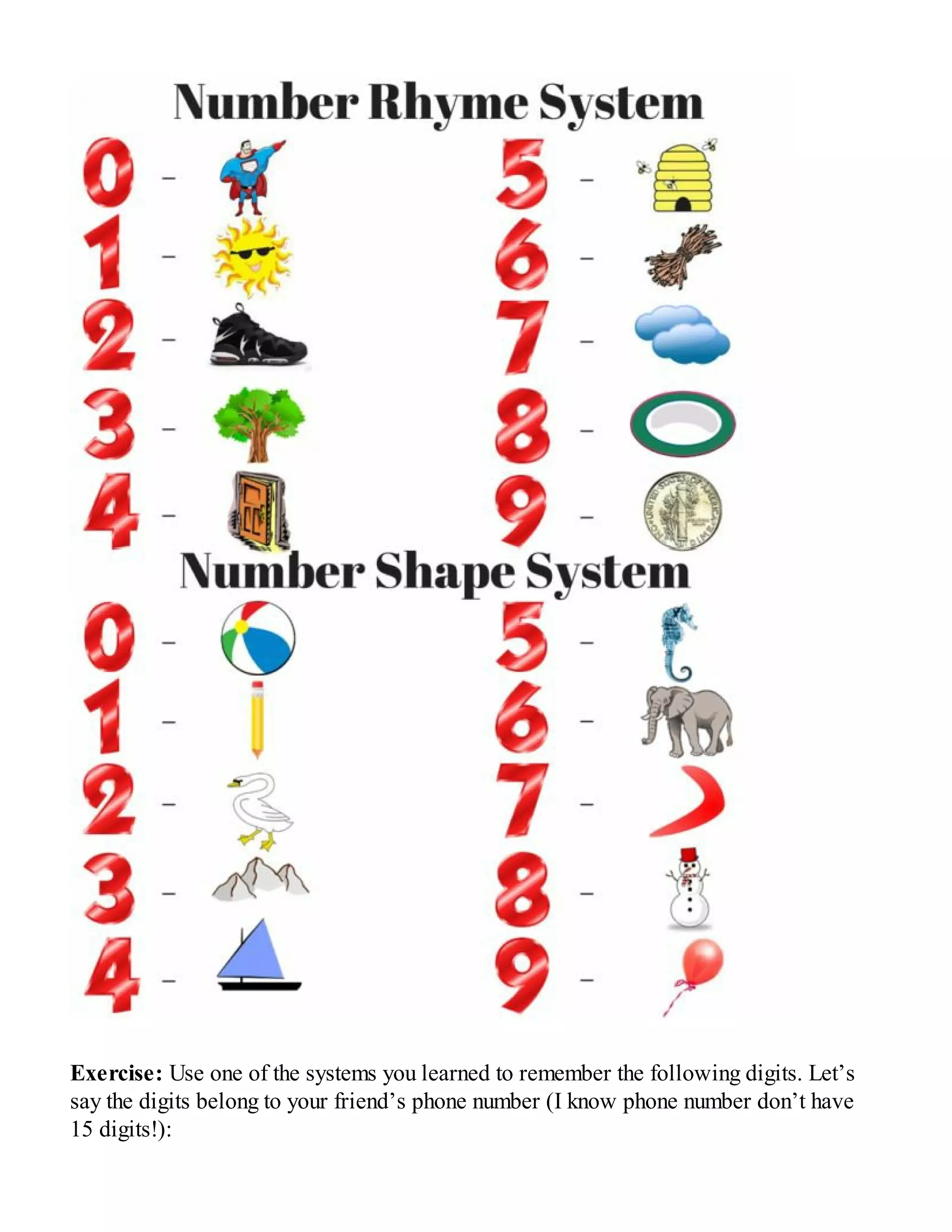
Number Rhyme System
You are going to create images for the digits of 0-9 because all other numbers
are made from these 10 digits. As the name of the system implies, you are going to
create the images for the numbers based off words that rhyme with them. For example 0
(zero) sounds like hero so maybe the picture you have is your hero. And let’s say your
hero is Batman. From now on when you see or hear 0, you think of Batman because he is
your hero which rhymes with zero.
Check out the picture at the end of the section for images that go with each
number. I suggest you try to come up with your own images first and if you get stuck, you
can just take some of mine. You might come up with some words like run or fun for one,
but these won’t work because they don’t have a concrete image. What does fun look like
or run? Some noun has to be doing these actions. Stay away from using verbs and
adjectives. Stick to nouns. The images you create should always be clear and constant
when you picture them.
Here is a list of images I came up with for the number plus some extra ones:
0=Hero, 1=sun, gun, bun, gum, or son, 2=shoe, tooth, or glue, 3=tree, flea, or key,
4=door or floor, 5= hive or knife, 6=sticks or bricks, 7= Kevin or heaven, 8=skate, gate,
or plate, and 9=wine, pine or mime. Now that you have your images for each numbers
you can start remembering numbers.
Let’s take 496 as an example number you want to remember. Say this is a bank
code number so the location you will think of is your bank. 4 is the first digit so you see
a big green door waiting in line to go see one of the bankers. But the door gets tired of
waiting so he opens up a bottle of wine (9) and starts drinking and becomes drunk. The
door is now being rude and loud. Somebody decides to throw a brick (6) at the wine
bottle so the door can’t drink any more.
The bottle breaks and the wine spills all over the floor. The door is trying to lick
up all the spilt wine! All you have to do when you want to recall the numbers is think of
the story and decode the images. There was a door (4) that started to drink some wine
(9), but somebody broke the wine bottle with a brick (6). So the number must be 496.
Maybe you don’t like the number rhyme system because you can’t come up with
good images or the images aren’t sticking. Well if this is the case, you can use the
number shape system to come up with the images for the numbers.
Number Shape System
What you do in this system is look at the numbers and think about what the shape
of the numbers look like. Take 0 for example, 0 might look like a basketball or a beach
ball so you would use that image to represent 0.
The same ideas from the rhyme system about coming up with the image applies
to the number shape system as well. Check out the picture at the end for images that go
with each number. I suggest you try to come up with your own images first and if you get
stuck just take some of mine.
Here is a list of images you can use for the numbers: 0=football, soccer ball,
beach ball, sun, or wheel, 1=pencil, sword, candle, or stick, 2= snake or swan, 3=lips
or handcuffs, 4=sail boat or chair, 5= seahorse or hook, 6=elephant trunk or fishing
pole, 7=scythe or boomerang, 8=snowman or glasses, and 9= balloon or monocle.
This system works the same way as the rhyme system when you want to
memorize numbers. You can decide which system you like best and then use the one
when you memorize numbers. Don’t skip between systems because you can have some
problems if you do.
A major problem would be you see an image and it is a wine bottle (9 from
rhyme), but you are in the mind set of using the shape system so when you see wine in
the story, you won’t think of wine as 9 because that is not the image for 9 in the number
shape system. You will glance over it and recall the wrong numbers because you are
missing the 9. Unless you can keep track and know when the image you see is from the
rhyme or shape, you can go ahead and use a combination of both systems when trying to
remembering numbers.
You can apply your number systems to any information that has numbers in it
like PINs, passwords, phone numbers, historical dates, and the list goes on. It really
helps if you can get your images down so you don’t have to waste time thinking about
what is the image for 7 or 1. You should be able to say what image goes to each number
and say what number has what image. It may take a little while but believe me, it will
make a difference!
Exercise: Use one of the systems you learned to remember the following digits. Let’s
say the digits belong to your friend’s phone number (I know phone number don’t have
15 digits!):
Phone Number: 039720468167045
The Alphabet Systems
Another useful system to have in your arsenal is the alphabet system. Many
pieces of information today contain a combination of numbers and letters. It may be in
the form of passwords, equations, or a type of code, and it is hard to remember all these
types of information because it just seems like a mix of numbers and letters.
How is it possible to remember this information if it is seems totally random?
You learned how we change numbers into images because numbers are constant and
won’t change so you must do the same for letters. You pretty much know how this
system already works!
We are going to change the letters in the alphabet into images because the
letters in the alphabet are not going to change. There will always be 26 letters in the
alphabet. No more, no less. How are we going to come up with the images for the
letters? There are two ways you can approach making the images for the letters. You
can try both of the ways out to see which one you prefer to use but at the end, they both
accomplishment the same thing.
Alphabet Rhyme System
The first system is the Alphabet Rhyme System. You will create images that
sound exactly like the letter you are making the image for. For example, ape sounds like
A, Bee sounds like B, or Sea Saw sounds like C. So you would go through the whole
alphabet and make images that sound like the letter this way when you are recalling the
information and see an image, you know the image sounds exactly like the letter it stands
for.
Now to remember a list of random letters or a combination of numbers and
letters all you have to do is use the story method to connect the information together.
Let’s say you have to remember the code “AZIJQB” for your library account password.
The following story will take place in your library since the password relates to the
library.
You walk into the library and see an APE jumping around the library screaming,
but then a ZEBRA tackles the ape and arrests him for being destructive. The ape licks
the zebra in the EYE, and the zebra freaks out! A JAY bird sees the zebra’s eye got
licked and runs toward the zebra to help him. But the jay bird wasn’t watching where he
was running and trips on a CUBE crashing right into the front desk. You hear some
laughing and look around to find a BEE just cracking up and crying because he was the
one who put the cube on the floor.
Now do you have the code memorized? Picture your library and see if you can
recall the story you see there. When you go through the story, translate the images back
into the letters they stand for. In the order they appear you see: an ape, a zebra, an eye, a
jay bird, a cube, and a bee. The code is “AZIJQB.” It is just like making a story out of
the words in a list.
Alphabet Letter System
Maybe you can’t find images for all the letters like x or w so this system for the
alphabet system is not for you. Don’t worry! You can use the second system to make the
images: The Alphabet Letter system. The second method works by having the image
start with the letter it represents.
Back in grade school when you were learning the alphabet, you probably
learned that A is apple, B is bat, and D is dog. Each of this words started with the
respected letters so it would help us make the connection between the letter and a word.
You will make your system based on this idea.
This system works exactly the same as the Alphabet Rhyme System. You will
connect the letters together by using your images and form a story that connects them all
together. Now when you go through your story and see an apple, you now that this piece
of information is an A because apple stands for A. Check the picture at the end for
images for the Alphabet Letter System. Just in case you can’t tell what the images are,
here are the images I used for the letters:
A- Apple N- Nail
B- Bat O- Octopus
C- Cat P- Piano
D- Duck Q- Queen
E- Elephant R- Ring
F- Flamingo S- Sock
G- Glue T- Turtle
H- Hammer U- Umbrella
I- Ice V- Vacuum
J- Jeep W- Walrus
K- Kangaroo X- Xylophone
L- Lock Y- Yo-Yo
M- Mop Z- Zebra
Now that you have your alphabet systems, you can start remembering all types
of information that has letters in it. I actually have used this system to help me remember
passwords, poems, periodic table of elements, and more!
I was amazed by how fast and easy it was to do this. I never thought a system so
simple can help me remember so much material. The alphabet system has so many
applications and it is really useful when you are learning equations. I used this system
so many times for remembering equations. Start practicing one of the alphabet systems
so you will be ready for whatever comes your way!
Exercise: Use one of the methods you learned above to remember the following letters
that belong to your WiFi Password:
wpbmslfneid
Journey Method
I remember back in high school how it was so hard to learn different subjects at
one time because each subject would have so much information to learn and it was hard
to keep track of all the information. How was I going to keep organize all the math
equations I needed to know from all the Spanish, history, or language arts information?
The truth is none of the information was organized. I spent hours studying for all
of my tests and after I was done reviewing for one test, I would go back and review the
information for a test I already reviewed just to make sure I still had the information. It
was a long, frustrating, and boring process.
All I was doing essentially was just repeating the information over and over
hoping it all would stick because there was no way for me to check if I had the
information or not. I know you have gone through this same process, and it is just a
waste of time since there is a better way to store information.
What if you could keep all the information organized, know exactly where the
information is, and be able to retrieve it at a moment’s notice? Sounds too good to be
true? Well it isn’t! The Journey Method lets you accomplish such a feat.
With the journey method you use locations to store information you want to
remember. This method can be thought of as a file cabinet. In a file cabinet say you have
different folders like Spanish, chores, work, history, and math. You know anything that
is Spanish related goes into the Spanish folder and anything the deals with chores goes
into the chores folder. Any piece of information you have has a folder that you can place
it in.
So later on when you need an equation or the Spanish paper, you know where
exactly to find these pieces of information. They are in the math and Spanish folders,
respectively. The journey method works the same way. A journey is multiple locations
in a logical order. A location was any place you can picture such as your bed, dress,
closest, and so on.
When you go shopping, you start at the parking lot, go to the entrance, the cart
area, the bakery, the milk area, and the checkout is the last place you go. This could be
the typical journey you take when you go grocery shopping. The parking lot, the
entrance, the cart area, the bakery, the milk area, and the checkout are all the locations
in your journey.
Here is a list you need to learn for school: fish, plane, eggs, elephant, and tuba.
Make a journey with your house. Maybe it looks something like this: 1. Bedroom, 2.
Bathroom, 3. Couch, 4. TV, and 5. the kitchen table. There are five locations because
there are five pieces of information. Place each word in the corresponding location.
Here is what you see:
You walk into your bedroom and find a fish jumping on your bed knocking off
all the pillows and sheets. It also smells very fishy. You then go to the bathroom and see
a plane using the toilet. The plane screams at you to shut the door because the plane
wants it privacy! You walk to the couch to sit down, but you hear a crack. You just sat
on some eggs making the couch sticky. You decided to just watch TV and go over to the
TV just at the moment an elephant picks up the TV and smashes it on the floor. You
scream in horror. How could the elephant kill such an innocent TV! Being in shock, you
need to eat something before you faint. So you go to the kitchen but at the table, you see
a tuba eating pancakes. You just can’t handle this craziness happening in your house so
you just faint!
How was that story! To recall the information you learned, all you have to do is
walk through the journey. What was in your bedroom? A fish. Bathroom? Plane. Couch?
Eggs. TV? Elephant? And lastly Table? Tube. You know perfectly where each of the
words are because you can see them in the locations.
Now you can go forwards, backwards, and even jump around the list. If
somebody says what’s the third item? All you do is go to the third location, which is the
couch, and recall the image of you sitting on eggs. Eggs are the third item! Or what
number is the plane? The plane is in the bathroom so it must be 2nd
. The journey method
is very useful when you want to store a lot of information because all you need are
locations to store the information.
Another great feature of the journey method is you can add as much information
you want to a single location. The list you learned above could of all taken place in your
bedroom. You would have used the story method to connect all of the words together
then place the story in the location. This would be a hybrid of the story method with the
journey method.
But you do want to make sure you can keep track of all the information in one
location. You need to experiment to find out how much information you can put in one
location because in theory you could place an unlimited amount of information into one
location. Maybe 20 pieces of information is your limit or 10. The only way to find out is
by trying.
The journey method is so power and fast that I was able to learn the periodic
table of elements with great ease. I had to learn the first three line of the periodic table
for chemistry class in college, and everybody was upset because they thought it was too
much for them to learn.
But I took it one step further. I decided to learn the whole tale of elements
because it wouldn’t take that much more time to do so. There were 115 elements on the
table so I needed a total of 115 locations to store all the information. I broke it down
into 4 journeys with 25 locations plus a journey with 15 locations.
To be honest it took me more time to get all of the locations together than to
actually learn all of the elements. I also decided to learn all of the atomic masses for all
the elements. Why? Because I could! People were blown away by how easily I learned
the information and how fast I could recall the elements with their atomic masses. It
took me less time to learn all the elements than it took the other students to memorize 18
elements. The journey is a really powerful technique and it will absolutely change how
you remember information from now on!
Exercise: Create a 10 staged journey to remember the following words. Remember the
locations in your journey should flow and be in a logical order.
List: Banana, Compete, Piano, Staircase, Architecture, Think, Cloud, Race, Fly, Derive
Briones Double Digit System
You have already learned the simple number systems (rhyme and shape), but
those systems do have their limitations. Say you have a 20 digit number you want to
remember, but there is like 6 number 2’s in the 20 digit number. You will have a lot of
the number 2 image (shoe) in your story and that might throw you off.
Also, the bigger the number means your story will be longer or the more
locations you have to use (if you use the journey method). Overall, the simple number
systems are good but when it comes to larger numbers, they may not be as effective.
I remember when I decided to learn my friends’/family’s phone number,
(because I could!), and I ran into the problem where I kept seeing a lot of repetition of
images. I started to get the stories mixed up and couldn’t recall the telephone numbers
correctly. I decided to give up that idea because the simple number systems weren’t
good enough.
This is where my superior two digit system takes over. I use this system to help
me memorize 300 digits in 5 minutes, and I wouldn’t be able to do this with the rhyme
or shape system. Just image how many times the image 5 would appear in 300 digits.
That is a lot of seahorses! If you can memorize 300 digits in 5 minutes using the simple
number systems, I will give you a cookie!
With my two digit system you are taking a combination of two digits like 25 and
making an image for that combination. So instead of having a little story like a shoe (2)
got stuck in a hive (5), you would have a chair represent 25. The two digit system is a
little bit more complex because there is a code that gives you rules on how to make the
images for the numbers.
The code is set in place so you can figure out your number system quickly and
help you learn it faster since there is organization to your system. You will have a total
of 100 images because you will start from 00-99. This system will take a good bit of
time to complete so maybe you want to do 10-20 images a day so you don’t feel over
whelmed or if you want, you can make all the images in one setting like I did!
This is the code I made so you could have a lot of different words to choose
from. Imagine coming up with ten words that start with X is hard. Heck coming up with
5 words that start with x is even hard! There are two parts to the code: the first digit and
the second digit. The first digit is going to give you the starting letter that the image has
to start with.
The letters for the first digits are the following:
0=s or z
1= d
2=n
3=m
4=r
5=l
6=g or j
7=c or k
8=h
9=b
If you had 75 for example, the image you come up with has to start with a “c” or
“k” like Kate or kite, but these won’t work for 75 due to the word not having the right
vowel sound. The second digit in the pair of numbers will give you the vowel sound.
Here are the vowel sounds for the second digits:
0= “oo” as in moon
1= “a” as in sand
2=”e” as in bet
3=”I” as in mitt
4=”o” as in dog
5=”u” as in duck
6=”A” as in snake
7=”E” as in feet
8=”I” as in kite
9=”O” as in rose.
Now that you know what the code is, you are now ready to make your number
system. But say if some of the letters/vowels sounds that go with the digits don’t work
for you, you can change them if you want! You want the system to work best for you so
if it requires you to change the letters or vowel sounds, do it then!
You will have 100 different combinations of numbers from 00-99, and you get
the word you need for each number by the combination of the digits. Let’s take 06 for
example. 06 has a 0 as the first digit so you know it has to start with an “s” or “z”. Then
the second digit is 6 which means the vowel sound is “A”. So putting both of the parts
together, you get a word that needs to have an “s” or “z” with an “A” vowel sound.
Snake! Snake would be a word that follows the code for 06.
You have only 99 more images to go! Another example is 44. First digit is a 4 so
starts with an “r”, and the second digit is the vowel sound “o”. Rock! Rock would work
perfectly. You can start from 00-09 then go to 10-19 and so on or you could jump
around the numbers. You may have trouble coming up with some images for some of the
numbers and if this happens, just skip the numbers and come back to them later.
If you can’t just figure out a word for a specific code, you can just find a word
that is close enough to the sounds. You will remember that number because you had
trouble coming up with it and didn’t follow the code. 08, for me, doesn’t follow the
code. My word is Spencer which doesn’t follow any of the combinations of the digits so
I was never confused if Spencer was another number instead of 08. Here is an example
of what you might get for 00-09:
00: Zoo
01: Sand
02: Seth
03: Scissors
04: Sock
05: Sully
06: Snake
07: Sheep
08: Sign
09: Stone
You now have the tools to create a two digit system which will allow you to
remember more digits quickly and reduce repetition. Take the number
3009080704010203. If you used the rhyme or shape system you would have a lot of
your 0 image repeating which may confuse you (8 0’s to be exact). But with your new
two digit system, you would have no images repeating in the number above which is just
fantastic.
Also, you can put as many digits you like into one location as long as you make a
story. Say you have a ten digit number 1569873521. You would have each image for
two digits, and you would just make a story like you did with the simple number systems
or if you don’t like that approach, you can just have an image (two digits) per location.
So the telephone number could take up one location, if you used the former method, or
can take up 5 locations using the latter method. Try both of them out and see which on
works best for you!
With my two digit system, I memorized all of the atomic masses of the periodic
table. That is close to 600 digits! The stores I created with the images were each unique
and didn’t have any overlap expect for a few elements that had the same atomic masses.
If I would have tried to use the number shape or rhyme system, it would have taken me
hours upon hours to learn all of the atomic masses.
I would have probably might have given up because so many images would be
repeated, and I would have gotten confused with what image belonged to which
element. The two digit system takes care of having so much repetition and allows you
remember more numbers overall because you are taking 2 digits at a time instead of 1.
The best part is after you create this number system, you will never have to create
another number system. Plus, anything that has numbers will be a piece of cake for you!
Exercise: Finish this system! It may take a while depending on how fast you work on it.
I know it could take a while, but it is worth it!
Conclusion On The Basics
You now have all the tools you need in order to remember all types of
information quickly, for longer, and recall it at any moment! But you are not done yet
because you need to practice all the methods and systems you just learned. This will be
the hardest part (if you can call it that) when you are mastering the basics. All you need
to do is practice 15 minutes a day. No kidding! You want to get practice with the
systems and methods so you can get a feel for them.
Everyone one is different so you need to see what works for you. Maybe you
like the number shape system over the number rhyme system so every time you learn
anything with digits you use the number shape system (I highly recommend that you get
your double digit system down. Believe it is a lot easier to use when you have a lot of
information to learn). Practicing is the only way for you to figure out which
systems/methods you like better or are better with.
You can never become a pro football player if you never practice, right? The
same is true when it comes to improving your memory. You need to practice the
methods and systems so when you actual have to use them, you will be ready and know
how they work.
So get some random numbers, words, create journeys, practice going between
your images and the numbers they represent and lastly have fun! You will be creating
weird stories and imagining things you never would have pictured before but that is
what makes learning fun by using my methods and systems. The days of taking hours to
learn something are over forever!
Applications Of The Basics
Now that you got the basics out of the way, it is time to learn how to apply the
basics in order to help you breeze through school so you can ace your classes while
doing less work! There are a million ways for you to apply the basics in order to
remember different types of information in school. You may not know where to start or
know which method/system to use.
Well good news for you! I am going to explain the most efficient method to
remembering a lot of information you will face in school. I personally have used every
single method and techniques you are about to. This was the only way for me to figure
what work and doesn’t!
You don’t have to waste your time trying to figure out what works and what
doesn’t! You can use the method/technique as is or you can modify it to better fit your
liking. When it comes to using my techniques, methods, and systems, there is not really a
wrong or right way of using them because if you come up with a method that allows you
to remember the information, you accomplished your mission, right?
I guess I would say there is an efficient or a more efficient way of learning
something. If you tried to learn 100 digits using the simple number systems it would take
you a while and you would see a lot of repeating images. But if you used the double
digit system, it would take less time since you are remembering 2 digits at a time, and
you would have less repeating images since you have 100 images.
Keep this idea in mind when you apply the different methods and systems
because with a little thinking you might come up with a different method that is more
efficient than the first method you thought of. The methods you will read about are the
most efficient and effective methods, I found, for learning the information. If you think
you found a more efficient way, let me know. I would to hear about it!
You now have the choice to jump to any section you want, but I highly
recommend you read every section because you might get some ideas for other
information you face. One method might use another method in a different section so
reading through every section will help you. I will also let you know for each type of
information which method and system is needed!
How To Remember Vocabulary
(Uses: Story Method)
Have you ever had trouble remembering what a word means? I know I have!
The current solution to learning a definition of a word is to look it up and repeat the
definition and the word over and over. But when you see the word come up again, you
have no idea what it means even though you just looked it up!
When you are in school, there is a lot of new terms you have to learn because
each subject has its own terminology but using repetition can take you hours upon hours
to remember the definitions of all the words. Some definitions of words I had to
remember are: Eigenfunctions, isobaric, fugacity, and much more science words! I
didn’t have a clue what any of those words meant when I first started learning the
concepts, and I bet you can relate. But don’t fear! You can remember tons of definitions
in a fraction of them time using my memory techniques!
You have learned how to turn abstract words into images like the word
wavefunction. The image you see may be a big WAVE and there are people in the wave
who are having FUN. When you see the image, you will remember wave and fun which
stands for function. The idea is to break down complex words into smaller words and
create images from the smaller words.
Next you have to have a location to store the word and the definition. Let the
word or the definition of the word you are trying to remember come up with the
location. Wavefunction makes me think of a beach because of the wave part of the word.
You have to come up with an image for the definition of the word which can be hard.
The image has to represent the definition in some way. There can be two different
approaches to this.
The first way takes a bit more work. What you can do is turn every word in the
definition into an image. So when you are recalling the definition, you know the exact
definition of the word. All you have to do is turn the images you made back into the
actual words.
Let’s take the word ALOOF as an example. Aloof means at a distance. With the
first method you would change all of the words in the definition into images. “At”
would become bat, “a” would become Ape, and “distance” would become a disk
getting toss at a fence. Now you would make a story connecting all of the images
together in order.
You want to connect this story with the image for the word aloof. I see a loaf of
bread for aloof. Now let’s add it all together. I see a loaf of bread with a bat. An ape
takes the bat and starts to dance with the bat. The ape is crying because it has been ages
since he danced. All of a sudden disks are tossed at the ape knocking him unconscious.
You look and see a fence standing there with a disks in its hands.
This is the story I would use to remember the word “aloof.” Now that you have
the story you need to place it in a location that aloof or the definition brings up. For me,
I see a place from Hercules where he sings the song “You Can Go The Distance” since
the definition has distance in it. You would place the story in the location, and when you
see the word or definition, the story you created and the location will be triggered.
The second method deals with coming up with an image that represents the
definition as a whole and not in parts. The word magnanimous means revealing
generosity. You would do the same thing as the other method and come up with an image
for magnanimous. Maybe you see magnets as the image. Now comes the tricky part
coming up with an image for revealing generosity. What I would picture is somebody
giving money to a homeless person which is a kind and generous thing to do. That image
will represent the definition.
Now the location the story will take place is a checkout lane because the part of
the word mag reminds me of bag. I associate checkout lanes with bags. I would see
somebody giving magnets to a homeless person, but this homeless person has a metal
skull so the magnets fly to his head. All of this is happening at the end of the checkout
lane.
When you see the word or definition, you should see a man is being generous by
giving magnets to a homeless person which would trigger magnanimous and the
definition: revealing generosity. Like with all the systems and method you learn, you
need to experiment and figure out which method works for you. It also depends on if you
need to know the exact definition or not. Play around with it and see which one works
better for you.
I have always been bad when it comes to words. Since I studied engineering,
the need to remember vocabulary become necessary! At first it took me a bit to get use
to this vocabulary technique but after a while, it become second nature. Every time you
hear or read a new word look it up and try to use this technique. You will be amazed by
how easy it is to remember definitions and soon you will be a walking dictionary!
Exercise: Time to practice what you learned! Here are the vocabulary words you can
practice on:
Confer v. To bestow
Delude v. To mislead the mind or judgment of
Missive n. A message in writing
Rife adj. Abundant
Tyro n. One slightly skilled in or acquainted with any trade or profession
How To Learn Spanish
(And Other Letter Based Languages)
(Uses: Vocabulary Method)
Today we live in a more connected world where we have to communicate with
people from different countries. It is very important to know a foreign language so you
can communicate with people who speak a different language especially if you go to
another country. I remember in high school how long and boring it was to learn a foreign
language. You probably remembered words just by repetition. I took four years of
Spanish and barely remember any of it!
How would you remember “comer - to eat”? You would probably repeat this a
hundred times. Hopefully after all the time you spent, you should be able to remember it
when you are speaking to someone else. But what happens when you do talk to
someone? You can’t remember the word to save your life!
When you try to learn words through pure repetition, you are just tossing all of
those words in your head in a disorganized manner and when you need to recall a word,
you can’t find it. Well don’t worry because now you will learn how to remember
foreign languages quickly and be able to recall words when you need to! The language
we will be using as an example is Spanish (the technique you learn will work for other
letter base languages such as French or German).
The hardest problem when it comes to languages is being able to pronounce a
word correctly. I remember trying to say something in Spanish that I couldn’t get the
right pronunciation and said the wrong thing. My partner was very confused! Let’s first
focus on remembering the word itself. The Spanish word we will take for example is
“comer - to eat.”
Now the first thing you should do is find a location where you will store the
meaning of the word and the word itself. You can do this by coming up with a location
that is related to the word or letting the word create the location for you similar to the
vocabulary technique. So for “comer - to eat” maybe it makes you think of a kitchen or a
restaurant because those are places where you eat. You based the location off of what
the words mean. Or say you had the word “luz - light.” The word luz sounds like moose
so you might think of a forest. In this example, you allowed the word to create the
location you will be using.
You now have the location to place the image for the word you are going to
make, but you need to focus on remembering on how to recall the correct pronunciation.
The image you are going to make for the Spanish word is going to be based on how the
Spanish word is pronounce. The reason for this is when you want to recall the Spanish
word, the image you came up for it will sound similar to the Spanish word and trigger
how to say the Spanish word correctly.
Let’s take the word “comer - to eat.” Comer sounds like comb hair so maybe
what you see is a comb and hair. But now you have to connect this image with the
meaning of the Spanish word which is to eat. So maybe the image you come up with to
eat is somebody eating some food. You have the location where you will place the
image for the Spanish word and the image for the definition. Now it’s time to put them
all together so you can remember the word.
Let’s connect comb and hair with somebody eating. Say this person is eating
from a bowl but instead of using a spoon, he is using a comb! And instead of eating
some food, he is eating hair! The person is using a comb to eat hair (weird huh). Now
let’s place this image in a kitchen. It could be yours, a friends, or whatever kitchen you
want.
You just learned the Spanish word comer. How easy was that! Next time in
conversation say you need to say to eat in Spanish this the process you should go
through your head:
1. How do I say to eat? To eat makes me think of my kitchen and I see
somebody eating something from a bowl.
2. He is using a comb to eat instead of a spoon and he is not eating food
but hair!!
3. Oh he is using a COMB and eating HAIR. Comb Hair….. COMER!
Comer is the word for to eat.
I know this seems like it might take a long time to come to the conclusion of
comer, but I am writing what is happening which takes more time to say. In your mind,
you could see everything I just wrote in a couple of seconds because you are recalling
images and not words.
For the most part, this is how you remembering words for Spanish or any letter
based language. But there is a little bit more you have to do if the language you are
learning has a feminine or masculine form. In Spanish, a noun is either el, la, los, or las.
These four things are constant and will never change. Let’s take the word “el libro - the
book” for example.
You will do the same process as above by coming up with an image for the
Spanish word and the meaning then have a location to place the story you create. But
now you have “el” to remember. What you are going to do is make a premade image for
“el” just like how you made images for numbers. “El” is the masculine form of a noun
so maybe you come up with an image that is masculine or guy related. The image for
“el” could be a beard since guys have beards.
Let’s say the image you came up with for libro is (Bruce) Lee doing a bro fist
and for the meaning of book, you use a book. But since the book is masculine you have
to add the image for “el.” Now the image for “el” could go on the Spanish word image
or the meaning image. It doesn’t really matter at all where you place the image for “el”
as long as it is in the story.
Say you see the book with a beard. The whole image is Lee doing a bro fist with
the book, who has a bread. Since the word is a book the location you use is a library. At
the main desk in the library, you see Lee walking to his friend, the book, and does a bro
fist with the book. And maybe Lee complements the book on his beard.
To recall the Spanish word for book, works the exact same way as the word
“comer.” This time though when you see that the book has a beard, you know libro is
masculine since there was a beard in the story which means it is el libro. This comes in
handy when you are speaking or writing in Spanish. Saying the wrong form of the word
might confuse the person you are talking to or writing.
You have the technique to learn any letter based language quickly and recall
any words at a moment’s notice. You don’t have to waste hours trying to learn a foreign
languages anymore. What does “comer” mean in Spanish? How do you say “the book”
in Spanish? In the next section, you will learn how to remember character based
languages which differ from letter based languages in one aspect.
Exercise: Let’s get some practice in. Here are some Spanish words you can apply the
technique you just learned:
La bicicleta- The bike
Correr- To run
Blanco- White
El toro- The bull
Nadar- To swim
How To Learn Chinese
(And Other Symbol Based Languages)
(Uses: Vocabulary and Spanish Technique)
I had the chance to go to China to compete on a game show, which was
absolutely amazing, but I was totally clueless when people spoke Chinese to me or
when I saw Chinese characters. You probably have heard or seen Chinese, but it is a
different story when you need to actually communicate with someone. If it wasn’t for my
translator, I would have been lost (which did happened) and confused!
What makes Chinese different from Spanish is that Chinese has characters
instead of letters and words. To learn how to pronounce Chinese words, you will use
the exact same technique you learned for Spanish. The only different part is how you
remember the characters since you probably have no idea what they mean. They might
just look like symbols to you which is okay because you are about to learn a way to
remember them!
The first thing you have to do is come up with a location where you will place
the story you create from the images of the character and the meaning. The location can
be based off the character or the meaning just like how the location came from the word
or the meaning in Spanish. It may be a bit hard to get a location from a character so you
might find yourself coming up with a location based on the meaning most of the time
which is fine!
Let’s talk about how to create an image for characters. I am going to be honest
and tell you it will take imagination and creativity to create an image. We will use this
character 小 for example. What do you see when you see this character? For me, I see a
golf club with wings so that would be the image I use for this character.
Can you see how I was able to get that image from the character? The middle
looks like a golf club, and the lines on the side reminded me of wings. See I wasn’t
lying when I said you have to really use your imagination! This is going to be the hardest
part when it comes to learning a character in Chinese.
After you have the image for the character, you do the same process as for
Spanish. 小 means small. Now you will come up with an image for the meaning of the
character. What I would do is make the gulf club with wings small which having the golf
club small represents small. Maybe the location you came up with is a golf course so
you would now make a story out of the images for the character and the meaning then
place it in the golf course.
As you can tell, it is the same as learning a letter base language like Spanish.
But say if you want to know how to pronounce the character and not just draw it, you
will still use the same technique for Spanish. 小 (xiǎo) sounds like shout without the
“t.” To remember the pronunciation of the character, you have to make an image for how
the character is said.
For me, I think of a shout bottle, that you use to clean clothes, because it sounds
similar to xiǎo. Then all you have to do is add this new image to the location where you
already have the story of the character and the meaning. The small golf club with wings
is using a shout bottle to clean the golf course would be the whole story you see.
You now have all you need to learn any language out there. Isn’t that awesome!
If you are taking a language class or majoring in one, you will pass with great ease.
Your teachers will be blown away by how fast you can learn a language. All you need
to do is practice the techniques you learned, and you will be on your way to learning all
of the languages!
Exercise: Here are some Chinese symbols you can practice the technique you learned.
Some may be more complex, but it is good practice:
早安 (zǎoān) – Good Morning
謝謝 (xièxie) – Thank You
停 (tíng) – Stop
火啊 (huǒ a) – Fire
我愛你 (wǒ ài nǐ) – I Love You
How To Give Speeches And
Presentations
Form Memory
(Uses: Story Method and Journey Method)
There are a lot of times in your life, especially in school, where you have to
stand in front of a crowd and give a speech or a presentation. Maybe you get nervous,
start to lose focus on what you have to say, and end up freeze. This is a common
occurrence and may have happened to you because you simply forget what your points
were and just crashed.
When somebody freezes up, there is an awkward silence between the person and
the audience. The audience begins to think why this person is even talking in the first
place, why are they listening to this person, or making fun of you. You might be saying,
“I can just use notecards or look at the slides.”
This is very true but when you have to look at slides or notecards, it makes you
look like you don’t know what you are talking about, and you might even lose points
because of this. But what if the slides fail or you left your notecards, what is the worst
that can happen?
In a press conference for Samsung, Michael Bay completely failed on his
presentation because the teleprompter messed up, and he decided to wing it. He
couldn’t form complete sentences, and he ended up just walking off stage embarrassed
and can never live that moment down. But you don’t have to worry about this happening
to because you are about to learn how to give your speeches and presentations from
memory!
One big mistake people make when they want to remember a speech is they try
and memorize the whole thing! This is problematic because say you “memorized” your
speech and you start to give your speech. But then disaster happens! You can’t
remember the exact words that come next. So you pause trying to figure them out or
stubble around saying things to figure out what is next. You are so focused on trying to
recall your speech word for word that it causes your downfall.
You should never try and memorize your speech word for word. The key to
remembering a speech is remembering the main points of the speech because if you can
just remember the points you need to talk about, the rest of the information about the
points will come from your knowledge. Your knowledge of the subject will come out
naturally when you talk about the subject so there is no reason to remember your speech
word for word. So how do you remember the points in your speech/presentation? Let’s
jump right into it!
The way you are going to remember your main ideas is by using the method the
ancient Greeks actually used to remember speeches. What you have to do first is find the
main points of the speech you want to talk about. After you have your points, you will
need a journey with as many locations as you have points.
Next you need to change your main points into images. Say you have a speech
about productivity, time management, and training new people. You will create images
that either represent the points or the words. For productivity, maybe you see a factory
because factories produce items and are very productive. For time management, you
picture a grandfather clock because clocks remind you of time. Lastly, the image for
training new people could be somebody working out having a coach yelling.
Now that you have the images created, you will place them in the locations in
your journey. Say the first location in your journey is your bed, then your dresser, and
lastly your doorway. Picture a factory on your bed and maybe it has smoke clouds
coming out getting your bed all dirty. At your dresser, you see the grandfather clock
going through your dresser tossing out all of your clothes. Lastly at your door, you see
somebody doing push-ups with their coach yelling.
There you have it! You now have all the points in your speech memorized. All
you have to do is go through the images in your head while you are giving your speech
to help you trigger what the next point is. It is very easy for you to be speaking and
through your journey at the same time. Practice this so it becomes second nature to you!
You are ready to give your speech. You start at your first location, which is the
bed, and you see the factory reminding you of productivity. So you say, “We need to
start being more productive if we want to increase our profit margins this year. But how
will we accomplish this?” When you are saying the last line in your head, you are
moving on to the next location so you can bring up the next point.
You see your dresser, and there is the clock tossing out your clothes so you
remember time management is the next point. You say, “We will accomplish this by
having better time management. We need to use our time wisely and not waste time on
process that can be more efficient.” At this point, you think of the last location and see
this person being trained by his coach. “We need to make sure we use our time
efficiently when we train new workers because this will cut down the time they aren’t
doing anything and can start working right away.” And that is how you recall your
speech from memory!
Not so scary or hard to give speeches since you know how to remember your
speech/presentation from memory. The age of you freezing up in front of people is a
thing of the past now. Go out and start giving speeches from memory to practice the
technique you learned. You will be amazed by the response you will receive from the
audience by not using notecards or looking at the slides!
Exercise: Here are the main points to a speech you need to remember: Make an image
for each point and have a journey where you can store the images:
Speech:
1) We need to start investing in stocks
2) Team building exercises need to increase
3) Talk about methods to close the deal
4) Talk about the process of making products
5) Convince major sponsor to donate more money
How To Remember Historical Dates
(Uses: Number System, Journey Method, and Story Method)
History is full of interesting, scary, and exciting events that happened in our
world, but it is hard to remember exactly when somebody did what or what happened
when. In one year, there could easily be 100+ major events take place or maybe
somebody discovered something over a period of 30 years.
There must be an easy way to remember all this information and be able to
recall it at a moment’s notice. Thankfully for you there is a way to do it! It doesn’t
matter if you are not going to be a history major because every single subject has a
history of its own. When I was in chemistry I had to remember when an element was
founded and by whom. Not really useful in chemistry but it was on a test so I needed to
know it.
Now when it comes to remembering dates and events there is a lot of ways to
organize the information like by century, all the events in a person life, or by the
importance of the events just to name a few. I am going to give examples on how to
remember historical dates depending on what type of information you need to know.
Example 1: Say you need to remember events crossing over 1000’s of years of
events from the 1500’s to 2000’s. What you are going to do is take each century
separately from the others because the events in 1500’s don’t have anything in common
with the events in 2000’s. All the events in the 1500’s have in common that they all took
place in the 1500’s. You will start remembering the dates from the earliest to the latest
since that is most common, but you could do it any way you want.
The way you are going to organize the information is with a journey. For this
example, you will have 4 journeys. One for each of the centuries: 1500’s, 1600’s,
1700’s and 1900’s. So maybe the 1500’s is a journey around your house, and the 1900’s
is a journey of a friend’s house. This will allow you to jump directly to the dates that
are within each specific century.
If the teacher asks what happened in 1985? You would immediately jump to the
journey of your friend’s house, since it represents the 1900’s, and then you can find the
event, but I will explain that later. How long will each of the journeys be? Well that
depends on how much information you need to learn or want to learn. Say if the teachers
says you need to know these major ten events for each of the centuries, each of your
journeys will contain 10 locations. One location for each of the events.
You have a place to store the information, but what about the dates? You are
going to use the number system to change the dates into your corresponding image for
that number. The great thing about having a journey represent the centuries is you don’t
have to learn the first two digits of a date. If you are thinking of an event in your friend’s
house (1900’s), you know instantly the years of the events start with 19. So all you have
to worry about is remembering the last two digits.
Let’s say the historical date you have to remember is a monkey lands on the
moon in 1536. Your house is the 1500’s and say your bed is location one. Use your
image for the number 36 and create an image for the monkey landing on the moon.
Maybe the image is a monkey tossing the moon around or the monkey is on the moon.
But you have to connect the image for the monkey landing on the moon with your
image of 36 (let’s say 36 is Big bird) because you want to be able to get the date or the
event by seeing your story. You can see on your bed big bird and the monkey playing
catch with the moon. Maybe they are jumping around the bed as well with feather falling
down.
The image of the monkey playing catch is a trigger to the actual event. Also,
there is probably only going to be one event in history where a monkey lands on the
moon. So if somebody asks when did a monkey land on the moon? You will think of an
image of a monkey tossing the moon with Big Bird. That image is unique and there will
be only this one image in all of the stories you create.
Let’s say there is another event where a monkey eats a 100 foot long hot dog.
You may have an image of a monkey eating a big hot dog. There is no way you can
confuse, when recalling the date, the monkey playing catch with the moon with the
monkey eating the hot dog because there is a moon in one image and a hot dog in the
other. You just need to make sure you get an image for the main parts of the event.
Having just a monkey would make you unsure of the date and which event the image
represents.
After you imagined this mini story taking place on your bed, you will move on
to the next event and location. You will do the same process for this event just like the
last one you did. You will do this to every event and place them in the respective
journeys. But what happens if you get events that happen in the same year?
One idea would be just to place the events in separate locations just like you
have been doing. You would see your image for the number in two locations. Or another
idea would be to use a whole room to represent a specific year. So instead of your bed
just being a location for one year, your whole room will now represent the year of
1536. Maybe you see big bird outside your room acting like a bouncer so you can
remember that your room is the year 1536.
You will have locations in your room to place the events. So going back to the
monkey landing on the moon, you will just see a monkey playing with the moon on your
bed. Say another event that happened in 1536 is a car learns to talk. Maybe your dresser
is a location in your room. Picture a car talking while it is going through all of your
clothes.
Now if someday said what events happened in 1536, all you have to go is go to
your house (1500’s), go to you room (1536), and go through all the locations in your
room and recall the images you see back into the events. It’s that simple! You will need
to know how many dates and what the dates are so you can figure out which method to
use. It is also based on your preference as well.
What if this is your situation: You are given dates that are not in order and are
just random. How would you remember this? You could use the methods we already
talked about above, but the method above is not the best for this type of information. The
method I use for this type information is creating a location based on the event that is
given. Then I create and image for the event and use my number system for the year.
D-day happened in 1944. D-Day was a battle on a beach so based off that the
location I am going to use is a beach since that is the first thing I associated with D-Day.
Using your first association is usually the best because that is the first thing you think of
when you hear, think of, or see something. I also see a battle taking place on the beach.
In this battle, I see DeDe (my image for D in the alphabet system) running around
all scared but, she runs into a big bale of hay (my image for day) to hide from the battle.
The Rock (my 44) then jumps into the hay and drags out DeDe telling her to go fight.
This is the story I see in order to remember D-Day happened in 1944.
The next time someday asks me: When did D-Day happen? The first thing I think
of is a battle on the beach. The location of the beach pops up with all of this fighting
going on. I then see DeDe (D) running around screaming then jumping into hay (Day).
The Rock (44) then comes and drags her out. Right when I think of the location of the
beach, the story pops up instantly, allowing me to decode my images, and say D-Day
happened in 1994.
You may have notice I didn’t memorize the number 19. The reason for this is I
know D-Day happened during World War 2 so it has to be in the 1900’s. If you want,
you can have your image for 19 in the story too so you can remember it happened in the
1900’s. I would add Dopey into the story and maybe he was making a castle in the sand.
You know have the technique to remember dates depending on what types of
dates are given to you and how you would organize the. You will be a walking history
book! Remembering historical dates is just a combination of words and numbers. All
you are doing is connecting the words with the numbers and placing them in a location
so you can recall it later. Historical dates are not that bad after all!
Exercise: Here are some dates you can practice the technique you learned. They are
just made up dates so have fun:
1925 – Crab writes a book
2063 – Dinosaurs make a cake
1578 – Sand castle falls down
2001 – Chair learns how to cook
1835 – Rained candy
How To Remember Equations
(Uses: Alphabet System, Number System, Journey Method, and Story Method)
I went to an engineering school which is just code for math, math, and more
math! In all of my classes, there was math and a ton of equations I had to learn in order
to solve different problems. There was just one small problem: you had to remember all
of these equations from memory! In high school, I could use a sheet of paper to write
down all the equations I needed.
Not having a piece of paper can be a challenging task to undertake considering
there could easily be over 30+ equations you needed to know for the test. In addition,
each equation can vary in length and complexity depending of the nature of the class. I
have never seen so many equations in my life!
I am dealt with some equations that had 25 different parts to them and weird
symbols I have never seen before. Some students can spend hours upon hours studying
equations and still can’t recall them correctly. But you are going to learn how to
remember equations quickly and be able to recall them when needed.
When you learn equations, you will be using the alphabet system consistently
since so many equations have letters in them. The alphabet in math is just wrong! There
are different ways you can approach storing the equations which I will go over. The
method you will use depends on the equations and what you have to do with them.
Let’s start with something simple: V= R*I. This equation is volts equal
resistance times current. This equation applies to circuits and being able to find volts,
current, or resistance depending on what variable you have. The first way you can store
the equation is by coming up with a location based off what the equation is for or about.
The equation is used for circuits so maybe you picture a race circuit as a location.
Since now you have the location, you can create a story with the images. You
will use your alphabet system to create images for the variables.“V” can be a vacuum.
You will have to create images for the mathematical symbols “=” and “*.” The “=”
symbol can be double barrel shotgun. “R” would be a ring and “I” can be an ice cube.
The image you can create for “*” is an explosion.
Here is a story you can see for V=R*I: At the race circuit see a vacuum flying
around, and it is carrying a double barrel shotgun. The vacuum sees this ring with a big
diamond on it! The vacuum swoops down and shoots the diamond off the ring. The ring
is screaming and asking for help. An ice cube comes out and says, “I will help you.’ But
the way he is going to help is by tossing dynamite at the ring. The ice cube ignites the
dynamite and tosses it at the ring. The ring opens its mouth and eats the dynamite!!?!
Then boooom! A puff of smoke comes out of the ring’s mouth.
It is important to notice how the story is told. The vacuum (V) swooped down
and shot the ring with the shotgun (=). The ring got shot (R). The ice cube comes out and
tosses the dynamite at the ring. The dynamite (*) is tossed by the ice cube (I). When you
want to recall the equation, all you have to do is think of the story and decode the
images you see into V=R*I.
But what if you are having problems with remembering what the V or R means?
All you have to do is find an image based off what the variable means and connect it to
the other images in the story. So maybe volts makes you think of lightning bolts. When
you see the vacuum, maybe the vacuum is shooting out lightning bolts or gets hit by a
lightning bolt.
Seeing the lightning bolt interacting with the vacuum is going to remind you that
V means volts. You would do the same thing to the other variables in the equation if you
want to remember what they mean. The other way you could store this equation is by
using a journey. All you would do is see the story you created in the race circuit in a
location in your journey. But you can also use a journey to organize your equations.
Say you have 10 equations all about electricity. You would have a journey that
is specifically for equations dealing with electricity. Each location would belong to
each one of the equations. If you ever need an equation about electricity, you would go
to your journey with the electricity equations and find the equation you need.
Let’s talk about complex equations like this:
Ψ(x)=A*Sin(nπx/a)
This is the wave function equation for a particle in quantum mechanics. The
overall method to remembering complex equations is the same as above. You will be
making a story eventually and either store the story in a location based off the equation
or using a journey. But first you need to figure out how to remember these strange
symbols in the equation.
You are going to create premade images just like how you made images for the
alphabet system and the number system. The symbols you actually see in the equation
are part of the Greek Alphabet so pretty much it is another alphabet system. What does
Ψ look like or make you think of? Ψ kind of looks like a trident so that could be the
image you use for Ψ.
But Ψ has a (x) which means it is a function of x so maybe the trident gives birth
to a xylophone which is the image for “x.” Hey, I know that is a crazy thing to picture
but it works! The next symbol “π” (pi) which is the mathematical constant relating the
circumjacent to the area of a circle. It is easy to come up with an image for this because
you would picture a pie!
You would make an image for “/” which is the divide sign. The image you might
come up with is a serving tray. The images you make for these symbols are always
going to be the same because “π”,” /”, or “Ψ” won’t ever change. They are constant like
numbers or letters. Now all you would do is make a story out of the images and place it
in a journey or a location made by what the equation is about or for.
Whether you place it in a journey or in some location, you want to have some
sort of image that indicates what the equation represents. This equation is a wave
function so maybe the image you see is a wave crashing through your story. Seeing this
will trigger that this equation represents the wave function equation.
Now you have the tools to remember any equation that comes your way
regardless of how complex and crazy it may be. A lot of the students in my classes
struggled with remembering equations and when they had to take a test, they were
stressed about if they were going to use the right equation. While the whole time I am
just sitting there calm because I know where all the equation are exactly and know what
all of them mean.
It makes a big difference. After the test people asked me, “What did you do for
problem 5? What equation did you use?” When they hear the right equation, they get
very upset because they did the problem completely wrong. But you don’t have to worry
about this anymore. When everyone else is stressing out, you will be stress free and
ready to dominate the test!
Exercise: Let’s practice remembering some equations! The following the equations
vary in difficulty:
Pythagorean Theorem (used with right angle triangles): a2
+b2
=c2
Volume of a cylinder: V= π*r*2*h
Compound Interest: A=P*(1+(n/r))n*t
How To Remember Passwords
(Uses: Alphabet System, Number System, Journey Method, and Story Method)
Most of us spend a good amount of time on the internet browsing a lot of
different sites. Over time, you have probably accumulated a quite a bit of logins. Do you
ever have trouble remembering a password to a specific site? Find yourself clicking
that forgot password button time and time again?
This has happened to me more times than I would like to admit and it’s
frustrating because now you have to go through the hassle of changing your password
and answering security questions that you don’t know! You do this whole process just to
forget your password later on so the whole cycle starts again. But you are going to learn
how to remember passwords so that forgot password button will be nonexistent to you!
I am going to give you two ways to remember passwords that are sure fire. The
first method will be using the story method and connecting your password to the login
site. You will create an image for your password, the login site, and create a location
based off the site. Here is an example: The website is Facebook and your password is
cake60.
You will need to come up with an image that represents Facebook. Maybe the
image is a book with real faces on it (I know creepy but memorable!). Next make your
password into an image. You can picture a birthday cake and use your number system to
get your image for 60 which is a Goofy. You have your images for the information, but
now you need to have a location to place the story.
You want to use the site you are remembering the password for to be the one that
creates the location. The reason for this is the site is the first thing you will see which
will start to trigger your story and eventually your password. Maybe Facebook makes
you think of a library since it has book in its name. Now we create a story between all
the images you created and place them in the location.
You might come up with a story like this: You walk into a library and you see
this birthday CAKE reading a book but just not any book. The cake is reading a BOOK
that has FACES coming out of it! You toss a shoe at the book but all of a sudden, Goofy
comes out of nowhere and catches it. You run away screaming in horror!
Now the next time you are trying to remember your password for Facebook, you
will think of a library. Then you remember a cake, a book with faces, and Goofy. You
will decode your images into my Facebook password is cake60. The idea is you know
what your password is, but you just need a little bit of help triggering it.
But what if your password has capitals? Good question. You would make some
sort of modification to the word that has the capital. So if it was Cake, maybe the cake
would be on fire (my modification for a capital letter) in the story. And if the capital is
in the world like cAt, you would use your alphabet system and modify the letter that is
capitalized. I would see this cat and an ape (image for A), who is on fire, petting the cat.
You would do this so you would remember that there is a capital A in your password
cAt.
The other method is the same as above with the only difference is you will be
placing your story into in a journey. You could create a journey that is only for
passwords. Maybe you use your friend’s house as your journey. You would make as
many locations as you have passwords to sites. You would start on location one and
create a story in the location. Then you would move on to the next location and do the
same process except for a new password and site.
This method allows you to organize your passwords/sites, and all you have to
do to recall your passwords is to go through your locations until you find the right site
and decode your images for your password. If you have trouble remembering your login
like the email or username, all you do is make those pieces of information into an image
as well (like explained above) and just add it to the story. You now have the secret to
remembering password so go out and create random logins so you can practice your
new skill!
Exercise: Time to practice remembering passwords! Here are some made up
passwords you should try the techniques you learned:
Login: Cardmaster Password: Cook15oreo Site:
Google
Login: Smith101 Password: 94snOw Site:
Amazon
How To Remember Names
(Uses: Story Method)
Quickly try to remember these 5 names:
Diana Becky Jeff
Jennifer Kurt
Be honest with me: How soon after you met someone do you forget their name? I
used to forget people’s name right after I met them. How embarrassing is that! But the
worst part is when the person remembers your name. You just feel awful. Has this ever
happened to you? Well after you go through this section, you will never forget another
name again!
In school, you are always meeting new people if it is in class, lunch, or any
activities you are doing. But meeting people doesn’t end in school because you will be
meeting people for the rest of your life! So it would be a good idea to learn how to
remember names. Plus, it makes people feel really good when you are able to recall
their names. How do you feel when some you met recalls your name?
I am going to teach you a method to remember names that will allow you to
recall people’s names days, weeks, and even years later. I met some people my first
year in college one time and three years later, I was able to recall their name perfectly.
It goes without saying that these people where absolutely surprised!
Most people are good with recalling faces because back in the day you needed
to know if someone was a friend or foe. A name wasn’t really that important, but times
have changed. People forget names almost instantly, and a main reason is people are not
concentrating when the person says their name. As you learned, concentrating is one of
the keys to memory.
Another problem is that names have no images or mean anything. What does a
Hank look like or mean? You have no idea and neither do I! So what you are going to do
is use a method I call Image to the Face. This is just one of the 5 methods I use and I am
able to remember 60+ names in 5 minutes!
This is how Image to the Face works: First you are going to find a
characteristic that sticks out on the person’s face. When you meet someone, there is
always something about their face you notice. Maybe a long nose or big ears. This is
great because you will always notice that feature first when you see this person. So your
first job is to find a characteristic that stands out to you.
Next, you are going to change the name into an image just like how you changed
numbers and letters into images. Maybe you meet someone named Julie. An image you
can come up with is jewel. Jewel sounds like Julie right? You want to create an image
that sounds similar to the name.
The last step is you are going to connect the image you just made to the
characteristic on the person’s face. Take this for example: You meet someone named
Julie, and she has a big nose. You picture yourself shoving a whole bunch of jewels up
her nose!
You want to make you connection weird! So what happens the next time you
see her is this: You see Julie, and the first thing you notice is her nose. Then you see
yourself shoving jewels up her nose. Jewels…Julie! This is the process that will
happen when you use this technique to remember someone’s name. Can you recall the
names from the beginning?
Check the beginning of the section for their names!
I do have a warning for you though… DO NOT TELL PEOPLE WHAT YOU
SEE HAPPENING ON THEIR FACE!!! I REPEAT: DO NOT TELL THEM!!!
Uh let’s just say people get mad when you picture something on their face and
it’s not the nicest image. I don’t know this from experience or anything… Just keep to
yourself what you see and if someone ask, tell them you have a good memory!
You now have the power to remember anyone’s name. You will impress
people pretty easily by being able to recall their name. Believe me! I hope you enjoy
never forgetting names again and have a fun time seeing weird images on people’s faces
which you should never tell them!
Exercise: Time to practice remembering names! Use the technique you learned to
remember the following names. Come back later and cover up the names to see if you
can remember them:
Mary Josh
Megan
Nikki Cindy
How To Remember Your Schedule
(Uses: Story Method, Number System, and Journey Method)
As a student, you have a lot of activities going on and you feel like you are
overwhelmed. How are you supposed to remember all the things you have to do?
Forgetting what you have to do can ruin your day such as failing to turn in a project
resulting in an “F”. Remembering what you have planned for the day is so important and
fortunately for you, you are going to learn an easy way to remember your schedule for
the day, even the whole month!
Let’s start with how you would remember your month’s schedule because
remembering your day to day schedule is an offset of this method you will learn. You
start by creating a journey with 31 locations because the most days a month can have is
31 days. Go over your journey a couple of times to make sure all the locations are
strong and clear in your mind.
Now every location in the journey will correspond to a day in the month so the
first location represents the 1st
day of the month. If you are already a couple of days into
the month just start on whatever current day you are on. When you are planning your
schedule, you first need to figure out what you have to do for the day and make a list of
the order the events need to take place.
Here is an example list: vacuum the house at 9 am, mail a letter 11 am, get a
haircut 1 pm, and call Bob 3 pm. You are going to use the story method to remember the
order the events take place. Create a story connecting all the items in the schedule
together. The location you will put the story is in the first location of your 31 location
journey or whatever location the schedule’s day belongs to.
Your story for the example list could go like this: You are in the parking lot of
your favorite park. You see somebody vacuuming the parking lot, but the vacuum starts
to smokes then explodes! A whole bunch of envelopes come shooting out and fall to the
ground. All of a sudden, the envelopes rip open and hair comes bursting out being
chased by scissors. The hair then jumps on a bobsled with dogs and yells mush just in
time to escape the scissors.
To review what you have to do for a specific day, you go to the location in the
journey and recall the story. You start off by seeing the parking lot which had someone
vacuuming it. Which reminds you that you have to vacuum. The vacuum explodes and
envelopes come out. Right, you have to mail a letter. Then you will continue to decode
the story. The order of the story tells you what activities you have to do before the
others.
You may be asking what if you need to know the specific times you have to do
the activities? This is where your number system comes into play. All you have to do is
add your number image to the story where the it belongs. You see Darth Vader (09)
vacuuming the parking lot. Then you see pizza (11) trying to catch the falling envelopes.
Continue adding your number images until you go through all the activities.
Now you have everything you need to remember what you have to do and when.
You will see the pizza catching the envelopes which reminds you that you have to mail
letters at 11 am. After you finish making you images for the first day move on to the next
location and repeat the process until you have your schedule for all the days in the
month.
There is another way where you can remember your month schedule. Instead of
having one location where you make one story for your schedule, you can have one
location that has smaller locations in it. For example, your room can be the first location
but within your room, you have smaller locations like your dresser, bed, TV, and so on.
The smaller locations will give you the order of the activities you have to do.
Say your bed is first, the dresser is second, and so on. You would make your
image of the activity you have to do and use your number image to create a story on the
first sub location in your main location. From the example above, you would see Darth
Vader vacuuming on your bed. Next, you would see pizza catching envelopes on your
dresser. You keep creating your stories and placing them on the sub locations until you
are done with the day.
A great thing about using these techniques you learned is that you can check
instantly if you have anything at a specific time. If somebody ask you are you doing
anything at 7 am, all you would do is go through each sub location or your story and
look for your image of 7. If you don’t see your 7 image, then you know you don’t have
something at 7 am. Another benefit of using these techniques to remember your whole
month schedule is by the end of the month, the images from the early locations should be
faded or gone. This means you can start placing new images in those locations for the
next month’s schedule.
If you don’t want to learn your whole month’s schedule, what you can do is
create 6 journeys with 10 locations (this is just arbitrary because you can use as many
journeys you want with as many locations. I am suggesting this because this is what I
use). You can use one activity per location so 10 locations is a safe bet but if you have a
lot to do, maybe you need 15 or more locations. It all depends on how many activities
you do on a daily basis.
You would pretty much follow the process mentioned above except each journey
represents one day. You have 6 journeys so you can cycle through them. This helps
prevent old images from getting mixed with new images. The crazy stories you create
are strong and will last a while. Sometimes if you reuse the same journey, the old
images are there and mess you up when you are trying to recall information.
If you want to remember what you have to do for the next three days use three of
your journeys. Then for the next three days, use three other journeys and by the time you
are ready to learn your new schedule, the first three journeys should be clear of the old
images. Experiment with the different options you have and see which one fits your
situation the best. Imagine never forgetting to do something ever again!
Exercise: Here is your schedule for the day. Apply what you learned in order to
remember all the activities you have to do:
Schedule:
8 am- Mow the lawn
11 am- Feed the dog
12 pm- Pick up the laundry
2 pm- Clean the pool
3 pm- Dust the house
5 pm- Meet Hailey
Conclusion On Applications
How much easier was it to use the methods and techniques explained to learn
all those different types of information? Like a million times right! Well there you go,
you have the tools and saw how to use them in order for you to learn a whole range of
information. All you have to do now is just practice what you learned.
Just like the basics, you want to practice all the methods and techniques. You
want to figure out what way is the best for you to remember the information so when you
face it in school, you will be totally prepared for it. You need to only practice for 15
minutes a day! I promise you that if you practice for 15 minutes a day, you will see the
impact it will have on school.
How do you exactly practice? Well it depends on the information. You can
either make up information or use real information when you practice. Take vocabulary
for example. Open up a dictionary and pick random words that you don’t know then
learn them. Come back maybe an hour or so later and test yourself on the words.
Or if you are trying to practice historical dates, you can make the events up or
use real ones. Have made up dates like 1935 A plane learns to break dance. I
recommend that you have someone else make the events up for you. Also, you can make
the date super specific or keep it vague. You can add the month, day, and time or just
leave it at the year.
But what you have to keep in mind is how you will need to actually learn the
information when you are in class. You should always make your practice look like the
real thing. For my competitions, I try to train exactly like how it will be when I compete
because this will help prepare me the best for the competition. The same goes for
school. If you only practice remembering the year of an event but in class, you need to
remember the specific day and month, you might have trouble if you never practiced that
way before.
Just try to remember information in all the possible ways so you will be ready
for anything that comes your way. Your friends will be amazed by how easy it is for you
to learn information while they take hours upon hours learning it. They will think you
are some sort of genius or are just really lucky, but you and I will know the truth! Best
of luck in school… scratch that… because you don’t need luck!
Conclusion
Now you have everything you need in order to ace all your classes while
studying less! The days of you spending hours studying, being stressed, and not having
time to do what you want are over. You can truly have amazing results if you just use
what I teach you. I know you are going to be fighting years of learning information the
wrong way but if you keep practicing, you will break this in no time.
At first I had a little trouble overcoming this because I was just so use to
repeating everything a million times and hoping that it would somehow stick. But I kept
practicing all the methods/systems and eventually it became second nature to me. Being
valedictorian, studying 1 or 2 hours and getting A’s, getting scholarships, and having
time to do what I wanted to do is something anyone one can do. I know you can do this!
You have started your journey to improving your memory and hope you are as
excited as I was. I love helping students because I don’t want anybody to experience
what I experience in school because it was really rough for me for about 3 years. Also,
the benefits you will receive from improving your memory is huge not only in school but
in life. You will continue to use your memory for the rest of life.
Stay connected with me and receive anything memory such as tips, stories, fun
videos, and much more at My YouTube Channel. You can go to my channel by clicking
here…
Have fun making school a piece of cake and having all the free time to do what
you want. The best part is now you can learn anything you want and it won’t take you
forever! I just started learning anything for fun because I could! I wish you great success
in improving your memory and with your studies!
Memory Program
I want to tell you about my Acing College Memory Program. You can get is
now by clicking here! I assume you might be going to college or are even in college
already so this program is for you! Let me ask you something: How much does it cost to
go to college? Well it depends. College can cost 10K-30K per year! That is a lot of
money to spend. The sad part is that in all the money you are spending, you don’t learn a
single thing about improving your memory, studying, or being able to learn faster so you
can pass your classes and make sure you don’t waste all the money you invested.
There hasn’t been a program on how to improve your memory, how to study,
and increase your memory speed so you can ace your classes while studying less until
now! In this video program you will get all the new methods, techniques, and systems I
figured out! Plus, you will get detailed videos explaining every method, technique, and
system. You get to see my thought process when I am actually trying to learn something
in real time. How would you remember the presidents or medical terms? I am working
on videos explaining how you would do it!
But the best part is that you are going to get a discount on the program: 50%
OFF! Get my program now by clicking here… Since you got this book, I wanted to
reward you for getting it. My program is the most easy to follow, step by step program
out there that will help you ace school! You also have a 30 day Money-Back Guarantee!
If for any reason you want your money back, you will get a full refund.
An amazing part of the program is you get to ask me any questions on anything
you want to learn how to remember! I will personally go out and learn the material so I
can come back a share with you what I found out is the most efficient and effective way
to learn that material! But also, you get to attend live webinars where I will share new
information with you and then do a Q&A. I want to help you as much as I can so you can
have success in school. The Acing College Memory Program is what you need!
But there is more to the program! You will get two courses for free when you
act now. The first course is Study Hacks. In this course you will learn the correct way to
study so you don’t waste hours upon hours. Also, you will learn how to remember
information for weeks, months, and even years! Doesn’t it stink when you learn
something and then a week or two later you forget everything. After you go through this
course, this will be a thing of the past!
Get My Program Now!
Then the last course you will get is Speed Secrets. This course will teach you
how to take your memory speed to a whole new level. How was I able to develop one
of the best memories in only 3 months of training? You will find out in this course. Say
you can learn 20 vocabulary words in 10 minutes. Wouldn’t you want to be able to learn
20 vocabulary words in 5 minutes? Well this course will teach you how to get to that
level.
What are you waiting for! Get this course now! Since you got his book you will
get a discount for the whole program: 50% off! You also have a 30 day Money-Back
Guarantee! If for any reason you want your money back, you will get a full refund. There
is no reason for you to not get the program now! I want you to have success in school
and spend less time studying for you classes. This is the program you NEED! Period!
The Acing College Memory Program!
School is going to help you reach success so you don’t end up in working at
McDonalds and not accomplishing much. What you learned in this book is just the
beginning. This program is going to get updated constantly and you get to interact with
me! What you will learn in this program, you will never learn in school. But this is what
you need to help you reach success. Get my program by clicking here…
If you have any questions at all you can contact me here:
Jbrionesgmm@gmail.com

How to improve your memory

  • 2.
    How To Improve YourMemory For Students Study Less But Still Ace Your Classes By Johnny Briones Grandmaster of Memory
  • 3.
    Copyright © 2015-2016John Briones: Master Your Memory, LLC with all rights reserved. It is illegal to copy, distribute, or create derivative works from this book in whole or in part or to contribute to the copying, distribution, or creating of derivative works of this book.
  • 4.
    Dedication For my momwho has always showed me how to get anything done even if I didn’t want to. Love you.
  • 5.
    Table of Contents Preface Introduction:The Days Of School Being A Pain Are Over Mastering The Basics 3 Keys To Memory Imagination Location Concentration Story Method Simple Number Systems Number Rhyme System Number Shape System The Alphabet Systems Alphabet Rhyme System Alphabet Letter System Journey Method Briones Double Digit System Conclusion On The Basics Applications Of The Basics How To Remember Vocabulary How To Learn Spanish (And Other Letter Based Languages) How To Learn Chinese (And Other Symbol Based Languages) How To Give Speeches And Presentations Form Memory
  • 6.
    How To RememberHistorical Dates How To Remember Equations How To Remember Passwords How To Remember Names How To Remember Your Schedule Conclusion On Applications Conclusion Memory Program
  • 7.
    Preface Quickly! Memorize thefollowing digits in 20 seconds: 003982430831917043644013 Could you do it? Well if you are like most people, you would think I am crazy for asking and think it’s impossible for you, if not everyone, to do it. The truth is that you are capable of learning those 24 digits in 20 seconds: Believe it or not! My name is Johnny Briones and I am a Grandmaster of Memory. I teach students how to improve their memory so they can study less and still ace their classes. Many students think they are doomed to get poor grades and the student who do get good grades are just smart. This is far from true. But also most students don’t believe they can improve their memory. This is also not true! You are going to learn that getting good grades and improving your memory is actually easy! The 24 digit I gave you above is a piece of cake for me. My personal best for a certain event is memorizing 80 digits in 40 seconds! But I am not a memory genius or a memory savant. I am just a normal person with a normal memory that figured out how to improve my memory to amazing extents. I have broken US memory records, been on a game show in China, and I am the youngest American to achieve the title of Grandmaster of Memory at the age of 19 years old. I was also the valedictorian and student of the year in my high school. And believe me, I didn’t like school or find it easy at all until I improved my memory. But the best thing about having a good memory is you have the ability to learn anything you want quickly, remember it for years, and recall it at a moment’s notice. I was able to breeze through school easily! While all of my friends where studying, being stressed, and worried, do you know what I was doing? Playing games, watching shows, doing my hobbies, and pretty much anything I wanted! Improving your memory is the most important thing you can do as a student because you will be learning information all through school and you don’t want to spend all of your time studying, right? You don’t want to spend all your time doing school related work! This book is going to change your life and help make school a piece of cake. You will be able to improve your memory to superhuman levels and learn things so quickly people will think you are superhuman! For me I always had the mind set of: If I could memorize a deck of cards under a minute, then learning 20 vocabulary words pretty easily. Don’t worry this book is all

  • 8.
    about how touse my different methods, techniques, and systems to remember all sorts of school material. You will be wondering why you never learned this stuff in school! I also create a video program on how to improve your memory called Acing College Memory Program. You NEED to have this program if you are a student! This memory program keeps getting updated with new systems and methods that I figure out. Plus you get to ask me questions and get explanations directly from me. If you are interested you can see it by clicking here. And since you got this ebook, I am going to give you a discount on the program. How does that sound! But it is limited for only a certain amount of time so make sure you act now! Also if you want to stay connected, see videos, and see what I am up to, you can go to my YouTube channel and subscribe to stay in touch by clicking here! Also, you can follow me on Twitter: Johnny Briones Go through this book as fast as you can because you will be eager to start using what you learn so you can show school who’s the boss! I want you to have success in school like I did. I studied less then everyone one else in college and high school, but I still manage to get better grades than all of them. You can get the same results! What are you waiting for? Start reading!
  • 9.
    Introduction: The DaysOf School Being A Pain Are Over “You will have a test on the American Revolution next Wednesday so make sure you study.” Then in your next class, “You will have a test on the periodic table of elements next Thursday and this test will be a hard one so study.” Don’t you hate this! By the time you go through all of your classes, your next week is full of tests. So what does your weekend look like? Studying. Studying. Studying. You swear all the teachers got together and planned to ruin your weekend with all of these tests! You now have no other choice but to study all weekend while you wish you could be doing anything else than studying. How much time do you end up study for? 8 hours? 12 hours? 20+ hours? I had a friend that studied for 8+ hours for only one test! That is a lot of studying for one test wouldn’t you say? Don’t think that your weekend is just ruined because you always have to be studying for school if it’s for quizzes, presentations, projects, or homework on a daily basis. Just think about how much time you actually spend studying. What could you be doing instead of studying all that time? Well you could hang out with friends/family, go to concerts, parties, do sports, clubs, volunteer, or sleep (just to name a few)! There are more important things to be doing than spending all your time study for school because most of it is a complete waste of time and energy! But let me ask you: Did you ever learn in school how to improve your memory so you could learn information more quickly, remember it for longer, and recall the information perfectly any time you want? You NEVER learned how to do this! How messed up is that! Has this ever happened to you: You spend hours upon hours study for a test and you feel all pumped up for it. Then you take the test like a champ believing you aced it. But you get it back and you got a C or worse. I have been there! You wasted all of that time studied just for a C! You think you should at least get a B if not an A. Doesn’t that just stink? So you pretty much had two choices up until this point: 1) Not really study much for your classes and hopefully you pass or 2) Study your butt off and spend hours of your life studying not even sure if you will do well. If you want to go to college or are in college, getting good grades will help you get scholarships which will help save thousands and thousands of dollars. Now a lot of scholarships want more than just academics. They want you to be
  • 10.
    doing a wholebunch of different activities and get good grades at the same time. But how are you supposed to do all of these different activities if you are spending most of your time doing school work? The key to solving this problem is improving your memory! In this book you will learn the way I remember information and all my methods, techniques, and systems I used in order to make school a walk in the park. Learning how to improve your memory will allow you to study less but still get fantastic grades. Remember my friend that studied for 8+ hours and only got a C? Well, I studied for the same test for only 2 hours and got a 99.9% on the test! The best part is you can have the same results! You will learn how I did that in this book. It doesn’t matter if you are in elementary, middle, high school, or college. Improving your memory is the most important thing you can do in order to ace your classes while studying less. This is how the book works: You first want to start off by reading Mastering The Basics because you need to learn the new way to remember information. You have to learn the 3 keys to transforming you memory which are imagination, location, and concentration. After learning these 3 keys, you will have to learn the basic methods, techniques, and systems in order for you to remember different types of information you will face in your classes like languages, vocabulary, and historical dates. But after you learn the basics, you can feel free to jump around and go to the sections where you will learn how to apply the methods, techniques, and systems to remember specific types of information. I recommend that you still read all the sections because you will get ideas on how to remember new information you face. Are you ready to get the best memory of your life and breeze through school? Let’s get started!
  • 11.
    Mastering The Basics Beforeyou can start learning school material with great ease, you need to learn the correct way to remember information and the keys that go into transforming your memory. More likely than not, you probably learn information by repeating it over and over hoping that it will stick. But what happens by the next day? You can’t remember a single thing of what you were trying to learn. Repeating information over and over is inefficient and wastes a lot of time. How long would it take you to remember all the countries and capitals in the world with using repetition? You would be there for hours reviewing this information! Also, when I memorize a deck of cards or digits, there way repetition would work. Memorizing a deck of cards under a minute gives you a little over a second/card. There is no time to repeat the cards at all. Repetition doesn’t help you in school at all. When you get done with this book, you will know exactly where you stored the information you learned, remember any type of information, remember information quickly, and remember it for longer! This is because the keys, methods, techniques, and systems you will learn allow you to do this. How did I manage to remember all of the presidents of the USA, vice presidents, term dates, and their political parties all in one hour? You will find out in this book and be able to do the same! But before you get to that level, you need to learn the basics. You NEED to understand the basics and practice them because any information you learn will use the basics in some shape and form. So if you master the basics, the rest will be easy. I promise you this. How did you learn to run? You first learned to walk and before that you learned how to crawl. I made it my focus to explain everything is the clearest way possible so you don’t have any confusion. And that is why I included examples to show you exactly how the methods, systems, and techniques work. You are about to learn my simplest methods and systems so get ready to transform your memory!
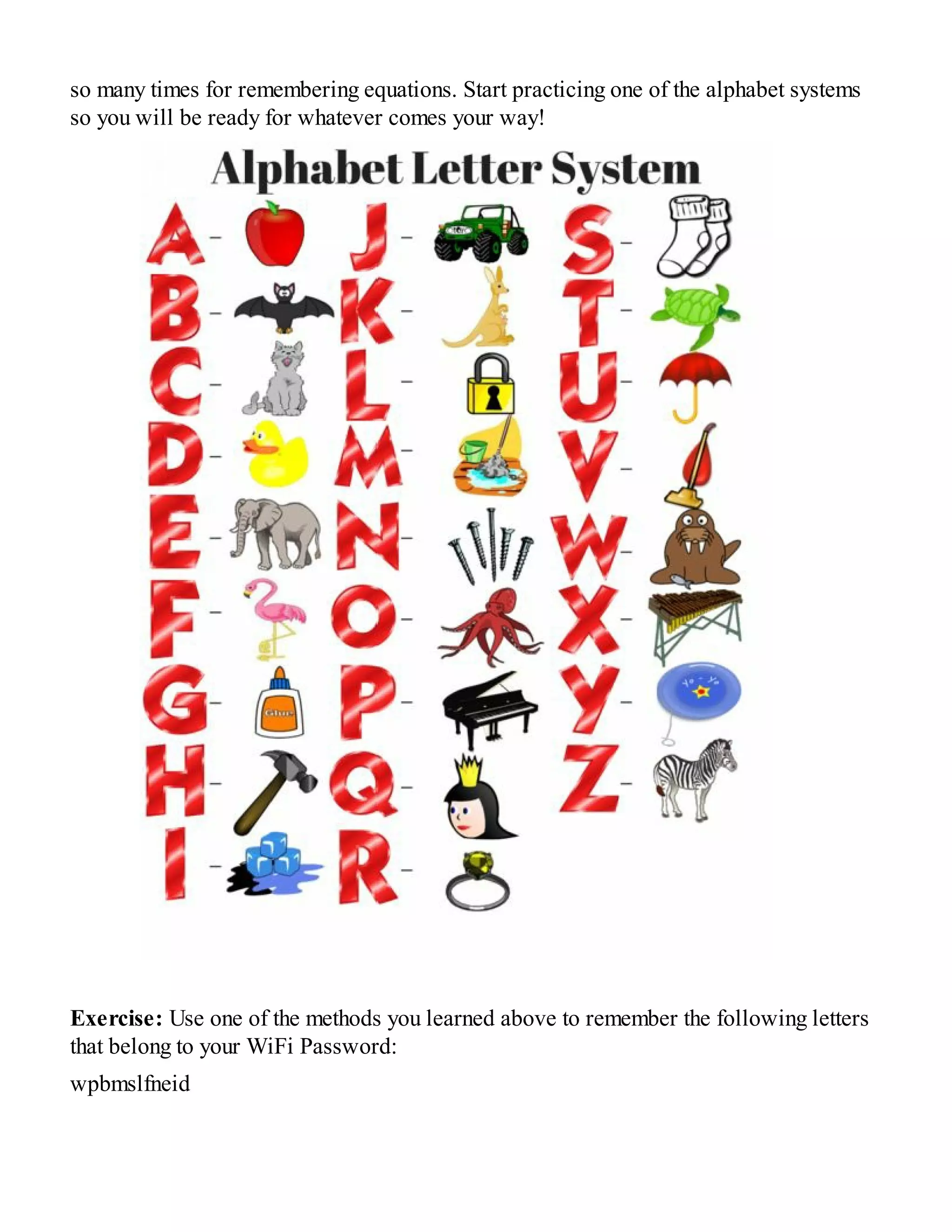
  • 12.
    3 Keys ToMemory
  • 13.
    Imagination When you arestudying for your classes, what kind of information are you looking at? Words? Numbers? I know after a while or even looking at the school material is super boring and makes you want to fall asleep. Why is it so hard for you to learn this information? The answer is words and numbers are just boring! What is so interesting about intermolecular forces? Or A=1/2bh? You are probably falling asleep just thinking about this stuff. This is a reason why studying is so hard and takes you hours to study for all of your classes. Well, you are about to discover how to learn any type of information and actually have fun doing it! Imagine this: A cow breakdancing on a pile of bananas! How crazy is that? You may be asking yourself: What does imagining this have to do with improving your memory or learning information? The first key to memory is IMAGINATION! This key is truly going to allow you to remember all types of information from historical dates to languages to equations and more! How you will learn information from now on is by turning any information into an image then create a crazy story out of the image. The story I told you to picture is memorable right? But why is that? The reason why is because you never expect to see a cow break dancing on a pile of bananas! Humans naturally remember images and stories better than words, numbers, or symbols. Any information you are trying to remember for class will now become an image of some sort. But there is a problem you may have and that is your imagination may not be good. Quick make a story between a dog and a piece of pizza! What did you come up with? Let me share my story I came up with: A pizza riding the dog into battle to save the land of Pizzaland from the evil rats! I see Pizzaland with the buildings made of cheese and toppings. The dog even takes a bite out of the buildings when the pizza wasn’t looking. It was a quick short scene I saw in my head. You may not have pictured something this crazy and weird which is a problem because your images and stories have to be creative and imaginative. A great way to start to get your imagination and creative juices flowing is to write stories. An exercise I want you to do is write a story about whatever comes to mind. There doesn’t have to be any structure to the story. Also, don’t worry about any grammar or punctuation. Anything can happen in your story. It doesn’t have to be logical or real. The point of this exercise is to let your mind run free and break any barriers on
  • 14.
    your imagination. But whatdo you do after you create these images and stories? This is where the next key comes into play: Location.
  • 15.
    Location Ask yourself thisquestion: When you learn information, where is it stored? It is weird and confusing to think about. Most people learn by repetition so when you think about it, the information isn’t stored in a particular area. Where is your friend’s name stored? But now you are going to learn how location will allow you to remember exactly where you placed information with the power of second key: Location. A location, in terms of memory, is any place you can mentally picture such as your bed, closest, bathroom, sink, and so on. Remember the images and stories you created with the information? What you are going to do is place these images and stories into a location you pick. You might be saying: “But wait Johnny! Now I have to remember a crazy story and the location where I placed it!?! This is getting to hard!” Relax! I promise that this is easy and makes sense. You are going to be wondering why you never learned this. Let me ask you: Can you picture your room? The store? Or your school? If you can, you already have a lot of locations so you don’t have to think of any new ones. It’s time for an example to show you how using a location exactly works. Say you want to remember the word piano and the location you want to store it at your car. Maybe the piano is jumping on your car so you hear your car getting crushed and the alarm is going off. You are just standing there shocked and scared of this evil piano. You may picture this:
  • 16.
    Later on whenyou need to recall this word, you will think: 1. The word I wanted to remember was placed at my car. 2. I can hear my car alarm going off because it was being crushed by a piano! 3. Piano is the word I needed to remember! Your brain follows the cues of associations to help you trigger the word you learned. It is that easy to remember information from now on! All you have to do is have a location in mind and connect the image of the piece of information to the location. If you can’t recall the image you placed in the location, it may be due to your story not being crazy or detailed enough. You want to make these stories seem like they are really happening so add emotions, feelings, and your senses. You will be using locations in every method and technique you learn. Quick what was at the car?
  • 17.
    Concentration The last keyto improving your memory is CONCENTRATION. Don’t believe me? Has this ever happened to you: You are introducing yourself to a new person and this happens, “Hi, what’s your name?” “My name is Bob.” “Nice to meet you Bob, I am Johnny.” You then walk away from the person. Literally five seconds later, no joke, you ask yourself, “What was that person’s name?” I always find this funny when this happens because how can you forget something like that so fast! Haha So what do you do? You AVOID that person at all cost! And if by chance you do have to talk to the person, you talk to them by saying, “HHheeeyyyy yyooouuuuuu. How’s it going?” Trying to avoid her/his name. Don’t feel bad, I have experienced enough times to know how embarrassed you feel and the shame… A main reason this happens is because you are not concentrating on the person’s name! When you meet someone, you are thinking about who else you have to meet, what you have to do when you get home, or about what you want to eat! But this happens all the time when you are studying. Have you ever “multitasked” when you were studying? Do you watch TV or browse the internet when you are studying? Or how about eating? Or texting constantly? Well what happens by the time you finish studying? You don’t remember a thing you studied! Why? Because you weren’t concentrating on the material. Your mind was distracted with all the other activities you were doing. So you just end up studying for longer and get frustrated. This is one specific case of how important concentration is but how does it work with the rest of memory? When you make these crazy images and stories, you need to concentrate on the details by using all of your senses, feelings, and emotions. You want a clear picture in your head so when you think of the location and the story pops up, you can see everything vividly and clearly. When I am memorizing a deck of cards, I am completely focused on the deck of cards and nothing else. I don’t care what is happening on Facebook, if I am hungry, or anything happening outside. Would I be able to memorize a deck of cards if I was trying to do or think about other things? Not a chance! Concentrating is very important when it comes to learning and studying. You will also see when you start to use my methods, techniques, and system how important this key is. You have learned my 3 keys to memory: IMAGINATION, LOCATION, and CONCENTRAION. Now it’s time for you to see how all of them work together in order for you to learn faster and remember more.
  • 18.
    Here are 5words you need to remember: Bear, Lamp, Car, Jacket, and Lawn mower. To remember this list of words you are going to create a story out of them and picture it happening in a location. Picture the story you are about to read happening in your kitchen: You walk into the kitchen because you are craving some cereal. But when you walk in, you see a big black BEAR in your kitchen! The bear growls at you and you stand there frozen in fear. The bear then walks to the fridge and when he opens the fridge, a LAMP jumps out and starts to attack the bear! You scream out in horror because the lamp spilt the milk in the fridge. You start to hear this humming from somewhere and it starts to get louder and louder. Then all of a sudden, a CAR burst through the wall and runs over the lamp! The car says to the bear, "Don't worry Bro, I got your back." The car and the bear do a fist bump. The car starts to shiver because the fridge door is still open so the car pulls out a fluffy, pink JACKET from his trunk and puts it on. The bear just cracks up when he sees the jacket on the car. The car starts yelling at the bear to be quiet but walking into the kitchen is a LAWN MOWER. The lawn mower tries to steal the jacket off the car because it has been looking for a jacket like that for years! The car fights back with the lawn mower and takes the jacket back. The lawn mower says "If I can't have it, then no one can." The lawn mower turns on its blades and chops up the jacket!! Everybody just stands there in shock. But the only thing you are thinking about is how are you going to eat cereal without milk… How did you like that story! Could you actually see this story happening in your kitchen? The goal when you are creating any stories is trying to see them like they are real. Can you recall all of the words in the list? All you do is think of your kitchen and you should start to see the story pop up. If you can’t recall all the words or see the story clearly, don’t feel bad! You are just learning the right way to remember information. Go back and read the story again but really try to see all the detail and experience it happening. In no time, this will be second nature. You just got a small taste on what is to come! Imagine being able to study less but remember more information. School will have nothing on you! You have the 3 keys so the next step is to learn the basic methods and systems. Get ready!
  • 19.
    Story Method Have youever had to bring items to a friend’s house and when you got to the house, you realize you totally forgot some items your friend told you to bring? So now you have to go back home and waste time just to go get the items because if you don’t, you won’t hear the end of it from your friend. Believe me I know how this feels! It can be hard to remember all the items on a list especially if you have a list of 20 or more items. So maybe you write the list on a piece of paper, but you can lose the piece of paper and have no idea what you have to bring or get. Just trying to repeat a list is ineffective and takes a long time to get it down. Plus, you may even forget an item or two but be none the wiser because there is no way to tell if you remembered the whole list with using repetition. Thankfully there is a method to help solve this problem called: The story method. The story method is necessary for all of the other complex systems, methods, and techniques. Master the story method and you will be set for all of my memory techniques! The idea behind the story method is to help remember items that relate to each other and keep the order of all the items. You will be making connects between each of the items in the format of a story. The story will start with the first piece of information and each new piece will be added to the story. The story you are going to make has to be creative and crazy! It can’t be boring and simple like: There were eggs and on top of the eggs was a lobster. This story won’t work! BORING! You need something like this: You saw a small egg, the size of a grape, sitting on top of the table when suddenly it started to shake. Then boom! A lobster broke out of the egg, and egg shells went everywhere getting the kitchen dirty. The lobster let out a scream because it was now free and going to take over the world! This is the kind of story you need to make with the items. Let’s take an example list and try to image the story you are going to read. Use your senses and add emotion to what you are seeing. For example, maybe the lobster making the mess in the kitchen made you mad because now you have to clean the mess up! Here is the list: Corn, Pop, Milk, Chicken, and Donuts. Say this is your grocery list so the story will take place in your grocery store. Imagine this story: You are walking towards the entrance to the store and when the doors open, you are attacked by some CORN stalks. They start to beat you up and demand you give them
  • 20.
    your money. Youare scared and start to look around for anything you can use to defend yourself when you see some POP bottles. You grab some pop bottles, shake them up, and toss them at the corn stalks. The pop bottles explode when they hit the corn stalks, and pop goes everywhere. But you get a little too excited tossing pop bottles and toss a pop bottle pass the corn stalks striking a cow that was walking by. The pop bottle hit the cow so hard she released MILK. The cow was crying because now her milk was everywhere. A CHICKEN walking by sees the cow crying so decided to go see what’s wrong, but the chicken didn’t know about the milk and slips screaming its head off. The chicken is just sliding on the floor and runs into a pyramid of DONUTS. The donuts fly everywhere. It’s raining donuts in the store! You decided you are hungry so you grab some of the donuts and dunk them in the milk then leave the store. A pretty crazy story which will make it more memorable because you never expect stuff like that to happen when you go to the grocery story! Read over the story a couple of times if you need to so you can see the whole story in your head. Now to recall your grocery list, all you have to do is go through the story. All the items on your list were emphasized in the story to help them stick out in the story. You start the story by remembering it takes place at the store then the story should start to appear. You see corn stalks which means CORN. Then you toss exploding pop bottles at the corn stalk so the next item is POP. You hit a cow that released milk everywhere so the next word is MILK. A chicken slips on the milk and starts to slide. CHICKEN is another item. And lastly, the chicken slides into a pyramid of donuts which the last item on the list is DONUTS. You just memorized a list of five words with this weird and crazy story. Now say if you wanted to recall the items backwards, all you have to do is start from the end of the story and go from there. The great thing with the story method is that it lets you know if you are missing an item. Say you forget pop, you would go straight from corn stalks to the cow releasing milk. You would know something is wrong because there story doesn’t flow right and doesn’t make sense so you must be missing something. Then it will click. Oh yeah the cow got hit by a pop bottle so the item I left out was pop. If you do have a gap in the story, review the story and whatever item you left out make that part of the story clearer so it won’t happen again. Also add emotion to the story. Maybe it made you feel sad when you hit the cow with the pop bottle.
  • 21.
    You really wantto imagine the story you make. If it seems like you can’t remember the story, it may be because you aren’t visualizing the story, the story itself is not that creative, or you are not using your senses or emotions. Did you smell the pop when it exploded? What kind of pop was it? Or feel the texture of the corn stalk on your skin? You want to feel like you were really in the story. You can use this method for anything list like or anything that you need to remember the order of. But what if the information you need to remember are abstract words? The items in a grocery list will all be nouns like milk, bread, or cereal. All of these words have an image that is already associated with them. You know what bread looks like or cereal. But a word such as withdraw doesn’t have an image. So what do you do if you come across information that doesn’t have a natural image? You make an image for it. There are two ways to do this. The first way is to use the first thing that comes to you mind when you hear/see the word. When you hear the word snow, maybe you think of a snowman, having a snowball fight, or just a layer of snow on the ground. These are the types of things you associate with snow. If you have to remember comprise, you may think of surprise so the image you will see is a whole bunch of people saying surprise with balloons. In your story when you are learning the word comprise, you will see the image of surprise. Then when you recall the list of words and get to the image of surprise, you will should remember surprise stands for comprise. When you are initially learning the list, you natural memory knows you read the word comprise and not the word surprise. But maybe you think you would get confused on what word you really learned using this method. If this is the case, then you can use the second method. The second method helps get rid of the problem of getting confused on what word you actually learned. With the second method, you break down the word into small words and make images for the small words then make them into a mini story. Take the word withdraw. Let’s take “with” as on part of the word and “draw” as the other. When I hear the word “with,” I think of whip because it sounds similar to it. So I am going to use an image of a whip. Then for “draw”, I think of drawing a picture. Now that I have the images for the two words I will connect them in the order they appear in the main world. I would picture a whip drawing a picture. This image will represent the word withdraw. Then from here it works the same as the method above where you are recalling the list and see the image. You should think whip sounds like “with”, and the whip is drawing so “draw”. The word must be withdraw! Try both methods and figure
  • 22.
    out which oneworks best for you. With using the story method, I have been able to save myself a ton of time from studying and not stress out about if I remember the information or not. Back in high school, we had to remember the order of the literature eras of England. The whole class was pretty upset by that because they had to remember something but for me, I was like bring it on! I made a list of the eras and then I applied the techniques I talked about above and learned the list in a couple of minutes. The other students where having a hard time remembering the order of the eras and wasting a lot of time as well. The other students were using repetition as the way to remember the information. But they would keep forgetting eras. I got to enjoy my time and do what I liked while my classmates wasted time and energy using the traditional method of repetition. A method as simple as the story method can totally make the difference. This method will be used later on consistently as you will see. Master this simple method! Exercise: Let’s get some practice using the story method. Remember the following words by using the story method. Create a weird, fun, and crazy story with the items. 10 Word List: Bat, Tree, Lava, Mug, Bottle, Watch, Burrito, Mouse, Box, Cord.
  • 23.
    Simple Number Systems Whyare numbers so hard to remember? The reason for this is because they are abstract concepts. What is a 7 or 657? They are just numbers that represent a quantity and have no clear image. For example, when I say Elmo, you know how I am talking about (hopefully) without me explain who he is, but you can also probably see a picture of Elmo in your head as well. Numbers don’t work this way since there is no concrete image to 7 or 14. Numbers are all around us as prices, phone numbers, addresses, equations, and dates. Students might say they don’t need to remember these things because our phone or computer can do it for us. This is true but when is the last time you were allowed to use your phone or computer on a test? That’s right you can’t name one can you! Even though we do have technology we can’t rely on it 100% because technology fails all the time (ever wrote a paper and the internet goes out!), can’t use it on a test, and doesn’t help you remember information. So how do we remember numbers? What we are going to do is give numbers an image so we can make a story out of them like in the story method for words. There are two simple number systems we are going to learn: the rhyme and shape systems. Let’s start with the number rhyme system.
  • 24.
    Number Rhyme System Youare going to create images for the digits of 0-9 because all other numbers are made from these 10 digits. As the name of the system implies, you are going to create the images for the numbers based off words that rhyme with them. For example 0 (zero) sounds like hero so maybe the picture you have is your hero. And let’s say your hero is Batman. From now on when you see or hear 0, you think of Batman because he is your hero which rhymes with zero. Check out the picture at the end of the section for images that go with each number. I suggest you try to come up with your own images first and if you get stuck, you can just take some of mine. You might come up with some words like run or fun for one, but these won’t work because they don’t have a concrete image. What does fun look like or run? Some noun has to be doing these actions. Stay away from using verbs and adjectives. Stick to nouns. The images you create should always be clear and constant when you picture them. Here is a list of images I came up with for the number plus some extra ones: 0=Hero, 1=sun, gun, bun, gum, or son, 2=shoe, tooth, or glue, 3=tree, flea, or key, 4=door or floor, 5= hive or knife, 6=sticks or bricks, 7= Kevin or heaven, 8=skate, gate, or plate, and 9=wine, pine or mime. Now that you have your images for each numbers you can start remembering numbers. Let’s take 496 as an example number you want to remember. Say this is a bank code number so the location you will think of is your bank. 4 is the first digit so you see a big green door waiting in line to go see one of the bankers. But the door gets tired of waiting so he opens up a bottle of wine (9) and starts drinking and becomes drunk. The door is now being rude and loud. Somebody decides to throw a brick (6) at the wine bottle so the door can’t drink any more. The bottle breaks and the wine spills all over the floor. The door is trying to lick up all the spilt wine! All you have to do when you want to recall the numbers is think of the story and decode the images. There was a door (4) that started to drink some wine (9), but somebody broke the wine bottle with a brick (6). So the number must be 496. Maybe you don’t like the number rhyme system because you can’t come up with good images or the images aren’t sticking. Well if this is the case, you can use the number shape system to come up with the images for the numbers.
  • 25.
    Number Shape System Whatyou do in this system is look at the numbers and think about what the shape of the numbers look like. Take 0 for example, 0 might look like a basketball or a beach ball so you would use that image to represent 0. The same ideas from the rhyme system about coming up with the image applies to the number shape system as well. Check out the picture at the end for images that go with each number. I suggest you try to come up with your own images first and if you get stuck just take some of mine. Here is a list of images you can use for the numbers: 0=football, soccer ball, beach ball, sun, or wheel, 1=pencil, sword, candle, or stick, 2= snake or swan, 3=lips or handcuffs, 4=sail boat or chair, 5= seahorse or hook, 6=elephant trunk or fishing pole, 7=scythe or boomerang, 8=snowman or glasses, and 9= balloon or monocle. This system works the same way as the rhyme system when you want to memorize numbers. You can decide which system you like best and then use the one when you memorize numbers. Don’t skip between systems because you can have some problems if you do. A major problem would be you see an image and it is a wine bottle (9 from rhyme), but you are in the mind set of using the shape system so when you see wine in the story, you won’t think of wine as 9 because that is not the image for 9 in the number shape system. You will glance over it and recall the wrong numbers because you are missing the 9. Unless you can keep track and know when the image you see is from the rhyme or shape, you can go ahead and use a combination of both systems when trying to remembering numbers. You can apply your number systems to any information that has numbers in it like PINs, passwords, phone numbers, historical dates, and the list goes on. It really helps if you can get your images down so you don’t have to waste time thinking about what is the image for 7 or 1. You should be able to say what image goes to each number and say what number has what image. It may take a little while but believe me, it will make a difference!
  • 26.
    Exercise: Use oneof the systems you learned to remember the following digits. Let’s say the digits belong to your friend’s phone number (I know phone number don’t have 15 digits!):
  • 27.
  • 28.
    The Alphabet Systems Anotheruseful system to have in your arsenal is the alphabet system. Many pieces of information today contain a combination of numbers and letters. It may be in the form of passwords, equations, or a type of code, and it is hard to remember all these types of information because it just seems like a mix of numbers and letters. How is it possible to remember this information if it is seems totally random? You learned how we change numbers into images because numbers are constant and won’t change so you must do the same for letters. You pretty much know how this system already works! We are going to change the letters in the alphabet into images because the letters in the alphabet are not going to change. There will always be 26 letters in the alphabet. No more, no less. How are we going to come up with the images for the letters? There are two ways you can approach making the images for the letters. You can try both of the ways out to see which one you prefer to use but at the end, they both accomplishment the same thing.
  • 29.
    Alphabet Rhyme System Thefirst system is the Alphabet Rhyme System. You will create images that sound exactly like the letter you are making the image for. For example, ape sounds like A, Bee sounds like B, or Sea Saw sounds like C. So you would go through the whole alphabet and make images that sound like the letter this way when you are recalling the information and see an image, you know the image sounds exactly like the letter it stands for. Now to remember a list of random letters or a combination of numbers and letters all you have to do is use the story method to connect the information together. Let’s say you have to remember the code “AZIJQB” for your library account password. The following story will take place in your library since the password relates to the library. You walk into the library and see an APE jumping around the library screaming, but then a ZEBRA tackles the ape and arrests him for being destructive. The ape licks the zebra in the EYE, and the zebra freaks out! A JAY bird sees the zebra’s eye got licked and runs toward the zebra to help him. But the jay bird wasn’t watching where he was running and trips on a CUBE crashing right into the front desk. You hear some laughing and look around to find a BEE just cracking up and crying because he was the one who put the cube on the floor. Now do you have the code memorized? Picture your library and see if you can recall the story you see there. When you go through the story, translate the images back into the letters they stand for. In the order they appear you see: an ape, a zebra, an eye, a jay bird, a cube, and a bee. The code is “AZIJQB.” It is just like making a story out of the words in a list.
  • 30.
    Alphabet Letter System Maybeyou can’t find images for all the letters like x or w so this system for the alphabet system is not for you. Don’t worry! You can use the second system to make the images: The Alphabet Letter system. The second method works by having the image start with the letter it represents. Back in grade school when you were learning the alphabet, you probably learned that A is apple, B is bat, and D is dog. Each of this words started with the respected letters so it would help us make the connection between the letter and a word. You will make your system based on this idea. This system works exactly the same as the Alphabet Rhyme System. You will connect the letters together by using your images and form a story that connects them all together. Now when you go through your story and see an apple, you now that this piece of information is an A because apple stands for A. Check the picture at the end for images for the Alphabet Letter System. Just in case you can’t tell what the images are, here are the images I used for the letters: A- Apple N- Nail B- Bat O- Octopus C- Cat P- Piano D- Duck Q- Queen E- Elephant R- Ring F- Flamingo S- Sock G- Glue T- Turtle H- Hammer U- Umbrella I- Ice V- Vacuum J- Jeep W- Walrus K- Kangaroo X- Xylophone L- Lock Y- Yo-Yo M- Mop Z- Zebra Now that you have your alphabet systems, you can start remembering all types of information that has letters in it. I actually have used this system to help me remember passwords, poems, periodic table of elements, and more! I was amazed by how fast and easy it was to do this. I never thought a system so simple can help me remember so much material. The alphabet system has so many applications and it is really useful when you are learning equations. I used this system
  • 31.
    so many timesfor remembering equations. Start practicing one of the alphabet systems so you will be ready for whatever comes your way! Exercise: Use one of the methods you learned above to remember the following letters that belong to your WiFi Password: wpbmslfneid
  • 32.
    Journey Method I rememberback in high school how it was so hard to learn different subjects at one time because each subject would have so much information to learn and it was hard to keep track of all the information. How was I going to keep organize all the math equations I needed to know from all the Spanish, history, or language arts information? The truth is none of the information was organized. I spent hours studying for all of my tests and after I was done reviewing for one test, I would go back and review the information for a test I already reviewed just to make sure I still had the information. It was a long, frustrating, and boring process. All I was doing essentially was just repeating the information over and over hoping it all would stick because there was no way for me to check if I had the information or not. I know you have gone through this same process, and it is just a waste of time since there is a better way to store information. What if you could keep all the information organized, know exactly where the information is, and be able to retrieve it at a moment’s notice? Sounds too good to be true? Well it isn’t! The Journey Method lets you accomplish such a feat. With the journey method you use locations to store information you want to remember. This method can be thought of as a file cabinet. In a file cabinet say you have different folders like Spanish, chores, work, history, and math. You know anything that is Spanish related goes into the Spanish folder and anything the deals with chores goes into the chores folder. Any piece of information you have has a folder that you can place it in. So later on when you need an equation or the Spanish paper, you know where exactly to find these pieces of information. They are in the math and Spanish folders, respectively. The journey method works the same way. A journey is multiple locations in a logical order. A location was any place you can picture such as your bed, dress, closest, and so on. When you go shopping, you start at the parking lot, go to the entrance, the cart area, the bakery, the milk area, and the checkout is the last place you go. This could be the typical journey you take when you go grocery shopping. The parking lot, the entrance, the cart area, the bakery, the milk area, and the checkout are all the locations in your journey. Here is a list you need to learn for school: fish, plane, eggs, elephant, and tuba.
  • 33.
    Make a journeywith your house. Maybe it looks something like this: 1. Bedroom, 2. Bathroom, 3. Couch, 4. TV, and 5. the kitchen table. There are five locations because there are five pieces of information. Place each word in the corresponding location. Here is what you see: You walk into your bedroom and find a fish jumping on your bed knocking off all the pillows and sheets. It also smells very fishy. You then go to the bathroom and see a plane using the toilet. The plane screams at you to shut the door because the plane wants it privacy! You walk to the couch to sit down, but you hear a crack. You just sat on some eggs making the couch sticky. You decided to just watch TV and go over to the TV just at the moment an elephant picks up the TV and smashes it on the floor. You scream in horror. How could the elephant kill such an innocent TV! Being in shock, you need to eat something before you faint. So you go to the kitchen but at the table, you see a tuba eating pancakes. You just can’t handle this craziness happening in your house so you just faint! How was that story! To recall the information you learned, all you have to do is walk through the journey. What was in your bedroom? A fish. Bathroom? Plane. Couch? Eggs. TV? Elephant? And lastly Table? Tube. You know perfectly where each of the words are because you can see them in the locations. Now you can go forwards, backwards, and even jump around the list. If somebody says what’s the third item? All you do is go to the third location, which is the couch, and recall the image of you sitting on eggs. Eggs are the third item! Or what number is the plane? The plane is in the bathroom so it must be 2nd . The journey method is very useful when you want to store a lot of information because all you need are locations to store the information. Another great feature of the journey method is you can add as much information you want to a single location. The list you learned above could of all taken place in your bedroom. You would have used the story method to connect all of the words together then place the story in the location. This would be a hybrid of the story method with the journey method. But you do want to make sure you can keep track of all the information in one location. You need to experiment to find out how much information you can put in one location because in theory you could place an unlimited amount of information into one location. Maybe 20 pieces of information is your limit or 10. The only way to find out is by trying. The journey method is so power and fast that I was able to learn the periodic table of elements with great ease. I had to learn the first three line of the periodic table
  • 34.
    for chemistry classin college, and everybody was upset because they thought it was too much for them to learn. But I took it one step further. I decided to learn the whole tale of elements because it wouldn’t take that much more time to do so. There were 115 elements on the table so I needed a total of 115 locations to store all the information. I broke it down into 4 journeys with 25 locations plus a journey with 15 locations. To be honest it took me more time to get all of the locations together than to actually learn all of the elements. I also decided to learn all of the atomic masses for all the elements. Why? Because I could! People were blown away by how easily I learned the information and how fast I could recall the elements with their atomic masses. It took me less time to learn all the elements than it took the other students to memorize 18 elements. The journey is a really powerful technique and it will absolutely change how you remember information from now on! Exercise: Create a 10 staged journey to remember the following words. Remember the locations in your journey should flow and be in a logical order. List: Banana, Compete, Piano, Staircase, Architecture, Think, Cloud, Race, Fly, Derive
  • 35.
    Briones Double DigitSystem You have already learned the simple number systems (rhyme and shape), but those systems do have their limitations. Say you have a 20 digit number you want to remember, but there is like 6 number 2’s in the 20 digit number. You will have a lot of the number 2 image (shoe) in your story and that might throw you off. Also, the bigger the number means your story will be longer or the more locations you have to use (if you use the journey method). Overall, the simple number systems are good but when it comes to larger numbers, they may not be as effective. I remember when I decided to learn my friends’/family’s phone number, (because I could!), and I ran into the problem where I kept seeing a lot of repetition of images. I started to get the stories mixed up and couldn’t recall the telephone numbers correctly. I decided to give up that idea because the simple number systems weren’t good enough. This is where my superior two digit system takes over. I use this system to help me memorize 300 digits in 5 minutes, and I wouldn’t be able to do this with the rhyme or shape system. Just image how many times the image 5 would appear in 300 digits. That is a lot of seahorses! If you can memorize 300 digits in 5 minutes using the simple number systems, I will give you a cookie! With my two digit system you are taking a combination of two digits like 25 and making an image for that combination. So instead of having a little story like a shoe (2) got stuck in a hive (5), you would have a chair represent 25. The two digit system is a little bit more complex because there is a code that gives you rules on how to make the images for the numbers. The code is set in place so you can figure out your number system quickly and help you learn it faster since there is organization to your system. You will have a total of 100 images because you will start from 00-99. This system will take a good bit of time to complete so maybe you want to do 10-20 images a day so you don’t feel over whelmed or if you want, you can make all the images in one setting like I did! This is the code I made so you could have a lot of different words to choose from. Imagine coming up with ten words that start with X is hard. Heck coming up with 5 words that start with x is even hard! There are two parts to the code: the first digit and the second digit. The first digit is going to give you the starting letter that the image has to start with.
  • 36.
    The letters forthe first digits are the following: 0=s or z 1= d 2=n 3=m 4=r 5=l 6=g or j 7=c or k 8=h 9=b If you had 75 for example, the image you come up with has to start with a “c” or “k” like Kate or kite, but these won’t work for 75 due to the word not having the right vowel sound. The second digit in the pair of numbers will give you the vowel sound. Here are the vowel sounds for the second digits: 0= “oo” as in moon 1= “a” as in sand 2=”e” as in bet 3=”I” as in mitt 4=”o” as in dog 5=”u” as in duck 6=”A” as in snake 7=”E” as in feet 8=”I” as in kite 9=”O” as in rose. Now that you know what the code is, you are now ready to make your number system. But say if some of the letters/vowels sounds that go with the digits don’t work for you, you can change them if you want! You want the system to work best for you so if it requires you to change the letters or vowel sounds, do it then! You will have 100 different combinations of numbers from 00-99, and you get the word you need for each number by the combination of the digits. Let’s take 06 for example. 06 has a 0 as the first digit so you know it has to start with an “s” or “z”. Then the second digit is 6 which means the vowel sound is “A”. So putting both of the parts together, you get a word that needs to have an “s” or “z” with an “A” vowel sound. Snake! Snake would be a word that follows the code for 06.
  • 37.
    You have only99 more images to go! Another example is 44. First digit is a 4 so starts with an “r”, and the second digit is the vowel sound “o”. Rock! Rock would work perfectly. You can start from 00-09 then go to 10-19 and so on or you could jump around the numbers. You may have trouble coming up with some images for some of the numbers and if this happens, just skip the numbers and come back to them later. If you can’t just figure out a word for a specific code, you can just find a word that is close enough to the sounds. You will remember that number because you had trouble coming up with it and didn’t follow the code. 08, for me, doesn’t follow the code. My word is Spencer which doesn’t follow any of the combinations of the digits so I was never confused if Spencer was another number instead of 08. Here is an example of what you might get for 00-09: 00: Zoo 01: Sand 02: Seth 03: Scissors 04: Sock 05: Sully 06: Snake 07: Sheep 08: Sign 09: Stone You now have the tools to create a two digit system which will allow you to remember more digits quickly and reduce repetition. Take the number 3009080704010203. If you used the rhyme or shape system you would have a lot of your 0 image repeating which may confuse you (8 0’s to be exact). But with your new two digit system, you would have no images repeating in the number above which is just fantastic. Also, you can put as many digits you like into one location as long as you make a story. Say you have a ten digit number 1569873521. You would have each image for two digits, and you would just make a story like you did with the simple number systems or if you don’t like that approach, you can just have an image (two digits) per location. So the telephone number could take up one location, if you used the former method, or can take up 5 locations using the latter method. Try both of them out and see which on works best for you! With my two digit system, I memorized all of the atomic masses of the periodic table. That is close to 600 digits! The stores I created with the images were each unique and didn’t have any overlap expect for a few elements that had the same atomic masses.
  • 38.
    If I wouldhave tried to use the number shape or rhyme system, it would have taken me hours upon hours to learn all of the atomic masses. I would have probably might have given up because so many images would be repeated, and I would have gotten confused with what image belonged to which element. The two digit system takes care of having so much repetition and allows you remember more numbers overall because you are taking 2 digits at a time instead of 1. The best part is after you create this number system, you will never have to create another number system. Plus, anything that has numbers will be a piece of cake for you! Exercise: Finish this system! It may take a while depending on how fast you work on it. I know it could take a while, but it is worth it!
  • 39.
    Conclusion On TheBasics You now have all the tools you need in order to remember all types of information quickly, for longer, and recall it at any moment! But you are not done yet because you need to practice all the methods and systems you just learned. This will be the hardest part (if you can call it that) when you are mastering the basics. All you need to do is practice 15 minutes a day. No kidding! You want to get practice with the systems and methods so you can get a feel for them. Everyone one is different so you need to see what works for you. Maybe you like the number shape system over the number rhyme system so every time you learn anything with digits you use the number shape system (I highly recommend that you get your double digit system down. Believe it is a lot easier to use when you have a lot of information to learn). Practicing is the only way for you to figure out which systems/methods you like better or are better with. You can never become a pro football player if you never practice, right? The same is true when it comes to improving your memory. You need to practice the methods and systems so when you actual have to use them, you will be ready and know how they work. So get some random numbers, words, create journeys, practice going between your images and the numbers they represent and lastly have fun! You will be creating weird stories and imagining things you never would have pictured before but that is what makes learning fun by using my methods and systems. The days of taking hours to learn something are over forever!
  • 40.
    Applications Of TheBasics Now that you got the basics out of the way, it is time to learn how to apply the basics in order to help you breeze through school so you can ace your classes while doing less work! There are a million ways for you to apply the basics in order to remember different types of information in school. You may not know where to start or know which method/system to use. Well good news for you! I am going to explain the most efficient method to remembering a lot of information you will face in school. I personally have used every single method and techniques you are about to. This was the only way for me to figure what work and doesn’t! You don’t have to waste your time trying to figure out what works and what doesn’t! You can use the method/technique as is or you can modify it to better fit your liking. When it comes to using my techniques, methods, and systems, there is not really a wrong or right way of using them because if you come up with a method that allows you to remember the information, you accomplished your mission, right? I guess I would say there is an efficient or a more efficient way of learning something. If you tried to learn 100 digits using the simple number systems it would take you a while and you would see a lot of repeating images. But if you used the double digit system, it would take less time since you are remembering 2 digits at a time, and you would have less repeating images since you have 100 images. Keep this idea in mind when you apply the different methods and systems because with a little thinking you might come up with a different method that is more efficient than the first method you thought of. The methods you will read about are the most efficient and effective methods, I found, for learning the information. If you think you found a more efficient way, let me know. I would to hear about it! You now have the choice to jump to any section you want, but I highly recommend you read every section because you might get some ideas for other information you face. One method might use another method in a different section so reading through every section will help you. I will also let you know for each type of information which method and system is needed!
  • 41.
    How To RememberVocabulary (Uses: Story Method) Have you ever had trouble remembering what a word means? I know I have! The current solution to learning a definition of a word is to look it up and repeat the definition and the word over and over. But when you see the word come up again, you have no idea what it means even though you just looked it up! When you are in school, there is a lot of new terms you have to learn because each subject has its own terminology but using repetition can take you hours upon hours to remember the definitions of all the words. Some definitions of words I had to remember are: Eigenfunctions, isobaric, fugacity, and much more science words! I didn’t have a clue what any of those words meant when I first started learning the concepts, and I bet you can relate. But don’t fear! You can remember tons of definitions in a fraction of them time using my memory techniques! You have learned how to turn abstract words into images like the word wavefunction. The image you see may be a big WAVE and there are people in the wave who are having FUN. When you see the image, you will remember wave and fun which stands for function. The idea is to break down complex words into smaller words and create images from the smaller words. Next you have to have a location to store the word and the definition. Let the word or the definition of the word you are trying to remember come up with the location. Wavefunction makes me think of a beach because of the wave part of the word. You have to come up with an image for the definition of the word which can be hard. The image has to represent the definition in some way. There can be two different approaches to this. The first way takes a bit more work. What you can do is turn every word in the definition into an image. So when you are recalling the definition, you know the exact definition of the word. All you have to do is turn the images you made back into the actual words. Let’s take the word ALOOF as an example. Aloof means at a distance. With the first method you would change all of the words in the definition into images. “At” would become bat, “a” would become Ape, and “distance” would become a disk getting toss at a fence. Now you would make a story connecting all of the images together in order.
  • 42.
    You want toconnect this story with the image for the word aloof. I see a loaf of bread for aloof. Now let’s add it all together. I see a loaf of bread with a bat. An ape takes the bat and starts to dance with the bat. The ape is crying because it has been ages since he danced. All of a sudden disks are tossed at the ape knocking him unconscious. You look and see a fence standing there with a disks in its hands. This is the story I would use to remember the word “aloof.” Now that you have the story you need to place it in a location that aloof or the definition brings up. For me, I see a place from Hercules where he sings the song “You Can Go The Distance” since the definition has distance in it. You would place the story in the location, and when you see the word or definition, the story you created and the location will be triggered. The second method deals with coming up with an image that represents the definition as a whole and not in parts. The word magnanimous means revealing generosity. You would do the same thing as the other method and come up with an image for magnanimous. Maybe you see magnets as the image. Now comes the tricky part coming up with an image for revealing generosity. What I would picture is somebody giving money to a homeless person which is a kind and generous thing to do. That image will represent the definition. Now the location the story will take place is a checkout lane because the part of the word mag reminds me of bag. I associate checkout lanes with bags. I would see somebody giving magnets to a homeless person, but this homeless person has a metal skull so the magnets fly to his head. All of this is happening at the end of the checkout lane. When you see the word or definition, you should see a man is being generous by giving magnets to a homeless person which would trigger magnanimous and the definition: revealing generosity. Like with all the systems and method you learn, you need to experiment and figure out which method works for you. It also depends on if you need to know the exact definition or not. Play around with it and see which one works better for you. I have always been bad when it comes to words. Since I studied engineering, the need to remember vocabulary become necessary! At first it took me a bit to get use to this vocabulary technique but after a while, it become second nature. Every time you hear or read a new word look it up and try to use this technique. You will be amazed by how easy it is to remember definitions and soon you will be a walking dictionary! Exercise: Time to practice what you learned! Here are the vocabulary words you can practice on:
  • 43.
    Confer v. Tobestow Delude v. To mislead the mind or judgment of Missive n. A message in writing Rife adj. Abundant Tyro n. One slightly skilled in or acquainted with any trade or profession
  • 44.
    How To LearnSpanish (And Other Letter Based Languages) (Uses: Vocabulary Method) Today we live in a more connected world where we have to communicate with people from different countries. It is very important to know a foreign language so you can communicate with people who speak a different language especially if you go to another country. I remember in high school how long and boring it was to learn a foreign language. You probably remembered words just by repetition. I took four years of Spanish and barely remember any of it! How would you remember “comer - to eat”? You would probably repeat this a hundred times. Hopefully after all the time you spent, you should be able to remember it when you are speaking to someone else. But what happens when you do talk to someone? You can’t remember the word to save your life! When you try to learn words through pure repetition, you are just tossing all of those words in your head in a disorganized manner and when you need to recall a word, you can’t find it. Well don’t worry because now you will learn how to remember foreign languages quickly and be able to recall words when you need to! The language we will be using as an example is Spanish (the technique you learn will work for other letter base languages such as French or German). The hardest problem when it comes to languages is being able to pronounce a word correctly. I remember trying to say something in Spanish that I couldn’t get the right pronunciation and said the wrong thing. My partner was very confused! Let’s first focus on remembering the word itself. The Spanish word we will take for example is “comer - to eat.” Now the first thing you should do is find a location where you will store the meaning of the word and the word itself. You can do this by coming up with a location that is related to the word or letting the word create the location for you similar to the vocabulary technique. So for “comer - to eat” maybe it makes you think of a kitchen or a restaurant because those are places where you eat. You based the location off of what the words mean. Or say you had the word “luz - light.” The word luz sounds like moose so you might think of a forest. In this example, you allowed the word to create the location you will be using.
  • 45.
    You now havethe location to place the image for the word you are going to make, but you need to focus on remembering on how to recall the correct pronunciation. The image you are going to make for the Spanish word is going to be based on how the Spanish word is pronounce. The reason for this is when you want to recall the Spanish word, the image you came up for it will sound similar to the Spanish word and trigger how to say the Spanish word correctly. Let’s take the word “comer - to eat.” Comer sounds like comb hair so maybe what you see is a comb and hair. But now you have to connect this image with the meaning of the Spanish word which is to eat. So maybe the image you come up with to eat is somebody eating some food. You have the location where you will place the image for the Spanish word and the image for the definition. Now it’s time to put them all together so you can remember the word. Let’s connect comb and hair with somebody eating. Say this person is eating from a bowl but instead of using a spoon, he is using a comb! And instead of eating some food, he is eating hair! The person is using a comb to eat hair (weird huh). Now let’s place this image in a kitchen. It could be yours, a friends, or whatever kitchen you want. You just learned the Spanish word comer. How easy was that! Next time in conversation say you need to say to eat in Spanish this the process you should go through your head: 1. How do I say to eat? To eat makes me think of my kitchen and I see somebody eating something from a bowl. 2. He is using a comb to eat instead of a spoon and he is not eating food but hair!! 3. Oh he is using a COMB and eating HAIR. Comb Hair….. COMER! Comer is the word for to eat. I know this seems like it might take a long time to come to the conclusion of comer, but I am writing what is happening which takes more time to say. In your mind, you could see everything I just wrote in a couple of seconds because you are recalling images and not words. For the most part, this is how you remembering words for Spanish or any letter based language. But there is a little bit more you have to do if the language you are learning has a feminine or masculine form. In Spanish, a noun is either el, la, los, or las. These four things are constant and will never change. Let’s take the word “el libro - the book” for example. You will do the same process as above by coming up with an image for the
  • 46.
    Spanish word andthe meaning then have a location to place the story you create. But now you have “el” to remember. What you are going to do is make a premade image for “el” just like how you made images for numbers. “El” is the masculine form of a noun so maybe you come up with an image that is masculine or guy related. The image for “el” could be a beard since guys have beards. Let’s say the image you came up with for libro is (Bruce) Lee doing a bro fist and for the meaning of book, you use a book. But since the book is masculine you have to add the image for “el.” Now the image for “el” could go on the Spanish word image or the meaning image. It doesn’t really matter at all where you place the image for “el” as long as it is in the story. Say you see the book with a beard. The whole image is Lee doing a bro fist with the book, who has a bread. Since the word is a book the location you use is a library. At the main desk in the library, you see Lee walking to his friend, the book, and does a bro fist with the book. And maybe Lee complements the book on his beard. To recall the Spanish word for book, works the exact same way as the word “comer.” This time though when you see that the book has a beard, you know libro is masculine since there was a beard in the story which means it is el libro. This comes in handy when you are speaking or writing in Spanish. Saying the wrong form of the word might confuse the person you are talking to or writing. You have the technique to learn any letter based language quickly and recall any words at a moment’s notice. You don’t have to waste hours trying to learn a foreign languages anymore. What does “comer” mean in Spanish? How do you say “the book” in Spanish? In the next section, you will learn how to remember character based languages which differ from letter based languages in one aspect. Exercise: Let’s get some practice in. Here are some Spanish words you can apply the technique you just learned: La bicicleta- The bike Correr- To run Blanco- White El toro- The bull Nadar- To swim
  • 47.
    How To LearnChinese (And Other Symbol Based Languages) (Uses: Vocabulary and Spanish Technique) I had the chance to go to China to compete on a game show, which was absolutely amazing, but I was totally clueless when people spoke Chinese to me or when I saw Chinese characters. You probably have heard or seen Chinese, but it is a different story when you need to actually communicate with someone. If it wasn’t for my translator, I would have been lost (which did happened) and confused! What makes Chinese different from Spanish is that Chinese has characters instead of letters and words. To learn how to pronounce Chinese words, you will use the exact same technique you learned for Spanish. The only different part is how you remember the characters since you probably have no idea what they mean. They might just look like symbols to you which is okay because you are about to learn a way to remember them! The first thing you have to do is come up with a location where you will place the story you create from the images of the character and the meaning. The location can be based off the character or the meaning just like how the location came from the word or the meaning in Spanish. It may be a bit hard to get a location from a character so you might find yourself coming up with a location based on the meaning most of the time which is fine! Let’s talk about how to create an image for characters. I am going to be honest and tell you it will take imagination and creativity to create an image. We will use this character 小 for example. What do you see when you see this character? For me, I see a golf club with wings so that would be the image I use for this character. Can you see how I was able to get that image from the character? The middle looks like a golf club, and the lines on the side reminded me of wings. See I wasn’t lying when I said you have to really use your imagination! This is going to be the hardest part when it comes to learning a character in Chinese. After you have the image for the character, you do the same process as for Spanish. 小 means small. Now you will come up with an image for the meaning of the character. What I would do is make the gulf club with wings small which having the golf club small represents small. Maybe the location you came up with is a golf course so
  • 48.
    you would nowmake a story out of the images for the character and the meaning then place it in the golf course. As you can tell, it is the same as learning a letter base language like Spanish. But say if you want to know how to pronounce the character and not just draw it, you will still use the same technique for Spanish. 小 (xiǎo) sounds like shout without the “t.” To remember the pronunciation of the character, you have to make an image for how the character is said. For me, I think of a shout bottle, that you use to clean clothes, because it sounds similar to xiǎo. Then all you have to do is add this new image to the location where you already have the story of the character and the meaning. The small golf club with wings is using a shout bottle to clean the golf course would be the whole story you see. You now have all you need to learn any language out there. Isn’t that awesome! If you are taking a language class or majoring in one, you will pass with great ease. Your teachers will be blown away by how fast you can learn a language. All you need to do is practice the techniques you learned, and you will be on your way to learning all of the languages! Exercise: Here are some Chinese symbols you can practice the technique you learned. Some may be more complex, but it is good practice: 早安 (zǎoān) – Good Morning 謝謝 (xièxie) – Thank You 停 (tíng) – Stop 火啊 (huǒ a) – Fire 我愛你 (wǒ ài nǐ) – I Love You
  • 49.
    How To GiveSpeeches And Presentations Form Memory (Uses: Story Method and Journey Method) There are a lot of times in your life, especially in school, where you have to stand in front of a crowd and give a speech or a presentation. Maybe you get nervous, start to lose focus on what you have to say, and end up freeze. This is a common occurrence and may have happened to you because you simply forget what your points were and just crashed. When somebody freezes up, there is an awkward silence between the person and the audience. The audience begins to think why this person is even talking in the first place, why are they listening to this person, or making fun of you. You might be saying, “I can just use notecards or look at the slides.” This is very true but when you have to look at slides or notecards, it makes you look like you don’t know what you are talking about, and you might even lose points because of this. But what if the slides fail or you left your notecards, what is the worst that can happen? In a press conference for Samsung, Michael Bay completely failed on his presentation because the teleprompter messed up, and he decided to wing it. He couldn’t form complete sentences, and he ended up just walking off stage embarrassed and can never live that moment down. But you don’t have to worry about this happening to because you are about to learn how to give your speeches and presentations from memory! One big mistake people make when they want to remember a speech is they try and memorize the whole thing! This is problematic because say you “memorized” your speech and you start to give your speech. But then disaster happens! You can’t remember the exact words that come next. So you pause trying to figure them out or stubble around saying things to figure out what is next. You are so focused on trying to recall your speech word for word that it causes your downfall. You should never try and memorize your speech word for word. The key to remembering a speech is remembering the main points of the speech because if you can
  • 50.
    just remember thepoints you need to talk about, the rest of the information about the points will come from your knowledge. Your knowledge of the subject will come out naturally when you talk about the subject so there is no reason to remember your speech word for word. So how do you remember the points in your speech/presentation? Let’s jump right into it! The way you are going to remember your main ideas is by using the method the ancient Greeks actually used to remember speeches. What you have to do first is find the main points of the speech you want to talk about. After you have your points, you will need a journey with as many locations as you have points. Next you need to change your main points into images. Say you have a speech about productivity, time management, and training new people. You will create images that either represent the points or the words. For productivity, maybe you see a factory because factories produce items and are very productive. For time management, you picture a grandfather clock because clocks remind you of time. Lastly, the image for training new people could be somebody working out having a coach yelling. Now that you have the images created, you will place them in the locations in your journey. Say the first location in your journey is your bed, then your dresser, and lastly your doorway. Picture a factory on your bed and maybe it has smoke clouds coming out getting your bed all dirty. At your dresser, you see the grandfather clock going through your dresser tossing out all of your clothes. Lastly at your door, you see somebody doing push-ups with their coach yelling. There you have it! You now have all the points in your speech memorized. All you have to do is go through the images in your head while you are giving your speech to help you trigger what the next point is. It is very easy for you to be speaking and through your journey at the same time. Practice this so it becomes second nature to you! You are ready to give your speech. You start at your first location, which is the bed, and you see the factory reminding you of productivity. So you say, “We need to start being more productive if we want to increase our profit margins this year. But how will we accomplish this?” When you are saying the last line in your head, you are moving on to the next location so you can bring up the next point. You see your dresser, and there is the clock tossing out your clothes so you remember time management is the next point. You say, “We will accomplish this by having better time management. We need to use our time wisely and not waste time on process that can be more efficient.” At this point, you think of the last location and see this person being trained by his coach. “We need to make sure we use our time efficiently when we train new workers because this will cut down the time they aren’t
  • 51.
    doing anything andcan start working right away.” And that is how you recall your speech from memory! Not so scary or hard to give speeches since you know how to remember your speech/presentation from memory. The age of you freezing up in front of people is a thing of the past now. Go out and start giving speeches from memory to practice the technique you learned. You will be amazed by the response you will receive from the audience by not using notecards or looking at the slides! Exercise: Here are the main points to a speech you need to remember: Make an image for each point and have a journey where you can store the images: Speech: 1) We need to start investing in stocks 2) Team building exercises need to increase 3) Talk about methods to close the deal 4) Talk about the process of making products 5) Convince major sponsor to donate more money
  • 52.
    How To RememberHistorical Dates (Uses: Number System, Journey Method, and Story Method) History is full of interesting, scary, and exciting events that happened in our world, but it is hard to remember exactly when somebody did what or what happened when. In one year, there could easily be 100+ major events take place or maybe somebody discovered something over a period of 30 years. There must be an easy way to remember all this information and be able to recall it at a moment’s notice. Thankfully for you there is a way to do it! It doesn’t matter if you are not going to be a history major because every single subject has a history of its own. When I was in chemistry I had to remember when an element was founded and by whom. Not really useful in chemistry but it was on a test so I needed to know it. Now when it comes to remembering dates and events there is a lot of ways to organize the information like by century, all the events in a person life, or by the importance of the events just to name a few. I am going to give examples on how to remember historical dates depending on what type of information you need to know. Example 1: Say you need to remember events crossing over 1000’s of years of events from the 1500’s to 2000’s. What you are going to do is take each century separately from the others because the events in 1500’s don’t have anything in common with the events in 2000’s. All the events in the 1500’s have in common that they all took place in the 1500’s. You will start remembering the dates from the earliest to the latest since that is most common, but you could do it any way you want. The way you are going to organize the information is with a journey. For this example, you will have 4 journeys. One for each of the centuries: 1500’s, 1600’s, 1700’s and 1900’s. So maybe the 1500’s is a journey around your house, and the 1900’s is a journey of a friend’s house. This will allow you to jump directly to the dates that are within each specific century. If the teacher asks what happened in 1985? You would immediately jump to the journey of your friend’s house, since it represents the 1900’s, and then you can find the event, but I will explain that later. How long will each of the journeys be? Well that depends on how much information you need to learn or want to learn. Say if the teachers says you need to know these major ten events for each of the centuries, each of your journeys will contain 10 locations. One location for each of the events.
  • 53.
    You have aplace to store the information, but what about the dates? You are going to use the number system to change the dates into your corresponding image for that number. The great thing about having a journey represent the centuries is you don’t have to learn the first two digits of a date. If you are thinking of an event in your friend’s house (1900’s), you know instantly the years of the events start with 19. So all you have to worry about is remembering the last two digits. Let’s say the historical date you have to remember is a monkey lands on the moon in 1536. Your house is the 1500’s and say your bed is location one. Use your image for the number 36 and create an image for the monkey landing on the moon. Maybe the image is a monkey tossing the moon around or the monkey is on the moon. But you have to connect the image for the monkey landing on the moon with your image of 36 (let’s say 36 is Big bird) because you want to be able to get the date or the event by seeing your story. You can see on your bed big bird and the monkey playing catch with the moon. Maybe they are jumping around the bed as well with feather falling down. The image of the monkey playing catch is a trigger to the actual event. Also, there is probably only going to be one event in history where a monkey lands on the moon. So if somebody asks when did a monkey land on the moon? You will think of an image of a monkey tossing the moon with Big Bird. That image is unique and there will be only this one image in all of the stories you create. Let’s say there is another event where a monkey eats a 100 foot long hot dog. You may have an image of a monkey eating a big hot dog. There is no way you can confuse, when recalling the date, the monkey playing catch with the moon with the monkey eating the hot dog because there is a moon in one image and a hot dog in the other. You just need to make sure you get an image for the main parts of the event. Having just a monkey would make you unsure of the date and which event the image represents. After you imagined this mini story taking place on your bed, you will move on to the next event and location. You will do the same process for this event just like the last one you did. You will do this to every event and place them in the respective journeys. But what happens if you get events that happen in the same year? One idea would be just to place the events in separate locations just like you have been doing. You would see your image for the number in two locations. Or another idea would be to use a whole room to represent a specific year. So instead of your bed just being a location for one year, your whole room will now represent the year of 1536. Maybe you see big bird outside your room acting like a bouncer so you can
  • 54.
    remember that yourroom is the year 1536. You will have locations in your room to place the events. So going back to the monkey landing on the moon, you will just see a monkey playing with the moon on your bed. Say another event that happened in 1536 is a car learns to talk. Maybe your dresser is a location in your room. Picture a car talking while it is going through all of your clothes. Now if someday said what events happened in 1536, all you have to go is go to your house (1500’s), go to you room (1536), and go through all the locations in your room and recall the images you see back into the events. It’s that simple! You will need to know how many dates and what the dates are so you can figure out which method to use. It is also based on your preference as well. What if this is your situation: You are given dates that are not in order and are just random. How would you remember this? You could use the methods we already talked about above, but the method above is not the best for this type of information. The method I use for this type information is creating a location based on the event that is given. Then I create and image for the event and use my number system for the year. D-day happened in 1944. D-Day was a battle on a beach so based off that the location I am going to use is a beach since that is the first thing I associated with D-Day. Using your first association is usually the best because that is the first thing you think of when you hear, think of, or see something. I also see a battle taking place on the beach. In this battle, I see DeDe (my image for D in the alphabet system) running around all scared but, she runs into a big bale of hay (my image for day) to hide from the battle. The Rock (my 44) then jumps into the hay and drags out DeDe telling her to go fight. This is the story I see in order to remember D-Day happened in 1944. The next time someday asks me: When did D-Day happen? The first thing I think of is a battle on the beach. The location of the beach pops up with all of this fighting going on. I then see DeDe (D) running around screaming then jumping into hay (Day). The Rock (44) then comes and drags her out. Right when I think of the location of the beach, the story pops up instantly, allowing me to decode my images, and say D-Day happened in 1994. You may have notice I didn’t memorize the number 19. The reason for this is I know D-Day happened during World War 2 so it has to be in the 1900’s. If you want, you can have your image for 19 in the story too so you can remember it happened in the 1900’s. I would add Dopey into the story and maybe he was making a castle in the sand. You know have the technique to remember dates depending on what types of dates are given to you and how you would organize the. You will be a walking history
  • 55.
    book! Remembering historicaldates is just a combination of words and numbers. All you are doing is connecting the words with the numbers and placing them in a location so you can recall it later. Historical dates are not that bad after all! Exercise: Here are some dates you can practice the technique you learned. They are just made up dates so have fun: 1925 – Crab writes a book 2063 – Dinosaurs make a cake 1578 – Sand castle falls down 2001 – Chair learns how to cook 1835 – Rained candy
  • 56.
    How To RememberEquations (Uses: Alphabet System, Number System, Journey Method, and Story Method) I went to an engineering school which is just code for math, math, and more math! In all of my classes, there was math and a ton of equations I had to learn in order to solve different problems. There was just one small problem: you had to remember all of these equations from memory! In high school, I could use a sheet of paper to write down all the equations I needed. Not having a piece of paper can be a challenging task to undertake considering there could easily be over 30+ equations you needed to know for the test. In addition, each equation can vary in length and complexity depending of the nature of the class. I have never seen so many equations in my life! I am dealt with some equations that had 25 different parts to them and weird symbols I have never seen before. Some students can spend hours upon hours studying equations and still can’t recall them correctly. But you are going to learn how to remember equations quickly and be able to recall them when needed. When you learn equations, you will be using the alphabet system consistently since so many equations have letters in them. The alphabet in math is just wrong! There are different ways you can approach storing the equations which I will go over. The method you will use depends on the equations and what you have to do with them. Let’s start with something simple: V= R*I. This equation is volts equal resistance times current. This equation applies to circuits and being able to find volts, current, or resistance depending on what variable you have. The first way you can store the equation is by coming up with a location based off what the equation is for or about. The equation is used for circuits so maybe you picture a race circuit as a location. Since now you have the location, you can create a story with the images. You will use your alphabet system to create images for the variables.“V” can be a vacuum. You will have to create images for the mathematical symbols “=” and “*.” The “=” symbol can be double barrel shotgun. “R” would be a ring and “I” can be an ice cube. The image you can create for “*” is an explosion. Here is a story you can see for V=R*I: At the race circuit see a vacuum flying around, and it is carrying a double barrel shotgun. The vacuum sees this ring with a big diamond on it! The vacuum swoops down and shoots the diamond off the ring. The ring is screaming and asking for help. An ice cube comes out and says, “I will help you.’ But the way he is going to help is by tossing dynamite at the ring. The ice cube ignites the
  • 57.
    dynamite and tossesit at the ring. The ring opens its mouth and eats the dynamite!!?! Then boooom! A puff of smoke comes out of the ring’s mouth. It is important to notice how the story is told. The vacuum (V) swooped down and shot the ring with the shotgun (=). The ring got shot (R). The ice cube comes out and tosses the dynamite at the ring. The dynamite (*) is tossed by the ice cube (I). When you want to recall the equation, all you have to do is think of the story and decode the images you see into V=R*I. But what if you are having problems with remembering what the V or R means? All you have to do is find an image based off what the variable means and connect it to the other images in the story. So maybe volts makes you think of lightning bolts. When you see the vacuum, maybe the vacuum is shooting out lightning bolts or gets hit by a lightning bolt. Seeing the lightning bolt interacting with the vacuum is going to remind you that V means volts. You would do the same thing to the other variables in the equation if you want to remember what they mean. The other way you could store this equation is by using a journey. All you would do is see the story you created in the race circuit in a location in your journey. But you can also use a journey to organize your equations. Say you have 10 equations all about electricity. You would have a journey that is specifically for equations dealing with electricity. Each location would belong to each one of the equations. If you ever need an equation about electricity, you would go to your journey with the electricity equations and find the equation you need. Let’s talk about complex equations like this: Ψ(x)=A*Sin(nπx/a) This is the wave function equation for a particle in quantum mechanics. The overall method to remembering complex equations is the same as above. You will be making a story eventually and either store the story in a location based off the equation or using a journey. But first you need to figure out how to remember these strange symbols in the equation. You are going to create premade images just like how you made images for the alphabet system and the number system. The symbols you actually see in the equation are part of the Greek Alphabet so pretty much it is another alphabet system. What does Ψ look like or make you think of? Ψ kind of looks like a trident so that could be the image you use for Ψ. But Ψ has a (x) which means it is a function of x so maybe the trident gives birth to a xylophone which is the image for “x.” Hey, I know that is a crazy thing to picture
  • 58.
    but it works!The next symbol “π” (pi) which is the mathematical constant relating the circumjacent to the area of a circle. It is easy to come up with an image for this because you would picture a pie! You would make an image for “/” which is the divide sign. The image you might come up with is a serving tray. The images you make for these symbols are always going to be the same because “π”,” /”, or “Ψ” won’t ever change. They are constant like numbers or letters. Now all you would do is make a story out of the images and place it in a journey or a location made by what the equation is about or for. Whether you place it in a journey or in some location, you want to have some sort of image that indicates what the equation represents. This equation is a wave function so maybe the image you see is a wave crashing through your story. Seeing this will trigger that this equation represents the wave function equation. Now you have the tools to remember any equation that comes your way regardless of how complex and crazy it may be. A lot of the students in my classes struggled with remembering equations and when they had to take a test, they were stressed about if they were going to use the right equation. While the whole time I am just sitting there calm because I know where all the equation are exactly and know what all of them mean. It makes a big difference. After the test people asked me, “What did you do for problem 5? What equation did you use?” When they hear the right equation, they get very upset because they did the problem completely wrong. But you don’t have to worry about this anymore. When everyone else is stressing out, you will be stress free and ready to dominate the test! Exercise: Let’s practice remembering some equations! The following the equations vary in difficulty: Pythagorean Theorem (used with right angle triangles): a2 +b2 =c2 Volume of a cylinder: V= π*r*2*h Compound Interest: A=P*(1+(n/r))n*t
  • 59.
    How To RememberPasswords (Uses: Alphabet System, Number System, Journey Method, and Story Method) Most of us spend a good amount of time on the internet browsing a lot of different sites. Over time, you have probably accumulated a quite a bit of logins. Do you ever have trouble remembering a password to a specific site? Find yourself clicking that forgot password button time and time again? This has happened to me more times than I would like to admit and it’s frustrating because now you have to go through the hassle of changing your password and answering security questions that you don’t know! You do this whole process just to forget your password later on so the whole cycle starts again. But you are going to learn how to remember passwords so that forgot password button will be nonexistent to you! I am going to give you two ways to remember passwords that are sure fire. The first method will be using the story method and connecting your password to the login site. You will create an image for your password, the login site, and create a location based off the site. Here is an example: The website is Facebook and your password is cake60. You will need to come up with an image that represents Facebook. Maybe the image is a book with real faces on it (I know creepy but memorable!). Next make your password into an image. You can picture a birthday cake and use your number system to get your image for 60 which is a Goofy. You have your images for the information, but now you need to have a location to place the story. You want to use the site you are remembering the password for to be the one that creates the location. The reason for this is the site is the first thing you will see which will start to trigger your story and eventually your password. Maybe Facebook makes you think of a library since it has book in its name. Now we create a story between all the images you created and place them in the location. You might come up with a story like this: You walk into a library and you see this birthday CAKE reading a book but just not any book. The cake is reading a BOOK that has FACES coming out of it! You toss a shoe at the book but all of a sudden, Goofy comes out of nowhere and catches it. You run away screaming in horror! Now the next time you are trying to remember your password for Facebook, you will think of a library. Then you remember a cake, a book with faces, and Goofy. You will decode your images into my Facebook password is cake60. The idea is you know
  • 60.
    what your passwordis, but you just need a little bit of help triggering it. But what if your password has capitals? Good question. You would make some sort of modification to the word that has the capital. So if it was Cake, maybe the cake would be on fire (my modification for a capital letter) in the story. And if the capital is in the world like cAt, you would use your alphabet system and modify the letter that is capitalized. I would see this cat and an ape (image for A), who is on fire, petting the cat. You would do this so you would remember that there is a capital A in your password cAt. The other method is the same as above with the only difference is you will be placing your story into in a journey. You could create a journey that is only for passwords. Maybe you use your friend’s house as your journey. You would make as many locations as you have passwords to sites. You would start on location one and create a story in the location. Then you would move on to the next location and do the same process except for a new password and site. This method allows you to organize your passwords/sites, and all you have to do to recall your passwords is to go through your locations until you find the right site and decode your images for your password. If you have trouble remembering your login like the email or username, all you do is make those pieces of information into an image as well (like explained above) and just add it to the story. You now have the secret to remembering password so go out and create random logins so you can practice your new skill! Exercise: Time to practice remembering passwords! Here are some made up passwords you should try the techniques you learned: Login: Cardmaster Password: Cook15oreo Site: Google Login: Smith101 Password: 94snOw Site: Amazon
  • 61.
    How To RememberNames (Uses: Story Method) Quickly try to remember these 5 names: Diana Becky Jeff Jennifer Kurt Be honest with me: How soon after you met someone do you forget their name? I used to forget people’s name right after I met them. How embarrassing is that! But the worst part is when the person remembers your name. You just feel awful. Has this ever happened to you? Well after you go through this section, you will never forget another name again! In school, you are always meeting new people if it is in class, lunch, or any activities you are doing. But meeting people doesn’t end in school because you will be meeting people for the rest of your life! So it would be a good idea to learn how to remember names. Plus, it makes people feel really good when you are able to recall their names. How do you feel when some you met recalls your name? I am going to teach you a method to remember names that will allow you to recall people’s names days, weeks, and even years later. I met some people my first year in college one time and three years later, I was able to recall their name perfectly. It goes without saying that these people where absolutely surprised!
  • 62.
    Most people aregood with recalling faces because back in the day you needed to know if someone was a friend or foe. A name wasn’t really that important, but times have changed. People forget names almost instantly, and a main reason is people are not concentrating when the person says their name. As you learned, concentrating is one of the keys to memory. Another problem is that names have no images or mean anything. What does a Hank look like or mean? You have no idea and neither do I! So what you are going to do is use a method I call Image to the Face. This is just one of the 5 methods I use and I am able to remember 60+ names in 5 minutes! This is how Image to the Face works: First you are going to find a characteristic that sticks out on the person’s face. When you meet someone, there is always something about their face you notice. Maybe a long nose or big ears. This is great because you will always notice that feature first when you see this person. So your first job is to find a characteristic that stands out to you. Next, you are going to change the name into an image just like how you changed numbers and letters into images. Maybe you meet someone named Julie. An image you can come up with is jewel. Jewel sounds like Julie right? You want to create an image that sounds similar to the name. The last step is you are going to connect the image you just made to the characteristic on the person’s face. Take this for example: You meet someone named Julie, and she has a big nose. You picture yourself shoving a whole bunch of jewels up her nose! You want to make you connection weird! So what happens the next time you see her is this: You see Julie, and the first thing you notice is her nose. Then you see yourself shoving jewels up her nose. Jewels…Julie! This is the process that will happen when you use this technique to remember someone’s name. Can you recall the names from the beginning?
  • 63.
    Check the beginningof the section for their names! I do have a warning for you though… DO NOT TELL PEOPLE WHAT YOU SEE HAPPENING ON THEIR FACE!!! I REPEAT: DO NOT TELL THEM!!! Uh let’s just say people get mad when you picture something on their face and it’s not the nicest image. I don’t know this from experience or anything… Just keep to yourself what you see and if someone ask, tell them you have a good memory! You now have the power to remember anyone’s name. You will impress people pretty easily by being able to recall their name. Believe me! I hope you enjoy never forgetting names again and have a fun time seeing weird images on people’s faces which you should never tell them! Exercise: Time to practice remembering names! Use the technique you learned to remember the following names. Come back later and cover up the names to see if you can remember them: Mary Josh Megan
  • 64.
  • 65.
    How To RememberYour Schedule (Uses: Story Method, Number System, and Journey Method) As a student, you have a lot of activities going on and you feel like you are overwhelmed. How are you supposed to remember all the things you have to do? Forgetting what you have to do can ruin your day such as failing to turn in a project resulting in an “F”. Remembering what you have planned for the day is so important and fortunately for you, you are going to learn an easy way to remember your schedule for the day, even the whole month! Let’s start with how you would remember your month’s schedule because remembering your day to day schedule is an offset of this method you will learn. You start by creating a journey with 31 locations because the most days a month can have is 31 days. Go over your journey a couple of times to make sure all the locations are strong and clear in your mind. Now every location in the journey will correspond to a day in the month so the first location represents the 1st day of the month. If you are already a couple of days into the month just start on whatever current day you are on. When you are planning your schedule, you first need to figure out what you have to do for the day and make a list of the order the events need to take place. Here is an example list: vacuum the house at 9 am, mail a letter 11 am, get a haircut 1 pm, and call Bob 3 pm. You are going to use the story method to remember the order the events take place. Create a story connecting all the items in the schedule together. The location you will put the story is in the first location of your 31 location journey or whatever location the schedule’s day belongs to. Your story for the example list could go like this: You are in the parking lot of your favorite park. You see somebody vacuuming the parking lot, but the vacuum starts to smokes then explodes! A whole bunch of envelopes come shooting out and fall to the ground. All of a sudden, the envelopes rip open and hair comes bursting out being chased by scissors. The hair then jumps on a bobsled with dogs and yells mush just in time to escape the scissors. To review what you have to do for a specific day, you go to the location in the journey and recall the story. You start off by seeing the parking lot which had someone vacuuming it. Which reminds you that you have to vacuum. The vacuum explodes and envelopes come out. Right, you have to mail a letter. Then you will continue to decode the story. The order of the story tells you what activities you have to do before the
  • 66.
    others. You may beasking what if you need to know the specific times you have to do the activities? This is where your number system comes into play. All you have to do is add your number image to the story where the it belongs. You see Darth Vader (09) vacuuming the parking lot. Then you see pizza (11) trying to catch the falling envelopes. Continue adding your number images until you go through all the activities. Now you have everything you need to remember what you have to do and when. You will see the pizza catching the envelopes which reminds you that you have to mail letters at 11 am. After you finish making you images for the first day move on to the next location and repeat the process until you have your schedule for all the days in the month. There is another way where you can remember your month schedule. Instead of having one location where you make one story for your schedule, you can have one location that has smaller locations in it. For example, your room can be the first location but within your room, you have smaller locations like your dresser, bed, TV, and so on. The smaller locations will give you the order of the activities you have to do. Say your bed is first, the dresser is second, and so on. You would make your image of the activity you have to do and use your number image to create a story on the first sub location in your main location. From the example above, you would see Darth Vader vacuuming on your bed. Next, you would see pizza catching envelopes on your dresser. You keep creating your stories and placing them on the sub locations until you are done with the day. A great thing about using these techniques you learned is that you can check instantly if you have anything at a specific time. If somebody ask you are you doing anything at 7 am, all you would do is go through each sub location or your story and look for your image of 7. If you don’t see your 7 image, then you know you don’t have something at 7 am. Another benefit of using these techniques to remember your whole month schedule is by the end of the month, the images from the early locations should be faded or gone. This means you can start placing new images in those locations for the next month’s schedule. If you don’t want to learn your whole month’s schedule, what you can do is create 6 journeys with 10 locations (this is just arbitrary because you can use as many journeys you want with as many locations. I am suggesting this because this is what I use). You can use one activity per location so 10 locations is a safe bet but if you have a lot to do, maybe you need 15 or more locations. It all depends on how many activities you do on a daily basis.
  • 67.
    You would prettymuch follow the process mentioned above except each journey represents one day. You have 6 journeys so you can cycle through them. This helps prevent old images from getting mixed with new images. The crazy stories you create are strong and will last a while. Sometimes if you reuse the same journey, the old images are there and mess you up when you are trying to recall information. If you want to remember what you have to do for the next three days use three of your journeys. Then for the next three days, use three other journeys and by the time you are ready to learn your new schedule, the first three journeys should be clear of the old images. Experiment with the different options you have and see which one fits your situation the best. Imagine never forgetting to do something ever again! Exercise: Here is your schedule for the day. Apply what you learned in order to remember all the activities you have to do: Schedule: 8 am- Mow the lawn 11 am- Feed the dog 12 pm- Pick up the laundry 2 pm- Clean the pool 3 pm- Dust the house 5 pm- Meet Hailey
  • 68.
    Conclusion On Applications Howmuch easier was it to use the methods and techniques explained to learn all those different types of information? Like a million times right! Well there you go, you have the tools and saw how to use them in order for you to learn a whole range of information. All you have to do now is just practice what you learned. Just like the basics, you want to practice all the methods and techniques. You want to figure out what way is the best for you to remember the information so when you face it in school, you will be totally prepared for it. You need to only practice for 15 minutes a day! I promise you that if you practice for 15 minutes a day, you will see the impact it will have on school. How do you exactly practice? Well it depends on the information. You can either make up information or use real information when you practice. Take vocabulary for example. Open up a dictionary and pick random words that you don’t know then learn them. Come back maybe an hour or so later and test yourself on the words. Or if you are trying to practice historical dates, you can make the events up or use real ones. Have made up dates like 1935 A plane learns to break dance. I recommend that you have someone else make the events up for you. Also, you can make the date super specific or keep it vague. You can add the month, day, and time or just leave it at the year. But what you have to keep in mind is how you will need to actually learn the information when you are in class. You should always make your practice look like the real thing. For my competitions, I try to train exactly like how it will be when I compete because this will help prepare me the best for the competition. The same goes for school. If you only practice remembering the year of an event but in class, you need to remember the specific day and month, you might have trouble if you never practiced that way before. Just try to remember information in all the possible ways so you will be ready for anything that comes your way. Your friends will be amazed by how easy it is for you to learn information while they take hours upon hours learning it. They will think you are some sort of genius or are just really lucky, but you and I will know the truth! Best of luck in school… scratch that… because you don’t need luck!
  • 69.
    Conclusion Now you haveeverything you need in order to ace all your classes while studying less! The days of you spending hours studying, being stressed, and not having time to do what you want are over. You can truly have amazing results if you just use what I teach you. I know you are going to be fighting years of learning information the wrong way but if you keep practicing, you will break this in no time. At first I had a little trouble overcoming this because I was just so use to repeating everything a million times and hoping that it would somehow stick. But I kept practicing all the methods/systems and eventually it became second nature to me. Being valedictorian, studying 1 or 2 hours and getting A’s, getting scholarships, and having time to do what I wanted to do is something anyone one can do. I know you can do this! You have started your journey to improving your memory and hope you are as excited as I was. I love helping students because I don’t want anybody to experience what I experience in school because it was really rough for me for about 3 years. Also, the benefits you will receive from improving your memory is huge not only in school but in life. You will continue to use your memory for the rest of life. Stay connected with me and receive anything memory such as tips, stories, fun videos, and much more at My YouTube Channel. You can go to my channel by clicking here… Have fun making school a piece of cake and having all the free time to do what you want. The best part is now you can learn anything you want and it won’t take you forever! I just started learning anything for fun because I could! I wish you great success in improving your memory and with your studies!
  • 70.
    Memory Program I wantto tell you about my Acing College Memory Program. You can get is now by clicking here! I assume you might be going to college or are even in college already so this program is for you! Let me ask you something: How much does it cost to go to college? Well it depends. College can cost 10K-30K per year! That is a lot of money to spend. The sad part is that in all the money you are spending, you don’t learn a single thing about improving your memory, studying, or being able to learn faster so you can pass your classes and make sure you don’t waste all the money you invested. There hasn’t been a program on how to improve your memory, how to study, and increase your memory speed so you can ace your classes while studying less until now! In this video program you will get all the new methods, techniques, and systems I figured out! Plus, you will get detailed videos explaining every method, technique, and system. You get to see my thought process when I am actually trying to learn something in real time. How would you remember the presidents or medical terms? I am working on videos explaining how you would do it! But the best part is that you are going to get a discount on the program: 50% OFF! Get my program now by clicking here… Since you got this book, I wanted to reward you for getting it. My program is the most easy to follow, step by step program out there that will help you ace school! You also have a 30 day Money-Back Guarantee! If for any reason you want your money back, you will get a full refund. An amazing part of the program is you get to ask me any questions on anything you want to learn how to remember! I will personally go out and learn the material so I can come back a share with you what I found out is the most efficient and effective way to learn that material! But also, you get to attend live webinars where I will share new information with you and then do a Q&A. I want to help you as much as I can so you can have success in school. The Acing College Memory Program is what you need! But there is more to the program! You will get two courses for free when you act now. The first course is Study Hacks. In this course you will learn the correct way to study so you don’t waste hours upon hours. Also, you will learn how to remember information for weeks, months, and even years! Doesn’t it stink when you learn something and then a week or two later you forget everything. After you go through this course, this will be a thing of the past! Get My Program Now!
  • 71.
    Then the lastcourse you will get is Speed Secrets. This course will teach you how to take your memory speed to a whole new level. How was I able to develop one of the best memories in only 3 months of training? You will find out in this course. Say you can learn 20 vocabulary words in 10 minutes. Wouldn’t you want to be able to learn 20 vocabulary words in 5 minutes? Well this course will teach you how to get to that level. What are you waiting for! Get this course now! Since you got his book you will get a discount for the whole program: 50% off! You also have a 30 day Money-Back Guarantee! If for any reason you want your money back, you will get a full refund. There is no reason for you to not get the program now! I want you to have success in school and spend less time studying for you classes. This is the program you NEED! Period! The Acing College Memory Program! School is going to help you reach success so you don’t end up in working at McDonalds and not accomplishing much. What you learned in this book is just the beginning. This program is going to get updated constantly and you get to interact with me! What you will learn in this program, you will never learn in school. But this is what you need to help you reach success. Get my program by clicking here… If you have any questions at all you can contact me here: Jbrionesgmm@gmail.com