






How to Execute
Your CX Vision
Jamie Morningstar
Product Manager
Qualtrics
2
The recording and slides for today’s presentation will be made available on cxweek.com
along with other content and webinars from throughout the week
Please use the chat window to submit questions throughout the webinar, we will have time
designated at the end for Q & A
Join the conversation on Twitter by tweeting @Qualtrics using #cxweek
Housekeeping
©2015QUALTRICSLLC.
3
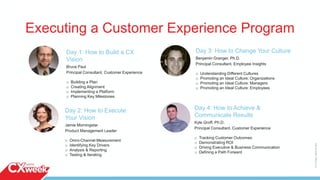
Executing a Customer Experience Program
Day 1: How to Build a CX
Vision
Bruce Paul
Principal Consultant, Customer Experience
o Building a Plan
o Creating Alignment
o Implementing a Platform
o Planning Key Milestones
Day 2: How to Execute
Your Vision
Jamie Morningstar
Product Management Leader
o Omni-Channel Measurement
o Identifying Key Drivers
o Analysis & Reporting
o Testing & Iterating
Day 3: How to Change Your Culture
Benjamin Granger, Ph.D.
Principal Consultant, Employee Insights
o Understanding Different Cultures
o Promoting an Ideal Culture: Organizations
o Promoting an Ideal Culture: Managers
o Promoting an Ideal Culture: Employees
Day 4: How to Achieve &
Communicate Results
Kyle Groff, Ph.D.
Principal Consultant, Customer Experience
o Tracking Customer Outcomes
o Demonstrating ROI
o Driving Executive & Business Communication
o Defining a Path Forward
©2015QUALTRICSLLC.
Jamie Morningstar
Product Manager
Jamie joined Qualtrics in 2014 to lead product
development for reporting, analytics, and customer
experience. Jamie comes with a strong background in
software engineering and product management and
led the product development launch team for
Qualtrics Vocalize.
©2015QUALTRICSLLC.
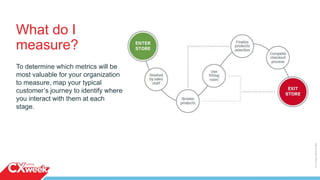
What do I
measure?
To determine which metrics will be
most valuable for your organization
to measure, map your typical
customer’s journey to identify where
you interact with them at each
stage.
©2015QUALTRICSLLC.
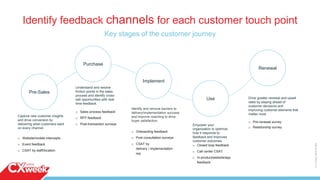
Identify feedback channels for each customer touch point
Key stages of the customer journey
Capture new customer insights
and drive conversion by
delivering what customers want
on every channel.
Understand and resolve
friction points in the sales
process and identify cross-
sell opportunities with real-
time feedback.
Identify and remove barriers to
delivery/implementation success
and improve coaching to drive
buyer satisfaction.
Empower your
organization to optimize
how it responds to
feedback and improves
customer outcomes.
Drive greater renewal and upsell
rates by staying ahead of
customer decisions and
improving customer elements that
matter most.
o Website/mobile intercepts
o Event feedback
o CSAT by staff/location
o Sales process feedback
o RFP feedback
o Post-transaction surveys
o Onboarding feedback
o Post consultation surveys
o CSAT by
delivery / implementation
rep
o Closed loop feedback
o Call center CSAT
o In-product/website/app
feedback
o Pre-renewal survey
o Relationship survey
Pre-Sales
Purchase
Implement
Use
Renewal
©2015QUALTRICSLLC.
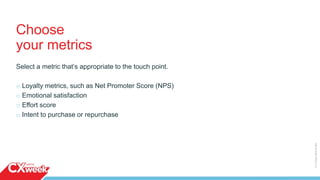
Choose
your metrics
Select a metric that’s appropriate to the touch point.
o Loyalty metrics, such as Net Promoter Score (NPS)
o Emotional satisfaction
o Effort score
o Intent to purchase or repurchase
©2015QUALTRICSLLC.
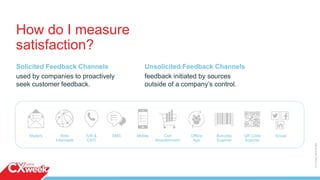
Solicited Feedback Channels
used by companies to proactively
seek customer feedback.
How do I measure
satisfaction?
Unsolicited Feedback Channels
feedback initiated by sources
outside of a company’s control.
Mailers Web
Intercepts
IVR &
CATI
SMS Mobile Cart
Abandonment
Offline
App
Barcode
Scanner
QR Code
Scanner
Social
©2015QUALTRICSLLC.
To test questions and channels, check reliability and validity.
o Reliability – Ensure that all questions are well-designed and
will collect reliable data. (e.g. No duplicate questions)
o Validity – How easy survey items are to understand and
analyze.
Test &
Iterate
©2015QUALTRICSLLC.
Survey Creation
Survey Distribution
Site Intercept
Demo:
Key Drivers
12
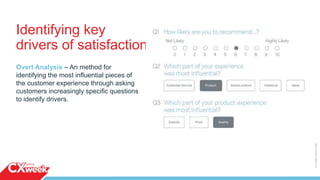
Overt Analysis – An method for
identifying the most influential pieces of
the customer experience through asking
customers increasingly specific questions
to identify drivers.
Identifying key
drivers of satisfaction
©2015QUALTRICSLLC.
13
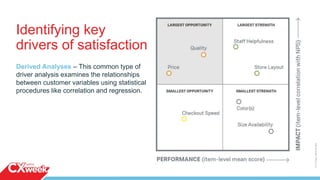
Derived Analyses – This common type of
driver analysis examines the relationships
between customer variables using statistical
procedures like correlation and regression.
Identifying key
drivers of satisfaction
©2015QUALTRICSLLC.
14
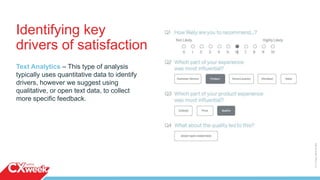
Text Analytics – This type of analysis
typically uses quantitative data to identify
drivers, however we suggest using
qualitative, or open text data, to collect
more specific feedback.
Identifying key
drivers of satisfaction
©2015QUALTRICSLLC.
Key Driver Analysis
Text Tools
Demo:
Dashboards
Real-time, relevant reporting
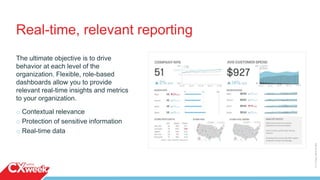
The ultimate objective is to drive
behavior at each level of the
organization. Flexible, role-based
dashboards allow you to provide
relevant real-time insights and metrics
to your organization.
o Contextual relevance
o Protection of sensitive information
o Real-time data
©2015QUALTRICSLLC.
18
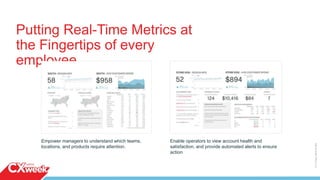
Putting Real-Time Metrics at
the Fingertips of every
employee
Empower managers to understand which teams,
locations, and products require attention.
Enable operators to view account health and
satisfaction, and provide automated alerts to ensure
action
©2015QUALTRICSLLC.
19
Reporting Frequency
Decide on your reporting channels. There’s a time and a place for
curated periodic reports and on-demand data.
o Dashboards
o Curated Reports
©2015QUALTRICSLLC.
Building Reports
Demo:
Taking Action
Take Action
Every great program is meant to drive action and change!
o Micro Opportunities – Make a difference on a small scale
o Macro Opportunities – Discover and drive large-scale changes
©2015QUALTRICSLLC.
Take Action
Micro Opportunities – The most straightforward customer
opportunity. Micro opportunities usually involve a single
customer with a negative experience.
o Can be as simple as refunding a purchase or issuing an
apology
©2015QUALTRICSLLC.
©2015QUALTRICSLLC.
25
©2015QUALTRICSLLC.
Take Action
Demo:
Triggers
Take Action
Macro Opportunities – Typically rely on a large amount of
quantitative feedback. Analytical and statistical methods are
critical for identifying macro opportunities.
o A poor NPS or CSAT might be examples of macro
opportunities.
o Macro opportunities can take significant time and financial
investments.
©2015QUALTRICSLLC.
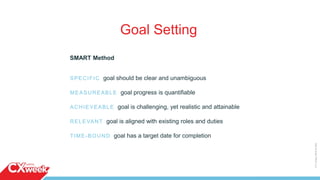
Goal Setting
SMART Method
SPECIFIC goal should be clear and unambiguous
MEASUREABLE goal progress is quantifiable
ACHIEVEABLE goal is challenging, yet realistic and attainable
RELEVANT goal is aligned with existing roles and duties
TIME-BOUND goal has a target date for completion
©2015QUALTRICSLLC.
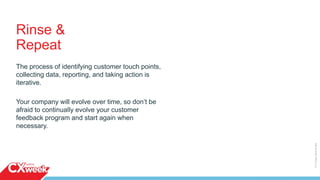
Rinse &
Repeat
The process of identifying customer touch points,
collecting data, reporting, and taking action is
iterative.
Your company will evolve over time, so don’t be
afraid to continually evolve your customer
feedback program and start again when
necessary.
©2015QUALTRICSLLC.
Q & A
32
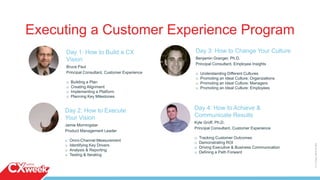
Executing a Customer Experience Program
Day 1: How to Build a CX
Vision
Bruce Paul
Principal Consultant, Customer Experience
o Building a Plan
o Creating Alignment
o Implementing a Platform
o Planning Key Milestones
Day 2: How to Execute
Your Vision
Jamie Morningstar
Product Management Leader
o Omni-Channel Measurement
o Identifying Key Drivers
o Analysis & Reporting
o Testing & Iterating
Day 3: How to Change Your Culture
Benjamin Granger, Ph.D.
Principal Consultant, Employee Insights
o Understanding Different Cultures
o Promoting an Ideal Culture: Organizations
o Promoting an Ideal Culture: Managers
o Promoting an Ideal Culture: Employees
Day 4: How to Achieve &
Communicate Results
Kyle Groff, Ph.D.
Principal Consultant, Customer Experience
o Tracking Customer Outcomes
o Demonstrating ROI
o Driving Executive & Business Communication
o Defining a Path Forward
©2015QUALTRICSLLC.
Thank You!

How To Execute Your Vision

  • 1.
    How to Execute YourCX Vision Jamie Morningstar Product Manager Qualtrics
  • 2.
    2 The recording andslides for today’s presentation will be made available on cxweek.com along with other content and webinars from throughout the week Please use the chat window to submit questions throughout the webinar, we will have time designated at the end for Q & A Join the conversation on Twitter by tweeting @Qualtrics using #cxweek Housekeeping ©2015QUALTRICSLLC.
  • 3.
    3 Executing a CustomerExperience Program Day 1: How to Build a CX Vision Bruce Paul Principal Consultant, Customer Experience o Building a Plan o Creating Alignment o Implementing a Platform o Planning Key Milestones Day 2: How to Execute Your Vision Jamie Morningstar Product Management Leader o Omni-Channel Measurement o Identifying Key Drivers o Analysis & Reporting o Testing & Iterating Day 3: How to Change Your Culture Benjamin Granger, Ph.D. Principal Consultant, Employee Insights o Understanding Different Cultures o Promoting an Ideal Culture: Organizations o Promoting an Ideal Culture: Managers o Promoting an Ideal Culture: Employees Day 4: How to Achieve & Communicate Results Kyle Groff, Ph.D. Principal Consultant, Customer Experience o Tracking Customer Outcomes o Demonstrating ROI o Driving Executive & Business Communication o Defining a Path Forward ©2015QUALTRICSLLC.
  • 4.
    Jamie Morningstar Product Manager Jamiejoined Qualtrics in 2014 to lead product development for reporting, analytics, and customer experience. Jamie comes with a strong background in software engineering and product management and led the product development launch team for Qualtrics Vocalize. ©2015QUALTRICSLLC.
  • 5.
    What do I measure? Todetermine which metrics will be most valuable for your organization to measure, map your typical customer’s journey to identify where you interact with them at each stage. ©2015QUALTRICSLLC.
  • 6.
    Identify feedback channelsfor each customer touch point Key stages of the customer journey Capture new customer insights and drive conversion by delivering what customers want on every channel. Understand and resolve friction points in the sales process and identify cross- sell opportunities with real- time feedback. Identify and remove barriers to delivery/implementation success and improve coaching to drive buyer satisfaction. Empower your organization to optimize how it responds to feedback and improves customer outcomes. Drive greater renewal and upsell rates by staying ahead of customer decisions and improving customer elements that matter most. o Website/mobile intercepts o Event feedback o CSAT by staff/location o Sales process feedback o RFP feedback o Post-transaction surveys o Onboarding feedback o Post consultation surveys o CSAT by delivery / implementation rep o Closed loop feedback o Call center CSAT o In-product/website/app feedback o Pre-renewal survey o Relationship survey Pre-Sales Purchase Implement Use Renewal ©2015QUALTRICSLLC.
  • 7.
    Choose your metrics Select ametric that’s appropriate to the touch point. o Loyalty metrics, such as Net Promoter Score (NPS) o Emotional satisfaction o Effort score o Intent to purchase or repurchase ©2015QUALTRICSLLC.
  • 8.
    Solicited Feedback Channels usedby companies to proactively seek customer feedback. How do I measure satisfaction? Unsolicited Feedback Channels feedback initiated by sources outside of a company’s control. Mailers Web Intercepts IVR & CATI SMS Mobile Cart Abandonment Offline App Barcode Scanner QR Code Scanner Social ©2015QUALTRICSLLC.
  • 9.
    To test questionsand channels, check reliability and validity. o Reliability – Ensure that all questions are well-designed and will collect reliable data. (e.g. No duplicate questions) o Validity – How easy survey items are to understand and analyze. Test & Iterate ©2015QUALTRICSLLC.
  • 10.
  • 11.
  • 12.
    12 Overt Analysis –An method for identifying the most influential pieces of the customer experience through asking customers increasingly specific questions to identify drivers. Identifying key drivers of satisfaction ©2015QUALTRICSLLC.
  • 13.
    13 Derived Analyses –This common type of driver analysis examines the relationships between customer variables using statistical procedures like correlation and regression. Identifying key drivers of satisfaction ©2015QUALTRICSLLC.
  • 14.
    14 Text Analytics –This type of analysis typically uses quantitative data to identify drivers, however we suggest using qualitative, or open text data, to collect more specific feedback. Identifying key drivers of satisfaction ©2015QUALTRICSLLC.
  • 15.
  • 16.
  • 17.
    Real-time, relevant reporting Theultimate objective is to drive behavior at each level of the organization. Flexible, role-based dashboards allow you to provide relevant real-time insights and metrics to your organization. o Contextual relevance o Protection of sensitive information o Real-time data ©2015QUALTRICSLLC.
  • 18.
    18 Putting Real-Time Metricsat the Fingertips of every employee Empower managers to understand which teams, locations, and products require attention. Enable operators to view account health and satisfaction, and provide automated alerts to ensure action ©2015QUALTRICSLLC.
  • 19.
    19 Reporting Frequency Decide onyour reporting channels. There’s a time and a place for curated periodic reports and on-demand data. o Dashboards o Curated Reports ©2015QUALTRICSLLC.
  • 20.
  • 21.
  • 22.
    Take Action Every greatprogram is meant to drive action and change! o Micro Opportunities – Make a difference on a small scale o Macro Opportunities – Discover and drive large-scale changes ©2015QUALTRICSLLC.
  • 23.
    Take Action Micro Opportunities– The most straightforward customer opportunity. Micro opportunities usually involve a single customer with a negative experience. o Can be as simple as refunding a purchase or issuing an apology ©2015QUALTRICSLLC.
  • 24.
  • 25.
  • 26.
  • 27.
  • 28.
    Take Action Macro Opportunities– Typically rely on a large amount of quantitative feedback. Analytical and statistical methods are critical for identifying macro opportunities. o A poor NPS or CSAT might be examples of macro opportunities. o Macro opportunities can take significant time and financial investments. ©2015QUALTRICSLLC.
  • 29.
    Goal Setting SMART Method SPECIFICgoal should be clear and unambiguous MEASUREABLE goal progress is quantifiable ACHIEVEABLE goal is challenging, yet realistic and attainable RELEVANT goal is aligned with existing roles and duties TIME-BOUND goal has a target date for completion ©2015QUALTRICSLLC.
  • 30.
    Rinse & Repeat The processof identifying customer touch points, collecting data, reporting, and taking action is iterative. Your company will evolve over time, so don’t be afraid to continually evolve your customer feedback program and start again when necessary. ©2015QUALTRICSLLC.
  • 31.
  • 32.
    32 Executing a CustomerExperience Program Day 1: How to Build a CX Vision Bruce Paul Principal Consultant, Customer Experience o Building a Plan o Creating Alignment o Implementing a Platform o Planning Key Milestones Day 2: How to Execute Your Vision Jamie Morningstar Product Management Leader o Omni-Channel Measurement o Identifying Key Drivers o Analysis & Reporting o Testing & Iterating Day 3: How to Change Your Culture Benjamin Granger, Ph.D. Principal Consultant, Employee Insights o Understanding Different Cultures o Promoting an Ideal Culture: Organizations o Promoting an Ideal Culture: Managers o Promoting an Ideal Culture: Employees Day 4: How to Achieve & Communicate Results Kyle Groff, Ph.D. Principal Consultant, Customer Experience o Tracking Customer Outcomes o Demonstrating ROI o Driving Executive & Business Communication o Defining a Path Forward ©2015QUALTRICSLLC.
  • 33.

Editor's Notes

  • #4 (see page 7 of Ultimate Guide) Micro: identifying issues and solving right away—a hotel guest who had a bad meal in the hotel. Following up involves creating formal or informal processes and workflows to follow up. Call it closing the loop or case management, it can be as simple as a manager talking to the front line staff or an email generated to the sales rep or service manager. Macro: Something that re-occurs. Like long lines in a particular retail shop or bank branch Takes large scale change Best practices: give one person the responsibility and authority to make it better External: how do we learn what they think Customers do not always tell us about problems, they just leave (especially in the midwest and the south) Have seen as high as 30% problems, and 29% cross sell opptys No brainer ROI case Internal: criticism is a gift because we can react Worst case scenario is not reacting, or reacting poorly. How do you build an organization that is CAPABLE of serving customers? Not all companies are capable.
  • #6 Before you begin mapping, you’ll need to decide which mapping approach you want to take. Many journey mappers start by producing a rough draft on their own or with the help of a small team and solicit feedback on that draft. Others aim to create a holistic journey mapping team from the beginning and aim to take one run through the exercise. Either method is fine as long as the end product has received input from the necessary parties. Ideally, you want a customer journey map that has been vetted by members from all applicable areas of a company and actual customers. Once you have solidified your strategy you can start the actual exercise by identifying your most common type of customer. Customer types are often referred to as personas and any organization could potentially have several personas. However, I suggest focusing on the most common customer persona. With your journey map complete, we now move to identifying what you need to know about each touch point.
  • #7 Journey stage + event + priority + channel Prioritize the channels that will be most impactful for your company Determine when you will measure for each touchpoint You may need to measure more than once at each touchpoint Beware of burnout and over surveying
  • #8  Talk track: Unfortunately, people often overlook this step in building a VoC program. The purpose of this step is to actually test the performance of the questions and channels you designated in the previous steps. When gauging the performance of your survey questions there are two key factors to check: reliability and validity. Reliability is important if you’re asking groups of questions relevant to a similar topic. For example, if you have a group of four survey items aimed at gauging website design you would want to test to see if those items are, in fact, reliably measuring the construct of website design satisfaction. Poor reliability signifies that the items may be poorly designed and you should either consider revising items or remove items that are the least reliable.
  • #9 Focus on execution – nuts and bolts of the decisions you need to make We know the touchpoints, how do we choose an appropriate channel for each?
  • #10  Talk track: Unfortunately, people often overlook this step in building a VoC program. The purpose of this step is to actually test the performance of the questions and channels you designated in the previous steps. When gauging the performance of your survey questions there are two key factors to check: reliability and validity. Reliability is important if you’re asking groups of questions relevant to a similar topic. For example, if you have a group of four survey items aimed at gauging website design you would want to test to see if those items are, in fact, reliably measuring the construct of website design satisfaction. Poor reliability signifies that the items may be poorly designed and you should either consider revising items or remove items that are the least reliable.
  • #11 Survey creation, Distribution, Intercepts
  • #12 Survey creation, Distribution, Intercepts
  • #13 Part of your testing is asking only the most important questions – and part of testing is discovering the key impacts to customer experience... Talk track: Overt analysis is an explicit method for identifying the most influential pieces of the customer experience. Overt methods help you avoid complicated stats while you’re identifying key drivers. To construct a overt driver analysis survey, start by including some high-level outcome metric such as NPS. Follow this with a second question that contains high-level touchpoint choices for the customer to choose from. Finally, end with granular options for each of the high-level touchpoints. Feel free to be very granular in the final questions as branching logic will limit customer exposure to the deluge of options.
  • #14  Talk Track: [Jamie explains how this would work] (could be a demo opp)
  • #15 Find key drivers by asking... And by listening... (esp good to find blindspots) Talk Track: Using qualitative feedback in conjunction with quantitative feedback provides coverage of topics and issues that may otherwise go unmeasured or unnoticed. As discussed previously, there are limits on how much quantitative feedback can reasonably be collected at a single point of measurement. This results in compromises where topic coverage is concerned. Qualitative feedback is a great way to circumvent this shortcoming.
  • #16 Text tools > key driver
  • #17 Text tools > key driver
  • #18 Call back to channel discussion – survey distribution needs its own channel decisions, and report distribution does, too! Push or pull (on demand) or both! Consider channel – presentation, memo that you walk around, online, scheduled email (store manager needs different channel to get and discuss with team than a call center supervisor behind a computer vs. On the go exec who wants to get info anywhere vs CEO who expects a monthly summary)
  • #19 Call back to channel discussion – survey distribution needs its own channel decisions, and report distribution does, too! Push or pull (on demand) or both! Consider channel – presentation, memo that you walk around, online, scheduled email (store manager needs different channel to get and discuss with team than a call center supervisor behind a computer vs. On the go exec who wants to get info anywhere vs CEO who expects a monthly summary)
  • #20 Call back to channel discussion – survey distribution needs its own channel decisions, and report distribution does, too! Push or pull (on demand) or both! Consider channel – presentation, memo that you walk around, online, scheduled email (store manager needs different channel to get and discuss with team than a call center supervisor behind a computer vs. On the go exec who wants to get info anywhere vs CEO who expects a monthly summary)
  • #21 Vocalize flexibility, roles, export options, scheduled emails
  • #22 Vocalize flexibility, roles, export options, scheduled emails
  • #23 Every great program is around to change something – from an exercise program to a customer experience program, we engage in these activities because we want to see change. The final step in creating a voice of the customer program focuses on addressing opportunities. For companies that are quick to adopt customer-focused goals, having an action process on the back end is an important step to ensure you’re making progress towards those goals. When referring to an action process there are two primary categories: micro-level and macro-level opportunities.
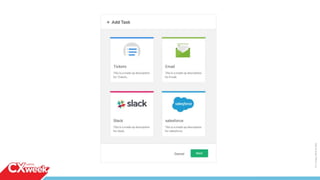
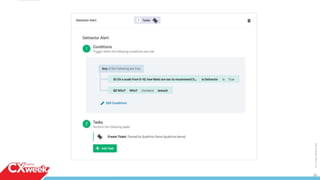
  • #24 Talk track: Addressing micro issues can be as simple as refunding a purchase or issuing an apology. The only prerequisites for closing the loop is a set process defining what customers will be engaged (e.g., detractors), a channel to flag customers that meet the engagement criteria (e.g., survey distribution platform) and a tool capable of tracking customers as they go through the closed loop process (e.g., ticketing system).
  • #27 Focus on micro, tease to macro with root cause, slide for triggering
  • #28 Focus on micro, tease to macro with root cause, slide for triggering
  • #29 Talk track: The final step in creating a voice of the customer program focuses on addressing opportunities. For companies that are quick to adopt customer-focused goals, having an action process on the back end is an important step to ensure you’re making progress towards those goals. When referring to an action process there are two primary categories: micro-level and macro-level opportunities.
  • #30 talk track: Measuring the right things in the right way and distributing customer data to the right people in a way that is meaningful to them are all necessary elements of creating buy-in. However, to take the next step towards company-wide buy-in you need some type of formalized goal setting focused on the customer experience. With a systematic and proven goal setting framework in place, you can eliminate the confusion that often surrounds goal setting processes. The most widely used framework is referred to as the SMART method.
  • #33 (see page 7 of Ultimate Guide) Micro: identifying issues and solving right away—a hotel guest who had a bad meal in the hotel. Following up involves creating formal or informal processes and workflows to follow up. Call it closing the loop or case management, it can be as simple as a manager talking to the front line staff or an email generated to the sales rep or service manager. Macro: Something that re-occurs. Like long lines in a particular retail shop or bank branch Takes large scale change Best practices: give one person the responsibility and authority to make it better External: how do we learn what they think Customers do not always tell us about problems, they just leave (especially in the midwest and the south) Have seen as high as 30% problems, and 29% cross sell opptys No brainer ROI case Internal: criticism is a gift because we can react Worst case scenario is not reacting, or reacting poorly. How do you build an organization that is CAPABLE of serving customers? Not all companies are capable.