


www.hrgazette.com                                Mary E. Wright, Editor


                      How To Deliver a
                      Verbal Warning
                           With Talking Points


             Your personal shopper for HR news!
A disciplinary action by a
 What is a
 “verbal warning?
                    supervisor to a subordinate
 Verbal Warning     employee.
                    a) Verbally identifies observed
                       performance deficiencies or
                       misconduct.
                    b) Communicates performance
                       expectations.
                    c) Delivers notice of consequences
                       for failure to improve and/or
                       meet expectations


www.hrgazette.com                         Mary E. Wright, Editor
The purpose of a verbal
 What is the purpose of a
 “verbal warning?”
                            warning is to:
 Verbal Warning             a) provide notice to an employee
                               that they are not meeting
                               employer expectations and that
                               there could be disciplinary
                               consequences for failure to
                               improve.
                            b) correct or change observed
                               behavior.


www.hrgazette.com                                Mary E. Wright, Editor
An employee’s direct
 Who gives the
 “verbal warning?”
                     supervisor typically gives a
 Verbal Warning      verbal warning.
                     a) It may, however, be given by any
                        agent of the employer in a
                        superior position to the
                        employee.
                     b) The warning should be given in
                        private. Unless given in an
                        emergency situation.


www.hrgazette.com                          Mary E. Wright, Editor
The supervisor should :
 What is said in the   a) identify misconduct or
 “verbal warning?”        performance deficiencies
 Verbal Warning           observed.
                       b) communicate that the conduct
                          violates policy, constitutes
                          misconduct or demonstrates
                          inadequate performance.
                       c) request improvement within a
                          certain period, i.e., immediate,
                          sustained improvement within
                          the next 30 days, etc., and
                       d) identify the specific
                          consequences of failure to meet
                          expectations.


www.hrgazette.com                            Mary E. Wright, Editor
The verbal warning should
 What is said in the
 “verbal warning?”
                       identify the manner or means
 Verbal Warning        for correcting behavior. For
                       instance requesting the
                       employee:
                       a) obtain further training or
                          instruction,
                       b) engage in constructive
                          conversation with coworkers or
                       c) improve work habits or ethics.


www.hrgazette.com                            Mary E. Wright, Editor
Should the employer    Yes. Always. Make a written
 document the “verbal
 warning?”
                        record of:
 Verbal Warning         a) performance deficiency or
                           misconduct observed,
                        b) time and place of the
                           observation,
                        c) what was said to (and by) the
                           employee, and when, and
                        d) the time frame given for
                           improvement.


www.hrgazette.com                             Mary E. Wright, Editor
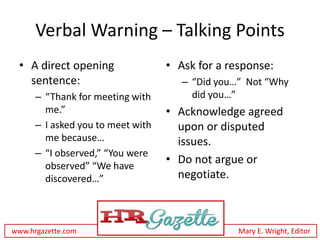
Verbal Warning – Talking Points
 • A direct opening                • Ask for a response:
   sentence:                          – “Did you…” Not “Why
      – “Thank for meeting with         did you…”
        me.”                       • Acknowledge agreed
      – I asked you to meet with     upon or disputed
        me because…                  issues.
      – “I observed,” “You were
        observed” “We have
                                   • Do not argue or
        discovered…”                 negotiate.


www.hrgazette.com                                Mary E. Wright, Editor
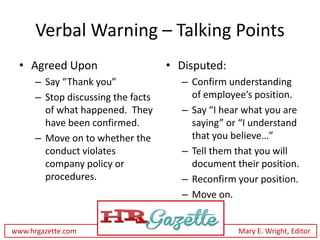
Verbal Warning – Talking Points
 • Agreed Upon                      • Disputed:
      – Say “Thank you”               – Confirm understanding
      – Stop discussing the facts       of employee’s position.
        of what happened. They        – Say “I hear what you are
        have been confirmed.            saying” or “I understand
      – Move on to whether the          that you believe…”
        conduct violates              – Tell them that you will
        company policy or               document their position.
        procedures.                   – Reconfirm your position.
                                      – Move on.


www.hrgazette.com                                 Mary E. Wright, Editor
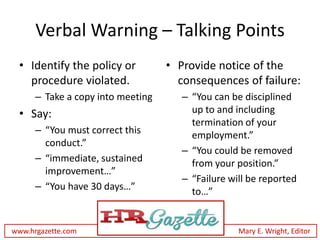
Verbal Warning – Talking Points
 • Identify the policy or          • Provide notice of the
   procedure violated.               consequences of failure:
      – Take a copy into meeting      – “You can be disciplined
 • Say:                                 up to and including
                                        termination of your
      – “You must correct this          employment.”
        conduct.”
                                      – “You could be removed
      – “immediate, sustained           from your position.”
        improvement…”
                                      – “Failure will be reported
      – “You have 30 days…”             to…”


www.hrgazette.com                                  Mary E. Wright, Editor
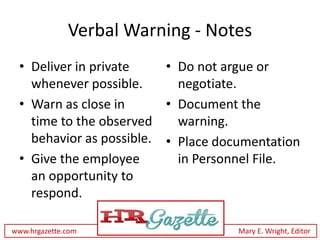
Verbal Warning - Notes
 • Deliver in private    • Do not argue or
   whenever possible.      negotiate.
 • Warn as close in      • Document the
   time to the observed    warning.
   behavior as possible. • Place documentation
 • Give the employee       in Personnel File.
   an opportunity to
   respond.

www.hrgazette.com                   Mary E. Wright, Editor
www.hrgazette.com                                  Mary E. Wright, Editor


                      Of course, nothing is ever that easy.
                      There are all sorts of factual twists that can
                      change the way this material applies in
                      your particular situation.

                      Email questions or comments to:
                      Mary Wright, Editor, HR Gazette


             Your personal shopper for HR news!
www.hrgazette.com                                        Mary E. Wright, Editor


                     Ubiquitous Disclaimer
                     HR Gazette does not provide legal advice.
                     The content of this slide deck is for
                     informational purposes only. Before using
                     this information – or any information you
                     get over the Internet – consult your lawyer.

                         Nothing takes the place of advice from a
                         lawyer who knows you and your business,
                         and who understands the laws of the state
                         in which your business is located.


             Your personal shopper for HR news!

How to Deliver a Verbal Warning to an Employee (Plus Talking Points)

  • 1.
    www.hrgazette.com Mary E. Wright, Editor How To Deliver a Verbal Warning With Talking Points Your personal shopper for HR news!
  • 2.
    A disciplinary actionby a What is a “verbal warning? supervisor to a subordinate Verbal Warning employee. a) Verbally identifies observed performance deficiencies or misconduct. b) Communicates performance expectations. c) Delivers notice of consequences for failure to improve and/or meet expectations www.hrgazette.com Mary E. Wright, Editor
  • 3.
    The purpose ofa verbal What is the purpose of a “verbal warning?” warning is to: Verbal Warning a) provide notice to an employee that they are not meeting employer expectations and that there could be disciplinary consequences for failure to improve. b) correct or change observed behavior. www.hrgazette.com Mary E. Wright, Editor
  • 4.
    An employee’s direct Who gives the “verbal warning?” supervisor typically gives a Verbal Warning verbal warning. a) It may, however, be given by any agent of the employer in a superior position to the employee. b) The warning should be given in private. Unless given in an emergency situation. www.hrgazette.com Mary E. Wright, Editor
  • 5.
    The supervisor should: What is said in the a) identify misconduct or “verbal warning?” performance deficiencies Verbal Warning observed. b) communicate that the conduct violates policy, constitutes misconduct or demonstrates inadequate performance. c) request improvement within a certain period, i.e., immediate, sustained improvement within the next 30 days, etc., and d) identify the specific consequences of failure to meet expectations. www.hrgazette.com Mary E. Wright, Editor
  • 6.
    The verbal warningshould What is said in the “verbal warning?” identify the manner or means Verbal Warning for correcting behavior. For instance requesting the employee: a) obtain further training or instruction, b) engage in constructive conversation with coworkers or c) improve work habits or ethics. www.hrgazette.com Mary E. Wright, Editor
  • 7.
    Should the employer Yes. Always. Make a written document the “verbal warning?” record of: Verbal Warning a) performance deficiency or misconduct observed, b) time and place of the observation, c) what was said to (and by) the employee, and when, and d) the time frame given for improvement. www.hrgazette.com Mary E. Wright, Editor
  • 8.
    Verbal Warning –Talking Points • A direct opening • Ask for a response: sentence: – “Did you…” Not “Why – “Thank for meeting with did you…” me.” • Acknowledge agreed – I asked you to meet with upon or disputed me because… issues. – “I observed,” “You were observed” “We have • Do not argue or discovered…” negotiate. www.hrgazette.com Mary E. Wright, Editor
  • 9.
    Verbal Warning –Talking Points • Agreed Upon • Disputed: – Say “Thank you” – Confirm understanding – Stop discussing the facts of employee’s position. of what happened. They – Say “I hear what you are have been confirmed. saying” or “I understand – Move on to whether the that you believe…” conduct violates – Tell them that you will company policy or document their position. procedures. – Reconfirm your position. – Move on. www.hrgazette.com Mary E. Wright, Editor
  • 10.
    Verbal Warning –Talking Points • Identify the policy or • Provide notice of the procedure violated. consequences of failure: – Take a copy into meeting – “You can be disciplined • Say: up to and including termination of your – “You must correct this employment.” conduct.” – “You could be removed – “immediate, sustained from your position.” improvement…” – “Failure will be reported – “You have 30 days…” to…” www.hrgazette.com Mary E. Wright, Editor
  • 11.
    Verbal Warning -Notes • Deliver in private • Do not argue or whenever possible. negotiate. • Warn as close in • Document the time to the observed warning. behavior as possible. • Place documentation • Give the employee in Personnel File. an opportunity to respond. www.hrgazette.com Mary E. Wright, Editor
  • 12.
    www.hrgazette.com Mary E. Wright, Editor Of course, nothing is ever that easy. There are all sorts of factual twists that can change the way this material applies in your particular situation. Email questions or comments to: Mary Wright, Editor, HR Gazette Your personal shopper for HR news!
  • 13.
    www.hrgazette.com Mary E. Wright, Editor Ubiquitous Disclaimer HR Gazette does not provide legal advice. The content of this slide deck is for informational purposes only. Before using this information – or any information you get over the Internet – consult your lawyer. Nothing takes the place of advice from a lawyer who knows you and your business, and who understands the laws of the state in which your business is located. Your personal shopper for HR news!