





Title
Subtitle
Presenter – Instructor Name
How to Crack CFA Level 1 Exam!
Presenter – Ankur Kulshrestha
Slide 2 www.edureka.co/cfa-level1
What will you learn today…?
 The Instructors- Led by FinStudyClub Powered by Wiley
 CFA Level 1 Introduction
 Who should write it?
 How to prepare for it?
 The Refresher Course: Your Success Mantra
 Sample Class: FRA: Cash Flow Statement (R27)
 Q & A Sessions
Slide 3 www.edureka.co/cfa-level1Slide 3
The Instructors
 Ankur is a veteran CFA trainer- 7 years, 70 batches of training experience
 Has worked in Corporate Finance (Suzuki), in consulting (E&Y), valuation assignments
 Is a serial ranker- University, Chartered Accountancy and is a swimming buff
 Domain specialist- FRA, Corporate Finance, Equity, Ethics
 Dabbled with corporate banking, equity research and strategic finance
 Taught finance, accountancy, cost accounting, mathematics…know bit of everything
 Aced various exams and doing so, discovered my strength
 Help students prepare and crack exams! CA, CFA, FRM, MBA…am there
Amit Parakh-CFA, ACA, CS, FRM,
PGDM (IIM A)
Ankur Kulshrestha, CFA, ACA
Powered by
Slide 4 www.edureka.co/cfa-level1Slide 4
CFA Level 1 Introduction
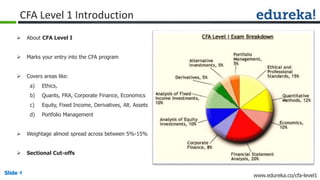
 About CFA Level I
 Marks your entry into the CFA program
 Covers areas like:
a) Ethics,
b) Quants, FRA, Corporate Finance, Economics
c) Equity, Fixed Income, Derivatives, Alt. Assets
d) Portfolio Management
 Weightage almost spread across between 5%-15%
 Sectional Cut-offs
Slide 5 www.edureka.co/cfa-level1Slide 5
CFA Level 1 Introduction (Contd.)
 What is the exam like?
 Level I has two paper- AM and PM
 MCQs. Nothing to lose.
 120 questions. 180 minutes. Game on.
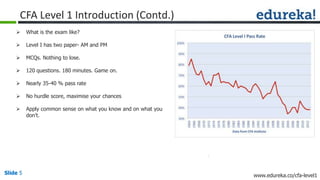
 Nearly 35-40 % pass rate
 No hurdle score, maximise your chances
 Apply common sense on what you know and on what you
don’t.
Slide 6 www.edureka.co/cfa-level1Slide 6
Who should write the exam?
 Are you interested in the investment industry?
 Are you in the final year of your college?
 Want to get into banking/investment/ research/ investment banking profile?
 Looking out for the best self study course in finance?
 Your passport for international investment industry
 Gold Standard
Slide 7 www.edureka.co/cfa-level1Slide 7
How to prepare for the exam?
 350-400 hours is good. And a day has 24 hours!
 Spread it across 2 months
 Take along a few topics
 Watch and listen to the Video tutorials
 Back to back practice
Slide 8 www.edureka.co/cfa-level1Slide 8
The Refresher Course: Your Success Mantra
 8 weekends, 50 hours of face-time with expert trainers from
 Live Webinars on Crucial topics across all subjects: 80:20 rule
 Accompanied with lots of practical examples
 ‘Not-so-important’ topics also covered through online recorded tutorials: Comprehensive Coverage
 Includes Wiley’s Test bank with more than 500 Qs. & Two Mock Exam: Exam Oriented
Powered by
Slide 9 www.edureka.co/cfa-level1Slide 9
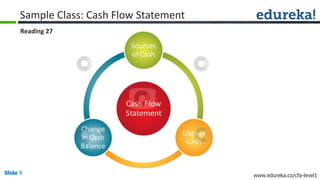
Sample Class: Cash Flow Statement
Reading 27
Slide 10 www.edureka.co/cfa-level1
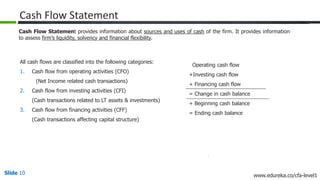
Cash Flow Statement
Cash Flow Statement provides information about sources and uses of cash of the firm. It provides information
to assess firm’s liquidity, solvency and financial flexibility.
All cash flows are classified into the following categories:
1. Cash flow from operating activities (CFO)
(Net Income related cash transactions)
2. Cash flow from investing activities (CFI)
(Cash transactions related to LT assets & investments)
3. Cash flow from financing activities (CFF)
(Cash transactions affecting capital structure)
Operating cash flow
+Investing cash flow
+ Financing cash flow
= Change in cash balance
+ Beginning cash balance
= Ending cash balance
Slide 11 www.edureka.co/cfa-level1
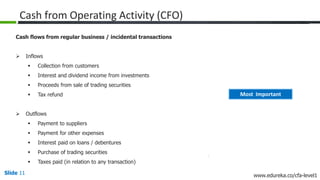
Cash from Operating Activity (CFO)
Cash flows from regular business / incidental transactions
 Inflows
 Collection from customers
 Interest and dividend income from investments
 Proceeds from sale of trading securities
 Tax refund
 Outflows
 Payment to suppliers
 Payment for other expenses
 Interest paid on loans / debentures
 Purchase of trading securities
 Taxes paid (in relation to any transaction)
Most Important
Slide 12 www.edureka.co/cfa-level1
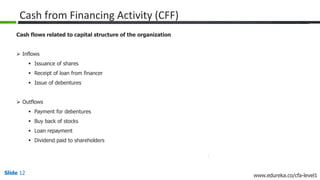
Cash from Financing Activity (CFF)
Cash flows related to capital structure of the organization
 Inflows
 Issuance of shares
 Receipt of loan from financer
 Issue of debentures
 Outflows
 Payment for debentures
 Buy back of stocks
 Loan repayment
 Dividend paid to shareholders
Slide 13 www.edureka.co/cfa-level1
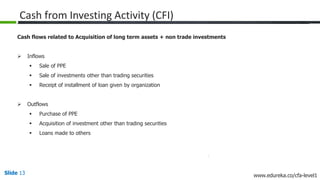
Cash from Investing Activity (CFI)
Cash flows related to Acquisition of long term assets + non trade investments
 Inflows
 Sale of PPE
 Sale of investments other than trading securities
 Receipt of installment of loan given by organization
 Outflows
 Purchase of PPE
 Acquisition of investment other than trading securities
 Loans made to others
Slide 14 www.edureka.co/cfa-level1
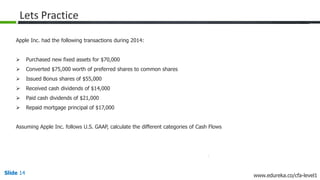
Lets Practice
Apple Inc. had the following transactions during 2014:
 Purchased new fixed assets for $70,000
 Converted $75,000 worth of preferred shares to common shares
 Issued Bonus shares of $55,000
 Received cash dividends of $14,000
 Paid cash dividends of $21,000
 Repaid mortgage principal of $17,000
Assuming Apple Inc. follows U.S. GAAP, calculate the different categories of Cash Flows
Slide 15 www.edureka.co/cfa-level1
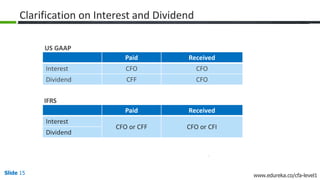
Clarification on Interest and Dividend
Paid Received
Interest CFO CFO
Dividend CFF CFO
Paid Received
Interest
CFO or CFF CFO or CFI
Dividend
US GAAP
IFRS
Slide 16 www.edureka.co/cfa-level1
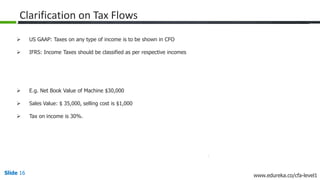
Clarification on Tax Flows
 US GAAP: Taxes on any type of income is to be shown in CFO
 IFRS: Income Taxes should be classified as per respective incomes
 E.g. Net Book Value of Machine $30,000
 Sales Value: $ 35,000, selling cost is $1,000
 Tax on income is 30%.
Slide 17 www.edureka.co/cfa-level1
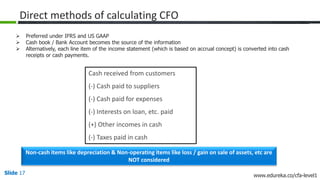
Direct methods of calculating CFO
Cash received from customers
(-) Cash paid to suppliers
(-) Cash paid for expenses
(-) Interests on loan, etc. paid
(+) Other incomes in cash
(-) Taxes paid in cash
Non-cash items like depreciation & Non-operating items like loss / gain on sale of assets, etc are
NOT considered
 Preferred under IFRS and US GAAP
 Cash book / Bank Account becomes the source of the information
 Alternatively, each line item of the income statement (which is based on accrual concept) is converted into cash
receipts or cash payments.
Slide 18 www.edureka.co/cfa-level1
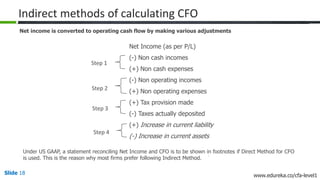
Indirect methods of calculating CFO
Net income is converted to operating cash flow by making various adjustments
Net Income (as per P/L)
(-) Non cash incomes
(+) Non cash expenses
(-) Non operating incomes
(+) Non operating expenses
(+) Tax provision made
(-) Taxes actually deposited
(+) Increase in current liability
(-) Increase in current assets
Step 1
Step 2
Step 3
Step 4
Under US GAAP, a statement reconciling Net Income and CFO is to be shown in footnotes if Direct Method for CFO
is used. This is the reason why most firms prefer following Indirect Method.
Slide 19 www.edureka.co/cfa-level1
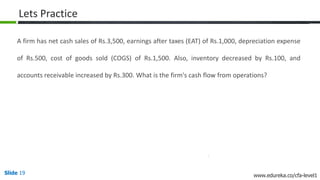
Lets Practice
A firm has net cash sales of Rs.3,500, earnings after taxes (EAT) of Rs.1,000, depreciation expense
of Rs.500, cost of goods sold (COGS) of Rs.1,500. Also, inventory decreased by Rs.100, and
accounts receivable increased by Rs.300. What is the firm's cash flow from operations?
Slide 20 www.edureka.co/cfa-level1
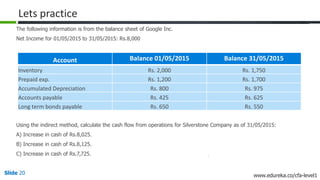
Lets practice
The following information is from the balance sheet of Google Inc.
Net Income for 01/05/2015 to 31/05/2015: Rs.8,000
Using the indirect method, calculate the cash flow from operations for Silverstone Company as of 31/05/2015:
A) Increase in cash of Rs.8,025.
B) Increase in cash of Rs.8,125.
C) Increase in cash of Rs.7,725.
Account Balance 01/05/2015 Balance 31/05/2015
Inventory Rs. 2,000 Rs. 1,750
Prepaid exp. Rs. 1,200 Rs. 1,700
Accumulated Depreciation Rs. 800 Rs. 975
Accounts payable Rs. 425 Rs. 625
Long term bonds payable Rs. 650 Rs. 550
Slide 21 www.edureka.co/cfa-level1
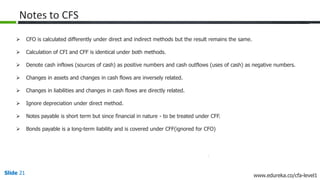
Notes to CFS
 CFO is calculated differently under direct and indirect methods but the result remains the same.
 Calculation of CFI and CFF is identical under both methods.
 Denote cash inflows (sources of cash) as positive numbers and cash outflows (uses of cash) as negative numbers.
 Changes in assets and changes in cash flows are inversely related.
 Changes in liabilities and changes in cash flows are directly related.
 Ignore depreciation under direct method.
 Notes payable is short term but since financial in nature - to be treated under CFF.
 Bonds payable is a long-term liability and is covered under CFF(ignored for CFO)
Slide 22 www.edureka.co/cfa-level1
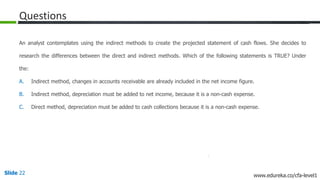
Questions
An analyst contemplates using the indirect methods to create the projected statement of cash flows. She decides to
research the differences between the direct and indirect methods. Which of the following statements is TRUE? Under
the:
A. Indirect method, changes in accounts receivable are already included in the net income figure.
B. Indirect method, depreciation must be added to net income, because it is a non-cash expense.
C. Direct method, depreciation must be added to cash collections because it is a non-cash expense.
Slide 23 www.edureka.co/cfa-level1
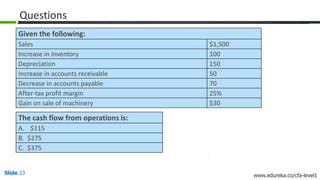
Questions
Given the following:
Sales $1,500
Increase in Inventory 100
Depreciation 150
Increase in accounts receivable 50
Decrease in accounts payable 70
After-tax profit margin 25%
Gain on sale of machinery $30
The cash flow from operations is:
A. $115
B. $275
C. $375
Certifications
CFA level 1 Exam
Edureka's Refresher course for CFA Level 1 course:
• Refresher course on CFA Level I Exam focuses on the ten topic areas and prepares you to write the CFA
Level 1 Exam
• Online Live Courses: 50 hours
• Assignments: 15 hours
• Lifetime Access + 24 X 7 Support
Go to www.edureka.co/cfa-level1
Batch starts from 10th October (Weekend Batch)
Timings: 6:00PM to 9:00PM
Wiley's Study Guide Worth INR 30,000 Free!
How Edureka course will help you scale up your career
Thank You
Questions/Queries/Feedback
Recording and presentation will be made available to you within 24 hours

How to crack CFA level 1 Exam

  • 1.
    Title Subtitle Presenter – InstructorName How to Crack CFA Level 1 Exam! Presenter – Ankur Kulshrestha
  • 2.
    Slide 2 www.edureka.co/cfa-level1 Whatwill you learn today…?  The Instructors- Led by FinStudyClub Powered by Wiley  CFA Level 1 Introduction  Who should write it?  How to prepare for it?  The Refresher Course: Your Success Mantra  Sample Class: FRA: Cash Flow Statement (R27)  Q & A Sessions
  • 3.
    Slide 3 www.edureka.co/cfa-level1Slide3 The Instructors  Ankur is a veteran CFA trainer- 7 years, 70 batches of training experience  Has worked in Corporate Finance (Suzuki), in consulting (E&Y), valuation assignments  Is a serial ranker- University, Chartered Accountancy and is a swimming buff  Domain specialist- FRA, Corporate Finance, Equity, Ethics  Dabbled with corporate banking, equity research and strategic finance  Taught finance, accountancy, cost accounting, mathematics…know bit of everything  Aced various exams and doing so, discovered my strength  Help students prepare and crack exams! CA, CFA, FRM, MBA…am there Amit Parakh-CFA, ACA, CS, FRM, PGDM (IIM A) Ankur Kulshrestha, CFA, ACA Powered by
  • 4.
    Slide 4 www.edureka.co/cfa-level1Slide4 CFA Level 1 Introduction  About CFA Level I  Marks your entry into the CFA program  Covers areas like: a) Ethics, b) Quants, FRA, Corporate Finance, Economics c) Equity, Fixed Income, Derivatives, Alt. Assets d) Portfolio Management  Weightage almost spread across between 5%-15%  Sectional Cut-offs
  • 5.
    Slide 5 www.edureka.co/cfa-level1Slide5 CFA Level 1 Introduction (Contd.)  What is the exam like?  Level I has two paper- AM and PM  MCQs. Nothing to lose.  120 questions. 180 minutes. Game on.  Nearly 35-40 % pass rate  No hurdle score, maximise your chances  Apply common sense on what you know and on what you don’t.
  • 6.
    Slide 6 www.edureka.co/cfa-level1Slide6 Who should write the exam?  Are you interested in the investment industry?  Are you in the final year of your college?  Want to get into banking/investment/ research/ investment banking profile?  Looking out for the best self study course in finance?  Your passport for international investment industry  Gold Standard
  • 7.
    Slide 7 www.edureka.co/cfa-level1Slide7 How to prepare for the exam?  350-400 hours is good. And a day has 24 hours!  Spread it across 2 months  Take along a few topics  Watch and listen to the Video tutorials  Back to back practice
  • 8.
    Slide 8 www.edureka.co/cfa-level1Slide8 The Refresher Course: Your Success Mantra  8 weekends, 50 hours of face-time with expert trainers from  Live Webinars on Crucial topics across all subjects: 80:20 rule  Accompanied with lots of practical examples  ‘Not-so-important’ topics also covered through online recorded tutorials: Comprehensive Coverage  Includes Wiley’s Test bank with more than 500 Qs. & Two Mock Exam: Exam Oriented Powered by
  • 9.
    Slide 9 www.edureka.co/cfa-level1Slide9 Sample Class: Cash Flow Statement Reading 27
  • 10.
    Slide 10 www.edureka.co/cfa-level1 CashFlow Statement Cash Flow Statement provides information about sources and uses of cash of the firm. It provides information to assess firm’s liquidity, solvency and financial flexibility. All cash flows are classified into the following categories: 1. Cash flow from operating activities (CFO) (Net Income related cash transactions) 2. Cash flow from investing activities (CFI) (Cash transactions related to LT assets & investments) 3. Cash flow from financing activities (CFF) (Cash transactions affecting capital structure) Operating cash flow +Investing cash flow + Financing cash flow = Change in cash balance + Beginning cash balance = Ending cash balance
  • 11.
    Slide 11 www.edureka.co/cfa-level1 Cashfrom Operating Activity (CFO) Cash flows from regular business / incidental transactions  Inflows  Collection from customers  Interest and dividend income from investments  Proceeds from sale of trading securities  Tax refund  Outflows  Payment to suppliers  Payment for other expenses  Interest paid on loans / debentures  Purchase of trading securities  Taxes paid (in relation to any transaction) Most Important
  • 12.
    Slide 12 www.edureka.co/cfa-level1 Cashfrom Financing Activity (CFF) Cash flows related to capital structure of the organization  Inflows  Issuance of shares  Receipt of loan from financer  Issue of debentures  Outflows  Payment for debentures  Buy back of stocks  Loan repayment  Dividend paid to shareholders
  • 13.
    Slide 13 www.edureka.co/cfa-level1 Cashfrom Investing Activity (CFI) Cash flows related to Acquisition of long term assets + non trade investments  Inflows  Sale of PPE  Sale of investments other than trading securities  Receipt of installment of loan given by organization  Outflows  Purchase of PPE  Acquisition of investment other than trading securities  Loans made to others
  • 14.
    Slide 14 www.edureka.co/cfa-level1 LetsPractice Apple Inc. had the following transactions during 2014:  Purchased new fixed assets for $70,000  Converted $75,000 worth of preferred shares to common shares  Issued Bonus shares of $55,000  Received cash dividends of $14,000  Paid cash dividends of $21,000  Repaid mortgage principal of $17,000 Assuming Apple Inc. follows U.S. GAAP, calculate the different categories of Cash Flows
  • 15.
    Slide 15 www.edureka.co/cfa-level1 Clarificationon Interest and Dividend Paid Received Interest CFO CFO Dividend CFF CFO Paid Received Interest CFO or CFF CFO or CFI Dividend US GAAP IFRS
  • 16.
    Slide 16 www.edureka.co/cfa-level1 Clarificationon Tax Flows  US GAAP: Taxes on any type of income is to be shown in CFO  IFRS: Income Taxes should be classified as per respective incomes  E.g. Net Book Value of Machine $30,000  Sales Value: $ 35,000, selling cost is $1,000  Tax on income is 30%.
  • 17.
    Slide 17 www.edureka.co/cfa-level1 Directmethods of calculating CFO Cash received from customers (-) Cash paid to suppliers (-) Cash paid for expenses (-) Interests on loan, etc. paid (+) Other incomes in cash (-) Taxes paid in cash Non-cash items like depreciation & Non-operating items like loss / gain on sale of assets, etc are NOT considered  Preferred under IFRS and US GAAP  Cash book / Bank Account becomes the source of the information  Alternatively, each line item of the income statement (which is based on accrual concept) is converted into cash receipts or cash payments.
  • 18.
    Slide 18 www.edureka.co/cfa-level1 Indirectmethods of calculating CFO Net income is converted to operating cash flow by making various adjustments Net Income (as per P/L) (-) Non cash incomes (+) Non cash expenses (-) Non operating incomes (+) Non operating expenses (+) Tax provision made (-) Taxes actually deposited (+) Increase in current liability (-) Increase in current assets Step 1 Step 2 Step 3 Step 4 Under US GAAP, a statement reconciling Net Income and CFO is to be shown in footnotes if Direct Method for CFO is used. This is the reason why most firms prefer following Indirect Method.
  • 19.
    Slide 19 www.edureka.co/cfa-level1 LetsPractice A firm has net cash sales of Rs.3,500, earnings after taxes (EAT) of Rs.1,000, depreciation expense of Rs.500, cost of goods sold (COGS) of Rs.1,500. Also, inventory decreased by Rs.100, and accounts receivable increased by Rs.300. What is the firm's cash flow from operations?
  • 20.
    Slide 20 www.edureka.co/cfa-level1 Letspractice The following information is from the balance sheet of Google Inc. Net Income for 01/05/2015 to 31/05/2015: Rs.8,000 Using the indirect method, calculate the cash flow from operations for Silverstone Company as of 31/05/2015: A) Increase in cash of Rs.8,025. B) Increase in cash of Rs.8,125. C) Increase in cash of Rs.7,725. Account Balance 01/05/2015 Balance 31/05/2015 Inventory Rs. 2,000 Rs. 1,750 Prepaid exp. Rs. 1,200 Rs. 1,700 Accumulated Depreciation Rs. 800 Rs. 975 Accounts payable Rs. 425 Rs. 625 Long term bonds payable Rs. 650 Rs. 550
  • 21.
    Slide 21 www.edureka.co/cfa-level1 Notesto CFS  CFO is calculated differently under direct and indirect methods but the result remains the same.  Calculation of CFI and CFF is identical under both methods.  Denote cash inflows (sources of cash) as positive numbers and cash outflows (uses of cash) as negative numbers.  Changes in assets and changes in cash flows are inversely related.  Changes in liabilities and changes in cash flows are directly related.  Ignore depreciation under direct method.  Notes payable is short term but since financial in nature - to be treated under CFF.  Bonds payable is a long-term liability and is covered under CFF(ignored for CFO)
  • 22.
    Slide 22 www.edureka.co/cfa-level1 Questions Ananalyst contemplates using the indirect methods to create the projected statement of cash flows. She decides to research the differences between the direct and indirect methods. Which of the following statements is TRUE? Under the: A. Indirect method, changes in accounts receivable are already included in the net income figure. B. Indirect method, depreciation must be added to net income, because it is a non-cash expense. C. Direct method, depreciation must be added to cash collections because it is a non-cash expense.
  • 23.
    Slide 23 www.edureka.co/cfa-level1 Questions Giventhe following: Sales $1,500 Increase in Inventory 100 Depreciation 150 Increase in accounts receivable 50 Decrease in accounts payable 70 After-tax profit margin 25% Gain on sale of machinery $30 The cash flow from operations is: A. $115 B. $275 C. $375
  • 24.
    Certifications CFA level 1Exam Edureka's Refresher course for CFA Level 1 course: • Refresher course on CFA Level I Exam focuses on the ten topic areas and prepares you to write the CFA Level 1 Exam • Online Live Courses: 50 hours • Assignments: 15 hours • Lifetime Access + 24 X 7 Support Go to www.edureka.co/cfa-level1 Batch starts from 10th October (Weekend Batch) Timings: 6:00PM to 9:00PM Wiley's Study Guide Worth INR 30,000 Free! How Edureka course will help you scale up your career
  • 25.
    Thank You Questions/Queries/Feedback Recording andpresentation will be made available to you within 24 hours