How SteamOS is contributing
to the Linux ecosystem
Alberto García
Igalia
Open Source Summit Europe
Bilbao, September 2023
1
About me
Igalian since 2001
Debian developer
Working on SteamOS
Previous projects: QEMU, Maemo, ...
2
3
The Steam Deck
Handheld gaming computer released by Valve in 2022
Custom operating system: SteamOS 3
Versions 1 and 2 have been discontinued
Successful consumer device with standard Linux components
4
The power of open source software
How has SteamOS contributed to the Linux ecosystem?
Disclaimer:
The list of examples in this presentation is by no means complete
Contributions by different developers, companies, and regular users
5
A closer look at the Steam Deck
6
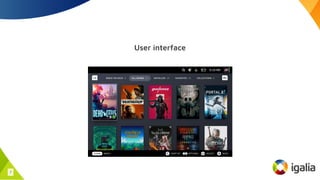
User interface
7
SteamOS under the hood
Linux distribution, based on Arch Linux
Standard components with some customizations
FHS-based layout, GNU userspace, systemd, dbus
Unlocked by default, full access to the OS
8
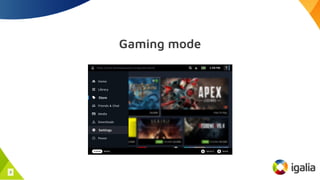
Gaming mode
9
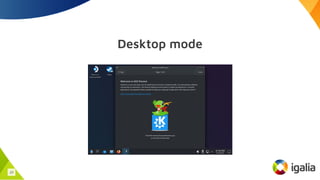
Desktop mode
10
Desktop mode
Regular KDE Plasma desktop
You can install anything:
Web browser
Tools
Non-Steam games
Usable like a regular desktop computer
11
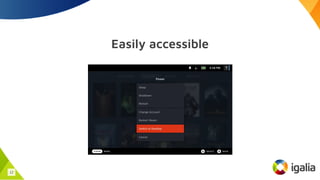
Easily accessible
12
Gaming on Linux
13
Linux OS, Windows games
SteamOS is a Linux-based OS
Most Steam games are for Windows
Most will never get a Linux version
Solution: Proton
14
Proton
Tool to run Windows games on Linux
Collection of different open source packages, notably:
Wine: Compatibility layer for Windows APIs
DXVK: Translates Direct3D 9-11 into Vulkan
VKD3D-Proton: Translates Direct3D 12 into Vulkan
Also GStreamer and other libraries
Published by Valve in 2018
Very actively developed
https://github.com/ValveSoftware/Proton
15
Wine
Run Windows apps on Linux
Not an emulator, the code runs directly on the CPU
Windows APIs implemented using Linux APIs and other standards
Developed by CodeWeavers in partnership with Valve
https://source.winehq.org/git/wine.git/
https://github.com/ValveSoftware/wine
16
Implementing Windows APIs
If the APIs are similar ⇨ no problem
Otherwise Wine needs to implemented the missing parts
This can result in overhead
Not always easily solvable in userspace
Solution: new Linux features to fill in the missing gaps
17
Windows synchronization functions
WaitForMultipleObjects(): used by many Windows games
No direct equivalent in Linux: implemented using futex()
Inefficient: restricted to a single object
Performance problems in heavily multithreaded games
Solution: new futex API
18
New futex API
futex: fast user-space locking
Can only wait on a single object
Only 32-bit futexes
Hard to use and hard to extend
New API (Linux 5.16): futex_waitv()
Similar to WaitForMultipleObjects()
New API (wip): futex2
Work by André Almeida
https://lwn.net/Articles/866112/
19
20
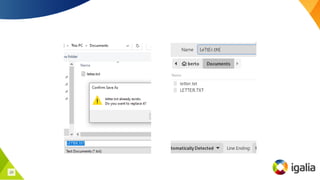
Case insensitive filesystem
Windows filesystems are traditionally case insensitive
Apps expect that data.bin and DATA.BIN are the same file
Linux filesystems are case sensitive
Slow solution: implement this in Wine
Fast solution: make ext4 case insensitive
Work by Gabriel Krisman
Later added to F2FS by Daniel Rosenberg
https://lwn.net/Articles/784041/
https://lore.kernel.org/all/20190719000322.106163-3-drosen@google.com/
21
Other contributions to the Linux kernel
22
Reliable userspace spinlocks
Spinlock: efficient synchronization mechanism
Used extensively in the kernel
Hard to implement reliably in user space
Work by André Almeida, Mathieu Desnoyers
Presented at the OSS EU this week
https://lwn.net/Articles/931789/
23
btrfs same-fsid feature
btrfs identifies a filesystem by its fsid
You cannot mount two filesystems with the same id
Problem: this can happen in systems with A/B partitioning
Solution: add mechamism to support this scenario
Work by Guilherme Piccoli
https://lore.kernel.org/linux-btrfs/20230504170708.787361-1-gpiccoli@igalia.com/
24
Split-lock detector handling
Atomic operations on non-aligned memory can cause a denial of service
The kernel slows them down to prevent this
Problem: many games use them
Solution: add a way to control this behavior
Work by Guilherme Piccoli
https://lwn.net/Articles/911219/
25
More kernel features
panic notifiers refactor
kdumpst: tool for collecting data on a kernel crash
Arch Linux pstore and kdump tool, supports GRUB and both
initcpio/dracut as init systems
Work by Guilherme Piccoli
https://kernel-recipes.org/en/2023/schedule/panic-attack/
https://gitlab.freedesktop.org/gpiccoli/kdumpst
26
And many other improvements and bug fixes...
27
Graphics
28
RADV
Mesa Vulkan driver for AMD GPUs
Developed by Valve and other contributors
Alternative to AMD's official drivers
Most popular driver, shipped by most distros
ACO: a shader compiler for AMD graphics
Reduces stuttering, increases FPS
Developed by Valve, announced in 2019
https://steamcommunity.com/games/221410/announcements/detail/1602634609636894200
29
Advanced color in Linux: HDR
Linux DRM exposes a small set of color properties
Proposals to extend the DRM color API have stalled
AMD GPUs have additional color capabilities
New work: driver-specific color API for AMD drivers
Allows displaying content with High Dynamic Range (HDR)
Supported in userspace by the Gamescope compositor
Available in the upcoming SteamOS 3.5
Melissa Wen (Igalia), Joshua Ashton (Valve), Harry Wentland (AMD)
https://melissawen.github.io/blog/2023/08/21/amd-steamdeck-colors
30
Better handling of GPU resets
GPUs are complex and can crash
No standard API to report the problem to userspace
Roadmap:
Standarize how DRM reports GPU hangs to userspace
Standarize how userspace drivers deal with a hang
Standarize what compositors do after a reset
Work (in progress) by André Almeida
Presented at the North American OSS
https://www.youtube.com/watch?v=qpBLju1l9_w
31
Asynchronous page flip in atomic API
Improve the atomic DRM API to add asynchronous page flipping
Work by André Almeida
Presented at the XDC 2022
https://www.youtube.com/watch?v=qayPPIfrqtE
32
Gamescope
A micro-compositor for games, developed by Valve
Allows:
Spoofing resolutions
Upscaling
Frame rate limiting
Runs the Steam Deck's game UI
Available in your favorite Linux distro
https://github.com/ValveSoftware/gamescope
33
General OS work
34
SteamOS 3
Arch Linux with a customization layer on top
Almost all packages come directly from Arch, unmodified
Policy: upstream everything
Original developer
Arch (when appropriate)
35
Immutable OS
SteamOS has an immutable, read-only root filesystem
A/B partitioning scheme
Users are not expected to use the package manager or do anything that
touches the root filesystem
How to install new software then?
36
Adding software to an immutable OS
Steam games: Steam store
Desktop apps: Flatpak
Also used in other distros like Silverblue or Endless OS
37
Flatpak
A sandboxed app framework for the Linux desktop
Apps are
Handled directly by their developers
Distro-independent
Isolated from the OS
Flathub: the Linux app store
More than 2000 apps available
Primary distribution channel for some apps (e.g. Bottles)
38
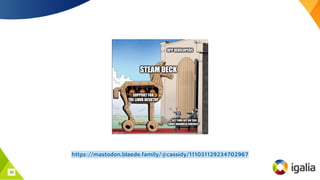
https://mastodon.blaede.family/@cassidy/111031129234702967
39
XDG Portals
A way for apps to interact with the host
Used by Flatpak, but also by others
Portals define D-Bus interfaces for things like:
Access to files
Opening URIs
Screenshots
Settings
40
Selecting the right portals
Portal APIs are implemented by desktop-specific backends (GTK, KDE, ...)
Not all backends work on all desktop environments
Developers cannot test all posible desktops
This can cause crashes, timeouts and other issues
Many backends can be installed at the same time
Problem: limited way to select which portal to use
Affects the Steam Deck: two graphical sessions
41
New mechanism to configure portals
Desktops can select which portals to use
Feature added to xdg-desktop-portal 1.18.0
Soon in all major distros
Work by Emmanuele Bassi
https://github.com/flatpak/xdg-desktop-portal/issues/906
42
Bugfixes and new features: KDE
Discover: handle updates with large numbers of packages
Work by Harald Sitter
Improve detection of new icons when an app is installed
Work by David Redondo
Better handling of udev events from external drives
Work by Alberto García and David Edmundson
https://invent.kde.org/plasma/discover/-/merge_requests/630
https://invent.kde.org/frameworks/kded/-/merge_requests/21
https://bugs.kde.org/show_bug.cgi?id=467751
43
Bugfixes and new features: UDisks
Pass arbitrary options to mkfs
Mount a filesystem on behalf of a different user
Handle filesystem labels with non-printable characters
Work by Alberto García
https://github.com/storaged-project/udisks/issues/583
https://github.com/storaged-project/udisks/issues/1065
https://github.com/storaged-project/udisks/issues/1056
44
And many more
Network Manager
ALSA
Pipewire
SDL
...
45
Conclusion
SteamOS is a fairly standard Linux system
Policy: upstream everything
Contributions to the Linux kernel, graphics, desktop, ...
Brings new users and app developers closer to Linux
46
Thanks!
47
48
How SteamOS is contributing to the Linux ecosystem

How SteamOS is contributing to the Linux ecosystem

  • 1.
    How SteamOS iscontributing to the Linux ecosystem Alberto García Igalia Open Source Summit Europe Bilbao, September 2023 1
  • 2.
    About me Igalian since2001 Debian developer Working on SteamOS Previous projects: QEMU, Maemo, ... 2
  • 3.
  • 4.
    The Steam Deck Handheldgaming computer released by Valve in 2022 Custom operating system: SteamOS 3 Versions 1 and 2 have been discontinued Successful consumer device with standard Linux components 4
  • 5.
    The power ofopen source software How has SteamOS contributed to the Linux ecosystem? Disclaimer: The list of examples in this presentation is by no means complete Contributions by different developers, companies, and regular users 5
  • 6.
    A closer lookat the Steam Deck 6
  • 7.
  • 8.
    SteamOS under thehood Linux distribution, based on Arch Linux Standard components with some customizations FHS-based layout, GNU userspace, systemd, dbus Unlocked by default, full access to the OS 8
  • 9.
  • 10.
  • 11.
    Desktop mode Regular KDEPlasma desktop You can install anything: Web browser Tools Non-Steam games Usable like a regular desktop computer 11
  • 12.
  • 13.
  • 14.
    Linux OS, Windowsgames SteamOS is a Linux-based OS Most Steam games are for Windows Most will never get a Linux version Solution: Proton 14
  • 15.
    Proton Tool to runWindows games on Linux Collection of different open source packages, notably: Wine: Compatibility layer for Windows APIs DXVK: Translates Direct3D 9-11 into Vulkan VKD3D-Proton: Translates Direct3D 12 into Vulkan Also GStreamer and other libraries Published by Valve in 2018 Very actively developed https://github.com/ValveSoftware/Proton 15
  • 16.
    Wine Run Windows appson Linux Not an emulator, the code runs directly on the CPU Windows APIs implemented using Linux APIs and other standards Developed by CodeWeavers in partnership with Valve https://source.winehq.org/git/wine.git/ https://github.com/ValveSoftware/wine 16
  • 17.
    Implementing Windows APIs Ifthe APIs are similar ⇨ no problem Otherwise Wine needs to implemented the missing parts This can result in overhead Not always easily solvable in userspace Solution: new Linux features to fill in the missing gaps 17
  • 18.
    Windows synchronization functions WaitForMultipleObjects():used by many Windows games No direct equivalent in Linux: implemented using futex() Inefficient: restricted to a single object Performance problems in heavily multithreaded games Solution: new futex API 18
  • 19.
    New futex API futex:fast user-space locking Can only wait on a single object Only 32-bit futexes Hard to use and hard to extend New API (Linux 5.16): futex_waitv() Similar to WaitForMultipleObjects() New API (wip): futex2 Work by André Almeida https://lwn.net/Articles/866112/ 19
  • 20.
  • 21.
    Case insensitive filesystem Windowsfilesystems are traditionally case insensitive Apps expect that data.bin and DATA.BIN are the same file Linux filesystems are case sensitive Slow solution: implement this in Wine Fast solution: make ext4 case insensitive Work by Gabriel Krisman Later added to F2FS by Daniel Rosenberg https://lwn.net/Articles/784041/ https://lore.kernel.org/all/20190719000322.106163-3-drosen@google.com/ 21
  • 22.
    Other contributions tothe Linux kernel 22
  • 23.
    Reliable userspace spinlocks Spinlock:efficient synchronization mechanism Used extensively in the kernel Hard to implement reliably in user space Work by André Almeida, Mathieu Desnoyers Presented at the OSS EU this week https://lwn.net/Articles/931789/ 23
  • 24.
    btrfs same-fsid feature btrfsidentifies a filesystem by its fsid You cannot mount two filesystems with the same id Problem: this can happen in systems with A/B partitioning Solution: add mechamism to support this scenario Work by Guilherme Piccoli https://lore.kernel.org/linux-btrfs/20230504170708.787361-1-gpiccoli@igalia.com/ 24
  • 25.
    Split-lock detector handling Atomicoperations on non-aligned memory can cause a denial of service The kernel slows them down to prevent this Problem: many games use them Solution: add a way to control this behavior Work by Guilherme Piccoli https://lwn.net/Articles/911219/ 25
  • 26.
    More kernel features panicnotifiers refactor kdumpst: tool for collecting data on a kernel crash Arch Linux pstore and kdump tool, supports GRUB and both initcpio/dracut as init systems Work by Guilherme Piccoli https://kernel-recipes.org/en/2023/schedule/panic-attack/ https://gitlab.freedesktop.org/gpiccoli/kdumpst 26
  • 27.
    And many otherimprovements and bug fixes... 27
  • 28.
  • 29.
    RADV Mesa Vulkan driverfor AMD GPUs Developed by Valve and other contributors Alternative to AMD's official drivers Most popular driver, shipped by most distros ACO: a shader compiler for AMD graphics Reduces stuttering, increases FPS Developed by Valve, announced in 2019 https://steamcommunity.com/games/221410/announcements/detail/1602634609636894200 29
  • 30.
    Advanced color inLinux: HDR Linux DRM exposes a small set of color properties Proposals to extend the DRM color API have stalled AMD GPUs have additional color capabilities New work: driver-specific color API for AMD drivers Allows displaying content with High Dynamic Range (HDR) Supported in userspace by the Gamescope compositor Available in the upcoming SteamOS 3.5 Melissa Wen (Igalia), Joshua Ashton (Valve), Harry Wentland (AMD) https://melissawen.github.io/blog/2023/08/21/amd-steamdeck-colors 30
  • 31.
    Better handling ofGPU resets GPUs are complex and can crash No standard API to report the problem to userspace Roadmap: Standarize how DRM reports GPU hangs to userspace Standarize how userspace drivers deal with a hang Standarize what compositors do after a reset Work (in progress) by André Almeida Presented at the North American OSS https://www.youtube.com/watch?v=qpBLju1l9_w 31
  • 32.
    Asynchronous page flipin atomic API Improve the atomic DRM API to add asynchronous page flipping Work by André Almeida Presented at the XDC 2022 https://www.youtube.com/watch?v=qayPPIfrqtE 32
  • 33.
    Gamescope A micro-compositor forgames, developed by Valve Allows: Spoofing resolutions Upscaling Frame rate limiting Runs the Steam Deck's game UI Available in your favorite Linux distro https://github.com/ValveSoftware/gamescope 33
  • 34.
  • 35.
    SteamOS 3 Arch Linuxwith a customization layer on top Almost all packages come directly from Arch, unmodified Policy: upstream everything Original developer Arch (when appropriate) 35
  • 36.
    Immutable OS SteamOS hasan immutable, read-only root filesystem A/B partitioning scheme Users are not expected to use the package manager or do anything that touches the root filesystem How to install new software then? 36
  • 37.
    Adding software toan immutable OS Steam games: Steam store Desktop apps: Flatpak Also used in other distros like Silverblue or Endless OS 37
  • 38.
    Flatpak A sandboxed appframework for the Linux desktop Apps are Handled directly by their developers Distro-independent Isolated from the OS Flathub: the Linux app store More than 2000 apps available Primary distribution channel for some apps (e.g. Bottles) 38
  • 39.
  • 40.
    XDG Portals A wayfor apps to interact with the host Used by Flatpak, but also by others Portals define D-Bus interfaces for things like: Access to files Opening URIs Screenshots Settings 40
  • 41.
    Selecting the rightportals Portal APIs are implemented by desktop-specific backends (GTK, KDE, ...) Not all backends work on all desktop environments Developers cannot test all posible desktops This can cause crashes, timeouts and other issues Many backends can be installed at the same time Problem: limited way to select which portal to use Affects the Steam Deck: two graphical sessions 41
  • 42.
    New mechanism toconfigure portals Desktops can select which portals to use Feature added to xdg-desktop-portal 1.18.0 Soon in all major distros Work by Emmanuele Bassi https://github.com/flatpak/xdg-desktop-portal/issues/906 42
  • 43.
    Bugfixes and newfeatures: KDE Discover: handle updates with large numbers of packages Work by Harald Sitter Improve detection of new icons when an app is installed Work by David Redondo Better handling of udev events from external drives Work by Alberto García and David Edmundson https://invent.kde.org/plasma/discover/-/merge_requests/630 https://invent.kde.org/frameworks/kded/-/merge_requests/21 https://bugs.kde.org/show_bug.cgi?id=467751 43
  • 44.
    Bugfixes and newfeatures: UDisks Pass arbitrary options to mkfs Mount a filesystem on behalf of a different user Handle filesystem labels with non-printable characters Work by Alberto García https://github.com/storaged-project/udisks/issues/583 https://github.com/storaged-project/udisks/issues/1065 https://github.com/storaged-project/udisks/issues/1056 44
  • 45.
    And many more NetworkManager ALSA Pipewire SDL ... 45
  • 46.
    Conclusion SteamOS is afairly standard Linux system Policy: upstream everything Contributions to the Linux kernel, graphics, desktop, ... Brings new users and app developers closer to Linux 46
  • 47.
  • 48.