Teacher’s Notes
This sequence of slides is designed to introduce, and explain, the different
types of variables (categoric, ordered, discrete, continuous), as
explained on pages 360 in New Physics for You, 2006 & 2011 editions.
It should be used after the other PowerPoint on ‘Variables’.

Note : When you start this PowerPoint if you see a message about “Read-only embedded fonts” then you
are recommended to select “Open Read-Only” as this (i) gives a clearer font for those
at the back of the room and (ii) ensures that the text-highlighting of key words is correct.


On each slide the key points are revealed step by step,
at the click of your mouse (or the press of a key such as the space-bar).

Before making the next mouse-click you can ask questions of the class
or make statements about what is about to be revealed.
This should help students to become clearer about the ideas involved.
Naturally it pays to have quick practice-run first.

To start the slide-show, press function-key F5
(or right-click->Full Screen)
(to return to ‘normal view’ press the <Esc> key).

For more (free) PowerPoint presentations, visit www.physics4u.co.uk
How Science works:


          Types of

       Variables

   N w Phy s ic s fo r Yo u, page 360
    e
Learning Objectives

You should learn :

• About different types of variables,

• How to identify them when doing
  your practical work.
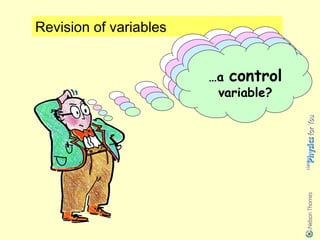
Revision of variables
                            Can you
                        …an independent
                        remember what
                              dependent
                           …a …a control
                         is meant by…
                             variable?
                              variable?
                               variable?
Revision of variables             Summary:

The independent variable
is the one that you change or select.

The dependent variable
is the one changes as a result,
and that you measure.

The control variables must not change,
so that it is a fair test.
Types of variables

There are 4 other types of variables that
you may meet.
Their names are:
• Categoric
• Ordered
• Discrete
• Continuous
We’ll look at two examples of each one.
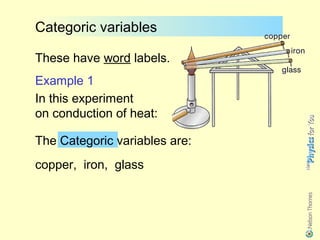
Categoric variables

These have word labels.
Example 1
In this experiment
on conduction of heat:

The Categoric variables are:
copper, iron, glass
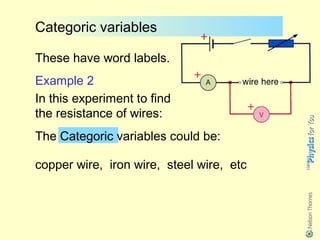
Categoric variables

These have word labels.
Example 2
In this experiment to find
the resistance of wires:
The Categoric variables could be:

copper wire, iron wire, steel wire, etc
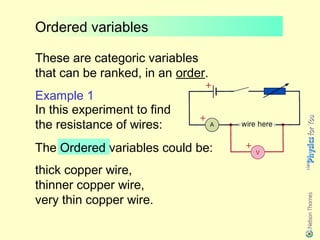
Ordered variables

These are categoric variables
that can be ranked, in an order.
Example 1
In this experiment to find
the resistance of wires:
The Ordered variables could be:
thick copper wire,
thinner copper wire,
very thin copper wire.
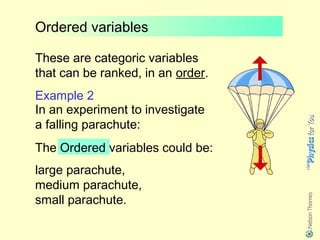
Ordered variables

These are categoric variables
that can be ranked, in an order.
Example 2
In an experiment to investigate
a falling parachute:
The Ordered variables could be:
large parachute,
medium parachute,
small parachute.
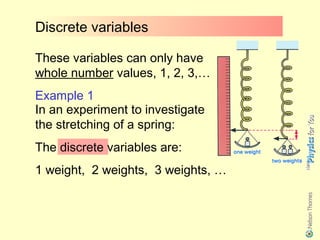
Discrete variables

These variables can only have
whole number values, 1, 2, 3,…
Example 1
In an experiment to investigate
the stretching of a spring:
The discrete variables are:
1 weight, 2 weights, 3 weights, …
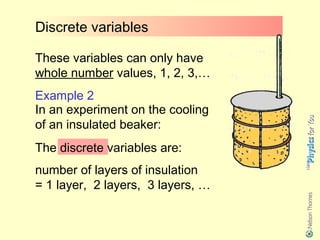
Discrete variables

These variables can only have
whole number values, 1, 2, 3,…
Example 2
In an experiment on the cooling
of an insulated beaker:
The discrete variables are:
number of layers of insulation
= 1 layer, 2 layers, 3 layers, …
Continuous variables

These variables can have
any numerical value.
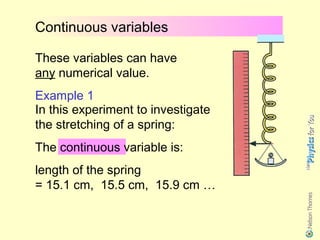
Example 1
In this experiment to investigate
the stretching of a spring:
The continuous variable is:
length of the spring
= 15.1 cm, 15.5 cm, 15.9 cm …
Continuous variables

These variables can have
any numerical value.
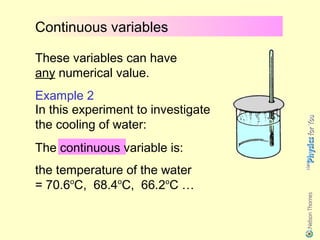
Example 2
In this experiment to investigate
the cooling of water:
The continuous variable is:
the temperature of the water
= 70.6oC, 68.4oC, 66.2oC …
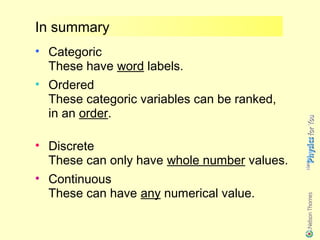
In summary
• Categoric
  These have word labels.
• Ordered
  These categoric variables can be ranked,
  in an order.

• Discrete
  These can only have whole number values.
• Continuous
  These can have any numerical value.
Learning Outcomes
You should now:
• Understand the difference between
  - Categoric,
  - Ordered,
  - Discrete, and
  - Continuous variables
• Be able to identify these variables
  when doing your practical work.
For more details, see:

 New Physics for You, page 360


For more free PowerPoints, visit

 the web-site at www.physics4u.co.uk
If you are connected to the web at the
moment, click below to see what’s
available:
   http://www.physics4u.co.uk/
How scienceworks -types-of-variables

How scienceworks -types-of-variables

  • 1.
    Teacher’s Notes This sequenceof slides is designed to introduce, and explain, the different types of variables (categoric, ordered, discrete, continuous), as explained on pages 360 in New Physics for You, 2006 & 2011 editions. It should be used after the other PowerPoint on ‘Variables’. Note : When you start this PowerPoint if you see a message about “Read-only embedded fonts” then you are recommended to select “Open Read-Only” as this (i) gives a clearer font for those at the back of the room and (ii) ensures that the text-highlighting of key words is correct. On each slide the key points are revealed step by step, at the click of your mouse (or the press of a key such as the space-bar). Before making the next mouse-click you can ask questions of the class or make statements about what is about to be revealed. This should help students to become clearer about the ideas involved. Naturally it pays to have quick practice-run first. To start the slide-show, press function-key F5 (or right-click->Full Screen) (to return to ‘normal view’ press the <Esc> key). For more (free) PowerPoint presentations, visit www.physics4u.co.uk
  • 2.
    How Science works: Types of Variables N w Phy s ic s fo r Yo u, page 360 e
  • 3.
    Learning Objectives You shouldlearn : • About different types of variables, • How to identify them when doing your practical work.
  • 4.
    Revision of variables Can you …an independent remember what dependent …a …a control is meant by… variable? variable? variable?
  • 5.
    Revision of variables Summary: The independent variable is the one that you change or select. The dependent variable is the one changes as a result, and that you measure. The control variables must not change, so that it is a fair test.
  • 6.
    Types of variables Thereare 4 other types of variables that you may meet. Their names are: • Categoric • Ordered • Discrete • Continuous We’ll look at two examples of each one.
  • 7.
    Categoric variables These haveword labels. Example 1 In this experiment on conduction of heat: The Categoric variables are: copper, iron, glass
  • 8.
    Categoric variables These haveword labels. Example 2 In this experiment to find the resistance of wires: The Categoric variables could be: copper wire, iron wire, steel wire, etc
  • 9.
    Ordered variables These arecategoric variables that can be ranked, in an order. Example 1 In this experiment to find the resistance of wires: The Ordered variables could be: thick copper wire, thinner copper wire, very thin copper wire.
  • 10.
    Ordered variables These arecategoric variables that can be ranked, in an order. Example 2 In an experiment to investigate a falling parachute: The Ordered variables could be: large parachute, medium parachute, small parachute.
  • 11.
    Discrete variables These variablescan only have whole number values, 1, 2, 3,… Example 1 In an experiment to investigate the stretching of a spring: The discrete variables are: 1 weight, 2 weights, 3 weights, …
  • 12.
    Discrete variables These variablescan only have whole number values, 1, 2, 3,… Example 2 In an experiment on the cooling of an insulated beaker: The discrete variables are: number of layers of insulation = 1 layer, 2 layers, 3 layers, …
  • 13.
    Continuous variables These variablescan have any numerical value. Example 1 In this experiment to investigate the stretching of a spring: The continuous variable is: length of the spring = 15.1 cm, 15.5 cm, 15.9 cm …
  • 14.
    Continuous variables These variablescan have any numerical value. Example 2 In this experiment to investigate the cooling of water: The continuous variable is: the temperature of the water = 70.6oC, 68.4oC, 66.2oC …
  • 15.
    In summary • Categoric These have word labels. • Ordered These categoric variables can be ranked, in an order. • Discrete These can only have whole number values. • Continuous These can have any numerical value.
  • 16.
    Learning Outcomes You shouldnow: • Understand the difference between - Categoric, - Ordered, - Discrete, and - Continuous variables • Be able to identify these variables when doing your practical work.
  • 17.
    For more details,see:  New Physics for You, page 360 For more free PowerPoints, visit  the web-site at www.physics4u.co.uk
  • 18.
    If you areconnected to the web at the moment, click below to see what’s available: http://www.physics4u.co.uk/