HOW DOES THE MEDIA USE IMAGES? By Sacha Ginsberg
Summary of the Lesson This presentation will show how images can attract and influence audiences, how images can have ethical issues, and how technology can effect images in the media.
Learning Objectives How images attract audiences looking at newspapers, television, online media, magazines, and logos.  Look at the power of images analyzing the emotions they convey and the detail they can show, which writing cannot. Learn how ethics and images cross content. See ethical issues and learn how to fix them.  See how technology can effect images. Learn about Photoshop and how images can go viral with the use of the internet.  See how images promote eye tracking and design.
Modules How images attract and influence the public The Power of Images Ethics and Images The use of Technology for Images Eye Tracking and Design
Exercise: A Picture vs.  1,000  Words Look at this next image and describe it. Think what the article could be about.
 
Comments
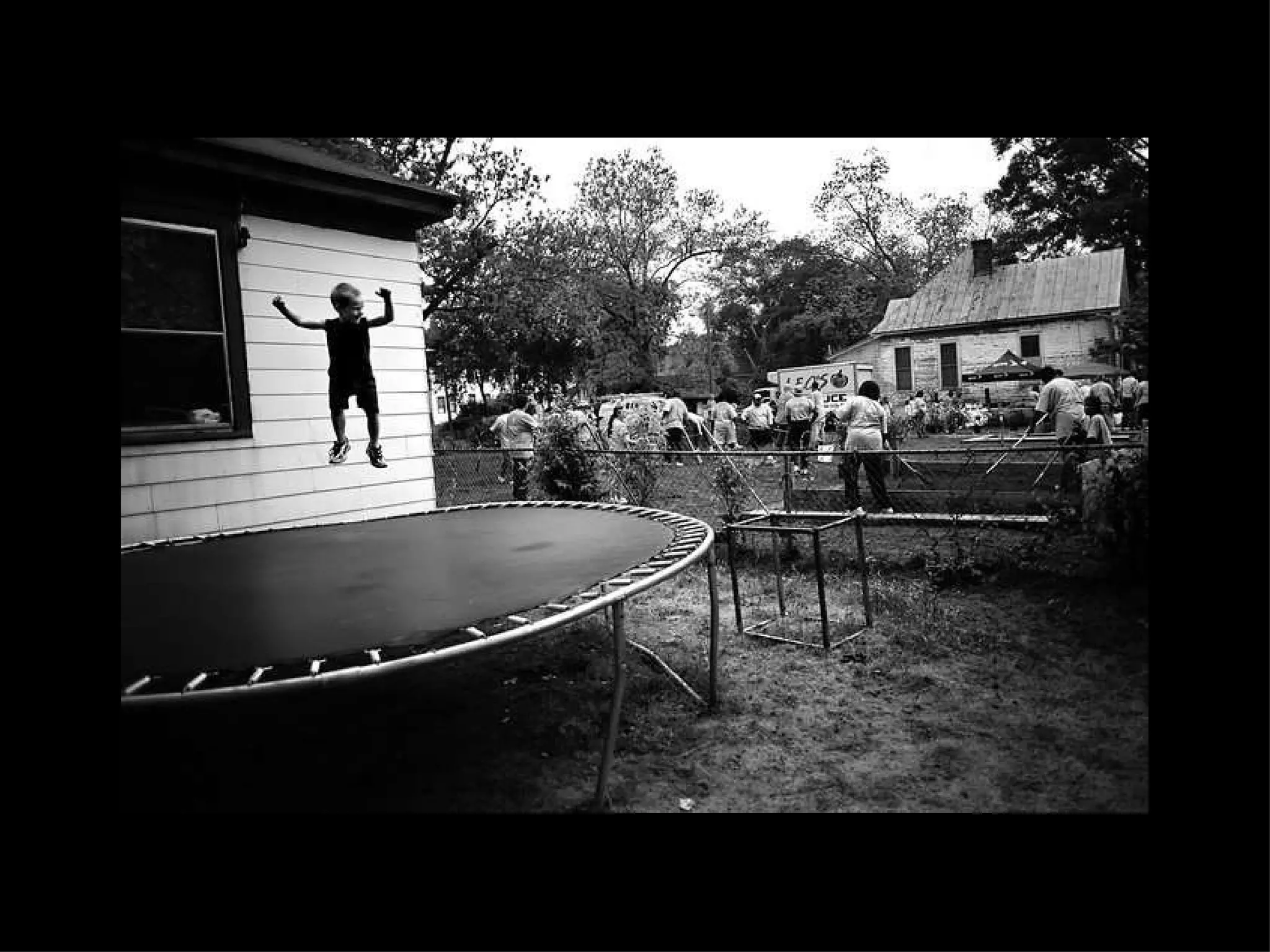
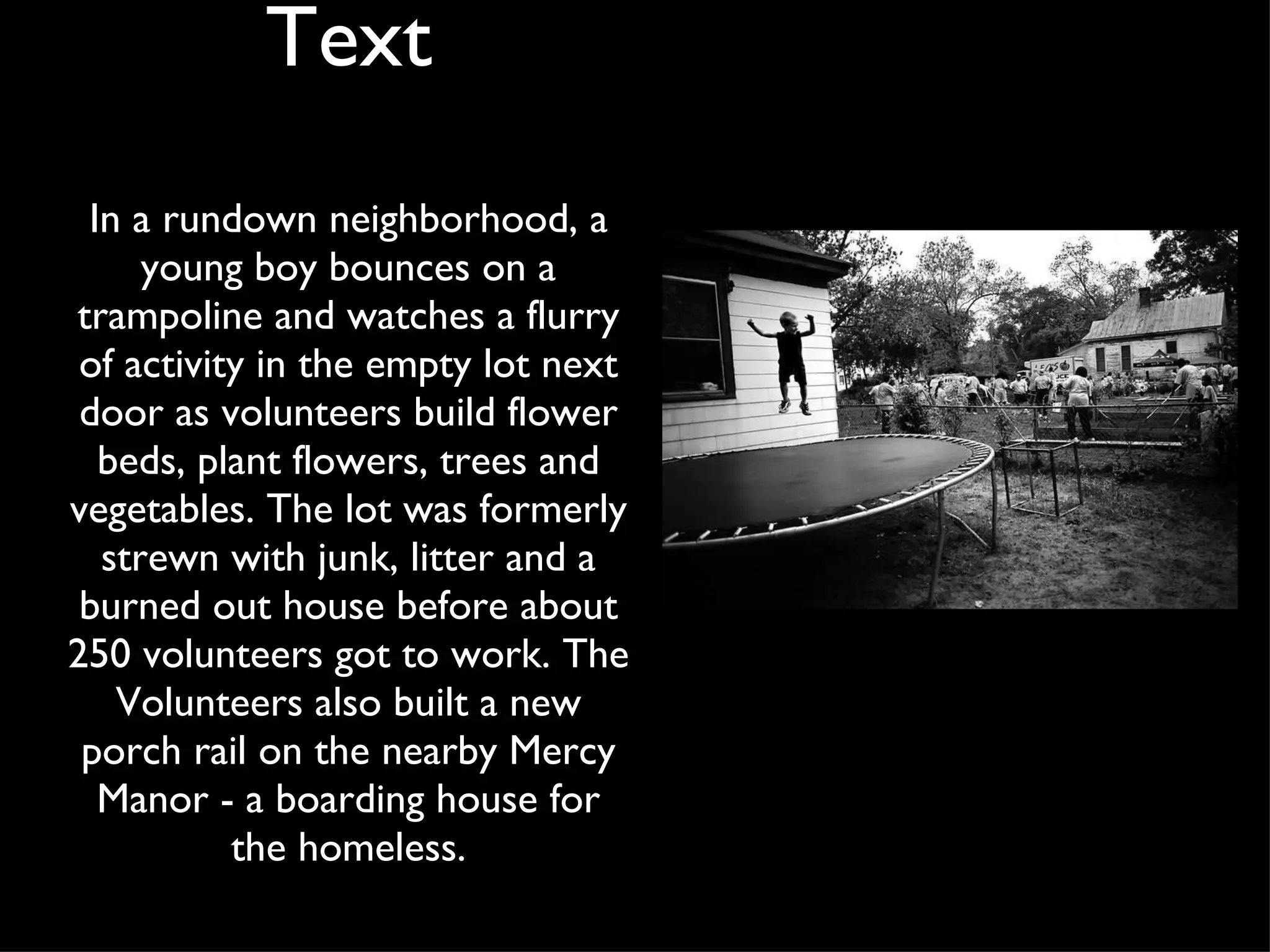
In a rundown neighborhood, a young boy bounces on a trampoline and watches a flurry of activity in the empty lot next door as volunteers build flower beds, plant flowers, trees and vegetables. The lot was formerly strewn with junk, litter and a burned out house before about 250 volunteers got to work. The Volunteers also built a new porch rail on the nearby Mercy Manor - a boarding house for the homeless. Text
 
Comments
Anthony Harley, 16, tried to revive his mother in the tiny hotel room they shared with his twin siblings, Akera and Akeil, both 10. But it was too late. “She just went to sleep, and I tried to wake her up and I couldn’t wake her up,” Anthony said. At just 34-years-old, Clementina Hagin was dead. Clementina had no money and no life insurance. So it fell to her minor children to see that she got a proper funeral. A day after her death they went to work. With the help of local church pastor Lynn Sims and their fathers (who also had no money), the kids organized a car wash behind a local Pizza Hut. They also solicited donations from passing motorists on nearby street corners. For three days, with temperatures nearing 100 degrees, everyone pitched in. “It’s real hot out,” Sims admitted. “It’s hard being out here, especially when your mom just passed and you got to push that aside to be able to take care of business.”
Still dressed in her pajamas, Cindy Hooper talks with the repo man, right, after he agrees to let the family stay until 9:30 the next morning. The time extension is not an act of mercy. The repo men are having a difficult time preparing the family's large double-wide mobile home for transport. Now read the caption of a photograph.
Think what the picture could be. How does this caption make you feel? Would you be interested in reading the full story?
 
Does seeing the picture make you feel different?
A picture is truly worth 1,000 words. It can mean and describe things in many different ways. Seeing a picture intrigues the audience to learn more. A photo can also help the audience set the scene for what they’re reading and it can convey emotion in a way words cannot. Images are very instrumental in journalism.
Just like we learned in the previous exercise, images can speak volumes. They can also attract audiences. For example, at a grocery store, if a newspaper stand or magazine stand shows a compelling photo on the front page, people are more likely to pick it up and read it...maybe even buy it. The media uses this tactic to bring people in, increase viewers, and make money.  How Images Attract Audiences
How Images Attract Audiences-Newspapers Not everyone reads an entire newspaper, so when it gets delivered, to entice you to read an article, the pictures (along with headlines) grab your attentions. There are also newspaper stands on the sidewalks, in coffee shops, in supermarkets, etc. This is when the pictures really count. If you’re passing buy and see a really moving photo, you will stop to look at it.
How Images Attract Audiences-Newspapers
How Images Attract Audiences-Online Ever notice when you’re on the web how every images, especially when it’s moving, attracts your eye. Well media sources use that strategy. They want to make you look at the individual articles, and they use that by placing pictures next to the headlines of each of them. Using images also makes their page more attractive and will keep viewers on the page and coming back.
How Images Attract Audiences-Online When online, you have to be very careful. It is so easy to leave a webpage and be distracted by another one. The Washington Post keeps viewers on their page very well with their new formatting of “Today’s Paper.” In this, you view each page of the newspaper how it is in the stands, and when you click on an image or an article, it enlarges it like an advertisement pop up on the same   page!  www.washingtonpost.com/todays_paper
How Images Attract Audiences
The Power of Images

How Media Uses Images

  • 1.
    HOW DOES THEMEDIA USE IMAGES? By Sacha Ginsberg
  • 2.
    Summary of theLesson This presentation will show how images can attract and influence audiences, how images can have ethical issues, and how technology can effect images in the media.
  • 3.
    Learning Objectives Howimages attract audiences looking at newspapers, television, online media, magazines, and logos. Look at the power of images analyzing the emotions they convey and the detail they can show, which writing cannot. Learn how ethics and images cross content. See ethical issues and learn how to fix them. See how technology can effect images. Learn about Photoshop and how images can go viral with the use of the internet. See how images promote eye tracking and design.
  • 4.
    Modules How imagesattract and influence the public The Power of Images Ethics and Images The use of Technology for Images Eye Tracking and Design
  • 5.
    Exercise: A Picturevs. 1,000 Words Look at this next image and describe it. Think what the article could be about.
  • 6.
  • 7.
  • 8.
    In a rundownneighborhood, a young boy bounces on a trampoline and watches a flurry of activity in the empty lot next door as volunteers build flower beds, plant flowers, trees and vegetables. The lot was formerly strewn with junk, litter and a burned out house before about 250 volunteers got to work. The Volunteers also built a new porch rail on the nearby Mercy Manor - a boarding house for the homeless. Text
  • 9.
  • 10.
  • 11.
    Anthony Harley, 16,tried to revive his mother in the tiny hotel room they shared with his twin siblings, Akera and Akeil, both 10. But it was too late. “She just went to sleep, and I tried to wake her up and I couldn’t wake her up,” Anthony said. At just 34-years-old, Clementina Hagin was dead. Clementina had no money and no life insurance. So it fell to her minor children to see that she got a proper funeral. A day after her death they went to work. With the help of local church pastor Lynn Sims and their fathers (who also had no money), the kids organized a car wash behind a local Pizza Hut. They also solicited donations from passing motorists on nearby street corners. For three days, with temperatures nearing 100 degrees, everyone pitched in. “It’s real hot out,” Sims admitted. “It’s hard being out here, especially when your mom just passed and you got to push that aside to be able to take care of business.”
  • 12.
    Still dressed inher pajamas, Cindy Hooper talks with the repo man, right, after he agrees to let the family stay until 9:30 the next morning. The time extension is not an act of mercy. The repo men are having a difficult time preparing the family's large double-wide mobile home for transport. Now read the caption of a photograph.
  • 13.
    Think what thepicture could be. How does this caption make you feel? Would you be interested in reading the full story?
  • 14.
  • 15.
    Does seeing thepicture make you feel different?
  • 16.
    A picture istruly worth 1,000 words. It can mean and describe things in many different ways. Seeing a picture intrigues the audience to learn more. A photo can also help the audience set the scene for what they’re reading and it can convey emotion in a way words cannot. Images are very instrumental in journalism.
  • 17.
    Just like welearned in the previous exercise, images can speak volumes. They can also attract audiences. For example, at a grocery store, if a newspaper stand or magazine stand shows a compelling photo on the front page, people are more likely to pick it up and read it...maybe even buy it. The media uses this tactic to bring people in, increase viewers, and make money. How Images Attract Audiences
  • 18.
    How Images AttractAudiences-Newspapers Not everyone reads an entire newspaper, so when it gets delivered, to entice you to read an article, the pictures (along with headlines) grab your attentions. There are also newspaper stands on the sidewalks, in coffee shops, in supermarkets, etc. This is when the pictures really count. If you’re passing buy and see a really moving photo, you will stop to look at it.
  • 19.
    How Images AttractAudiences-Newspapers
  • 20.
    How Images AttractAudiences-Online Ever notice when you’re on the web how every images, especially when it’s moving, attracts your eye. Well media sources use that strategy. They want to make you look at the individual articles, and they use that by placing pictures next to the headlines of each of them. Using images also makes their page more attractive and will keep viewers on the page and coming back.
  • 21.
    How Images AttractAudiences-Online When online, you have to be very careful. It is so easy to leave a webpage and be distracted by another one. The Washington Post keeps viewers on their page very well with their new formatting of “Today’s Paper.” In this, you view each page of the newspaper how it is in the stands, and when you click on an image or an article, it enlarges it like an advertisement pop up on the same page! www.washingtonpost.com/todays_paper
  • 22.
  • 23.