of
Social
Justic
  e
Conveying information through images is
 one of the most effective, emotion-arousing
          forms of communication.
- Research has shown that emotional content is the most
likely to become viral, as are “awe-inspiring” stories that
force readers to view the world differently.
- News-related images are more likely to be shared than
humorous ones, according to research by Social Media
Expert Dan Zarrella.
- “Vivid” images are particularly effective because they
present content in a “language” that is understood by all
people, regardless of literacy, culture, etc. All brains have
the same capability of interpreting images.
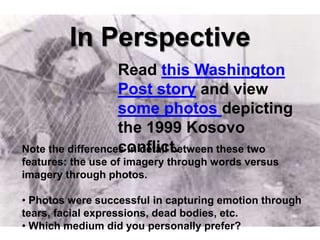
In Perspective
                   Read this Washington
                   Post story and view
                   some photos depicting
                   the 1999 Kosovo
                   conflict.
Note the differences in detail between these two
features: the use of imagery through words versus
imagery through photos.

• Photos were successful in capturing emotion through
tears, facial expressions, dead bodies, etc.
• Which medium did you personally prefer?
What goes into consideration when
 selecting images for publication?
1. Subject: immediately recognizable; audience can
   easily understand the point of the photo
2. Quality: colors, shading, resolution, size, clarity are
   in harmony
3. Relevance: the photo directly relates to and
   complements the accompanying story, if there is one
4. Effect: provoking discussion, emotion, action from
   audience
5. Taste: Will the photo offend, frighten, or disturb the
   audience? Disclaimer necessary?
Why is it such a big deal?
There is an argument that the media’s use of dramatic,
  compelling photos sensationalizes serious issues, or
exploits them for profit rather than journalistic purposes.

          Controversial Examples:
        Click photos to enlarge and read more
ACTIVITY
You are the editor of the New York Times. You
must select one of these photos to accompany
 a front page story about the Somali famine.


  How will you make your
                             Click to view larger
        decision?            images
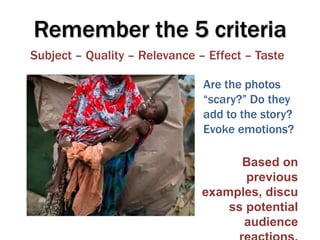
Remember the 5 criteria
Subject – Quality – Relevance – Effect – Taste

                               Are the photos
                               “scary?” Do they
                               add to the story?
                               Evoke emotions?

                                     Based on
                                      previous
                               examples, discu
                                   ss potential
                                     audience
The Times’ actual front page
Results
“The fact that people far away can see with visceral immediacy the facts of a crisis
like the one now hitting the Horn of Africa is one of the most optimistic aspects of
the modern world. Consciences are awakened by the camera ... [these pictures]
tell the whole world what will happen across the region unless urgent international
action comes immediately.” – Jonathan Jones, The Guardian

 “The photographs fail to show the reason why so many people have reached this
      state of destitution. Underneath the high visibility famine lies an age-old and
 sustainable way of living that has been disrupted by a modern world system, and
  whose ability to adapt to the cycle of drought has been severely undermined.” –
                                                       Helen de Jode, The Guardian

       NYT Executive Editor Bill Keller stood by it:
   “[Our photographers] sent us a harrowing story
    and vivid, arresting photographs. We put them
  before the attention of our readers. That's our job.”
Images, continued
Discussion:

• How did you feel after viewing the Times’
slideshow?
• After seeing the photos, do you feel more
compelled to take action to help the Somali
cause?
• Where is the line for journalists between
informing the public and advocating for a
social issue?
• Is it okay for TIME’s “100 to advocate for global
Related content: journalistsPhotos that Changed the
World” Are there exceptions?
crises?

Social justice images1

  • 1.
  • 2.
    Conveying information throughimages is one of the most effective, emotion-arousing forms of communication. - Research has shown that emotional content is the most likely to become viral, as are “awe-inspiring” stories that force readers to view the world differently. - News-related images are more likely to be shared than humorous ones, according to research by Social Media Expert Dan Zarrella. - “Vivid” images are particularly effective because they present content in a “language” that is understood by all people, regardless of literacy, culture, etc. All brains have the same capability of interpreting images.
  • 3.
    In Perspective Read this Washington Post story and view some photos depicting the 1999 Kosovo conflict. Note the differences in detail between these two features: the use of imagery through words versus imagery through photos. • Photos were successful in capturing emotion through tears, facial expressions, dead bodies, etc. • Which medium did you personally prefer?
  • 4.
    What goes intoconsideration when selecting images for publication? 1. Subject: immediately recognizable; audience can easily understand the point of the photo 2. Quality: colors, shading, resolution, size, clarity are in harmony 3. Relevance: the photo directly relates to and complements the accompanying story, if there is one 4. Effect: provoking discussion, emotion, action from audience 5. Taste: Will the photo offend, frighten, or disturb the audience? Disclaimer necessary?
  • 5.
    Why is itsuch a big deal? There is an argument that the media’s use of dramatic, compelling photos sensationalizes serious issues, or exploits them for profit rather than journalistic purposes. Controversial Examples: Click photos to enlarge and read more
  • 6.
    ACTIVITY You are theeditor of the New York Times. You must select one of these photos to accompany a front page story about the Somali famine. How will you make your Click to view larger decision? images
  • 7.
    Remember the 5criteria Subject – Quality – Relevance – Effect – Taste Are the photos “scary?” Do they add to the story? Evoke emotions? Based on previous examples, discu ss potential audience
  • 8.
  • 9.
    Results “The fact thatpeople far away can see with visceral immediacy the facts of a crisis like the one now hitting the Horn of Africa is one of the most optimistic aspects of the modern world. Consciences are awakened by the camera ... [these pictures] tell the whole world what will happen across the region unless urgent international action comes immediately.” – Jonathan Jones, The Guardian “The photographs fail to show the reason why so many people have reached this state of destitution. Underneath the high visibility famine lies an age-old and sustainable way of living that has been disrupted by a modern world system, and whose ability to adapt to the cycle of drought has been severely undermined.” – Helen de Jode, The Guardian NYT Executive Editor Bill Keller stood by it: “[Our photographers] sent us a harrowing story and vivid, arresting photographs. We put them before the attention of our readers. That's our job.”
  • 10.
    Images, continued Discussion: • Howdid you feel after viewing the Times’ slideshow? • After seeing the photos, do you feel more compelled to take action to help the Somali cause? • Where is the line for journalists between informing the public and advocating for a social issue? • Is it okay for TIME’s “100 to advocate for global Related content: journalistsPhotos that Changed the World” Are there exceptions? crises?