WWW.LRJJ.CN
The Role of
Housekeeping
in Hospitality Operations
WWW.LRJJ.CN
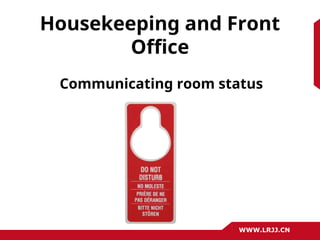
Housekeeping and Front
Office
Communicating room status
WWW.LRJJ.CN
Housekeeping and
Maintenance
Types of Maintenance
• Routine Maintenance
• Preventive Maintenance
• Scheduled Maintenance
WWW.LRJJ.CN
Routine Maintenance
Related to the general upkeep of the
property, occurs on a regular (daily) basis,
and requires relatively minimal training or
skills.
Housekeeping and
Maintenance
WWW.LRJJ.CN
Housekeeping and
Maintenance
Preventive Maintenance
• Inspection (on random basis)
• Discover any problems
• Work order initiation
WWW.LRJJ.CN
Housekeeping and
Maintenance
Scheduled Maintenance
Preventive maintenance sometimes identifies
problems and needs beyond the scope of a
minor correction. These problems are brought
to the attention of engineering through the
work order system and the necessary work is
then scheduled by the property engineering
department.
WWW.LRJJ.CN
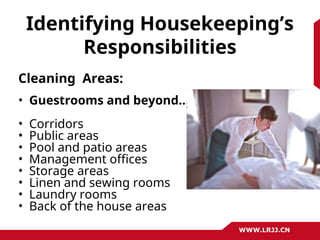
Identifying Housekeeping’s
Responsibilities
Cleaning Areas:
• Guestrooms and beyond…
• Corridors
• Public areas
• Pool and patio areas
• Management offices
• Storage areas
• Linen and sewing rooms
• Laundry rooms
• Back of the house areas
WWW.LRJJ.CN
Identifying Housekeeping’s
Responsibilities
Management of Housekeeping
Department:
• Room Assignment
• Training
• Room inspection
• Communication
• Inventory control – linens, guest
supplies, cleaning supplies,
• Occupational Safety and Health
• Going green – green initiatives
WWW.LRJJ.CN
Planning the work of the
Housekeeping Department
• Area inventory lists
• Performance standards
• Productivity standards
WWW.LRJJ.CN
Area inventory lists
Is the first planning activity, because the
lists ensure that the rest of the planning
activities address every item for which
Housekeeping will be held accountable.
Inventory lists are bound to be long and
extremely detailed. Since most properties
offer several different types of guestrooms,
separate inventory lists may be needed
for each room type.
WWW.LRJJ.CN
Performance
Standards
• Not only what must be done, but also describes
in detail how the job must be done. (The
primary objective is consistency of cleaning
tasks)
• Performance standards are communicated
through ongoing training programs
• Manager must ensure conformity to standards
by inspection (“You can’t expect what you
don’t inspect”)
WWW.LRJJ.CN
Productivity Standards
• Determine the acceptable quantity of work to be
done by department employees.
“How long should it take for a housekeeping
employee to perform an assigned task
according to the department’s performance
standard?”
(Handout)
WWW.LRJJ.CN
Par Number
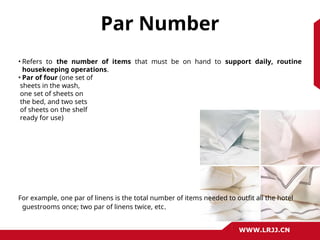
• Refers to the number of items that must be on hand to support daily, routine
housekeeping operations.
• Par of four (one set of
sheets in the wash,
one set of sheets on
the bed, and two sets
of sheets on the shelf
ready for use)
For example, one par of linens is the total number of items needed to outfit all the hotel
guestrooms once; two par of linens twice, etc.
WWW.LRJJ.CN
Turn-down
service
• Hotel service in which a room is cleaned and refreshed, and bed linen is turned
down for sleeping, usually during the period guest is not in the room.(5-7pm)
• Room is cleaned/refreshed
• Bathrobe/slipper prepared
• Guest amenities – chocolate, cookies, fruits, sparkling water, mint, etc.
• Ice bucket filled up
• Extra complimentary water provided
• Curtains are drawn
• Background music playing
WWW.LRJJ.CN
Lost and Found
• Register the item/s in the Lost & Found Register
• Tag the item/s so that the item serial number is easily visible
• Segregate the items into the following categories: Perishable items (esp.
Food),Medicine, Non-Valuable,Valuable
• Perishable items - To be disposed of within 24 hours of receipt. HSKP
Manager/Security Manager will sign the item off so that it can be properly
disposed of.
• Medicine - To be disposed of after a three (3) month period, OR according
to the expiry date on the packaging of the medicine, whichever date is first
• Non-Valuables – To be disposed of after three (3) months
• Valuables - ID/passport, any items above xx amount or at the discretion of
HSKP/Security Manager - once logged, the Security Supervisor must store
items in the safe. For passports/Ids, if no inquiry is received within twenty
four (24) hours, contact the respective Embassy/Consulate)

Housekeeping Management powerpoint presentation.ppt

  • 1.
  • 2.
  • 3.
    WWW.LRJJ.CN Housekeeping and Maintenance Types ofMaintenance • Routine Maintenance • Preventive Maintenance • Scheduled Maintenance
  • 4.
    WWW.LRJJ.CN Routine Maintenance Related tothe general upkeep of the property, occurs on a regular (daily) basis, and requires relatively minimal training or skills. Housekeeping and Maintenance
  • 5.
    WWW.LRJJ.CN Housekeeping and Maintenance Preventive Maintenance •Inspection (on random basis) • Discover any problems • Work order initiation
  • 6.
    WWW.LRJJ.CN Housekeeping and Maintenance Scheduled Maintenance Preventivemaintenance sometimes identifies problems and needs beyond the scope of a minor correction. These problems are brought to the attention of engineering through the work order system and the necessary work is then scheduled by the property engineering department.
  • 7.
    WWW.LRJJ.CN Identifying Housekeeping’s Responsibilities Cleaning Areas: •Guestrooms and beyond… • Corridors • Public areas • Pool and patio areas • Management offices • Storage areas • Linen and sewing rooms • Laundry rooms • Back of the house areas
  • 8.
    WWW.LRJJ.CN Identifying Housekeeping’s Responsibilities Management ofHousekeeping Department: • Room Assignment • Training • Room inspection • Communication • Inventory control – linens, guest supplies, cleaning supplies, • Occupational Safety and Health • Going green – green initiatives
  • 9.
    WWW.LRJJ.CN Planning the workof the Housekeeping Department • Area inventory lists • Performance standards • Productivity standards
  • 10.
    WWW.LRJJ.CN Area inventory lists Isthe first planning activity, because the lists ensure that the rest of the planning activities address every item for which Housekeeping will be held accountable. Inventory lists are bound to be long and extremely detailed. Since most properties offer several different types of guestrooms, separate inventory lists may be needed for each room type.
  • 11.
    WWW.LRJJ.CN Performance Standards • Not onlywhat must be done, but also describes in detail how the job must be done. (The primary objective is consistency of cleaning tasks) • Performance standards are communicated through ongoing training programs • Manager must ensure conformity to standards by inspection (“You can’t expect what you don’t inspect”)
  • 12.
    WWW.LRJJ.CN Productivity Standards • Determinethe acceptable quantity of work to be done by department employees. “How long should it take for a housekeeping employee to perform an assigned task according to the department’s performance standard?” (Handout)
  • 13.
    WWW.LRJJ.CN Par Number • Refersto the number of items that must be on hand to support daily, routine housekeeping operations. • Par of four (one set of sheets in the wash, one set of sheets on the bed, and two sets of sheets on the shelf ready for use) For example, one par of linens is the total number of items needed to outfit all the hotel guestrooms once; two par of linens twice, etc.
  • 14.
    WWW.LRJJ.CN Turn-down service • Hotel servicein which a room is cleaned and refreshed, and bed linen is turned down for sleeping, usually during the period guest is not in the room.(5-7pm) • Room is cleaned/refreshed • Bathrobe/slipper prepared • Guest amenities – chocolate, cookies, fruits, sparkling water, mint, etc. • Ice bucket filled up • Extra complimentary water provided • Curtains are drawn • Background music playing
  • 15.
    WWW.LRJJ.CN Lost and Found •Register the item/s in the Lost & Found Register • Tag the item/s so that the item serial number is easily visible • Segregate the items into the following categories: Perishable items (esp. Food),Medicine, Non-Valuable,Valuable • Perishable items - To be disposed of within 24 hours of receipt. HSKP Manager/Security Manager will sign the item off so that it can be properly disposed of. • Medicine - To be disposed of after a three (3) month period, OR according to the expiry date on the packaging of the medicine, whichever date is first • Non-Valuables – To be disposed of after three (3) months • Valuables - ID/passport, any items above xx amount or at the discretion of HSKP/Security Manager - once logged, the Security Supervisor must store items in the safe. For passports/Ids, if no inquiry is received within twenty four (24) hours, contact the respective Embassy/Consulate)