House Electrical Switches Mobile
Phone Control
Objectives to discuss
 Determine the statement of the problem
 Discuss the importance of the study
 Determine the main purpose of the study
 Determine the objectives of the study
 Define the scope and limitations of the study
 Review some of the related literature of the study
 Determine the design and methodologies used
 Provide a prototype sample and visualization
Statement of the Problem
The power conservation done by residential consumers aims to reduce unwanted electrical usage
and reduce risks. The process of conservation should be improved for manageability but also simple
enough that allows even those less familiar with it to be easily performed.
However, some residential consumers disregard electrical consumption efficiency. By leaving
electrical switches unattended, the average demand of electricity accumulate, the chance of fire hazard
increases, and by the lack of assurance of power supply for the next coming months, they pose a
serious issue in energy conservation.
Statement of the Problem
Importance of the Study
The findings of this study will contribute to today's innovative and technological society, as a
constituent of The Internet of Things, and playing an important role regarding power conservation. The
more developed our everyday lifestyle becomes, the greater demand is imposed for power usage
where instant gratification is achieved and there is lesser concern for possible consequences. Thus,
there is a need for an efficiency.
Residents and even entrepreneurs applying the derived concepts from this study will be able to
witness a development in their expenses, more manageable power consumption, and increased
awareness. For the researchers, this study will enable them uncovering compatible integrations and
learning areas that other researchers may not provide. Thus, a collaborative effort has been made.
Purpose of the Study
The purpose of this paper is to describe the flow of wireless home automation using Android
devices and explain how to use the microcontrollers and I/O software modules to achieve connectivity.
This represents an investigation into the problem of unwanted electrical consumption and power
waste.
The purpose of this study is to show how the users to be able to control their electrical switches
through Android devices using the Arduino microcontrollers.
Objectives of the Study
Objectives of the Study - General
This research aims to obtain knowledge and insight concerning the setup and connectivity of
Android modules to the microcontrollers set to the electrical circuit system of the house to be
automated through wireless connectivity.
It aims to review related applications with the same concerning ground in the field of home
automation and to determine the different technologies to be used, find a way to relate each other and
discover proper algorithms for its implementation.
Objectives of the Study - Specific
 This research will aim to obtain knowledge about the Arduino hardware on how in will connect from
different switches and microcontrollers.
 This research will aim to obtain knowledge on how the microcontrollers works from the electrical circuit of
the house.
 This research will aim to obtain knowledge on how the microcontrollers connect through the server to
command the switches from the house.
Scope and Limitations
Integrating a mobile application to a home electrical system using latest frameworks and
technology will be the scope of the study. The application is only limited to controlling the electrical
system and detecting damaged electrical switches of the house to be automated and giving
suggestions to fix them.
Monitoring the user’s electrical consumption is not included although this would be a better
addition, but due to time and resources constraints, it is not pursued. Monitoring the electrical usage
would have an additional cost in terms of development and the price itself. It does not suggest an
energy saving mode wherein the user can opt to set a threshold for electrical usage.
Review of Related Literature
RRL – Existing Systems
A ZigBee-Based Home Automation System
ZigBee is a radio frequency (RF) communications standard based on IEEE 802.15.4. This depicts the
general architecture of a Zigbee based home automation network. The Zigbee coordinator is
responsible for creating and maintaining the network.
Each electronic device (i.e. Washing Machine, Television, Lamp etc.) in the system is a Zigbee
device managed by the coordinator. All communication between devices propagates through the
coordinator to the destination device. The wireless nature of ZigBee helps overcome the intrusive
installation problem with the existing home automation systems identified earlier (Yao, 2009).
RRL – Existing Systems
Android Based Security and Home Automation System using Bluetooth
To start communication with Bluetooth, Android first seeks permission which is required for
requesting a connection, accepting a connection, and transferring data. To discover local Bluetooth
devices this permission is required. To connect with the external Bluetooth module, user should press
connect which will appear from the menu tab of the Android mobile phone. If the connection is
established properly a confirmation toaster will appear on the screen.
RRL – Mobile Development Tools
Arduino Language
Arduino is an open-source electronics platform based on easy-to-use hardware and
software. Arduino boards can read inputs - light on a sensor, a finger on a button, or a Twitter message
- and turn it into an output - activating a motor, turning on an LED, publishing something online. You
can tell your board what to do by sending a set of instructions to the microcontroller on the board
RRL – Mobile Development Tools
Node.js
Node.js is an open-source, cross-platform JavaScript run-time for executing JavaScript
code server-side. Historically, JavaScript was used primarily for client- side scripting, in which scripts
written in JavaScript are embedded in a webpage's HTML, to be run client-side by a JavaScript engine
in the user's web browser. Node.js enables JavaScript to be used for server-side scripting, and runs
scripts server-side to produce dynamic web page content before the page is sent to the user's web
browser.
RRL – Mobile Development Tools
React Native
React Native lets you build mobile apps using only JavaScript. It uses the same design as React,
letting you compose a rich mobile UI from declarative components. With React Native, you don’t build
a “mobile web app”, an “HTML5 app”, or a “hybrid app”.
RRL – Software Development Model
Waterfall Model
The Waterfall model, one of the earliest SDLC models, comprises five consecutive phases and they
are respectively: Business analysis, design, implementation, testing, and maintenance. On the other
hand, the incremental model has seven phases and they are respectively: Planning, requirements,
analysis, implementation, deployment, testing, and evaluation.
RRL – Synthesis
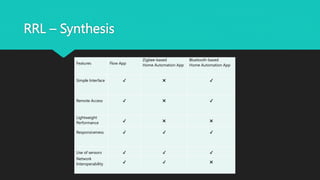
Features Flow App
Zigbee-based
Home Automation App
Bluetooth-based
Home Automation App
Simple Interface ✔ ✖ ✔
Remote Access ✔ ✖ ✔
Lightweight
Performance ✔ ✖ ✖
Responsiveness ✔ ✔ ✔
Use of sensors ✔ ✔ ✔
Network
Interoperability ✔ ✔ ✖
Design and Methodology
DM – Conceptual Design
A prototype or scale model of a smart house, which can control the electric consumption of a
house. The machine will be in the form of a switch or an electric circuit located all around the house. By
toggling the respective switches in a smartphone app it can control the electric consumption of the
said house.
DM – System Software Architecture
The overall structure parts are composed of hardware platforms, network system structure and a
smart phone application. The system achieves the following function/s:
 Toggle switches on and off – saves electricity, time and effort by immediately turning on or shutting
down the circuit or switch even if you are away from the said switch
 Monitor on and off switches – gives live feedback to the user on the current statuses of each
switches or circuits
DM – Flow Chart
Sample UI/Prototype
Sample UI/Prototype
Visualization
Visualization
User using the app
Wi-Fi
(Internet Connection)
Database
(With the server)
House
(With Internet Connection) Microcontrollers
Switch
Visualization
Creating the database
and necessary tables;
Setting up privileges
Connecting Arduino
microcontroller to the
house electrical circuit setup
Files for capturing
data sent from Arduino
and write to the database
Files written in Arduino code
sending switches status

House_Electrical_Switches_Mobile_Phone_Control.pptx

  • 1.
    House Electrical SwitchesMobile Phone Control
  • 2.
    Objectives to discuss Determine the statement of the problem  Discuss the importance of the study  Determine the main purpose of the study  Determine the objectives of the study  Define the scope and limitations of the study  Review some of the related literature of the study  Determine the design and methodologies used  Provide a prototype sample and visualization
  • 3.
  • 4.
    Statement of theProblem The power conservation done by residential consumers aims to reduce unwanted electrical usage and reduce risks. The process of conservation should be improved for manageability but also simple enough that allows even those less familiar with it to be easily performed. However, some residential consumers disregard electrical consumption efficiency. By leaving electrical switches unattended, the average demand of electricity accumulate, the chance of fire hazard increases, and by the lack of assurance of power supply for the next coming months, they pose a serious issue in energy conservation.
  • 5.
  • 6.
  • 7.
  • 8.
    Importance of theStudy The findings of this study will contribute to today's innovative and technological society, as a constituent of The Internet of Things, and playing an important role regarding power conservation. The more developed our everyday lifestyle becomes, the greater demand is imposed for power usage where instant gratification is achieved and there is lesser concern for possible consequences. Thus, there is a need for an efficiency. Residents and even entrepreneurs applying the derived concepts from this study will be able to witness a development in their expenses, more manageable power consumption, and increased awareness. For the researchers, this study will enable them uncovering compatible integrations and learning areas that other researchers may not provide. Thus, a collaborative effort has been made.
  • 9.
  • 10.
    Purpose of theStudy The purpose of this paper is to describe the flow of wireless home automation using Android devices and explain how to use the microcontrollers and I/O software modules to achieve connectivity. This represents an investigation into the problem of unwanted electrical consumption and power waste. The purpose of this study is to show how the users to be able to control their electrical switches through Android devices using the Arduino microcontrollers.
  • 11.
  • 12.
    Objectives of theStudy - General This research aims to obtain knowledge and insight concerning the setup and connectivity of Android modules to the microcontrollers set to the electrical circuit system of the house to be automated through wireless connectivity. It aims to review related applications with the same concerning ground in the field of home automation and to determine the different technologies to be used, find a way to relate each other and discover proper algorithms for its implementation.
  • 13.
    Objectives of theStudy - Specific  This research will aim to obtain knowledge about the Arduino hardware on how in will connect from different switches and microcontrollers.  This research will aim to obtain knowledge on how the microcontrollers works from the electrical circuit of the house.  This research will aim to obtain knowledge on how the microcontrollers connect through the server to command the switches from the house.
  • 14.
  • 15.
    Scope and Limitations Integratinga mobile application to a home electrical system using latest frameworks and technology will be the scope of the study. The application is only limited to controlling the electrical system and detecting damaged electrical switches of the house to be automated and giving suggestions to fix them. Monitoring the user’s electrical consumption is not included although this would be a better addition, but due to time and resources constraints, it is not pursued. Monitoring the electrical usage would have an additional cost in terms of development and the price itself. It does not suggest an energy saving mode wherein the user can opt to set a threshold for electrical usage.
  • 16.
  • 17.
    RRL – ExistingSystems A ZigBee-Based Home Automation System ZigBee is a radio frequency (RF) communications standard based on IEEE 802.15.4. This depicts the general architecture of a Zigbee based home automation network. The Zigbee coordinator is responsible for creating and maintaining the network. Each electronic device (i.e. Washing Machine, Television, Lamp etc.) in the system is a Zigbee device managed by the coordinator. All communication between devices propagates through the coordinator to the destination device. The wireless nature of ZigBee helps overcome the intrusive installation problem with the existing home automation systems identified earlier (Yao, 2009).
  • 18.
    RRL – ExistingSystems Android Based Security and Home Automation System using Bluetooth To start communication with Bluetooth, Android first seeks permission which is required for requesting a connection, accepting a connection, and transferring data. To discover local Bluetooth devices this permission is required. To connect with the external Bluetooth module, user should press connect which will appear from the menu tab of the Android mobile phone. If the connection is established properly a confirmation toaster will appear on the screen.
  • 19.
    RRL – MobileDevelopment Tools Arduino Language Arduino is an open-source electronics platform based on easy-to-use hardware and software. Arduino boards can read inputs - light on a sensor, a finger on a button, or a Twitter message - and turn it into an output - activating a motor, turning on an LED, publishing something online. You can tell your board what to do by sending a set of instructions to the microcontroller on the board
  • 20.
    RRL – MobileDevelopment Tools Node.js Node.js is an open-source, cross-platform JavaScript run-time for executing JavaScript code server-side. Historically, JavaScript was used primarily for client- side scripting, in which scripts written in JavaScript are embedded in a webpage's HTML, to be run client-side by a JavaScript engine in the user's web browser. Node.js enables JavaScript to be used for server-side scripting, and runs scripts server-side to produce dynamic web page content before the page is sent to the user's web browser.
  • 21.
    RRL – MobileDevelopment Tools React Native React Native lets you build mobile apps using only JavaScript. It uses the same design as React, letting you compose a rich mobile UI from declarative components. With React Native, you don’t build a “mobile web app”, an “HTML5 app”, or a “hybrid app”.
  • 22.
    RRL – SoftwareDevelopment Model Waterfall Model The Waterfall model, one of the earliest SDLC models, comprises five consecutive phases and they are respectively: Business analysis, design, implementation, testing, and maintenance. On the other hand, the incremental model has seven phases and they are respectively: Planning, requirements, analysis, implementation, deployment, testing, and evaluation.
  • 23.
    RRL – Synthesis FeaturesFlow App Zigbee-based Home Automation App Bluetooth-based Home Automation App Simple Interface ✔ ✖ ✔ Remote Access ✔ ✖ ✔ Lightweight Performance ✔ ✖ ✖ Responsiveness ✔ ✔ ✔ Use of sensors ✔ ✔ ✔ Network Interoperability ✔ ✔ ✖
  • 24.
  • 25.
    DM – ConceptualDesign A prototype or scale model of a smart house, which can control the electric consumption of a house. The machine will be in the form of a switch or an electric circuit located all around the house. By toggling the respective switches in a smartphone app it can control the electric consumption of the said house.
  • 26.
    DM – SystemSoftware Architecture The overall structure parts are composed of hardware platforms, network system structure and a smart phone application. The system achieves the following function/s:  Toggle switches on and off – saves electricity, time and effort by immediately turning on or shutting down the circuit or switch even if you are away from the said switch  Monitor on and off switches – gives live feedback to the user on the current statuses of each switches or circuits
  • 27.
  • 28.
  • 29.
  • 30.
  • 31.
    Visualization User using theapp Wi-Fi (Internet Connection) Database (With the server) House (With Internet Connection) Microcontrollers Switch
  • 32.
    Visualization Creating the database andnecessary tables; Setting up privileges Connecting Arduino microcontroller to the house electrical circuit setup Files for capturing data sent from Arduino and write to the database Files written in Arduino code sending switches status