HORMON
ES
&
EXERCISE
HOW EXERCISE INFLUENCES ENDOCRINE
MECHANISMS, METABOLIC REGULATION, ENERGY
BALANCE, AND OVERALL HEALTH
GROUP: 15
SUPERVISED BY: DR.SARA ELSAYED
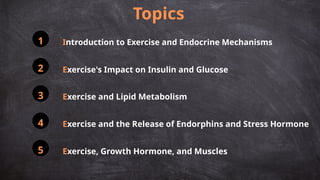
Introduction to Exercise and Endocrine Mechanisms
1
Exercise's Impact on Insulin and Glucose
2
Exercise and the Release of Endorphins and Stress Hormone
4
Exercise and Lipid Metabolism
3
Exercise, Growth Hormone, and Muscles
5
Topics
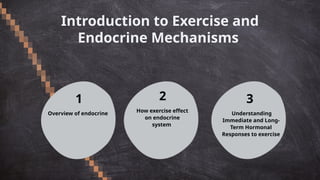
Overview of endocrine
1
How exercise effect
on endocrine
system
2
Understanding
Immediate and Long-
Term Hormonal
Responses to exercise
3
Introduction to Exercise and
Endocrine Mechanisms
1-OVERVIEW OF
ENDOCRINE
The human body is a complex network of systems
that work together to maintain balance and
regulate various functions. One such vital system is
the endocrine system, which consists of a collection
of glands that secrete hormones into the
bloodstream
HORMONES AND
THEIR FUNCTIONS
Hormones are chemical substances produced
by endocrine glands that act as messengers,
transmitting signals to various parts of the
body. These hormones regulate a wide range
of physiological processes, including
metabolism, growth and development,
reproduction, stress response, and mood
regulation. Each hormone has a specific target
and triggers specific responses within the
body.
2-HOW EXERCISE EFFECT
ON ENDOCRINE SYSTEM
Exercise plays a vital role in maintaining
a healthy lifestyle and has far-reaching
effects on various bodily systems. One
such system that is profoundly
influenced by exercise is the endocrine
system. exploring the immediate and
long-term hormonal responses to
physical activity.
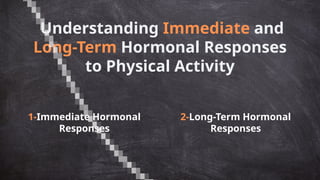
2-Long-Term Hormonal
Responses
1-Immediate Hormonal
Responses
Understanding Immediate and
Long-Term Hormonal Responses
to Physical Activity
1-Immediate Hormonal
Responses
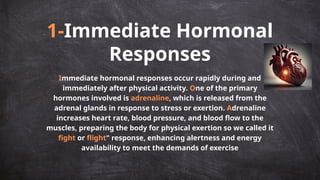
Immediate hormonal responses occur rapidly during and
immediately after physical activity. One of the primary
hormones involved is adrenaline, which is released from the
adrenal glands in response to stress or exertion. Adrenaline
increases heart rate, blood pressure, and blood flow to the
muscles, preparing the body for physical exertion so we called it
fight or flight" response, enhancing alertness and energy
availability to meet the demands of exercise
1-Immediate Hormonal
Responses
Another hormone that plays a crucial role in immediate
responses is cortisol, often referred to as the stress hormone.
Cortisol levels increase during exercise to mobilize glucose and
fatty acids from storage sites in the body, providing fuel for the
muscles. While cortisol is essential for energy production during
exercise , but excessive or prolonged elevation can lead to
muscle breakdown and impair recovery.
2-Long-Term Hormonal
Responses
Long-term hormonal responses to physical activity involve
adaptations that occur over days, weeks, and months of
consistent exercise. One of the most well-known long-term
hormonal adaptations is the increase in growth hormone (GH)
secretion. GH stimulates muscle growth, repair, and fat
metabolism, contributing to improvements in strength,
endurance, and body composition
.
2-Long-Term Hormonal
Responses
Another hormone that undergoes long-term changes is insulin
sensitivity. Regular physical activity enhances insulin
sensitivity, allowing cells to more efficiently uptake glucose
from the bloodstream. Improved insulin sensitivity reduces the
risk of developing insulin resistance and type 2 diabetes
.

HORMONES & EXERCISE endocrine system.pptx

  • 1.
  • 2.
    HOW EXERCISE INFLUENCESENDOCRINE MECHANISMS, METABOLIC REGULATION, ENERGY BALANCE, AND OVERALL HEALTH GROUP: 15 SUPERVISED BY: DR.SARA ELSAYED
  • 3.
    Introduction to Exerciseand Endocrine Mechanisms 1 Exercise's Impact on Insulin and Glucose 2 Exercise and the Release of Endorphins and Stress Hormone 4 Exercise and Lipid Metabolism 3 Exercise, Growth Hormone, and Muscles 5 Topics
  • 4.
    Overview of endocrine 1 Howexercise effect on endocrine system 2 Understanding Immediate and Long- Term Hormonal Responses to exercise 3 Introduction to Exercise and Endocrine Mechanisms
  • 5.
    1-OVERVIEW OF ENDOCRINE The humanbody is a complex network of systems that work together to maintain balance and regulate various functions. One such vital system is the endocrine system, which consists of a collection of glands that secrete hormones into the bloodstream
  • 6.
    HORMONES AND THEIR FUNCTIONS Hormonesare chemical substances produced by endocrine glands that act as messengers, transmitting signals to various parts of the body. These hormones regulate a wide range of physiological processes, including metabolism, growth and development, reproduction, stress response, and mood regulation. Each hormone has a specific target and triggers specific responses within the body.
  • 7.
    2-HOW EXERCISE EFFECT ONENDOCRINE SYSTEM Exercise plays a vital role in maintaining a healthy lifestyle and has far-reaching effects on various bodily systems. One such system that is profoundly influenced by exercise is the endocrine system. exploring the immediate and long-term hormonal responses to physical activity.
  • 8.
    2-Long-Term Hormonal Responses 1-Immediate Hormonal Responses UnderstandingImmediate and Long-Term Hormonal Responses to Physical Activity
  • 9.
    1-Immediate Hormonal Responses Immediate hormonalresponses occur rapidly during and immediately after physical activity. One of the primary hormones involved is adrenaline, which is released from the adrenal glands in response to stress or exertion. Adrenaline increases heart rate, blood pressure, and blood flow to the muscles, preparing the body for physical exertion so we called it fight or flight" response, enhancing alertness and energy availability to meet the demands of exercise
  • 10.
    1-Immediate Hormonal Responses Another hormonethat plays a crucial role in immediate responses is cortisol, often referred to as the stress hormone. Cortisol levels increase during exercise to mobilize glucose and fatty acids from storage sites in the body, providing fuel for the muscles. While cortisol is essential for energy production during exercise , but excessive or prolonged elevation can lead to muscle breakdown and impair recovery.
  • 11.
    2-Long-Term Hormonal Responses Long-term hormonalresponses to physical activity involve adaptations that occur over days, weeks, and months of consistent exercise. One of the most well-known long-term hormonal adaptations is the increase in growth hormone (GH) secretion. GH stimulates muscle growth, repair, and fat metabolism, contributing to improvements in strength, endurance, and body composition .
  • 12.
    2-Long-Term Hormonal Responses Another hormonethat undergoes long-term changes is insulin sensitivity. Regular physical activity enhances insulin sensitivity, allowing cells to more efficiently uptake glucose from the bloodstream. Improved insulin sensitivity reduces the risk of developing insulin resistance and type 2 diabetes .