The Most Fearless (or Stupid) Animal on Earth
What's fiercer than a lion but smaller than a beagle? Pound for pound the
honey badger is one of Africa’s fiercest carnivores. Honey badgers stand
less than a foot high. They are only a couple feet long. They weigh just over
20 pounds. Yet they have a reputation for toughness that is far greater
than their size. Birds, bees, scorpions and snakes make up its usual prey
but, attacks on antelopes and buffalo are not off limits for this fearless
animal. It is the world’s most fearless creature, according to the Guinness
Book of World Records.
Honey Badgers have many reasons to be fearless. They have very thick
(about 1/4 inches), rubbery skin. It helps protect the Honey Badger from
the teeth of predators.
The Honey Badger’s skin is also fairly loose and this allows it quite a bit of
freedom of movement within the skin. This particularly aids it when larger
predators attack it. The Honey Badger can simply squirm around and
viciously attack the creature’s face and eyes.
Along with sharp teeth, Honey Badgers also have incredibly powerful
jaws. This is helpful because the Honey Badger eats every part of its
prey, including the bones. The jaws are even powerful enough to eat a
turtle, including the shell, without difficulty. Furthermore, they are
naturally more resistant to many types of stings and venom.
Along with its innate toughness, the Honey Badger is also incredibly
intelligent. They also are smart enough to follow Honeyguide birds to find
beehives where they’ll eat the larvae and honey.
Bonus Facts
 Honey Badgers get their name from their ability to seek out and
eat honey and bee larvae. They even have no problems with
attacking Africanized Honey Bee (“killer bees”) hives.
 Honey Badgers can dig quickly into hard earth. Within a few
minutes they can dig a hole deep enough to hide themselves.
 Honey Badgers usually hunt and live alone.
 A Honey Badger eats a variety of food items including: porcupines,
small crocodiles, berries, roots, scorpions, snakes, eggs, insects,
rodents, birds, fruit, frogs, human corpses, honey, sheep, horses, etc.
Basically, if they can kill it or come across the dead body of
the animal, they’ll eat it.
HONEY BADGER
Glossary
carnivore (n.): an animal that
eats meat.
make up (v.): compose, form.
off limits (adj.): forbidden.
fearless (adj.): not afraid, very
brave.
fairly (adv.): very, quite but not
extremely.
aid (v.): help.
freedom (n.): the ability to move
or act freely.
squirm (v.): twist, wriggle.
vicious (adj.): very violent and
cruel
particularly (adv.): very,
extremely.
incredibly (adv.): extremely.
quite a bit (adj.): considerably, a
lot.
jaw (n.): two bones of the face
where teeth grow.
shell (n.): the hard outer
covering of an animal, insect,
etc., that protects it.
venom (n.): poison that is
produced by an animal (such as a
snake).
innate (adj.): inborn, hereditary.
resistant (adj.): not affected or
harmed by something.
seek out (v.): search for, try to
find.
come across (v.): meet or find
(something or someone) by
chance.
A. Answer the following questions.
1. What does a honey badger commonly eat?
2. What is a honey badger famous for?
3. Write two distinct features of honey badgers?
4. How tall is a honey badger?
B. Phrase Match
1. What's fiercer than a lion
2. they have a reputation
3. According to
4. They have very thick
5. the teeth of
6. creature’s face
7. incredibly powerful
8. powerful enough
9. ability to seek
10. dead body
a. of the animal
b. than a lion
c. out and eat honey
d. for toughness
e. the Guinness Book of World Records
f. rubbery skin
g. to eat a turtle
h. jaws
i. predators
j. and eyes
C. Fill in each gap by using the information in the text.
So what makes a honey badger so tough? They are not faster, more powerful or stronger than lions.
But how do they stop lions? The answer is their __________. It is thick and tough. Their skin is not only
thick but it is also very __________. This allows it to twist and turn to attack. They are also very good
at digging. They dig in order to __________themselves. You don't get a reputation like the honey
badger by running from danger. The honey badger is fearless and a tireless __________. They attack
any creature that come __________ them. You might be wondering: “If they are so dangerous, why do
their names sound like a piece of candy?.” The answers is that they ___________ Honeyguide birds
and eat __________.
D. Test Each Other: Read the text again and try to recall how these words were used in the text.
 Fearless
 Resistant
 Jaws
 Honeyguide
 Freedom
 Lion
 Dig
 Viciously
 Ability
 skin
E. DISCUSSION
Student A’s Questions Student B’s Questions
1. What did you think when you read the
headline?
2. What images are in your head when you
hear the word “animal”?
3. How dangerous is a Honey Badger?
4. Did you like the animal, Honey Badger?
1. Did you like reading this text about Honey
Badger?
2. What comes to your mind when you hear the
word “honey”?
3. What do you think about honey badgers?
4. What is the fiercest animal in the World?
F. LANGUAGE-CLOZE TEST
What's fiercer (1)____ a lion but smaller than a beagle? Pound for pound the
honey badger is one of Africa’s fiercest (2)____. Honey badgers stand
less than a foot high. They are only a couple feet long. They weigh just over
20 pounds. Yet (3)____have a reputation for toughness that is far greater
than their size. Birds, bees, scorpions and snakes make up its usual (4)____
but, attacks on antelopes and buffalo are not off limits for this fearless
animal. It is the (5)____most fearless creature, according to the Guinness
Book of World Records.
Honey Badgers have (6)____reasons to be fearless. They have very thick
(about 1/4 inches), rubbery skin. It (7)____protect the Honey Badger from
the teeth of predators.The Honey Badger’s (8)____is also fairly loose and this
allows it quite a bit of freedom of movement (9)____the skin. This particularly aids
it when (10)____predators attack it. The Honey Badger can simply squirm around
and viciously (11)____the creature’s face and eyes.
Along with sharp teeth, Honey Badgers also have incredibly (12)____
jaws. This is helpful (13)____the Honey Badger eats every part of its
prey, including the bones. The jaws are even powerful enough to eat a
turtle, including the shell, without difficulty. Furthermore, they are
naturally more (14)____to many types of stings and venom.Along with its innate
toughness, the Honey Badger is also incredibly intelligent. They also are
(15)____enough to follow Honeyguide birds to find beehives where they’ll eat the
larvae and honey.
world’s
carnivores
than
prey
they
attack
skin
helps
within
larger
many
because
powerful
smart
resistant
G. Put the words in the correct order.
1. many – Honey- be -have – reasons- fearless- Badgers - . – to
2. rubbery - . -have -thick - skin- They – very
3. They - more to -. – venom - naturally – resistant – are - .
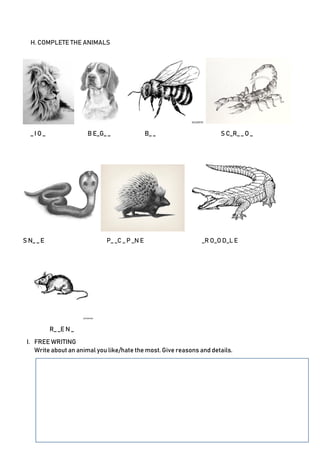
H. COMPLETE THE ANIMALS
_ I O _ B E_G_ _ B_ _ S C_R_ _ O _
S N_ _ E P_ _C _ P _N E _R O_O D_L E
R_ _E N _
I. FREE WRITING
Write about an animal you like/hate the most. Give reasons and details.

Honey badger (comparative superlative)

  • 1.
    The Most Fearless(or Stupid) Animal on Earth What's fiercer than a lion but smaller than a beagle? Pound for pound the honey badger is one of Africa’s fiercest carnivores. Honey badgers stand less than a foot high. They are only a couple feet long. They weigh just over 20 pounds. Yet they have a reputation for toughness that is far greater than their size. Birds, bees, scorpions and snakes make up its usual prey but, attacks on antelopes and buffalo are not off limits for this fearless animal. It is the world’s most fearless creature, according to the Guinness Book of World Records. Honey Badgers have many reasons to be fearless. They have very thick (about 1/4 inches), rubbery skin. It helps protect the Honey Badger from the teeth of predators. The Honey Badger’s skin is also fairly loose and this allows it quite a bit of freedom of movement within the skin. This particularly aids it when larger predators attack it. The Honey Badger can simply squirm around and viciously attack the creature’s face and eyes. Along with sharp teeth, Honey Badgers also have incredibly powerful jaws. This is helpful because the Honey Badger eats every part of its prey, including the bones. The jaws are even powerful enough to eat a turtle, including the shell, without difficulty. Furthermore, they are naturally more resistant to many types of stings and venom. Along with its innate toughness, the Honey Badger is also incredibly intelligent. They also are smart enough to follow Honeyguide birds to find beehives where they’ll eat the larvae and honey. Bonus Facts  Honey Badgers get their name from their ability to seek out and eat honey and bee larvae. They even have no problems with attacking Africanized Honey Bee (“killer bees”) hives.  Honey Badgers can dig quickly into hard earth. Within a few minutes they can dig a hole deep enough to hide themselves.  Honey Badgers usually hunt and live alone.  A Honey Badger eats a variety of food items including: porcupines, small crocodiles, berries, roots, scorpions, snakes, eggs, insects, rodents, birds, fruit, frogs, human corpses, honey, sheep, horses, etc. Basically, if they can kill it or come across the dead body of the animal, they’ll eat it. HONEY BADGER Glossary carnivore (n.): an animal that eats meat. make up (v.): compose, form. off limits (adj.): forbidden. fearless (adj.): not afraid, very brave. fairly (adv.): very, quite but not extremely. aid (v.): help. freedom (n.): the ability to move or act freely. squirm (v.): twist, wriggle. vicious (adj.): very violent and cruel particularly (adv.): very, extremely. incredibly (adv.): extremely. quite a bit (adj.): considerably, a lot. jaw (n.): two bones of the face where teeth grow. shell (n.): the hard outer covering of an animal, insect, etc., that protects it. venom (n.): poison that is produced by an animal (such as a snake). innate (adj.): inborn, hereditary. resistant (adj.): not affected or harmed by something. seek out (v.): search for, try to find. come across (v.): meet or find (something or someone) by chance.
  • 2.
    A. Answer thefollowing questions. 1. What does a honey badger commonly eat? 2. What is a honey badger famous for? 3. Write two distinct features of honey badgers? 4. How tall is a honey badger? B. Phrase Match 1. What's fiercer than a lion 2. they have a reputation 3. According to 4. They have very thick 5. the teeth of 6. creature’s face 7. incredibly powerful 8. powerful enough 9. ability to seek 10. dead body a. of the animal b. than a lion c. out and eat honey d. for toughness e. the Guinness Book of World Records f. rubbery skin g. to eat a turtle h. jaws i. predators j. and eyes C. Fill in each gap by using the information in the text. So what makes a honey badger so tough? They are not faster, more powerful or stronger than lions. But how do they stop lions? The answer is their __________. It is thick and tough. Their skin is not only thick but it is also very __________. This allows it to twist and turn to attack. They are also very good at digging. They dig in order to __________themselves. You don't get a reputation like the honey badger by running from danger. The honey badger is fearless and a tireless __________. They attack any creature that come __________ them. You might be wondering: “If they are so dangerous, why do their names sound like a piece of candy?.” The answers is that they ___________ Honeyguide birds and eat __________. D. Test Each Other: Read the text again and try to recall how these words were used in the text.  Fearless  Resistant  Jaws  Honeyguide  Freedom  Lion  Dig  Viciously  Ability  skin
  • 3.
    E. DISCUSSION Student A’sQuestions Student B’s Questions 1. What did you think when you read the headline? 2. What images are in your head when you hear the word “animal”? 3. How dangerous is a Honey Badger? 4. Did you like the animal, Honey Badger? 1. Did you like reading this text about Honey Badger? 2. What comes to your mind when you hear the word “honey”? 3. What do you think about honey badgers? 4. What is the fiercest animal in the World? F. LANGUAGE-CLOZE TEST What's fiercer (1)____ a lion but smaller than a beagle? Pound for pound the honey badger is one of Africa’s fiercest (2)____. Honey badgers stand less than a foot high. They are only a couple feet long. They weigh just over 20 pounds. Yet (3)____have a reputation for toughness that is far greater than their size. Birds, bees, scorpions and snakes make up its usual (4)____ but, attacks on antelopes and buffalo are not off limits for this fearless animal. It is the (5)____most fearless creature, according to the Guinness Book of World Records. Honey Badgers have (6)____reasons to be fearless. They have very thick (about 1/4 inches), rubbery skin. It (7)____protect the Honey Badger from the teeth of predators.The Honey Badger’s (8)____is also fairly loose and this allows it quite a bit of freedom of movement (9)____the skin. This particularly aids it when (10)____predators attack it. The Honey Badger can simply squirm around and viciously (11)____the creature’s face and eyes. Along with sharp teeth, Honey Badgers also have incredibly (12)____ jaws. This is helpful (13)____the Honey Badger eats every part of its prey, including the bones. The jaws are even powerful enough to eat a turtle, including the shell, without difficulty. Furthermore, they are naturally more (14)____to many types of stings and venom.Along with its innate toughness, the Honey Badger is also incredibly intelligent. They also are (15)____enough to follow Honeyguide birds to find beehives where they’ll eat the larvae and honey. world’s carnivores than prey they attack skin helps within larger many because powerful smart resistant G. Put the words in the correct order. 1. many – Honey- be -have – reasons- fearless- Badgers - . – to 2. rubbery - . -have -thick - skin- They – very 3. They - more to -. – venom - naturally – resistant – are - .
  • 4.
    H. COMPLETE THEANIMALS _ I O _ B E_G_ _ B_ _ S C_R_ _ O _ S N_ _ E P_ _C _ P _N E _R O_O D_L E R_ _E N _ I. FREE WRITING Write about an animal you like/hate the most. Give reasons and details.